PSSA Perspectives
Pharmaceutical Society of South Africa
Report on the Internship Placement
Survey conducted by the Pharmaceutical
Society of South Africa – December 2017
Towards the end of 2017, the PSSA was inundated with requests from final year pharmacy students who had not been successful in securing an internship position for 2018. Those affected represented a substantial proportion – roughly 25-30% – of the annual pharmacy graduate output in South Africa. The situation was unprecedented, as the annual output of pharmacy students had not increased by the same ratio, when compared with previous years. Due to this situation, the PSSA decided to conduct two surveys on internship placements and to collect data from both the unemployed final year pharmacy students who were unable to secure an internship position and pharmacy managers and responsible pharmacists who are in the position to employ pharmacy staff.
Surveys conducted
Two surveys were conducted by the Professional Development and Support department of the PSSA. The first targeted those pharmacy students who did not have a confirmed internship at the beginning of Dember 2017, while the second was aimed at
pharmacy managers or responsible pharmacists who were in a position to appoint pharmacy personnel.
1. Survey for final year pharmacy students
unable to secure an internship position
Pharmacy students from eight of the nine pharmacy schools in South Africa participated in the survey, but the majority of the students who participated in the survey were from the University of the Western Cape, Rhodes University, Nelson Mandela University or Sefako Makgatho Health Sciences University/ Tshwane University of Technology (Fig 1).
Most students who participated in the survey were from the Eastern Cape Province, with Western Cape Province having the second largest number, followed by Gauteng, KwaZulu-Natal and Limpopo provinces (Fig 2).
More than 82% of the pharmacy students who participated in this survey were South African citizens.
Figure 1: Universities from which participating pharmacy students without internship employment in December 2017, graduated
Nelson Mandela University 13
North-West University 7
Rhodes University 19
Sefako Makgatho Health Sciences University/Tshw 13
University of KwaZulu Natal 5
University of Limpopo 7
University of Western Cape 26
University of the Witwatersrand 4
13,8%
7,4%
20,2%
13,8% 5,3%
7,4% 27,7%
4,3%
Universities where students graduated in 2017
Nelson Mandela University
North-West University
Rhodes University
Sefako Makgatho Health Sciences University/Tshwane University of Technology
University of KwaZulu Natal
University of Limpopo
University of Western Cape
PSSA PERSPECTIVES
Internship applications submitted in 2017
The students were asked in which provinces they applied for internship positions. They were allowed to select more than one option, if applicable.
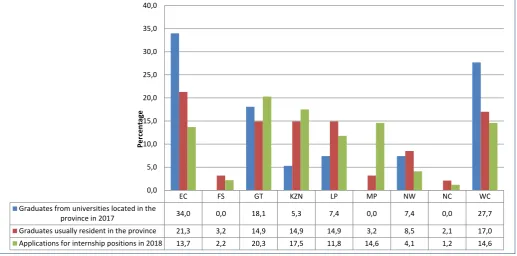
A total of 321 applications had been submitted by 95 students in all nine provinces. This equates to an average of almost 3.5 applications per student. Most of the unemployed interns applied in Gauteng, KwaZulu-Natal, the Western Cape or Mpumalanga (Fig 3).
Students chose the preferred province because they lived in that province, they had studied in that province or their parents/ family lived there. Some students chose a province in which they perceived that there should be opportunities for employment.
Less than 2% of the respondents indicated that their choice was based on the province being more urbanised than the province in which they currently resided.
It was important to find out in which practice settings of the profession students applied for internship positions. A total of 291 applications in seven different practice settings were submitted by 95 students (Fig 4). On average, every student submitted an application to three different practice settings. Most applications were submitted to public institutional pharmacies, followed by private institutional pharmacies, corporate community pharmacies and the pharmaceutical industry. Fewer applications were submitted to independent community pharmacies and very few to academia. A few applied to wholesale and distribution facilities, despite the fact that these establishments are not permitted to take interns. More than 87% of students indicated that they were willing to work in rural settings. For those students who indicated that they are not willing to work in rural and remote areas, the reasons provided were financial constraints associated with not living with their families, inability to care for parents, partners or children, safety, being engaged or married or religious considerations (inaccessible place of worship).
Relationship with pharmacy where 400 hours of work during pre-graduate training was conducted
There was nearly an equal split between yes and no when students were asked if they had applied for internship in the same pharmacy(ies) where they did their 400 hours of work during the undergraduate training.
Eastern Cape 20 Free State 3 Gauteng 14 Kwa-Zulu Natal 14 Limpopo 14 Mpumalanga 3 North West 8 Northern Cape 2 Western Cape 16
21,3%
3,2%
14,9%
14,9% 14,9%
3,2% 8,5% 2,1%
17,0%
Provinces where students live
Eastern Cape Free State Gauteng Kwa-Zulu Natal Limpopo Mpumalanga North West Northern Cape Western Cape
Figure 3: Relationship between provinces where pharmacy students graduated from, lived and applied for internship positions
Figure 2: Indication of provinces wherein the students without internship employment in December 2017, lived
Graduates from universities located i Graduates usually resident in the pro Applications for internship positions in 2018
EC 34,0 21,3 13,7
FS 0,0 3,2 2,2
GT 18,1 14,9 20,3
KZN 5,3 14,9 17,5
LP 7,4 14,9 11,8
MP 0,0 3,2 14,6
NW 7,4 8,5 4,1
NC 0,0 2,1 1,2
WC 27,7 17,0 14,6
EC FS GT KZN LP MP NW NC WC
Graduates from universities located in the
province in 2017 34,0 0,0 18,1 5,3 7,4 0,0 7,4 0,0 27,7 Graduates usually resident in the province 21,3 3,2 14,9 14,9 14,9 3,2 8,5 2,1 17,0 Applications for internship positions in 2018 13,7 2,2 20,3 17,5 11,8 14,6 4,1 1,2 14,6
0,0 5,0 10,0 15,0 20,0 25,0 30,0 35,0 40,0
Per
cen
ta
PSSA PERSPECTIVES
The main reasons provided for not applying at the same pharmacy where students did their 400 hours were that they wanted to work in a different environment during their internship, that the particular pharmacy in which they did experiential training was not registered to provide an internship but could take in pharmacy students, that the internship positions were reserved for bursary holders, or that budgetary constraints at the pharmacy limited internship positions.
Some students performed their 400 hours outside of South Africa and wanted to complete their internship in South Africa.
Although a few students were still waiting for feedback on their internship applications, there were also others who were not informed as to why their applications were unsuccessful.
When asked to think of possible reasons why their applications were unsuccessful, the responses can be divided into two groups. Some students identified internal reasons for not being successful, such as that they had applied too late or not at enough places, a possible poor interview performance, lower than average academic records, conducting their undergraduate training at pharmacies that are not registered for internship, lack of work experience and not being able to start their internship on 1 January due to outstanding supplementary examinations in January 2018.
External reasons identified for unsuccessful applications were that students applied for internship positions in provinces other than where they resided and that these positions were kept for students originating from the specific province, being non-South African residents, or budgetary constraints in government institutions. Academia (Universities) 10
Corporate community pharmacy 51 Independent community pharmacy 27 Private hospital/institutional pharmacy 61 Public hospital/institutional pharmacy 85
Industry 50
Wholesale/Distribution 7
10
51
27
61
85
50
7
0 10 20 30 40 50 60 70 80 90
Fre
qu
en
cy
Figure 4: Distribution of students’ applications for internships in different sectors of pharmacy
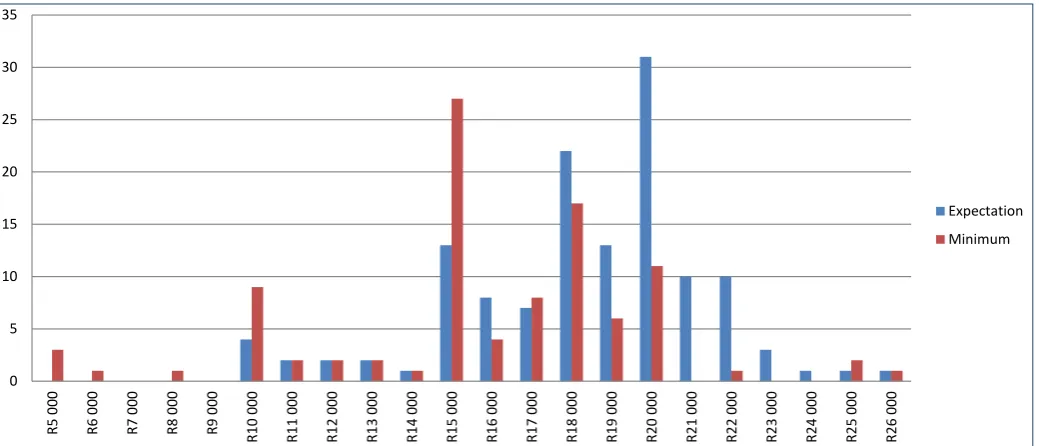
Figure 5: Difference between expected monthly nett salary and minimum monthly nett salary for which they are willing to work
0 5 10 15 20 25 30 35
R5
0
00
R6
0
00
R7
0
00
R8
0
00
R9
0
00
R1
0
000
R1
1
000
R1
2
000
R1
3
000
R1
4
000
R1
5
000
R1
6
000
R1
7
000
R1
8
000
R1
9
000
R2
0
000
R2
1
000
R2
2
000
R2
3
000
R2
4
000
R2
5
000
R2
6
000
PSSA PERSPECTIVES
Remuneration expectations
Students were asked three questions regarding remuneration expectations.
Firstly, students were asked what monthly income (after tax and other deductions) they expected during their internship year. Answers varied between R10 000 and R26 000 per month, with one exception of R35 000 indicated by one student. The average nett salary expectation was R18 129.77.
Students perception of whether they were worth this salary varied with 71 who believed that their employment would represent value for money for the employer and a return on their investment while 14 students acknowledged that they are not yet worth the amount expected, but would achieve this status during their internship year. Only two students doubted whether they were worth the expected salary, while four students felt that they were not worth the employer’s investment.
When asked what the absolute minimum monthly nett salary was that they were willing to accept during the internship the average was R15 591.84 (Fig 5).
Suggested solutions from pharmacy students
Students were asked what needs to be done to solve this perceived national lack of internship positions. Although the majority of the comments were in line with the reasons already mentioned earlier, three new suggestions emerged.
Some students suggested a decrease in internship remuneration, as they realised that some pharmacies cannot afford internship salaries and therefore would rather appoint a pharmacist’s assistant. These students also motivated that if, for example, the public sector reduced the remuneration per intern but kept the same budget for interns, it would be able to employ more interns in understaffed government institutions. The substantially lower remuneration for academic interns was also mentioned as a great demotivation for applying for post-graduate studies at universities, although there are positions available.
Students identified difficulty in accessing advertisements for internship positions from different institutions and pharmacies.
Another possibility suggested was that an increased ratio between interns and tutors (e.g. 2 interns to 1 tutor) would enable smaller pharmacies with possibly only one pharmacist to take on more interns.
2. Survey for pharmacy managers or
responsible pharmacists
Demographic data
Of the 142 pharmacists who participated, most worked at independent community pharmacies, followed by corporate community pharmacies, private institutional pharmacies, public institutional pharmacies and industry (Fig 6). A few were from universities, wholesale or distribution or other environments, such as managed care, non-governmental organisation, research pharmacy, clinical trial centre and medicines information.
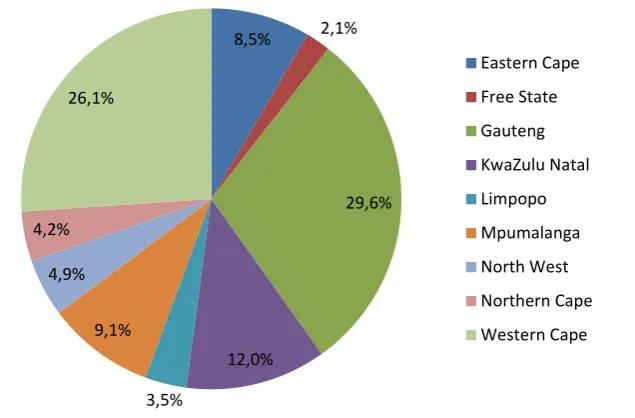
Participants were mostly from Gauteng and Western Cape but all other provinces were also represented (Fig 7).
Most of these workplaces were in urban areas, with fewer in semi-urban and rural areas.
Academia (Universities) 3 Community pharmacy - Corporate (Clicks, Dis-Chem, PnP, MediRite) 19 Community pharmacy - Independent 73 Hospital/Institutional pharmacy - Private 14 Hospital/Institutional pharmacy - Public/government/state 13
Industry 12
Wholesale/Distribution 3
Other 5
2,1%
13,4%
51,4% 9,9%
9,1% 8,5%
2,1% 3,5%
Sector where participants work
Academia (Universities)
Community pharmacy - Corporate (Clicks, Dis-Chem, PnP, MediRite) Community pharmacy
-Independent
Hospital/Institutional pharmacy -Private
Hospital/Institutional pharmacy -Public/government/state Industry
Wholesale/Distribution
Other
Eastern Cape 12 Free State 3 Gauteng 42 KwaZulu Natal 17 Limpopo 5 Mpumalanga 13 North West 7 Northern Cape 6 Western Cape 37
8,5% 2,1%
29,6%
12,0% 3,5%
9,1% 4,9% 4,2%
26,1%
Pronvince where participants work
Eastern Cape Free State Gauteng KwaZulu Natal Limpopo Mpumalanga North West Northern Cape Western Cape Figure 6: Sectors of pharmacy where pharmacist participants work
PSSA PERSPECTIVES
Previous and current training of interns
Almost half of the participants had not previously supervised an intern. Of those who had previously supervised interns, 29 had done so for 3 or less years, 13 for between 4 and 7 years and 30 for 8 or more years.
Of the 142 participants who answered this question, only 22 were currently registered to train interns and had undertaken to supervise an intern in 2018.
For the remainder:
• 20 were registered to supervise interns but had not accepted an intern in 2018
• 28 were registered to supervise interns but did not want an intern in 2018
• 21 had never been registered as a tutor before • 20 did not plan to register as a tutor
• 31 had been registered before but when registration expired did not renew registration.
This means that, based on this survey and not taking into account the reasons why they had not taken interns, 48 internship posts could potentially be offered as participants were registered to train an intern.
Factors influencing the decision to employ a pharmacy intern
Factors explored by the survey were:
• Profitability of workplace (gross profit at the end of the financial year, sufficient cash-flow to employ another staff member)
• Remuneration of pharmacist interns (salaries, cost to company) • Time and effort to mentor a pharmacist intern and assist with
internship programme (training, attending SAPC internship workshops, CPD submissions, progress reports)
• Return on investment (the contribution a pharmacist intern can make to your workplace/business)
• SAPC requirements to register as a tutor (application process, registration fee, inspection)
• SAPC requirements for the premises to be registered as a training facility (application process, registration fee, inspection)
• SAPC downgrading after inspections
• SAPC internship programme (Intern/tutor workshops, pre-registration exam, CPDs, progress reports)
• Skills, knowledge, attitudes and productivity of interns It was clear from results that all factors that were considered major influences are linked to the financial implications and expenditure incurred in employing a pharmacist intern – the profitability of the pharmacy, remuneration of employee, return on investment and registration fees for the training facility and tutor.
There were also other factors that participants identified that might influence the decision to accept an intern.
• Some pharmacist participants expressed a fear that universities
were overproducing graduates and thus contributing to the perceived increase in intern unemployment.
• Another factor considered by employers was that an intern potentially takes the place of a member of staff who does not leave at the end of the internship year, and can therefore be developed.
• Some pharmacies do not have sufficient space available for another staff member as they are already running at full capacity.
• The willingness of employers (decision makers) to make funding available for interns was raised.
• The effort required creating internship positions and navigating the bureaucracy involved in sourcing funding and approval for the position from management was also cited. • It was reiterated that interns must remember that the
internship is still a year of training.
• Interns cost more money and effort than a post-basic pharmacist’s assistant does so some pharmacists preferred to employ a post-basic pharmacist’s assistant.
• A notable variety in salaries offered between sectors also contributed to interns preferring certain employers over others.
Pharmacists mentioned the potential impact of government subsidies or discounted SAPC fees as ways in which their decisions could be influenced. A suggestion was offered that a pharmacist may train two interns simultaneously.
Recommendations
From the survey results, the following recommendations can be made to various role players, as an attempt to avoid a similar lack of internship positions in future.
• Interns
Interns, when working on their 400 hours or any other part-time work during university recesses as part of their undergraduate training, where possible should consider approaching these facilities for potential internship. It is important to indicate the desire to conduct an internship at the facility and in which year the pharmacy student will or plans to be an intern.
PSSA PERSPECTIVES
(if conducted at another pharmacy), unique capabilities and the potential value-add the pharmacy student might bring to the pharmacy as an intern. This includes any additional courses (such as first aid) which may be valuable expertise that the pharmacy currently lacks and/or which may result in increased patient satisfaction.
Both pharmacy students and pharmacists commented that no incentive exists to benefit the institution to train the intern. An option to consider could be an agreement for post qualification commitment to return for a specified period after community service as an added return on investment for the pharmacy. The intern must also exhibit an attitude of willingness to learn as much as possible and do whatever is assigned to him or her. This may include dispensing, patient counselling, stock order and receipt thereof, organising the dispensary or assisting colleagues with a higher workload.
It was noted that there were a few pharmacy students who had only one option for internship in mind, limiting the possibility of finding placement. Internship can be performed in a wide variety of practice settings. It is also important to continue applying for internship positions until the student is a successful candidate and secures a position. From the students’ responses, it appears that pharmacy students do not keep a record of their applications and do not follow-up on them. It is essential to follow-up on all applications on a regular basis. The majority of advertisements for staff mention that if applicants have not heard from them by a certain date, they should consider their applications unsuccessful. Pharmacy students should keep a record of those dates so that they can manage their applications and know when they were unsuccessful to avoid waiting for feedback on an application that they will never receive. If no such date is provided, feel free to follow-up on the progress of the applications 2-3 weeks after the closing date with the relevant contact person provided in the advert. Pharmacy students should remember that they are the ones who must actively source an internship position and that this process is not similar to medical interns who will be placed for internship through a central system.
The last recommendation is that pharmacy students who have government provincial bursaries should in the beginning of their final year of study, remind their provincial head of pharmaceutical services of their bursary so that the necessary budgetary allocations for the following year can be confirmed.
• Tutors and pharmacists
PSSA members who offer internship positions can forward the details on the internship position being offered to PSSA office staff who will upload the information to the website for pharmacy students to access.
The PSSA will present a webinar to PSSA members on how to approach the Health and Welfare Sector Education and Training Authority (HWSETA) in order to apply for internship funding through the Skills Development Fund (SDF).
Universities
It was requested by both pharmacy students and pharmacists that universities should play a more active role in ensuring their graduates can continue with their training. Pharmacy students requested more assistance with preparation to apply for internships as well as distributing advertisements to students. This could be sourced through communication to the university’s alumni. Pharmacists suggested that universities should work together with SAPC in preparing the profession for the number of interns expected the following year.
• SAPC
Both pharmacy students and pharmacists suggested that SAPC look into changing the current ratio of 1 intern to 1 tutor so that tutors may have more than one intern.
Another big contributor to pharmacists’ unwillingness to participate in the internship process is the registration fees for facilities and tutors together with the registration process and compulsory inspections of facilities.
SAPC should also work with universities in informing the profession of the expected number of graduates annually so that the profession can prepare for the incoming number of interns. SAPC maintains all registers and can easily compare the number of registered tutors with the number of graduates.
• Government and National Department of Health
The majority of the pharmacy students who were still without internship positions by December 2017 indicated that they had applied, among others, to public institutional pharmacies. The reasons that they were given for being unsuccessful in their applications were mainly budgetary cuts and lack of funding. Together with pharmacy students and pharmacists, the PSSA pleads with the National Department of Health and the Provincial Departments of Health to ensure and secure sufficient and transparent funding to employ pharmacy interns in public hospitals and institutions.
• PSSA
PSSA PERSPECTIVES
PSSA CONFERENCE 2018
Don’t miss out on the 2018 PSSA Conference! It will take place from 22 – 24 June 2018, at the Birchwood Hotel and OR Tambo Conference Centre, Boksburg, Johannesburg. We want to make sure that we’re ready for anything the future holds, so the theme is “Failure to prepare is preparing to fail”.
Conference documents and information:
All information can be viewed on the PSSA website https://www. pssa.org.za/NewsEvents/ConferencesThe conference programme promises to enhance and develop delegates’ understanding of current issues and opportunities facing the profession. Detailed information and learning objectives are drafted for each session of the PSSA, YPG and SAPSF programmes.
Conference registration is open to PSSA members, non members, SAPSF members, day registration and accompanying persons.
The venue for the 2018 PSSA Conference is Birchwood Hotel & OR Tambo Conference Centre, Boksburg, Johannesburg.
Accommodation is not included in the Conference Registration fee and should be booked separately and directly with Birchwood Hotel.
The Young Pharmacists’ Group of the PSSA will again host an YPG evening on Friday 22 June 2018 from 20:00. Tickets will be sold at R180 per person. This event is open for anyone to attend and
partners are welcome. The theme is Mad Scientists and everyone is encouraged to dress accordingly.
Registration is open!
Delegates and their accompanying partners can register for the 2018 PSSA Conference at https://confpro.outsystemscloud.com/ PSSA2018/Home.aspx?In_ConferenceID=1. After successful registration, delegates will receive an email with registration confirmation. Banking details will appear on the confirmation email and proof of payment should be forwarded to admin@ confpro.co.za and [email protected] as soon as possible.
Conference registrations will close on Thursday 14 June 2018.
Advertising and Marketing Opportunities
Several advertising and marketing opportunities are available during the 2018 PSSA Conference. If you are interested in being involved in the 2018 PSSA Conference as a sponsor, please contact Mariet or Karina for more information and the sponsorship proposal.Queries
For any queries, please feel free to contact the conference organisers:
Dr Mariet J Eksteen, [email protected], 012 470 9560
Ms Karina Nel, [email protected], 084 708 2597
The Pharmaceutical Society of South Africa
73
rd
Annual General Meeting
Notice in terms of the Constitution – Section 22.2
To:
All members of the General Council of the Pharmaceutical Society of South Africa
You are hereby notified that the 73rd Annual General Meeting of the General Council will take place at the Birchwood Hotel and OR Tambo Conference Centre, Boksburg on Friday, 22 June 2018 commencing at 09:30
Issued by:
Ivan Kotzé, Executive Director Pharmaceutical Society of South Africa
April 2018
CONFERENCE 2018
PSSA
PSSA PERSPECTIVES
Die Aptekersvereniging van Suid-Afrika
73ste Algemene Jaarvergadering
Kennisgewing ingevolge die Grondwet – Artikel 22.2
Aan:
Alle lede van die Algemene Raad van die Aptekersvereniging van Suid-Afrika
U word hierby verwittig dat die 73ste Algemene Jaarvergadering van die Algemene Raad gehou sal word by Birchwood Hotel and OR Tambo Conference Centre, Boksburg op Vrydag, 22 Junie 2018 om 09:30
Uitgereik deur:
Ivan Kotzé, Uitvoerende Direkteur Aptekersvereniging van Suid-Afrika
April 2018
The PSSA/Alpha Pharm distance learning
programme 2018
The PSSA/Alpha Pharm Distance Learning Programme continues to offer pharmacists useful, practical, up-to-date information that enables them to provide optimal pharmaceutical care to their patients.
Module 1/2018 – Osteoporosis – Revised
South African clinical guideline
Osteoporosis is a silent disease until it is complicated by a fracture – a fracture that occurs following minimal trauma or, in some cases, no trauma. Osteoporosis is a risk factor for fracture, just as hypertension is a risk factor for stroke.
Fractures are common and place an enormous medical and personal burden on the ageing individuals who suffer them.
Osteoporosis is a serious health threat for ageing postmenopausal women by predisposing them to an increased risk of fracture. This module is based on the recently updated South African clinical guideline for Osteoporosis published by the National Osteoporosis Foundation of South Africa. The module provides a comprehensive overview of the disease, risk factors for developing osteoporosis, and helpful information on the prevention, treatment and management of the condition. It will equip you to be able to counsel patients with the most up-to-date information on osteoporosis.
For more information about this programme contact Gill or Glynis at Insight Medicine Information on 011 706 6939 or email: [email protected].
The PSSA/Alpha Pharm clinical education
programme 2018 for pharmacy staff
Recognising that consumers frequently encounter front-shop assistants or pharmacist’s assistants before they speak to the pharmacist, the PSSA and Alpha Pharm continue to offer a clinical education programme for pharmacy staff. All pharmacy staff need to be familiar with the use of unscheduled medicines and should be reminded of when it is necessary to refer the patient to the pharmacist.
Module 1/2018 – Osteoporosis
Osteoporosis is a disease that causes bones to become abnormally thin, weakened and easily fractured. Fractures can occur with little or no force and may occur after a minor fall.
Fortunately, there are many steps that can be taken to prevent osteoporosis, including diet, exercise and not smoking. For people
that are already affected by osteoporosis, there are medicines available that can slow further bone loss or help to increase the density of bones.
This module discusses osteoporosis and the treatments available (medical and non-medical) for the prevention and treatment of osteoporosis. Preventing falls is a special concern for people with osteoporosis as falls can increase the chance of a fracture and steps that may be taken to prevent falls are also discussed.