(DV\WLPH$&DVH6WXG\RI,QFUHPHQWDO'RPDLQ6SHFLILF
/DQJXDJH'HYHORSPHQW
,]WRN-U)LVWHU
7RPDå.RVDU
,]WRN)LVWHU
0DUMDQ0HUQLN
University of Maribor, Faculty of Electrical Engineering and Computer Science Smetanova 17, SI-2000 Maribor, Slovenia
e-mail: [email protected], [email protected], [email protected], [email protected]4
http://dx.doi.org/10.5755/j01.itc.42.1.1968
$EVWUDFW. EasyTime is a domain-specific language (DSL) for measuring time during sports competitions. A distinguishing feature of DSLs is that they are much more amenable to change, and EasyTime is no exception in this regard. This paper introduces two new EasyTime features: classifications of competitors into categories, and the inclusion of competitions where the number of laps must be dynamically determined. It shows how such extensions can be incrementally added into the base-language reusing most of the language specifications. Two case studies are presented showing the suitability of this approach.
.H\ZRUGV: Domain-specific languages; Language composition; Incremental language development; EasyTime.
,QWURGXFWLRQ
Domain-specific languages (DSLs) are languages tailored to specific application domain [1–4]. They offer substantial gains regarding expressiveness and ease of use compared with general-purpose languages (GPLs) within their domain of application [5–7]. However, DSLs are more amenable to changes [1, 8] since stakeholders’ requirements frequently change. In order to design and implement DSLs more easily, we need to develop fully modular, extensible, and reusable language descriptions, whilst some of the descriptions could even be inferred from DSL programs [9, 10]. The language designer wants to include new language features incrementally as the programming language evolves. Ideally, a language designer would like to build a language simply by reusing different language definition modules (language components), such as modules for expressions, declarations, etc., as well as to extend previous language specifications. In the case of general software development the use of object-oriented techniques and concepts like encapsulation and inheritance, greatly improves incremental software development, whilst reusability is even further enhanced using aspect-oriented techniques [11]. The object-oriented, as well as the aspect-oriented techniques and concepts, have also been integrated into programming language specifications [12, 13] making new features more easily
implemented. One of such tools, where object-oriented and aspect-object-oriented concepts have been incorporated, is the LISA tool [8, 14]. This paper shows how LISA is used within the incremental development of Easy-Time DSL, which has been developed recently for measuring time at different sports competitions (e.g., triathlon, cycling) [15, 16]. EasyTime DSL has already proved to be successful when used at real sport events (e.g., World Championship in the double ultra triathlon in 2009, National (Slovenian) Championship in the time-trials for cycles in 2010), so the requirements are changing quickly. Recent extensions to EasyTime have included the possibility of classifying competitors into different categories, where the number of laps is different for each category, and the inclusion of competitions where the number of laps can be dynamically determined during a competition (e.g., biathlon, where the number of extra laps depends on missed shots). The objective of this paper is to introduce EasyTime++ DSL, which supports these new extensions, as well as to show how such an extension can be incrementally developed using the introduced LISA tool.
,-U)LVWHU7.RVDU,)LVWHU00HUQLN
presented in Section 5. The paper is concluded with Section 6, where a brief overview and word about future work is described.
5HODWHGZRUN
Several kinds of language composition have been identified in the literature [8, 17–24]. In their recent paper [17], Erdweg et al., point out that language composition has obtained little attention, that it is still insufficiently understood, and that the terminology is confusing thus indicating that the research is inadequate, as yet. Erdweg et al. identified the language composeability not as a property of languages themselves, but as a property of language definition (e.g., how language specifications can be composed together). The following types of language composition have been distinguished in [17]: language extension (which subsumes also language restriction), language unification, self-extension, and extension composition. In language extension the specifications of base language ܤare extended with a new language specification fragment ܧ, which typically makes little sense when regarded independently from the base language ܤ . Hence, language ܤ is a dominant language, which can be a DSL or a GPL, and serves as a base for other languages. Language extension, as a kind of language composition, is denoted as ܤ ٱ ܧ indicating that the base language ܤhas been extended with the language ܧ. The LISA tool supports language extensions when single attribute grammar inheritance [8] is employed. As is shown in Section 4, EasyTime++ is a language extension over the base language Easy-Time (EasyTime / EasyTime++). In language unification the composition of language specifications is not based on the dominance of one language, but is based on equal terms. The dominance of one language over another does not exist and both language specifications are complete and standalone (note that in the case of language extension the language specifications for the extended part makes little sense alone). Language unification, as a kind of language composition, is denoted as ܮଵًܮଶ ,
describing the language composition of languages ܮଵ
and ܮଶ using a glue code g. Since LISA supports
multiple attribute grammar inheritance [8], language unification is easily achieved by inheriting both language specifications (from ܮଵ and ܮଶ), where the
glue code is specified as a new language specification fragment. In selfextension the language specifications do not change. The language itself is powerful enough for new extensions to be implemented using macros, function composition, and libraries that provide domain-specific constructs. This form of language composition is called ’pure language embedding’ [3]. Functional languages are these languages particularly suitable for self-extension. Self-extension, as a kind of language composition, is denoted asܪ ՚ ܧindicating that the host language ܪhas been self-extended with the embedded language ܧ. The last form of language
composition is extension composition, which describes how language specifications also support the combination of various language compositions. That is showing how different compositions can work together. This kind of language composition can also be described as high-order language composition. Languageunification allows for such higher-order compositionper se (e.g., ܮଵً(ܮଶًܮଷ)). Whilst
some other useful examples of higher-order language composition like (ܤ ٱ ܧଵ)ٱ ܧଶ, and ܤ ٱ ൫ܮଵًܮଶ൯
can not always be easily achieved. Extension compositions involving language extension and language unification can also be easily achieved in the LISA tool.
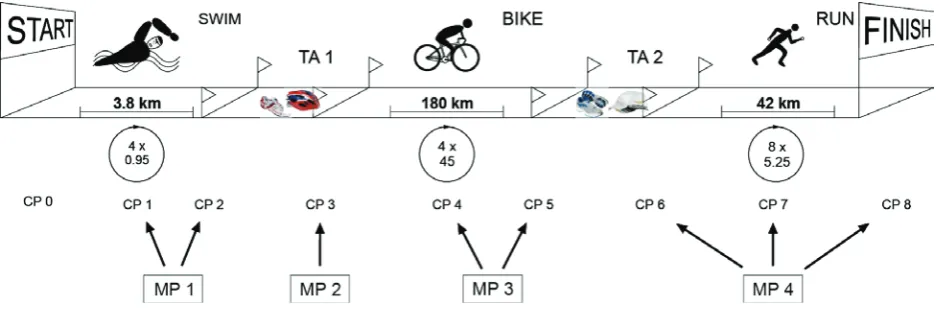
)LJXUHMeasuring time in Ironman triathlon
(DV\7LPH
EasyTime was developed for measuring time during Double ultra triathlon in 2009. At that time, the organizers of this competition were confronted with the problem of how to measure the times of competitors within three disciplines using a limited number of measuring devices. Besides this limitation, measures needed to be reliable and accurate, especially, because of its long duration. Although the measuring time for the triathlon was our first specific task, the goal was to develop a DSL for measuring time for any competition. A domain analysis was performed [15] using feature diagrams [29] with the aim of identifying common and variable concepts, their relations, and structure of particular concepts. In the case of EasyTime, the concept race consists of subconcepts: events (e.g., swimming, cycling, and running), control points (starting and finishing lines, the number of laps), the measuring time (updating time and decrementing laps), optional transition area (difference between the finish and start times), and agents (automatic or manual). In the next step, these concepts were mapped to the context-free grammar nonterminalsof EasyTime. Finally, its whole syntax and semantics were developed [15].
In order to illustrate the power of EasyTime, lets describe the Ironman triathlon, as presented in Figure 1. This triathlon consists of: 3.8 km swim, 180 km cycling, and a 42 km run. These disciplines run one after another with two interruptions: In the first, those competitors who have finished with swimming prepare themselves for the cycling, whilst in the second, those competitors who have finished the cycling prepare themselves for running. Both interruptions occur within so-called transition areas. Their times spent within these areas are added to their swimming, cycling, and running times, in order to obtain the total times of specific competitors.
Typically, the organizers divide those courses on which they run particular disciplines into laps because of easier management. As can be seen in Figure 1,
competitors need to accomplish 4 laps of swimming, 4 laps of cycling, and 8 laps of running. These laps represent another demand for the measuring time in such competitions because, besides the intermediate times of each lap, decrementing also needs to be performed. In order to reduce the number of measuring devices, a measuring point (MP in Figure 1) at which the intermediate time is measured and the number of laps is decremented, can be incorporated. In other words, when the number of laps is zero the last intermediatetime becomes the final time of a specific discipline.
This characteristic of the triathlon is put to profitableuse by EasyTime. In fact, EasyTime is a DSL that enables the organizers of sporting competitions to adapt measuring systems for various kinds of competitions, reduce the number of measuring devices, and achieve accuracy and reliability. The EasyTime program runs on a measuring system and employs a set of agents that control the measuring devices. For measuring time during Inronman, as illustrated in Figure 1, the EasyTime program presented in Program 1 is used.
At the start of Program 1, two agents are defined: The former describes a measuring device on which manual measuring time is performed on a portable computer by an operator, whilst the latter denotes a measuring device that automatically tracks an event caused when a competitor crossing the measuring place, based on RFID technology [30]. Typically, the automatic measuring place is implemented as a mat that acts as an antenna having two functions: Firstly, the antenna induces a passive tag that is born by competitor. Secondly, this induced tag acts as a transmitter that transmits its identification code to a measuring device. The transmitted code is detected by the measuring device as an event. This event is transmitted to the measuring system and recorded into a database by an agent.
,-U)LVWHU7.RVDU,)LVWHU00HUQLN
3URJUDP EasyTime program for measuring time in Ironman
1: 1 manual "man.dat"; //definition of manual agent 2: 2 auto 192.168.225.100; //definition of automatic agent 3: // definition of variables
4: var ROUND1 ؔ4; 5: var INTER1 ؔ0; 6: var SWIM ؔ0; 7: var TRANS1 ؔ0; 8: var ROUND2 ؔ4; 9: var INTER2 ؔ0; 10: var BIKE ؔ0; 11: var TRANS2 ؔ0; 12: var ROUND3 ؔ8; 13: var INTER3 ؔ0; 14: var RUN ؔ0;
15: // definition of measuring place 1 16: mp[1]Ѝagnt[1] {
17: (true)Ѝupd INTER1; 18: (true)Ѝdec ROUND1; 19: (ROUND1 == 0)Ѝupd SWIM; 20: }
21: // definition of measuring place 2 22: mp[2]Ѝagnt[1] {
23: (true)Ѝupd TRANS1; 24: }
25: // definition of measuring place 3 26: mp[3]Ѝagnt[2] {
27: (true)Ѝupd INTER2; 28: (true)Ѝdec ROUND2; 29: (ROUND2 == 0)Ѝupd BIKE; 30: }
31: // definition of measuring place 4 32: mp[4]Ѝagnt[2] {
33: (true)Ѝupd INTER3; 34: (ROUND3 == 8)Ѝupd TRANS2; 35: (true)Ѝdec ROUND3; 36: (ROUND3 == 0)Ѝupd RUN; 37: }
ROUNDx. The final achievements of a competitor for specific disciplines are saved within variables SWIM, BIKE, and RUN.
The EasyTime program is completed by definitions of measuring places mp[i], where i represents its identification number that must be defined uniquely. The measuring place represents a physical device that is connected to a measuring device. The measuring device can support more measuring places simultaneously. Conversely to a measuring place, a control point (CP in Figure 1) represents an event from a logical point of view and denotes the specific location on the course, where the referees need to track the time information about competitors. As a matter of fact, the control points in EasyTime are directly mapped into variables. The identification numbers of each agent responsible for transmitting the events is assigned to each measuring place. For example, manual agent agnt[1] in line 16 of Program 1 controls the first measuring place.
Before recording the event into a database, a sequence of statements in curly brackets are interpreted on an abstract machine (AM). These statements are in forms of (SUHGLFDWH)՜RSHUDWLRQ,
where RSHUDWLRQ denotes a sequence of instructions that are executed when the value of SUHGLFDWHreturns value ݐݎݑ݁. Typically, two instructions are employed in EasyTime++:XSG and GHF. The former update the value of variable in the database, whilst the latter decrements its value.
Although, DSLs can be implemented in vastly possible ways [1], an appropriate implementation when the end-users are not also the programmers is, a compiler/interpreter approach [31]. Hence, EasyTime was implemented using a compiler generator tool called LISA [8, 14]. The LISA specifications include lexical, syntax and semantic specifications. Whilst classical regular expressions and BNF are used for the first two specifications, the third specifications are based on Attribute Grammars [32]. One of the distinguishing features of a LISA compiler generator is that specifications (lexical, syntax, and semantics) can be easily reused and extended. An overall view of LISA specifications is given in Listing 1.
/LVWLQJOverall view of LISA specifications
ODQJXDJHܮଵ [extends ܮଶ, . . . ,ܮே] {
OH[LFRQ {
[[P] RYHUULGHV | [P] H[WHQGV] R regular expr. ڭ
}
DWWULEXWHVtype A1; :::;AM ڭ
UXOH[[Y] H[WHQGVj [Y] RYHUULGHV] Z { ܺ ؔXଵଵXଵଶ. . . XଵFRPSXWH {
semantic functions } ڭ
|
XଵXଶ. . . X௧compute {
semantic functions } ;
} ڭ
PHWKRG[[N] RYHUULGHVj [N] H[WHQGV] M { operations on semantic domains
} ڭ }
(DV\7LPH
EasyTime’s formal description was introduced in [15], whilst the mapping of EasyTime’s denotational semantics into attribute grammars, as well as its implementation, are presented in [16]. Due to requested extensions of EasyTime the language has evolved into EasyTime++. This section describes the formal specifications that were necessary for the change. Due to the space constraints, we are unable to include complete specifications. Interested readers are further referred to [15, 16].
ܩ݁݊݀݁ݎ and ܥܽݐ݁݃ݎݕ regarding competitors have added to the semantic domain 5XQQHUV. The second, and the most important change within the semantic domains is how the 6WDWH, which is the mapping from variables to values, has been modelled (Listing 2). Within EasyTime, the 6WDWH was a simple mapping: 6WDWH 9DU՜,QWHJHU, however in EasyTime++ an initial value of an attribute depends on categories, and a variable, called ’dynamicvar’, can also be initialized during a run-time. Hence, the State is now modelled as: 6WDWH=9DU՜((&DWHJRU\ĺ,QWHJHU)×7UXWK9DOXH). /LVWLQJSemantic domains in EasyTime++
&DWHJRU\={0, 1, 2, 3 ...} *HQGHU={݂݈݁݉ܽ݁,݈݉ܽ݁}
5XQQHUV=(Id×RFID×LastName×FirstName×Gender×Category)*
6WDWH 9DUĺ&DWHJRU\՜,QWHJHU)×7UXWK9DOXH)
Let us describe the 6WDWHusing a simple excerpt from EasyTime++ declarations. Three variables were declared within an EasyTime++ program (Program 2). The first variable, ܴܱܷܰܦ1 specifies that all competitors need to complete 50 laps, hence in a database of competitors the attribute ܴܱܷܰܦ1is set at 50 for all competitors. The second variable, ܴܱܷܰܦ2, specifies that, in a case where a competitor belongs to ܿܽݐ݁݃ݎݕ= 1, he/she needs to complete 20 laps, whilst a competitor within ܿܽݐ݁݃ݎݕ= 2 only needs 10 laps. In the database of competitors, the attribute ܴܱܷܰܦ2 is initialized according to the category. For all competitors in the first category this attribute will be initialized to 20, and for all competitors in the second category to 10. The third variable, ܲܧܰܣܮܻܶ , is a dynamic variable and its initial value for each competitor will be set during the run-time.
3URJUDPExcerpt from EasyTime++ declarations 1: var ROUND1 := 50;
2: var ROUND2 := { (category==1)ĺ20, 3: (category==2)ĺ10 };
4: dynamicvar PENALTY; // definition of dynamic var.
The 6WDWHin EasyTime++ is mapping which maps variable names (e.g., ܴܱܷܰܦ1 , ܴܱܷܰܦ2 , ܲܧܰܣܮܻܶ) into two components. The first component is itself a mapping from &DWHJRU\ to ,QWHJHU (e.g., ! !), whilst the second component indicates whether a variable is dynamic or not. To cope with this new model for variables in EasyTime++, the following LISA methods are needed
(note that the mapping from &DWHJRU\to ,QWHJHUcan be implemented using a hashtable [16], see Program 3).
3URJUDPImplementation of EasyTime++ State in LISA 1: method M_Var
2: class Var { 3: String name; 4: Hashtable values; 5: boolean isDynamic;
6: Var (String name, Hashtable values, 7: boolean isDynamic) {
8: this.name = name; 9: this.values = values; 10: this.isDynamic = isDynamic; 11: }
12: // Java methods are omitted 13: …
14: } 15: } 16:
17: method VarEnvironment { 18: import java.util.*;
19: public Hashtable put (Hashtable env, Var aVar) { 20: env = (Hashtable)env.clone();
21: env.put(aVar.getName(), aVar); 22: return env;
23: } // java method 24: } // Lisa method
Since all changes in EasyTime++ are done in a declaration part the semantic function D (for full description of EasyTime semantic functions please see [15, 16]), which describes the meanings of the declarations needs to be changed accordingly (Listing 3).
Semantic functionࣞmaps the syntactic construct 'HF, representing the declarations, into its meaning 6WDWH՜6WDWH, which is a mapping from6WDWHto 6WDWH. Note, how the first component of 6WDWHis defined in a case where the categories are unspecified (first equation in Listing 3), and in a case of dynamic variables (third equation in Listing 3). In the first equation, it is stated that variable ݔis mapped to value ܽ regardless of category. The mapping function ߣܿܽݐ݁݃ݎݕ.ܽ is a constant function. The second equation states that variable ݔis mapped to different values (e.g., ܽଵ,ܽଶ) according to different categories (e.g., ܿܽݐଵ,ܿܽݐଶ), whilst in the third equation, the
variable x is mapped to undefined value ٣regardless of category. In the case of dynamic variables the second component of (&DWHJRU\ ՜ ,QWHJHU) ×7UXWK-9DOXHis true, otherwise it is false.
/LVWLQJMeaning of declarations in EasyTime++
ࣞ:'HFĺ6WDWH ĺ 6WDWH
ࣞ ۤܞ܉ܚई ؔaۥݏ = ݏൣݔ ՜ ൫(ߣܿܽݐ݁݃ݎݕ.ܽ) ×݂݈ܽݏ݁൯൧
ࣞۤܞ܉ܚई ؔ{ܿܽݐଵ՜aଵ,ܿܽݐଶ՜aଶ}ۥݏ = ݏ[ݔ ՜ ({ܿܽݐଵ՜aଵ,ܿܽݐଶ՜aଶ} ×݂݈ܽݏ݁)]
ࣞۤ܌ܡܖ܉ܕܑ܋ܞ܉ܚईۥݏ = ݏൣݔ ՜ ൫(ߣܿܽݐ݁݃ݎݕ.٣) ×ݐݎݑ݁൯൧
,-U)LVWHU7.RVDU,)LVWHU00HUQLN
The aforementioned changes in formal specifica-tions of EasyTime++ also require changes in the implementation part. Note that changes are required in the lexical part (new keywords category and dynamicvar, new separator), syntax part (new syntax rules for declarations), as well as in the semantic part (new semantics for declarations). All the other parts of EasyTime (e.g., agents, measuring places, statements) [16] are intact and hence can be completely reused. Since EasyTime is implemented in LISA, which supports attribute grammar inheritance [8], and where lexical, syntax and semantic specifications can be inherited, it was natural to extend Easy-Time specifications written in LISA for implementing EasyTime++, thus achieving incremental language development. Program 4 shows the LISA specification of EasyTime++. Note, how all EasyTime specifications have been reused (’language EasyTime++ extends EasyTime’). In the inherited specifications it was necessary to override rule ܦ݁ܿ, which contained syntactic and semantic specifications for declarations, add some new grammar productions and their semantics (rule ܥܽݐ݁݃ݎ݅݁ݏ), as well as add new atribute ݒܽݎݒ݈ܽݑ݁ݏ of type ܪܽݏ݄ݐܾ݈ܽ݁, which were attached to the non-terminal ܥܶܩܴܵ, and extend regular definitions for ܵ݁ܽݎܽݐݎ and ܭ݁ݕݓݎ݀. Overall less than 70 lines of LISA specifications have been newly written to obtain the complete compiler for EasyTime++. Note that this is an example of language extension where language specifications’ fragment (Program 4) alone does not make any sense and can not exist without base-language specifications (for complete EasyTime specifications in LISA see [16]). Hence, this kind of language composition can be denoted as EasyTime ٱEasyTime++.
([DPSOHV
In order to test EasyTime++ DSL two casestudies were performed:
x cyclo-cross Grand-prix, and x biathlon.
The former was experienced in practice, whilst the latter could be taken as proof of concept. In the rest of this section, both case-studies are discussed in detail.
&DVHVWXG\&\FORFURVV*UDQG3UL[
This case-study tested the introduction of categories in EasyTime++. Cyclo-cross is a relatively new sport that typically takes place in winter and is dedicated to cycle road-riders who are preparing for the new season. Races usually consist of several laps of a short course featuring pavements, wooded trails, grass, steep hills, and obstacles.
In this case-study, one lap of 2.5 km was used (Figure 2). According to the number of laps, the competitors were divided into three categories, as follows:
3URJUDPLISA specification of EasyTime++ 1: language EasyTime++ extends EasyTime { 2: lexicon {
3: extends Separator,
4: extends Keyword category | dynamicvar 5: }
6: attributes Hashtable*.varvalues; 7: rule extends Start
8: compute { } 9: }
10: rule overrides Dec {
11: DEC::=var#Id:=#Int; compute {
12: //category is not specified; isDynamic=false 13: DEC.outState = put(DEC.inState,
14: new Var(#Id.value(), 15: put(new Hashtable(), "0",
16: Integer.valueOf(#Int.value()).intValue()),false)); 17: };
18: DEC ::= dynamicvar #Id ; compute {
19: // category can not be specified; isDynamic=true 20: DEC.outState = put(DEC.inState,
21: new Var(Id.value(), null, true)); 22: };
23: DEC ::= var #Id := { CTGRS } ; compute {
24: // categories are specified and can’t be dynamic 25: DEC.outState = put(DEC.inState,
26: new Var(#Id.value(), CTGRS.varvalues, false)); 27: };
28: }
29: rule Categories {
30: CTGRS ::= ( category == #Int ) -> #Int , CTGRS 31: compute {
32: CTGRS[0].varvalues = put(CTGRS[1].varvalues, 33: #Int[0].value(),
34: Integer.valueOf(#Int[1].value()).intValue()); 35: };
36: CTGRS ::= ( category == #Int ) -> #Int compute { 37: CTGRS.varvalues = put(new Hashtable(), 38: #Int[0].value(),
39: Integer.valueOf(#Int[1].value()).intValue()); 40: };
41: } 42: ...
43: // LISA methods 44: }
x 4 laps: junior men and women up to 15 years old (U-15),
x 6 laps: junior men and women up to 19 years old (U-19), and
x 9 laps: absolute categories (U-23, Elite, Masters).
)LJXUHTrack layout of the cyclo-cross competition
The EasyTime++ program for measuring time in this competition can be seen by Program 5. Note that here both measuring places, i.e., mats, were laid so that the whole length of the finish line was captured. In line with this, a competitor can cross either of both mats. As a result, the programs for both measuring devices are the same, and work in parallel.
3URJUDPEasyTime++ program for measuring time in cyclo-cross competition
1: 2 auto 192.168.225.100; // definition of agent 2: var BIKEؔ0;
3: var ROUND1 ؔ{(category ==1)՜4,
4: (category == 2)՜6, (category ==3)՜ 9 }; 5: // definition of measuring place 1
6: mp[1]՜ agnt[2] { 7: (true)՜dec ROUND1; 8: (ROUND1 == 0)՜upd BIKE; 9: }
10: // definition of measuring place 2 11: mp[2]՜agnt[2] {
12: (true)՜dec ROUND1; 13: (ROUND1 == 0)՜upd BIKE; 14: }
In summary, measuring time in cyclo-cross performed well with EasyTime++. Although the organizers prepared three different lengths of courses, six different lists of results were obtained according to gender. Fortunately, in our case the gender could be handled by a database system, whilst the EasyTime++ program was unaware of it.
&DVHVWXG\%LDWKORQ
A biathlon was the second case-study for Easy- Time++. Biathlon refers specifically to the winter sport that combines cross-country skiing and rifle shooting. As can be seen from Figure 3, competitors start with skiing. Skiing is interrupted by rifle shooting. Typically, biathlon consists of 4 laps of skiing. The shooting appears close to the end of a lap.
Two positions for competitors are allowed when shooting, i.e., prone and standing. Interestingly, the number of missed shoots is penalized by the additional number of penalty laps. Note that the time spent within the penalty laps are added to the total time of the competitor. The time of the penalty lap is typically taken to be between 20-30 seconds.
The EasyTime++ program for measuring time in biathlon can be seen by Program 6. Three measuring devices are needed to cover this competition. Each measuring device realizes one measuring place. Moreover, each measuring place also represents a control point. In contrast to Ironman, in a biathlon time spent in penalty loops is of no interest in the preferred race. Here, only the total time of competitor is important.
)LJXUHMeasuring time in biathlon competitions
3URJUDPEasyTime++ program for measuring time in biathlon competition
1: 1 auto 192.168.225.110; // definition of agent 1 2: 2 auto 192.168.225.100; // definition of agent 2 3: var ROUND ؔ4;
4: var RUN ؔ0;
5: dynamicvar PENALTY; // definition of dynam.variable 6: // definition of measuring place 1
7: mp[1] ՜ agnt[1] { 8: (true)՜upd PENALTY; 9: }
10: // definition of measuring place 2 11: mp[2] ՜agnt[2] {
12: (true)՜dec PENALTY; 13: }
14: // definition of measuring place 3 15: mp[3] ՜agnt[2] {
16: (true)՜dec ROUND; 17: (ROUND == 0) ՜ upd RUN; 18: }
,-U)LVWHU7.RVDU,)LVWHU00HUQLN
&RQFOXVLRQV
Easy language composition is still an open-issue within programming language research. In particular, a new young field of software language engineering is of interest regarding engineering principles when constructing new languages, whether general-purpose or domain-specific. A language designer would like to build a new language simply by composing different components and/or extending previous components. This paper has presented EasyTime++ DSL as a language extension of EasyTime, where the base language specifications written in the LISA compiler generator have been extended with new features, thus enabling the introduction of categories into competitions, and those new competitions where the number of laps is dynamically determined. The implemented multiple attribute grammar inheritance in LISA enables easy language composition since lexical, syntax, and semantic specifications can be reused and extended. In such a manner, an incremental language development using LISA has been demonstrated. The suitability of EasyTime++ was shown in two case studies: cyclo-cross Grand-prix and a biathlon. More extensive experimental work, which would include other types of language compositions and more DSLs, is also planned in the future.
5HIHUHQFHV
[1] 00HUQLN-+HHULQJ$06ORDQHWhen and how to develop domain-specific languages. IN: ACM Computing Surveys, 2005, Vol. 37, No. 4, pp. 316-344. [2] $YDQ'HXUVHQ 3.OLQW -9LVVHUDomain-specific
languages: an annotated bibliography. In: ACM SIGPLAN Notices, 2000, Vol. 35, No. 6, pp. 26–36. [3] 3+XGDN Building domain-specific embedded
languages. In: ACM Computing Surveys, 1996, 28(4es).
[4] 0)RZOHUDomain Specific Languages. In: Addison-Wesley Professional, 2010.
[5] 0-9DUDQGD 3HUHLUD 00HUQLN 'GD&UX]
35+HQULTXHV Program comprehension for
domainspecific languages. In: Computer Science and Information Systems, 2008, Vol. 5, No. 2, pp. 1–17.
[6] 7.RVDU 35+HQULTXHV 0-9DUDQGD3HUHLUD
0ýUHSLQãHN 00HUQLN 12OLYHLUD 'GD&UX] Comparing General-Purpose and Domain-Specific Languages: An Empirical Study. In: Computer Science and Information Systems, 2010, Vol. 7, No. 2, pp. 247-264.
[7] 7.RVDU 00HUQLN -& &DUYHU Program comprehension of domain-specific and general-purpose languages: comparison using a family of experiments. In: Empiricalsoftware engineering, 2012, Vol. 17, No. 3, pp. 276–304.
[8] 00HUQLN 9äXPHU. Incremental programming language development. In: Computer Languages, Systems and Structures, 2005, Vol. 31, No. 1, pp. 1-16.
[9] '+UQþLþ 00HUQLN %5%U\DQW Embedding
DSLs into GPLs: A Grammatical Inference Approach. In: Information Technology and Control, 2011, Vol. 40, No. 4, pp. 307-315.
[10]'+UQþLþ 00HUQLN %5%U\DQW )-DYHG A
memetic grammar inference algorithm for language learning. In: Applied Soft Computing, 2012, Vol. 12, No. 3, pp. 1006-1020.
[11]*.LF]DOHVAspect-oriented programming. In: ACM Computing Surveys, 1996, Vol. 28, No. 4, Article No. 154.
[12]3.OLQW 7YDQ GHU 6WRUP --9LQMX Term
rewriting meets aspect-oriented programming. In: Processes, Terms and Cycles: Steps on the Road to Infinity,Springer-Verlag, 2005, pp. 88–105.
[13]00HUQLN '5HEHUQDN Aspect-Oriented Attribute Grammars. In: Electronics and Electrical Engineering, 2011, Vol. 10, No. 116, pp. 99–104.
[14]35 +HQULTXHV 0- 9DUDQGD 3HUHLUD 0/HQLþ 00HUQLN-*UD\+:XAutomatic generation of language-based tools using LISA. In: IEE Proceedings-Software Engineering, 2005, Vol. 152, No. 2, pp. 54-69.
[15],-U )LVWHU ,)LVWHU 00HUQLN -%UHVW Design and implementation of domain-specific language Easytime. In: Computer Languages, Systems and Structures, 2011, Vol. 37, No. 4, pp. 276-304.
[16],-U )LVWHU 00HUQLN ,)LVWHU '+UQþLþ
Implementation of EasyTime Formal Semantics using a LISA Compiler Generator. In: Computer Science and Information Systems, 2012, Vol. 9, No. 3, pp. 1019-1044.
[17]6(UGZHJ 3* *LDUUXVVR 75HQGHOLanguage Composition Untangled. In: Proceedings of Workshop on Language Descriptions, Tools and
Applications (LDTA’12). Available at
http://www.informatik.unimarburg.de/~seba/publicatio ns/languagecomposition.pdf, 2012.
[18]$*UDQLF] -+LFNH\Phobos: A front-end approach to extensible compilers. In: Proceedings of the 36th Annual Hawaii International Conference on System Sciences (HICSS36), 2003.
[19]*+HGLQ (0DJQXVVRQJastAdd: an aspectoriented compiler construction system. In: Science of Computer Programming, 2003, Vol. 47, No. 1, pp. 37–58.
[20](9DQ:\N'%RGLQ-*DR/.ULVKQDQSilver:
An extensible attribute grammar system. In: Science of Computer Programming, 2010, Vol. 75, No. 1, pp. 39-54.
[21]7&ODUN 36DPPXW -:LOODQV Superlanguages: Developing languages and applications with XMF. Published online at: hhtp://bit.ly/HiTOKp, 2008.
[22]-&HUYHOOH 5)RUD[ *5RXVVHO A simple implementation of grammar libraries. In: Computer Science and Information Systems, 2007, Vol. 4, No. 2, pp. 65–77.
[23]+.UDKQ %5XPSH 69RHONHO MontiCore:
Modular development of textual domain specific languages. In: Proceedings of the 30th International Conference on Software Engineering (SLE 2008), 2008, pp. 925–926.
[24]$6WRQLV '5XEOLDXVNDV -%ORQVNLV Mapping Syntax Extensions. In: Information Technology and Control, 2002, Vol. 24, No. 3, pp. 35-48.
[25]-3RUXElQ 0)RUJiþ 06DER 0%uKiOHN
Annotation Based Parser Generator. In: Computer Science and Information Systems, 2010, Vol. 7, No. 2, pp. 291-307.
Grammars First-Class. In: Proceedings of Workshop on Language Descriptions, Tools and
Applications (LDTA’12). Available at
http://www.cs.uu.nl/research/techreps/repo/CS-2011/2011-029.pdf, 2012.
[27]'%URZQ-/HYLQH70DVRQ Lex & yacc. O’Reilly Media, 2nd Edition, 1992.
[28];:X %5 %U\DQW -*UD\ 00HUQLN
Component-based LR parsing. In: Computer Languages, Systems and Structures, 2010, Vol. 36, No. 1, pp. 16-33.
[29]9âWXLN\V 5'DPDãHYLFLXV Measuring Complexity of Domain Models Represented by Feature Diagrams.
In: Information Technology and Control, 2009, Vol. 38, No. 3, pp. 179-187.
[30].)LQNHQ]HOOHURFID Handbook. John Wiley & Sons, 2010.
[31]7.RVDU 3( 0DUWtQH] /ySH] 3$ %DUULHQWRV 00HUQLN A Preliminary Study on Various Implementation Approaches of Domain-Specific Language. In: Information and Software Technology, 2008, Vol. 50, No. 5, pp. 390-405.
[32]-3DDNNL Attribute Grammar Paradigms - A High-Level Methodology in Language Implementation. ACM Computing Surveys, 1995, Vol. 27, No. 2, pp. 196-255.