Copyright © 2015 IJECCE, All right reserved 131
Offering a New Approach for Approximate Pattern
Matching in Example-Based Machine Translation
Reza Akbari
Dept. of Computer and IT Engineering, Shiraz University, Shiraz, Iran email: [email protected]
Mohammad Hadi Sadreddini
Dept. of Computer and IT Engineering, Shiraz University, Shiraz, Iran
email: [email protected]
Seyed Mostafa Fakhrahmad
Dept. of Computer and IT Engineering, Shiraz University, Shiraz, Iran email: [email protected]
Abstract: In this article, a new model is proposed in order to measure the degree of similarity between two sentences in machine translation based on example. The proposed model has applied genetic algorithm beside a new fitness function which is based on semantic load matching between the two sentences. Here, verbs are considered as the heart of a sentence because they are the main part of a sentence and carry the major part of the semantic load in the sentence; therefore more attention is paid to the verbs in the fitness function. It is noteworthy that the proposed model is largely dependent on the verbal part and the extracted synonyms from WordNet as well as the arrangement of words. The results are promising by precision and recall, indicating that the proposed method improves the quality of the retrieved matched sentences.
Keywords: Machine Translation, Example Based Machine Translation, Matching Phase, The Similarity of Sentences, Semantic Load, Genetic Algorithm.
1.
I
NTRODUCTIONCorpus-based machine translation [1] is one of the most prominent areas of machine translation. The most actively studied frameworks are especially Example-Based Mach- ine Translation (EBMT) [2] and Translation Memory (TM) [3]. In example-based machine translation, a new sentence is translated from the source language into the target language using previous translated examples [4]. In this kind of machine translation, matching phase is the process that extracts the most similar sentences for an input sentence from a series of pre-ready examples.
This process undoubtedly needs a similarity meas-urement criterion [5]. So far, many studies have been carried out on the matching process by the researchers, which have created various scales for measuring the similarity of sentences, but none of the proposed measures have been able to measure the similarity of sentences in different conditions at a very high level. A potential solution that can be considered for defining the criteria is weighting the words in a sentence. Accordingly, each word in a sentence has a specific weight that can vary with the weight of other words. For example, consider the following two sentences S1 and S2:
S1: Young people like playing football. S2: Old people like walking.
The general meaning to be inferred from both sentences can be "interest of people in sports" that indicate a strong degree of similarity between the two sentences. But if the subject and the object are taken into consideration, a noticeable difference between the two sentences would
reveal that difference of people leads to different preferred exercises. So, if two sentences have identical or synonym- ous verbs, most likely they have the same concept. But as seen in the two sentences above, other words also cause semantic differences in the sentences. If we take 1.0 as the maximum semantic value and 0.0 as the minimum semantic value in a sentence, then we can deduce that both of the above sentences receive 1.0 points. But if we consider the value of semantic similarity between the two sentences S1 and S2, the resulting point would be a number between 0.0 and 1.0.
It looks like vectors, as some researchers have rep-resented their documents as vectors [6,7]. When two vectors have the same size but are not in the same direction, it could not be said that they are quite similar. But if two vectors have the same size and direction, one can say that they are quite similar. This fully applies to sentences. If in a sentence other words value rather less than the verb, then the verb plays the key role, because if in a sentence the words that play the role of noun or adverb are removed, the decreased semantic load will not reduce essentially. Now if in the same sentence, the verb(s) are removed, we can see that the original meaning of the sentence will be very incomplete and unclear. Therefore, as the most important phase of the algorithm we shall define and use a criterion for measuring semantic similarity based on semantic similarity of words in a sentence. Two sentences are similar in meaning if the semantic load of one approaches the semantic load of the other [8]. Like our colleagues [9], we failed to find any precise and clear definition for "semantic load". We define the degree of similarity by matched semantic load between two sentences. To calculate this criterion, we have to clearly match two sentences and then determine the similarities and value them.
Verbs in sentences are considered as content words. For this reason, in measuring the similarity of meaning between the two sentences, most of the attention is put on verbs, because most sentences contain at least one verb which indicates an event or situation in that sentence. Other words are also somehow related to the verbs in the sentences. So far, much research has been performed on simple sentences, but there are many sentences that are composed of several clauses, or in other words are made up of some main verbs.
Copyright © 2015 IJECCE, All right reserved 132
algorithm are considered. In pre-processing phase, sections like speech tagging (POS) and finding the root of verbs and extraction of synonyms for each word is done from WordNet [10] and other sources. The pre-processing phase reduces the time needed for processing in the main phase and thereby increases system performance. In the second phase of genetic algorithm, mutation and crossover operators are applied for changing the structure of the sentences and replacing the synonym of the words in order to approximate the intrinsic semantic load of the example set sentences. Depending on the domain, the matching process may be done on syntactic or semantic level or both [11]. The sentences were compared semantically and structurally. Then, the sentences with the highest level of semantic and structural similarity were chosen as the most similar sentences. If the two sentences contain the highest similarity values of 1.0, the sentences are quite identical. For example, in the two sentences S1 and S2 certain levels of syntactic and semantic similarity are deductible. The two sentences have the same verb as the main component. Although in some cases like subjects, there are differences and this has reduced the semantic similarity, but they can have the same ancestor in the tree structure of WordNet or similar POS structures.
The focus here was on English sentences in which the composition of words in the clauses is more consistent with S-V-O(subject verb object). Each clause in the two sentences is divided into three parts and the verb is placed between two other partitions. In each partition, POS of each word is identified and labeled. Then, the related partitions are integrated and compared. Thus the similarity level of two sentences is formed of the obtained matching from three partitions for each clause. Sentence matching is performed at different levels, and each level of matching has its own relevant scores. These sentences can be composed of one or several clauses and as a result have one or several verbs such as complex sentences or compound sentences that are connected by conjunction or semicolon. Generally, in the proposed method, the most important part of the fitness function is related to the genetic algorithm that calculates the approximate similarity value of the sentences in the example set to the input sentence using the matched semantic load of the sentences.
Semantic and syntactic information both contribute the meaning of a sentence. In comparing sentence similarity, most methods usually consider semantic, POS, syntactic (word order) information or a combination of them, and offer an overall similarity of the two sentences that are compared.
In [12], has proposed a method adopting the Edit Distance as similarity measure between(parts of) senten- ces. This method mainly pays attention to the similarity of syntax structure.
Shan Jian-fang et al [13], proposed a new method for measuring sentence similarity. The proposed method takes into account both semantic and syntax where semantic similarity is measured based on events, and syntactic similarity is measured based on the sequence of content w-
ords.
Lin Li et al [14], have proposed that sentence similarities be determined from four different aspects: Objects-Specified Similarity, Objects-Property Similarity, Objects-Behavior Similarity and Overall Similarity that are based on the information that people get from a sentence. In order to measure semantic similarity between words and concepts, Jay J. Jiang et al [15] proposed a new approach. The approach combines a lexical taxonomy structure with corpus statistical information. In this manner, the semantic distance between nodes in the semantic space constructed by the taxonomy can be better quantified with the computational evidence derived from a distributional analysis of corpus data. The proposed measure is a combined approach that inherits the edge-based approach of the edge counting scheme. Then, it is enhanced by the node-based approach of the information content calculation.
In [16], an existing word similarity method was adopted to deal with the similarity of verbs and nouns, while the similarity of adjectives and adverbs were measured only based on simple overlap of words.
The idea of using matched semantic load comes from the work of Mehdi Mohammadi et al [9], of two sentences based on the semantic load value shared between the input sentences and the sentences that exist in the example set. So, semantic load is defined as: each part of the sentence carries a different part of the sentence meaning, and the sum of the meaning of different parts of a sentence can add up to the total meaning of that sentence.
2.
P
ROPOSEDA
PPROACHEach sentence is made up of some words or phrases each carrying part of the original meaning. So, the first question after the definition of semantic load is to determine the contribution of different parts to it. If we divide this amount equally between all words in a sentence, most definitely it will not be acceptable, because each part of the sentence has a different semantic load comparing the other parts. For example, in the sentence "I fly in the sky" the contribution of each word to semantic load cannot be 20%. Thus, each word must be given the score proportionate to its contribution. To demonstrate this, you can remove some parts to realize the change in the original meaning. If the word "sky" or "I" is removed, it can be seen that the main concept of the sentence will not change. While if the word "fly" is removed which plays the role of the verb in the sentence, its meaning altogether becomes ambiguous. So, any part of the sentence has its own specific semantic load to complete the overall meaning of the sentence.
Sometimes two sentences have almost the same meaning but are located in two different structures. Consider the following examples:
A) My friend is Ahmad and he is so clever. B) Ahmad was clever and he was my friend.
Copyright © 2015 IJECCE, All right reserved 133
lowing two sentences:
C) That is my home. D) That is my house.
For sentences A and B by moving the clauses, the same semantic and structural sentence could be made. For sentences C and D by realizing that the two words "home" and "house" are synonymous, it can be detected that the two sentences are exactly alike.
Based on the fact that verbs carry the bulk of the semantic load of a sentence [9] (which will be proved in the next sections), the proposed algorithm is based on two phases. In the first phase, the pre-processing function is performed on the sentences and then in the second and main phase for each sentence in the example set that its similarity with the input sentence is calculated, first the various synonymous compositions of that sentence obtained in the pre-processing phase is taken as the primary sample and then using the genetic algorithm and an efficient fitness function the degree of approximate similarity of the input sentence to the example set sentences is obtained through the created new generations.
In the suggested method, each clause from a sentence is divided into three parts: before the verb, the verb and after the verb. The default partitioning is based on SVO. To calculate the total similarity, the clauses and the corresponding partitions in the two sentences are matched and calculations are performed to measure the similarity levels (in the next section below). Suppose A as the input sentence and B as one of the sentences in the example set which their similarity level is going to be calculated using the new method. Before anything, the clauses relating to each sentence are specified and each clause is partitioned in three parts as follows. In this example, we assume that the sentences have two clauses.
A:
{p the word before the first verb} {the first verb} {q the word after the first verb} {Conjunction}{r the word before the second verb} {the second verb} {t the word after the second verb}, p, q, r, t> = 0.B:
{x the word before the first verb} {the first verb} {y the word after the first verb} {Conjunction}{w the word before the second verb} {the second verb} {z the word after the second verb}, x, y, w, z > = 0.Thus, for each clause in the sentence three partitions are created. It is noteworthy that the initial major condition for comparing a sentence from example set with the input sentence that has one or several verbs is that at least one of the verb roots in the input sentence or its synonym in the example set exists in the common clauses. For example, if the two sentences A and B have a common verb and both are located in the first clause of the sentences, the initial condition is established. However, if the common verb of the two sentences is located in the first clause of the sentence A and the second clause of the sentence B, the initial condition is not established, and the sentence is set aside from the example set and no calculations will be performed on it. Perhaps it may seem that the above condition is not true. Because it is likely that there are sentences that have the same verbs in different clauses but are semantically identical. The solution proposed in this article is the genetic algorithm that creates different
generations from one sentence of the example set that differs in the structure and word synonym so as to achieve a similar and optimum structure from the input sentence and calculation of an exact level of the similarity is made possible. But there are sentences such as "Good morning" that do not contain verbs. These sentences are compared to the sentences without verbs and the semantic load will be divided equally among words.
The question now arising about the matched semantic load is how much of the semantic load shall be allocated to different clauses and partitions? As mentioned in the previous part, giving an equal value to all clauses or parts would not be acceptable. As mentioned in the previous section, if we divide the amount equally between clauses or partitions, it would not be acceptable. The approach
we've taken includes “the reduction of semantic load of the
sentence by moving toward the next clauses in each
sentence”. That is, in most cases, the main verb of the first
clause carries more important concepts and semantic loads of the sentence compared to the verbs in the next clauses. So, in most sentences, the more one gets close to the last clauses, the more the main concept gets farther and the more the details are dealt with rather than the concept of the sentence. For example, note the two sentences below: - My brother went to the market to buy a shirt.
- Ahmad went to Tehran and came back after a few days. As seen in the above sentences, the main purpose and concept is "going to a place" and events such as "buying" and "coming back" are at a lower semantic level than the original concept. This principle does not work for a number of sentences, but is true for most sentences (in the experiments section it has been tried to demonstrate this). If the value of x is taken as a proportion of the total semantic load for all parts of the sentence verbs, the result would be that the value of (1-x) would remain for the other parts. Now the question arises that in the case of having several clauses and therefore, having several verbs, how do we divide the scores attributed to the section of verbs among all verbs? We've done an attempt to answer this question. If we divide the number of scores related to the verbs equally among the verbs, it will be unacceptable, because we have not followed the proposed rule which generally states by going ahead along the clauses, the main concept of the sentence is weakened. So the new equation (1) is defined and used in this context. In this regard, much attention is paid to the number of main verbs of a sentence and their place so as the scores can be divided appropriately between the verbs in the sentence.
� �=�− + ∗ (� − ∑= � − ) (1)
In the above equation
vs
jis the share of the j thverb from the 5th total contributions made to the verbs, n is the number of verbs in that sentence, and f is the percentage of shares of intended for semantic load for the verbs. At every phase, we need knowledge of the contribution
allocated to the previous verbs 1 1
(
j i)
i
vs
Copyright © 2015 IJECCE, All right reserved 134
number of verbs that have not yet received a share (n-j). So, to allocate the share of each verb, we need to start from the first verb and continue to the last. To allocate a share to the first verb, the variable of the scores of the previous verbs shall be taken zero
(
vs
0
0)
. Generally, in the first part of the equation, the shares are divided regarding the remaining portion and in the second part of the equation, the value of semantic load for all remaining verbs are calculated. By multiplying the two parts, a proportionate value of the score allocated to each verb regarding its position is achieved. Thus by the proposed equation, each verb is given the value regarding its position in the sentence. Figure 1 shows the partitioning and dividing the similarity score for a sentence that has two clauses where the value of x is the share of total semantic load related to all verbs that is divided among them using the equation (1) and the remaining value of (1-x) is equally divided among the remaining words before and after verbs.Fig.1. Sentence Partitioning and Semantic Load Sharing among Partitions
A. Approximation of Matched Semantic Load for
Verbs:
To determine matched semantic load for different parts of the sentence, first the value shall be determined for verbs. This way the scores for other parts can be allocated correctly. To determine these scores, we conducted a test on the dataset. We tested the model with different values of x semantic load that were exerted on the verbs of the sentence (The range of the experiment numbers is from 0.3 0.8 with 0.1 phases). In this experiment, we created a series of examples, including 165000 English sentences which one-third of them are taken from the first sentences, one third from the middle sentences and one-third from the final sentences in the Europarl [17] in order to have a variety of sentences in the example set. Then 500 sentences were randomly collected from various sources as the input sentences. It is noteworthy that the collected sentences had one or more clause and simple sentences alone were not used. The proposed algorithm was six times tested with varying amounts of semantic load share of the verbs on the input sentences and the matched sentences were obtained. Then, based on the criteria discussed below, the review and evaluation was performed manually. These criteria are placed at four ranks A, B, C, D as follows.
A
( The input sentence is quite similar to the matched sentence or it can be achieved with a small amount of change.B
( The input and matched sentences contains the same verb roots and many changes are required to extract the input sentence from the matched sentence.C
( The matched sentence has at least half of the verb roots in the input sentence, but not all verbs. Many changes are required to extract the input sentence from the matched sentence.D)
The matched sentence includes none or less than half of the input sentences but it is common in some words.Using the proposed criteria and considering the impact of each of the ratings given to the verb in a six-run, the analysis has been performed studying and counting the best matched sentences.
Figure 2 illustrates the fact that verbs with a score of 0.6, with a rating of A and B in matching the sentences had increases in the scores comparing other verbs. In contrast, the number of matched sentences was reduced in rank D. Accordingly, in accordance with the test, the semantic load of the verbs is taken 0.6.
Fig.2. Comparing the Best Matches for Different Values for the Share of Verb Score
B. Pre-processing of Sentences:
The first phase to identify the most similar sentences of the example set to the input sentence is identifying the semantic and structural relation of the sentences. On this basis, in the pre-processing phase, first the sentences are labeled in the speech labeling section to determine transition of the speech part of each word. Then non useful words like (of, the ...) are deleted from the source and target sentences, because they have no significant impact on the general meaning of the sentence. Now, the roots of words in each sentence are extracted and their synonyms are found from WordNet and then several limited permutations are considered from the composition of word synonyms in each sentence in the example set as the initial population of the genetic algorithm. With this phase, for each sentence in the example set several permutations of that sentence is obtained which almost all the compositions have the same meaning using different words. Then for each of the extracted meanings, one weighted likelihood is required. Weighted likelihood for each of the meanings of a word is obtained from equation (2):
(2)
0 50 100 150 200 250
0,3 0,4 0,5 0,6 0,7 0,8
M
a
tc
h
ed
c
o
u
n
t
Share of semantic load for verb
rank A
rank B
rank C
Copyright © 2015 IJECCE, All right reserved 135
Where w is the target word, s number of the selected meaning and Total Sense is the total number of meanings of the intended word. It is noteworthy that the number of one meaning is identified regarding the total time applied in the transmutation of text of semantic core for each word. Thus, the first meaning of a word is its most common meaning. Finally, the number of main verbs in the sentence and also the length of the sentence would be saved for use in equations.
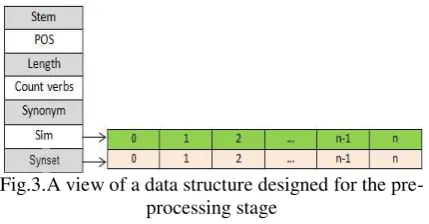
In general, the pre-processing stage reduces the time needed to process in the main stage and thus increases system performance. So, for every sentence, all of the above cases shall be saved. For this purpose, a data structure displayed in Figure 3 is considered for each sentence.
Fig.3.A view of a data structure designed for the pre-processing stage
3.
I
MPLEMENTATION OFG
ENETICA
LGORITHMP
ROVIDED FORS
ENTENCEM
ATCHINGThe process of measuring the similarity of the sentences using the genetic algorithm starts when each sentence is taken as a chromosome and each word is taken as a gene.
The proposed genetic algorithm is: (1) start with a set of solutions (the first generation prepared in pre-processing), (2) select two parent solutions and combine them as a child, (3) use a cost function to evaluate solutions, (4) Repeat all phases from phase 2 to 4.
In the presented genetic algorithm if the initial condition is met (having at least one common verb with the input sentence) for each sentence in the example set a variety of structurally and semantically various generation of sentences are created that can make the example set similar to the input sentence if the two sentences are semantically and structurally similar. To estimate the degree of similarity between each generation of the example set to input sentences an efficient fitness function is required that is able to consider the two important criteria of meaning and structural similarity in order to measure the similarity between two sentences.
A. Fitness Function:
Fitness function is the most important part of genetic algorithm. This part of algorithm clarifies if a solution is correct or better than other solutions. This is while the method that determines the best answer depends on the type of problem and the proposed approach. If fitness function does not properly compare the solutions, the genetic algorithm will reach the incorrect answer. In furtherance of this goal, matched semantic load was used
to measure the approximate value of similarity between sentences. So, in this matter, the defined fitness function shall be able to compare two sentences semantically and structurally in order to find the approximate similarity between the sentences.
To find the most similar sentence to the input sentence in the example set, all sentences in the example set shall have at least one root or synonym of the verbs in the input sentence to be taken as the candidates for the matching and to retrieve them. The similarity score is calculated from the POS of the words in the sentence identified in the pre-processing stage to detect matched verbs and then it is used for the input sentence and all sentences in the example set that have been considered as a candidate match.
To determine the share of semantic load for each word, we must first determine the matching levels for allocation of points. Table 1 shows these levels. The tests performed in the previous parts revealed that the share of semantic load for sentence verbs is 0.6. So, the total amount of shares in other parts which is 0.4 will be divided among other words in the sentence before and after the verb.
Table 1.Different levels of matching
Levels Explanations
Root The verb is given scores if the verb roots are the same or if the two verbs are detected as synonyms in the WordNet.
Equal Words The scores are obtained for each word if the two words are equal in common parts.
The Ancestor Part
Obtaining part of the scores of every word, enjoying the privilege of being a sibling and space between words, using the libraries provided by WordNet. POS Tag Obtaining only a quarter of the scores for each word
if only the role is same in common parts.
After sharing the scores among the verbs and dividing the remaining scores among the other words in the input sentence, the distributed values are considered as the potential (p-score), because it is possible for a word not to obtain this similarity score, but this value can be considered as a high level of similarity value for that word. Finally, each word will receive a share of the determined point by C-Score in this method. C-Score for each word is calculated based on the matching level defined in Table 1.
In presented matching levels, the point related to p-score of that word is added to the similarity value of the sentence if the two words or the verb roots are equal (verb synonymy). Another level is the ancestor part which in case of similar ancestor for two words such as "Iran" and "Canada" (their ancestors is "Country") a similarity value is extracted using equation (3) [18] for the two words and then it is multiplied by the p-score of that word and finally it would be added to the similarity value of that sentence.
1 ( , ) / W
( , )
0 !(W )
i j i j
i j
i j
dis W W D W
Sim W W
W
(3)
Copyright © 2015 IJECCE, All right reserved 136
D is the depth of the tree of these words in the WordNet. WiWjshows the condition that the two intended words
in question have the same ancestor, and dis W W( i, j)repre-
sents the distance between the two words in the tree created by Word Net.
Another level is considered for POS tag which in case two words have the same role, for example both are verbs, one fourth of the p-score of that word is added to the similarity level. But if there is no matching in the POS level, no value is added to the similarity level of the sentence. For example, if you have a sentence with a clause containing a verb and four other words, then the p-score of each word except the verb is equal to 0.1. Now to calculate C-score for each word in POS level, one fourth of the value (0.025) is considered as the C-score in case the words in the sentence have equal roles. Otherwise, the C-score of that word is zero, because there is no other matched level for scoring and POS level is the last level. It is noteworthy that if a word obtains the score of root level, the score of other lower levels will not be calculated for it. So, to calculate the approximate similarity of a pair of sample sentences, first the C-scores of each matched words in each stage are extracted and added to each other to make the total score which is initially equal to zero. For example, in Table 2, two sentences are given where the first and second sentences are respectively considered as the input sentence and example set sentence and pre-processing phase is performed on them. The potential score given to input verbs which is 0.6 is divided among them using equation (1) and then the remaining amount is divided equally among other words.
Table2.Calculation of TotalScore for an example sentence
L V1 R L V2 R
P-score 0.066 0.39 0.066 0.066 0.066 0.21 0.066 0.066
Input
sentence He be born Esfahan he have good voice Corpus
sentence She be born Shiraz she have two brother C-score 0.0165 0.39 0.066 0.0574 0.0165 0.21 0 0.0165
Total Score = 0.0165+0.39+0.066+0.0574+0.0165+0.21+0+0.0165 = 0.772
Now each word in the example set gets the intended C-score regarding the matched levels and at the end they are added to obtain Totalscore value which in this example is 0.77. In this example, "he" and "she", and "voice" and "brother" are matched in POS level. Words like "born" that come in one common partition of the two sentences receive the full score of the p-score in the level of equal words. But words like "Esfahan" and "Shiraz" which have the same ancestor (City) receive a score at the ancestor level using equation (2).
As an important reality, the input and matched sentences must be of the same appropriate length. For this purpose, the similarity score of the two sentences shall be norma- lized using length ratio of the two sentences. Such pair of matched sentences with nearly the same length receives a higher score than the sentences with different lengths. So
length ratio should be considered and applied in the calculation of similarity scores. In another case, if the input sentence is a sub sentence of the example set, then their similarity scores should not decrease too much.
In order to avoid this side effect, a rate of algorithm values from the length of each sentence should be used. The rate of total score obtained in the previous phase is multiplied to obtain the total similarity. If the length of the input sentence is equal to the length of corpus sentence, then the rate of their algorithm value should be equal to 1. So, final similarity score of these two sentences should be equal to the similarity score obtained in the previous phase. It shall be noted that the input sentences in this algorithm shall be of one length with the example set sentences and no empty sentence can be considered. For this purpose, equation (4) is used in order to normalize the scores and obtain the final score.
�� �� � � = �� � � × g i {���� ℎg ax{���� ℎ ,���� ℎ,���� ℎ }} (4)
Where S1 and S2 respectively represent the input and the example set sentence and Total Score scores is the score that is obtained from the sum of c-scores. If, for example, we calculate the final score of the Table 2, it is calculated as follows:
�� �� � � = . ×� �� � = . × = .
As it is seen, if the lengths of the sentences are equal, it will have no effect on the results and the value of 0.77 is considered as the degree of similarity between the two sentences.
B. Crossover and Mutation Operators:
In order to get the example set sentence to the maximum inherent semantic and structural similarity to the input sentence through creating new generations, we need semantic and structural changes in the sentence and consequently in the new generations of that sentence in order to achieve a better similarity approximation. For this purpose, we need the crossover and mutation operators. The purpose of crossover stage is combining two sentences into one. The new sentence is retained if it is similar to or better than the previous sentence compared to the input sentence (which is calculated using fitness function). Otherwise it is eliminated and will not be used for the next compounds. To this end we have used the method of dominant genes. So, we try to choose more powerful sentences. Thus, children sentences have stronger genes inherited from their parents and will naturally be stronger than their parents. The speed of this method in producing robust solutions is higher than many other methods [19].
Copyright © 2015 IJECCE, All right reserved 137
(2) are selected and then are transferred to the child. Then, from the second parent, two-third of the words with have the highest value are selected and transferred to the child (if the corresponding words in child are empty). Finally, the remaining words from the child are valued by corresponding words from the first parents.
One other important operator of genetic algorithms is mutation. The original idea of mutation, is giving another chance to genetic algorithm, because there are solutions that are local maximum and the algorithm may identify them as the ultimate answer. In the method of dominant genes, mutation pursues two objectives: (1) providing a second chance that will be through providing another dominant gene, and (2) offering an approach that could help improve rebound and undervalued genes.
In our algorithm, a mutation operator randomly alters some of the words with the aim to obtain better solutions and to avoid algorithm trapping in the local maximum. The combination of two methods of swap and invert were used for mutation of algorithm. In the stage of swap, first a random number (n) between zero and sentence length is produced. Then n% of the meaning of the words with the lowest value are replaced with one of the other meanings of the corresponding words (with a value greater than the current meaning). Then, in the invert stage, if the sentence has several clauses, the weight of each clause shall be calculated based on the sum of the meaning values of the words in that clause and then the clauses are sorted in descending order. Otherwise, only the swap stage in mutation operator in our algorithm takes place.
4.
D
ISCUSSION ANDA
NALYSISTo evaluate the proposed method, information retrieval model evaluation criteria and implementing the work of other colleagues in this field and comparing them on the same example sets can be used. For this purpose, the two methods above are used to evaluate the new algorithm.There are several criteria for evaluating information retrieval algorithm. Among these are Recall and Precision that are most frequently used as the standard criteria [20]. Precision is defined as the number of correct matches divided by the total number of matches (correct or incorrect) and Recall is defined as the number of correct matches divided by the number of all sentences in the example set that are similar to the input sentence. The correct matches are detected manually.
To evaluate the matching algorithm, an example set as the corpus sentences and an example set as the input sentences as well as a reference file are needed to determine the highest level of similarity of the input sentence to one of the corpus sentences. On this basis, a data set with 643 example set sentences and 100 input sentences are randomly selected from English news sites and Wikipedia and also a reference file obtained by manual evaluation of the sentences are used to evaluate the suggested method. In order to see the efficiency of the equation (1), the proposed method was tested by equal division of the considered score (0.6) among the verbs of
the input sentences and the next time the method testing was performed using the (1) equation. This way, to compare the proposed metric with a number of standard similarity metrics Cosine and Jaccard, first, the metrics were implemented on the set of input sentences and then the words were extracted for each match. Then, precision and recall were separately performed on all three methods. Table 3 represents these results.
Table 3. Comparing Precision of Proposed Method
Method Correct
Matches
Total
Matches Precision Recall
Jaccard 46 100 46% 46%
Cosine 44 100 44% 44%
Proposed without
equation (1) 79 100 79% 79%
Proposed with
equation (1) 85 100 85% 85%
As shown in Table 3, the proposed method provides a higher precision compared to other standard methods used in IR. One of the main objections against Jaccard and Cosine methods, is not taking into account the order of words, as well as not considering any worth for the role of words. This means that the weight of a verb can be the same as other words. So, one of the main advantages of our proposed method compared to other methods is covering this important issue in determining the similarity of two sentences.
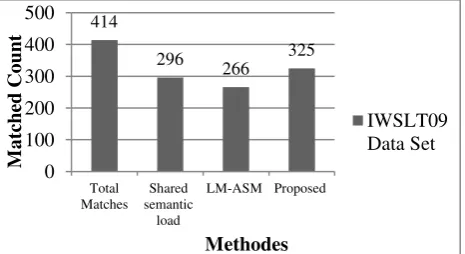
Now, to evaluate this work and compare it with other methods used by colleagues, the results of the presented method [21] called LM-ASM and data set are used which are among the newest methods in the field of matching algorithm. Thus, to evaluate the method, the data set of the existing algorithm [21] called IWSLT09 was used. It was also implemented on the algorithm performed by other colleagues [9] called shared semantic load, and the results were compared to the results of LM-ASM method. The figure 4 shows the result of this evaluation. The underlying reason for using LM-ASM, in addition to its strength, is the availability of the dataset, because despite much effort, we were unable to obtain a good dataset in the field of EBMT matching phase.
Fig.4.The results are consistent with the proposed method in terms of comparisons with other methods on the dataset
IWSLT09
After observing and evaluating the results, the dataset and matched sentences obtained in the method were manually analyzed. The analysis of the sentences revealed
414
296 266
325
0 100 200 300 400 500
Total Matches
Shared semantic
load
LM-ASM Proposed
M
a
tched
Co
un
t
Methodes
Copyright © 2015 IJECCE, All right reserved 138
that the proposed method has in some occasions considered some sentences as the most similar ones which are by far better than the sentence determined in the dataset reference file or at least both sentences could be considered as the most similar. For example, take the input sentence "It is August fifteenth" in the dataset. Consider the matched sentence in the data set which is "July fifteenth", while in our method the sentence "it is the fifteenth of August" is extracted from the dataset as the most semantically and structurally similar sentence. Table 4 shows another example of this. Thus, errors in the dataset should be seen as external factors affecting the outcomes.
Table 4. Another example of errors in the dataset IWSLT09
Sentences
could you send this to japan? Input Sentence
could you send it to japan? Selected in
IWSLT09
could you send these to japan? Selected by
proposed method
5.
C
ONCLUSIONIn this article, a new method was proposed based on genetic algorithm to match the input sentences with the example set sentences. The presented algorithm, unlike many methods is efficient on the simple as well as sentences with several clauses. The most important part of the present research is the fitness function of genetic algorithm which performs comparison based on the semantic proximity of two sentences and considering verbs as the heart of the sentence and extracts the most similar sentence to the input sentence. To approximate the inherent similarity of the sentences in the example set to the input sentence structurally and semantically, genetic algorithm is used to most optimally approximate the corpus sentence to the input sentence and consequently calculate a better value of similarity.
The stress placed on the verb as well as the special storage structure of the examples which defined an index on verbs of example sentences demonstrated a more precise behavior of proposed model compared to other standard retrieval methods.
The proposed matching process is based on partial order which provided a more faithful translation of the original text by selecting the most similar sentence in the corpus to the input sentence.
The results of evaluation show that prioritizing the verb for matching increases the accuracy of the matching method. This precision is twice as much as standard methods like Jaccard and Cosine.
R
EFERENCES[1] H. L. Somers, “New Paradigms in MT: The state of the play now
that the dust has settled”, 10th European Summer School in Logic,
Language and Information, Workshop on Machine Translation,
1998, pp. 22–33.
[2] M. Nagao, “A framework of a mechanical translation between
Japanese and English by analogy principle”, in Artificial and
Human Intelligence, North Holland, Amsterdam, 1984, pp. 173–
180.
[3] M. Kay, “The proper place of men and machines in language
translation”, Research Report CSL-80-11, Xerox Palo Alto
Research Center, Palo Alto, Calif., Reprinted in Machine
Translation,1997, vol.12, pp.3– 23.
[4] D. J. KIM, and H. W. KIM, “A Metric for Example Matching in Example-Based Machine Translation”, IEICE TRANS on
Fundamentals of Electronics, Communications and Computer
Sciences, 2006, Vol.E89–A, pp. 1713-1716.
[5] H. Somers, “Review Article: Example-based machine translation”,
Machine Translation, 1999, Vol. 14, pp. 113-157.
[6] P. D. Turney, and P. Pantel, “From Frequency to Meaning: Vector
Space Models of Semantics”, Artificial Inteligence Research, 2010, Vol. 37, pp. 141-188.
[7] L. Cranisa, H. Papageorgiou, and S. Piperidis, “A Matching
technique in Example Based Machine Translation”, Proceedings of the 15th conference on Computational linguistics, Kyoto, Japan, 1994, pp. 100-104.
[8] H. Papageorgiou, L. Cranias, and S. Piperidis “Automatic
Alignment in Parallel Corpora”, ACL '94 Proceedings of the 32nd
annual meeting on Association for Computational Linguistics,
1994, pp. 334-336.
[9] M. Mohamadi, and S. M. Fakhrahmad, “Effective estimation of context similarity: A proposed matching model based on weighted
semantic load”, International Journal of Artificial Intelligence &
Applications (IJAIA), 2012, pp. 1-10, Vol.3, No.3.
[10] J. J. Castillo, and M. E. Cardenas, “using sentence semantic similarity based on wordnet in recognizing textual entailment”,
iberamia'10 proceedings of the 12th ibero-american conference on advances in artificial intelligence, 2010, pp. 366-375.
[11] G. Somya, “A survey of Data Driven Machine Translation”, Center
for Indian Language Technology (CFILT), 2012.
[12] F. Mandreoli, R. Martoglia, and P. Tiberio, “A syntactic approach
for searching similarities within sentences”, Proceeding of International Conference on Information and Knowledge
Management, 2002, pp. 656–637.
[13] J. Shan, Z. Liu, and W. Zhou, "Sentence similarity measure based on events and content words", Fuzzy Systems and Knowledge
Discovery, Sixth International Conference, Tianjin, 2009, pp. 623–
627.
[14] L. Li, X. HU, B. Y. HU, J. Wang, and Y. M. Zhou, “Measuring sentence similarity from different aspects”, Proceedings of the eighth international conference on machine learning and cybernetics, baoding, 2009, P. 12-15.
[15] J. Jiang Jay, and W. Conrath David, “Semantic Similarity Based on
Corpus Statistics and Lexical Taxonomy”, In Proceedings of International Conference Research on Computational Linguistics
(ROCLING X), Taiwan, 1997, pp.19-33.
[16] X. Y. Liu, Y. M. Zhou, and R. S. Zheng, “Measuring Semantic
Similarity in WordNet”, Proc. 6th International Conference on
Machine Learning and Cybernetics, 2007, pp. 3431-3435.
[17] P. Koehn, “Europarl: a parallel corpus for statistical machine
translation” MT summit X, the tenth machine translation summit, 2005, pp.79-86.
[18] L. Yuntong, and L. Yanjun, “A sentence semantic similarity calculating method based on segmented semantic comparison”,
Journal of Theoretical and Applied Information Technology, 2013,
Vol. 48. No. 1, pp. 231 – 235.
[19] Z. Jinhua, Z. Jian, D. Haifeng, and W. Sunan, "Self-organizing genetic algorithm based tuning of PID controllers." Information
Sciences, 2008, pp.1007-1018.
[20] L. Ahrengerg, M. Merkel, A. S. Hein, and J. Tiedmann, “Evaluation
of word alignment systems” LREC2000, 2000, pp.1255-1261. [21] L. Johannes, G. Debasis, D. Sandipan, and G. J. F. Jones,
“Approximate Sentence Retrieval for Scalable and Efficient
Example-based Machine Translation”, Statistical Significance
Copyright © 2015 IJECCE, All right reserved 139
A
UTHOR’
SP
ROFILEReza Akbari
received his M.Sc. degree in Softwareof Computer Science and Engineering Department of Shiraz University. As one of his research interests, he focuses on Machine Translation especially Corpus-based Machine Translation. Also, he is co-author of several articles in Natural Language Processing and Evolutionary Algorithms area.
Mohammad Hadi Sadreddini
received hisB.Sc. degree in Computer Science, M.Sc. in Information Technology and PhD degree in Distributed Information Systems from the University of Ulster in UK, in 1985, 1986 and 1991, respectively. He has been working in the Department of Computer Science and Engineering at Shiraz University since 1993. His research interests include Natural Language Processing, Association Rules Mining, Bioinformatics, and Distributed Systems.