This is an open access journal, and articles are distributed under the terms of the Creative Commons Attribution-Non Commercial-ShareAlike 4.0 License, which allows others to remix, tweak, and build upon the work non-commercially, as long as appropriate credit is given and the new creations are licensed under the identical terms.
© 2019 Journal of Advanced Pharmacy Education & Research | Published by SPER Publication
34
Motivation sources study of pharmacy specialists within their
cooperation with the pharmacy
Valentin Tolochko, Tetiana Artiukh*, Mariya Zarichkova
Department of Management and Economics of Pharmacy, Institute of Pharmacy Professionals Qualification Improvement, National University of Pharmacy, Kharkov, Ukraine.
Correspondence:Tetiana Artiukh, Department of Management and Economics of Pharmacy, Zahysnykiv Ukrainy sq. 17, Kharkiv, Ukraine, 61001.
Email: art_tanya @ ukr.net
ABSTRACT
The purpose of the work is to determine the motivation sources of the pharmacy specialists within their cooperation with the pharmacy as a guarantee of creating a system of adaptive personnel management of the pharmacy. The search and systematization of various motivation sources is an actual attempt to find the ways to increase the productivity of a particular pharmacy specialist and pharmacy staff as a whole. The motivation questionnaire "Motivation Sources Inventory" has been proposed as a basis, which had been adapted based on the specific of activity in the pharmacy. Five modern motivation sources have been chosen, the study of which will allow to improve the personnel management system of pharmacy. The categorical distribution of the indicators based on motivation sources according to the pharmacy specialists’ length of service has been made. Group integral indicators for each source for individual groups of respondents have been calculated. The integrated group profiles of pharmacy specialists’ motivation sources have been organized according to their length of service. Thus, internal motivation - is the most important motivation sources for the category of young pharmacy specialists who work for a short period of time (up to 5 years). Instrumental motivation plays the main role for motivation in the group of up to 5 years and the “external concept “I” (J3) has a big priority for pharmacy specialists with length of service of up to 10 years. The obtained results indicate the prospects of using further study to improve the system personnel management through the development and further introduction of technologies for managing the pharmacy specialist motivational profile, taking into account their indicators and orientation of the motivation sources.
Keywords: pharmacy specialists, pharmacy, motivation, adaptation.
Introduction
The functioning of a modern Pharmacy in conditions of economic, political and legislative reforms in pharmacy is impossible without modernizing the methods of personnel management, finding a creative, innovative approach of decision making, nonstandard view of a problem and without moving beyond the already known methods of work. Such an approach requires the expansion of the horizons to manage the system of specialists’ motivation in pharmacy, as an integral part in
shaping and correcting the organizational culture of the institution from the point of view of adaptive personnel management in the rapidly changing conditions of the European integration [1-6].
Considering the fact that the management of motivation is complicated by the uncertainty and unpredictability of the pharmacy specialists motives of behavior, the variability of their motivational factors depending on the particular situation, the variety of motivational structures and the availability of lots of ways and means to meet the particular need of the pharmacy specialists and the specifics of the pharmacy specialists’ occupation, the search and systematization of various motivation sources is an actual attempt to find the ways to increase the productivity of a particular pharmacy specialist and Pharmacy staff as a whole [7-9]. The study of motivation sources
will permit pharmacy managers to make the pharmacy specialists "motivational card", taking into account the specific situation and the mental or cultural features of a particular employee: all motivation sources and degree of their expression
Access this article online
Website: www.japer.in E-ISSN: 2249-3379
How to cite this article: Valentin Tolochko, Tetiana Artiukh, Mariya Zarichkova. Motivation sources study of pharmacy specialists within their cooperation with the pharmacy. J Adv Pharm Edu Res 2019;9(3):34-40.
Journal of Advanced Pharmacy Education & Research | Jul-Sep 2019 | Vol 9 | Issue 3 35
can be identified from each pharmacy specialist (as well as from a group of employees). In the future, the information obtained can be used to develop a set of measures to motivate the pharmacy specialists, as a basis for decision making to meet the requirements and stimulate the work. In addition, the identification of the motivation sources, and not the specific need or factor of the pharmacy specialist motivation, will allow the pharmacy management depending on the available funds, time, organizational culture, pharmacy development stage, and other factors to choose the most appropriate way to meet the needs of the same source of pharmacy specialist motivation [10-13].
At various times a lot of scientists paid sufficient attention to the study of certain aspects of personnel management in pharmacy, in particular, the analysis of the pharmacy specialist motivation, the pharmacy specialist socio-psychological characteristics, their competencies and the organization of work, etc. [14-19].
However, it is necessary to note the dynamism of such a category as the pharmacy specialist motivation, the modern version of which is formed under the influence of globalization and the integration of the latest information space, and the transience of changeable socio-cultural features of society and the circumstances of the modern market functioning to which the pharmacy specialist must adapt. It is the present source, which form the system of pharmacy specialist motivation in pharmacy, remain unascertained and require to be researched
[20-23].
In addition, taking into account the influence of various factors (age of pharmacy employees and the peculiarities of their value system, cultural and educational level, moral qualities, competencies, gender, status, orientation, awareness, etc.) on the formation of specific needs of the pharmacy specialists; the creation of motivation profiles of the pharmacy specialist according to certain groups is actual, and until now remains an unresolved issue.
The above defined purpose of the work was to determine the pharmacy specialist motivation sources within their cooperation with the pharmacy and creation of the profiles of pharmacy specialist motivation sources.
Materials and Methods
Modern methods of study were used to achieve the goal, including sociological methods, analytical analysis, logical, typological grouping and comparison [24]. All statistical
calculations were performed using StatSoft's statistical package Inc. (2014). The motivation questionnaire "Motivation Sources Inventory" – MSI, by the authors - John Barbuto and Richard Scholl, was used as a basis and adapted to determine the pharmacy specialist motivation sources, taking into account the specifics of their occupation [25]. Thus, the authors of the
questionnaire proposed to use the informative model of motivation within "human-organization" relationship, which played a key role in choosing research methods in the framework of establishing the cooperation of pharmacy
specialists with the pharmacy in the system of adaptive personnel management and improving the questionnaire in the form of a questionnaire.
Thus, 1940 pharmacy specialist’ questionnaires were processed by a personal study of the pharmacy specialist activities, which were representatives of 23 regions of Ukraine. In particular, the research has been conducted in Kharkiv - 39.17%, Poltava - 23.20%, Vinnytsia - 6.21%, Chernihiv - 5.27%, Luhansk - 3.79%, Kiev - 2.49%, Sumy – 2.49%, Odessa - 2.19%, Donetsk - 2.19%, Kirovohrad - 2.01%, Volyn - 1.78%, Chernovtsy - 1.72%, Rivne - 1.60%, Zhytomyr - 1 42%, Dnipropetrovsk - 0.95%, Crimea - 0.89%, Cherkasy - 0.77%, Transcarpathian - 0.48%, Mykolaiv - 0.47%, Ternopil - 0.36%, Lviv - 0 36%, Zaporozhye - 0.36%, and Ivano-Frankivsk - 0.18% areas. Thus, sociological survey covered almost all of Ukraine. The largest number of the pharmacy specialists, whose work was investigated, is from the eastern region (44.38%) and the lowest number represents the southern region (3.40%). For convenience, the results were grouped by geographic region (Table 1).
Table 1. Categorical distribution of respondents by geographic region
Geographic region % Eastern
Northern Central Southern Western
44,38 13,30 33,56 3,40 5,36
Figure 1.Categorical distribution of respondents by the general length of services in the specialty and length of services
from the last place of employment.
36 Journal of Advanced Pharmacy Education & Research | Jul-Sep 2019 | Vol 9 | Issue 3 categorical distribution of respondents made it possible to
determine the differences between sources of PS motivation and to show their expression depending on their length of service.
Results and Discussion
Given that motivation is a dynamic phenomenon, the questionnaire is focused on the main motivation sources as the fundamental personal entities of the pharmacy specialist. A total of five such sources were selected for analysis, the study of which will improve the personnel management system of pharmacy through motivation.
1. Internal processes: the desire to get pleasure from the
process.
2. Instrumental motivation: the desire to get the external
rewards (surcharges, bonuses, social guarantees, benefits, etc.).
3. The external concept of “I”: the desire that your own
features, competencies and values will be accepted and supported by other employees, the reference group and the staff of the pharmacy as a whole.
4. The internal concept of “I”: the pharmacy specialists’ desire
to comply with their own standards of features, competencies and values.
5. Internalization of the goal: the pharmacy specialist desire
to achieve the goals corresponding to their internal values.
The questionnaire structure contains all motivation sources in order to determine the expression of each of them in the pharmacy specialist’ individual motivational profile, and their tension in the overall motivation balance. The internal filling of the questionnaire in form of questions has been composed according to each category (six questions in each). In total, the pharmacy specialists have answered to 30 questions of the questionnaire. It was suggested to answer on a seven-point scale for each point from "-3" to "3" (Fig. 2).
Figure 2. The scale for pharmacy specialists’ answers analyzing.
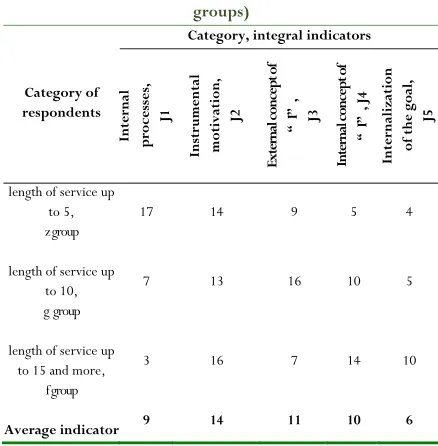
Individual indicators have been calculated for each source to summarize the results of the first study stage. It should be noted that both positive and negative values are possible for each motivation source. At the next stage, the group integrated indicators for each source for individual groups of respondents have been calculated: for young pharmacy specialists up to 5 years, up to 10 years and for experienced pharmacy specialists (up to 15 years and over). According to the study results, the following data were obtained (Table 2).
Table 2. Distribution of integral indicators of motivation sources for respondents with different length of service (by
groups)
Category of respondents
Category, integral indicators
Int er na l pr oce sses, J1 In stru me ntal m otivation, J2 Ex te rn al c onc ep t of “I ” , J3 Inte rnal c onc ept o f “I ”, J 4 In tern al izat ion of the goal, J5
length of service up to 5, z group
17 14 9 5 4
length of service up to 10, g group
7 13 16 10 5
length of service up to 15 and more,
f group
3 16 7 14 10
Average indicator 9 14 11 10 6
As can be seen from Table 2, the group integral indicators of motivation sources (J1 - J5) vary considerably depending on the respondents’ length of service. Thus, group J1 - internal motivation, is the most important motivation source for the category of young pharmacy specialists who work for a short period of time - up to 5 years (the group integral indicator was by far the highest score among other motivation sources with figure being 17). The above-mentioned motivation source involves the desire to get pleasure from the processes. Such a choice of motivation is not accidental, since the impact of modern worldview and technology on young pharmacy specialists is significant, and it is reflected in their desire to find an interesting job, to communicate, to improve their activity with the help of information technologies, various gadgets, the capabilities of the internet, since this is the generation that has grown and raised in the current conditions and with many opportunities, among which, in particular, there is the possibility of having an internship abroad and gaining practical experience and knowledge [26-28]. The above-mentioned
Journal of Advanced Pharmacy Education & Research | Jul-Sep 2019 | Vol 9 | Issue 3 37 30]. The “external concept “I” (J3) - 9 takes the third place, and
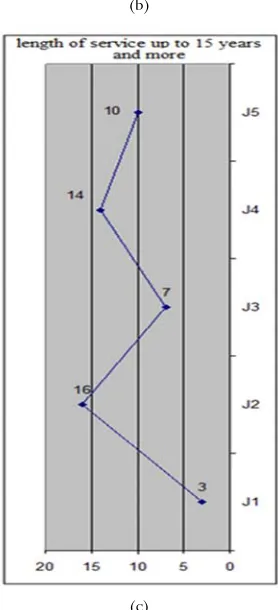
it is characterized by the desire that your own personal features, competencies and values will be accepted and supported by other employees, the reference group and the staff of the pharmacy as a whole. As for “Internal concept of “I” - J4 and “Internalization of the goal” - J5, both have similar figures: 5 and 4 respectively. According to the results of the study, integrated group motivational profiles of the pharmacy specialists have been compiled according to the length of service (Fig. 3).
(a)
(b)
(c)
Figure 3 (a, b, c).Integrated group profiles of pharmacy specialist’ motivation sources according to their length of
service.
38 Journal of Advanced Pharmacy Education & Research | Jul-Sep 2019 | Vol 9 | Issue 3 Comparison of motivation sources among different categories of
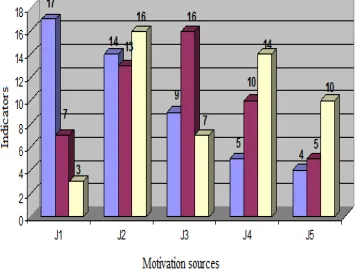
pharmacy specialists is presented in Fig.4.
Figure 4.Comparison of sources of motivation among different pharmacy specialists.
As can be seen from Fig. 4, “the desire to receive satisfaction from the processes” has the lowest value for the pharmacy specialists with a length of service of up to 10 years (3). In the group of up to 5 years, the indicator of the motivation source is – 17 and it is significantly higher, which is explained by the enthusiasm and desire of young pharmacy specialists to learn new information, gain experience, etc. This is due to the high degree of awareness of the importance to fulfill the duties and the desire to focus on the results of their work, the desire to hold down the workplace no matter what.
On the basis of the conducted research, given the identified motivation sources inherent in each of the pharmacy specialist categories the following recommendations can be defined. Thus, in order to meet the needs of the instrumental motivation source, most managers see a way out only in material incentives - financial surcharges, taking into account the general socio-economic status of the country as a whole and the financial situation of the pharmacy specialists. This is especially evident in the underdeveloped regions and villages or, conversely, in the regions with a high level of competitiveness in the labor market among the pharmacy specialists, (especially where the National University of Pharmacy and pharmaceutical faculties with a significant number of graduates are located). Thus, there is an imbalance between the salary level of the pharmacy specialists from different regions (according to the statistics of the State Statistics Committee and the data analysis of job seeking websites), which creates a wide range for management to use the indicated incentive [19, 24]. However, the falsity of such
opinion should be mentioned: the presence of a psychological aspect from the use of this type of stimulus, and short-term effect due to the quick addiction to the availability of a certain number of financial payments. That is, having received a surcharge or a bonus, or a wage increase, at first the pharmacy specialist may feel a stimulus that will last at best three months, and then the pharmacy specialist will wait for the next increase, and sometimes to receive such an increase as an undeniable
right to a decent pay for their work. In this case, incentives will not occur, as opposed using a non-material motivation that is perceived by the pharmacy specialist as an award. Moreover, according to research by M. Armstrong, money alone does not stimulate better work, although its lack can be a very serious demotivating factor [29, 30]. That is, increasing wages does not
guarantee that the employee will work better and better, however, if he feels that his salary is too low, then the productivity of his labor can significantly decrease. That is why the best option is to focus on the “The External Concept of “I” and "The Inner Concept of “I” sources of motivation to meet these particular needs of the pharmacy specialist.
Conclusion
It is established that today the socio-cultural features of the development of society, the circumstances of the functioning of the modern market, as well as the level of globalization and integration in modern society have a significant influence on the pharmacy specialist’ motivation.
The motivation questionnaire "Motivation Sources Inventory" (MSI), by the authors John Barbuto and Richard Scholl, has been proposed to use as the best informative motivation model within the relationship between pharmacy specialist and Pharmacy and has been adopted according to the specifics of the activity in the pharmacy.
The categorical distribution of indicators based on motivation sources according to the length of service of the pharmacy specialist has been carried out. The group integral indicators for each source for individual groups of respondents have been calculated. The integrated group profiles of pharmacy specialist’ motivation sources have been formed according to their length of service. Recommendations on stimulating the pharmacy specialist by motivation sources have been given.
Group J1 - internal motivation, is the most important motivation sources for the category of young pharmacy specialists who work for a short period of time - up to 5 years (the group integral indicator was by far the highest score among other motivation sources with figure being 17). J2 - instrumental motivation ranks the second place for young pharmacy specialists who work for a short period of time (up to 5 years among the motivation sources). The “external concept “I” (J3) - 9 takes the third place. The indicator of categories J2 for pharmacy specialists with length of service up to 10 years is 13 in comparison with the indicator of categories J2 for pharmacy specialists with length of service over 15 years – 16. “The desire to receive satisfaction from the processes” has the lowest value for the pharmacy specialists with a length of service of up to 10 years (3) in comparison with the indicator of the motivation source in the group of up to 5 years, where it is 17.
Journal of Advanced Pharmacy Education & Research | Jul-Sep 2019 | Vol 9 | Issue 3 39
profile, taking into account their indicators and orientation of the motivation sources.
Conflict of interest
The authors declare that they do not have a conflict of interest to disclose.
References
1. Adler NJ, Ghada F. Strategic human resource management: a global perspective. San Yat-Sen Management Review. 1993; 11(1): 1–39. Available
from: URL: http://mgtr.cm.nsysu.edu.tw/Upload/Journal/87/010
11/633621863076562500.pdf
2. Broeck A, Vansteenkiste M, Witte H, Soenens B, Lens W. Capturing autonomy, competence, and relatedness at work: Construction and initial validation of the work-related basic need satisfaction scale. Journal of Occupational and Organizational Psychology. 2010; 83(4): 981–1002.
3. Hawthorne N, Anderson C. The global pharmacy workforce: A systematic review of the literature. Hum Resour Health. 2009;7(1):48. Available from: URL: https://doi: 10.1186/1478-4491-7-48
4. Parvin MM, Kabir MN. Factors affecting employee job satisfaction of pharmaceutical sector. Australian Journal of Business and Management Research. 2011;1(9):113. 5. Pavitra Dhamija, Shivam Gupta, Surajit Bag. Measuring
of job satisfaction: the use of quality of work life factors. Benchmarking: An International Journal/. 2019; 26(3): 871-892. Available from: URL: https://doi.org/10.1108/BIJ-06-2018-0155
6. Rodrigues VF, Ribeiro MI, Pinto IC. Work satisfaction within community pharmacy professionals. Adv Pharmacol Pharm. 2014; 2: 6-12. Available from: URL: https://doi: 10.13189/app.2014.020102
7. Atkinson JW, Raynor JO. Motivation and achievement. Washington: DC. 1974: 121 - 59.
8. Baumeister R F, Leary MR. The need to belong: Desire for interpersonal attachments as a fundamental human motivation. Psychological Bulletin. 1995; 117(3): 497– 529.
9. Carvajal MJ, Popovici I. Gender, age, and pharmacists’ job satisfaction. Pharmacy Practice. 2018 Oct-Dec; 16(4): 1396. Available from: URL: https://doi.org/10.18549/PharmPract.2018.04.1396 10.Bender KA, Heywood JS. Job satisfaction of the highly
educated: The role of gender, academic tenure, and earnings. Scot J Polit Econ. 2006; 53(2): 253-279. Available from: URL: https://doi: 10.1111/j.1467-9485.2006.00379.
11.Hamermesh DS. The changing distribution of job satisfaction. J Hum Resour. 2001; 36(1): 1-30.
12.Janssen O, Van Yperen NW. Employees’ goal orientations, the quality of leader-member exchange, and
the outcomes of job performance and job satisfaction. Academy of Management Journal. 2004; 47(3): 368– 384.
13.Seston E, Hassell K, Ferguson J, Hann M. Exploring the relationship between pharmacists' job satisfaction, intention to quit the profession, and actual quitting. Res Social Adm Pharm. 2009; 5(2): 121-132. Available from: URL: https://doi: 10.1016/j.sapharm.2008.08.002 14.Aziri B. Job satisfaction: A literature review.
Management Research and Practice. 2011; 3(4): 77–86. Available from: URL: http://mrp.ase.ro/no34/f7.pdf 15.Huczynski A, Buchanan D. Organizational behaviour.
London. Prentice Hall. 1991.
16.Ryan RM, Deci EL. Self-determination theory: Basic psychological needs in motivation, development, and wellness. New York: Guilford Publications Press. 2017. 17.Sheldon KM, Gunz A. Psychological needs as basic
motives, not just experiential requirements. Journal of Personality. 2009; 77(5): 1467–1492.
18.Sonnentag S. Dynamics of well-being. Annual Review of Organizational Psychology and Organizational Behaviour. 2015; 2(1): 261–293.
19.Van Yperen NW, Orehek E. Achievement goals in the workplace: Conceptualization, prevalence, profiles, and outcomes. Journal of Economic Psychology. 2013; 38: 71–79.
20.Vancouver JB. Living systems theory as a paradigm for organizational behavior: Understanding humans, organizations, and social processes. Behavioral Science. 1996; 41(3): 165–204.
21.Vansteenkiste M, Neyrinck B, Niemiec CP, Soenens B, Witte H, Broeck A. On the relations among work value orientations, psychological need satisfaction and job outcomes: A self-determination theory approach. Journal of Occupational and Organizational Psychology. 2007; 80(2): 251–277.
22.Vansteenkiste M, Soenens B, Duriez B. Presenting a positive alternative to strivings for material success and the thin-ideal: Understanding the effects of extrinsic relative to intrinsic goal pursuits. Positive Psychology: Exploring the Best in People. 2008; 4: 57–86.
23.Williams GC, Hedberg VA, Cox EM, Deci EL. Extrinsic life goals and health-risk behaviors in adolescents 1. Journal of Applied Social Psychology. 2000; 30(8): 1756–1771.
24.Peacock J, Peacock Ph. Handbook of Medical Statistics. Oxford University Press. 2011. Available from: URL: http://oxfordmedicine.com/view/10.1093/med/9780 199551286.001.0001/med-9780199551286
40 Journal of Advanced Pharmacy Education & Research | Jul-Sep 2019 | Vol 9 | Issue 3 26.Hamermesh DS. The changing distribution of job
satisfaction. J Hum Resour. 2001; 36(1): 1-30. 27.Landry AT, Kindlein J, Trépanier S, Forest J, Zigarmi D,
Houson D, Brodbeck FC. Why individuals want money is what matters: Using self-determination theory to explain the differential relationship between motives for making money and employee psychological health. Motivation and Emotion. 2016; 40(2): 226–242.
28.Li Y. Can pursuit for material bring us happiness and well-being? Studies on materialistic values and its effects.
Journal of Beijing University of Technology (Social Science Edition). 2015; 15(4): 7–12.
29.Armstrong MA. TAYLOR S. Armstrong’s handbook of personnel management practice. London: Kogan Page. 13th edition. 2013.