This is an open access journal, and articles are distributed under the terms of the Creative Commons Attribution-Non Commercial-ShareAlike 4.0 License, which allows others to remix, tweak, and build upon the work non-commercially, as long as appropriate credit is given and the new creations are licensed under the identical terms.
© 2019 Journal of Advanced Pharmacy Education & Research | Published by SPER Publication
82
Can lumbar proprioception Predict Hamstring Strain in Soccer
Players?
Khaled Afifi
1, Alaa Eldin Abdel-Hakim Balbaa
1, Emad Samuel Boles Saweeres
21 Department of Physical Therapy for Musculoskeletal Disorders and Its Surgery, Faculty of Physical Therapy, Cairo University, Cairo, Egypt. 2 Assistant Professor and Orthopaedic Consultant, El-Sahel Teaching Hospital, Cairo, Egypt.
Correspondence:Khaled Afifi. Department of Physical Therapy for Musculoskeletal Disorders and Its Surgery, Faculty of Physical Therapy, Cairo University, Cairo, Egypt. Email: Khalednabil789 @ yahoo.com.
ABSTRACT
Background: Although there is growing knowledge about hamstring muscle injuries in athletes over the last 30 years, acute and recurrent injuries are still common. Due to the high incidence, recurrence rate and time lost from competitions, risk factors for the initial injury have been investigated retrospectively and prospectively. There is small evidence that core stability can minimize the risk of recurrence of hamstring strain injury and that it might be a risk factor for lower limb joints and muscles injures. However, core stability is a continuum from power, strength, endurance and sensory-motor control. It has been a question which is the most important core stability component or exercises in treatment, rehabilitation or prevention of hamstring strain. Lumbar spine proprioception, a component of core stability, has been prospectively studied as a risk factor for knee injuries in female athletes. The results showed a correlation between impaired lumbar spine proprioception and knee injuries. However, it has not been investigated before as a risk factor for hamstring strain. Objective: to investigate lumbar spine proprioception as a risk factors for hamstring muscle strain in soccer players. Study design: prospective cohort study. Methods: lumbar spine proprioception was measured by the absolute value of error in active repositioning to a target angle (30˚ flexion) in soccer players who were prospectively followed up for one year
for incidence of hamstring strain. Results: forty two soccer players participated in the study. During the follow up period, 6 players developed hamstring strain injury while 36 players did not develop any injury. the mean age was 22 (±4.97); the mean height was 1.76 (±0.056); mean weight was 72.5 (±12.11); and mean body mass index (BMI) was 23.29 (±2.5). the mean age was 21.63 (±3.01); the mean height was 1.76 (±0.063); the mean weight was 70.23 (±7.98); and the mean BMI was 22.6 (±1.81).
Comparisons between the injured and non-injured players did not show any differences in lumbar proprioception. For RE the mean
value for the injured group was 3.44˚ (±1.79) while the mean value for the non-injured group was 4.39˚ (±4.28) (P-value = 0.365, 95% CI =-3.115-1.208). Conclusion: The current study showed that – as one component of core stability - lumbar spine proprioception is not a risk factor for hamstring strain injuries.
Keywords:Low back pain, etiology -low back pain, proprioception - etiology and exercises therapies- therapy and hamstring muscle- etiology and hamstring muscle injury - diagnosis and muscle, hamstring.
Introduction
Hamstrings strain (HS) is a common injury in soccer players [1]. Strain injuries are characterized by an observable disruption of the musculoten dinous junction [2], followed by post injury remodeling that includes scar tissue formation and muscle
regeneration [3]. The injury can cause an athlete to miss a few days to a few weeks of sport [4]. Moreover, this injury has a high recurrence rate, with approximately one in three athletes being reinjured within a year of returning to sport [5]. Taking into account the prevalence of hamstring strain injuries, the sports medicine field is challenged by the need to develop preventing strategies for the initial injury and appropriate rehabilitation to prevent potential recurrence [4].
Many predisposing factors for hamstring strain have been suggested in the literature, including insufficient warm up [6], poor flexibility [7], muscle imbalances, muscle weakness [4], neural tension [8], fatigue [7] and previous injury [9]. The role of these predisposing factors in causing hamstring strain is still contradictory with minimal supporting evidence available [10]. To date, in spite of the great number of possible risk factors,
Access this article online
Website: www.japer.in E-ISSN: 2249-3379
How to cite this article: Khaled Afifi, Alaa Eldin Abdel-Hakim Balbaa,
Emad Samuel Boles Saweeres. Can lumbar proprioception Predict Hamstring Strain in Soccer Players?. J Adv Pharm Edu Res 2019;9(1):82-87.
only a few of them have been scientifically proven to be associated with that injury, while other potential factors have been simply suggested as being involved to some extent and need further investigation [4].
Core stability is a continuum from power, strength, endurance and sensory- motor control of the lumbo-pelvic hip complex musculature [11]. It has been suggested that injury occur when deficits in one of these components affect the spine stability before and during activities [11-13]. Blaiser et al., (2017) reported that there is a conflicting evidence about the lumbar proprioception as a risk factor for lower extremities injuries [14]. Perrott et al., (2013) stated that there is some evidence that core stability can reduce the risk for lower limb muscle strain [15]. Pasanen et al., (2008) found that neuromuscular training was effective in reducing the lower limb muscle injuries in female floor ball players [16]. In addition to this, a progressive agility and trunk stabilization was effective in reducing the rate of recurrence of HS [17, 18], however, these two studies did not assess or measure any component of core stability [19].
The exact role of core muscles stability as a risk factor predisposing to hamstrings injury is still unclear [19]. It has been a question as to which is the most important core stability component or exercises in treatment, rehabilitation or prevention of hamstring strain. Therefore, the aim of this study was to answer the research question: can lumbar proprioception measured by repositioning error predict hamstring strain in soccer players.
Materials and Methods:
This prospective cohort study was conducted for the Faculty of Physical Therapy Cairo University, but the measurements conducted at the isokinetic laboratory of the Army Rehabilitation Centre, Cairo, Egypt.
1. Subjects:
Fifty nine normal subjects were interviewed and screened based on the following inclusion and exclusion criteria:
Inclusion criteria:
1) Age ranges from 18 to 37 years old.
2) Professional players who trained regularly and are physically fit to participate in soccer games.
3) Have successfully completed the previous playing season as a healthy player.
Exclusion criteria:
1) Any previous musculoskeletal injury or surgical intervention that prevented the athlete from participating in the previous season such as fracture or ACL injury.
2) The occurrence of any other musculoskeletal dysfunction or injury during soccer season playing.
2. Instrumentation:
• Cybex Isokinetic Trunk Extension Flexion Device
(Model 6000; Cybex-Lumex Inc., Ronkonkoma,
NY) was used to measure the lumbar repetition error (RE).
• Post-season hamstring injury evaluation form (Appendix I).
Procedures:
The subjects were recruited by formally contacting the football club doctor. The subjects were initially checked for any exclusion criteria. Then, the purpose of the study was explained and they were asked to sign the experiment consent form. After that, participants’ demographic data (weight in Kg
and height in meter) was recorded on an Excel spreadsheet (v.12.0.6739.5000) SP3 MSO, Microsoft Corporation, Redmond, WA, USA).
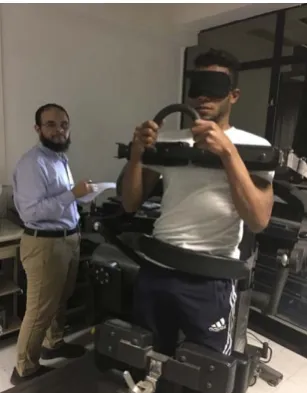
Then, the RE was measured using Isokinetic Trunk Extension Flexion Device (figure 1). The manufacturer’s instructions
were followed to put the participants on the trunk unit. The subject stood on the foot plate with his foot in the heel cups. The foot plate height was adjusted so that the rubber plate is opposite L5/S1. The thigh stabilizer height was adjusted to be on the level of the patella. The waist and chest belt is pulled tightly to stabilize the patient. Black sleeping eye mask was used to isolate the eyes’ contribution to the trunk proprioception. The tested range of motion was 0˚ to 30˚
flexion [20, 21]. The procedures started by three trials to insure that the subject understood the procedure. Then, the average of three trials was calculated. The author chose three trials to eliminate the training effect. RE was calculated as the absolute difference between the target angle and the reproduced angle by the subject [22].
All statistical analyses were done using the SPSS version 21.0
(IBM Inc., Chicago, IL) with the p-value set at < 0.05.
Ethical approval was obtained by the Research Ethics Committee of the Faculty of Physical Therapy, Cairo University, Egypt.
Results:
Participants:
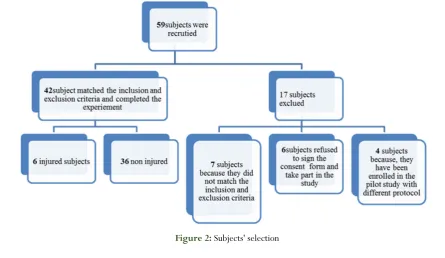
Fifty nine subjects were recruited for the experiment, however
only 42 subjects completed the experiment (figure 2). The base line characteristics of subjects are shown in (table 1).
Figure 2: Subjects' selection
The outcome measures:
Comparisons between the injured and non-injured players’ groups were done using un-paired t-test (table 2). For RE the mean value for the injured group was 3.44 (±1.79) while the
mean value for the non-injured group was 4.39 (±4.28).
Results did not show any differences between the two groups (P-value = 0.365, 95% CI =-3.115-1.208)(Table 2, Figure 3).
Table 2: Repositioning error in both groups Mean (±SD) and p-value.
Injured group Non injured group p-value
Repositioning error 3.44(±1.79) 4.39 (±4.28) 0.365
Figure 3:mean repositioning error.
Discussion
The purpose of this study was to answer the question: can lumbar proprioception predict hamstring strain in soccer players? The results of the current study showed that lumbar spine proprioception cannot predict the incidence of HS in soccer players. To the best of the author’s knowledge this is the first prospective study to investigate lumbar spine proprioception as a risk factor for HS.
Core stability has been widely used for treatment, improving performance and prevention of injury [23]. However, this widespread use is based on strong theoretical foundation [24, 25] rather than an evidence based research [26]. The components of core stability are strength, endurance, flexibility, motor Table 1: Groups base line characteristics and comparison.
P-value was tested at confidence interval=95% (CI=95%). BMI: body mass index
injured group
Mean (±SD)
Non- injured group
Mean (±SD)
P- value CI=95%
Number 6 36
Age 22(±4.97) 21.63(±3.01) 0.807
Height (meter) 1.76(±0.056) 1.76(±0.063) 0.960
Weight (kg) 72.5(±12.11) 70.23(±7.98) 0.554
control and function [27]. Core proprioception has been investigated as a risk factor for lower limb injuries in one study [28] which was conducted to investigate the effects of core proprioception on knee injuries. The results showed that lumbar spine proprioception cannot predict HS injury in soccer players.
Trunk muscles are believed to play a crucial role in stiffening the spine in order to provide a foundation for functional movements [24]. Moreover, trunk muscles coactivation is important in providing dynamic trunk stability that protects the spine by attenuating sudden forces that contribute to low back and lower extremity pain and injury [29]. The dynamic stability is also influenced by the gluteal muscles, trunk and lower extremity fascial systems which is closely associated with the regulation of trunk and extremity posture, muscular biomechanics, motor control, and proprioception [26].
Proprioception is the complex interaction between sensory afferent receptors and motor efferent response in order to regulate the position and movement in space [22]. RE is the measure of proprioception deficit in the lumbar spine and it includes a reproduction of a target angle [30]. The subject can be asked to reproduce the angle actively (active joint repositioning sense) or passively (passive joint repositioning sense) the former is the most commonly used in literature [31] and have been used in the current study. The possible explanation for the non-significant relation between lumbar
spine proprioception and HS in the current study; the testing position (standing position) [28], participants age [30], the examination angle did not challenge the proprioception enough [22], small sample size [30, 32], low number of injured athletes and the movement direction [27]-lumbar flexion- was only examined.
Only one prospective study with good methodological quality [28] investigated the lumbar proprioception as a risk factor for
low back pain (LBP) in athletes [30]. The results showed that there was no correlation between active trunk repositioning and LBP in athletes [30]. RE was larger in patients with nonspecific chronic LBP [27] the authors recommended that these results must be interpreted with caution due to methodological flaw such as the low power, precision, variable injury definition, different definition of the outcome measures and the patients selection [27]. Tong, et al (2017) reached a more precise conclusion about the relation between lumbar spine proprioception and RE. They stated that the patient position and the methods of measuring RE has a crucial role in assessing the proprioception [31]. LBP patients have deficits in the lumbar spine proprioception when measured in sitting position by either active joint repositioning sense or threshold to detection of passive motion [31]. In accordance with the results of the current study [31], seven studies measured proprioception in standing position did not report a correlation between LBP and proprioception [31]. This might be explained by the fact that the proprioception input from the lower limb, cutaneous sensation and vestibular input have been influencing the trunk proprioception [22]. However, Silfies et al., (2007) used a special technique which examined the lumbar spine
proprioception only without influence from the lower extremities or vestibular system which showed that there is no proprioception deficits in young college athletes and proprioception deficits was not a risk factor for LBP in college athletes. The authors think that the absence of correlation was due to the young age of participants [33].
On the other hand, Kim et al., (2015) reported that core stability training improved the lumbar spine proprioception in female office worker [33]. Proprioception training has been proven as an effective injury prevention method in soccer [34] and in youth from different sports. It helped with reducing lower extremities injuries [34]. However, it must be implemented probably and should be used with other modalities [34].
The current study has several limitations: firstly, the follow up was done after one year not on regular intervals [17] which might affect the accurate reporting of injured subjects. Secondly, the few number of injured players did not help to reach a firm conclusion about lumbar spine proprioception as a risk factor for HS.
Conclusion
Core stability has been widely used in injury prevention and rehabilitation however, the evidence about its effectiveness is lacking. The current study showed that lumbar spine proprioception as one component of core stability is not a risk factor for hamstrings muscle strain in soccer players. Further studies including a comprehensive test battery to examine multiple components of core stability and with larger sample size are recommended.
Acknowledgements
Special thanking for Dr Rafek Radwan for helping with isokinetic lab.
Conflicts of Interest:
There is no conflict of interest directly relevant to this study.
Post-season hamstring injury evaluation
form (Appendix I)
[34]• Player’s age and position.
• Leg dominance: dominant limb is identified by the predominant foot used for kicking a ball.
• Injury time: during training or an actual playing game.
• Incidence of Re-injury: recurrence of an injury of the same
nature and location involving the same player in the same season.
• Location of hamstring strain:
biceps femoris
unspecified
semimembranosus
Severity of injury
Slight: the player will be absent from training or competition
for 2-3 days.
Minor: the player will be absent from training or competition
for 4-7 days.
Moderate: the player will be absent from training or
competition for one to four weeks.
Major: the player will be absent from training or competition
for more than four weeks.
Radiographic findings (if present).
References
1. Schuermans J, Danneels L, Van Tiggelen D, Palmans T, Witvrouw E. Proximal Neuromuscular Control Protects Against Hamstring Injuries in Male Soccer Players: A Prospective Study With Electromyography Time-Series Analysis During Maximal Sprinting. Am J
Sports Med [Internet]. 2017;45(6):1315–25. Available from:
http://journals.sagepub.com/doi/10.1177/0363546 516687750
2. Koulouris G, Connell D. Hamstring muscle complex:
an imaging review. Radiographics. 2005;25(3):571– 86.
3. Kaariainen M, Jarvinen T, Jarvinen M, Rantanen J, Kalimo H. Relation between myofibers and connective tissue during muscle injury repair. Scand J Med Sci
Sport [Internet]. 2000;10(6):332–7. Available from:
http://doi.wiley.com/10.1034/j.1600-0838.2000.010006332.x
4. Liu H, Garrett WE, Moorman CT, Yu B. Injury rate, mechanism, and risk factors of hamstring strain injuries in sports: A review of the literature. J Sport Heal Sci
[Internet]. 2012;1(2):92–101. Available from: http://linkinghub.elsevier.com/retrieve/pii/S209525 4612000452
5. Orchard, J and Best T. The management of muscle strain injuries: an early return versus the risk of
recurrence. Clin J Sport Med. 2002;12(1):3–5. 6. Kujala UM, Orava S, Järvinen M. Hamstring injuries.
Current trends in treatment and prevention. Sports
Med. 1997;23(6):397–404.
7. Hoskins W, Pollard H. The management of hamstring injury - Part 1: Issues in diagnosis. Man Ther.
2005;10:96–107.
8. Turl SE, George KP. Adverse neural tension: a factor in repetitive hamstring strain? J Orthop Sports Phys
Ther [Internet]. 1998;27(1):16–21. Available from: http://www.jospt.org/doi/abs/10.2519/jospt.1998. 27.1.16#.Va_VpPntmkp
9. Opar DA, Williams MD, Shield AJ. Hamstring strain injuries: Factors that Lead to injury and re-Injury.
Sport Med. 2012;42(3):209–26.
10. Cibulka MT, Rose SJ, Delitto a, Sinacore DR. Hamstring muscle strain treated by mobilizing the
sacroiliac joint. Phys Ther. 1986;66:1220–3.
11. Rickman AM, Ambegaonkar JP, Cortes N. Core stability: implications for dance injuries. Med Probl
Perform Art [Internet]. 2012;27(3):159–64. Available from:
http://www.ncbi.nlm.nih.gov/pubmed/22983134 12. Borghuis J, Hof AL, Lemmink KAPM. The importance
of sensory-motor control in providing core stability: Implications for measurement and training. Sport Med.
2008;38(11):893–916.
13. Akuthota V, Ferreiro A, Moore T, Fredericson M. Core stability exercise principles. Curr Sports Med
Rep. 2008;7(1):39–44.
14. Blaiser C De, Roosen P, Willems T, Danneels L, Bossche L Vanden, Ridder R De. Is core stability a risk factor for lower extremity injuries in an athletic population? A systematic review. Phys Ther Sport
[Internet]. 2017; Available from:
http://dx.doi.org/10.1016/j.ptsp.2017.08.076 15. Perrott MA, Pizzari T, Cook J. Lumbopelvic exercise
reduces lower limb muscle strain injury in recreational
athletes. Phys Ther Rev [Internet]. 2013;18(1):24–33.
Available from: http://www.tandfonline.com/doi/full/10.1179/174
3288X12Y.0000000055
16. Pasanen, K, Parkkari, J, Pasanen, M, Hiiilloskorpi, H, Ma ¨kinen, T, Ja ¨rvinen, M and Kannus P. Neuromuscular training and the risk of leg injuries in female floorball players: cluster randomised controlled
study Kati. Bmj. 2008;337(7661):96–9.
17. Silder A, Sherry MA, Sanfilippo J, Tuite MJ, Hetzel SJ, Heiderscheit BC. Clinical and Morphological Changes Following 2 Rehabilitation Programs for Acute Hamstring Strain Injuries: A Randomized Clinical Trial. J Orthop Sport Phys Ther [Internet].
2013;43(5):284–99. Available from: http://www.jospt.org/doi/10.2519/jospt.2013.445
2
18. Sherry MA, Best TM. A Comparison of 2 Rehabilitation Programs in the Treatment of Acute Hamstring Strains. J Orthop Sport Phys Ther
[Internet]. 2004; 34(3):116–25. Available from: http://www.jospt.org/doi/10.2519/jospt.2004.34.3 .116
19. Shield AJ, Bourne MN. Hamstring Injury Prevention Practices in Elite Sport: Evidence for Eccentric Strength vs. Lumbo-Pelvic Training. Sport Med. 2017; 48(3):1–12
20. Bliss, L S an Teeple P. Core stability: the centerpiece
21. Parkhouse KL, Ball N. Influence of dynamic versus static core exercises on performance in field based fitness tests. J Bodyw Mov Ther [Internet]. 2011;
15(4):517–24. Available from: http://dx.doi.org/10.1016/j.jbmt.2010.12.001
22. Waldhelm A, Li L. Endurance tests are the most reliable core stability related measurements. J Sport
Heal Sci [Internet]. 2012;1(2):121–8. Available from: http://linkinghub.elsevier.com/retrieve/pii/S209525 461200049X
23. Zazulak BT, Hewett TE, Reeves NP, Goldberg B, Cholewicki J. The effects of core proprioception on knee injury: A prospective
biomechanical-epidemiological study (A). Am J Sports Med. 2007; 35(3):368–73.
24. Sherry M, Best T, Heiderscheit B. The core: Where are we and where are we going? Clin J Sport Med.
2005;15(1):1–2.
25. Hibbs AE, Thompson KG, French D, Wrigley A, Spears I. Optimizing Performance by Improving Core Stability and Core Strength. Sport Med [Internet].
2008; 38(12):995–1008. Available from:
http://link.springer.com/10.2165/00007256-200838120-00004
26. Stecco, C, Porzionato, A, Macchi, V, Tiengo, C, Parenti, A, Aldegheri, R, Delmas, V and De Caro R. A histological study of the deep fascia of the upper limb.
Int J Anat Embryol. 2006;111(2):1–6.
27. Osthoff A-KR, Ernst MJ, Rast F. M, Mauz D, Graf ES, Kool J and, et al. Measuring lumbar reposition accuracy in patients with unspecific low back pain: Systematic review and meta-analysis. Spine (Phila Pa
1976). 2015;40(2):E97–111.
28. Tong MH, Mousavi SJ, Kiers H, Ferreira P, Refshauge K and, van Dieën J. Is There a Relationship Between Lumbar Proprioception and Low Back Pain? A
Systematic Review with Meta-Analysis. Arch Phys Med
Rehabil. 2017;98(1):120–136.
29. Georgy EE. Lumbar repositioning accuracy as a measure of proprioception in patients with back dysfunction and healthy controls. Asian Spine J
[Internet]. 2011 Dec [cited 2016 Nov 23];5(4):201–7.
Available from: http://www.ncbi.nlm.nih.gov/pubmed/22164313.
30. Silfies SP, Cholewicki J, Reeves NP, Greene HS. Lumbar position sense and the risk of low back injuries in college athletes: a prospective cohort study. BMC Musculoskelet Disord [Internet]. 2007 Dec 31 [cited
2016 Nov 21]; 8(1):129. Available from:
http://bmcmusculoskeletdisord.biomedcentral.com/a rticles/10.1186/1471-2474-8-129
31. Chaudhari AMW, McKenzie CS, Pan X, Oñate JA. Lumbopelvic control and days missed because of injury in professional baseball pitchers. Am J Sports Med.
2014;42(11):2734–40.
32. Al Attar WSA, Soomro N, Pappas E, Sinclair PJ, Sanders RH. How Effective are F-MARC Injury Prevention Programs for Soccer Players? A Systematic Review and Meta-Analysis. Sport Med. 2016; 46(2):205–17.
33. Kim TH, Kim EH, Cho HY. The effects of the CORE programme on pain at rest, movement-induced and secondary pain, active range of motion, and proprioception in female office workers with chronic low back pain: A randomized controlled trial. Clin
Rehabil. 2015;29(7):653–62.
34. Woods, C., Hawkins, R. D., Maltby, S., Hulse, M., Thomas, A. and Hodson A. The Football Association medical Research Programme: an aduted of injuries in professional football analysis of hamstring injuries. Br J