This is an open access journal, and articles are distributed under the terms of the Creative Commons Attribution-Non Commercial-ShareAlike 4.0 License, which allows others to remix, tweak, and build upon the work non-commercially, as long as appropriate credit is given and the new creations are licensed under the identical terms.
© 2019 Journal of Advanced Pharmacy Education & Research | Published by SPER Publication
102
Restoration of motive function of the lower extremities using
virtual reality technique
A.V. Zakharov
1*,E.V. Khivintseva
1, V.F. Pytin
1, A.V. Kolsanov
1, V.A. Kalinin
1, M.A. Osadchuk
2, A.M.
Osadchuk
1, M.V. Trushin
31Samara State Medical University under the Ministry of Health of the Russian Federation, Department Neurology and Neurosurgery. Samara. Russia. 2The Federal State
Autonomous Education Institution of Higher Training The First Sechenov Moscow State Medical University under the Ministry of Health of the Russian Federation (Sechenovskiy University), Department of outpatient therapy. Moscow. Russia. 3Institute of Fundamental Medicine and Biology, Kazan Federal University, Kazan, Russia.
Correspondence:
A.V. Zakharov, Samara State Medical University under the Ministry of Health of the Russian Federation.
ABSTRACT
Objective: To study the efficiency of usage of immersive virtual reality with proprioceptive sensory effects for the rehabilitation of the static locomotor function of patients in the acute period of ischemic stroke. Material and methods: The study involved 33 patients in the acute period of ischemic stroke in the carotid system. The patients were randomized into two groups, the study group additionally received classes under immersive virtual reality with a sensory impact. The course consisted of 10 classes of 15 minutes each. Results. According to the Berg balance scale, on the 6th day of classes (p = 0.03), an improvement in the static-locomotor function was detected in the study group. On the last day of the rehabilitation course, the patients from the group subjected to the course demonstrated an improvement in the static locomotor function by 23 points (95% CI 13-27 points) in the study population and by 7 points (95% CI 2-13 points) on the Berg balance scale, as compared with the control group. Conclusion. Our preliminary results demonstrate a positive effect of the usage of immersive virtual reality tools in the rehabilitation of static-locomotor function. Also, this research demonstrates the safety of this method for patients in the acute period of ischemic stroke. Further increase in the efficiency of usage of immersive virtual reality is possible due to multi-touch feedback or neurocomputer interface technology.
Keywords: acute stroke, immersive virtual reality, rehabilitation, lower extremities.
Introduction
Currently, stroke is the main cause of death and the third most frequent cause of disability worldwide [1-3]. Deaths from stroke are mostly in older individuals [4]. Stroke is induced by two types of vascular dysfunction in the brain: ischemia or bleeding and ischemic stroke is more prevalent [5]. The hypertension is the most command reason of stroke [6, 7]. Disability in stroke is caused by the impaired motor function of the upper and lower limbs [8]. It is believed that the leading cause of disability in
patients with stroke is motor disorders of the upper extremities. At the same time, the restoration of stato-locomotor function of the lower extremities is the earliest goal of motor rehabilitation contributing to a significant expansion of rehabilitation measures in the future [9].
In a large number of stroke patients, there is a pronounced restriction of their mobility, the capability of performing daily tasks independently, as well as the problems with balance and coordination. All these manifestations can lead to a significant increase in the risk of falls [10]. With a single episode of the fall, patients develop a fear of falling, which also significantly limits their mobility, leading to a decrease in the quality of life [11]. Functional magnetic resonance imaging studies show that patients in the subacute stage of stroke have the greatest rehabilitation potential, demonstrating the most significant restoration of motor function [12, 13].
Currently used methods of rehabilitation to restore motor functions of the limbs are quite effective, but they are resource-demanding and expensive, and they often require specialized tools, which, unfortunately, are not always widely available [14, Access this article online
Website: www.japer.in E-ISSN: 2249-3379
How to cite this article: A.V. Zakharov, E.V. Khivintseva, V.F. Pytin, A.V. Kolsanov, V.A. Kalinin, M.A. Osadchuk and et al.Restoration of motive function of the lower extremities using virtual reality technique. J Adv Pharm Edu Res 2019;9(2):102-107.
15]. Also, most of the methods of motor rehabilitation are
"monotonous", and they quickly lead to a loss of motivation of the patient to follow-up classes. Therefore, it is necessary to find some alternative approaches that can successfully overcome these shortcomings.
Virtual reality (VR)-based learning can be one solution to this problem. VR technique can be subdivided onto immersive and non-immersive systems [16, 17]. Unlike non-immersive VR systems, where users experience a sensory experience of both the physical world and the virtual world, immersive VR systems integrate users into the environment. At the same time, the sensory signals from the physical world are blocked or displaced by the sensory information from VR.
Non-immersive VR systems have been widely used in motor rehabilitation after a stroke for many years [18]. Most of these studies have shown that non-immersive VR-based rehabilitation was effective in improving the function of both upper and lower limbs in patients after stroke [19]. At the same time, it is believed that immersive VR systems can increase the efficiency of motor function restoration to a greater extent than non-immersive ones. Despite significant progress in the development of VR systems for motor rehabilitation of the upper limb, the amount of research on the restoration of stato-locomotor function is still insufficient. In particular, there are open questions about the intensity, such as immersive rehabilitation based on VR promotes maximum activation of recovery of motor function of the limbs.
The aim of the study is to assess the effectiveness of the usage of virtual reality for the restoration of motor function of the lower extremities of patients in the acute period after an ischemic stroke in the carotid pool according to the Berg balance scale, as well as to determine the minimum duration of classes to identify a statistically significant effect.
The second aim is to assess the dynamics of neurological disorders on a scale of stroke severity according to the National Institute of Health (NIHSS), the Rankin scale of mobility, and the Riverbed mobility index.
Materials and Methods
The study was conducted in accordance with the international standards for the quality of scientific research (Good Clinical Practice). Approval of the local ethical Committee of the V. Seredavin Samara Regional Clinical Hospital No. 146 was received on 14.03.2018. Prior to inclusion in the study, all participants signed written informed consent.
Criteria for inclusion in the study:
1. Patients aged 18 to 80 years with the first acute ischemic cerebral circulation disorder in the carotid pool.
2. No more than 14 days from the date of the stroke. 3. One confirmed the focus of ischemic stroke of
supratentorial localization according to computed tomography of the brain.
4. Motor disorders in the lower extremities in the form of a central paresis less than 3 points (according to the scale of muscle strength assessment of the British medical research Council).
Exclusion criteria:
1. Cognitive impairment with reduced scores on the Montreal scale assessment of cognitive function (MoCA) not less than 24 points.
2. Concomitant neurological diseases that cause reduced muscle strength or increased muscle tone in the lower extremities (for example, a history of stroke, cerebral palsy, and brain damage as a result of injury), or rigidity (for example, Parkinson's disease and contracture). 3. Late stages of arthritis or clinically significant limitation
of the amplitude of passive movements in the area of any joints, studied in the study, due to other reasons. 4. The use of different classes of drugs that affect muscle
tone.
5. Pronounced visual impairment more than 20/160 according to Snellen Eye Chart.
Safety assessment was carried out, and all adverse events occurring during rehabilitation were recorded.
The patients were randomly distributed among the study and control groups. All patients received rehabilitation care according to the standards of medical services to patients with acute cerebral circulation disorders. Patients from the main group additionally received the VR classes as an adjuvant method. Rehabilitation using VR was carried out in the rehabilitation room or directly in the ward starting from the moment when the patients have become capable of taking a semi-sitting or sitting position in bed.
When placed into the VR environment, the patients were instructed to walk on a horizontal surface with proprioceptive confirmation of the step. This implicit sensory confirmation of the performed step was carried out by means of exposure to the plantar surface of the feet by means of inflatable compressors of multi-chamber cuffs in the frequency and intensity of the physiological step of the patient weighing 70-80 kg. The duration of therapy was 10 sessions of 15 minutes. The neurological status was assessed on the Berg motor balance scale during the whole time of the classes.
Data analysis was performed using Statistica 12.0 (StatSoft) software. The Shapiro-Wilk test was used as a statistical method of evaluation samples on the subject of the normal distribution. The Wilcoxon rank test for related samples and the Mann-Whitney test for independent samples were applied. An evaluation of the relationship between variables was performed using the Spearman correlation coefficient.
Results
related to the rehabilitation procedure: one patient had thromboembolism of the pulmonary artery branches, and two patients developed an acute psychotic condition that required sedation. All adverse events were stopped by the appointment of additional therapy and completely resolved by the end of the study. The data of these patients were not used in the further statistical analysis of the results of the study, as patients have not
completed a full course of rehabilitation on the studied technology.
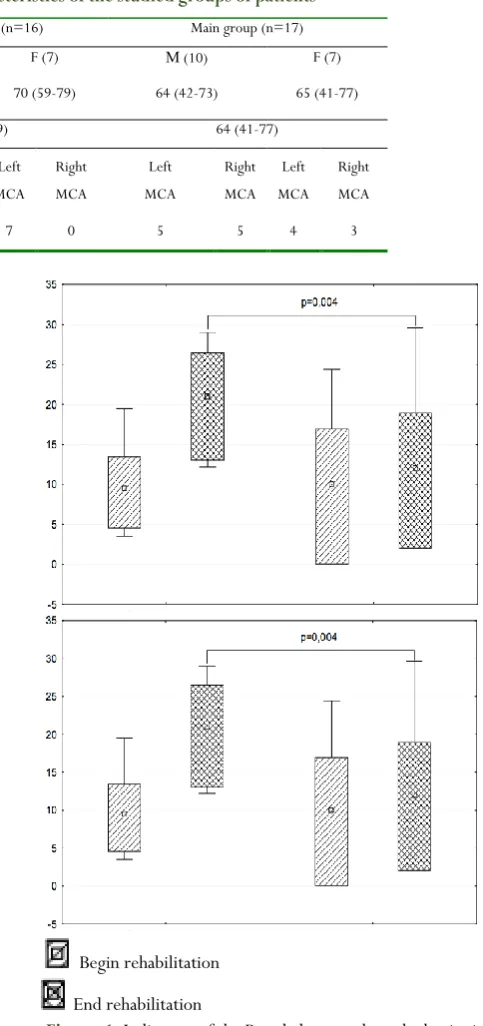
Clinical and demographic characteristics of the studied groups of patients are presented in table 1. As can be seen, the groups were comparable in age and gender. The average age of patients in the study group was 64 years, and in the control group was 65 years.
Table 1. Clinical and demographic characteristics of the studied groups of patients
Characteristics Control group (n=16) Main group (n=17)
Gender M (9) F (7) М (10) F (7)
Age (min-max) 62 (40-76) 70 (59-79) 64 (42-73) 65 (41-77)
Average age in the group (min-max) 65(40-79) 64 (41-77)
Pool (number of cases)
Left MCA
Right MCA
Left MCA
Right MCA
Left MCA
Right MCA
Left MCA
Right MCA
5 4 7 0 5 5 4 3
Stroke in the pool of the right middle cerebral artery (right MCA) was observed twice as often in the main group. Stroke in the basin of the left middle cerebral artery (left MCA) in the control group was 12 cases, and in the main group was 9 cases. Despite the signs of asymmetry of stroke localization, there were no statistically significant differences between the compared groups at the stage of inclusion in the study. The study groups were homogeneous in demographic indicators, as well as in the degree of severity of neurological deficit.
The Berg balance scale was selected as the main criterion for evaluating the effectiveness of rehabilitation in VR due to its high sensitivity. This scale was validated in patients in acute stroke conditions to assess stato-locomotor function. The sensitivity of this scale is within 6-8 points. An important feature of this scale is that it can evaluate not only the motor function but also the restoration of motor skills that are required for patients to restore their stato-locomotor function, as well as self-service skills. It should be noted that the dynamics of the score on the Berg scale has a fairly high statistical difference when the two groups of the study are compared.
Figure 1 shows the dynamics of the Berg balance scale indicators against the background of rehabilitation. The average value of the score dynamics during the study in the control group was 7 (95% CI 2-11) points (p < 0.05), which was almost at the level of the minimum sensitivity of this scale. In contrast, in the main group, the dynamics were 19 (95% CI 12-27) points (p = 0.004).
Begin rehabilitation
End rehabilitation
Figure 1.Indicators of the Berg balance scale at the beginning and end of the rehabilitation period.
the control group, a high positive effect of the initial Berg’s
score on the degree of recovery at the end of the study was observed: rs = 0.78; p = 0.001. Also, a positive relationship between the Berg balance scale value and the left hemisphere (dominant) localization of stroke (rs = 0.54; p = 0.024) was noted. No such correlation was found in patients of the main group. These figures are not unexpected. It is known that the localization of stroke in non-dominance hemisphere motor impairment is more pronounced because of anosognosia. In the main group, the initial level of motor disorders had no effect on the degree of recovery of motor function by the end of the study; also, there was no correlation with the third-party localization of stroke.
The second, additional task of this research was to study the effect of the intensity (duration) of classes in immersive VR on the restoration of motor function according to the Berg balance scale. The absolute value of the score on the Berg balance scale recorded on each day of the study was used as the main criterion for the influence of the intensity of training.
There were no statistically significant changes in the control group during all days of the study. Significant statistical differences in the main group occurred on the sixth day of the rehabilitation complex with the use of immersive VR (p=0.03), as shown in figure 2. The positive trend was remaining in the main group during all subsequent training sessions.
Day of rehabilitation
Control group
Main group
Figure 2.Dynamics of indicators of the scale of the Berg days of rehabilitation.
In most cases, the patients from both the main group and the control group at the time of inclusion in the study showed severe impairment of life. They were unable to walk unaided and cope with their physical needs, which corresponded to a severe or moderate degree of disability on the Rankin scale (table 2).
Table 2: Indicators of scales of neurological examination and indicators of functioning at the stages of inclusion and
completion of the study
The scale of assessment (average, 95% CI) Control group Main group NIHSS (selection visit) 11 (8-14) 10 (8-11) Rankin (selection visit) 4 (3-4) 4(3-4) Rivermid (selection visit) 3 (2-4) 2 (1-4) NIHSS (final visit) 9 (6-13) 7(6-9) Rankin (final visit) 3 (1-4) 3 (2-4) Rivermid (final visit) 5 (4-6) 6 (4-7)
The Riverbed mobility index of patients from the main group had even more serious conditions than patients in the control group. Thus, in most cases, patients from the main group could only sit down independently from the supine position. At the end of the study, there was a positive trend in all scales of evaluation of the effectiveness of rehabilitation measures: the Riverbed mobility index in the control group was characterized by the ability of the patient to stand alone for more than 10 seconds, and in the main group of patients could move independently at a distance of 10 meters without assistance. According to the NIHSS scale, positive dynamics were observed in both groups during treatment and rehabilitation, but there were no significant statistical differences.
Discussion
The immersive VR demonstrated significant effectiveness when used as an adjuvant method of motor rehabilitation in patients with a severe neurological deficit due to an acute cerebrovascular accident. The method of sensory interaction with the VR object is safe during the acute period of stroke. No adverse events related to the use of VR were observed during the entire rehabilitation period. The resulting adverse events were not unexpected for this group of patients. Their frequency (8.0%) did not exceed the statistical indicators of complications of acute cerebrovascular accident observed in patients at the stage of inpatient treatment.
the influence of anosognosia as a neuropsychological syndrome and the recovery of motor function by means of immersive VR. The positive effect of training by means of immersive VR becomes noticeable on the sixth day of training, and this trend continued during the following days, whereas the patients from the control group showed no appreciable positive dynamics. According to the Rankin disability scale, the Riverbed mobility index, and NIHSS scale, no significant difference was detected between the study and control groups. This is obviously due to the large inertia of these scales in the assessment of the dynamics of the state-locomotor function. Despite the same scores on these scales, mobility and ability to self-care in patients of the main group were significantly higher.
The increase in motivation of patients to further rehabilitation sessions, as well as positive emotions were observed during the sessions using VR in patients of the main group. All of that obviously has an additional positive impact on the restoration of stato-locomotive functions.
Conclusion
Virtual reality has several significant advantages in the treatment of patients with severe motor disorders due to ischemic stroke. The use of sensory interaction with virtual objects can be considered as a method that activates the neuroplasticity of the Central nervous system. The processes of restoration of motor function of the lower extremities and stato-locomotor function are probably related to the processes of movement organization at the cortical and pyramidal-striar levels. A high degree of safety of the method of immersive virtual reality should be noted in patients with acute stroke.
Obviously, the next step in the development of rehabilitation technologies with the use of virtual reality will be the enhancement of immersiveness, primarily due to the expansion of sensory interaction with objects of the virtual environment. The use of multimodal sensory interaction with objects of the virtual environment in explicit mode will improve the effectiveness of rehabilitation and expand its capabilities. It should also be noted that the achievement of a greater immersive effect in VR should be expected from the expansion of multi-sensory interaction with the VR object, the addition of an explicit orientation due to neurocomputer interfaces, and "storytelling" in rehabilitation devices developed on the basis of VR.
Conflict of Interest
The project was implemented with the financial support of the Ministry of Science and Higher Education of the Russian Federation, a unique project identifier RFMEFI60418X0208.
References
1. Roger VL, Go AS, Lloyd-Jones DM, Adams RJ, Berry JD, Brown TM, Carnethon MR, Dai S, De Simone G, Ford ES, Fox CS. Heart disease and stroke statistics—
2011 update: a report from the American Heart
Association. Circulation. 2011 Feb 1;123(4):e18-209. DOI: 10.1161 / CIR.0b013e3182009701.
2. Feigin VL, Lawes CM, Bennett DA, Barker-Collo SL, Parag V. Worldwide stroke incidence and early case fatality reported in 56 population-based studies: a systematic review. The Lancet Neurology. 2009 Apr 1;8(4):355-69. DOI: 10.1016/S1474-4422(09)70025-0
3. Lozano R, Naghavi M, Foreman K, Lim S, Shibuya K, Aboyans V, Abraham J, Adair T, Aggarwal R, Ahn SY, AlMazroa MA. Global and regional mortality from 235 causes of death for 20 age groups in 1990 and 2010: a systematic analysis for the Global Burden of Disease Study 2010. The lancet. 2012 Dec 15;380(9859):2095-128. DOI: 10.1016/S0140-6736(12)61728-0.
4. Dehvari H, Kumar P. Antiplatelet Activity of Aspirin in the Prevention of Cardiovascular Disease in a Tertiary Care Hospital, Bangalore, India. J Biochem Tech. 2018; Special Issue (2): 111-115.
5. Amiri-Nikpour MR, Golmohammadi S. Evaluation of serum cholesterol levels in patients with hemorrhagic stroke. Pharmacophore. 2017; 8(1): 31-35.
6. Neirang OM. Assessment of Medication Therapy Management in Hypertension Patient, Baptist Hospital, Bangalore, India. J Biochem Tech. 2018; Special Issue (2): 132-138.
7. Amini R, Amir Daddost R, Khodavisi M, Tapak L. Correlation between Health Literacy and Self-Management in Patients with Hypertension, Province of Hamadan, Iran. J Biochem Tech. 2018; Special Issue (2): 134-141.
8. Wang W, Jiang B, Sun H, Ru X, Sun D, Wang L, Wang L, Jiang Y, Li Y, Wang Y, Chen Z. Prevalence, incidence, and mortality of stroke in China: results from a nationwide population-based survey of 480 687 adults. Circulation. 2017 Feb 21;135(8):759-71. DOI: 10.1161/CIRCULATIONAHA.116.025250
9. Prabhakaran S, Zarahn E, Riley C, Speizer A, Chong JY, Lazar RM, Marshall RS, Krakauer JW. Inter-individual variability in the capacity for motor recovery after ischemic stroke. Neurorehabilitation and neural
repair. 2008 Jan;22(1):64-71.
DOI:10.1177/1545968307305302
10. Batchelor FA, Mackintosh SF, Said CM, Hill KD. Falls after stroke. International Journal of Stroke. 2012 Aug;7(6):482-90. DOI:10,1111 / j.1747-4949.2012.00796.x
2014 Dec;18(6):502-12. DOI: 10.1590 / bjpt-rbf.2014.0062
12. Gonzalez RG, Hirsch JA, Koroshetz WJ, Lev MH, Schaefer P. Acute ischemic stroke. Imaging and intervention| Springer-Verlag, Berlin Heidelberg 2006. DOI: 10,1007 / 978-3-642-12751-9
13. Richards CL, Malouin F, Nadeau S. Stroke rehabilitation: clinical picture, assessment, and therapeutic challenge. InProgress in brain research 2015 Jan 1 (Vol. 218, pp. 253-280). Elsevier. DOI: 10.1016 / bs.pbr.2015.01.003
14. Saposnik G, Cohen LG, Mamdani M, Pooyania S, Ploughman M, Cheung D, Shaw J, Hall J, Nord P, Dukelow S, Nilanont Y. Efficacy and safety of non-immersive virtual reality exercising in stroke rehabilitation (EVREST): a randomised, multicentre, single-blind, controlled trial. The Lancet Neurology. 2016 Sep 1;15(10):1019-27. DOI: 10.1016/S1474-4422(16)30121-1
15. Teasell R, Meyer MJ, McClure A, Pan C, Murie-Fernandez M, Foley N, Salter K. Stroke rehabilitation: an international perspective. Topics in stroke
rehabilitation. 2009 Jan 1;16(1):44-56. DOI: 10.1310/tsr1601-44
16. Laver KE. George 5, Thomas S. Deutsch JE, Crotty M. Virtual reality for stroke rehabilitation. Cochrane
Database Syst Rev. 2011;9. DOI:
0.1002/14651858.CD008349.pub2
17. Peñasco-Martín B, De los Reyes-Guzmán A, Gil-Agudo Á, Bernal-Sahún A, Pérez-Aguilar B, De la Peña González AI. Aplicación de la realidad virtual en los aspectos motores de la neurorrehabilitación. Rev
Neurol. 2010 Mar;51(481):8. DOI:
https://doi.org/10.33588/rn.5108.2009665
18. Park DS, Lee DG, Lee K, Lee G. Effects of virtual reality training using Xbox Kinect on motor function in stroke survivors: a preliminary study. Journal of Stroke and Cerebrovascular Diseases. 2017 Oct
1;26(10):2313-9. DOI: 10.1016 /
j.jstrokecerebrovasdis.2017.05.019