Short
Commun
ficat
fion
Three
noteworthy
add
fit
fions
to
the
fflora
of
the
western
H
fimaflaya
,
Ind
fia
Ishwarfi Dat Rafi, Amfit Kumar, Gajendra Sfingh, Bhupendra Sfingh Adhfikarfi & Gopafl Sfingh Rawat
26Jufly 2017 | Vofl. 9| No. 7 | Pp. 10421–10425 10.11609/jot.3371.9.7.10421–10425
Threatened Taxa TheJournafl of Threatened Taxafis dedficatedto bufifldfing evfidencefor conservafion gflobaflfly by pubflfishfing peer-revfiewed arficfles onflfine every month at a reasonabfly rapfid rate at www.threatenedtaxa.org.Aflfl arficfles pubflfishedfin JoTT are regfistered under Creafive Commons Atrfibufion 4.0InternafionaflLficense unfless otherwfise menfioned.JoTT aflflows unrestrficted use of arficfles finany medfium, reproducfion, and dfistrfibufion by provfidfing adequate credfit to the authors and the source of pubflficafion.
OPEN
ACCESS
Partner
www
.
threa
tenedtaxa
.org
ISSN 0974-7907(Onflfine) |ISSN 0974-7893(Prfint)
Bufifldfing evfidencefor conservafion gflobaflfly
Journa
fl
o
f
Threatened
Taxa
Pub
fl
fisher/Host
For Focus, Scope, Afims, Poflficfies and Gufideflfines vfisfit htp://threatenedtaxa.org/About_JoTT For Arficfle Submfissfion Gufideflfines vfisfit htp://threatenedtaxa.org/Submfissfion_Gufideflfines
For Poflficfies agafinst Scfienfific Mfisconduct vfisfithtp://threatenedtaxa.org/JoTT_Poflficy_agafinst_Scfienfific_Mfisconduct
10421
Sh
or
t
Co
m
mu
nfi
ca
tfi
on
DOI:htp://dofi.org/10.11609/jot.3371.9.7.10421-10425
Edfitor: P. Lakshmfinarasfimhan, Botanficafl Survey ofIndfia, Pune,Indfia. Date of pubflficafion: 26Jufly 2017(onflfine & prfint)
Manuscrfipt detafifls: Ms # 3371 | Recefived 24 February 2017 | Ffinafl recefived 25 May 2017 | Ffinaflfly accepted 03Jufly 2017
Cfitafion: Rafi,I.D., A. Kumar, G. Sfingh, B.S. Adhfikarfi & G.S. Rawat (2017).Three noteworthy addfifionstothe flora ofthe western Hfimaflaya,Indfia.Journafl of Threat -ened Taxa 9(7):10421–10425;htp://dofi.org/10.11609/jot.3371.9.7.10421-10425
Copyrfight: ©Rafi et afl. 2017. Creafive Commons Atrfibufion 4.0Internafionafl Lficense.JoTT aflflows unrestrficted use ofthfis arficflefin any medfium,reproducfion and dfistrfibufion by provfidfing adequate credfit to the authors and the source of pubflficafion.
Fundfing: Scfience and Engfineerfing Research Board(SERB), Govt. ofIndfia, Unfiversfity Grant Commfissfion, New Deflhfi and WfifldflfifeInsfitute ofIndfia, Dehradun
Compefingfinterests: The authors decflare no compefingfinterests.
Acknowfledgements: The authors are gratefufl to the Dfirector and Dean of the WfifldflfifeInsfitute ofIndfiaforfinsfitufionafl support.
Three
noteworthy
add
fit
fions
to
the
fflora
of
the
western
H
fimaflaya
,
Ind
fia
Ishwarfi Dat Rafi1, Amfit Kumar2, Gajendra Sfingh3, Bhupendra Sfingh Adhfikarfi4& Gopafl Sfingh Rawat5
1,2,4,5WfifldflfifeInsfitute ofIndfia, Post Box # 18, Chandrabanfi, Dehradun, Utarakhand 248001,Indfia 3Utarakhand Space Appflficafion Centre, 93/II Vasant Vfihar, Dehradun, Utarakhand 248006,Indfia 1 fishwarfi.rafi@gmafifl.com(correspondfing author),2amfit_ndbr@wfifi.gov.fin,3 gajendrawat@yahoo.com, 4adhfikarfibs@wfifi.gov.fin,5 rawatg@wfifi.gov.fin
ISSN 0974-7907(Onflfine) ISSN 0974-7893(Prfint)
OPEN ACCESS
Journafl of Threatened Taxa | www.threatenedtaxa.org | 26 Jufly 2017 | 9(7): 10421–10425
The Hfimaflaya represent a dfisfinct bfiogeographfic eco-regfion wfith hfigh bfiodfiversfity and endemfism due toflarge varfiafionfintopography andcflfimate(Oflson et afl. 2001).It harbours a rfich array of the florafl dfiversfity across dfiverse habfitatsfin mountafin systems expandfing as a paraflflefl chafin from the Shfivaflfiks to the Trans -Hfimaflaya. The mountafins rfise abruptfly, resuflfingfin a dfiversfity of ecosystemsthatrangefromsubtropficafl cflfimate to perpetuafl snow beyond the aflpfine areas. It represents about 61% of endemficspecfies and 49% of the endemfic genera of flowerfing pflantsfin Indfia (Nayar 1996). The Hfimaflayan Bfiodfiversfity Hotspotfis dfivfided finto eastern and western Hfimaflaya, of whfichthe eastern
Abstract: Durfing recent botanficafl expflorafions fin the western Hfimaflaya,threefinteresfing specfies wererecordedfromthe subaflpfine -aflpfine areas, whfich were hfitherto unknownfromthfisregfion. Thefir occurrence fin thfis regfion fis phytogeographficaflfly sfignfificant and noteworthy.Inthfis paper a brfief descrfipfion ofthesespecfies aflong wfith phenoflogy, dfistrfibufion, ecoflogy, photographs and phytogeographficafl notes are provfided.
Keywords: Anemone demfissa,Anthoxanthum flexuosum,Scrophuflarfia paucfiflora.
regfionfis consfidered as one of the centres of evoflufion. At present the eastern Hfimaflaya have 466 endemfic taxa of angfiosperms andthe western Hfimaflaya have 297 endemfic taxa(Sfingh et afl. 2015).
Journal of Threatened Taxa | www.threatenedtaxa.org | 26 July 2017 | 9(7): 10421–10425
10422
Additions to the flora of western Himalaya Rai et al.
than in the western Himalaya. Compared to the eastern Himalaya, this region is floristically more explored; however, several pockets in the interior valleys still need intensive botanical surveys. The state of Uttarakhand in the western Himalaya alone contains more than 4,700 species of flowering plants (Uniyal et al. 2007), which is about 27% of the flowering plants of India. Interestingly, reports of several noteworthy species are still coming out from this region (Jalal et al. 2010; Kumar et al. 2016; Rai et al. 2016) indicating the need for intensive floristic explorations.
Materials and Methods
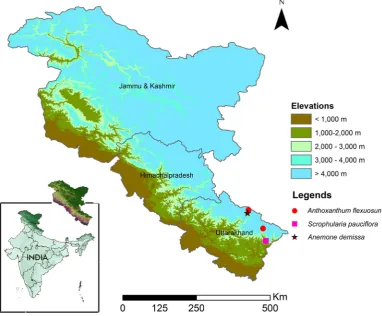
During recent floristic surveys, we recorded Anemone
demissa (Ranunculaceae), Scrophularia pauciflora
(Scrophulariaceae) and Anthoxanthum flexuosum (Poaceae) which were hitherto unknown from the western Himalaya (Fig. 1). Upon detailed scrutiny of the literature and regional flora (Hooker 1982–87; Hooker & Thomson 1855; Karthikeyan et al. 1989; Press et al. 2000; Uniyal et al. 2007), taxonomic notes and herbaria (Botanical Survey of India, Dehradun (BSD), Forest Research Institute, Dehradun (DD) and Wildlife Institute of India, Dehradun (WII) and Virtual Herbaria’s (Royal Botanic Garden, Kew (K) and National Museum
of Natural History, Peris (MNHN), the identities of these species were confirmed. Since they are new records to the western Himalaya, a brief description of the species, distribution and ecology along with images have been provided for easy identification in the field.
Anemone demissa
Hook.f. & Thomson Fl. Ind. 1: 23. 1855 (Ranunculaceae)
(Image 1)
Perennial herbs with monopodial woody rootstock, surrounded by fibrous leaf remains. Stem erect, ascending or decumbent. Radical leaves broadly ovate, 3-partite or twice ternately divided; petiole 5–30 cm long, sparsely or densely villous. Leaf blade 3-sect, ovate, rhombic-pentagonal or reniform-pentagonal, 5–8×4–6 cm, villous or subglabrous, base cordate or subtruncate, margin ciliate; central segment petiolulate, 3-parted, broadly rhombic or rhombic-ovate, margin incised lobulate, ultimate lobules ovate or triangular; lateral segments subsessile, unequally 2 or 3-parted, smaller than central one, sometimes much more so. Scapes 1–3, 5–30 cm long, densely white hairy, 3–6-flowered in simple umbels, involucral bracts 3 or 4; bract blade 3-lobed, broadly rhombic or narrowly obovate-oblong,
Journal of Threatened Taxa | www.threatenedtaxa.org | 26 July 2017 | 9(7): 10421–10425 10423
Additions to the flora of western Himalaya Rai et al.
pubescent. Pedicel 2–6 cm long, pubescent. Sepals 5–7, blue, purple or red, obovate or elliptic, 8–18×4–12 mm, sometimes dimorphic (inner ones smaller and of different shape), sparsely puberulent. Stamens 3–5 mm long; filament slightly dilated; anther cylindric, 1–2 mm, apex rounded. Staminodes sometimes present. Ovary glabrous or scarcely pubescent, sometimes sterile. Achene broadly ellipsoid or obovoid, 6–7×4–6 mm, glabrous or scarcely pubescent; wings 0.8–1.2 mm wide; style curved, 1.8–2 mm long.
Specimen examined: 14607 (WII), 24.vii.2004, India, Uttarakhand, Chamoli, Niti Valley, Lang Payar, 30.7825N & 79.8163E, 3,600m, coll. G.S. Rawat & G. Singh.
Flowering and fruiting: May–July.
Distribution: India (Uttarakhand, Sikkim, Arunachal Pradesh), Bhutan, Nepal, Myanmar, China.
Ecology and phytogeography: The species was recorded in open habitats especially on dry grassy slopes sparsely distributed in association with one or more species of Carex, Festuca, Kobresia, Thymus,
Bistorta, Anaphalis, Anemone, Potentilla, Cassiope,
and scrub vegetation comprising Lonicera myrtillus,
Juniperus communis, and Rhododendron anthopogon.
Situated in the cold arid region of Nanda Devi Biosphere Reserve in Uttarakhand, the area is locally known as ‘Lang Payar’ which is protected for wild plants as well as animals by the local community throughout the year for the past 20–25 years. Overall, 85–95 % of the area is vegetated. The species was recorded in north-east facing gentle slope (10–200) between 3,500–3,900 m
elevation. Earlier records of its habitat and distribution are from open grassy and rocky slopes and moraines at 3,300–5,000 m elevation zones in the Nepal, central Himalaya eastwards to Bhutan, Myanmar and southern Gansu, southern Qinghai, western Sichuan, eastern and southern Xizang, nothwestern Yunnan regions of southwestern China (www.efloras.org).
Scrophularia pauciflora
Benth.Scroph. Ind. : 17. 1835. (Scophulariaceae)
(Images 2,3)
Perennial herbs, erect, up to 60cm tall, branched. Stem quadrangular, white glandular hairy. Leaves simple, opposite, decussate; Petiole ca. 5cm long, decurrent on stem and becoming wing like ribs, densely white glandular hairy; blade ovate-cordate, up to 9cm long, short hairy on veins when young, margin coarsely double serrate. Inflorescence thyrses, terminal, narrowly spicate, up to 22cm long; cymes opposite, densely to widely spaced, usually 4-flowered; peduncle glandular
Journal of Threatened Taxa | www.threatenedtaxa.org | 26 July 2017 | 9(7): 10421–10425
10424
Additions to the flora of western Himalaya Rai et al.
hairy. Flowers crowded; pedicel short, glandular hairy. Calyx 3–4 mm long; lobes ovate-lanceolate, glandular hairy, apex acute. Corolla 5–6 mm long, glabrous; lower lip middle lobe smaller than lateral lobes; upper lip slightly longer than lower lip. Stamens slightly shorter than lower lip; staminode absent. Ovary ovoid, ca. 1.5 mm. Style as long as ovary. Capsule ovoid, 6–8 mm long.
Specimen examined: 11465 (WII), 03.vi.2015, India, Uttarakhand, Pithoragarh, Ro-Ro Dhar (Daphiyadhura), 29.9428N & 80.3622E, 3,030m, coll. I.D. Rai & G.S. Rawat.
Flowering and fruiting: May–June.
Distribution: India (Uttarakhand, West Bengal, Sikkim), China, Bhutan, Nepal.
Ecology and phytogeography: The species grows in the south-west facing rocky slopes dominated by
Quercus semecarpifolia and Rhododendron arboreum.
The individuals were found mostly on shady ravines especially under the shelter of rocks and boulders between 2,500–3,300 m elevation and 40–60 degree slope. Unlike most species of Scrophularia in this region, this species was selectively browsed by wild herbivores. The dominant plant species observed in association
with it were Impatiens sulcata, Rubrivena polystachya,
Primula edgeworthii, Ajuga brachystemon, Trachydium roylei and one or more species of fern. The soil is
sandy with deposits of gravel. This species is hitherto reported from Khaptad National Park in western Nepal where forests are dominated by Rhododendron spp. and Oaks. Khaptad is located in the south-east of present location along a parallel chain of mountains with similar vegetation types, dissected by deep valleys with sub-tropical climate which may lead to interrupted distribution of the species. Patchy distribution and habitat specificity of this species might also be a cause of limited reports of its occurrence in the past and the species might have a broader distribution in the Himalayan region.
Anthoxanthum flexuosum
(Hook.f.) VeldkampBlumea 30: 347. 1985.
Hierochloe flexuosa Hook.f., Fl. Brit. India 7: 222. 1896.
(Poaceae) (Image 4)
Perennial tufted grass, 30–60 cm high. Ligule an eciliate membrane. Leaf-blades 5–12×0.2–0.4 cm; apex abruptly acute. Inflorescence a very loose panicle,
Journal of Threatened Taxa | www.threatenedtaxa.org | 26 July 2017 | 9(7): 10421–10425 10425
Additions to the flora of western Himalaya Rai et al.
ovate, 5–8 cm long. Panicle branches capillary; flexuous. Spikelets solitary, cuneate, laterally compressed, ca. 5mm long. Basal sterile florets 2; fertile florets 1. Glumes persistent; reaching apex of florets; shiny. Lower and upper glume ovate, ca. 5mm long, membranous, purple, 1-keeled, 3-veined, apex acute. Lemma of lower sterile floret oblong, ca. 5mm long, 1-keeled, 5-veined, pubescent, dentate, 2-fid, obtuse, awned. Awn of lower sterile floret ca. 1.5mm long. Lemma of upper sterile floret oblong, ca. 5mm long, pubescent, lobed, 2-fid, awned. Awn exserted, nearly as long as the spikelet, Awn of upper sterile floret dorsal, 5–6 mm long. Lower lemma hairy, fertile lemma ovate, ca.3.5mm long, without keel. Lemma surface pubescent, hairy above. Lemma margins convolute, covering most of palea. Lemma apex acute. Palea elliptic, 1-veined, without keels. Anthers 2 (bisexual) or 3 (male); 1.5mm long. Ovary glabrous. Fruit caryopsis with adherent pericarp.
Specimen examined: 21967 (WII), 18.x.2014, India, Uttarakhand, Chamoli, Niti Valley, 30.9117N & 79.8547 E, 4,055m, coll. Amit Kumar; 14275 (WII), Uttarakhand, Pithoragarh, Ralam, 30.3219N & 80.3205E, 4,010m, coll. G.S. Rawat & G. Singh.
Flowering and fruiting: July–September.
Distribution: India (Uttarakhand, Sikkim), Nepal.
Ecology and phytogeography: Anthoxanthum flexuosum grows in alpine dry scrub and dry alpine pastures above 4,000m. In Ganesh Ganga watershed, it inhabits dry rocky stable slopes. It grows in association with one or more species of Elymus, Festuca, Trisetum,
Oxytropis, Astragalus, Caragana, Eurotia, Lonicera, Lappula, Potentilla and Thymus. The species is endemic
to the Himalayan region. The species was earlier reported from central Himalaya (Nepal; e-monocot.org, Karthikeyan et al. 1989) and eastern Himalaya (Sikkim).
Discussion
In the Indian Himalayan region, the three species discussed above are previously known to occur in eastern and central Himalaya; however, the current reports from western Himalaya make them biogeographically noteworthy by means of their distribution in the Himalaya Biodiversity Hotspot. The present record of these species in this region could be attributed to their extended range of distribution not recorded earlier
due to an artefact of restrained botanical excursions in these interior valleys. Further, the current report on the presence of a few individuals indicates their rarity in the region.
References
Bentham, G. (1835). Scrophularineae Indicae. J. Ridgway, London, 57pp.
Chatterjee, D. (1939). Studies on the endemic flora of India and Burma.
Journal of the Royal Asiatic Society of Bengal 5(1): 19–67.
Chawla, A., O. Parkash, V. Sharma, S. Rajkumar, B. Lal, Gopichand, R.D. Singh & A.K. Thukral (2012). Vascular plants, Kinnaur, Himachal Pradesh, India. Check List 8(3): 321–348.
Hooker, J.D. & T. Thomson (1855). Flora Indica - Vol. 1. W. Pamplin, London, 285pp.
Hooker, J.D. (1872–1897). The Flora of British India. Vol. 1–7. Bishen Singh Mahendra Pal Singh, Dehradun.
Hooker, J.D. (1907). Sketch of the Flora of British India. Imperial Gazetteer of India. Oxford 1(4): 157–212.
http://e-monocot.org (as accessed on 01/02/2017). http://www.efloras.org (as accessed on 01/02/2017)
Jalal, J.S., I.D. Rai, P. Kumar, G.S. Rawat & Y.P.S. Pangtey (2010).
Platanthera leptocaulon (Hooker f.) Soo: An addition to the orchid
flora of western Himalaya, India. Richardiana 10(2): 85–93. Karthikeyan, S., S.K. Jain, M.P. Nayar & M. Sanjappa (1989). Florae
Indicae Enumeratio: Monocotyledonae. Botanical Survey of India,
Calcutta, 435pp.
Khullar, S.P. (2000). An illustrated fern flora of the west Himalaya, Vol.
II. International Book Distributors, Dehradun, India.
Kumar, A., B.S. Adhikari & G.S. Rawat (2016). New phytogeographically noteworthy plant records from Uttarakhand, Western Himalaya, India. Journal of Threatened Taxa 8(6): 8943–8947; http://dx.doi. org/10.11609/jott.2416.8.6.8943-8947
Nayar, M.P. (1996). Hot Spots of Endemic Plants of India, Nepal
and Bhutan. Thiruvananthapuram: Tropical Botanic Garden and
Research Institute, Palode, 252pp.
Olson, D.M., E. Dinerstein, E.D. Wikramanayake, N.D. Burgess, G.V.N. Powell, E.C. Underwood, J.A. D’amico, I. Itoua, H.E. Strand, J.C. Morrison, C.J. Loucks, T.F. Allnutt, T.H. Ricketts, Y. Kura, J.F. Lamoreux, W.W. Wettengel & K.R. Kassem (2001). Terrestrial eco-regions of the World: a new map of life on Earth. BioScience 51(11): 933–938.
Press, J.R., K.K. Shrestha & D.A. Sutton (2000). Annotated Checklist
of the Flowering Plants of Nepal. Natural History Museum, London,
i-x+430pp.
Rai, I.D., G. Singh & G.S. Rawat (2016). Noteworthy additions to the flora of Uttarakhand, western Himalaya, India, Journal of Threatened
Taxa 8(7): 9004–9008; http://doi.org/10.11609/jott.2607.8.7.9004-9008
Schouten, Y. & J.F. Veldkamp (1985). A revision of Anthoxanthum including Hierochloe (Gramineae) in Malesia and Thailand. Blumea 30: 319–351.
Singh, P., K. Karthigeyan, P. Lakshminarasimhan & S.S. Dash (2015).
Endemic Vascular Plants of India. Botanical Survey of India, 339pp.
Uniyal, B.P., J.R. Sharma, U. Choudhery & D.K. Singh (2007). Flowering
plants of Uttarakhand - A Checklist. Bishen Singh Mahendra Pal
Singh, Dehradun, 404pp.
The Journal of Threatened Taxa is dedicated to building evidence for conservation globally by publishing
peer-reviewed articles online every month at a reasonably rapid rate at www.threatenedtaxa.org. All articles
published in JoTT are registered under Creative Commons Attribution 4.0 International License unless
otherwise mentioned. JoTT allows unrestricted use of articles in any medium, reproduction, and distribution by providing adequate credit to the authors and the source of publication.
July 2017 | Vol. 9 | No. 7 | Pages: 10369–10492
Date of Publication: 26 July 2017 (Online & Print)
DOI: 10.11609/jott.2017.9.7.10369-10492
www.threatenedtaxa.org
ISSN 0974-7907 (Online); ISSN 0974-7893 (Print)
OPEN ACCESS
Threatened Taxa
CommunicationsThe status of Arabian Gazelles Gazella arabica (Mammalia: Cetartiodactyla: Bovidae) in Al Wusta Wildlife Reserve and Ras Ash Shajar Nature Reserve, Oman
-- Mansoor H. Al Jahdhami, Sultan Al Bulushi, Haitham Al Rawahi,
Waheed Al Fazari, Ahmed Al Amri, AbdulRahman Al Owaisi, Salim Al Rubaiey, Zahran Al Abdulasalam, Metab Al Ghafri, Shaeilendra Yadav, Sami Al Rahbi & Steven Ross, Pp. 10369–10373
On the occurrence of the Black Spine-cheek Gudgeon
Eleotris melanosoma Bleeker in Sri Lankan waters, with comments on the Green-backed Guavina Bunaka gyrinoides (Bleeker) (Teleostei: Eleotridae)
-- Sudesh Batuwita, Sampath Udugampala & Udeni Edirisinghe,
10374–10379
Captive breeding for conservation of Dussumier’s Catfish
(Actinopterygii: Siluriformes: Clariidae: Clarias dussumieri)
a Near Threatened endemic catfish of peninsular India
-- K.G. Padmakumar, L. Bindu, P.S. Sreerekha, Nitta Joseph, Anuradha Krishnan, P.S. Manu & V.S. Basheer, Pp. 10380–10385
Influence of seasonal and edaphic factors on the diversity of scolopendromorph centipedes (Chilopoda: Scolopendromorpha) and general observations on their ecology from Kerala, India
-- Dhanya Balan & P.M. Sureshan, 10386–10395
Butterflies of eastern Assam, India
-- Arun P. Singh, 10396–10420
Short Communications
Three noteworthy additions to the flora of the western Himalaya, India
-- Ishwari Datt Rai, Amit Kumar, Gajendra Singh, Bhupendra Singh Adhikari & Gopal Singh Rawat, 10421–10425
New distribution records of three Sarcophyton species (Alcyonacea: Alcyoniidae) in Indian waters from Andaman Islands
-- Seepana Rajendra, C. Raghunathan & Tamal Mondal, 10426– 10432
Additions to the Indian dragonfly fauna, and new records of two enigmatic damselflies (Insecta: Odonata) from northeastern
India
-- Shantanu Joshi, Joyce Veino, Dahru Veino, Lightson Veino, Rakoveine Veino & Krushnamegh Kunte, Pp. 10433–10444
Dragonflies and Damselflies (Odonata: Insecta) of Keoladeo National Park, Rajasthan, India
-- Dheerendra Singh, Brijendra Singh & Jan T. Hermans,
Pp. 10445–10452
Records of the Indian Sand Snake Psammophis condanarus
(Merrem, 1820) (Reptilia: Lamprophiidae) in southern India
-- S.R. Ganesh, Vivek Sharma & M. Bubesh Guptha, Pp. 10453– 10458
An ecological note on the new record of Cuora amboinensis (Riche in Daudin, 1801) (Reptilia: Testudines: Geoemydidae)
in northeastern India
-- Kulendra Chandra Das & Abhik Gupta, Pp. 10459–10462
A new distribution record of the European Free-tailed Bat Tadarida teniotis (Chiroptera: Molossidae) from the western Himalaya, India
-- Rohit Chakravarty, Pp. 10463–10467
Measuring Indian Blackbuck Antilope cervicapra (Mammalia: Cetartiodactyla: Bovidae) abundance at Basur Amruth Mahal Kaval Conservation Reserve, Chikkamagaluru, southern India
-- H.S. Sathya Chandra Sagar & P.U. Antoney, Pp. 10468–10472
Notes
A new species of Sarcinella (Ascomycetes) from Eturnagaram Wildlife Sanctuary, Warangal District, Telangana, India
-- Khaja Moinuddin Mohammad, Bagyanarayana Gaddam &
Rana Kausar, Pp. 10473–10475
Re-collection of the Black Catchfly Silene nigrescens
(Caryophyllales: Caryophyllaceae) after 130 years from Indian western Himalaya
-- Satish Chandra, D.S. Rawat & P.K. Pusalkar, Pp. 10476–10479
Eight new records of the family Erebidae (Lepidoptera: Noctuoidea) from India
-- Jagbir Singh Kirti, Navneet Singh & Harkanwal Singh, Pp. 10480–10486
New records of hover wasps (Hymenoptera: Vespidae: Stenogastrinae) from Bhutan
-- Tshering Nidup, Wim Klein & Phurpa Dorji, Pp. 10487–10489
Addition of four species to the butterfly checklist of Kaleshwar National Park, Haryana, India