R E S E A R C H
Open Access
An algorithm for a common fixed point of a
family of pseudocontractive mappings
Habtu Zegeye
1and Naseer Shahzad
2**Correspondence:
2Department of Mathematics, King
Abdulaziz University, P.O. Box 80203, Jeddah, 21589, Saudi Arabia Full list of author information is available at the end of the article
Abstract
We introduce an iterative process which converges strongly to a common fixed point of a family of Lipschitzian pseudocontractive mappings. Our theorems improve and unify most of the results that have been proved for this important class of nonlinear operators.
MSC: 47H09; 47J20; 65J15
Keywords: fixed points of mappings; monotone mappings; pseudocontractive mappings; strong convergence
1 Introduction
LetCbe a nonempty subset of a real Hilbert space H. A mappingT :C→H is called
pseudocontractiveif and only if
Tx–Ty≤ x–y+(I–T)x– (I–T)y, for allx,y∈C, (.)
andTis calledα-strictly pseudocontractive[] if and only if there existsα∈[, ) such that
Tx–Ty≤ x–y+α(I–T)x– (I–T)y, for allx,y∈C, (.)
Tis calledLipschitzianif and only if
Tx–Ty ≤Lx–y, for allx,y∈K. (.)
If in (.) we haveL≤, thenTis callednonexpansive. We note that inequalities (.) and (.) can be equivalently written as
x–y,Tx–Ty ≤ x–y, for allx,y∈C (.)
and
x–y,Tx–Ty ≤ x–y–λ(I–T)x– (I–T)y, (.)
for someλ> , respectively.
We observe from (.), (.) and (.) that every nonexpansive mapping is anα-strictly pseudocontractive mapping and everyα-strictly pseudocontractive mapping is a pseudo-contractive mapping, and hence a class of pseudopseudo-contractive mappings is a more general class of mappings.
Furthermore, pseudocontractive mappings are related with the important class of non-linearmonotonemappings, where a mappingAwith domainD(A) and rangeR(A) inHis calledmonotoneif the inequality
x–y,Ax–Ay ≥, (.)
holds for everyx,y∈D(A). We note thatT is pseudocontractive if and only ifA:=I–T
is monotone, and hence a fixed point of T, F(T) :={x∈D(T) :Tx=x}, is a zero ofA,
N(A) :={x∈D(A) :Ax= }. It is now well known (see,e.g., []) that ifAis monotone, then the solutions of the equationAx= correspond to the equilibrium points of some evolution systems.
Finding a point in the intersection of fixed point sets of a family of nonexpansive map-pings is a task that occurs frequently in various areas of mathematical sciences and en-gineering. For example, the well-known convex feasibility problem reduces to finding a point in the intersection of fixed point sets of a family of nonexpansive mappings; see,e.g., [, ].
Consequently, considerable research efforts have been devoted to developing iterative methods for approximating a common fixed point (when it exists) for a family of nonex-pansive mappings andα-strictly pseudocontractive mappings. Bauschke [] was the first to introduce a Halpern-type iterative process (see,e.g., []) for approximating a common fixed point for a finite family ofNnonexpansive self-mappings. He proved the following theorem.
Theorem BSK (Bauschke [], Theorem .) Let K be a nonempty closed convex sub-set of a Hilbert space H, and let T,T, . . . ,TN be a finite family of nonexpansive
map-pings of K into itself with F:=Ni=F(Ti)=∅and F=F(TNTN–· · ·T) =F(TTN· · ·T) =
F(TN–TN–· · ·TTN).Given points u,x∈C,let{xn}be generated by
xn+:=αn+u+ ( –αn+)Tn+xn, n≥, (.)
where Tn:=Tn(modN)and{αn} ⊂(, )satisfies
n≥|αn+r–αn|<∞.Then{xn}converges
strongly to PFu,where PF:H→F is the metric projection.
Various authors have studied iterative schemes similar to that of Theorem BSK in more general Banach spaces on the one hand, and using various conditions on the sequence{αn} on the other hand (see, for example, Colaoet al.[], Yao [], Takahashi and Takahashi [], Plubtieng and Punpaeng [], Cenget al.[] and the references therein). Many authors have also studied iterative methods for a family ofα-strictly pseudocontractive mappings (see,e.g., [–] and the references therein).
Our concern now is the following:Can we construct an iterative sequence for a common fixed point of a finite family of pseudocontractive mappings?
Hilbert spaces. LetCbe a closed convex subset ofE, and let{Ti}Ni=be a finite family of Lipschitzian pseudocontractive self-mappings ofCsubset ofEwhich is a real uniformly convex Banach space with a Frêchet differentiable norm andF:=Ni=F(Ti)=∅. Let{xn} be defined by
xn=αnxn–+ ( –αn)Tnxn, n≥, (.)
whereTn=Tn(modN). He proved that{xn}converges weakly to a common fixed point of the family{Ti}Ni=under certain conditions on the parameter{αn}.
We remark that the scheme in the theorem of Zhou [] isimplicitand the convergence isweak convergence.
Recently, Zegeyeet al.[] proved the following strong convergence of Ishikawa iterative process [] for a common fixed point of a finite family of Lipschitz pseudocontractive mappings.
Theorem ZSA [] Let C be a nonempty, closed and convex subset of a real Hilbert space H.Let Ti:C→C,i= , , . . . ,N,be a finite family of Lipschitz pseudocontractive
mappings with Lipschitzian constants Li,for i= , , . . . ,N,respectively.Assume that the interior of F:=Ni=F(Ti)is nonempty.Let{xn}be a sequence generated from an arbitrary
x∈E by ⎧ ⎨ ⎩
yn= ( –βn)xn+βnTnxn,
xn+= ( –αn)xn+αnTnyn, n≥,
(.)
where Tn:=Tn(modN) and{αn},{βn} ⊂(, )satisfy certain appropriate conditions.Then
{xn}converges strongly to a common fixed point of{T,T, . . . ,TN}.
It is worth to mention that the assumption ‘interior of F(T)is nonempty’ in Theo-rem ZSA issevere restriction.
More recently, Daman and Zegeye [] proved the following strong convergence of a Halpern-type [] iterative process for a common fixed point of a finite family of Lipschitz pseudocontractive mappings under the assumption that the family satisfiescondition(H), that is, the family{Ti:i= , , . . . ,N}of pseudocontractive mappings is said to satisfy
con-dition(H) if and only ifTix–x,Tjx–x ≥ fori,j∈ {, , . . . ,N}. We can also see that condition (H) is againsevere restriction.
It is our purpose in this paper to introduce an iterative scheme which converges strongly to a common fixed point of a family of Lipschitz pseudocontractive mappings. The as-sumption thatinterior of F(T)is nonemptyorcondition(H) is dispensed with. The results obtained in this paper improve and extend the results of Zhou [], Theorem ZSA, Daman and Zegeye [] and some other results in this direction.
2 Preliminaries
In what follows we shall make use of the following lemmas.
Lemma . Let H be a real Hilbert space.Then,for any given x,y∈E,the following in-equality holds:
Lemma .[] Let C be a convex subset of a real Hilbert space H.Let x∈H.Then x=
PCx if and only if
z–x,x–x ≤, ∀z∈C.
Lemma .[] Let{an}be a sequence of nonnegative real numbers satisfying the following
relation:
an+≤( –αn)an+αnδn, n≥n,
where{αn} ⊂(, )and{δn} ⊂R satisfy the following conditions:limn→∞αn= ,
∞
n=αn=
∞,andlim supn→∞δn≤.Thenlimn→∞an= .
Lemma .[] Let H be a real Hilbert space,C be a closed convex subset of H and T:
C→C be a continuous pseudocontractive mapping.Then
(i) F(T)is a closed convex subset ofC;
(ii) (I–T)is demiclosed at zero,i.e.,if{xn}is a sequence inCsuch thatxnxand
Txn–xn→,asn→ ∞,thenx=T(x).
Lemma .[] Let{an}be sequences of real numbers such that there exists a subsequence
{ni}of{n}such that ani<ani+ for all i∈N.Then there exists a nondecreasing sequence
{mk} ⊂N such that mk→ ∞and the following properties are satisfied by all(sufficiently
large)numbers k∈N:
amk ≤amk+ and ak≤amk+.
In fact,mkis the largest number n in the set{, , . . . ,k}such that the condition an≤an+
holds.
Lemma .[] Let H be a real Hilbert space.Then,for all xi∈H andαi∈[, ]for
i= , , . . . ,n such thatα+α+· · ·+αn= ,the following equality holds:
αx+αx+· · ·+αnxn= n
i=
αixi–
≤i,j≤n
αiαjxi–xj.
3 Main result
Theorem . Let C be a nonempty,closed and convex subset of a real Hilbert space H.
Let T,T:C→C be Lipschitz pseudocontractive mappings with Lipschitz constants L
and L,respectively.Assume thatF=F(T)∩F(T)is nonempty.Let a sequence{xn}be
generated from an arbitrary x,u∈C by
⎧ ⎪ ⎪ ⎨ ⎪ ⎪ ⎩
zn= ( –cn)xn+cnTxn;
yn= ( –βn)xn+βnTxn;
xn+=αnu+ ( –αn)(θnxn+δnTyn+γnTzn), n≥,
(.)
where{δn},{θn},{γn} ⊂(a,b)⊂(, ),{αn} ⊂(,c)⊂(, )satisfy the following conditions: (i)θn+δn+γn= ; (ii)limn→∞αn= ,
αn=∞; (iii)δn+γn≤cn,βn≤β<√
for L:=max{L,L}.Then{xn}converges strongly to a common fixed point of T and T
nearest to u.
Proof We make use of some ideas of the paper []. Letp∈F. Then, from (.), (.) and
Lemma ., we have that
xn+–p =αnu+ ( –αn)(θnxn+δnTyn+γnTzn) –p
≤αnu–p+ ( –αn)δn(Tyn–p) +θn(xn–p) +γn(Tzn–p)
≤αnu–p+ ( –αn)
δnTyn–p+θnxn–p
+γnTzn–p
– ( –αn)δnθnTyn–xn
– ( –αn)θnγnTzn–xn,
and hence
xn+–p≤αnu–p+ ( –αn)δn
yn–p+yn–Tyn
+ ( –αn)θnxn–p+ ( –αn)γn
zn–p+zn–Tzn
– ( –αn)δnθnTyn–xn– ( –αn)θnγnTzn–xn
≤αnu–p+ ( –αn)δnyn–p+ ( –αn)δnyn–Tyn
+ ( –αn)θnxn–p+ ( –αn)γnzn–p
+ ( –αn)γnzn–Tzn– ( –αn)δnθnTyn–xn
– ( –αn)θnγnTzn–xn. (.)
In addition, from (.), Lemma . and (.), we get that
yn–p =( –βn)(xn–p) +βn(Txn–p)
= ( –βn)xn–p+βnTxn–p
–βn( –βn)xn–Txn
≤( –βn)xn–p+βn
xn–p+xn–Txn
–βn( –βn)xn–Txn
=xn–p+βnxn–Txn. (.)
Similarly, we have that
zn–p=xn–p+cnxn–Txn. (.)
Furthermore, from (.) and Lemma ., we have that
yn–Tyn=( –βn)(xn–Tyn) +βn(Txn–Tyn)
–βn( –βn)xn–Txn
≤( –βn)xn–Tyn+βnLxn–yn
–βn( –βn)xn–Txn
= ( –βn)xn–Tyn+βnLxn–Txn
–βn( –βn)xn–Txn
= ( –βn)xn–Tyn–βn
–Lβn–βnxn–Txn. (.)
Similarly, we obtain that
zn–Tzn= ( –cn)xn–Tzn–cn
–Lcn–cn
xn–Txn. (.)
Substituting (.), (.), (.) and (.) into (.), we obtain that
xn+–p≤αnu–p+ ( –αn)δn
xn–p+βnxn–Txn
+ ( –αn)δn
( –βn)xn–Tyn–βn
–Lβn–βn
× xn–Txn
+ ( –αn)θnxn–p+ ( –αn)γn
xn–p
+cnxn–Txn
+ ( –αn)γn
( –cn)xn–Tzn
–cn
–Lcn–cn
xn–Txn
– ( –αn)δnθnTyn–xn
– ( –αn)θnγnTzn–xn
=αnu–p+ ( –αn)xn–p– ( –αn)δnβn
× –Lβn+ βn
xn–Txn
– ( –αn)γncn
–Lcn+ cn
xn–Txn
+ ( –αn)δn( –θn–βn)Tyn–xn
+ ( –αn)γn( –θn–cn)Tzn–xn,
and hence
xn+–p≤αnu–p+ ( –αn)xn–p– ( –αn)δnβn
× –Lβn+ βn
xn–Txn
– ( –αn)γncn
–Lcn+ cn
xn–Txn
+ ( –αn)δn(δn+γn–βn)Tyn–xn
+ ( –αn)γn(δn+γn–cn)Tzn–xn. (.)
Now, from (iii) of the hypothesis, we have that
– βn–Lβn≥ – β–Lβ> , (.)
and
(δn+γn) –βn≤, (δn+γn) –cn≤ for alln≥. (.)
Thus, inequality (.) implies that
xn+–p≤αnu–p+ ( –αn)xn–p. (.)
Thus, by induction,
xn+–p≤max
u–p,x–p
, ∀n≥,
which implies that{xn}and hence{yn}are bounded.
Letx∗ =PF(u). Then, using (.), Lemma . and following the methods used to get (.), we obtain that
xn+–x∗ =αnu+ ( –αn)(θnxn+δnTyn+γnTzn) –x∗
=αn
u–x∗+ ( –αn)θnxn+δnTyn+γnTzn–x∗
≤( –αn)δnTyn+θnxn+γnTzn–x∗
+ αn
u–x∗,xn+–x∗
≤( –αn)δnTyn–x∗
+ ( –αn)θnxn–x∗
+ ( –αn)γnTzn–x∗– ( –αn)θnδnTyn–xn
– ( –αn)θnγnTzn–xn+ αn
u–x∗,xn+–x∗
and
xn+–x∗≤( –αn)δnyn–x∗+yn–Tyn
+ ( –αn)θnxn–x∗
+ ( –αn)γnzn–x∗
+zn–Tzn
– ( –αn)θnδnTyn–xn
– ( –αn)θnγnTzn–xn+ αn
u–x∗,xn+–x∗
≤( –αn)δnxn–x∗
+βnxn–Txn
+ ( –αn)δn
( –βn)xn–Tyn–βn
–Lβn–βn
× xn–Txn
+ ( –αn)θnxn–x∗
+ ( –αn)γnxn–x∗
+cnxn–Txn
+ ( –αn)γn
( –cn)xn–Tzn–cn
–Lcn–cn
× xn–Txn
– ( –αn)θnδnTyn–xn– ( –αn)θnγn
× Tzn–xn+ αn
u–x∗,xn+–x∗
which implies that
xn+–x∗≤( –αn)xn–x∗– ( –αn)δnβn
–Lβn– βn
× xn–Txn+ ( –αn)δn(δn+γn–βn)xn–Tyn
– ( –αn)δncn
–Lcn– cn
xn–Txn
+ ( –αn)γn(δn+γn–cn)xn–Tzn+ αn
u–x∗,xn+–x∗
(.)
≤( –αn)xn–x∗+ αn
u–x∗,xn+–x∗
. (.)
Now, we consider two cases.
Case . Suppose that there existsn∈Nsuch that{xn–x∗}is decreasing for alln≥n. Then, we get that{xn–x∗}is convergent. Thus, from (.), (.), (.) and (.), we have that
xn–Txn→, xn–Txn→ asn→ ∞. (.)
Furthermore, since{xn+} is a bounded subset ofH which is reflexive, we can choose a subsequence {xni+}of{xn+}such that xni+xandlim supn→∞u–x∗,xn+–x∗=
limi→∞u–x∗,xni+–x∗. Then, from (.) and Lemma ., we have thatx∈F(T) and
x∈F(T). Therefore, by Lemma ., we immediately obtain that
lim sup n→∞
u–x∗,xn+–x∗
= lim i→∞
u–x∗,xni+–x∗
=u–x∗,x–x∗≤. (.)
Then it follows from (.), (.) and Lemma . thatxn–x∗ → asn→ ∞. Conse-quently,xn→x∗=PF(u).
Case . Suppose that there exists a subsequence{ni}of{n}such that
xni–x∗<xni+–x∗
for alli∈N. Then, by Lemma ., there exists a nondecreasing sequence{mk} ⊂Nsuch thatmk→ ∞, and
xmk–x∗≤xmk+–x∗ and xk–x∗≤xmk+–x∗ (.)
for allk∈N. Now, from (.), (.), (.) and (.), we get thatxmk–Txmk → and
xnk–Txnk→ ask→ ∞. Thus, like in Case , we obtain that
lim sup k→∞
u–x∗,xmk+–x
∗≤. (.)
Now, from (.) we have that
xmk+–x∗
≤( –αmk)xmk–x∗
+ αmk
u–x∗,xmk+–x∗
and hence (.) and (.) imply that
αmkxmk–x∗
≤xmk–x∗
–xmk+–x∗
+ αmk
u–x∗,xmk+–x∗
≤+αmk
u–x∗,xmk+–x
∗.
But using the fact thatαmk> and (.), we obtain that
lim sup k→∞
xmk–x∗
≤,
and hencexmk–x∗ → ask→ ∞. This together with (.) implies thatxmk+–x∗ → ask→ ∞. Butxk–x∗ ≤ xmk+–x
∗ for allk∈N, thus we obtain thatx
k→x∗. Therefore, from the above two cases, we can conclude that{xn}converges strongly to a common fixed point ofTandTnearest tou. The proof is complete.
We note that the method of the proof of Theorem . provides a convergence theorem for a finite family of Lipschitzian pseudocontractive mappings. In fact, we have the fol-lowing theorem.
Theorem . Let C be a nonempty,closed and convex subset of a real Hilbert space H.
Let Ti:C→C,i= , , . . . ,N,be Lipschitz pseudocontractive mappings with Lipschitz
con-stants Li,i= , , . . . ,N,respectively.Assume thatF=Ni F(Ti)is nonempty.Let a sequence {xn}be generated from an arbitrary x,u∈C by
⎧ ⎨ ⎩
yni= ( –βn)xn+βnTixn, i= , , . . . ,N;
xn+=αnu+ ( –αn)(θnxn+ N
i=θniTiyni),
(.)
where{θni:i= , , , . . . ,N} ⊂(a,b)⊂(, ),{αn} ⊂(,c)⊂(, )satisfy the following
con-ditions: (i)θn+θn+· · ·+θnN= ; (ii)limn→∞αn= ,
αn=∞; (iii) N
i=θni≤βn≤β<
√
+L+,∀n≥,for L:=max{Li:i= , , . . . ,N}.Then{xn}converges strongly to a common fixed point of Ti(i= , , . . . ,N)nearest to u.
If in Theorem . we assume thatT is nonexpansive, then we have thatT is Lipschitz pseudocontractive withL= , and hence we get the following corollary.
Corollary . Let C be a nonempty,closed and convex subset of a real Hilbert space H.Let
T,T:C→C be nonexpansive mappings.Assume thatF=F(T)∩F(T)is nonempty.
Let a sequence{xn}be generated from an arbitrary x,u∈C by ⎧
⎪ ⎪ ⎨ ⎪ ⎪ ⎩
zn= ( –cn)xn+cnTxn;
yn= ( –βn)xn+βnTxn;
xn+=αnu+ ( –αn)(θnxn+δnTyn+γnTzn),
(.)
where{δn},{θn},{γn} ⊂(a,b)⊂(, ),{αn} ⊂(,c)⊂(, )satisfy the following conditions: (i)δn+θn+γn= ; (ii)limn→∞αn= ,
αn=∞; (iii)δn+γn≤cn,βn≤β< (
√
– ),∀n≥.
We now state and prove the convergence theorem for a common zero of a family of monotone mappings.
Corollary . Let H be a real Hilbert space.Let Ai:H→H,i= , ,be Lipschitz monotone
mappings with Lipschitz constants Land L,respectively.Assume that F:=
i=N(Ai)is
nonempty.Let a sequence{xn}be generated from an arbitrary x,u∈H by ⎧
⎪ ⎪ ⎨ ⎪ ⎪ ⎩
zn=xn–cnAxn;
yn=xn–βnAxn;
xn+=αnu+ ( –αn)(θnxn+δn(I–A)yn+γn(I–A)zn),
(.)
where{δn},{θn},{γn} ⊂(a,b)⊂(, ),{αn} ⊂(,c)⊂(, )satisfy the following conditions: (i)δn+θn+γn= ; (ii)limn→∞αn= ,
αn=∞; (iii)δn+γn≤cn,βn≤β<√ +(+L)+, ∀n≥,for L:=max{L,L}.Then{xn}converges strongly to a common zero point of Aand
Anearest to u.
Proof LetTix:= (I–Ai)xfori= , . Then we get that everyTifor alli∈ {, }is a Lipschitz pseudocontractive mapping with the Lipschitz constant Li := ( +Li) and
i=F(Ti) =
i=(Ai)=∅. Moreover, whenAiis replaced with (I–Ti), for eachi∈ {, }, then scheme (.) reduces to scheme (.), and hence the conclusion follows from Theorem ..
We may also have the following corollary for a finite family of monotone mappings.
Corollary . Let H be a real Hilbert space.Let Ai:H→H,i= , , . . . ,N,be Lipschitz
monotone mappings with Lipschitz constants Li,i= , , . . . ,N,respectively.Assume that
F:=Ni=N(Ai)is nonempty.Let a sequence{xn}be generated from an arbitrary x,u∈H
by
⎧ ⎨ ⎩
yni=xn–βnAixn, i= , , . . . ,N;
xn+=αnu+ ( –αn)(θnxn+ N
i=θni(I–Ai)yni),
(.)
where{θni:i= , , , . . . ,N} ⊂(a,b)⊂(, ),{αn} ⊂(,c)⊂(, )satisfy the following
con-ditions: (i)θn+θn+· · ·+θnN= ; (ii)limn→∞αn= ,
αn=∞; (iii) N
i=θni≤βn≤β<
√
+(+L)+,∀n≥,for L:=max{Li:i= , , . . . ,N}.Then{xn}converges strongly to a com-mon zero point of Ai,i= , , . . . ,N,nearest to u.
If in Corollary . we consider a single Lipschitz monotone mapping, then we obtain the following corollary.
Corollary . Let H be a real Hilbert space.Let A:H→H be a Lipschitz monotone map-ping with Lipschitz constant L.Assume that F:=N(A)is nonempty.Let a sequence{xn}be
generated from an arbitrary x,u∈H by
⎧ ⎨ ⎩
yn=xn–βnAxn;
xn+=αnu+ ( –αn)(( –γn)xn+γn(I–A)yn),
where {γn} ⊂ (a,b) ⊂ (, ), {αn} ⊂ (,c) ⊂ (, ) satisfy the following conditions: (i)limn→∞αn= ,
αn=∞; (ii)γn≤βn≤β< √
+(+L)+,∀n≥.Then{xn}converges strongly to the zero point of A nearest to u.
4 Numerical example
Now, we give an example of a finite family of pseudocontractive mappings satisfying The-orem . and some numerical experiment result to explain the conclusion of the theThe-orem as follows.
Example . LetH=Rwith absolute value norm. LetK= [–, ] andT,T:K→Kbe defined by
Tx:= ⎧ ⎨ ⎩
x+x, x∈[–, ],
x, x∈(, ] (.)
and
Tx:= ⎧ ⎨ ⎩
x, x∈[–,
],
x– (x–), x∈( , ].
(.)
Clearly,F=F(T)∩F(T) = [, ]∩[–,] = [,], and forx,y∈Kwe have that
(I–T)x– (I–T)y,x–y
≥ (.)
and
(I–T)x– (I–T)y,x–y
≥, (.)
which show that both mappings are pseudocontractive. Next, we show that T is Lips-chitzian withL= . Ifx,y∈[–, ], then
|Tx–Ty|=x+x–y–y
=(x+y) + |x–y| ≤|x+y|. (.)
Ifx,y∈(, ], then
|Tx–Ty|=|x–y|.
Ifx∈[–, ] andy∈(, ], then
|Tx–Ty|=x+x–y
=x–y+x=x–y+x–y+y
=x–y+x–y+y
≤ |x+y+ | · |x–y|+|y–x|
Ifx∈(, ] andy∈[–, ], then
|Tx–Ty|=x–
y+y
=x–y–y+x–x=x–y+ (x+y)(x–y) –x
=( +x+y)|x–y|+x
≤( +x+y)|x–y|+ (x–y)
≤| +x+y|+|x–y||x–y|
≤|x–y|. (.)
Thus, we get thatTis Lipschitzian pseudocontractive withL= . Similarly, we can show thatTis Lipschitzian pseudocontractive withL= .
Now, takingαn=n+ ,cn=βn= +n+ ,γn=δn= .[ +n+ ] andθn= – [ +
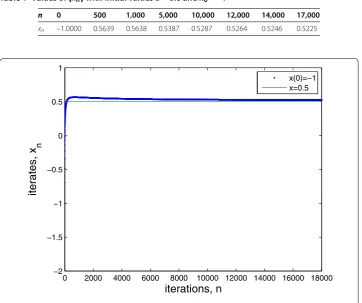
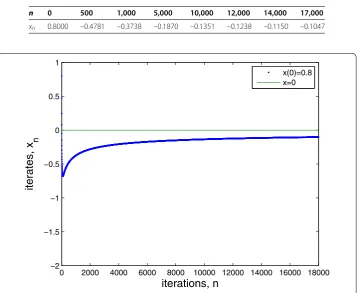
n+], we observe that the conditions of Theorem . are satisfied and scheme (.) pro-vides the data in Tables and and Figures and .
(i) Whenu= . andx= –, we see that the sequence converges tox∗= . as shown in Table and Figure .
(ii) Whenu= – andx= ., we see that the sequence converges tox∗= as shown in Table and Figure .
Table 1 Values of{xn}with initial valuesu= 0.6 andx0= –1
n 0 500 1,000 5,000 10,000 12,000 14,000 17,000
xn –1.0000 0.5639 0.5638 0.5387 0.5287 0.5264 0.5246 0.5225
Table 2 Values of{xn}with initial valuesu= –1 andx0= 0.8
n 0 500 1,000 5,000 10,000 12,000 14,000 17,000
xn 0.8000 –0.4781 –0.3738 –0.1870 –0.1351 –0.1238 –0.1150 –0.1047
Figure 2 Figure of{xn}with initial valuesu= –1 andx0= 0.8.
Remark . Theorem . provides a convergence sequence to a common fixed point of two Lipschitzian pseudocontractive mappings, whereas Theorem . provides a conver-gence sequence to a common fixed point of a finite family of Lipschitzian pseudocontrac-tive mappings. In addition, Corollary . provides a convergence sequence to a common zero of two Lipschitzian monotone mappings, whereas Theorem . provides a conver-gence sequence to a common zero of a finite family of Lipschitzian monotone mappings.
Remark . Theorem . improves Theorem ZSA, Theorem . of Daman and Zegeye [] in the sense that our convergence does not require the assumption that interior of F(T)is nonemptyorcondition(H).
Remark . Theorem . improves Theorem . of Zhou [], Theorem . of Yaoet al.
[] and Theorem . of Tanget al.[] in the sense that our convergence requires neither compactness ofT nor computation of closed and convexCnofCfor eachn≥.
Competing interests
The authors declare that they have no competing interests.
Authors’ contributions
All the authors contributed equally. All authors read and approved the final manuscript.
Author details
1Department of Mathematics, University of Botswana, Pvt. Bag 00704, Gaborone, Botswana.2Department of
Acknowledgements
This article was funded by the Deanship of Scientific Research (DSR), King Abdulaziz University, Jeddah. The second author acknowledges with thanks DSR for financial support.
Received: 8 April 2013 Accepted: 15 August 2013 Published: 5 September 2013 References
1. Browder, FE, Petryshyn, WV: Construction of fixed points of nonlinear mappings in Hilbert space. J. Math. Anal. Appl. 20, 197-228 (1967)
2. Zeidler, E: Nonlinear Functional Analysis and Its Applications, Part II: Monotone Operators. Springer, Berlin (1985) 3. Bauschke, HH, Borwein, JM: On projection algorithms for solving convex feasibility problems. SIAM Rev.38, 367-426
(1996)
4. Combettes, PL: The foundations of set theoretic estimation. Proc. IEEE81, 182-208 (1993)
5. Bauschke, HH: The approximation of fixed points of compositions of nonexpansive mappings in Hilbert spaces. J. Math. Anal. Appl.202, 150-159 (1996)
6. Halpern, B: Fixed points of nonexpansive maps. Bull. Am. Math. Soc.73, 957-961 (1967)
7. Colao, V, Marino, G, Xu, HK: An iterative method for finding common solutions of equilibrium and fixed point problems. J. Math. Anal. Appl.344, 340-352 (2008)
8. Yao, Y: A general iterative method for a finite family of nonexpansive mappings. Nonlinear Anal.66, 2676-2687 (2007) 9. Takahashi, S, Takahashi, W: Viscosity approximation methods for equilibrium problems and fixed point problems in
Hilbert spaces. J. Math. Anal. Appl.331, 506-515 (2007)
10. Plubtieng, S, Punpaeng, R: A general iterative method for equilibrium problems and fixed point problems in Hilbert spaces. J. Math. Anal. Appl.336, 455-469 (2007)
11. Ceng, LC, Cubiotti, P, Yao, JC: Strong convergence theorems for finitely many nonexpansive mappings and applications. Nonlinear Anal.67, 1464-1473 (2007)
12. Osilike, MO, Shehu, Y: Cyclic algorithm for common fixed points of finite family of strictly pseudocontractive mappings of Browder-Petryshyn type. Nonlinear Anal.70, 3575-3583 (2009)
13. Zegeye, H, Shahzad, N: Strong convergence theorems for a common zero of a countably infinite family ofλ-inverse strongly accretive mappings. Nonlinear Anal.71, 531-538 (2009)
14. Zegeye, H, Shahzad, N: Strong convergence theorems for a common zero of a finite family ofm-accretive mappings. Nonlinear Anal.66, 1161-1169 (2007)
15. Zhang, Y, Guo, Y: Weak convergence theorems of three iterative methods for strictly pseudocontractive mappings of Browder-Petryshyn type. Fixed Point Theory Appl.2008, Article ID 672301 (2008)
16. Zhou, H: Convergence theorems of fixed points for a finite family of Lipschitz pseudo-contractions in Banach spaces. Nonlinear Anal.68, 2977-2983 (2008)
17. Zegeye, H, Shahzadb, N, Alghamdi, MA: Convergence of Ishikawa’s iteration method for pseudocontractive mappings. Nonlinear Anal.74, 7304-7311 (2011)
18. Ishikawa, S: Fixed points by a new iteration method. Proc. Am. Math. Soc.44, 147-150 (1974) 19. Daman, OA, Zegeye, H: Strong convergence theorems for a common fixed point of a finite family of
pseudocontractive mappings. Int. J. Math. Math. Sci.2012, Article ID 405315 (2012). doi:10.1155/2012/405315 20. Zhou, H: Convergence theorems of fixed points for Lipschitz pseudo-contractions in Hilbert spaces. J. Math. Anal.
Appl.343, 546-556 (2008)
21. Alber, Y: Metric and generalized projection operators in Banach spaces: properties and applications. In: Kartsatos, AG (ed.) Theory and Applications of Nonlinear Operators of Accretive and Monotone Type. Lecture Notes in Pure and Appl. Math., vol. 178, pp. 15-50. Dekker, New York (1996)
22. Xu, HK: Another control condition in an iterative method for nonexpansive mappings. Bull. Aust. Math. Soc.65, 109-113 (2002)
23. Zhang, QB, Cheng, CZ: Strong convergence theorem for a family of Lipschitz pseudocontractive mappings in a Hilbert space. Math. Comput. Model.48, 480-485 (2008)
24. Maingé, PE: Strong convergence of projected subgradient methods for nonsmooth and non-strictly convex minimization. Set-Valued Anal.16, 899-912 (2008)
25. Zegeye, H, Shahzad, N: Convergence of Mann’s type iteration method for generalized asymptotically nonexpansive mappings. Comput. Math. Appl.62, 4007-4014 (2011)
26. Yao, YH, Liou, YC, Marino, G: A hybrid algorithm for pseudo-contractive mappings. Nonlinear Anal.71, 4997-5002 (2009)
27. Tang, Y-C, Peng, J-G, Liu, L-W: Strong convergence theorem for pseudocontractive mappings in Hilbert spaces. Nonlinear Anal.74, 380-385 (2011). doi:10.1016/j.na.2010.08.048
doi:10.1186/1687-1812-2013-234