The Thirty-Third AAAI Conference on Artificial Intelligence (AAAI-19)
Greedy Maximization of Functions with
Bounded Curvature under Partition Matroid Constraints
Tobias Friedrich,
1Andreas G¨obel,
1Frank Neumann,
2Francesco Quinzan,
1Ralf Rothenberger
11Chair of Algorithm Engineering, Hasso Plattner Institute, Potsdam, Germany
2Optimisation and Logistics, School of Computer Science, The University of Adelaide, Adelaide, Australia
Abstract
We investigate the performance of a deterministic GREEDY algorithm for the problem of maximizing functions under a partition matroid constraint. We consider non-monotone submodular functions and monotone subadditive functions. Even though constrained maximization problems of mono-tone submodular functions have been extensively studied, lit-tle is known about greedy maximization of non-monotone submodular functions or monotone subadditive functions.
We give approximation guarantees for GREEDY on these
problems, in terms of thecurvature. We find that this simple
heuristic yields a strong approximation guarantee on a broad class of functions.
We discuss the applicability of our results to three real-world problems: Maximizing the determinant function of a positive semidefinite matrix, and related problems such as the max-imum entropy sampling problem, the constrained maxmax-imum cut problem on directed graphs, and combinatorial auction games.
We conclude that GREEDYis well-suited to approach these
problems. Overall, we present evidence to support the idea that, when dealing with constrained maximization problems with bounded curvature, one needs not search for (approxi-mate) monotonicity to get good approximate solutions.
Introduction
Submodular functions capture the notion of diminishing re-turns, i.e. the more we acquire the less our marginal gain will be. This notion occurs frequently in the real world, thus, the problem of maximizing a submodular function finds applica-bility in a plethora of scenarios. Examples of such scenarios include: maximum cut problems (Goemans and Williamson 1995), combinatorial auctions (Maehara et al. 2017), facility location (Cornuejols, Fisher, and Nemhauser 1977), prob-lems in machine learning (Elenberg et al. 2017), coverage functions (Krause, Singh, and Guestrin 2008), online shop-ping (Tschiatschek, Singla, and Krause 2017). As such, the literature on submodular functions contains a vast number of results spanning over three decades.
Formally, a set functionf: 2V
→Rissubmodularif for
allU, W ⊆V,f(U) +f(W)≥f(U ∪W) +f(U∩W).
As these functions come from a variety of applications, in
Copyright c2019, Association for the Advancement of Artificial
Intelligence (www.aaai.org). All rights reserved.
this work we will assume that, given a set U ⊆ V, the
value f(U) is returned from an oracle. This is a
reason-able assumption as in most applicationsf(U)can be
com-puted efficiently. Often in these applications, a realistic so-lution is subject to some constraints. Among the most com-mon constraints are Matroid and Knapsack constraints — see (Lee et al. 2009). From these families of constraints the most natural and common type of constraints are uni-form matroid constraints also known as cardinality
con-straints. Optimizing a submodular function given k as a
cardinality constraint is equivalent to finding a setU, with
|U| ≤ k, that maximizes f(U). In this paper we
sider submodular maximization under partition matroid con-straints. These constraints are in the intersection of matroid and knapsack constaints and generalize uniform matroid constraints. In partition matroid constraints we are given
a collection B1, . . . , Bk of disjoint subsets of V, integers
d1. . . dk. Every feasible solution to our problem must then
include at mostdielements from each setBi. Submodular
maximization under partition matroid constraints are consid-ered in various applications, e.g. see (Lin and Bilmes 2010; Jegelka and Bilmes 2011).
As the literature in submodular optimization is immense, we will only review the results on submodular maximiza-tion under matroid and knapsack constraints. The classical result of (Cornuejols, Fisher, and Nemhauser 1977) shows
that a greedy algorithm achieves a1/2approximation ration
when maximizing monotone submodular functions under partition matroid constraints. (Nemhauser and Wolsey 1978) showed that no-polynomial time algorithm can achieve a
better approximation ratio than(1−1/e). Many years later
(C˘alinescu et al. 2011) where able to achieve this upper bound using a randomized algorithm. Recently (Buchbinder,
Feldman, and Garg 2018) achieved a deterministic
0.5008-approximation ratio by derandomizing search heuristics. The previous approximation ratios can be further im-proved when assuming that the rate of change of the
marginal values off is bounded. This is expressed by the
curvatureαof a function as in Definition 1. The results of
(Conforti and Cornu´ejols 1984; Vondr´ak 2010) show that a
continuous greedy algorithm gives a α1(1−e−α)
approxi-mation when maximizing a monotone submodular function
under any matroid constraint. Thus, whenα≤1.58933the
(Buch-binder, Feldman, and Garg 2018) and whenα≤1the con-tinuous greedy outperforms the algorithm of (C˘alinescu et al. 2011). Finally, (Bian et al. 2017) show that the
determin-istic greedy algorithm achieves aα1(1−e−α)approximation
when maximizing submodular monotone functions of
curva-tureα, but only under cardinality constraints.
All of the aforementioned approximation results rely on
the fact that f is monotone. In practice submodular
func-tions such as maximum cut, combinatorial aucfunc-tions, sensor placement and experimental design the functions need not be monotone. To solve such problems using simple greedy
algorithms, often assumptions are made that the functionf
is monotone or thatf is under some sense “close” to being
monotone. Practical problems that are solved using greedy algorithms under such assumptions can be found in many articles such as (Bian et al. 2017; Das and Kempe 2011; Lawrence, Seeger, and Herbrich 2002; Singh et al. 2009).
In this article we show that the greedy algorithm finds
a α1(1−e−α)-approximation inO(dn)oracle evaluations,
for the problem of maximizing a submodular function sub-ject to partition matroid constraints (Theorem 1). Our result extends previous known approximation ratios on monotone submodular functions to all submodular functions under par-tition matroid constraints.
Additionally, we extend the results on monotone submod-ular functions to another direction, to the class of mono-tone subadditive functions. Subadditivity is a natural prop-erty assumed to hold for functions evaluating items sold in combinatorial acutions (Bhawalkar and Roughgarden 2011;
Assadi 2017). Formally, we say that a set functionf: 2V
→
R issubadditive if for all U, W ⊆ V, f(U) +f(W) ≥
f(U∪W). We show (Theorem 2) that the greedy algorithm
achieves aα1(1−eα2−α)approximation ratio when
optimiz-ing monotone subadditive functions with curvatureαunder
partition matroid constraints.
We motivate our results by considering three real world applications. The first application we consider is to maxi-mize the logarithm of determinant functions. In this setting
we are given a matrixPand we want to find the submatrixA
ofDwith the largest determinant, whereAsatisfies matroid
partition constraints. This problem appears in a variety of real world settings. In this article, as a real world example of this application, we compute the sensor (thermometer) placement across the world that maximizes entropy, subject to a cardinality constraint and subject to a partition matroid constrain where the partitions of the data sets are countries.
Our second application is the problem of finding the max-imum directed cut of a graph, under partition matroid con-straints. The cut function of a graph is known to be sub-modular and non-monotone in general (Feige, Mirrokni, and Vondr´ak 2011). We show how to bound the curvature of the cut function with respect to the maximum degree. We also run experiments on this setting, showing that in most graphs of our dataset the deterministic greedy algorithm finds the
actual optimal solution. Thus GREEDY seems to perform
well on non-monotone submodular functions in practice. Finally, the third application is computing the social wel-fare of a subadditive combinatorial auction. We show that the social welfare is also a subadditive function and its
cur-vature is bounded by the maximum curcur-vature of the utility functions.
Due to space limitations, the proofs of our theorems can be found on the arxiv version of our paper (Friedrich et al.
2018). Our experimental code is available on github1.
Preliminary Definitions and Algorithms
Problem description.
Letf: 2V
−→R≥0be a non-negative function over a setV
of sizen, letB1, . . . , Bk be a collection of disjoint subsets
ofV, and letdi integers s.t.1 ≤ di ≤ |Bi|, ∀i ∈ [k]. We
consider the maximization problem
max
S⊆V{f(S) :|S∩Bi| ≤di, ∀i∈[k]}. (1)
Note that the problem of maximizingf under a cardinality
constrain is a special case of the above, where k = 1and
B1=V.
We evaluate the quality of an approximation of a global
maximum as follows. Let U ⊆ V be a feasible solution
to Problem (1). We say that U is an ε-approximation if
f(OPT)/f(U) ≥ ε, whereOPTis the optimal solution set.
We often refer to the valuef(U)as thef-value ofU.
In this paper, we evaluate run time in the black-box oracle model: We assume that there exists an oracle that returns
the correspondingf-value of a solution candidate, and we
estimate the run time, by counting the total number of calls to the valuation oracle.
To simplify the exposition, throughout our analyses, we always assume that the following reduction holds.
Reduction 1 For Problem(1) we may assumecdi ≤ |Bi|
for alli= 1, . . . , k, for an arbitrary constantc >0.
More-over, we may assume that there exists a setDi ⊆Biof size
dis.t.f(S) =f(S\Di)for allS⊆V, for alli= 1, . . . , k.
Algorithms.
GREEDY is the simple discrete greedy algorithm that
ap-pears in Algorithm 1. Starting with the empty set, GREEDY
iteratively adds points that maximize the marginal values with respect to the already found solution. This algorithm is a mild generalization of the simple deterministic greedy due to Nemhauser and Wolsey (Nemhauser and Wolsey 1978).
Notation.
For any non-negative functionf: 2V
−→R≥0and any two
subsetsS,Ω⊆ V, we define themarginal valueofSwith
respect toΩasρΩ(S) =f(S∪Ω)−f(S).
We denote withB1, . . . , Bkdisjoint subsets ofV and with
d1, . . . , dktheir respective sizes, as in the problem
descrip-tion secdescrip-tion. We denote withdthe sumPk
j=1dj. We denote
withDthe subset of “dummy” elements as in Reduction 1,
and we denote withOPTany solution to Problem (1), such
thatOPT∩D=∅.
We letStbe a solution found by GREEDY at time step
tand we denote withρtthe marginal valueρt =f(St)−
f(St−1). We use the conventionρ0=f(∅).
1
Algorithm 1:The GREEDYalgorithm.
input:a functionf:V −→R≥0;
disjoint subsetsB1, . . . , Bk⊆V;
integersd1, . . . , dks.t.0≤di≤ |Bi|, ∀i∈[k];
output:an approximate global maximumSoffs.t.|S∩Bi| ≤di, ∀i∈[k];
S← ∅;
while|S| ≤Pk
i=1dido
letω∈V maximizingf(S∪ {ω})−f(S)and s.t.|(S∪ {ω})∩Bi| ≤di, ∀i∈[k];
S←S∪ {ω};
returnS;
Curvature
In this paper we give approximation guarantees in terms of
thecurvature. Intuitively, the curvature is a parameter that
bounds the maximum rate with which a function changes.
As our functionsf map sets to positive reals, i.e.f: 2V
−→
R≥0, we say thatfhas curvatureαif the valuef(S∪{ω})−
f(S)does not change by a factor larger than1−αwhen
varyingS. This parameter was first introduced by (Conforti
and Cornu´ejols 1984) to beat the(1−e−1)-approximation
barrier of monotone submodular functions. Formally we use the following definition of curvature, relaxing the definition
ofgreedycurvature (Bian et al. 2017).
Definition 1 (Curvature) Consider a non-negative
func-tionf: 2V
−→ Ras in Problem (1). The curvature is the
smallest scalarαs.t.
ρω((S∪Ω)\ {ω})≥(1−α)ρω(S\ {ω}),
for allS,Ω⊆V of size at mostP
idiandω∈S\Ω.
Note thatα≥0. We say that a functionf haspositive
cur-vatureif α ≤ 1. We further observe that the curvature of
a monotone function is alwaysα≤1. Hence, all functions
with negative curvature are non-monotone. We remark that the curvature is invariant under multiplication by a positive
scalar. In other words, if a functionf has curvatureα, then
any functioncf has curvatureα, for all c > 0. Moreover,
the following simple result holds.
Proposition 1 Letf, g: 2V
−→R≥0be non-negative
func-tions with curvatureα1, α2respectively. Then the curvature
αof the functionf +gis upper-bounded asα≤supiαi.
In the case of a submodular function, it is possible to give a simple characterization of Definition 1. In fact, one can easily prove the following.
Proposition 2 Letf: 2V
−→ R≥0be a submodular
func-tion with curvatureα, as in Problem(1). Then,
α≤1− min
{S⊆V, ω∈S}
f(S)−f(S\ {ω})
f(ω)−f(∅) ,
for all subsetsS⊆V s.t.|S| ≤P
idi
Proposition 2 gives the original definition of curvature for submodular functions (Conforti and Cornu´ejols 1984). However, the inequality of Proposition 2 does not necessar-ily hold for non-submodular functions.
Approximation Guarantees
We give approximation guarantees for GREEDYon Problem
(1), when optimizing a (non-monotone) submodular
func-tion with bounded curvatureα. Our proof technique
gener-alizes the results of (Conforti and Cornu´ejols 1984) to
non-monotone functions f by utilizing the notion of curvature.
We have the following theorem.
Theorem 1 Letf be a submodular function with curvature
α.GREEDY is a α1(1−e−α)-approximation algorithm for
Problem(1)with run-time inO(dn).
Note that iff is monotone, then our approximation
guar-antee matches the approximation guarguar-antee of Conforti and Cornu´ejols, which is known to be nearly optimal (Conforti and Cornu´ejols 1984; Vondr´ak 2010). Furthermore, in the non-monotone case our lower-bound may yield significant improvement over state-of-the-art known bounds (Buch-binder et al. 2014; Buch(Buch-binder and Feldman 2018).
Partic-ularly, we beat the 1/e-approximation barrier on functions
with curvatureα≤2.49375and the1/2-approximation
bar-rier on functions with curvatureα≤1.59362.
Observation 1 There exists a submodular functionf with
curvatureα=n, such thatGREEDYdoes not find a solution
which is better than a1/napproximation of OPT. Therefore,
the approximation guarantee of Theorem 1 is asymptotically tight.
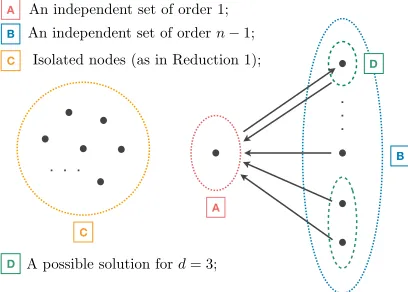
We give a formal description of Observation 1 for the con-strained maximum directed cut problem on a graph in Figure 1.
We give some approximation guarantee for GREEDY,
as-suming that the function f is monotone subadditive. Our
proof method further generalizes the proof of (Conforti and Cornu´ejols 1984). The following theorem holds.
Theorem 2 Letf be a monotone subadditive function with
curvature α ∈ [0,1], and suppose that f(∅) = 0. Then
GREEDY is a α1(1−eα2−α)-approximation algorithm for
Problem(1)with run-time inO(dn).
To our knowledge, this is the first approximation guarantee
for the simple GREEDYmaximizing a monotone subadditive
Applications
Maximizing the logarithm of determinant
functions.
An n×nmatrixP is positive definite ifP is symmetric
and all its eigenvalues λ1, . . . , λn are strictly greater than
0. Consider such ann×npositive definite matrixP. The
determinant functiondetP : {0,1}n →R≥0, with input an
arrayx∈ {0,1}n, returns the determinant of the square
sub-matrix ofPindexed byx. We search for a sub-matrix ofP
that satisfies a partition or a cardinality constraint, and such
thatlogdet is maximal.
Variations of this setting can be found in informative vec-tor machines (Lawrence, Seeger, and Herbrich 2002) and in maximum entropy sampling problems (Krause, Singh, and Guestrin 2008).
The constrained problem of maximizinglogdetP studied
in the context of maximizing submodular functions under a single matroid constraint with a continuous greedy and non-oblivious local search (Sviridenko, Vondr´ak, and Ward 2017).
The problem of maximizing detP under a cardinality
con-straint is studied in (Bian et al. 2017), whenP is a matrix
of the formP =I+σΣ, withIthen×nidentity matrix,
Σa positive semidefinite matrix, andσ >0a scalar. In this
case, the functiondetP is monotone, supermodular, and the
submodularity ratio can be estimated in terms of the
eigen-values. Note that a matrix of the formI+σΣalways has
eigenvaluesλj≥1.
We study the problem of maximizing detP under a
parti-tion matroid constraint, assuming that P is positive
def-inite with eigenvalues λj ≥ 1. We show that in this
case the simple greedy algorithm is sufficient to obtain a
nearly-optimal approximation guarantee. IflogdetP is
non-constant, using Proposition 2 we can upper bound the
ac-tivity by α ≤ 1−1/λ, where λthe largest eigenvalue of
P (Sviridenko, Vondr´ak, and Ward 2017). Thus, GREEDY
gives a(1−1/λ) (1−e1/λ−1)-approximation for Problem
(1) whenf = logdetP with runtime inO(nd). We do not
assume that the eigenvalues are such that λj > 1, so our
analysis applies to monotone as well as non-monotone
func-tions. For instance, consider the functionlogdetAwith
A=
δ √δ−1
√
δ−1 1
for allδ > 1. In this case, the functionlog detA is neither
monotone, nor approximately monotone (Lee et al. 2009;
Krause, Singh, and Guestrin 2008). GREEDY, nevertheless,
finds a(1−1/δ) (1−e1/δ−1)-approximation of the global
optimum under partition matroid constraints.
We can further generalize this result to more complex
function, by means of Proposition 1. For instance, letf be
the entropy function of a Gaussian process, as defined in
(4). Then the functionf is the sum of a linear term((1 +
ln(2π))/2)|S|and1/2 ln detΣ(S), for a positive
semidef-inite matrix Σ with eigenvalues λj ≥ 1. This function
is submodular, because both terms are submodular.
More-over, the linear term has curvatureα = 0, and the function
1/2 ln detΣ(S)has curvature 1−1/λ, with λthe largest
Figure 1: We consider a bipartite graph with nnodes and
partitionsAandB. In this example, there’s only one node
in A, and n−1 nodes in B. Moreover, there’s only one
edge fromAtoB, whereas there is one edge from each node
inB toA. Since all nodes inAandB have equalf-value
the GREEDYmay output Aas a solution to maximum cut
under uniform constrain of any size d. This yields a
1/d-approximation of the global optimum.
A
A
B
D
B
D
. . .
C
. . .
C
An independent set of order 1;
<latexit sha1_base64="slcr6GXtK1w4Ou7abiSUJ2wXiKA=">AAACD3icbVC7TsMwFHV4lvIKMLJYtAimKkGVALEUsTAWidJKbVU5zk1r1bEj20FUUT+BhV9hYQDEysrG3+A+Bmg5kq2jc+617z1Bwpk2nvftLCwuLa+s5tby6xubW9vuzu6dlqmiUKOSS9UIiAbOBNQMMxwaiQISBxzqQf9q5NfvQWkmxa0ZJNCOSVewiFFirNRxj1pxIB+yS4GZCCEBewmDNRgsIyxVCAoX/eLFsOMWvJI3Bp4n/pQU0BTVjvvVCiVNY/sc5UTrpu8lpp0RZRjlMMy3Ug0JoX3ShaalgsSg29l4oSE+tEqII6nsseOM1d8dGYm1HsSBrYyJ6elZbyT+5zVTE521MyaS1ICgk4+ilGMj8SgdHDIF1PCBJYQqZmfFtEcUocZmmLch+LMrz5PaSem85N+UC5XyNI0c2kcH6Bj56BRV0DWqohqi6BE9o1f05jw5L8678zEpXXCmPXvoD5zPH5v4m88=</latexit>
<latexit sha1_base64="slcr6GXtK1w4Ou7abiSUJ2wXiKA=">AAACD3icbVC7TsMwFHV4lvIKMLJYtAimKkGVALEUsTAWidJKbVU5zk1r1bEj20FUUT+BhV9hYQDEysrG3+A+Bmg5kq2jc+617z1Bwpk2nvftLCwuLa+s5tby6xubW9vuzu6dlqmiUKOSS9UIiAbOBNQMMxwaiQISBxzqQf9q5NfvQWkmxa0ZJNCOSVewiFFirNRxj1pxIB+yS4GZCCEBewmDNRgsIyxVCAoX/eLFsOMWvJI3Bp4n/pQU0BTVjvvVCiVNY/sc5UTrpu8lpp0RZRjlMMy3Ug0JoX3ShaalgsSg29l4oSE+tEqII6nsseOM1d8dGYm1HsSBrYyJ6elZbyT+5zVTE521MyaS1ICgk4+ilGMj8SgdHDIF1PCBJYQqZmfFtEcUocZmmLch+LMrz5PaSem85N+UC5XyNI0c2kcH6Bj56BRV0DWqohqi6BE9o1f05jw5L8678zEpXXCmPXvoD5zPH5v4m88=</latexit>
<latexit sha1_base64="slcr6GXtK1w4Ou7abiSUJ2wXiKA=">AAACD3icbVC7TsMwFHV4lvIKMLJYtAimKkGVALEUsTAWidJKbVU5zk1r1bEj20FUUT+BhV9hYQDEysrG3+A+Bmg5kq2jc+617z1Bwpk2nvftLCwuLa+s5tby6xubW9vuzu6dlqmiUKOSS9UIiAbOBNQMMxwaiQISBxzqQf9q5NfvQWkmxa0ZJNCOSVewiFFirNRxj1pxIB+yS4GZCCEBewmDNRgsIyxVCAoX/eLFsOMWvJI3Bp4n/pQU0BTVjvvVCiVNY/sc5UTrpu8lpp0RZRjlMMy3Ug0JoX3ShaalgsSg29l4oSE+tEqII6nsseOM1d8dGYm1HsSBrYyJ6elZbyT+5zVTE521MyaS1ICgk4+ilGMj8SgdHDIF1PCBJYQqZmfFtEcUocZmmLch+LMrz5PaSem85N+UC5XyNI0c2kcH6Bj56BRV0DWqohqi6BE9o1f05jw5L8678zEpXXCmPXvoD5zPH5v4m88=</latexit>
<latexit sha1_base64="slcr6GXtK1w4Ou7abiSUJ2wXiKA=">AAACD3icbVC7TsMwFHV4lvIKMLJYtAimKkGVALEUsTAWidJKbVU5zk1r1bEj20FUUT+BhV9hYQDEysrG3+A+Bmg5kq2jc+617z1Bwpk2nvftLCwuLa+s5tby6xubW9vuzu6dlqmiUKOSS9UIiAbOBNQMMxwaiQISBxzqQf9q5NfvQWkmxa0ZJNCOSVewiFFirNRxj1pxIB+yS4GZCCEBewmDNRgsIyxVCAoX/eLFsOMWvJI3Bp4n/pQU0BTVjvvVCiVNY/sc5UTrpu8lpp0RZRjlMMy3Ug0JoX3ShaalgsSg29l4oSE+tEqII6nsseOM1d8dGYm1HsSBrYyJ6elZbyT+5zVTE521MyaS1ICgk4+ilGMj8SgdHDIF1PCBJYQqZmfFtEcUocZmmLch+LMrz5PaSem85N+UC5XyNI0c2kcH6Bj56BRV0DWqohqi6BE9o1f05jw5L8678zEpXXCmPXvoD5zPH5v4m88=</latexit>
A possible solution ford= 3;
<latexit sha1_base64="ZpE/EhtH/uiV59+6p/yzoyCMqeU=">AAACDXicbVA9T8MwFHTKVylfAUYWi6oSU5VAJUAIqYiFsUiEVmqjynGd1qpjR7aDqKL+Ahb+CgsDIFZ2Nv4NTpoBCjed7t7pvXdBzKjSjvNllRYWl5ZXyquVtfWNzS17e+dWiURi4mHBhOwESBFGOfE01Yx0YklQFDDSDsaXmd++I1JRwW/0JCZ+hIachhQjbaS+XetFgbhPL2AslKImBZVgSebBUEg4HcBzeHTWt6tO3ckB/xK3IFVQoNW3P3sDgZOIcI0ZUqrrOrH2UyQ1xYxMK71EkRjhMRqSrqEcRUT5af7OFNaMMsjXh4JrmKs/EymKlJpEgZmMkB6peS8T//O6iQ5P/JTyONGE49miMGFQC5h1AwdUEqzZxBCEJTW3QjxCEmFtGqyYEtz5l/8S77B+WnevG9Vmo2ijDPbAPjgALjgGTXAFWsADGDyAJ/ACXq1H69l6s95noyWryOyCX7A+vgFSJZsi</latexit>
<latexit sha1_base64="ZpE/EhtH/uiV59+6p/yzoyCMqeU=">AAACDXicbVA9T8MwFHTKVylfAUYWi6oSU5VAJUAIqYiFsUiEVmqjynGd1qpjR7aDqKL+Ahb+CgsDIFZ2Nv4NTpoBCjed7t7pvXdBzKjSjvNllRYWl5ZXyquVtfWNzS17e+dWiURi4mHBhOwESBFGOfE01Yx0YklQFDDSDsaXmd++I1JRwW/0JCZ+hIachhQjbaS+XetFgbhPL2AslKImBZVgSebBUEg4HcBzeHTWt6tO3ckB/xK3IFVQoNW3P3sDgZOIcI0ZUqrrOrH2UyQ1xYxMK71EkRjhMRqSrqEcRUT5af7OFNaMMsjXh4JrmKs/EymKlJpEgZmMkB6peS8T//O6iQ5P/JTyONGE49miMGFQC5h1AwdUEqzZxBCEJTW3QjxCEmFtGqyYEtz5l/8S77B+WnevG9Vmo2ijDPbAPjgALjgGTXAFWsADGDyAJ/ACXq1H69l6s95noyWryOyCX7A+vgFSJZsi</latexit>
<latexit sha1_base64="ZpE/EhtH/uiV59+6p/yzoyCMqeU=">AAACDXicbVA9T8MwFHTKVylfAUYWi6oSU5VAJUAIqYiFsUiEVmqjynGd1qpjR7aDqKL+Ahb+CgsDIFZ2Nv4NTpoBCjed7t7pvXdBzKjSjvNllRYWl5ZXyquVtfWNzS17e+dWiURi4mHBhOwESBFGOfE01Yx0YklQFDDSDsaXmd++I1JRwW/0JCZ+hIachhQjbaS+XetFgbhPL2AslKImBZVgSebBUEg4HcBzeHTWt6tO3ckB/xK3IFVQoNW3P3sDgZOIcI0ZUqrrOrH2UyQ1xYxMK71EkRjhMRqSrqEcRUT5af7OFNaMMsjXh4JrmKs/EymKlJpEgZmMkB6peS8T//O6iQ5P/JTyONGE49miMGFQC5h1AwdUEqzZxBCEJTW3QjxCEmFtGqyYEtz5l/8S77B+WnevG9Vmo2ijDPbAPjgALjgGTXAFWsADGDyAJ/ACXq1H69l6s95noyWryOyCX7A+vgFSJZsi</latexit>
<latexit sha1_base64="ZpE/EhtH/uiV59+6p/yzoyCMqeU=">AAACDXicbVA9T8MwFHTKVylfAUYWi6oSU5VAJUAIqYiFsUiEVmqjynGd1qpjR7aDqKL+Ahb+CgsDIFZ2Nv4NTpoBCjed7t7pvXdBzKjSjvNllRYWl5ZXyquVtfWNzS17e+dWiURi4mHBhOwESBFGOfE01Yx0YklQFDDSDsaXmd++I1JRwW/0JCZ+hIachhQjbaS+XetFgbhPL2AslKImBZVgSebBUEg4HcBzeHTWt6tO3ckB/xK3IFVQoNW3P3sDgZOIcI0ZUqrrOrH2UyQ1xYxMK71EkRjhMRqSrqEcRUT5af7OFNaMMsjXh4JrmKs/EymKlJpEgZmMkB6peS8T//O6iQ5P/JTyONGE49miMGFQC5h1AwdUEqzZxBCEJTW3QjxCEmFtGqyYEtz5l/8S77B+WnevG9Vmo2ijDPbAPjgALjgGTXAFWsADGDyAJ/ACXq1H69l6s95noyWryOyCX7A+vgFSJZsi</latexit>
An independent set of ordern 1;
<latexit sha1_base64="fxNO5SwGmMiQJ07Y3xNRTCtPbMc=">AAACE3icbVDLSgMxFM3UV62vqks3wVYQxDIjBRU3FTcuK1hbaEvJZO60oZlkSDJiGfoRbvwVNy5U3Lpx59+YPhbaeiDhcM69yb3HjznTxnW/nczC4tLySnY1t7a+sbmV39650zJRFGpUcqkaPtHAmYCaYYZDI1ZAIp9D3e9fjfz6PSjNpLg1gxjaEekKFjJKjJU6+aNW5MuH9FJgJgKIwV7CYA0GyxBLFYDCRYGPsVe8GHbyBbfkjoHniTclBTRFtZP/agWSJpF9knKiddNzY9NOiTKMchjmWomGmNA+6ULTUkEi0O10vNQQH1glwKFU9tiRxurvjpREWg8i31ZGxPT0rDcS//OaiQnP2ikTcWJA0MlHYcKxkXiUEA6YAmr4wBJCFbOzYtojilBjc8zZELzZledJ7aR0XvJuyoVKeZpGFu2hfXSIPHSKKugaVVENUfSIntErenOenBfn3fmYlGacac8u+gPn8we0upzS</latexit>
<latexit sha1_base64="fxNO5SwGmMiQJ07Y3xNRTCtPbMc=">AAACE3icbVDLSgMxFM3UV62vqks3wVYQxDIjBRU3FTcuK1hbaEvJZO60oZlkSDJiGfoRbvwVNy5U3Lpx59+YPhbaeiDhcM69yb3HjznTxnW/nczC4tLySnY1t7a+sbmV39650zJRFGpUcqkaPtHAmYCaYYZDI1ZAIp9D3e9fjfz6PSjNpLg1gxjaEekKFjJKjJU6+aNW5MuH9FJgJgKIwV7CYA0GyxBLFYDCRYGPsVe8GHbyBbfkjoHniTclBTRFtZP/agWSJpF9knKiddNzY9NOiTKMchjmWomGmNA+6ULTUkEi0O10vNQQH1glwKFU9tiRxurvjpREWg8i31ZGxPT0rDcS//OaiQnP2ikTcWJA0MlHYcKxkXiUEA6YAmr4wBJCFbOzYtojilBjc8zZELzZledJ7aR0XvJuyoVKeZpGFu2hfXSIPHSKKugaVVENUfSIntErenOenBfn3fmYlGacac8u+gPn8we0upzS</latexit>
<latexit sha1_base64="fxNO5SwGmMiQJ07Y3xNRTCtPbMc=">AAACE3icbVDLSgMxFM3UV62vqks3wVYQxDIjBRU3FTcuK1hbaEvJZO60oZlkSDJiGfoRbvwVNy5U3Lpx59+YPhbaeiDhcM69yb3HjznTxnW/nczC4tLySnY1t7a+sbmV39650zJRFGpUcqkaPtHAmYCaYYZDI1ZAIp9D3e9fjfz6PSjNpLg1gxjaEekKFjJKjJU6+aNW5MuH9FJgJgKIwV7CYA0GyxBLFYDCRYGPsVe8GHbyBbfkjoHniTclBTRFtZP/agWSJpF9knKiddNzY9NOiTKMchjmWomGmNA+6ULTUkEi0O10vNQQH1glwKFU9tiRxurvjpREWg8i31ZGxPT0rDcS//OaiQnP2ikTcWJA0MlHYcKxkXiUEA6YAmr4wBJCFbOzYtojilBjc8zZELzZledJ7aR0XvJuyoVKeZpGFu2hfXSIPHSKKugaVVENUfSIntErenOenBfn3fmYlGacac8u+gPn8we0upzS</latexit>
<latexit sha1_base64="fxNO5SwGmMiQJ07Y3xNRTCtPbMc=">AAACE3icbVDLSgMxFM3UV62vqks3wVYQxDIjBRU3FTcuK1hbaEvJZO60oZlkSDJiGfoRbvwVNy5U3Lpx59+YPhbaeiDhcM69yb3HjznTxnW/nczC4tLySnY1t7a+sbmV39650zJRFGpUcqkaPtHAmYCaYYZDI1ZAIp9D3e9fjfz6PSjNpLg1gxjaEekKFjJKjJU6+aNW5MuH9FJgJgKIwV7CYA0GyxBLFYDCRYGPsVe8GHbyBbfkjoHniTclBTRFtZP/agWSJpF9knKiddNzY9NOiTKMchjmWomGmNA+6ULTUkEi0O10vNQQH1glwKFU9tiRxurvjpREWg8i31ZGxPT0rDcS//OaiQnP2ikTcWJA0MlHYcKxkXiUEA6YAmr4wBJCFbOzYtojilBjc8zZELzZledJ7aR0XvJuyoVKeZpGFu2hfXSIPHSKKugaVVENUfSIntErenOenBfn3fmYlGacac8u+gPn8we0upzS</latexit>
Isolated nodes (as in Reduction 1);
<latexit sha1_base64="559CtjtBn/h/VKus9QJSERKxAzs=">AAACEnicbVDLSgMxFM3UV62vqks3wSJUF2VGCipuCm50V8WxhbaUTOa2Dc0kQ5IRy9B/cOOvuHGh4taVO//G9LHQ1gOBwznncnNPEHOmjet+O5mFxaXllexqbm19Y3Mrv71zp2WiKPhUcqnqAdHAmQDfMMOhHisgUcChFvQvRn7tHpRmUtyaQQytiHQF6zBKjJXa+aNmFMiH9EpLTgyEWMgQNC4SjZnANxAmdJTD3uH5sJ0vuCV3DDxPvCkpoCmq7fxXM5Q0iUAYyonWDc+NTSslyjDKYZhrJhpiQvukCw1LBYlAt9LxTUN8YJUQd6SyTxg8Vn9PpCTSehAFNhkR09Oz3kj8z2skpnPaSpmIEwOCThZ1Eo6NxKOCcMgUUMMHlhCqmP0rpj2iCDW2xpwtwZs9eZ74x6WzknddLlTK0zayaA/toyLy0AmqoEtURT6i6BE9o1f05jw5L8678zGJZpzpzC76A+fzBwthnSI=</latexit>
<latexit sha1_base64="559CtjtBn/h/VKus9QJSERKxAzs=">AAACEnicbVDLSgMxFM3UV62vqks3wSJUF2VGCipuCm50V8WxhbaUTOa2Dc0kQ5IRy9B/cOOvuHGh4taVO//G9LHQ1gOBwznncnNPEHOmjet+O5mFxaXllexqbm19Y3Mrv71zp2WiKPhUcqnqAdHAmQDfMMOhHisgUcChFvQvRn7tHpRmUtyaQQytiHQF6zBKjJXa+aNmFMiH9EpLTgyEWMgQNC4SjZnANxAmdJTD3uH5sJ0vuCV3DDxPvCkpoCmq7fxXM5Q0iUAYyonWDc+NTSslyjDKYZhrJhpiQvukCw1LBYlAt9LxTUN8YJUQd6SyTxg8Vn9PpCTSehAFNhkR09Oz3kj8z2skpnPaSpmIEwOCThZ1Eo6NxKOCcMgUUMMHlhCqmP0rpj2iCDW2xpwtwZs9eZ74x6WzknddLlTK0zayaA/toyLy0AmqoEtURT6i6BE9o1f05jw5L8678zGJZpzpzC76A+fzBwthnSI=</latexit>
<latexit sha1_base64="559CtjtBn/h/VKus9QJSERKxAzs=">AAACEnicbVDLSgMxFM3UV62vqks3wSJUF2VGCipuCm50V8WxhbaUTOa2Dc0kQ5IRy9B/cOOvuHGh4taVO//G9LHQ1gOBwznncnNPEHOmjet+O5mFxaXllexqbm19Y3Mrv71zp2WiKPhUcqnqAdHAmQDfMMOhHisgUcChFvQvRn7tHpRmUtyaQQytiHQF6zBKjJXa+aNmFMiH9EpLTgyEWMgQNC4SjZnANxAmdJTD3uH5sJ0vuCV3DDxPvCkpoCmq7fxXM5Q0iUAYyonWDc+NTSslyjDKYZhrJhpiQvukCw1LBYlAt9LxTUN8YJUQd6SyTxg8Vn9PpCTSehAFNhkR09Oz3kj8z2skpnPaSpmIEwOCThZ1Eo6NxKOCcMgUUMMHlhCqmP0rpj2iCDW2xpwtwZs9eZ74x6WzknddLlTK0zayaA/toyLy0AmqoEtURT6i6BE9o1f05jw5L8678zGJZpzpzC76A+fzBwthnSI=</latexit>
<latexit sha1_base64="559CtjtBn/h/VKus9QJSERKxAzs=">AAACEnicbVDLSgMxFM3UV62vqks3wSJUF2VGCipuCm50V8WxhbaUTOa2Dc0kQ5IRy9B/cOOvuHGh4taVO//G9LHQ1gOBwznncnNPEHOmjet+O5mFxaXllexqbm19Y3Mrv71zp2WiKPhUcqnqAdHAmQDfMMOhHisgUcChFvQvRn7tHpRmUtyaQQytiHQF6zBKjJXa+aNmFMiH9EpLTgyEWMgQNC4SjZnANxAmdJTD3uH5sJ0vuCV3DDxPvCkpoCmq7fxXM5Q0iUAYyonWDc+NTSslyjDKYZhrJhpiQvukCw1LBYlAt9LxTUN8YJUQd6SyTxg8Vn9PpCTSehAFNhkR09Oz3kj8z2skpnPaSpmIEwOCThZ1Eo6NxKOCcMgUUMMHlhCqmP0rpj2iCDW2xpwtwZs9eZ74x6WzknddLlTK0zayaA/toyLy0AmqoEtURT6i6BE9o1f05jw5L8678zGJZpzpzC76A+fzBwthnSI=</latexit>
eigenvalue ofΣ. Hence, we combine Theorem 1 with
Propo-sition 1 to conclude that GREEDYis a(1−1/λ)(1−e1/λ−1
)-approximation algorithm for Problem (1), withfthe entropy
as in (4). Note that our analysis does not require
monotonic-ity, and it holds for matrices such asΣ =A.
Finding the maximum directed cut of a graph.
LetG = (V, E)be a graph with nvertices andmedges,
together with a non-negative weight functionw:E→R≥0.
We consider the problem of finding a subsetU ⊆V of nodes
such that the sum of the weights on the outgoing edges ofU
is maximal. This problem is the maximum directed cut
prob-lem known to be NP-complete. We consider a constrained
version of this problem, as in Problem (1). We consider both directed and undirected graphs. We first define the cut func-tion as follows.
Let G = (V, E) and w be as above. For each subset
of nodes U ⊆ V, consider the set C(U) = {(e1, e2) ∈
E: e1 ∈ U ande2 ∈/ U} of the edges leaving U. We
define the cut function f: 2V
→ R≥0 with f(U) =
P
e∈C(U)w(e).
The constrained maximum directed cut problem can be approached by maximizing the cut function under a uniform cardinality constraint. Since we require the weights to be non-negative, this function is also non-negative. As noted in (Feige, Mirrokni, and Vondr´ak 2011), the cut function is always submodular and, in general, non-monotone.
Denote with∆+ the maximum out-degree ofG, i.e. the
maximum degree when countingoutgoingedges and denote
with∆−the maximum in-degree ofG, obtained by counting
theincomingedges only. Then from Proposition 2 the
as
α≤1 +inf{d,∆
−}
∆+ . (2)
WhenGis undirected,∆− = ∆+ and, therefore,α
≤ 2.
Thus, Theorem 1 yields that GREEDY is a 1/2(1−e−2
)-approximation algorithm for the constrained maximum cut
problem. This approximation guarantee improves asd
de-creases.
WhenG is a directed graph the approximation
guaran-tee can drop to1/d. Consider a bipartite graphG= (V, E)
withnvertices andnedges of weight 1 described as follows
(see Figure 1). LetA, Bbe the partitions ofV.Acontains
exactly one node andB containsn−1nodes. The unique
vertex of A has exactly one outgoing edge to a vertex in
B. Each vertex inB has an outgoing edge to the only
ver-tex ofA. When maximizing the cut function of this graph
Gunder the special case of cardinality constraintd, the
op-timal solution consists of dnodes inB. GREEDYthough,
may outputA as a possible solution, which yields only a
1/d-approximation of the optimal solution. In this case the
curvature isα≥d. However, we show experimentally that
the GREEDY performs well on a variety of real-world
net-works. We remark that in real-world networks the degree
∆+is expected to grow in the problem size (Newman 2003;
Albert and Barabasi 2001).
Social welfare in combinatorial auctions.
We consider combinatorial auctions withnplayers
compet-ing formitems, where the items can have different values
for each player. Moreover, the value of each item for a player may depend on the particular combination of items allocated
to that player. For any given playeri = 1, . . . , n, the value
of a combination of items is expressed by theutility
func-tion ui: 2[m]
→ R≥0. The objective of the social welfare
problem (SW) is to find disjoint setsS1, . . . , Snmaximizing
the total welfare Pn
i=1ui(Si). Following (Bhawalkar and
Roughgarden 2011), we make following natural assump-tions on all utility funcassump-tions:
1. ui(∅) = 0;
2. ui(U∪T)≤ui(U) +ui(T)for allU, T ⊆M;
3. ui(U)≤ui(T)for allU ⊆T ⊆M.
Since an explicit description of a utility function may require
exponential space, we assume the existence of anoracle
re-turns the values ofuifor sets of items. In the literature,
vari-ous oracle models have been considered (Dobzinski, Nisan, and Schapira 2010). We study the case where for each
util-ity function ui and any set of items S ⊆ M there exists
an oracle that returns the valueui(S). We refer to this
set-ting asvalue oracle model. We remark that in the context
of combinatorial auctions, the utility functionuiof a player
is unknown to other players. Thus players may choose not to reveal the true value of the cost functions. In this setting,
however, we assume all players to betruthful.
We formalize SW as a maximization problem under a partition matroid constraint, following (Feige and Vondr´ak
2010). For a given set of itemsM andn players, we
de-fine a ground setX = [n]×M. The elements of X are
copies of the items inM. For each player we require a copy
of each item inM. For each playeriwe define a mapping
πi : 2X
7−→ 2N that assigns copies of items to respective
players. In other words, for each setI×S⊆Xit holds
πi(I×S) ={ω∈M: (i, ω)∈I×S}.
Given utility functionsu1, . . . , un, the social welfare
prob-lem (SW) consists then of maximizing the following func-tion
f(S) =
n
X
i=1
ui(πi(S)).
We note that the function f is subadditive, monotone and
such that f(∅) = 0. In this setting a feasible solution S
can only assign one item per player. Thus, if we define
Bm = [n]× {m}, for all itemsm ∈ M, then a feasible
solution S must fulfill the constrain|S∪Bm| ≤ 1for all
m∈M. Thus, maximizingf in the above setting is
equiv-alent to maximizing a monotone function under a partition matroid constraint.
Consider SW withn players,mitems, and utility
func-tionsu1, . . . un. Denote withαithe curvature of each utility
functionui. Then the functionfhas curvatureα≤maxiαi,
by iteratively applying Proposition 1. We can now apply
Theorem 2 and conclude that GREEDYis a1/α(1−eα2−α
)-approximation algorithm for SW in the value oracle model.
Experiments
The maximum entropy sampling problem.
In this set of experiments we study the following problem: Given a set of random variables, find the most informative subset of variables subject to a side constraint as in Problem (1). This setting finds a broad spectrum of applications, from Bayesian experimental design (Sebastiani and Wynn 2002), to monitoring spatio-temporal dynamics (Singh et al. 2009).
We consider the Berkley Earth climate dataset 2. This
dataset combines 1.6 billion temperature reports from 16
preexisting data archives, for over39.000 unique stations.
For each station, we consider a unique time series for the
averagemonthly temperature. We always consider time
se-ries that span between years 2015-2017. This gives us a total
of2736time series, for unique corresponding stations.
We study the problem of searching for the most informa-tive sets of time series under various constraints, based on
these observations. Given a time seriesX={Xt}twe study
the corresponding variation seriesX = {Xt}t defined as
Xt=Xt−Xt−1. A visualization of time seriesXis given
in Figure 3(a).
We compute the covariance matrixΣbetween seriesX,
Y, the entries of which are defined as
cov(X,Y) = 1
m−1
m
X
t=1
(Xt−EX)(Yt−EY), (3)
withm= 35the length of each series. A visualization of the
covariance the matrixΣis given in Figure 4.
2
Figure 2: A visualization of the solution found by GREEDYford= 10%in the case of a uniform constraint (left), and a partition
constraint by countries (right). In both cases, a solution is obtained by maximizing the entropy (4). The covariance matrixΣfor
all possible locations is displayed in Figure 4. In the case of a cardinality constraint the informative stations tend to be spread out, whereas in the partition constraint by countries they tend to be grouped in a few areas. In the original dataset stations are not distributed uniformly among countries.
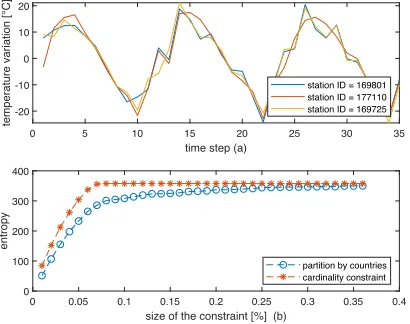
Figure 3: (a) A visualization of the monthly temperature variations of three time series, with particularly high vari-ance. Each series corresponds to a unique station ID. We model each variation series as a Gaussian distribution.
(b) Optimal solution found by GREEDYfor a uniform
con-straint and a partition matroid concon-straint by countries. The
f-value of each set of stations is the entropy (4), withΣthe
covariance matrix of variation series as in (a) (see Figure 4).
0 5 10 15 20 25 30 35
time step (a) -20
-10 0 10 20
temperature variation [°C]
station ID = 169801 station ID = 177110 station ID = 169725
0 0.05 0.1 0.15 0.2 0.25 0.3 0.35 0.4
size of the constraint [%] (b) 0
100 200 300 400
entropy
partition by countries cardinality constraint
Assuming that the joint probability distribution is
Gaus-sian, we proceed by maximizing theentropy, defined as
f(S) = 1 + ln(2π)
2 |S|+
1
2lndetΣ(S) (4)
for any indexing setS ⊆ {0,1}n.
We consider two types of constraints. In a first set of ex-periments we consider the problem of maximizing the en-tropy as in (4), under a cardinal constraint only. Specifically,
given a parameterd, the goal is to find a subsets of time
series that maximizes the entropy, of size at most dof all
available data. We also consider a more complex constraint:
Figure 4: A visualization of the covariance matrixΣof time
series available in the Berkley Earth climate dataset. We con-sider stations that have full available reports between years
2015-2017, for a total of2736stations. We consider the
vari-ation between average monthly temperatures of each time series. Each entry of this matrix is computed by taking the sample covariance as in (3).
500 1000 1500 2000 2500 500
1000
1500
2000
2500
-40 -20 0 20 40 60 80 100 120 140
Find a subset of time series that maximizes the entropy, and
s.t. it contains at mostdof all available data of each
coun-try. The latter constraint is a partition matroid constraints,
where each subsetBiconsists of all data series measured by
stations in a given country.
A summary of the results is displayed in Figure 3(b). We observe that in both cases the entropy quickly evolves to a stationary local optimum, indicating that a relatively small subset of stations is sufficient to explain the ran-dom variations between monthly observations in the model.
We observe that the GREEDY reaches similar
approxima-tion guarantees in both cases. We remark that the GREEDY
con-ca-netscienceweb-polblogsia-email-univia-fb-messagesweb-google bio-yeast ca-CSphdtech-routers-rfweb-edu ca-GrQcweb-spam inf-powerca-Erdos992ia-realitybio-dmela tech-pgp web-indochina-2004
web-BerkStan web-webbase-2001
ia-email-EU 103
104
solution value
greedy optimum
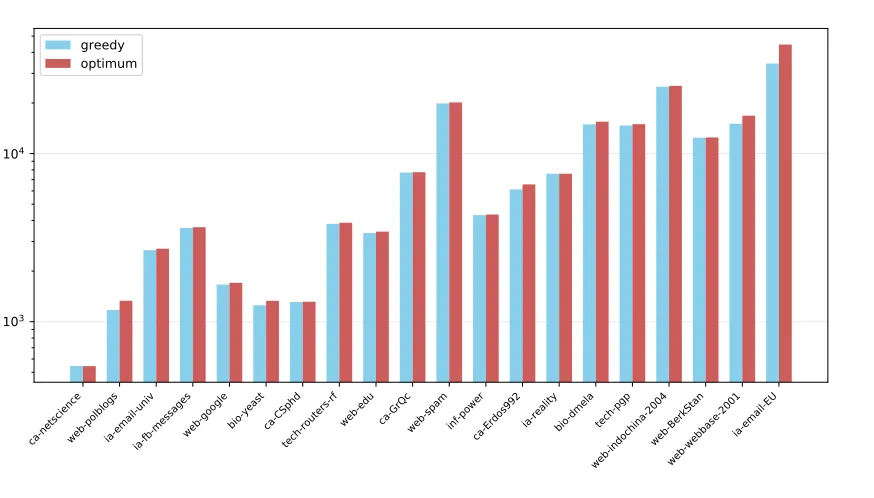
Figure 5: Visualization of the optimal solution and the solution found by GREEDYfor the maximum directed cut problem. The
input graphs are ordered by increasing number of vertices from left to right.
straint, assuming that the entropy is (approximately) mono-tone (Krause, Singh, and Guestrin 2008).
In Figure 2 we display solutions found by GREEDYfor the
cardinality and partition matroid constraint, withd= 10%.
We observe that in the case of a cardinality constraint, the sensors spread across the map; in the case of a partition matroid constraint sensors tend to be placed unevenly. We remark that in the original data set, some countries have a much higher density of stations than others.
Finding the maximum directed cut of a graph.
In this set of experiments we study the performance of GREEDYfor maximum directed cut in unweighted graphs. We compare these results with the optimal solutions, which we found via an Integer Linear Program solved with the state-of-the-art solver Gurobi (Gurobi Optimization 2018).The experiments were conducted on20instances from
Net-work Repository (Rossi and Ahmed 2016).
Figure 5 displays the quality of the solution found by GREEDY compared to the optimal solution, in the uncon-strained case. One can see that in most cases the greedy solution is very close to the optimum. This suggests that GREEDY might perform well on real-world instances. We remark that the solution quality is expected to increase as the
size of a possible constraint lowers (see (2)). Thus, GREEDY
is expected to perform even better in the constrained case. Theorem 1 implies that this might be due to the curvature
αof these graphs. However, we find that the solution
qual-ity of GREEDYis much better than the upper bound on the
curvature due to inequality (2) suggests.
Conclusion
In this paper we consider the problem of maximizing a func-tion with bounded curvature under a single partifunc-tion matroid constraint.
We derive approximation guarantees for the simple GREEDY algorithm (see Algorithm 1) on those problems, in the case of a (non-monotone) submodular function, and a monotone subadditive function (see Theorem 1 and Theo-rem 2). We observe that the lower bound on the approxima-tion guarantee is asymptotically tight in the case of a sub-modular function.
We discuss three applications. We first consider the prob-lem of maximizing a determinant function of a positive semidefinite matrix, and related maximum entropy sampling problem. We then consider the constrained maximum cut problem on directed graphs. We conclude discussing an ap-plication to game theory.
We observe that the simple GREEDYalgorithm is suitable
to approach Problem (1) it the functionf has bounded
cur-vature. Particularly, we need not search for (approximate) monotonicity or perform a local search to obtain good ap-proximate solutions.
Acknowledgements
This research has been supported by the Australian Re-search Council (ARC) through grant DP160102401 and the German Science Foundation (DFG) through grant FR2988 (TOSU).
References
Albert, R., and Barabasi, A.-L. 2001. Statistical mechanics of complex networks. 74.
Assadi, S. 2017. Combinatorial auctions do need modest
interaction. InEC, 145–162.
Bhawalkar, K., and Roughgarden, T. 2011. Welfare
guaran-tees for combinatorial auctions with item bidding. InProc.
of SODA, 700–709.
Bian, A. A.; Buhmann, J. M.; Krause, A.; and Tschiatschek,
S. 2017. Guarantees for greedy maximization of
non-submodular functions with applications. InProc. of ICML,
498–507.
Buchbinder, N., and Feldman, M. 2018. Deterministic
algo-rithms for submodular maximization problems.ACM
Trans-actions on Algorithms14(3):32:1–32:20.
Buchbinder, N.; Feldman, M.; Naor, J.; and Schwartz, R.
2014. Submodular maximization with cardinality
con-straints. InProc. of SODA, 1433–1452.
Buchbinder, N.; Feldman, M.; and Garg, M. 2018.
Deter-ministic (1/2 +)-approximation for submodular
maximiza-tion over a matroid. CoRRabs/1807.05532.
C˘alinescu, G.; Chekuri, C.; P´al, M.; and Vondr´ak, J. 2011. Maximizing a monotone submodular function
sub-ject to a matroid constraint. SIAM Journal of Computing
40(6):1740–1766.
Conforti, M., and Cornu´ejols, G. 1984. Submodular set functions, matroids and the greedy algorithm: Tight worst-case bounds and some generalizations of the rado-edmonds
theorem.Discrete Applied Mathematics7(3):251–274.
Cornuejols, G.; Fisher, M. L.; and Nemhauser, G. L. 1977. Location of Bank Accounts to Optimize Float: An Analytic
Study of Exact and Approximate Algorithms. Management
Science23(8):789–810.
Das, A., and Kempe, D. 2011. Submodular meets spectral: Greedy algorithms for subset selection, sparse
approxima-tion and dicapproxima-tionary selecapproxima-tion. InProc. of ICML, 1057–1064.
Dobzinski, S.; Nisan, N.; and Schapira, M. 2010.
Ap-proximation algorithms for combinatorial auctions with
complement-free bidders. Mathematics of Operations
Re-search35(1):1–13.
Elenberg, E. R.; Dimakis, A. G.; Feldman, M.; and Karbasi, A. 2017. Streaming weak submodularity: Interpreting
neu-ral networks on the fly. InAdvances in Neural Information
Processing Systems, 4047–4057.
Feige, U., and Vondr´ak, J. 2010. The submodular
wel-fare problem with demand queries. Theory of Computing
6(1):247–290.
Feige, U.; Mirrokni, V. S.; and Vondr´ak, J. 2011.
Maximiz-ing non-monotone submodular functions. SIAM Journal of
Computing40(4):1133–1153.
Friedrich, T.; G¨obel, A.; Neumann, F.; Quinzan, F.; and Rothenberger, R. 2018. Greedy Maximization of Func-tions with Bounded Curvature under Partition Matroid
Con-straints. ArXiv e-prints.
Goemans, M. X., and Williamson, D. P. 1995. Improved ap-proximation algorithms for maximum cut and satisfiability
problems using semidefinite programming. Journal of the
ACM42(6):1115–1145.
Gurobi Optimization, L. 2018. Gurobi optimizer reference manual.
Jegelka, S., and Bilmes, J. 2011. Submodularity beyond
submodular energies: Coupling edges in graph cuts. InProc.
of CVPR, 1897–1904.
Krause, A.; Singh, A. P.; and Guestrin, C. 2008. Near-optimal sensor placements in gaussian processes: Theory,
efficient algorithms and empirical studies. Journal of
Ma-chine Learning Research9:235–284.
Lawrence, N. D.; Seeger, M. W.; and Herbrich, R. 2002. Fast sparse gaussian process methods: The informative
vec-tor machine. InProc. of NIPS, 609–616.
Lee, J.; Mirrokni, V. S.; Nagarajan, V.; and Sviridenko, M. 2009. Non-monotone submodular maximization under
ma-troid and knapsack constraints. InProc. of STOC, 323–332.
Lin, H., and Bilmes, J. 2010. Multi-document summariza-tion via budgeted maximizasummariza-tion of submodular funcsummariza-tions. In Proc. of HLT, 912–920.
Maehara, T.; Kawase, Y.; Sumita, H.; Tono, K.; and Kawarabayashi, K. 2017. Optimal pricing for
submodu-lar valuations with bounded curvature. In Proc. of AAAI,
622–628.
Nemhauser, G. L., and Wolsey, L. A. 1978. Best algorithms for approximating the maximum of a submodular set
func-tion. Mathematics of Operations Research3(3):177–188.
Newman, M. E. J. 2003. The structure and function of
com-plex networks.SIAM Review45(2):167–256.
Rossi, R. A., and Ahmed, N. K. 2016. An interactive
data repository with visual analytics.SIGKDD Explorations
17(2):37–41.
Sebastiani, P., and Wynn, H. P. 2002. Maximum entropy
sampling and optimal bayesian experimental design.
Jour-nal of the Royal Statistical Society: Series B (Statistical
Methodology)62(1):145–157.
Singh, A.; Krause, A.; Guestrin, C.; and Kaiser, W. J. 2009.
Efficient informative sensing using multiple robots. Journal
of Artificial Intelligence Research34:707–755.
Sviridenko, M.; Vondr´ak, J.; and Ward, J. 2017. Optimal approximation for submodular and supermodular
optimiza-tion with bounded curvature. Mathematics of Operations
Research42(4).
Tschiatschek, S.; Singla, A.; and Krause, A. 2017. Selecting
sequences of items via submodular maximization. InProc.
of AAAI, 2667–2673.
Vondr´ak, J. 2010. Submodularity and curvature: the optimal