Advances in Radio Science (2003) 1: 191–196 c
Copernicus GmbH 2003
Advances in
Radio Science
A novel bottom-left packing genetic algorithm for analog module
placement
L. Zhang and U. Kleine
Otto-von-Guericke University of Magdeburg, IESK, PO Box 4120, D-39016 Magdeburg, Germany
Abstract. This paper presents a novel genetic algorithm for analog module placement. It is based on a generalization of the two-dimensional bin packing problem. The genetic encoding and operators assures that all constraints of the problem are always satisfied. Thus the potential problems of adding penalty terms to the cost function are eliminated, so that the search configuration space decreases drastically. The dedicated cost function covers the special requirements of analog integrated circuits. A fractional factorial experi-ment was conducted using an orthogonal array to study the algorithm parameters. A meta-GA was applied to determine the optimal parameter values. The algorithm has been tested with several local benchmark circuits. The experimental re-sults show this promising algorithm makes the better perfor-mance than simulated annealing approach with the satisfac-tory results comparable to manual placement.
1 Introduction
The significant tendency of system-on-chip (SoC) intensifies the booming market share of mixed-signal integrated circuits (ICs). Although most of the functions in such an integrated system are performed with digital circuitry, analog circuits are always needed as an interface to the external, continuous-valued world. The design of digital portion can be tackled with modern cell-based tools (Wang et al., 2000) for synthe-sis, mapping and physical design. The analog counterpart, however, is still routinely designed by hand. The layout of analog circuits is intrinsically more difficult than the digi-tal one. To address this problem, an automated layout tool called ALADIN (Automatic Layout Design Aid for Analog Integrated Circuits) (Zhang et al., 2000) is currently being developed for analog experts who can and must bring their specific knowledge into the synthesis process in order to cre-ate high quality layouts. The focus of this paper is on the
Correspondence to: L. Zhang
placement phase. Due to analog constraints such as match-ing requirements, it is usually preferred to build more or less complex clusters of devices, hereafter called modules or macro-cells, which are parameterized for the processed sub-circuits. The objective of placement is to position the modules appropriately so that the chip area and the total wire length of the interconnections are minimized under certain constraints.
Many heuristic strategies for module placement based on iterative improvement have been published so far, such as force-directed, min-cut, passive resistive optimization, simu-lated annealing (SA) (Su et al., 2001; Plas et al., 2001) and genetic algorithm (GA) (Shahookar and Mazumder, 1990; Esbensen and Mazumder, 1994). Among them, SA and GA are the latest and most promising techniques. SA is widely used in the domain of both digital and analog (Cohn et al., 1994; Plas et al., 2001) circuits. Although it yields good placement solutions, it is a very time-consuming pro-cess. In contrast, GA has been mainly applied for digital cir-cuits. This paper describes a GA application in analog circuit placement. It is organized as follows. Section 2 introduces the design flow with the use of DesignAssistant in which this placement approach is included. Section 3 describes the im-plementation of this adaptive strategy. Section 4 gives the parameter optimization with fractional factorial experiment and meta- GA. Section 5 shows experimental results and the conclusion is drawn finally.
2 DesignAssistant
DesignAssis-192 L. Zhang and U. Kleine: A novel bottom-left packing genetic algorithm
$ 129(/ %27720 /()7 3$&.,1* *(1(7,&
$/*25,7+0 )25 $1$/2* 02'8/( 3/$&(0(17
/LKRQJ =KDQJ 8OULFK .OHLQH
2WWR YRQ *XHULFNH 8QLYHUVLW\ RI 0DJGHEXUJ
,(6. 32 %R[ ' 0DJGHEXUJ *HUPDQ\
$%675$&7
7KLV SDSHU SUHVHQWV D QRYHO JHQHWLF DOJRULWKP IRU DQDORJ PRGXOH SODFHPHQW ,W LV EDVHG RQ D JHQHUDOL]DWLRQ RI WKH WZR GLPHQVLRQDO ELQ SDFNLQJ SUREOHP 7KH JHQHWLF HQFRGLQJ DQG RSHUDWRUV DVVXUHV WKDW DOO FRQVWUDLQWV RI WKH SUREOHP DUH DOZD\V VDWLVILHG 7KXV WKH SRWHQWLDO SUREOHPV RI DGGLQJ SHQDOW\ WHUPV WR WKH FRVW IXQFWLRQ DUH HOLPLQDWHG VR WKDW WKH VHDUFK FRQILJXUDWLRQ VSDFH GHFUHDVHV GUDVWLFDOO\ 7KH GHGLFDWHG FRVW IXQFWLRQ FRYHUV WKH VSHFLDO UHTXLUHPHQWV RI DQDORJ LQWHJUDWHG FLUFXLWV $ IUDFWLRQDO IDFWRULDO H[SHULPHQW ZDV FRQGXFWHG XVLQJ DQ RUWKRJRQDO DUUD\ WR VWXG\ WKH DOJRULWKP SDUDPHWHUV $ PHWD *$ ZDV DSSOLHG WR GHWHUPLQH WKH RSWLPDO SDUDPHWHU YDOXHV 7KH DOJRULWKP KDV EHHQ WHVWHG ZLWK VHYHUDO ORFDO EHQFKPDUN FLUFXLWV 7KH H[SHULPHQWDO UHVXOWV VKRZ WKLV SURPLVLQJ DOJRULWKP PDNHV WKH EHWWHU SHUIRUPDQFH WKDQ VLPXODWHG DQQHDOLQJ DSSURDFK ZLWK WKH VDWLVIDFWRU\ UHVXOWV FRPSDUDEOH WR PDQXDO SODFHPHQW
,1752'8&7,21
7KH VLJQLILFDQW WHQGHQF\ RI V\VWHP RQ FKLS 6R& LQWHQVLILHV WKH ERRPLQJ PDUNHW VKDUH RI PL[HG VLJQDO LQWHJUDWHG FLUFXLWV ,&V $OWKRXJK PRVW RI WKH IXQFWLRQV LQ VXFK DQ LQWHJUDWHG V\VWHP DUH SHUIRUPHG ZLWK GLJLWDO FLUFXLWU\ DQDORJ FLUFXLWV DUH DOZD\V QHHGHG DV DQ LQWHUIDFH WR WKH H[WHUQDO FRQWLQXRXV YDOXHG ZRUOG 7KH GHVLJQ RI GLJLWDO SRUWLRQ FDQ EH WDFNOHG ZLWK PRGHUQ FHOO EDVHG WRROV > @ IRU V\QWKHVLV PDSSLQJ DQG SK\VLFDO GHVLJQ 7KH DQDORJ FRXQWHUSDUW KRZHYHU LV VWLOO URXWLQHO\ GHVLJQHG E\ KDQG 7KH OD\RXW RI DQDORJ FLUFXLWV LV LQWULQVLFDOO\ PRUH GLIILFXOW WKDQ WKH GLJLWDO RQH 7R DGGUHVV WKLV SUREOHP DQ DXWRPDWHG OD\RXW WRRO FDOOHG $/$',1 $XWRPDWLF /D\RXW 'HVLJQ $LG IRU $QDORJ ,QWHJUDWHG &LUFXLWV > @ LV FXUUHQWO\ EHLQJ GHYHORSHG IRU DQDORJ H[SHUWV ZKR FDQ DQG PXVW EULQJ WKHLU VSHFLILF NQRZOHGJH LQWR WKH V\QWKHVLV SURFHVV LQ RUGHU WR FUHDWH KLJK TXDOLW\ OD\RXWV 7KH IRFXV RI WKLV SDSHU LV RQ WKH SODFHPHQW SKDVH 'XH WR DQDORJ FRQVWUDLQWV VXFK DV PDWFKLQJ UHTXLUHPHQWV LW LV XVXDOO\ SUHIHUUHG WR EXLOG PRUH RU OHVV FRPSOH[ FOXVWHUV RI GHYLFHV KHUHDIWHU FDOOHG PRGXOHV RU PDFUR FHOOV ZKLFK DUH SDUDPHWHUL]HG IRU WKH SURFHVVHG VXE FLUFXLWV 7KH REMHFWLYH RI SODFHPHQW LV WR SRVLWLRQ WKH PRGXOHV DSSURSULDWHO\ VR WKDW WKH FKLS DUHD
DQG WKH WRWDO ZLUH OHQJWK RI WKH LQWHUFRQQHFWLRQV DUH PLQLPL]HG XQGHU FHUWDLQ FRQVWUDLQWV
0DQ\ KHXULVWLF VWUDWHJLHV IRU PRGXOH SODFHPHQW EDVHG RQ LWHUDWLYH LPSURYHPHQW KDYH EHHQ SXEOLVKHG VR IDU VXFK DV IRUFH GLUHFWHG PLQ FXW SDVVLYH UHVLVWLYH RSWLPL]DWLRQ VLPXODWHG DQQHDOLQJ 6$ > @ > @ DQG JHQHWLF DOJRULWKP
*$ > @ > @ $PRQJ WKHP 6$ DQG *$ DUH WKH ODWHVW DQG PRVW SURPLVLQJ WHFKQLTXHV 6$ LV ZLGHO\ XVHG LQ WKH GRPDLQ RI ERWK GLJLWDO DQG DQDORJ > @> @ FLUFXLWV $OWKRXJK LW \LHOGV JRRG SODFHPHQW VROXWLRQV LW LV D YHU\ WLPH FRQVXPLQJ SURFHVV ,Q FRQWUDVW *$ KDV EHHQ PDLQO\ DSSOLHG IRU GLJLWDO FLUFXLWV 7KLV SDSHU GHVFULEHV D *$ DSSOLFDWLRQ LQ DQDORJ FLUFXLW SODFHPHQW ,W LV RUJDQL]HG DV IROORZV 6HFWLRQ LQWURGXFHV WKH GHVLJQ IORZ ZLWK WKH XVH RI 'HVLJQ$VVLVWDQW LQ ZKLFK WKLV SODFHPHQW DSSURDFK LV LQFOXGHG 6HFWLRQ GHVFULEHV WKH LPSOHPHQWDWLRQ RI WKLV DGDSWLYH VWUDWHJ\ 6HFWLRQ JLYHV WKH SDUDPHWHU RSWLPL]DWLRQ ZLWK IUDFWLRQDO IDFWRULDO H[SHULPHQW DQG PHWD *$ 6HFWLRQ VKRZV H[SHULPHQWDO UHVXOWV DQG WKH FRQFOXVLRQ LV GUDZQ ILQDOO\
'(6,*1$66,67$17
)LJ 'HVLJQ )ORZ ZLWK 'HVLJQ$VVLVWDQW
$ GHVLJQ HQYLURQPHQW FDOOHG 'HVLJQ$VVLVWDQW > @ LV SURYLGHG LQ $/$',1 ZKLFK HDVHV DQDORJ GHVLJQHUV IRU WKHLU VLOLFRQ FRPSLODWLRQ 7KH 'HVLJQ$VVLVWDQW LV LQWHJUDWHG LQ D FRPPHUFLDO GHVLJQ IUDPHZRUN ,WV *UDSKLFDO 8VHU ,QWHUIDFH *8, H[HFXWHV H[WHUQDO SURJUDPV VXFK DV WKH Fig. 1. Design Flow with DesignAssistant.
tant is illustrated, where the shadowed block is the subject of this paper.
3 Algorithm implementation
The GA is a search strategy based on the mechanics of natu-ral selection and natunatu-ral reproduction in a biological system. It differs from the other stochastic search techniques by being able to encode and exploit past information efficiently during a search.
3.1 Genetic encoding
The conventional chromosomal representation of the GA is based on bit-string (Shahookar and Mazumder, 1990). A GA for the two-dimensional bin packing problem has been de-veloped by Kroeger et al. (1991). Esbensen and Mazumder (1994) used this representation for the digital circuit place-ment. In this paper a bottom-left GA (BLGA) for the analog module placement is developed based on comprehensive ex-tensions and modifications of the genetic encoding and op-erators found in the above work (Esbensen and Mazumder, 1994; Kroeger et al., 1991). In GA a distinction is made be-tween genotype and phenotype of an individual. Here the ge-netic encoding is inspired by the two-dimensional bin pack-ing problem, which is the problem of compactly packpack-ing a number of rectangular blocks into a bin with a fixed width and infinite height in such a way that the distance from the top edge of the highest placed block to the bottom edge of the bin is minimized. The standard algorithm for this prob-lem places each block at a time at the downmost and then at the leftmost position. The placement algorithm is based on a generalization of this scheme. The solution space consid-ered by the algorithm is restricted to the set of all possible BL-placements.
Assume that the given problem hasncellsc1, ..., cn. An
example genotype withn = 6 cells is shown in Fig. 2
to-PRGXOH JHQHUDWRU WKH SODFHU DQG WKH URXWHU WR FUHDWH OD\RXWV DXWRPDWLFDOO\ ,Q )LJ WKH GHVLJQ IORZ LQ WKH 'HVLJQ$VVLVWDQW LV LOOXVWUDWHG ZKHUH WKH VKDGRZHG EORFN LV WKH VXEMHFW RI WKLV SDSHU
$/*25,7+0 ,03/(0(17$7,21
7KH *$ LV D VHDUFK VWUDWHJ\ EDVHG RQ WKH PHFKDQLFV RI QDWXUDO VHOHFWLRQ DQG QDWXUDO UHSURGXFWLRQ LQ D ELRORJLFDO V\VWHP ,W GLIIHUV IURP WKH RWKHU VWRFKDVWLF VHDUFK WHFKQLTXHV E\ EHLQJ DEOH WR HQFRGH DQG H[SORLW SDVW LQIRUPDWLRQ HIILFLHQWO\ GXULQJ D VHDUFK
*HQHWLF (QFRGLQJ
7KH FRQYHQWLRQDO FKURPRVRPDO UHSUHVHQWDWLRQ RI WKH *$ LV EDVHG RQ ELW VWULQJ > @ $ *$ IRU WKH WZR GLPHQVLRQDO ELQ SDFNLQJ SUREOHP KDV EHHQ GHYHORSHG E\ .URHJHU HW DO> @ + (VEHQVHQ > @ XVHG WKLV UHSUHVHQWDWLRQ IRU WKH GLJLWDO FLUFXLW SODFHPHQW ,Q WKLV SDSHU D ERWWRP OHIW *$ %/*$ IRU WKH DQDORJ PRGXOH SODFHPHQW LV GHYHORSHG EDVHG RQ FRPSUHKHQVLYH H[WHQVLRQV DQG PRGLILFDWLRQV RI WKH JHQHWLF HQFRGLQJ DQG RSHUDWRUV IRXQG LQ WKH DERYH ZRUN > @> @
,Q *$ D GLVWLQFWLRQ LV PDGH EHWZHHQ JHQRW\SH DQG SKHQRW\SH RI DQ LQGLYLGXDO +HUH WKH JHQHWLF HQFRGLQJ LV LQVSLUHG E\ WKH WZR GLPHQVLRQDO ELQ SDFNLQJ SUREOHP ZKLFK LV WKH SUREOHP RI FRPSDFWO\ SDFNLQJ D QXPEHU RI UHFWDQJXODU EORFNV LQWR D ELQ ZLWK D IL[HG ZLGWK DQG LQILQLWH KHLJKW LQ VXFK D ZD\ WKDW WKH GLVWDQFH IURP WKH WRS HGJH RI WKH KLJKHVW SODFHG EORFN WR WKH ERWWRP HGJH RI WKH ELQ LV PLQLPL]HG 7KH VWDQGDUG DOJRULWKP IRU WKLV SUREOHP SODFHV HDFK EORFN DW D WLPH DW WKH GRZQPRVW DQG WKHQ DW WKH OHIWPRVW SRVLWLRQ 7KH SODFHPHQW DOJRULWKP LV EDVHG RQ D JHQHUDOL]DWLRQ RI WKLV VFKHPH 7KH VROXWLRQ VSDFH FRQVLGHUHG E\ WKH DOJRULWKP LV UHVWULFWHG WR WKH VHW RI DOO SRVVLEOH %/ SODFHPHQWV
$VVXPH WKDW WKH JLYHQ SUREOHP KDV Q FHOOV F FQ $Q H[DPSOH JHQRW\SH ZLWK Q FHOOV LV VKRZQ LQ )LJ WRJHWKHU ZLWK WKH FRUUHVSRQGLQJ SKHQRW\SHV $ ELQDU\ WUHH
9 ( 9 ^F FQ` LQ ZKLFK WKHL©WK QRGH FRUUHVSRQGV WR
WKH FHOO L UHSUHVHQWLQJ WKH DEVROXWH SRVLWLRQV RI DOO FHOOV 7ZR NLQGV RI HGJHV H[LVW WRS HGJHV(WDQG ULJKW HGJHV(U VR WKDW
( (W∪ (U (W∩ (U •
(DFK QRGH KDV DW PRVW RQH RXWJRLQJ WRS HGJH DQG DW PRVW RQH RXWJRLQJ ULJKW HGJH $OO HGJHV DUH RULHQWHG DZD\ IURP WKH URRW RI WKH WUHH /HWHLM∈(GHQRWH DQ HGJH IURPFLWRFM DQG OHW
F
L[O\O L
F
DQGF
L[U \U LF
GHQRWH WKH FRRUGLQDWHV RI WKH ORZHU OHIW DQG XSSHU ULJKW FRUQHUV RI FL UHVSHFWLYHO\ 7KHQHLM∈(W(U PHDQV WKDW FHOOFMLV SODFHG DERYH RU WR WKH ULJKW RI FLLQ WKH SKHQRW\SH 7KDW LV∀HLM∈(
\O M
F
≥F
L\U LI HLM∈(W[O M
F
≥F
L[U LI HLM∈(UD
E
F
)LJ 5HSUHVHQWDWLRQ RI %/*$ ZLWK RQH SKHQRW\SH D WKH FRUUHVSRQGLQJ WZR JHQRW\SHV E F
7KH WUHH LV GHFRGHG DV IROORZV 7KH FHOOV DUH SODFHG RQH E\ RQH LQ D UHFWDQJXODU DUHD ZLWK KRUL]RQWDO OHQJWK : DQG LQILQLWH YHUWLFDO OHQJWK (DFK FHOO LV PRYHG DV IDU GRZQ DQG WKHQ DV IDU OHIW DV SRVVLEOH 7KH FHOOV DUH SODFHG LQ DVFHQGLQJ RUGHU DFFRUGLQJ WR WKHLU SULRULWLHV GHILQHG E\ RQH WR RQH IXQFWLRQ3 9→^ Q ` $Q\ QRGH KDV KLJKHU SULRULW\ WKDQ LWV SUHGHFHVVRU LQ WKH WUHH ,Q )LJ WKH SULRULWLHV DUH LQGLFDWHG DW WKH WRS ULJKW KDQG RI HDFK QRGH 7KH RULHQWDWLRQ L H WUDQVIRUPDWLRQ DQG UHIOHFWLRQ RI HDFK FHOO LV GHILQHG E\ WKH IXQFWLRQ 2 9→^ ` ZKLFK LV DOVR SDUW RI WKH JHQRW\SH
*HQHWLF 2SHUDWRUV
*LYHQ WZR LQGLYLGXDOV α DQG β WKH FURVVRYHU RSHUDWRU JHQHUDWHV D QHZ IHDVLEOH GHVFHQGDQW LQGLYLGXDO γ 7ZR SURSRVDOV DUH JLYHQ 7KH RSHUDWLRQV DUH LOOXVWUDWHG LQ )LJ
7KURXJKRXW WKLV VHFWLRQ D VXSHUVFULSW VSHFLILHV ZKLFK LQGLYLGXDO WKH PDUNHG SURSHUW\ EHORQJV WR 7KH H[SHULPHQWDO UHVXOWV DUH JLYHQ LQ 6HFWLRQ
,Q WKH ILUVW SURSRVDO (U L H HGJH VHW RI WKH GHVFHQGDQWγ LV FRQVWUXFWHG DV IROORZV )URP WKH FHOO WUHH RI α D FRQQHFWHG VXEVHW
7V 9V (V 9V⊂9 (V⊂(α
LV FKRVHQ 7V LV FKRVHQ DW UDQGRP EXW VXEMHFW WR WKH FRQVWUDLQW WKDW GHFRGLQJ7VLQ WKH RUGHU GHILQHG E\3α L H SULRULW\ RI LQGLYLGXDOα XVLQJ
F∈9V∀F′∈9V?^F` 3αF 3αF′
DV URRW FDXVHV QR FRQVWUDLQW YLRODWLRQV ,Q )LJ WKH FKRVHQ 7V LV LQGLFDWHG E\ WKH GDVKHG OLQH ,QLWLDOO\ (γ LV GHILQHG WR EH(V +HQFH γKDV LQKHULWHG DOO FHOOV LQ9VIURP
α 7KH UHPDLQLQJ FHOOV9 9VDUH WKHQ LQKHULWHG IURP β E\ H[WHQVLRQ RI(γ 7KH FHOO WUHH RIβLV WUDYHUVHG LQ DVFHQGLQJ RUGHU DFFRUGLQJ WR 3β $W DQ\ QRGH LW LV FKHFNHG LI WKH
Fig. 2. Representation of BLGA with one phenotype (a), the corre-sponding two genotypes (b) (c).
gether with the corresponding phenotypes. A binary tree (V , E), V = {c1, ..., cn}, in which thei’th node corresponds
to the celli, representing the absolute positions of all cells. Two kinds of edges exist: top-edgesEt and right-edgesEr,
so that
E=Et∪Er, Et∩Er = ∅ (1)
Each node has at most one outgoing top-edge and at most one outgoing right-edge. All edges are oriented away from the root of the tree. Leteij ∈Edenote an edge fromci tocj
and let(cixl, ciyl)and(cxri , ciyr)denote the coordinates of the lower left and upper right corners ofci, respectively. Then
eij ∈ Et(Er)means that cell cj is placed above (or to the
right of)ciin the phenotype. That is,
∀eij ∈E:c yl j ≥c
yr
i ifeij ∈Et, cxlj ≥c xr
i ifeij ∈Er (2)
The tree is decoded as follows. The cells are placed one by one in a rectangular area with horizontal length W and infinite vertical length. Each cell is moved as far down and then as far left as possible. The cells are placed in ascend-ing order accordascend-ing to their priorities defined by one-to-one functionP :V → {0...n−1}. Any node has higher priority than its predecessor in the tree. In Fig. 2 the priorities are indicated at the top right hand of each node. The orientation (i.e., transformation and reflection) of each cell is defined by the functionO :V → {0,1,2...7}, which is also part of the genotype.
3.2 Genetic operators
L. Zhang and U. Kleine: A novel bottom-left packing genetic algorithm 193 FRUUHVSRQGLQJ FHOOFEHORQJV WR9V WKDW LV ZKHWKHU LW KDV
EHHQ SODFHG LQ γ DOUHDG\ ,I VR WKH FHOO LV VNLSSHG 2WKHUZLVH FLV DGGHG WR WKH FHOO WUHH RIγ E\ H[WHQGLQJ(γ
UDQGRPO\ 7KH RULHQWDWLRQ RI DQ\ FHOO LV LQKHULWHG XQDOWHUHG WRJHWKHU ZLWK WKH FHOO LWVHOI 7KDW LV
− ∈ ∈ = V V 9 9 F LI F W 9 F LI F W F W β α γ
3γ VKRXOG FRUUHVSRQG WR WKH RUGHU LQ ZKLFK WKH FHOOV ZHUH SODFHG ZKHQ FUHDWLQJ (γ 6LQFH 3 LV D ELMHFWLRQ WKH IROORZLQJ FRQVWUDLQWV LQ XQLTXHO\ GHWHUPLQHV3γ
M L M L V M L M L M L V M L M L V M V L F 3 F 3 F 3 F 3 9 9 F F F 3 F 3 F 3 F 3 9 F F F 3 F 3 9 9 F 9 F γ γ β β γ γ α α γ γ < ⇒ < − ∈ ∀ < ⇒ < ∈ ∀ < − ∈ ∀ ∈ ∀
7KH VHFRQG SURSRVDO GLIIHUV IURP WKH ILUVW RQH E\ WKH FRQVWUXFWLRQ RI WKH UHPDLQLQJ FHOOV 9 9V ZKLFK LQKHULWV
IURP β E\ WKH RUGHUHG H[WHQVLRQ ,Q GHWDLO WKH FRQFDWHQDWLRQ WULHV WR IROORZ WKH VWUXFWXUH RIβILUVW RI DOO ,I LPSRVVLEOH UDQGRPO\ DGG WR DQ\ IUHH SRVLWLRQ RI γ ,Q )LJ G WKH QRGH % LV DGGHG WR WKH OHIW RI WKH QRGH (
LQVWHDG RI WKH OHIW RI WKH QRGH 'LQ )LJ F $V ZHOO WKH QRGH$LV DGGHG WR WKH OHIW RI WKH QRGH' LQVWHDG RI WKH OHIW RI WKH QRGH&LQ )LJ F
D 3DUHQW E 3DUHQW
F RIIVSULQJ WKH VW SURSRVDO
G RIIVSULQJ WKH QG SURSRVDO )LJ &URVVRYHU RSHUDWRUV
)LYH GLIIHUHQW PXWDWLRQ RSHUDWRUV DUH GHYHORSHG (DFK SHUIRUPV VRPH UDQGRP FKDQJH LQ WKH JLYHQ JHQRW\SH :KHQ SHUIRUPLQJ HDFK RI WKHVH PXWDWLRQV D SDUW RI WKH JHQRW\SH KDV WR EH GHFRGHG WR FKHFN LI WKH PXWDWHG LQGLYLGXDO VDWLVILHV DOO FRQVWUDLQWV $ PXWDWLRQ LV RQO\ SHUIRUPHG LI LW GRHV QRW FDXVH DQ\ FRQVWUDLQW YLRODWLRQV 7KH SXUSRVH RI WKH LQYHUVLRQ RSHUDWRU LV WR ZHDNHQ WKH OLQNDJH DPRQJ JHQHV *LYHQ D JHQRW\SH WKH LQYHUVLRQ RSHUDWRU FRPSXWHV D QHZ JHQRW\SH E\ UHDUUDQJLQJ WKH FRPSRQHQWV LQ VXFK D ZD\ WKDW WKHLU PXWXDO GLVWDQFHV
FKDQJHV ZKLOH DW WKH VDPH WLPH DVVXULQJ WKDW WKH FRUUHVSRQGLQJ SKHQRW\SH LV VWLOO WKH VDPH 7KH LQYHUVLRQ RSHUDWRU VHOHFWV D VXEWUHH DW UDQGRP DQG PRYHV LW WR DQRWKHU IUHH SRVLWLRQ LQ VXFK D ZD\ WKDW QR FRQVWUDLQWV DUH YLRODWHG DQG VR WKDW WKH FRUUHVSRQGLQJ SKHQRW\SH LV VWLOO WKH VDPH $Q H[DPSOH RI WKLV LV VKRZQ LV )LJ E DQG F 7KLV JHQRW\SH WUHH LV JHQHUDWHG E\ PRYLQJ WKH VXEWUHH URRWHG DW WKH QRGH)
&RVW )XQFWLRQ
7KH FRVW IXQFWLRQ LV WKH JRRGQHVV FULWHULRQ RI VHDUFKHG FRQILJXUDWLRQV ,W FRQVLVWV RI IRXU SDUWV ZKLFK DUH JLYHQ LQ
UDW DVS UDW DVS QHWV QHWV DUHD ' DUHD ' DUHD $ DUHD $ DUHD 3 DUHD 3 DUHD 1 DUHD 1 DUHD DOO DUHD DOO
&
&
&
&
&
&
&
&
B B B B B B B B B B B Bα
α
α
α
α
α
α
+
+
+
+
+
+
=
α LV D ZHLJKW IDFWRU IRU WKH FRUUHVSRQGLQJ FRVW & ZKLFK EDODQFHV WKH LPSRUWDQFH RI DOO WKH SRVVLEOH FRQVLGHUDWLRQV DFFRUGLQJ WR GLIIHUHQW GHVLJQ UHTXLUHPHQWV 7KH ILUVW LV WKH DUHD FRVW ZKLFK LV PDGH XS RI WKH ZKROH DUHD 1:(// DQG 3:(// UHJLRQ DUHDV DQDORJ DQG GLJLWDO UHJLRQ DUHDV 7KH\ ZLOO KHOS WR GHFUHDVH WKH ZKROH DUHD 0RUHRYHU WKH\ FRXOG PDNH 1:(// DQG 3:(// UHJLRQV UHODWLYHO\ FRQFHQWUDWHG LQ RUGHU WR HDVH WKH IDEULFDWLRQ $QG DQDORJ DQG GLJLWDO UHJLRQV DUH VHSDUDWHG IURP HDFK RWKHU VR WKDW WKH FRQVWUDLQWV IRU PL[HG VLJQDO FLUFXLWV FDQ EH LPSRVHG 7KH VHFRQG LV WKH QHW OHQJWK FRVW &QHWV LQ ZKLFK SULRULW\
FRHIILFLHQW FDQ EH VSHFLILHG IRU HDFK QHW )RU DQDORJ FLUFXLWV WKH VLJQLILFDQFH RI GLIIHUHQW QHWV LV GLVWLQFW 6RPH VHQVLWLYH QHWV IRU LQVWDQFH GLIIHUHQWLDO LQSXW VLJQDO QHWV VKRXOG EH DV VKRUW DV SRVVLEOH LQ RUGHU WR GHFUHDVH WKH SDUDVLWLF FDSDFLWDQFH DQG FURVVWDON 7KH PRUH VHQVLWLYH RQH QHW LV WKH KLJKHU LWV SULRULW\ FRHIILFLHQW LV GHILQHG /LQHDU RU H[SRQHQWLDO RSHUDWLRQV FDQ EH FKRVHQ RQ WKH QHW SULRULW\ )LYH DSSURDFKHV LQFOXGLQJ KDOI SHULPHWHU FHQWHU RI PDVV FRPSOHWH JUDSK PLQLPXP VSDQQLQJ WUHH DQG PLQLPXP VWHLQHU WUHH DUH GHYHORSHG IRU WKH QHW OHQJWK HVWLPDWLRQ VR WKDW DQDORJ GHVLJQHUV FDQ FKRRVH IRU WKH WUDGH RII EHWZHHQ DFFXUDF\ DQG HIILFLHQF\ > @ 7KH WKLUG LV WKH DVSHFW UDWLR FRVW&DVSBUDW ZKLFK LV XVHG WR FRQWURO WKH VKDSH RI WKH ILQDO
OD\RXW 'HVLJQHUV FDQ GHILQH WKH LGHDO ZLGWK OHQJWK UDWLR RU H[DFW ZLGWK YDOXH 7KH PRUH WKH UHDO OD\RXW VKDSH GLIIHUV IURP WKH LGHDO GHILQLWLRQ WKH PRUH SHQDOW\ LV EURXJKW DERXW 7KH JUDSKLF LQSXW ZLQGRZ RI WKH FRVW IXQFWLRQ LV SURYLGHG LQ WKH 'HVLJQ$VVLVWDQW
$OJRULWKP 2XWOLQH
7KH DOJRULWKP RXWOLQH LV GHSLFWHG LQ )LJ VWRS&ULWHULRQ
PDNHV WKH HYROXWLRQ SURFHVV WHUPLQDWHG LI QR LPSURYHPHQW KDV EHHQ REVHUYHG IRU D SUHGHILQHG QXPEHU RI FRQVHFXWLYH JHQHUDWLRQV RU D IL[HG QXPEHU RI JHQHUDWLRQV LV RYHU $ ILWQHVV LV WKH UHFLSURFDO RI WKH FRUUHVSRQGLQJ FRVW
Fig. 3. Crossover operators.
descendantγ) is constructed as follows. From the cell tree ofα, a connected subset
Ts =(Vs, Es), Vs ⊂V , Es ⊂Eα (3)
is chosen.Tsis chosen at random but subject to the constraint
that decodingTs in the order defined byPα (i.e., priority of
individualα), using
c∈Vs|∀c0∈Vs/{c} :Pα(c) < Pα(c0) (4)
as root, causes no constraint violations. In Fig. 3, the chosen Ts is indicated by the dashed line. Initially Eγ is defined
to beEs. Hence,γ has inherited all cells inVs fromα. The
remaining cellsV−Vsare then inherited fromβby extension
of Eγ. The cell tree ofβ is traversed in ascending order according toβ. At any node it is checked if the corresponding cellcbelongs toVs, that is, whether it has been placed inγ
already. If so, the cell is skipped. Otherwise,cis added to the cell tree ofγ by extendingEγ randomly. The orientation of any cell is inherited unaltered together with the cell itself. That is,
tγ(c)=
tα(c) if c∈Vs
tβ(c) if c∈V −Vs
(5)
Pγ should correspond to the order in which the cells were placed when creatingEγ. SinceP is a bijection, the follow-ing constraints in Eq. (6) uniquely determinesPγ:
∀ci ∈Vs, ∀cj ∈V −Vs :Pγ(ci) < Pγ(cj)
∀ci, cj ∈Vs :Pα(ci) < Pα(cj)⇒Pγ(ci) < Pγ(cj)
∀ci, cj ∈V −Vs :Pβ(ci) < Pβ(cj)⇒
Pγ(ci) < Pγ(cj) (6)
The second proposal differs from the first one by the con-struction of the remaining cellsV −Vs, which inherits from
βby the ordered extension. In detail, the concatenation tries to follow the structure ofβ first of all. If impossible, ran-domly add to any free position ofγ. In Fig. 3d the nodeBis added to the left of the nodeE, instead of the left of the node Din Fig. 3c. As well the nodeAis added to the left of the nodeD, instead of the left of the nodeCin Fig. 3c.
Five different mutation operators are developed. Each per-forms some random change in the given genotype. When performing each of these mutations, a part of the genotype has to be decoded to check if the mutated individual satisfies all constraints. A mutation is only performed if it does not cause any constraint violations. The purpose of the inver-sion operator is to weaken the linkage among genes. Given a genotype, the inversion operator computes a new genotype by rearranging the components in such a way that their mu-tual distances changes, while at the same time assuring that the corresponding phenotype is still the same. The inversion operator selects a subtree at random and moves it to another free position in such a way that no constraints are violated and so that the corresponding phenotype is still the same. An example of this is shown is Fig. 2b and c. This genotype tree is generated by moving the subtree rooted at the nodeF. 3.3 Cost function
The cost function is the goodness criterion of searched con-figurations. It consists of four parts, which are given in Eq. (7).
C=(αall areaCall area+αN areaCN area+αP areaCP area
+αA areaCA area+αD areaCD area)+αnet sCnet s
+αasp ratCasp rat (7)
α∗ is a weight factor for the corresponding costC∗, which balances the importance of all the possible considerations according to different design requirements. The first is the area cost which is made up of the whole area, NWELL and PWELL region areas, analog and digital region areas. They will help to decrease the whole area. Moreover they could make NWELL and PWELL regions relatively concentrated in order to ease the fabrication. And analog and digital re-gions are separated from each other so that the constraints for mixed signal circuits can be imposed. The second is the net-length cost Cnet s, in which priority coefficient can
194 L. Zhang and U. Kleine: A novel bottom-left packing genetic algorithm
$OJRULWKP%/*$
0 WKH SRSXODWLRQ VL]H
%HJLQ
LQSXW PDFUR FHOO JHRPHWU\ DQG QHW OLVW LQLWLDOL]H WKH ILUVW SRSXODWLRQ UDQGRPO\ HYDOXDWH WKH ILWQHVV
ZKLOH QRW VWRS&ULWHULRQ
IRUHDFK 0 FURVVRYHU5DWH
FKRRVH WKH ILUVW SDUHQW EDVHG RQ UDQN VHOHFWLRQ FKRRVH WKH VHFRQG SDUHQW UDQGRPO\
GR FURVVRYHU WR JHQHUDWH RQH RIIVSULQJ
HQGIRU
FKRRVH 0 LQGLYLGXDOV ZLWK WKH ODUJHVW ILWQHVV DPRQJ WKH FRPELQHG VHW RI SDUHQWV DQG RIIVSULQJ
IRUHDFK 0
GR PXWDWLRQ EDVHG RQ PXWDWLRQ5DWH GR LQYHUVLRQ EDVHG RQ LQYHUVLRQ5DWH
HQGIRU HQGZKLOH
RXWSXW WKH EHVW PHPEHU
(QG
)LJ 2XWOLQH RI %/*$
3$5$0(7(5 237,0,=$7,21
6LQFH WKH RSHUDWRUV DUH RI SDUDPRXQW LPSRUWDQFH WR WKH RYHUDOO SHUIRUPDQFH RI WKH DOJRULWKP WKHLU SDUDPHWHUV LQFOXGLQJ WKH SRSXODWLRQ VL]H FURVVRYHU PXWDWLRQ DQG LQYHUVLRQ UDWHV KDYH WR EH LQYHVWLJDWHG ZLWK FDUH 7KH VWXG\ RI WKH FRUUHODWLRQ DQG VHQVLWLYLW\ KHOSV WR VKULQN WKH UHJDUGHG UDQJHV DQG VHW XS WKH H[DFW RSWLPDO SDUDPHWHUV LQ WKH SUREOHP RI DQDORJ PRGXOH SODFHPHQW
3DUDPHWHU $QDO\VLV
7KH IUDFWLRQDO IDFWRULDO H[SHULPHQW LV DQ LPSRUWDQW WHFKQLTXH LQ 5REXVW 'HVLJQ > @ $ 7DJXFKL RUWKRJRQDO DUUD\ / LV HPSOR\HG WR FRQVWUXFW WKH IUDFWLRQDO IDFWRULDO H[SHULPHQW 7KH SRSXODWLRQ VL]H FURVVRYHU PXWDWLRQ DQG LQYHUVLRQ UDWHV DUH WDNHQ DV WKH IDFWRUV 7KH UHDVRQ ZK\ WR FKRRVH VXFK DQ DUUD\ ZLWK FROXPQV LV WR JLYH D GHOLEHUDWH VWXG\ DERXW LQWHU FRUUHODWLRQ EHWZHHQ WZR IDFWRUV 7KH H[SHULPHQW GHVLJQ LV GHSLFWHG LQ 7DEOH , FU
PHDQV FURVVRYHU UDWH PU PHDQV PXWDWLRQ UDWH LU PHDQV LQYHUVLRQ UDWH 0 PHDQV SRSXODWLRQ VL]H DQG PHDQV WKH FRPELQDWLRQ RI WZR IDFWRUV 7KUHH FROXPQV DQG DUH OHIW IRU HUURU HVWLPDWLRQ
)RU WKH FURVVRYHU DQG LQYHUVLRQ UDWHV WKUHH OHYHOV DUH
FKRVHQ DV DUH FKRVHQ IRU
WKH OHYHOV RI WKH PXWDWLRQ UDWH 7ZR JURXSV RI H[SHULPHQWV ZHUH SHUIRUPHG LQ RUGHU WR FRYHU D ZLGH UDQJH IRU WKH SRSXODWLRQ VL]H RQH ZLWK DQG WKH RWKHU ZLWK 7KH FRVW DQG H[HFXWLRQ WLPH DUH WDNHQ DV WKH VHDUFK WDUJHW ZKHUH WKH FRVW LV WKH SULPDU\ FRQVLGHUDWLRQ DQG H[HFXWLRQ WLPH LV VHFRQGDU\ $V D UHVXOW WKH FRUUHODWLRQ EHWZHHQ SDUDPHWHUV LV IRXQG TXLWH ZHDN 7KH SRSXODWLRQ VL]H EHFRPHV LQVLJQLILFDQW WR WKH FRVW LI LW LV
PRUH WKDQ 7KH FURVVRYHU DQG PXWDWLRQ UDWHV DUH VHQVLWLYH IRU WKH VHDUFK (YHQ WKRXJK WKH LQYHUVLRQ UDWH LV LQVHQVLWLYH WR WKH FRVW LW LV RSWLPDOO\ ZLWK WKH FRQVLGHUDWLRQ RI LWV HIIHFW RQ WKH H[HFXWLRQ WLPH 6R WKH RSWLPDO YDOXH RU UDQJHV IRU WKH IRXU SDUDPHWHUV DUH VHW DV IROORZV 7KH SRSXODWLRQ VL]H ZDV VHW DV WKH PXWDWLRQ UDQJH ZDV IURP WR WKH FURVVRYHU UDWH IURP WR DQG WKH LQYHUVLRQ UDWH IURP WR
3DUDPHWHU 'HWHUPLQDWLRQ
%HFDXVH WKH OHYHOV LQ WKH RUWKRJRQDO DUUD\ DUH OLPLWHG LW LV URXJK WR GHSHQG RQ LW GHWHUPLQLQJ WKH SDUDPHWHU H[DFW YDOXHV )XUWKHUPRUH DOWKRXJK WKH UHVXOW LQ 6HFWLRQ JLYHV WKH ZHDN FRUUHODWLRQ EHWZHHQ WZR SDUDPHWHUV LW LV SUHIHUDEOH WR WDNH WKH FRUUHODWLRQ LQWR DFFRXQW ZKHQ GHWHUPLQLQJ SDUDPHWHU H[DFW YDOXHV 6R D PHWD *$ > @ GHSLFWHG LQ )LJ ZDV HPSOR\HG WR GHWHUPLQH WKH H[DFW UDWH YDOXHV 7KH LQGLYLGXDOV LQ WKH SRSXODWLRQ RI WKH PHWD *$ FRQVLVW RI WKUHH LQWHJHUV LQ WKH UDQJH RI > @ UHSUHVHQWLQJ WKH FURVVRYHU UDWH LQYHUVLRQ UDWH DQG PXWDWLRQ UDWH RI %/*$ 7KH ILWQHVV RI DQ LQGLYLGXDO D %/*$ ZLWK D FHUWDLQ SDUDPHWHU FRPELQDWLRQ LV WDNHQ WR EH WKH ILWQHVV RI WKH EHVW SODFHPHQW WKDW WKH PHWD *$ FDQ ILQG LQ WKH HQWLUH UXQ XVLQJ WKHVH SDUDPHWHUV ,Q PHWD *$ WKH SRSXODWLRQ VL]H ZDV DQG WKH DOJRULWKP ZDV UXQ IRU JHQHUDWLRQV 7KH FURVVRYHU SUREDELOLW\ ZDV
$OJRULWKPPHWD *$
0 WKH SRSXODWLRQ VL]H
%HJLQ
VHW 0 DV DQG WKH JHQHUDWLRQ VXP DV LQLWLDOL]H WKH ILUVW SRSXODWLRQ UDQGRPO\ HYDOXDWH WKH ILWQHVV
ZKLOH QRW VWRS&ULWHULRQ
IRUHDFK 0
PDNH WZR UDQGRP WULDOV DQG VHOHFW WZR SDUHQWV IURP WKH SRSXODWLRQ ZLWK WKH SUREDELOLW\ SURSRUWLRQDO WR ILWQHVV
SHUIRUP FURVVRYHU E\ VHOHFWLQJ HDFK SDUDPHWHU UDQGRPO\ IURP HLWKHU SDUHQW ZLWK HTXDO SUREDELOLW\ PXWDWH RIIVSULQJ ZLWK SUREDELOLW\ E\ VHOHFWLQJ D SDUDPHWHU DW UDQGRP DQG DGGLQJ WR LW D UDQGRP QXPEHU ZLWKLQ WKH UDQJH RI > @
HQGIRU
FKRRVH 0 LQGLYLGXDOV ZLWK WKH ODUJHVW ILWQHVV DPRQJ WKH FRPELQHG VHW RI SDUHQWV DQG RIIVSULQJ
HQGZKLOH
VHOHFW WKH ILWWHVW VHW RI SDUDPHWHUV IURP WKH ILQDO SRSXODWLRQ
(QG
)LJ 2XWOLQH RI WKH PHWD *$
(;3(5,0(17$/ 5(68/76
%HFDXVH VR IDU WKH DQDORJ EHQFKPDUN FLUFXLWV DUH XQDYDLODEOH IRU WKH V\QWKHVLV SXUSRVH WKUHH ORFDO FLUFXLWV DUH XVHG WR HYDOXDWH WKH DERYH DOJRULWKPV (DFK DOJRULWKP
Fig. 4. Outline of BLGA.
The third is the aspect-ratio costCasp rat, which is used to
control the shape of the final layout. Designers can define the ideal width-length ratio or exact width value. The more the real layout shape differs from the ideal definition, the more penalty is brought about. The graphic input window of the cost function is provided in the DesignAssistant.
3.4 Algorithm outline
The algorithm outline is depicted in Fig. 4.st opCrit erion() makes the evolution process terminated if no improvement has been observed for a predefined number of consecutive generations or a fixed number of generations is over. A fit-ness is the reciprocal of the corresponding cost.
4 Parameter optimization
Since the operators are of paramount importance to the over-all performance of the algorithm, their parameters, including the population size, crossover, mutation and inversion rates, have to be investigated with care. The study of the correla-tion and sensitivity helps to shrink the regarded ranges and set up the exact optimal parameters in the problem of analog module placement.
4.1 Parameter analysis
The fractional factorial experiment is an important technique in Robust Design (Park, 1996). A Taguchi orthogonal ar-rayL27(313)is employed to construct the fractional factorial experiment. The population size, crossover, mutation and inversion rates are taken as the factors. The reason why to choose such an array with 13 columns is to give a deliberate
$OJRULWKP%/*$
0 WKH SRSXODWLRQ VL]H
%HJLQ
LQSXW PDFUR FHOO JHRPHWU\ DQG QHW OLVW LQLWLDOL]H WKH ILUVW SRSXODWLRQ UDQGRPO\ HYDOXDWH WKH ILWQHVV
ZKLOH QRW VWRS&ULWHULRQ
IRUHDFK 0 FURVVRYHU5DWH
FKRRVH WKH ILUVW SDUHQW EDVHG RQ UDQN VHOHFWLRQ FKRRVH WKH VHFRQG SDUHQW UDQGRPO\
GR FURVVRYHU WR JHQHUDWH RQH RIIVSULQJ
HQGIRU
FKRRVH 0 LQGLYLGXDOV ZLWK WKH ODUJHVW ILWQHVV DPRQJ WKH FRPELQHG VHW RI SDUHQWV DQG RIIVSULQJ
IRUHDFK 0
GR PXWDWLRQ EDVHG RQ PXWDWLRQ5DWH GR LQYHUVLRQ EDVHG RQ LQYHUVLRQ5DWH
HQGIRU HQGZKLOH
RXWSXW WKH EHVW PHPEHU
(QG
)LJ 2XWOLQH RI %/*$
3$5$0(7(5 237,0,=$7,21
6LQFH WKH RSHUDWRUV DUH RI SDUDPRXQW LPSRUWDQFH WR WKH RYHUDOO SHUIRUPDQFH RI WKH DOJRULWKP WKHLU SDUDPHWHUV LQFOXGLQJ WKH SRSXODWLRQ VL]H FURVVRYHU PXWDWLRQ DQG LQYHUVLRQ UDWHV KDYH WR EH LQYHVWLJDWHG ZLWK FDUH 7KH VWXG\ RI WKH FRUUHODWLRQ DQG VHQVLWLYLW\ KHOSV WR VKULQN WKH UHJDUGHG UDQJHV DQG VHW XS WKH H[DFW RSWLPDO SDUDPHWHUV LQ WKH SUREOHP RI DQDORJ PRGXOH SODFHPHQW
3DUDPHWHU $QDO\VLV
7KH IUDFWLRQDO IDFWRULDO H[SHULPHQW LV DQ LPSRUWDQW WHFKQLTXH LQ 5REXVW 'HVLJQ > @ $ 7DJXFKL RUWKRJRQDO DUUD\ / LV HPSOR\HG WR FRQVWUXFW WKH IUDFWLRQDO IDFWRULDO H[SHULPHQW 7KH SRSXODWLRQ VL]H FURVVRYHU PXWDWLRQ DQG LQYHUVLRQ UDWHV DUH WDNHQ DV WKH IDFWRUV 7KH UHDVRQ ZK\ WR FKRRVH VXFK DQ DUUD\ ZLWK FROXPQV LV WR JLYH D GHOLEHUDWH VWXG\ DERXW LQWHU FRUUHODWLRQ EHWZHHQ WZR IDFWRUV 7KH H[SHULPHQW GHVLJQ LV GHSLFWHG LQ 7DEOH , FU
PHDQV FURVVRYHU UDWH PU PHDQV PXWDWLRQ UDWH LU PHDQV LQYHUVLRQ UDWH 0PHDQV SRSXODWLRQ VL]H DQG PHDQV WKH FRPELQDWLRQ RI WZR IDFWRUV 7KUHH FROXPQV DQG DUH OHIW IRU HUURU HVWLPDWLRQ
)RU WKH FURVVRYHU DQG LQYHUVLRQ UDWHV WKUHH OHYHOV DUH
FKRVHQ DV DUH FKRVHQ IRU
WKH OHYHOV RI WKH PXWDWLRQ UDWH 7ZR JURXSV RI H[SHULPHQWV ZHUH SHUIRUPHG LQ RUGHU WR FRYHU D ZLGH UDQJH IRU WKH SRSXODWLRQ VL]H RQH ZLWK DQG WKH RWKHU ZLWK 7KH FRVW DQG H[HFXWLRQ WLPH DUH WDNHQ DV WKH VHDUFK WDUJHW ZKHUH WKH FRVW LV WKH SULPDU\ FRQVLGHUDWLRQ DQG H[HFXWLRQ WLPH LV VHFRQGDU\ $V D UHVXOW WKH FRUUHODWLRQ EHWZHHQ SDUDPHWHUV LV IRXQG TXLWH ZHDN 7KH SRSXODWLRQ VL]H EHFRPHV LQVLJQLILFDQW WR WKH FRVW LI LW LV
PRUH WKDQ 7KH FURVVRYHU DQG PXWDWLRQ UDWHV DUH VHQVLWLYH IRU WKH VHDUFK (YHQ WKRXJK WKH LQYHUVLRQ UDWH LV LQVHQVLWLYH WR WKH FRVW LW LV RSWLPDOO\ ZLWK WKH FRQVLGHUDWLRQ RI LWV HIIHFW RQ WKH H[HFXWLRQ WLPH 6R WKH RSWLPDO YDOXH RU UDQJHV IRU WKH IRXU SDUDPHWHUV DUH VHW DV IROORZV 7KH SRSXODWLRQ VL]H ZDV VHW DV WKH PXWDWLRQ UDQJH ZDV IURP WR WKH FURVVRYHU UDWH IURP WR DQG WKH LQYHUVLRQ UDWH IURP WR
3DUDPHWHU 'HWHUPLQDWLRQ
%HFDXVH WKH OHYHOV LQ WKH RUWKRJRQDO DUUD\ DUH OLPLWHG LW LV URXJK WR GHSHQG RQ LW GHWHUPLQLQJ WKH SDUDPHWHU H[DFW YDOXHV )XUWKHUPRUH DOWKRXJK WKH UHVXOW LQ 6HFWLRQ JLYHV WKH ZHDN FRUUHODWLRQ EHWZHHQ WZR SDUDPHWHUV LW LV SUHIHUDEOH WR WDNH WKH FRUUHODWLRQ LQWR DFFRXQW ZKHQ GHWHUPLQLQJ SDUDPHWHU H[DFW YDOXHV 6R D PHWD *$ > @ GHSLFWHG LQ )LJ ZDV HPSOR\HG WR GHWHUPLQH WKH H[DFW UDWH YDOXHV 7KH LQGLYLGXDOV LQ WKH SRSXODWLRQ RI WKH PHWD *$ FRQVLVW RI WKUHH LQWHJHUV LQ WKH UDQJH RI > @ UHSUHVHQWLQJ WKH FURVVRYHU UDWH LQYHUVLRQ UDWH DQG PXWDWLRQ UDWH RI %/*$ 7KH ILWQHVV RI DQ LQGLYLGXDO D %/*$ ZLWK D FHUWDLQ SDUDPHWHU FRPELQDWLRQ LV WDNHQ WR EH WKH ILWQHVV RI WKH EHVW SODFHPHQW WKDW WKH PHWD *$ FDQ ILQG LQ WKH HQWLUH UXQ XVLQJ WKHVH SDUDPHWHUV ,Q PHWD *$ WKH SRSXODWLRQ VL]H ZDV DQG WKH DOJRULWKP ZDV UXQ IRU JHQHUDWLRQV 7KH FURVVRYHU SUREDELOLW\ ZDV
$OJRULWKPPHWD *$
0 WKH SRSXODWLRQ VL]H
%HJLQ
VHW 0 DV DQG WKH JHQHUDWLRQ VXP DV LQLWLDOL]H WKH ILUVW SRSXODWLRQ UDQGRPO\ HYDOXDWH WKH ILWQHVV
ZKLOH QRW VWRS&ULWHULRQ
IRUHDFK 0
PDNH WZR UDQGRP WULDOV DQG VHOHFW WZR SDUHQWV IURP WKH SRSXODWLRQ ZLWK WKH SUREDELOLW\ SURSRUWLRQDO WR ILWQHVV
SHUIRUP FURVVRYHU E\ VHOHFWLQJ HDFK SDUDPHWHU UDQGRPO\ IURP HLWKHU SDUHQW ZLWK HTXDO SUREDELOLW\ PXWDWH RIIVSULQJ ZLWK SUREDELOLW\ E\ VHOHFWLQJ D SDUDPHWHU DW UDQGRP DQG DGGLQJ WR LW D UDQGRP QXPEHU ZLWKLQ WKH UDQJH RI > @
HQGIRU
FKRRVH 0 LQGLYLGXDOV ZLWK WKH ODUJHVW ILWQHVV DPRQJ WKH FRPELQHG VHW RI SDUHQWV DQG RIIVSULQJ
HQGZKLOH
VHOHFW WKH ILWWHVW VHW RI SDUDPHWHUV IURP WKH ILQDO SRSXODWLRQ
(QG
)LJ 2XWOLQH RI WKH PHWD *$
(;3(5,0(17$/ 5(68/76
%HFDXVH VR IDU WKH DQDORJ EHQFKPDUN FLUFXLWV DUH XQDYDLODEOH IRU WKH V\QWKHVLV SXUSRVH WKUHH ORFDO FLUFXLWV DUH XVHG WR HYDOXDWH WKH DERYH DOJRULWKPV (DFK DOJRULWKP
Fig. 5. Outline of the meta-GA.
study about inter-correlation between two factors. The exper-iment design is depicted in Table 1,crmeans crossover rate, mr means mutation rate,ir means inversion rate,Mmeans population size and∗means the combination of two factors. Three columns (4, 7 and 11) are left for error estimation.
For the crossover and inversion rates, three levels are cho-sen as (0.2, 0.55, 0.85). (0.05, 0.1, 0.2) are chocho-sen for the levels of the mutation rate. Two groups of experiments were performed in order to cover a wide range for the population size, one with (10, 35, 60) and the other with (40, 70, 100). The cost and execution time are taken as the search target, where the cost is the primary consideration and execution time is secondary. As a result, the correlation between pa-rameters is found quite weak. The population size becomes insignificant to the cost if it is more than 60. The crossover and mutation rates are sensitive for the search. Even though the inversion rate is insensitive to the cost, it is 0.25 optimally with the consideration of its effect on the execution time. So the optimal value or ranges for the four parameters are set as follows. The population size was set as 60, the mutation range was from 0 to 0.1, the crossover rate from 0.55 to 1 and the inversion rate from 0.20 to 0.55.
4.2 Parameter determination
represent-L. Zhang and U. Kleine: A novel bottom-left packing genetic algorithm 195
Table 1. Design of the fractional factorial experiment
Exp. No. 1 2 3 4 5 6 7 8 9 10 11 12 13
cr mr cr∗mr ir cr∗ir mr∗ir M cr∗M mr∗M ir∗M
1 1 1 1 1 1 1 1 1 1 1 1 1 1
2 1 1 1 1 2 2 2 2 2 2 2 2 2
... ... ... ... ... ... ... ... ... ... ... ... ... ...
27 3 3 2 1 3 2 1 2 1 3 1 3 2
Table 2. Comparison among distinct algorithms
SA BLGA1 BLGA2
Cmean 11799 11823 11698
Circuit 1 Cσ 176 46 39
Tmean(s) 846 213 222
Tσ(s) 210 40 69
Cmean 86653 83487 82122
Circuit 2 Cσ 3087 2925 2165
Tmean(s) 5068 3897 2848
Tσ(s) 783 163 1031
Cmean 215720 220740 216350
Circuit 3 Cσ 13554 4224 3932
Tmean(s) 1143 2586 3222
Tσ(s) 4 280 461
ing the crossover rate, inversion rate, and mutation rate of BLGA. The fitness of an individual (a BLGA with a certain parameter combination) is taken to be the fitness of the best placement that the meta-GA can find in the entire run, using these parameters. In meta-GA, the population size was 20, and the algorithm was run for 100 generations. The crossover probability was 1.
5 Experimental results
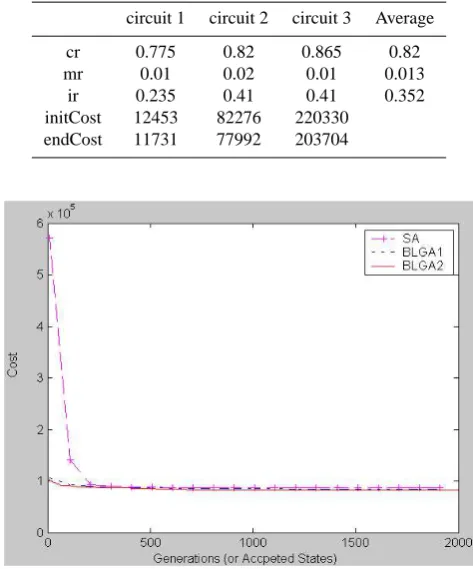
Because so far the analog benchmark circuits are unavailable for the synthesis purpose, three local circuits are used to eval-uate the above algorithms. Each algorithm is executed for ten times so that the mean and standard deviation are used for evaluation. The cost value is superior to the execution time. As the focus here is on the comparison of algorithms, the simple half-perimeter estimation is applied for all the trials. In order to demonstrate the efficiency of GA, one optimiza-tion with SA was also performed. The results are depicted in Table 2 including SA, BLGA1 means with the first crossover proposal and BLGA2 means with the second crossover pro-posal.
The result shows SA is generally poorer than BLGA while need more execution time. The BLGA2 works marginally better than BLGA1. So finally the second proposal, i.e., the close inheritance crossover scheme is applied. In order to
Table 3. Comparison among distinct algorithms
circuit 1 circuit 2 circuit 3 Average
cr 0.775 0.82 0.865 0.82
mr 0.01 0.02 0.01 0.013
ir 0.235 0.41 0.41 0.352
initCost 12453 82276 220330 endCost 11731 77992 203704
7DEOH , 'HVLJQ RI WKH IUDFWLRQDO IDFWRULDO H[SHULPHQW
([S 1R
FU
PU
FU PU
LU
FU LU
PU LU
0
FU 0
PU 0
LU 0
LV H[HFXWHG IRU WHQ WLPHV VR WKDW WKH PHDQ DQG VWDQGDUG
GHYLDWLRQ DUH XVHG IRU HYDOXDWLRQ
7KH FRVW YDOXH LV
VXSHULRU WR WKH H[HFXWLRQ WLPH $V WKH IRFXV KHUH LV RQ WKH
FRPSDULVRQ RI DOJRULWKPV
WKH VLPSOH KDOI SHULPHWHU
HVWLPDWLRQ LV DSSOLHG IRU DOO WKH WULDOV
,Q RUGHU WR
GHPRQVWUDWH WKH HIILFLHQF\ RI *$ RQH RSWLPL]DWLRQ ZLWK
6$ ZDV DOVR SHUIRUPHG 7KH UHVXOWV DUH GHSLFWHG LQ 7DEOH
,, LQFOXGLQJ 6$ %/*$
PHDQV ZLWK WKH ILUVW FURVVRYHU
SURSRVDO DQG %/*$
PHDQV ZLWK WKH VHFRQG FURVVRYHU
SURSRVDO
7DEOH ,, &RPSDULVRQ DPRQJ GLVWLQFW DOJRULWKPV
6$
%/*$
%/*$
&
PHDQ&
σ7
PHDQV
&LU
FXLW
7
σV
&
PHDQ&
σ7
PHDQV
&LU
FXLW
7
σV
&
PHDQ&
σ7
PHDQV
&LU
FXLW
7
σV
7KH UHVXOW VKRZV 6$ LV JHQHUDOO\ SRRUHU WKDQ %/*$ ZKLOH
QHHG PRUH H[HFXWLRQ WLPH 7KH %/*$ ZRUNV PDUJLQDOO\
EHWWHU WKDQ %/*$
6R ILQDOO\ WKH VHFRQG SURSRVDO L H
WKH FORVH LQKHULWDQFH FURVVRYHU VFKHPH LV DSSOLHG ,Q RUGHU
WR NHHS WKH GLYHUVLW\ GXULQJ WKH HYROXWLRQ WKH VHOHFWLRQ
EDVHG RQ ILWQHVV UDQN LV DSSOLHG LQVWHDG RI WKH ILWQHVV EDVHG
VXFK DV URXOHWWH ZKHHO VHOHFWLRQ > @ 7KH FRQYHUJHQFH
VFKHGXOH LV GHSLFWHG LQ )LJ
6LQFH WKH FRVWV RI %/*$
DQG %/*$
DUH WKH EHVW FRVW LQ HDFK JHQHUDWLRQ WKH
YDULDQFH DPSOLWXGH LV VPRRWKHU WKDQ 6$ LQ WKH ZKROH YLHZ
)LJ
&RQYHUJHQFH VFKHGXOHV RI GLIIHUHQW DOJRULWKPV
7KH UHSUHVHQWDWLRQ RI %/*$ LPSURYHV WKH VHDUFKLQJ
HIILFLHQF\ VR WKDW WKH VHDUFK QHHG QRW FRYHU D ZLGH VFRSH
DV 6$ EXW ZLWK PRUH DFFXUDF\ 7KH UHVXOWV ZLWK WKH 0HWD
*$ IRU WKH WKUHH FLUFXLWV DUH JLYHQ LQ 7DEOH ,,, )LQDOO\ WKH
EHVW SDUDPHWHU VHW LV WKH FURVVRYHU UDWH RI
WKH
PXWDWLRQ UDWH RI
DQG WKH LQYHUVLRQ UDWH RI
7KH
SURJUDP LV ZULWWHQ LQ &
UXQQLQJ XQGHU 6RODULV 81,; LQ
D 6XQ 8OWUD
ZRUNVWDWLRQ 7KH ZHLJKW IDFWRUV LQ WKH FRVW
IXQFWLRQ DUH VHW DV IROORZV
α
DOOBDUHDα
1BDUHDα
3BDUHDα
$BDUHDα
'BDUHDα
QHWVDQG
α
DVSBUDW7DEOH ,,, 3DUDPHWHU UHVXOWV ZLWK WKH PHWD *$
FLUFXLW
FLUFXLW
FLUFXLW
$YHUDJH
FU
PU
LU
LQLW&RVW
HQG&RVW
)LJ
D JLYHV WKH VFKHPDWLF RI WKH WKLUG FLUFXLW D FRPPRQ
PRGH
IHHGEDFN
RSWLRQDO
DPSOLILHU
LQ
ZKLFK
WKH
SDUWLWLRQLQJ LV LQGLFDWHG E\ UHFWDQJOHV 7KH FRUUHVSRQGLQJ
SODFHPHQW UHVXOW ZLWK WKH %/*$
LV VKRZQ LQ )LJ
E
Fig. 6. Convergence schedules of different algorithms.
keep the diversity during the evolution, the selection based on fitness rank is applied instead of the fitness-based such as roulette wheel selection (Kroeger et al., 1991). The con-vergence schedule is depicted in Fig. 6. Since the costs of BLGA1 and BLGA2 are the best cost in each generation, the variance amplitude is smoother than SA in the whole view.
The representation of BLGA improves the searching effi-ciency so that the search need not cover a wide scope as SA but with more accuracy. The results with the Meta-GA for the three circuits are given in Table 3. Finally the best pa-rameter set is the crossover rate of 0.82, the mutation rate of 0.023 and the inversion rate of 0.235. The program is writ-ten inC+ +running under Solaris-UNIX in a Sun-Ultra60 workstation. The weight factors in the cost function are set as follows: αall area = 2, αNarea = 0.2, αParea = 0.2,
196 L. Zhang and U. Kleine: A novel bottom-left packing genetic algorithm ZKLFK LV FRPSDUDEOH WR WKH PDQXDO SODFHPHQW ,Q
'HVLJQ$VVLVWDQW WKH UHODWLYH SRVLWLRQ RI PRGXOHV DUH UHFRUGHG DQG SDVVHG WR WKH URXWHU DV WKH LQSXW 7KH URXWHU WKHQ FRPSDFWV DOO WKH PRGXOHV ZLWK WKH GHWDLOHG URXWLQJ
D
E
)LJ 6FKHPDWLF D DQG SODFHPHQW OD\RXW E ZLWK %/*$ RI D FRPPRQ PRGH IHHGEDFN RSWLRQDO DPSOLILHU
6800$5<
,Q WKLV SDSHU D QHZ WHFKQLTXH ZLWK JHQHWLF DOJRULWKP WR VROYH WKH DQDORJ PRGXOH SODFHPHQW KDV EHHQ LQWURGXFHG %\ XVLQJ WKH QRWLRQ RI ELQ SDFNLQJ D JHQHWLF HQFRGLQJ KDV EHHQ GHYHORSHG LQ ZKLFK PRVW FRQVWUDLQWV RI WKH SUREOHP DUH LPSOLFLWO\ UHSUHVHQWHG $V D FRQVHTXHQFH HDFK LQGLYLGXDO DOZD\V VDWLVILHV FRQVWUDLQWV 7KH DGYDQWDJH RI WKH SURSRVHG VWUDWHJ\ LV WKDW LW DOORZV D PRUH DFFXUDWH HVWLPDWLRQ RI WKH OD\RXW TXDOLW\ ZLWK WKH FRQILJXUDWLRQ VSDFH VKUXQN GUDPDWLFDOO\ VLQFH WKH XVH RI SHQDOW\ WHUPV KDYH EHHQ DYRLGHG 6SHFLDO FRQVWUDLQWV IRU DQDORJ LQWHJUDWHG FLUFXLWV DUH LQFOXGHG LQ WKH FRVW IXQFWLRQ 7KH IUDFWLRQDO IDFWRULDO H[SHULPHQW ZLWK DQ RUWKRJRQDO DUUD\ LV HPSOR\HG LQ RUGHU WR VWXG\ WKH DOJRULWKP SDUDPHWHUV $ PHWD *$ LV DSSOLHG WR GHWHUPLQH WKH H[DFW SDUDPHWHU YDOXHV 7KH H[SHULPHQWDO UHVXOWV VKRZ WKDW WKLV DSSURDFK ZLWK WKH RSWLPL]HG SDUDPHWHUV FRQWULEXWHV KLJK GHVLJQ
HIILFLHQF\ ZLWK WKH VDWLVIDFWRU\ UHVXOW ZKLFK LV FRPSDUDEOH WR WKH PDQXDO FRXQWHUSDUW
5()(5(1&(6
> @ 0 :DQJ ; <DQJ 0 6DUUDI]DGHK 'UDJRQ )DVW 6WDQGDUG FHOO 3ODFHPHQW IRU /DUJH &LUFXLWV
3URF RI WKH ,((( ,QWHUQDWLRQDO &RQIHUHQFH RQ &RPSXWHU $LGHG 'HVLJQ ,&&$' SS
1RYHPEHU
> @ / =KDQJ 8 .OHLQH ) 5RHZHU 7 5XGROSK 0 :ROI
¦$ 1RYHO 'HVLJQ 7RRO IRU $QDORJ ,QWHJUDWHG &LUFXLWV§
3URF RI WKH )LUVW -RLQW 6\PSRVLXP RQ 2SWR 0LFURHOHFWURQLF 'HYLFH DQG &LUFXLWV SS $SULO
> @ /L[LQ 6X :UD\ %XQWLQH $ 5LFKDUG 1HZWRQ %UDGOH\ 6 3HWHUV /HDUQLQJ DV $SSOLHG WR 6WRFKDVWLF 2SWLPL]DWLRQ IRU 6WDQGDUG &HOO 3ODFHPHQW ,((( 7UDQV RQ &RPSXWHU DLGHG 'HVLJQ RI ,QWHJUDWHG &LUFXLWV DQG 6\VWHPV 9RO 1R SS
$SULO
> @ - 0 9DUDQHOOL - 3 &RKRRQ $ WZR VWDJH VLPXODWHG DQQHDOLQJ PHWKRGRORJ\ 3URF WKH )LIWK *UHDW /DNHV 6\PSRVLXP RQ 9/6, SS
> @ -RKQ 0 &RKQ 'DYLG - *DUURG 5RE $ 5XWHQEDU / 5LFKDUG &DUOH\ $QDORJ 'HYLFH OHYH /D\RXW $XWRPDWLRQ %RVWRQ .OXZHU $FDGHPLF 3XEOLVKHUV
> @ * 9 3ODV HW DO $0*,( $ 6\QWKHVLV (QYLURQHPHQW IRU &026 $QDORJ ,QWHJUDWHG &LUFXLWV ,((( 7UDQV RQ &RPSXWHU DLGHG 'HVLJQ RI ,QWHJUDWHG &LUFXLWV DQG
6\VWHPV 9RO 1R SS 6HSW
> @ . 6KDKRRNDU 3 0D]XPGHU ¦$ *HQHWLF $SSURDFK WR 6WDQGDUG &HOO 3ODFHPHQW 8VLQJ 0HWD *HQHWLF 3DUDPHWHU 2SWLPL]DWLRQ§ ,((( 7UDQV &RPSXWHU
$LGHG 'HVLJQ 9RO 1R SS 0D\
> @+ (VEHQVHQ 3 0D]XPGHU ¦6$*$ $ 8QLILFDWLRQ RI WKH *HQHWLF $OJRULWKP ZLWK 6LPXODWHG $QQHDOLQJ DQG ,WV $SSOLFDWLRQ WR 0DFUR &HOO 3ODFHPHQW§ 3URF RI 7KH WK ,QWHUQDWLRQDO &RQIHUHQFH RQ 9/6, 'HVLJQ SS
> @% .URHJHU 3 6FKZHQGHUOLQJ 2 9RUQEHUJHU ¦*HQHWLF 3DFNLQJ RI 5HFWDQJOHV RQ 7UDQVSXWHUV § 7UDQVSXWLQJ • 9RO ,26 3UHVV
> @0 :ROI 8 .OHLQH ) 6FKDIHU ¦$ 1RYHO 'HVLJQ $VVLVWDQW IRU $QDORJ &LUFXLWV§ 3URF $VLD DQG 6RXWK 3DFLILF 'HVLJQ $XWRPDWLRQ &RQIHUHQFH SS
)HE
> @6 0 6DLW + <RXVVHI ¦9/6, 3K\VLFDO 'HVLJQ $XWRPDWLRQ 7KHRU\ DQG 3UDFWLFH§ 0F*UDZ +LOO
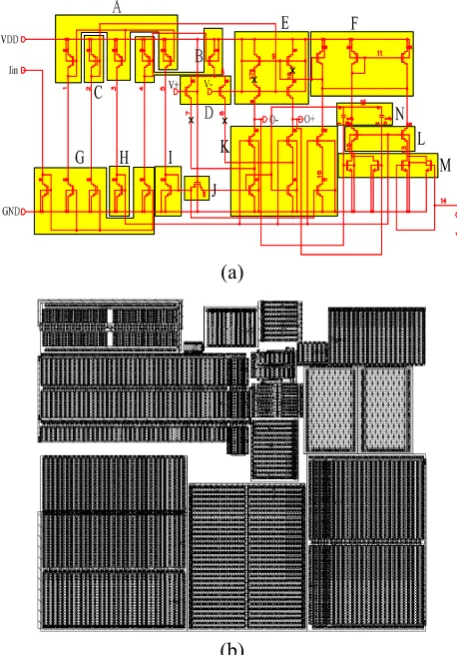
> @6XQJ + 3DUN 5REXVW 'HVLJQ DQG $QDO\VLV IRU 4XDOLW\ (QJLQHHULQJ &KDSPDQ +DOO /RQGRQ Fig. 7. Schematic (a) and placement layout (b) with BLGA2 of a
common mode feedback optional amplifier.
Figure 7a gives the schematic of the third circuit, a com-mon mode feedback optional amplifier, in which the parti-tioning is indicated by rectangles. The corresponding place-ment result with the BLGA2 is shown in Fig. 7b, which is comparable to the manual placement. In DesignAssistant the relative position of modules are recorded and passed to the router as the input. The router then compacts all the modules with the detailed routing.
6 Summary
In this paper a new technique with genetic algorithm to solve the analog module placement has been introduced. By using the notion of bin-packing, a genetic encoding has been devel-oped in which most constraints of the problem are implicitly represented. As a consequence, each individual always sat-isfies constraints. The advantage of the proposed strategy is that it allows a more accurate estimation of the layout quality with the configuration space shrunk dramatically, since the use of penalty terms have been avoided. Special constraints for analog integrated circuits are included in the cost func-tion. The fractional factorial experiment with an orthogonal array is employed in order to study the algorithm parameters.
A meta-GA is applied to determine the exact parameter val-ues. The experimental results show that this approach with the optimized parameters contributes high design efficiency with the satisfactory result, which is comparable to the man-ual counterpart.
References
Wang, M., Yang, X., and Sarrafzadeh, M.: Dragon2000: Fast Standard-cell Placement for Large Circuits, Proc. of the IEEE International Conference on Computer-Aided Design (ICCAD), pp 260–263, November 2000.
Zhang, L., Kleine, U., Roewer, F., Rudolph, T., and Wolf, M.: A Novel Design Tool for Analog Integrated Circuits, Proc. of the First Joint Symposium on Opto- & Microelectronic Device and Circuits, pp.146–149, April 2000.
Su, L., Buntine, W., Newton, A. R., and Peters, B. S.: Learning as Applied to Stochastic Optimization for Standard Cell Placement, IEEE Trans. on Computer-aided Design of Integrated Circuits and Systems, 20, 4, pp. 1499–1513, April 2001.
Varanelli, J. M. and Cohoon, J. P.: A two-stage simulated annealing methodology, Proc. the Fifth Great Lakes Symposium on VLSI, pp. 50–53, 1995.
Cohn, J. M., Garrod, D. J., Rutenbar, R. A., and Carley, L. R.: Ana-log Device-leve Layout Automation, Boston, Kluwer Academic Publishers, 1994.
van der Plas, G., Debyser, G., Leyn, F., Lampaert, K., Vandenbuss-che, J., Gielen, G., Sansen, W., Veselinovic, P., and Leenaerts, D.: AMGIE – A Synthesis Environement for CMOS Analog tegrated Circuits, IEEE Trans. on Computer-aided Design of In-tegrated Circuits and Systems, 20, 9, pp. 1037–1058, Sept. 2001. Shahookar, K. and Mazumder, P.: A Genetic Approach to Stan-dard Cell Placement Using Meta-Genetic Parameter Optimiza-tion”, IEEE Trans. Computer-Aided Design, 9, 5, pp. 500–511, May 1990.
Esbensen, H. and Mazumder, P.: SAGA: A Unification of the Ge-netic Algorithm with Simulated Annealing and Its Application to Macro-Cell Placement, Proc. of The 7th International Confer-ence on VLSI Design, pp. 211–214, 1994.
Kroeger, B., Schwenderling, P., and Vornberger, O.: Genetic Pack-ing of Rectangles on Transputers , TransputPack-ing 91, 2, IOS Press, 1991.
Wolf, M., Kleine, U., and Schafer, F.: A Novel Design Assistant for Analog Circuits, Proc. Asia and South Pacific Design Automa-tion Conference, pp. 495–500, Feb. 1998.
Sait, S. M. and Youssef, H.: VLSI Physical Design Automation (Theory and Practice), McGraw-Hill, 1995.