Adv. Radio Sci., 10, 159–165, 2012 www.adv-radio-sci.net/10/159/2012/ doi:10.5194/ars-10-159-2012
© Author(s) 2012. CC Attribution 3.0 License.
Advances in
Radio Science
Application of syndrome based Turbo decoding with adaptive
computational complexity in LTE downlink
J. Geldmacher1, K. Hueske1, M. Kosakowski2, and J. G¨otze1
1TU Dortmund University, Information Processing Lab, Otto-Hahn-Str. 4, 44227 Dortmund, Germany 2Research In Motion GmbH, Universit¨atsstr. 140, 44799 Bochum, Germany
Correspondence to: J. Geldmacher ([email protected])
Abstract. This paper describes the application of an adap-tive complexity decoder for the Long Term Evolution (LTE) downlink Turbo code. The proposed decoding approach is based on the block syndrome decoding principle and enables adaptive reduction of decoding effort depending on current SNR and iteration number with negligible influence on de-coding performance. Numerical results in context of LTE downlink using typical mobile channels are used to demon-strate the efficiency of the approach.
1 Introduction
Mobile communication usage has shifted from mainly speech-centered use to highly bandwidth demanding data communication: A mobile phone is no longer just a phone, but it has become a personal communication and multime-dia device, which is also used for internet browsing, video and audio streaming, online-based navigation etc. The result-ing increasresult-ing bandwidth demands are satisfied in one part by using more sophisticated signal processing in the physi-cal layer, like MIMO transmission or advanced forward error correction (FEC) methods.
Considering the Long Term Evolution (LTE), one of the most complex parts of these baseband processing compo-nents is the FEC, which is realised using Turbo coding (Berrou et al., 1993). Turbo Codes are used in several applications, because of their excellent BER performance, compared to classical codes like convolutional or block codes. In case of ideal uncorrelated Gaussian inputs and very large code block lengths, Turbo Codes can achieve close-to-capacity BERs. However, good performance has to be payed for with high computational complexity: Turbo codes are de-coded iteratively by using constituent decoders, which ex-change their beliefs about the transmitted information bits in the form of Log Likelihood Ratios (LLRs). Typically the LogMAP or the MaxLog algorithm (Robertson et al., 1995)
are used in the constituent decoders to generate these LLRs by doing forward and backward recursions on a trellis repre-sentation of the code. Traditionally this trellis represents the encoder G of the code.
In this paper, a different decoding approach is considered which is based on the so called syndrome former HT of the underlying code. While this decoder is equivalent to the con-ventional decoder in terms of trellis complexity and decod-ing performance, it can be modified to achieve adaptive de-coding complexity based on the so called Block Syndrome Decoding (BSD) approach. The BSD concept has been de-scribed earlier in context of Viterbi decoding (Geldmacher et al., 2009) and Turbo equalization (Geldmacher et al., 2010; Hueske et al., 2010). Applying it to Turbo decoding is, how-ever, not straightforward as will be shown in this paper, but requires the extension of the Turbo decoder by means of a pre-correction of the constituent decoders inputs.
In the following Sect. 2 the BSD concept is summarized. The syndrome based, adaptive complexity Turbo decoder is explained in Sect. 3 and numerical results for typical LTE scenarios are shown in Sect. 4. Conclusions are drawn in Sect. 5.
2 Block syndrome decoding
In syndrome decoding, instead of the trellis of the encoder, the trellis of the syndrome former HT is used, where each path represents an admissible error sequence . Given the hard decision r of a received distorted sequence, an admissi-ble error sequenceis defined as any sequence that results in a valid code sequence, when applied to r. This trellis can be constructed based on the syndrome former HT of the code, and the syndrome sequence b=rHT of r (Forney Jr., 1970; Schalkwijk and Vinck, 1976). Consequently, in this case a MAP decoder estimates the LLRs of the error in code or in-formation bits, and this approach is referred to as syndrome
decoding. The resulting absolute LLR is identical for both approaches, and therefor the choice of the trellis has no influ-ence on the decoding performance. Also trellis complexities of syndrome former and encoder are known to be identical in their minimal realizations (Forney Jr., 1970).
However, there is an interesting property of syndrome based decoding that can be exploited for reducing the de-coding complexity. As the syndrome based decoder outputs LLRs of the error bits and not of the code bits, the proba-bility of states and transitions depends on the number of er-rors in the decoders input sequence r: Less erer-rors relate to a higher probability of the all-zero state in the trellis. This also means that if a subblock in the decoder’s input sequence is error-free, then the zero-state is the most likely state in this subblock, and consequently that an estimation of error-free blocks can be interpreted as a state estimation.
Decoding complexity can then be reduced by identifying error-free subblocks before the decoding starts, and switch-ing off the decoder for these subblocks. Only the remainswitch-ing erroneous subblocks are actually processed by the decoder. In context of syndrome decoding, a very simple yet efficient criterion for estimating error-free subblocks is the syndrome b of the decoder’s input sequence. Because of the orthogo-nality of the syndrome former HT to the code, the syndrome only depends on the channel errorc,
b=rHT=(v+c)HT =uGHT+cHT=cHT, (1) so that subsequences of a certain number of consecutive ze-ros in b indicate error-free subblocks in r with certain proba-bility. In (1) v=uG denotes the code sequence correspond-ing to the information sequence u.
In summary, the basic idea of BSD consists of two steps: 1. Preprocessing Compute the syndrome b of the decoders
input sequence and identify subblocks of a predefined minimum number of consecutive zeros. These sub-blocks are considered to be error-free.
2. Decoding Apply the syndrome-based decoder only to the remaining erroneous subblocks.
The required minimum number of consecutive zeros is a de-sign parameter, which is called`minin the following. It in-fluences complexity reduction and loss of decoding perfor-mance: A smaller`min will result in the detection of more error-free subblocks, i.e. more reduction of decoding com-plexity, but also has a higher chance of identifying a sub-block as error-free which actually contains errors, i.e. higher degradation of decoding performance.
It is easy to see, that the BSD concept results in a decod-ing complexity that adapts to the number of errors contained in the decoders input sequence. In the worst case, if the in-put sequence contains many errors, no error-free subblocks are identified, and the decoder has to process the whole se-quence. In this case the effort is equal to a conventional coder plus the preprocessing overhead. However, if the
de-coder’s input contains only few errors, more error-free sub-blocks can be identified and the decoding effort is reduced.
Considering a Turbo decoder, it is expected that the num-ber of remaining errors in the a priori estimate of the sys-tematic part decreases during Turbo iterations. Additionally, if an estimate of the parity part is employed to correct er-rors in the parity part, then the overall number of erer-rors in the constituent decoder’s input decreases with ongoing itera-tions and increasing SNR. Thus, employing the BSD concept yields complexity reduction with increasing SNR and ongo-ing iterations.
The necessity of correcting the constituent decoder’s in-put sequence requires a modified transition metric, which ac-counts for the precorrection. Therefore the syndrome decod-ing approach for Turbo Codes described in this work differs from other syndrome based decoding algorithms (Schalkwijk and Vinck, 1976; Yamada et al., 1983; Tajima et al., 2002; Minowa, 2003; Geldmacher et al., 2010).
3 Adaptive complexity Turbo decoder
First the operation of the syndrome based constituent decoder is described (Sect. 3.1), then the Turbo decoding framework with precorrection and the BSD extension are explained (Sect. 3.2 and Sect. 3.3).
3.1 Syndrome based Turbo decoder
It is assumed, that a half rate systematic terminated encoder is employed, and that on receiver side depuncturing is re-alized by replacing punctured positions with zero reliability bits. One constituent decoder takes the received soft decision sequence˜r, a precorrection sequence x and a priori LLRs of the errorsLA()in the systematic part as input. For the sys-tematic part, it generates an a posteriori hard decision esti-mateˆ of the error in the harddecision r of r and extrinsic˜ LLRsLE(). The decoder performs the following steps:
1. Precorrection and syndrome computation The precor-rection sequence x is applied to r, and the syndrome b is computed as
b=(r⊕x)HT. (2)
2. Trellis operation Given the trellis of HT subject to b, the MaxLog algorithm is applied to generate an a posteriori estimateL(). The intial state for the forward recursion is set to the zero state, while the intial state for the back-ward recursion is selected according to the final state of the syndrome former from (2). The transition metric at time instanttis given as
˜
xtse˜s(p,q) | ˜rts| −LA(ts)/2
+ ˜xtpe˜p(p,q)| ˜rtp|, (3)
J. Geldmacher et al.: Application of syndrome based Turbo decoding 161
:
3
DeIntlvr
Intlvr
Decoder 1
Decoder 2
˜r ǫˆ
LE(ǫ)
x
LA(ǫ)
LE(ǫ) LA(ǫ)
x
ˆ
ǫ
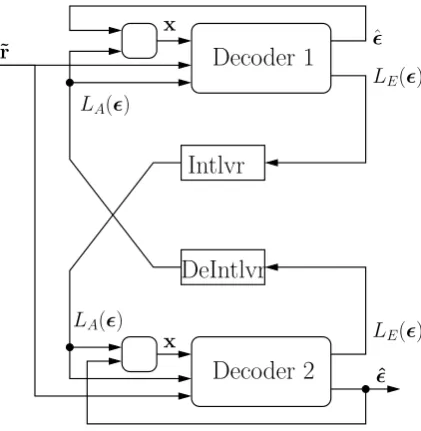
Fig. 1. Syndrome based Turbo decoder with precorrection.
where
x
˜
st,
x
˜
pt
and
˜
e
s(p,q),
e
˜
p(p,q)
represent BPSK
mod-ulated systematic and parity bits of precorrection
se-165
quence and error correponding to the trellis transition
from states
p
to
q
. This yields the a posteriori LLR
L
(
e
)
of the incremental error
e
w.r.t.
(
r
⊕
x
)
. Note that
for LogMAP decoding proper normalization using the
channel reliability would be required.
170
In order to generate the LLR
L
(
ǫ
)
of the absolute error
in
r
, the sign of
L
(
e
)
, which is an estimate of the error
in
r
⊕
x
, has to be flipped according to
x
,
L
(
ǫ
st) =
−
x
˜
stL
(
e
st)
.
(4)
The harddecision
ˆ
ǫ
of
L
(
ǫ
)
delivers the a posteriori
es-175
timate of the channel error
ǫ
c. Applying
ˆ
ǫ
to the
system-atic part
r
sof
r
results in the estimate
u
ˆ
of the original
information bits
u
.
3. Generation of extrinsic LLR The extrinsic LLRs
L
E(
ǫ
)
, that are passed to the other constituent decoder,
180
are generated by removing the a priori information
L
A(
ǫ
)
and the received systematic softbits from
L
(
ǫ
st
)
,
L
E(
ǫ
st) =
L
(
e
st
)
−
(
−
x
˜
s t)(˜
x
s t
|
r
˜
s t
| −
x
˜
s
t
L
A(
ǫ
st))
=
L
(
ǫ
st) +
|
r
˜
s
t
| −
L
A(
ǫ
st)
.
(5)
3.2
Turbo decoder with precorrection
185
An overview of the syndrome based Turbo decoder with two
constituent decoders is shown in Fig. 1. Like in the
conven-tional Turbo decoder, both constituent decoders use the
sys-tematic and their according parity part of the received
soft-bits, and, as a priori values, the interleaved extrinsic
informa-190
tions
L
E(
ǫ
st)
generated by the other decoder. Additionally,
the precorrection sequence
x
is used,
Generally an arbitrary sequence can be selected for
x
,
without changing the absolute values of the generated LLRs.
However, for the BSD concept it is crucial, that the input
195
possible, such that the hamming weight of
b
becomes small.
This can be achieved by selecting
x
as an estimate of the
channel error
ǫ
c, which in context of the Turbo decoding
framework can be done as follows:
200
– The systematic part
x
sis set according to the hard
deci-sion of the a priori values
L
A(
ǫ
)
.
– For the parity part
x
p, the output
u
ˆ
from the previous
iteration is reencoded, which yields an estimated code
sequence
v
ˆ
. The comparison of the parity part
v
ˆ
pof
ˆ
v
205
with
r
, yields
x
p=
r
p⊕
v
ˆ
p.
Thus the sequence
x
depends on both constituent
de-coders, such that it can be used as a measure for the decoding
progress. In case of convergence of the decoder, it leads to a
decreasing hamming weight of the syndrome sequence
b
.
210
The described syndrome based Turbo decoder is
identi-cal to the conventional decoder in terms of decoding
perfor-mance and trellis complexity. Additional effort is required
to compute the sequence
x
and the syndrome
b
. However,
both are binary operations and can be considered of
negligi-215
ble complexity.
3.3
Block syndrome decoding of Turbo codes
Based on the described syndrome based Turbo decoder, the
BSD concept (Geldmacher et al., 2009, 2010) as described
in Sec. 2 can be applied to achieve a reduction of decoding
220
effort. Because of the precorrection, the syndrome sequence
b
of a constituent decoder shows subsequences of
consec-utive zeros, that increase with ongoing iterations in case of
convergence. This can be exploited to separate the input
se-quence into subblocks that are considered to be erroneous
225
and subblocks that are considered to be error-free.
Conse-quently, a reduction of decoding effort can be achieved by
only processing the erroneous subblocks and neglecting the
supposely error-free subblocks.
More precisely the syndrome based Turbo decoding
algo-230
rithm from Sec. 3.1 is extended as follows:
1. Preprocessing of syndrome Identify subsequences of
≥
ℓ
minzeros in
b
. Consider the corresponding
sub-blocks in
˜
r
, except a padding of
⌊
ℓ
min/
2
⌋
at the
be-ginning and end of each subblock, as error-free, and the
235
remaining subblocks as erroneous.
2. Processing of subblocks
(a) Erroneous blocks The erroneous subblocks are
pro-cessed by the syndrome based MAP decoder, which
generates extrinsic values
L
E(
ǫ
st)
and the estimated
240
error
ǫ
st
for all
t
in these subblocks.
Note that
these blocks can be considered to be terminated in
the zero state, because the zero state is the most
likely state in the preceding and succeeding
error-Fig. 1. Syndrome based Turbo decoder with precorrection.
wherex˜ts,x˜tp ande˜s(p,q), e˜ p
(p,q) represent BPSK mod-ulated systematic and parity bits of precorrection se-quence and error correponding to the trellis transition from statesp toq. This yields the a posteriori LLR
L(e)of the incremental error e w.r.t.(r⊕x). Note that for LogMAP decoding proper normalization using the channel reliability would be required.
In order to generate the LLRL()of the absolute error in r, the sign ofL(e), which is an estimate of the error in r⊕x, has to be flipped according to x,
L(ts)= − ˜xtsL(ets). (4)
The harddecisionˆofL()delivers the a posteriori es-timate of the channel errorc. Applyingˆto the system-atic part rs of r results in the estimateu of the originalˆ information bits u.
3. Generation of extrinsic LLR The extrinsic LLRsLE(), that are passed to the other constituent decoder, are gen-erated by removing the a priori informationLA()and the received systematic softbits fromL(ts),
LE(st)=L(ets)−(− ˜xts) x˜ts| ˜rts| − ˜xtsLA(ts)
=L(ts)+ | ˜rts| −LA(ts). (5) 3.2 Turbo decoder with precorrection
An overview of the syndrome based Turbo decoder with two constituent decoders is shown in Fig. 1. Like in the conven-tional Turbo decoder, both constituent decoders use the sys-tematic and their according parity part of the received
soft-bits, and, as a priori values, the interleaved extrinsic informa-tionsLE(ts)generated by the other decoder. Additionally, the precorrection sequence x is used.
Generally an arbitrary sequence can be selected for x, without changing the absolute values of the generated LLRs. However, for the BSD concept it is crucial, that the input
(r⊕x)of the syndrome former contains as few errors as pos-sible, such that the hamming weight of b becomes small. This can be achieved by selecting x as an estimate of the channel error c, which in context of the Turbo decoding framework can be done as follows:
– The systematic part xsis set according to the hard deci-sion of the a priori valuesLA().
– For the parity part xp, the outputu from the previousˆ iteration is reencoded, which yields an estimated code sequencev. The comparison of the parity partˆ vˆp ofvˆ with r, yields xp=rp⊕ ˆvp.
Thus the sequence x depends on both constituent decoders, such that it can be used as a measure for the decoding progress. In case of convergence of the decoder, it leads to a decreasing hamming weight of the syndrome sequence b.
The described syndrome based Turbo decoder is identi-cal to the conventional decoder in terms of decoding perfor-mance and trellis complexity. Additional effort is required to compute the sequence x and the syndrome b. However, both are binary operations and can be considered of negligi-ble complexity.
3.3 Block syndrome decoding of Turbo codes
Based on the described syndrome based Turbo decoder, the BSD concept (Geldmacher et al., 2009, 2010) as described in Sect. 2 can be applied to achieve a reduction of decoding effort. Because of the precorrection, the syndrome sequence b of a constituent decoder shows subsequences of consec-utive zeros, that increase with ongoing iterations in case of convergence. This can be exploited to separate the input se-quence into subblocks that are considered to be erroneous and subblocks that are considered to be error-free. Conse-quently, a reduction of decoding effort can be achieved by only processing the erroneous subblocks and neglecting the supposely error-free subblocks.
More precisely the syndrome based Turbo decoding algo-rithm from Sect. 3.1 is extended as follows:
1. Preprocessing of syndrome Identify subsequences of≥
`minzeros in b. Consider the corresponding subblocks inr, except a padding of˜ b`min/2cat the beginning and end of each subblock, as error-free, and the remaining subblocks as erroneous.
2. Processing of subblocks
(a) Erroneous blocks The erroneous subblocks are pro-cessed by the syndrome based MAP decoder, which generates extrinsic valuesLE(ts)and the estimated error ts for all t in these subblocks. Note that these blocks can be considered to be terminated in the zero state, because the zero state is the most likely state in the preceding and succeeding error-free blocks.
(b) Error-free blocks No processing is required for the supposedly error-free blocks. Instead, the extrinsic LLR is set to a sufficiently large value,LE(ts)=
˜
xtsc, withc >0, and the estimated error is set to the systematic part of the pre-correction sequence,
ts=xst. A reasonable choice for c is the largest value in the quantization range of the LLR values. The choice of the design parameter`minaffects the achiev-able reduction of decoding effort and possible loss in decod-ing performance. Given an acceptable loss in block error rate (BLER), it may be selected heuristically.
4 Simulation results
To show the efficiency of the proposed BSD Turbo de-coder, it is analyzed in context of an LTE downlink scenario (Mehlf¨uhrer et al., 2009). For the simulations presented in this section, the modulation and coding scheme (MCS) is set according to the Channel Quality Indicator (CQI). A single-user, single antenna scenario is considered, where the carrier frequency is set tofC=2.1 GHz and Doppler frequency is
fD,max=0 Hz. For all simulations independent channel real-izations are used. The bandwidth is set to 5 MHz for all sim-ulations, and no control channel information is transmitted by the eNodeB, meaning all resources are used for payload data only. The decoder employs the Max Log MAP algo-rithm and is set to a maximum iteration number ofimax=8. CRC24 is employed for High SNR Early Termination (ET).
The computational effort will be measured as
equiva-lent iterations of the conventional decoder until termination.
Thus for the conventional decoder this measure equals the average number of full iterations until ET. For the BSD ap-proach, this corresponds to the averaged number of itera-tions, where each iteration is weighted with the percentage of erroneous blocks. For example, if for the BSD approach the decoder would terminate after 3 full iterations, but each constituent decoder would have only processed 50 % of the code block during each full iteration, then this would corre-spond to 1.5 equivalent iterations.
There are two factors which have major influence on the performance of the BSD approach:
– Code rate The code rate determines how many posi-tions are punctured in the transmitted block. The higher (b) Error-free blocks No processing is required for the
supposedly error-free blocks. Instead, the extrinsic LLR is set to a sufficiently large value, LE(ǫst) =
˜ xs
tc, withc >0, and the estimated error is set to
the systematic part of the pre-correction sequence, 250
ǫs
t=xst. A reasonable choice for cis the largest
value in the quantization range of the LLR values. The choice of the design parameter ℓmin affects the
achievable reduction of decoding effort and possible loss in decoding performance. Given an acceptable loss in block er-255
ror rate (BLER), it may be selected heuristically.
4 Simulation results
To show the efficiency of the proposed BSD Turbo de-coder, it is analyzed in context of an LTE downlink scenario (Mehlf¨uhrer et al., 2009). For the simulations presented in 260
this section, the modulation and coding scheme (MCS) is set according to the Channel Quality Indicator (CQI). A single-user, single antenna scenario is considered, where the car-rier frequency is set tofC= 2.1 GHzand Doppler frequency
isfD,max= 0 Hz. For all simulations independent chan-265
nel realizations are used. The bandwidth is set to5 MHz for all simulations, and no control channel information is transmitted by the eNodeB, meaning all resources are used for payload data only. The decoder employs the Max Log MAP algorithm and is set to a maximum iteration number of 270
imax= 8. CRC24 is employed for High SNR Early Termina-tion (ET).
The computational effort will be measured as
equiva-lent iterations of the conventional decoder until termination.
Thus for the conventional decoder this measure equals the 275
average number of full iterations until ET. For the BSD ap-proach, this corresponds to the averaged number of itera-tions, where each iteration is weighted with the percentage of erroneous blocks. For example, if for the BSD approach the decoder would terminate after 3 full iterations, but each 280
constituent decoder would have only processed 50% of the code block during each full iteration, then this would corre-spond to1.5equivalent iterations.
There are two factors which have major influence on the performance of the BSD approach:
285
– Code rate The code rate determines how many posi-tions are punctured in the transmitted block. The higher the code rate, the more punctured positions and conse-quently the more depunctured, zero-reliability bits are input to the decoder. However, the reliability of the 290
syndrome-based criterion for identification of error-free blocks depends on a good estimate of the parity se-quence, because of the involved precorrection. Thus, if there are more zero-reliability parity positions this crite-rion is less reliable and a larger value has to be selected 295
forℓminto avoid a loss of BLER.
−1.5 −1.4 −1.3 −1.2 −1.1 −1 −0.9 −0.8 −0.7 −0.6 −0.5 10−2
10−1 100
SNR [dB]
BLER
CQI 3
Reference BSD l
min=21
7.9 8 8.1 8.2 8.3 8.4 8.5 8.6 8.7 8.8 8.9 10−2
10−1 100
SNR [dB]
BLER
CQI 9
Reference BSD l
min=31
15.5 15.6 15.7 15.8 15.9 16 16.1 16.2 16.3 16.4 16.5 10−2
10−1 100
SNR [dB]
BLER
CQI 13
Reference BSD l
min=91
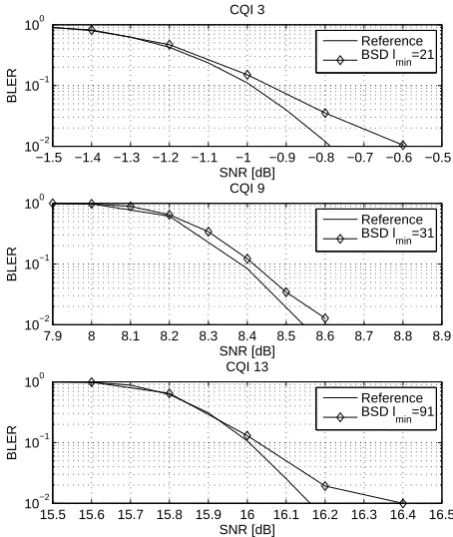
Fig. 2. Comparison of BLER for different CQI values (AWGN).
– Channel type The type of the channel influences the convergence behavior of the Turbo decoder. Naturally the BSD approach is more effective if the decoder exe-cutes more iterations before termination, because in this 300
case the BSD has more chances to identify error-free parts.
The following Sec. 4.1 compares BLER and equivalent iterations for different CQI values, i.e. different code rates. The influence of the transmission channel is analyzed in Sec. 305
4.2. A conventional Turbo decoder is used to provide refer-ence results.
4.1 Code rates
To illustrate the performance of the BSD approach for dif-ferent code rates, the CQI values 3, 9 and 13 are used under 310
the assumption of AWGN transmission. The parameterℓmin
is adjusted such that the BLER degradation is smaller than 0.1 dB compared to the reference; it is set toℓmin= 21for
CQI3,ℓmin= 31for CQI9 andℓmin= 91for CQI13. As
al-ready mentioned, a larger value is required for a higher CQI 315
(higher code rate). The resulting BLER for the three cases is shown on Fig. 2. It can be noted, that there is a slight per-formance decrease, which however is still smaller than the required 0.1dB at a working point of 10% BLER.
The equivalent number of iterations that are executed by 320
the decoder are shown in Fig. 3. Again, the BSD approach is
Fig. 2. Comparison of BLER for different CQI values (AWGN).
the code rate, the more punctured positions and conse-quently the more depunctured, zero-reliability bits are input to the decoder. However, the reliability of the syndrome-based criterion for identification of error-free blocks depends on a good estimate of the parity se-quence, because of the involved precorrection. Thus, if there are more zero-reliability parity positions this crite-rion is less reliable and a larger value has to be selected for`minto avoid a loss of BLER.
– Channel type The type of the channel influences the convergence behavior of the Turbo decoder. Naturally the BSD approach is more effective if the decoder exe-cutes more iterations before termination, because in this case the BSD has more chances to identify error-free parts.
The following Sect. 4.1 compares BLER and equivalent iterations for different CQI values, i.e. different code rates. The influence of the transmission channel is analyzed in Sect. 4.2. A conventional Turbo decoder is used to provide refer-ence results.
4.1 Code rates
To illustrate the performance of the BSD approach for dif-ferent code rates, the CQI values 3, 9 and 13 are used under the assumption of AWGN transmission. The parameter`min is adjusted such that the BLER degradation is smaller than
J. Geldmacher et al.: Application of syndrome based Turbo decoding 163
: 5
−1.5 −1.4 −1.3 −1.2 −1.12 −1 −0.9 −0.8 −0.7 −0.6 −0.5 4 6 8 SNR [dB] Eq Iterations CQI 3 Reference BSD lmin=21
7.9 8 8.1 8.2 8.3 8.4 8.5 8.6 8.7 8.8 8.9 2 4 6 8 SNR [dB] Eq Iterations CQI 9 Reference BSD lmin=31
15.52 15.6 15.7 15.8 15.9 16 16.1 16.2 16.3 16.4 16.5 4 6 8 SNR [dB] Eq Iterations CQI 13 Reference BSD lmin=91
Fig. 3. Equivalent iterations for different CQI values (AWGN).
compared to the conventional Turbo decoder for the consid-ered SNR range. For the conventional decoder the equivalent number of iterations only depends on the CRC24 based ET. For the BSD, it is additionally influenced by the amount of 325
error-free subblocks that are identified during the iterations. Naturally, the number of iterations that are required to code a block decreases with increasing SNR for both de-coders, because the quality of the received values improves. For the BSD decoder the number of equivalent iterations is 330
always smaller than that of the conventional decoder. For ex-ample, considering a working point of 10% BLER, the com-putational effort is reduced by about0.7,1.1and1equivalent iterations at CQI3, CQI9 and CQI13. This corresponds to a reduction of decoding operations by about20%.
335
4.2 Channels
In order to analyze the impact of different channel condi-tions, Figs. 4 and 5 compare the performance of BSD over AWGN channel to the performance over the fading channels Typical Urban (TU) and PedestrianA (PedA). The BSD is 340
shown along with the conventional decoder for a fixed CQI of 9. The BLER is shown in Fig. 4 for the three cases. As in the previous simulation, the parameter ℓmin has been selected
such that the impact on BLER performance is<0.1dB at the BLER working point of 10%. For all channels the design 345
parameter is set toℓmin= 31.
The reduction of decoding effort in terms of equivalent
it-7.9 8 8.1 8.2 8.3 8.4 8.5 8.6 8.7 8.8 8.9 10−2 10−1 100 SNR [dB] BLER AWGN Reference BSD lmin=31
10 11 12 13 14 15 16 10−2 10−1 100 SNR [dB] BLER Typical Urban Reference BSD lmin=31
10 12 14 16 18 20 22 24 10−2 10−1 100 SNR [dB] BLER PedestrianA Reference BSD l min=31
Fig. 4. Comparison of BLER for different channels (CQI9).
erations is shown in Fig. 5. It can be noticed, that for the fading channels TU and PedA the average number of itera-tions of the conventional Turbo decoder is much smaller than 350
in the AWGN case: While for the AWGN channel the de-coder executes about5.1iterations in average at the working point of10%BLER, it only executes about2.2and1.9 itera-tions for the TU and PedA channel, respectively. This clearly affects the efficiency of the BSD approach, because if less it-355
erations are executed until ET, there are less options for the BSD to identify error-free blocks, and thus less reduction of computational effort. Consequently the reduction in terms of equivalent iterations is about0.5and0.2for TU channel and PedA channel and thus smaller compared to the AWGN case. 360
Table 1 summarizes the results presented in this section. For a BLER working point of 10% and for the different CQIs and channel types, the equivalent iterations of conventional Turbo decoder and BSD are shown along with the used pa-rameterℓmin. Additionally the last column shows the
rela-365
tive reduction of equivalent iterations. It can be seen, that in case of AWGN and TU channel the reduction of computa-tional effort is about20%, while in case of the PedA channel it is only6%. It can further be noticed, that the choice of the parameter ℓmin depends on the CQI, i.e. the code rate,
370
and not on the channel type. Further simulations have also shown that the variation of other system parameters has no significant influence on the choice ofℓmin either. Thus, the
setting ofℓmincan be done by the decoder based on the
cur-rent MCS reporting. 375
Fig. 3. Equivalent iterations for different CQI values (AWGN).
0.1 dB compared to the reference; it is set to`min=21 for CQI3,`min=31 for CQI9 and`min=91 for CQI13. As al-ready mentioned, a larger value is required for a higher CQI (higher code rate). The resulting BLER for the three cases is shown on Fig. 2. It can be noted, that there is a slight per-formance decrease, which however is still smaller than the required 0.1dB at a working point of 10 % BLER.
The equivalent number of iterations that are executed by the decoder are shown in Fig. 3. Again, the BSD approach is compared to the conventional Turbo decoder for the consid-ered SNR range. For the conventional decoder the equivalent number of iterations only depends on the CRC24 based ET. For the BSD, it is additionally influenced by the amount of error-free subblocks that are identified during the iterations.
Naturally, the number of iterations that are required to code a block decreases with increasing SNR for both de-coders, because the quality of the received values improves. For the BSD decoder the number of equivalent iterations is always smaller than that of the conventional decoder. For ex-ample, considering a working point of 10 % BLER, the com-putational effort is reduced by about 0.7, 1.1 and 1 equivalent iterations at CQI3, CQI9 and CQI13. This corresponds to a reduction of decoding operations by about 20%.
: 5
−1.5 −1.4 −1.3 −1.2 −1.12 −1 −0.9 −0.8 −0.7 −0.6 −0.5 4 6 8 SNR [dB] Eq Iterations CQI 3 Reference BSD l min=21
7.9 8 8.1 8.2 8.3 8.4 8.5 8.6 8.7 8.8 8.9 2 4 6 8 SNR [dB] Eq Iterations CQI 9 Reference BSD l min=31
15.52 15.6 15.7 15.8 15.9 16 16.1 16.2 16.3 16.4 16.5 4 6 8 SNR [dB] Eq Iterations CQI 13 Reference BSD l min=91
Fig. 3. Equivalent iterations for different CQI values (AWGN).
compared to the conventional Turbo decoder for the consid-ered SNR range. For the conventional decoder the equivalent number of iterations only depends on the CRC24 based ET. For the BSD, it is additionally influenced by the amount of 325
error-free subblocks that are identified during the iterations. Naturally, the number of iterations that are required to code a block decreases with increasing SNR for both de-coders, because the quality of the received values improves. For the BSD decoder the number of equivalent iterations is 330
always smaller than that of the conventional decoder. For ex-ample, considering a working point of 10% BLER, the com-putational effort is reduced by about0.7,1.1and1equivalent iterations at CQI3, CQI9 and CQI13. This corresponds to a reduction of decoding operations by about20%.
335
4.2 Channels
In order to analyze the impact of different channel condi-tions, Figs. 4 and 5 compare the performance of BSD over AWGN channel to the performance over the fading channels Typical Urban (TU) and PedestrianA (PedA). The BSD is 340
shown along with the conventional decoder for a fixed CQI of 9. The BLER is shown in Fig. 4 for the three cases. As in the previous simulation, the parameterℓmin has been selected
such that the impact on BLER performance is<0.1dB at the BLER working point of 10%. For all channels the design 345
parameter is set toℓmin= 31.
The reduction of decoding effort in terms of equivalent
it-7.9 8 8.1 8.2 8.3 8.4 8.5 8.6 8.7 8.8 8.9 10−2 10−1 100 SNR [dB] BLER AWGN Reference BSD lmin=31
10 11 12 13 14 15 16 10−2 10−1 100 SNR [dB] BLER Typical Urban Reference BSD lmin=31
10 12 14 16 18 20 22 24 10−2 10−1 100 SNR [dB] BLER PedestrianA Reference BSD lmin=31
Fig. 4. Comparison of BLER for different channels (CQI9).
erations is shown in Fig. 5. It can be noticed, that for the fading channels TU and PedA the average number of itera-tions of the conventional Turbo decoder is much smaller than 350
in the AWGN case: While for the AWGN channel the de-coder executes about5.1iterations in average at the working point of10%BLER, it only executes about2.2and1.9 itera-tions for the TU and PedA channel, respectively. This clearly affects the efficiency of the BSD approach, because if less it-355
erations are executed until ET, there are less options for the BSD to identify error-free blocks, and thus less reduction of computational effort. Consequently the reduction in terms of equivalent iterations is about0.5and0.2for TU channel and PedA channel and thus smaller compared to the AWGN case. 360
Table 1 summarizes the results presented in this section. For a BLER working point of 10% and for the different CQIs and channel types, the equivalent iterations of conventional Turbo decoder and BSD are shown along with the used pa-rameter ℓmin. Additionally the last column shows the
rela-365
tive reduction of equivalent iterations. It can be seen, that in case of AWGN and TU channel the reduction of computa-tional effort is about20%, while in case of the PedA channel it is only 6%. It can further be noticed, that the choice of the parameterℓmin depends on the CQI, i.e. the code rate,
370
and not on the channel type. Further simulations have also shown that the variation of other system parameters has no significant influence on the choice ofℓmineither. Thus, the
setting ofℓmincan be done by the decoder based on the
cur-rent MCS reporting. 375
Fig. 4. Comparison of BLER for different channels (CQI9).
4.2 Channels
In order to analyze the impact of different channel condi-tions, Figs. 4 and 5 compare the performance of BSD over AWGN channel to the performance over the fading channels Typical Urban (TU) and PedestrianA (PedA). The BSD is shown along with the conventional decoder for a fixed CQI of 9. The BLER is shown in Fig. 4 for the three cases. As in the previous simulation, the parameter`minhas been selected such that the impact on BLER performance is<0.1dBat the BLER working point of 10 %. For all channels the design pa-rameter is set to`min=31.
The reduction of decoding effort in terms of equivalent it-erations is shown in Fig. 5. It can be noticed, that for the fading channels TU and PedA the average number of itera-tions of the conventional Turbo decoder is much smaller than in the AWGN case: While for the AWGN channel the de-coder executes about 5.1 iterations in average at the working point of 10% BLER, it only executes about 2.2 and 1.9 itera-tions for the TU and PedA channel, respectively. This clearly affects the efficiency of the BSD approach, because if less it-erations are executed until ET, there are less options for the BSD to identify error-free blocks, and thus less reduction of computational effort. Consequently the reduction in terms of equivalent iterations is about 0.5 and 0.2 for TU channel and PedA channel and thus smaller compared to the AWGN case.
7.9 8 8.1 8.2 8.3 8.4 8.5 8.6 8.7 8.8 8.9 2
4 6 8
SNR [dB]
Eq Iterations
AWGN
Reference BSD lmin=31
10 11 12 13 14 15 16 1
2 3 4
SNR [dB]
Eq Iterations
Typical Urban
Reference BSD lmin=31
10 12 14 16 18 20 22 24 1
2 3 4
SNR [dB]
Eq Iterations
PedestrianA
Reference BSD lmin=31
Fig. 5. Equivalent iterations for different channels (CQI9).
5 Conclusions
In this paper a decoding algorithm for Turbo Codes with re-duced computational complexity has been described. The approach is based on a syndrome based identification of sup-posedly error-free blocks in the input sequence of a con-380
stituent decoder. Decoding only the remaining erroneous blocks results in a reduction of decoding effort while keeping the impact on the BLER performance insignificant. Depend-ing on the channel type, the computational effort measured in equivalent iterations of the conventional decoder can be 385
reduced by up to20%. The approach is especially effective if the channel requires a relatively high number of iterations until termination, like e.g. in the AWGN case. On the other hand, if the channel only requires a small number of itera-tions (like 2-3 iteraitera-tions for the PedA and TU channels), the 390
reduction in terms of absolute iterations will be smaller. For these cases, a low SNR ET scheme may be considered, which may also be implemented based on the hamming weight of the syndrome sequenceb(Geldmacher et al., 2011).
The realization of a syndrome based Turbo decoder is of 395
the same complexity as a conventional Turbo decoder, be-cause only the underlying trellis is changed. Additional ef-fort is required for syndrome computation, the generation of an estimate of the parity errors and precorrection. These op-erations are based only on bits, such that they are easy to real-400
ize using XOR operations. Additionally, the identification of error-free blocks has to be done. This may be implemented by a simple counter.
Table 1. Summarized results for different CQIs and channels.
Code Eq. It. Eq. It.
Rate ℓmin Conv. Dec. BSD Saving
AWGN, CQI3 0.19 21 3.8 3.0 21%
AWGN, CQI9 0.60 31 5.1 3.9 22%
TU, CQI9 0.60 31 2.3 1.8 20%
PedA, CQI9 0.60 31 2.3 2.1 6%
AWGN, CQI13 0.75 91 5.0 3.8 24%
References
Evolved Universal Terrestrial Radio Access (E-UTRA) - 3GPP TS 405
36.213 V8.8.0, 2009.
Berrou, C., Glavieux, A., and Thitimajshima, P.: Near Shannon limit error-correcting coding and decoding: Turbo-codes, in: IEEE ICC 93, vol. 2, pp. 1064–1070, Geneva, Switzerland, 1993. Forney Jr., G.: Convolutional codes I: Algebraic structure, IEEE 410
Transactions on Information Theory, 16, 720–738, 1970. Geldmacher, J., Hueske, K., and G¨otze, J.: An Adaptive and
Com-plexity Reduced Decoding Algorithm for Convolutional Codes and its Application to Digital Broadcasting Systems, in: Int. Conf. on Ultra Modern Telecommunications (ICUMT2009), St. 415
Petersburg, Russia, doi:10.1109/ICUMT.2009.5345627, 2009. Geldmacher, J., Hueske, K., Bialas, S., and G¨otze, J.: Adaptive Low
Complexity MAP Decoding for Turbo Equalization, in: 6th Int. Symp. on Turbo Codes & Iterative Inf. Proc. (ISTC2010), Brest, France, doi:10.1109/ISTC.2010.5613804, 2010.
420
Geldmacher, J., Hueske, K., G¨otze, J., and Kosakowski, M.: Hard Decision Based Low SNR Early Termination for LTE Turbo De-coding, in: The 8th International Symposium on Wireless Com-munication Systems (ISWCS2011), Aachen, Germany, 2011. Hueske, K., Geldmacher, J., and G¨otze, J.: Syndrome Based Adap-425
tive Complexity Channel Decoding and Turbo Equalization for ATSC DTV, in: 44th Asilomar Conference on Signals, Systems and Computers, Pacific Grove, CA, USA, 2010.
Mehlf¨uhrer, C., Wrulich, M., Ikuno, J. C., Bosanska, D., and Rupp, M.: Simulating the Long Term Evolution Physical Layer, in: 430
Proc. of the 17th European Signal Processing Conference (EU-SIPCO 2009), Glasgow, Scotland, 2009.
Minowa, T.: A syndrome decoding of high-rate turbo codes, in: In-formation Theory, 2003. Proceedings. IEEE International Sym-posium on, pp. 384– 384, doi:10.1109/ISIT.2003.1228400, 2003. 435
Robertson, P., Villebrun, E., and Hoeher, P.: A comparison of opti-mal and sub-optiopti-mal MAP decoding algorithms operating in the log domain, in: IEEE ICC’95, vol. 2, pp. 1009–1013, Seattle, doi:10.1109/ICC.1995.524253, 1995.
Schalkwijk, J. and Vinck, A.: Syndrome Decoding of Binary Rate-440
1/2 Convolutional Codes, IEEE Transactions on Communica-tions, 24, 977–985, doi:10.1109/TCOM.1976.1093420, 1976. Tajima, M., Shibata, K., and Kawasaki, Z.: Modification of
Syn-drome Trellises for High-Rate Convolutional Codes, Tech. rep., The Institute of Electronics, Information and Communication 445
Engineers (IEICE), 2002.
Yamada, T., Harashima, H., and Miyakawa, H.: A new maximum likelihood decoding of high rate convolutional codes using a trel-lis, IEICE Trans. Electronics and Communications in Japan, J66-A, 611–616, doi:10.1002/ecja.4400660703, 1983.
450
Fig. 5. Equivalent iterations for different channels (CQI9).
Table 1 summarizes the results presented in this section. For a BLER working point of 10 % and for the different CQIs and channel types, the equivalent iterations of conventional Turbo decoder and BSD are shown along with the used pa-rameter`min. Additionally the last column shows the relative reduction of equivalent iterations. It can be seen, that in case of AWGN and TU channel the reduction of computational effort is about 20%, while in case of the PedA channel it is only 6%. It can further be noticed, that the choice of the pa-rameter`mindepends on the CQI, i.e. the code rate, and not on the channel type. Further simulations have also shown that the variation of other system parameters has no signifi-cant influence on the choice of`mineither. Thus, the setting of`mincan be done by the decoder based on the current MCS reporting.
5 Conclusions
In this paper a decoding algorithm for Turbo Codes with re-duced computational complexity has been described. The approach is based on a syndrome based identification of sup-posedly error-free blocks in the input sequence of a con-stituent decoder. Decoding only the remaining erroneous blocks results in a reduction of decoding effort while keeping the impact on the BLER performance insignificant. Depend-ing on the channel type, the computational effort measured
Table 1. Summarized results for different CQIs and channels.
Code Eq. It. Eq. It. Rate `min Conv. Dec. BSD Saving
AWGN, CQI3 0.19 21 3.8 3.0 21 % AWGN, CQI9 0.60 31 5.1 3.9 22 % TU, CQI9 0.60 31 2.3 1.8 20 % PedA, CQI9 0.60 31 2.3 2.1 6 % AWGN, CQI13 0.75 91 5.0 3.8 24 %
in equivalent iterations of the conventional decoder can be reduced by up to 20%. The approach is especially effective if the channel requires a relatively high number of iterations until termination, like e.g. in the AWGN case. On the other hand, if the channel only requires a small number of itera-tions (like 2–3 iteraitera-tions for the PedA and TU channels), the reduction in terms of absolute iterations will be smaller. For these cases, a low SNR ET scheme may be considered, which may also be implemented based on the hamming weight of the syndrome sequence b (Geldmacher et al., 2011).
The realization of a syndrome based Turbo decoder is of the same complexity as a conventional Turbo decoder, be-cause only the underlying trellis is changed. Additional ef-fort is required for syndrome computation, the generation of an estimate of the parity errors and precorrection. These op-erations are based only on bits, such that they are easy to real-ize using XOR operations. Additionally, the identification of error-free blocks has to be done. This may be implemented by a simple counter.
References
Evolved Universal Terrestrial Radio Access (E-UTRA): 3GPP TS 36.213 V8.8.0, 2009.
Berrou, C., Glavieux, A., and Thitimajshima, P.: Near Shannon limit error-correcting coding and decoding: Turbo-codes, in: IEEE ICC, 1064–1070, Geneva, Switzerland, 1993.
Forney Jr., G.: Convolutional codes I: Algebraic structure, IEEE Transactions on Information Theory, 16, 720–738, 1970. Geldmacher, J., Hueske, K., and G¨otze, J.: An Adaptive and
Com-plexity Reduced Decoding Algorithm for Convolutional Codes and its Application to Digital Broadcasting Systems, in: In-ternational Conference on Ultra Modern Telecommunications (ICUMT2009), St. Petersburg, Russia, doi:10.1109/ICUMT. 2009.5345627, 2009.
Geldmacher, J., Hueske, K., Bialas, S., and G¨otze, J.: Adaptive Low Complexity MAP Decoding for Turbo Equalization, in: 6th International Symposium on Turbo Codes & Iterative Inf. Proc. (ISTC2010), Brest, France, doi:10.1109/ISTC.2010.5613804, 2010.
Geldmacher, J., Hueske, K., G¨otze, J., and Kosakowski, M.: Hard Decision Based Low SNR Early Termination for LTE Turbo De-coding, in: 8th International Symposium on Wireless Communi-cation Systems (ISWCS2011), Aachen, Germany, 2011.
J. Geldmacher et al.: Application of syndrome based Turbo decoding 165
Hueske, K., Geldmacher, J., and G¨otze, J.: Syndrome Based Adap-tive Complexity Channel Decoding and Turbo Equalization for ATSC DTV, in: 44th Asilomar Conference on Signals, Systems and Computers, Pacific Grove, CA, USA, 2010.
Mehlf¨uhrer, C., Wrulich, M., Ikuno, J. C., Bosanska, D., and Rupp, M.: Simulating the Long Term Evolution Physical Layer, in: Proceedings of the 17th European Signal Processing Conference (EUSIPCO 2009), Glasgow, Scotland, 2009.
Minowa, T.: A syndrome decoding of high-rate turbo codes, in: IEEE International Symposium on Information Theory, 384– 384, doi:10.1109/ISIT.2003.1228400, 2003.
Robertson, P., Villebrun, E., and Hoeher, P.: A comparison of op-timal and sub-opop-timal MAP decoding algorithms operating in the log domain, IEEE ICC, 1009–1013, doi:10.1109/ICC.1995. 524253, Seattle, 1995.
Schalkwijk, J. and Vinck, A.: Syndrome Decoding of Binary Rate-1/2 Convolutional Codes, IEEE Transactions on Communica-tions, 24, 977–985, doi:10.1109/TCOM.1976.1093420, 1976. Tajima, M., Shibata, K., and Kawasaki, Z.: Modification of
Syn-drome Trellises for High-Rate Convolutional Codes, Tech. rep., The Institute of Electronics, Information and Communication Engineers (IEICE), 2002.
Yamada, T., Harashima, H., and Miyakawa, H.: A new maximum likelihood decoding of high rate convolutional codes using a trel-lis, IEICE Transactions on Electronics and Communications in Japan, J66-A, 611–616, doi:10.1002/ecja.4400660703, 1983.