R E S E A R C H A R T I C L E
Open Access
Mindfulness based interventions in multiple
sclerosis - a systematic review
Robert Simpson
1*, Jo Booth
2, Maggie Lawrence
2, Sharon Byrne
1, Frances Mair
1and Stewart Mercer
1Abstract
Background:Multiple sclerosis (MS) is a stressful condition; depression, anxiety, pain and fatigue are all common problems. Mindfulness based interventions (MBIs) mitigate stress and prevent relapse in depression and are increasingly being used in healthcare. However, there are currently no systematic reviews of MBIs in people with MS. This review aims to evaluate the effectiveness of MBIs in people with MS.
Methods:Systematic searches were carried out in seven major databases, using both subject headings and key words. Papers were screened, data extracted, quality appraised, and analysed by two reviewers independently, using predefined criteria. Study quality was assessed using the Cochrane Collaboration risk of bias tool. Perceived stress was the primary outcome. Secondary outcomes include mental health, physical health, quality of life, and health service utilisation. Statistical meta-analysis was not possible. Disagreements were adjudicated by a third party reviewer.
Results:Three studies (n = 183 participants) were included in the final analysis. The studies were undertaken in Wales (n = 16, randomised controlled trial - (RCT)), Switzerland (n = 150, RCT), and the United States (n = 17,
controlled trial). 146 (80%) participants were female; mean age (SD) was 48.6 (9.4) years. Relapsing remitting MS was the main diagnostic category (n = 123, 67%); 43 (26%) had secondary progressive disease; and the remainder were unspecified. MBIs lasted 6–8 weeks; attrition rates were variable (5-43%); all employed pre- post- measures; two had longer follow up; one at 3, and one at 6 months. Socio-economic status of participants was not made explicit; health service utilisation and costs were not reported. No study reported on perceived stress. All studies reported quality of life (QOL), mental health (anxiety and depression), physical (fatigue, standing balance, pain), and
psychosocial measures. Statistically significant beneficial effects relating to QOL, mental health, and selected physical health measures were sustained at 3- and 6- month follow up.
Conclusion:From the limited data available, MBIs may benefit some MS patients in terms of QOL, mental health, and some physical health measures. Further studies are needed to clarify how MBIs might best serve the MS population.
Keywords:Multiple sclerosis, Mindfulness, Stress management
Background
Multiple sclerosis (MS) is a chronic, unpredictable, and poorly understood neurodegenerative inflammatory condi-tion [1]. Nervous system damage can be extensive, with se-vere disability in both physical and cognitive realms [2,3]. Worldwide incidence of MS is increasing, with estimates at 3.6/100,000 person-years in females and 2.0/100,000 person-years in men [4]. MS can present in myriad
different ways and carries a high degree of uncertainty, in terms of disease progression and resultant impairment [5-7]. MS characteristically falls into several different diag-nostic subclassifications, depending on disease activity and stage of progression [8,9].
MS typically follows a chronic and eventually progressive course. Consequently, health service utilisation costs accu-mulate and impact significantly on resource allocation [10]. Epidemiological data from the United States, Canada, and China all highlight comorbidity as problematic [11-14], with mental health diagnoses frequently co-existing. The
* Correspondence:[email protected]
1
General Practice and Primary Care, Institute of Health and Wellbeing, University of Glasgow, Glasgow, G12 9LX, Scotland, UK
Full list of author information is available at the end of the article
literature demonstrates anxiety and depression point preva-lence estimates of up to 16.5% and 46%, respectively [15]. Health related quality of life (HRQOL) is often significantly impaired in people with MS [16], and may be exacerbated by disease uncertainty [5] and depression [13]. Mental health comorbidity is thought to be under-reported in people with MS [15,17] and is associated with diminished treatment adherence, increased somatic symptoms, and im-pairment of both functional ability, and social status [18]. As in many chronic illnesses, self-efficacy is of importance in people with MS. Enhanced feelings of control and ac-ceptance may lessen the psychological and emotional im-pact of living with a chronic condition, and contribute to improvements in clinical status, such as diminished fatigue [19,20].
Psychological distress may contribute to MS disease ac-tivity [21], and a growing body of research evidence exam-ines this hypothesis [22,23]. Cognitive behavioural therapy (CBT) has already been found to impact positively upon psychological stress [24] and pathological neuroimaging markers; the short term effect size for such CBT interven-tions has been shown in one study to rival that of certain disease modifying pharmacological agents [22].
Mindfulness based interventions
Mindfulness practices originate from ancient Buddhist meditation techniques, but have since been secularised, manualised, and appropriated for use in a diverse range of clinical settings. Jon Kabat-Zinn, who introduced Mindful-ness techniques to the West in the nineteen eighties, has defined Mindfulness as: ‘..paying attention in a particular way: on purpose, in the present moment, and nonjudge-mentally’[25]. The original research studies on Mindfulness focussed on chronic pain, but Mindfulness-based interven-tions (MBIs) have become increasingly popular in various areas of chronic disease management over the last 30 years. Group-oriented, Mindfulness Based Stress Reduction (MBSR) is the most well researched MBI approach and has been applied in the management of: anxiety, chronic pain, depression, and stroke [26-29]. MBSR appears to have neu-roendocrine, immunological and neuroplastic effects, al-though research in this area remains explorative in nature [30-33]. MBSR classically consists of instruction in three meditation techniques, namely breath awareness, body awareness, and dynamic yoga postures (mindful move-ment) [34] taught in groups over 8 weeks. Mindfulness Based Cognitive Therapy (MBCT) is a derivative of MBSR, with a greater emphasis on cognitive techniques, designed for specific mental health conditions such as recurrent de-pression [35].
Why is it important to undertake a review of MBIs? The mitigation of stress is proposed as a means to ac-tively manage and reduce pathological disease activity in
people with MS [22]. Indeed, a CBT intervention has already demonstrated efficacy, reducing gadolinium le-sion enhancement on neuroimaging during the active period of treatment. However, this effect is not sustained on cessation of therapist input [22]. MBIs are thought to operate in a different manner to CBT [36] and might have a more sustained effect, given the strong emphasis on regular self-practice. To date and as far as we are aware, no systematic review of the evidence for MBIs in people with MS has been published. This paper aims to evaluate the effectiveness of MBIs in people with MS.
Methods
Search strategy
In May 2013 a systematic search for published and un-published studies was conducted in six major electronic bibliographic databases: Cochrane Central Register of Controlled Trials, MEDLINE, EMBASE, CINAHL, Al-lied and Complementary Medicine Database, and Psy-cInfo. To identify any additional published and/or unpublished trials, we also searched ProQuest Disserta-tions & Theses Database and contacted MS/mindfulness researchers. Selected medical subject headings were combined with key words relating to MS and mindful-ness to create a search strategy which was finalised for use in MEDLINE (see Additional file 1) and amended for use in the other databases, using appropriate con-trolled vocabulary, Boolean operators, and search
sym-bols. Delimiters were: dates searched (1980–2013);
research subjects (human); and language (English). The search included the grey literature, using reference lists and citation searching from reviews and published trials, the Science Citation Index, and also involved consulting noted experts in the field. Endnote was used to store and manage the results of the database searches.
Selection criteria
Selection of papers for inclusion
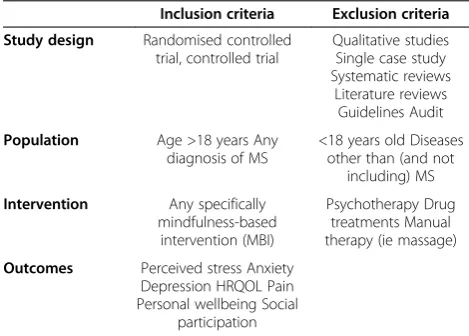
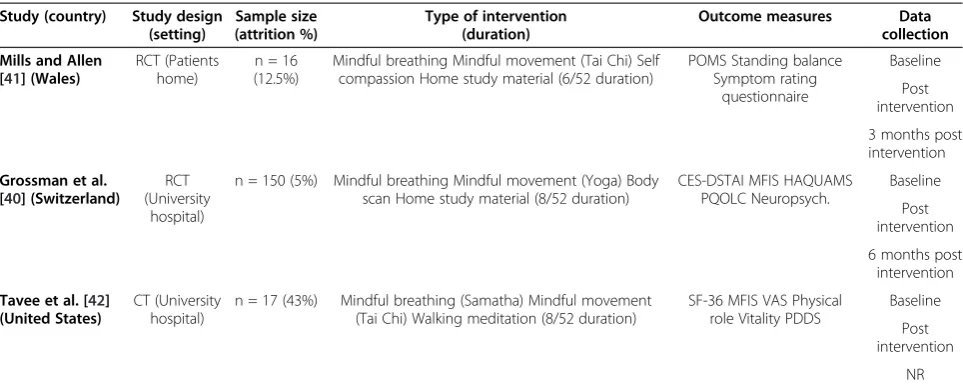
The bibliographic records identified by the searches were screened for relevance using broad inclusion cri-teria, i.e. ‘multiple sclerosis’and ‘mindfulness’. All rele-vant papers were then screened, using the SPIO inclusion criteria (Table 1), to select eligible papers. All selected papers were subject to methodological appraisal. As the search yielded low numbers, a decision was made not to exclude studies solely on the basis of poor meth-odological quality. Screening methods were based on the Systematic Reviews guidance outlined in the Centre for Reviews and Dissemination (CRD) [38]. Methodological issues are discussed below and reported in the evidence table (Table 2).
Quality appraisal
Risk of bias was assessed using the Cochrane Collabora-tion’s assessment tool [39] to summarise the risk of bias for major outcomes. The evidence for each individual outcome was graded as low, unclear, or high risk. This included assessing for evidence of: sequence generation; allocation concealment; blinding of participants, personnel and come assessors; incomplete outcome data; selective out-come reporting; and any other sources of bias.
Data extraction
The authors developed a data extraction tool, adapted from a previous systematic review examining the benefits of MBIs following transient ischaemic attack and stroke [29]. The data extracted included information on study design and methodology, the populations under review, the inter-ventions being employed, and the outcomes recorded in each study. Two reviewers working independently carried out screening and data extraction. Broad screening was undertaken by RS and SB; narrow screening by RS and JB. Any disagreements were adjudicated via a further reviewer (SM).
Data synthesis
As the results of the search and review were heterogenous, findings are presented in a narrative format. It was not pos-sible to undertake a meta-analysis.
Results
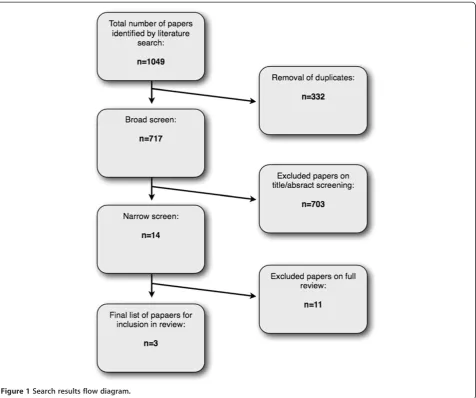
The search of the databases retrieved 1,049 records. Fol-lowing screening (Figure 1), 3 papers were considered eligible for inclusion in the review: Grossman et al. [40], Mills and Allen [41], and Tavee et al. [42]. See Additional file 2 for details of papers excluded by narrow screening. Further information on study findings was sought from authors Mills and Allen [41] and Tavee et al. [42], but no responses were received.
Study characteristics
The three studies originated from Wales (Mills and Allen [41]), Switzerland (Grossman et al. [40]), and the United States (Tavee et al. [42]). Grossman et al. [40] and Mills and Allen [41] conducted randomised con-trolled trials (RCT), while Tavee et al. [42] reported a non-randomised controlled trial. None of the studies compared MBIs against an active intervention. Grossman et al. [40] recruited from Neurology out-patients, and conducted the study in a university hospital setting, as did Tavee et al. [42]. Mills and Allen [41] recruited from a mixture of General Practitioner and Physiothe-rapist referrals.
Across the studies, there was a total of 183 partici-pants. Attrition was variable. Grossman et al. [40] de-scribed remarkably low attrition rates (5%) and a high attendance rate (92%), whilst Mills and Allen [41] re-ported drop out rates of 12.5% and cited reasons such as bereavement and dislike of Tai Chi style exercises. Tavee et al. [42] had the highest attrition of all (43%), and cited issues such as transportation and a lack of interest.
Tavee et al. [42] presented results for a mixed study population i.e. people with MS and patients with Peri-pheral Neuropathy. As we were unable to obtain MS-only data, this limited interpretation of their findings. Grossman et al. [40] collected data at 3 points (pre- and post- intervention, and at 6-month follow up), while Mills and Allen [41] recorded data at pre-, post- and 3 months after the intervention. Tavee et al. [42] only re-corded data at pre- and immediately post-intervention. See Table 2 for details.
Intervention characteristics
Grossman et al. [40] delivered an intervention closely mapped to MBSR. Mills and Allen [41] and Tavee et al. [42] used less standardised versions, introducing elements of Tai Chi and Qi Gong. However, all three studies were broadly comparable in content, with all three emphasising mindful breath awareness, mindful movement, and body
Table 1 SPIO narrow screen inclusion/exclusion criteria
Inclusion criteria Exclusion criteria
Study design Randomised controlled trial, controlled trial
Qualitative studies Single case study Systematic reviews
Literature reviews Guidelines Audit
Population Age >18 years Any diagnosis of MS
<18 years old Diseases other than (and not
including) MS
Intervention Any specifically mindfulness-based
intervention (MBI)
Psychotherapy Drug treatments Manual therapy (ie massage)
Outcomes Perceived stress Anxiety Depression HRQOL Pain Personal wellbeing Social
awareness or ‘scanning’. The MBIs were group based in 2 of the studies, but the Mills and Allen [41] intervention was delivered one to one.
Grossman et al. [40] used certified and experienced MBI teachers to deliver the MBI over 8 weekly 2.5 hour sessions, with a 7 hour session at week 6. They empha-sised mindfulness practices in the sitting, lying and yoga
asana postures, and also encouraged ‘homework’
prac-tices for 40 minutes daily. They were the only investiga-tors to record homework practice times. Tavee et al. [42] delivered a 4 hour introductory group session, followed by 8 weekly 1.5 hour classes, with a Buddhist Monk teaching all of the course components, including Samatha meditation (sitting and observing the breath), and mindful movement in the form of Tai Chi/Qi Gong and walking meditation. Tavee et al. [42] encouraged home practice, but did not record frequencies. Mills and Allen [41] delivered six individualised sessions in which unspecified teachers taught mindful movement with Tai Chi/Qi Gong, with breath and posture awareness, whilst encouraging participants to cultivate compassionate feel-ings towards themselves. Mills and Allen [41] also pro-vided self study material, but did not report on participant uptake and usage by participants. Please see Table 2.
Participant characteristics
None of the studies provided data regarding ethnicity of participants. Across the three studies, 80% (n = 146) of participants were female, and the mean (SD) age of the total sample (n = 183) was 48.6 (9.4) years. Data regard-ing socioeconomic status was generally not well re-ported; for example, Mills and Allen [41] provided data
on only half of their study population, of whom, 50% were in employment. Grossman et al. [40] recorded number of years in education. Disease phenotype was described in two of the studies; however, Tavee et al. [42] simply described participants (n = 17) as having any diagnosis of MS. From the remaining 166 patients where a phenotype could be discerned, 123 (67%) had a diag-nosis of relapsing remitting MS, and the other 43 (25%) were diagnosed with secondary progressive MS. All three studies excluded patients with significant cognitive impairment, as well as those with severe physical disabil-ity, according to either the Expanded Disability Status Scale being >6 (requiring 2 walking aids i.e. a pair of canes, crutches, etc. - in order to walk about 20 meters, without resting), or more generally, being unable to make their own way to the hospital (Mills and Allen [41]). See Table 3.
Outcomes
The primary outcome sought by this review (perceived stress) was not reported in any of the studies. However, secondary outcomes of interest included: anxiety, de-pression, HRQOL, concentration, fatigue, vitality and general wellbeing. No information was available on eco-nomic parameters, such as cost/benefit analysis for pa-tients, or health service utilisation. Please see Table 2.
Mental health outcomes
Anxiety
Grossman et al. [40] measured anxiety directly with the Spielberger Trait Anxiety Index (STAI), demonstrating significant reduction immediately post completion in
Table 2 Study characteristics
Study (country) Study design (setting)
Sample size (attrition %)
Type of intervention (duration)
Outcome measures Data collection
Mills and Allen [41] (Wales)
RCT (Patients home)
n = 16 (12.5%)
Mindful breathing Mindful movement (Tai Chi) Self compassion Home study material (6/52 duration)
POMS Standing balance Symptom rating
questionnaire
Baseline
Post intervention
3 months post intervention
Grossman et al. [40] (Switzerland)
RCT (University
hospital)
n = 150 (5%) Mindful breathing Mindful movement (Yoga) Body scan Home study material (8/52 duration)
CES-DSTAI MFIS HAQUAMS PQOLC Neuropsych.
Baseline
Post intervention
6 months post intervention
Tavee et al. [42] (United States)
CT (University hospital)
n = 17 (43%) Mindful breathing (Samatha) Mindful movement (Tai Chi) Walking meditation (8/52 duration)
SF-36 MFIS VAS Physical role Vitality PDDS
Baseline
Post intervention
NR
Figure 1Search results flow diagram.
Table 3 Participant characteristics
Mills and Allen [41] Grossman et al. [40] Tavee et al. [42]
Ethnicity NR NR NR
Number of participants (% female) 16 (80%) 150 (80%) 17 (78%)
Mean age (SD) 49.8 (6.8) 47.3 (10.3) 48.7 (11.2)
Socio-economic status NR NR NR
Employment status 4 employed (25%) NR NR
Mean years of education (SD) NR 14.1 (1.9) NR
Disease phenotype SP 16 (100%) RR 123 (82%) SP 27 (18%) NR
Stage in disease progression NR Mean EDSS 3.0 (1.1) Mean EDSS 3.0 (2.5)
Comorbidities NR NR NR
Number of patients on disease modifying medication NR 91 (60.1%) NR
Number of patients on psychotropic medication NR 30 (20%) NR
both whole intervention group and in further subgroup analyses of those with evidence of pre-intervention im-pairment. This was maintained at six-month follow up in overall group and subgroup analyses. Mills and Allen [41] included data on change in anxiety scores via a gen-eral MS symptom checklist, and the Profile of Mood States (POMS), reporting non-significant change. Please refer to Table 4.
Depression
Two studies assessed the effect of MBIs on depression. Grossman et al. [40] used the Center for Epidemiological Studies Depression (CES-D) scale, reporting significant reductions in both whole intervention group and sub-group analyses of those with pre-intervention impair-ment at intervention completion. This was maintained at six-month follow up in the overall group and in sub-group analyses. Mills and Allen [41] also reported a sig-nificant change using the POMS scale. See Table 4.
Physical outcomes
Standing balance
Mills and Allen [41] reported preferentially on physical measures, opting to focus on single-leg standing balance, with significant improvement noted at both study com-pletion and at three-month follow up, although one par-ticipant’s data was missing for this latter calculation. Please see Table 5.
Pain
At study completion, Tavee et al. [42] described a signifi-cant reduction in bodily pain, as measured by the Visual Analogue Scale (VAS). See Table 5.
Fatigue
All three studies measured the effect of MBIs on fatigue. Scores on the Modified Fatigue Impact Scale (MFIS) were significantly reduced in the study by Grossman et al. [40] at both intervention completion in the overall population, as well as in subgroup analyses of those with
pre-intervention impairment. Beneficial effect was
maintained in the overall group at six-months, as well as in those with pre-intervention impairment. Tavee et al. [42] also reported significant change on MFIS at study completion. Fatigue was non-significantly reduced on POMS in the Mills and Allen [41] study see Table 5.
Psychosocial outcomes
Grossman et al. [40] measured both disease-specific (Hamburg Quality of Life Questionnaire in Multiple Sclerosis; HAQUAMS) and generic HRQOL (Profile of Health-Related Quality of Life in Chronic Disorders; PQOLC), with PQOLC being significantly improved at study completion in the overall group and in subgroup analyses for those with pre-intervention impairment, as well as at six-month follow up in overall group and in subgroup analyses. Similarly, HAQUAMS was signifi-cantly improved at completion in the overall group and in subgroup analyses in those with pre-intervention im-pairment, as well as at six-month follow up in overall group and subgroup analyses. Mills and Allen [41] re-port an overall trend towards general symptom improve-ment, but did not justify this statistically. Tavee et al. [42] did not report population-specific results for the Short Form-36 (SF-36). See Table 6.
Methodological quality of included papers
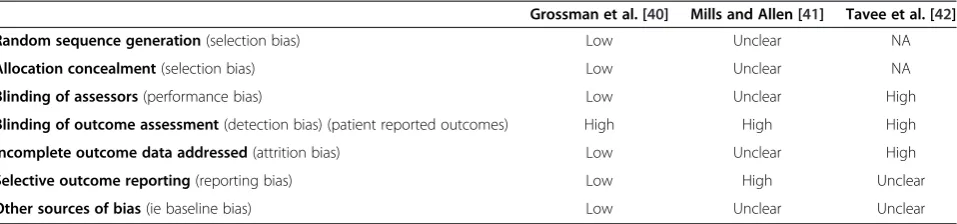
Quality was assessed using the Cochrane Collaboration tool for Risk of Bias [39]. Of the 3 studies, only Grossman et al. [40] adequately describe evidence of sequence ge-neration at the randomisation stage. Allocation conceal-ment was most convincingly impleconceal-mented by Grossman et al. [40], where the investigator was fully blinded to pa-tient information, but this was not clearly described by Mills and Allen [41]; Tavee et al. [42] appear to have collected a control group independently of those ex-pressing a desire to take part in the intervention group. Only Grossman et al. [40] described blinding of outcome assessors. All three authors described incomplete outcome data, including attrition rates, but only Grossman et al. [40] included this intention to treat and attrition data in the statistical analysis. There was no substantive evidence for selective outcome reporting in any of the studies,
Table 4 Mental health outcomes
Study Outcome (measure) Post intervention effect size (p) Follow up effect size (p) and time point
Grossman et al. [40] Full intervention group Anxiety (STAI) 0.39 (0.0006) 0.36 (0.02) at six months
Sub-group analysis 1.00 (0.002) 0.64 (0.05) at six months
Full intervention group Depression (CES-D) 0.65 (0.00001) 0.36 (0.03) at six months
Sub-group analysis 1.06 (0.0002) 0.66 (0.03) at six months
Mills and Allen [41] Anxiety (POMS) p > 0.05* p > 0.05*
Depression (POMS) p < 0.01* NR
although Mills and Allen [41] omitted data on mood recording via Profile of Mood States (POMS), which is described elsewhere [43]. Overall, only the study by Grossman et al. [40] can be considered of high metho-dological quality (see Table 7).
Discussion
This systematic review on the use of MBIs in people with MS identified three studies eligible for inclusion, which were varied in nature, with only one of the studies being adequately powered to calculate meaningful effect sizes (n = 150). Attrition rates across the studies were variable, and the reasons for this are unclear. The MBIs used in the studies were heterogenous. Two papers de-scribed a protocol comparable to MBSR, but stemming from Qi Gong practices; the other study closely resem-bled a more standardised version of MBSR [34]. Two of the interventions were applied in a hospital based group setting; one was individualised and delivered one to one in patients’ homes. There were a variety of measures of interest recorded. However, none of the studies focussed on our primary outcome of interest: perceived stress.
Results from the three studies are encouraging in the domains of mental health and HRQOL. Improvements in HRQOL, anxiety, depression, and fatigue remained statistically significant at six-month follow up in the Grossman et al. [40] study, albeit with diminished effect sizes; standing balance remained significantly improved at three-month follow up in the Mills and Allen [41] study. There were no adverse events reported.
Strengths of this review
This review employed a rigorous methodological strat-egy to search and appraise the research literature involv-ing MBIs in people with MS. Three reviewers were involved in the screening and appraisal of studies suit-able for inclusion, with further discussion taking place, as required. Quality was assessed in accordance with the Cochrane Collaboration guidance.
Limitations of this review
The fact that MBIs originate from ancient oriental tradi-tions may bias the results, in that, due to resource con-straints, our review was limited to papers published in English. The low methodological quality of two studies, and the overall heterogenous nature of the studies, pre-cluded quantitative meta-analysis.
Strengths and limitations of the included papers
Grossman et al. [40] produced a well designed RCT, with adequate numbers being included to allow power calcula-tions. Their strict inclusion/exclusion criteria, and widely recognisable form of MBI, delivered by experienced, certi-fied trainers, with pre-post and three-month follow up measures being collected, allows a degree of confidence when reviewing their findings. Mills and Allen [41] and Tavee et al. [42] conducted studies that were of lower methodological quality, with small sample sizes, and less well-defined intervention standards. There was no random-isation employed by Tavee et al. [42]. Comparing all three studies, there is considerable heterogeneity with respect to
Table 5 Physical outcomes
Study Outcome (measure) Post intervention
effect size (p)
Follow up effect size (p) and time point
Grossman et al. [40] Full intervention group Fatigue (MFIS) 0.41 (0.0001) 0.38 (0.001) at six months
Sub-group analysis 1.27 (0.0005) 1.09 (0.02) at six months
Mills and Allen [41] Fatigue (POMS) p > 0.05* NR
Single leg standing balance p < 0.05* p < 0.05* at three months
Tavee et al. [42] Fatigue (MFIS) p = 0.035* NR
Pain (VAS) p = 0.031* NR
PDDS p > 0.05* NR
1. MFIS - Modified Fatigue Index Scale; 2. POMS - Profile of Mood States; 3. VAS - Visual Analogue Scale for pain; 4. PDDS - Patient Determined Disease Steps; 5. NR - Not recorded; *Effect size not recorded.
Table 6 Quality of life outcomes
Study Measure Post intervention effect size (p) Follow up effect size (p) and time point
Grossman et al. [40] Full intervention group HAQUAMS 0.43 (0.0002) 0.28 (0.04) at six months
PQOLC 0.86 (0.00000001) 0.51 (0.03) at six months
Sub-group analysis HAQUAMS 1.01 (0.0001) 0.58 (0.04) at six months
PQOLC 1.71 (0.00000001) 0.51 (0.003) at six months
populations, interventions and outcome measures, and al-most no meaningful information on the effects on different socioeconomic groups. Limited information was provided regarding different disease phenotypes and‘stages’of illness. Furthermore, little evidence is available about economic costs/benefits of the MBIs in this group, making drawing conclusions about any individual MBI technique in this population in general problematic. As such, these results should be treated with caution.
Implications for research
Future studies of MBIs in people with MS should be of a larger scale, employing robust methodological techniques. They should examine physical and psychological measures; different disease phenotypes, at various defined stages of disease progression, of varied functional status; and should address important questions around feasibility, acceptability and appropriateness in diverse ethnic groups; as well as economic concerns such as health care utilisation and cost effectiveness. For specialist groups, such as people with MS, it may be worth examining whether having classes run by specialist trainers’ (i.e. health professionals) rather than
‘generic’MBI trainers has any specific advantages/benefits. Correlating findings with neuropsychological, bio-marker and clinical imaging evidence would also be very informative. Given the widely varying attrition rates re-ported, qualitative research should also be employed to gather information on the broad acceptability of MBIs from the perspective of people with MS. Such research could also explore perceived stress and self-efficacy, as discussed previously.
Implications for practice
MBIs may have utility in the MS clinical population, par-ticularly for mental health conditions, such as anxiety and depression, as well as physical function. There is no overt evidence of harm.
Conclusions
Although the evidence is limited, this review indicates that MBIs can hold benefit for people with MS, specific-ally in terms of quality of life, mental health, and some
physical aspects of the condition. It is unclear at this time whether these results are generalisable to different ethnic groups; both genders; all age groups; different dis-ease phenotypes; and diverse socio-economic groups. There is no evidence regarding health service utilisation costs. It also remains unclear what benefit MBIs may hold for people with more advanced MS. Further high quality studies are needed to clarify the feasibility, practi-cality, acceptability, health and psychosocial benefits of MBIs for people with MS.
Additional files
Additional file 1:Search history: OVIDsp - MEDLINE with Full Text 3/5/13 - pdf.
Additional file 2:Excluded studies - pdf.
Competing interests
The authors declare that they have no competing interests.
Author’s contributions
This systematic review was conceived by RS, SM, FM, ML and JB. RS registered this project with PROSPERO and took the lead for the review. RS conducted all database searches. RS, SB and JB carried out the screening of studies identified on database searching. RS authored the manuscript, whilst SM, FM, ML and JB all provided critical review and input into manuscript writing. All authors read and approved the final manuscript.
Author details
1General Practice and Primary Care, Institute of Health and Wellbeing, University of Glasgow, Glasgow, G12 9LX, Scotland, UK.2Institute for Applied Health Research/School of Health and Life Sciences, Glasgow Caledonian University, Glasgow, G4 0BA, Scotland, UK.
Received: 15 October 2013 Accepted: 14 January 2014 Published: 17 January 2014
References
1. Franklin RJM, Ffrench-Constant C, Edgar JM, Smith KJ:Neuroprotection and repair in multiple sclerosis.Nat Rev Neurol2012,8(11):624–634.
2. Scalfari A, Neuhaus A, Degenhardt A, Rice GP, Muraro PA, Daumer M,et al: The natural history of multiple sclerosis, a geographically based study 10: relapses and long-term disability.Brain2010,133(7):1914–1929. 3. Chiaravalloti ND, DeLuca J:Cognitive impairment in multiple sclerosis.
The Lancet Neurol2008,7(12):1139–1151.
4. Young CA:Factors predisposing to the development of multiple sclerosis.QJM2011,104(5):383–386.
5. Dennison L, Moss-Morris R, Chalder T:A review of psychological correlates of adjustment in patients with multiple sclerosis.Clin Psychol Rev2009, 29(2):141–153.
Table 7 Risk of bias summary
Grossman et al. [40] Mills and Allen [41] Tavee et al. [42]
Random sequence generation(selection bias) Low Unclear NA
Allocation concealment(selection bias) Low Unclear NA
Blinding of assessors(performance bias) Low Unclear High
Blinding of outcome assessment(detection bias) (patient reported outcomes) High High High
Incomplete outcome data addressed(attrition bias) Low Unclear High
Selective outcome reporting(reporting bias) Low High Unclear
Other sources of bias(ie baseline bias) Low Unclear Unclear
6. Damasceno A, Von Glehn F, Brandão CO, Damasceno BP, Cendes F: Prognostic indicators for long-term disability in multiple sclerosis patients.J Neurol Sci2012,234(1):29–33.
7. Boland P, Levack WM, Hudson S, Bell EM:Coping with multiple sclerosis as a couple:’peaks and troughs’-an interpretative phenomenological exploration.Disabil Rehabil2012,34(16):1367–1375.
8. McDonald WI, Compston A, Edan G, Goodkin D, Hartung H-P, Lublin FD,
et al:Recommended diagnostic criteria for multiple sclerosis: guidelines from the international panel on the diagnosis of multiple sclerosis.
Ann Neurol2001,50(1):121–127.
9. Polman CH, Reingold SC, Banwell B, Clanet M, Cohen JA, Filippi M,et al: Diagnostic criteria for multiple sclerosis: 2010 revisions to the McDonald criteria.Ann Neurol2011,69(2):292–302.
10. McCrone P, Heslin M, Knapp M, Bull P, Thompson A:Multiple Sclerosis in the UK.Pharmacoecon2008,26(10):847–860.
11. Marrie R, Horwitz R, Cutter G, Tyry T, Campagnolo D, Vollmer T: Comorbidity, socioeconomic status and multiple sclerosis.Mult Scler
2008,14(8):1091–1098.
12. Dallmeijer AJ, Beckerman H, de Groot V, van de Port IG, Lankhorst GJ, Dekker J:Long-term effect of comorbidity on the course of physical functioning in patients after stroke and with multiple sclerosis.J Rehabil Med2009,41(5):322–326.
13. Warren SA, Turpin KV, Pohar SL, Jones CA, Warren K:Comorbidity and health-related quality of life in people with multiple sclerosis.Int J of MS Care2009,11(1):6–16.
14. Kang JH, Chen YH, Lin HC:Comorbidities amongst patients with multiple sclerosis: a population‐based controlled study.Eur J Neurol2010, 17(9):1215–1219.
15. Marrie R, Horwitz R, Cutter G, Tyry T, Campagnolo D, Vollmer T:The burden of mental comorbidity in multiple sclerosis: frequent, underdiagnosed, and undertreated.Mult Scler2009,15(3):385–392.
16. Klevan G, Jacobsen C, Aarseth J, Myhr KM, Nyland H, Glad S,et al:Health related quality of life in patients recently diagnosed with multiple sclerosis.Acta Neurol Scand2013,129(1):21–26.
17. McGuigan C, Hutchinson M:Unrecognised symptoms of depression in a community–based population with multiple sclerosis.J neurol2006, 253(2):219–223.
18. Chwastiak LA, Ehde DM:Psychiatric issues in multiple sclerosis.
Psychiatr Clin N Am2007,30(4):803–817.
19. Trojan DA, Arnold D, Collet J-P, Shapiro S, Bar-Or A, Robinson A,et al: Fatigue in multiple sclerosis: association with disease-related, behavioural and psychosocial factors.Mult Scler2007,13(8):985–995. 20. Bol Y, Duits AA, Hupperts RM, Vlaeyen JW, Verhey FR:The psychology of
fatigue in patients with multiple sclerosis: a review.J Psychosom Res2009, 66(1):3–11.
21. Mohr DC, Hart SL, Julian L, Cox D, Pelletier D:Association between stressful life events and exacerbation in multiple sclerosis: a meta-analysis.Bmj2004,328(7442):731.
22. Mohr DC, Lovera J, Brown T, Cohen B, Neylan T, Henry R,et al:A randomized trial of stress management for the prevention of new brain lesions in MS.Neurology2012,79(5):412–419.
23. Kern S, Ziemssen T:Review: Brain—immune communication
psychoneuroimmunology of multiple sclerosis.Mult Scler2008,14(1):6–21. 24. Thomas P, Thomas S, Hillier C, Galvin K, Baker R:Psychological
interventions for multiple sclerosis.Cochrane Database Syst Rev2006, 1:1–53.
25. Kabat-Zinn J:Wherever you go, there you are: Mindfulness meditation in everyday life: Hyperion. 1994.
26. Miller JJ, Fletcher K, Kabat-Zinn J:Three-year follow-up and clinical impli-cations of a mindfulness meditation-based stress reduction intervention in the treatment of anxiety disorders.Gen Hosp Psychiatry1995, 17(3):192–200.
27. Kabat-Zinn J, Lipworth L, Burncy R, Sellers W:Four-year follow-up of a meditation-based program for the self-regulation of chronic pain: treatment outcomes and compliance.The Clinical Journal of Pain1986, 2(3):159–774.
28. Piet J, Hougaard E:The effect of mindfulness-based cognitive therapy for prevention of relapse in recurrent major depressive disorder: a system-atic review and meta-analysis.Clin Psychol Rev2011,31(6):1032–1040.
29. Lawrence M, Booth J, Mercer S, Crawford E:A systematic review of the benefits of mindfulness‐based interventions following transient ischemic attack and stroke.Int J Stroke2013,8(6):465–474.
30. Robinson FP, Mathews HL, Witek-Janusek L:Psycho-endocrine-immune response to mindfulness-based stress reduction in individuals infected with the human immunodeficiency virus: a quasiexperimental study.
The JAltern & Complement Med2003,9(5):683–694.
31. Davidson RJ, Kabat-Zinn J, Schumacher J, Rosenkranz M, Muller D, Santorelli SF,et al:Alterations in brain and immune function produced by mindful-ness meditation.Psychosom Med2003,65(4):564–570.
32. Carlson LE, Speca M, Patel KD, Goodey E:Mindfulness-based stress reduction in relation to quality of life, mood, symptoms of stress and levels of cortisol, dehydroepiandrosterone sulfate (DHEAS) and melatonin in breast and prostate cancer outpatients.
Psychoneuroendocrinology2004,29(4):448–474.
33. Hölzel BK, Lazar SW, Gard T, Schuman-Olivier Z, Vago DR, Ott U:How does mindfulness meditation work? Proposing mechanisms of action from a conceptual and neural perspective.Perspect Psychol Sci2011, 6(6):537–559.
34. Kabat-Zinn J:Full catastrophe living: Using the wisdom of your body and mind to face stress, pain, and illness: Delta. 2009.
35. Teasdale JD, Segal ZV, Williams JMG, Ridgeway VA, Soulsby JM, Lau MA: Prevention of relapse/recurrence in major depression by mindfulness-based cognitive therapy.J Consult Clin Psychol2000,68(4):615. 36. Kahl KG, Winter L, Schweiger U:The third wave of cognitive behavioural
therapies: what is new and what is effective?Curr Opin Psychiatry2012, 25(6):522–528. doi:10.1097/YCO.0b013e328358e531.
37. Richardson WS, Wilson MC, Nishikawa J, Hayward RS:The well-built clinical question: a key to evidence-based decisions.ACP J Club1995,
123(3):A12–A13.
38. Reviews UoYCf D, Akers J:Systematic reviews: CRD’s guidance for undertaking reviews in health care: Centre for Reviews and Dissemination. 2009.
39. Higgins JP, Altman DG, Gøtzsche PC, Jüni P, Moher D, Oxman AD,et al:The Cochrane Collaboration’s tool for assessing risk of bias in randomised trials.BMJ: British Medical Journal2011,343:d5928.
40. Grossman P, Kappos L, Gensicke H, D’Souza M, Mohr DC, Penner IK,et al: MS quality of life, depression, and fatigue improve after mindfulness training: a randomized trial.Neurology2010,75(13):1141–1149. 41. Mills N, Allen J:Mindfulness of movement as a coping strategy in
multiple sclerosis: a pilot study.Gen Hosp Psychiatry2000,22(6):425–431. 42. Tavee J, Rensel M, Pope Planchon S, Stone L:Effects of meditation on pain
and quality of life in multiple sclerosis and polyneuropathy: a controlled study.Int J MS Care2011,13(S2):163–168.
43. Mills N, Allen J, Carey-Morgan S:Does Tai Chi/Qi Gong help patients with multiple sclerosis?J Bodyw Mov Ther2000,4(1):39–48.
doi:10.1186/1471-2377-14-15
Cite this article as:Simpsonet al.:Mindfulness based interventions in multiple sclerosis - a systematic review.BMC Neurology201414:15.
Submit your next manuscript to BioMed Central and take full advantage of:
• Convenient online submission
• Thorough peer review
• No space constraints or color figure charges
• Immediate publication on acceptance
• Inclusion in PubMed, CAS, Scopus and Google Scholar
• Research which is freely available for redistribution