www.ann-geophys.net/26/2237/2008/ © European Geosciences Union 2008
Annales
Geophysicae
Polyphase alternating codes
M. Markkanen1, J. Vierinen2, and J. Markkanen3
1Eigenor Corporation, Lompolontie 1, 99600 Sodanykyl¨a, Finland
2Sodankyl¨a Geophysical Obervatory, T¨ahtel¨antie 62, 99600 Sodankyl¨a, Finland 3EISCAT Scientific Association, T¨ahtel¨antie 54B, 99600 Sodankyl¨a, Finland
Received: 29 November 2007 – Revised: 29 February 2008 – Accepted: 15 April 2008 – Published: 5 August 2008
Abstract. We present a new class of alternating codes. In-stead of the customary binary phase codes, the new codes utilize eitherpor p–1 phases, wherep is a prime number. The first class of codes has code lengthpm, where mis a positive integer, the second class has code lengthp–1. We give an actual construction algorithm, and explain the princi-ples behind it. We handle a few specific examprinci-ples in detail. The new codes offer an enlarged collection of code lengths for radar experiments.
Keywords. Radio science (Ionospheric physics; Instru-ments and techniques)
1 Introduction
Alternating codes are widely used in incoherent scatter radar measurements and their properties are well known. There are two classes of these codes. The so called type 1 codes were introduced by Lehtinen (1986). The number of bauds in any single transmission of a type 1 code, i.e. the code length, is a power of two. Also the number of transmissions, i.e. the code set size, is a power of two, which sometimes causes inflexibility when designing radar experiments. With this in mind, Sulzer (1993) proposed a new type of alternat-ing codes (type 2) which made it possible to use other code lengths. These codes also produce unambiguous back-scatter autocorrelation function estimates of the target, but there are no efficient search strategies for finding longer type 2 codes. The longest type 2 alternating code that we know about has length 141.
Correspondence to: J. Vierinen ([email protected])
1The 8 sequences forming the 14-bit code are in hexadecimal
format: 406, b72, 4df, bab, 24c, d38, 295 and de1.
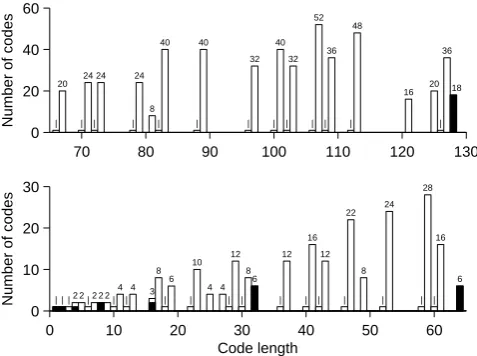
In this paper we generalize previous work (Markkanen and Nygr´en, 1997) and apply it to polyphase codes, i.e. codes that are phase coded with two or more different phases. We have identified two different classes of polyphase alternat-ing codes. The first class includes codes that havepphases and code lengthspm, wherep is a prime number andmis a positive integer. The second class contains codes withp– 1 phases and code length p–1. The number of codes in a code set of either class is equal to the (common) length of the codes belonging to the set. The new codes increase the number of available code lengths considerably, as shown in Fig. 1. Within codes shorter than 130, there are eight lengths of binary codes and additional 64 lengths of polyphase codes. Often there are several alternating codes of a given length, so that there are altogether 763 essentially different code sets shorter than 130.
This paper concentrates on polyphase alternating codes satisfying the so called weak condition. Strong codes can be generated from weak codes using the method described by Sulzer (1989), which also works for the polyphase alter-nating codes presented here. To create an alteralter-nating code set satisfying the strong condition, the code set is duplicated, and in each code in the duplicated part, bauds with even indices are multiplied by−1.
70 80 90 100 110 120 130 0
20 40 60
Number of codes | 20 | 24 | 24 | 24 8 | 40 | 40 | 32 | 40 | 32 | 52 | 36 | 48 16 20 | 36 18
0 10 20 30 40 50 60
0 10 20 30
[image:2.595.47.286.64.242.2]Number of codes | | |2 2|2 2 2| 4 | 4 3 8 | 6 | 10 4 4 | 12 | 8 6 | 12 | 16 | 12 | 22 8 | 24 | 28 | 16 6 Code length
Fig. 1. Number of different alternating codes up to code length 130. The black bars represent the well-known binary phase alternating codes, the white bars represent new polyphase alternating codes.
2 Construction ofp-nary alternating codes
By ap-nary sequence (p-nary pulse) we mean a phase modu-lated pulse where the complex phase factors of the bauds be-long to the setEp={αi=ei2π
√
−1/p|i=0, . . . , p−1}. In what
follows,pis a prime number unless otherwise stated. A p-nary alternating code of length n+1 and size n+1 is a set
{Ak=(ak,0, . . . , ak,n)|k=0, . . . , n}of p-nary pulses, which
satisfies the natural extension of the weak condition given in Lehtinen (1986) for binary codes:
Condition 1. For each i, i0, j and j0 where j−i=j0−i0, i6=j,andi6=i0
n X
k=0
ak,iak,jak,i0ak,j0 =0.
We now first consider codes of lengthn, and later increase the length ton+1. We denote byMthe operator which shifts the elements of a sequence cyclically by one, that is
M (a0, . . . , an−1)=(a1, . . . , an−1, a0).
LetA=(a0, . . . , an−1)be ap-nary sequence and let us de-note byUthe unit sequenceU=(1,1, . . . ,1). By multiplica-tion of two sequences we mean pointwise multiplicamultiplica-tion⊗, and by the conjugate ofAwe mean pointwise complex con-jugateA. ThenA⊗A=U, because|ai|=1 for alli.
LetCA be the set of sequences generated by the pulseA,
CA={A, MA, . . . , Mn−1A, U}, whereMimeansirepeated
cyclical shift operations. We will show thatCAconstitutes a
p-nary alternating code set, if the following two conditions are met.
Condition 2a. All the sequences inCAare different.
Condition 3a. Multiplying all the sequences ofCAby a fixed sequence inCApermutesCA.
To prove that these conditions are sufficient, we need the following properties 1 and 2 of the sequences satisfying con-ditions 2a and 3a.
Property 1. The sumsof elements ofAis−1.
This can be seen by considering the sequence
S=A+MA+ · · · +Mn−1A+U, which equals (s+1)U
(the sequences A, . . . , Mn−1A contain in each location all the elements of A in some cyclic order). Because by condition 3a multiplication byA permutes the terms of S, A⊗S=S, and becauseA⊗U=A, it follows that
(s+1)A=(s+1)U.
Now condition 2a requires that A6=U. Thus s+1=0 and s=−1. Notice that in the case ofp=2, whenEp={1,−1}, it
follows from property 1 thatnis odd.
Property 2. There exists ani0such thatMiA=Mi+i0Afor alli.
By condition 3a there is ani0such thatA⊗Mi0A=U, that is,Mi0A=A. Then
MiA=MiA=MiMi0A=Mi+i0A, for anyi.
We can now show that the condition 1 holds. We denote by Aithe sequence formed by taking theith elements of the se-quencesA0, . . . , An−1. Condition 1 is then the requirement that the sum of elements of sequenceD=Ai⊗Aj⊗Ai0
⊗Aj0
, added by 1 (coming fromAn=U), is 0. That is, the sum of
elements ofDis−1. NowAi=MiAand thus D=MiA⊗MjA⊗Mi0
A⊗Mj0
A.
Property 2 says thatD∈C and if we can show thatD6=U, it follows from property 1 that the sum of elements ofDis indeed−1.
BecauseB1⊗B26=Ufor anyB16=B2when elements ofB1 andB2have absolute value 1, it is enough to show that MiA⊗MjA6=Mi0
A⊗Mj0
A. (1)
The left hand side is MiA⊗Mj+i0A=Mi(A⊗Mj−i+i0A) and similarly the right hand side is Mi0(A⊗Mj0−i0+i0A). Because j−i=j0−i0, the sequences inside parentheses are equal, and becausei6=j, they are not equal toU. Then in-deedMi(. . .)6=Mi0(. . .), becausei6=i0.
trivially from what was said above (by dropping the first ele-ment of each sequence we have the same codes, only in order MA, . . . , Mn−1A, A, U). If both 0 andnbelong to the set
{i, j, i0, j0}, the only possibility isi=0,j=i0=n/2. Thenn must be even, so we can suppose thatp6=2. With the above choice of indices the left hand side of Eq. (1) isA⊗Mn/2A and the right hand side isMn/2A⊗A. As they are conju-gates, they are unequal, unless they are both equal toU. But Mn/2A6=A and thusA⊗Mn/2A6=A⊗A=U, and so D6=U, meaning that condition 1 is satisfied also in this case.
The requirement that p is prime is necessary for this method of constructing alternating codes. With compositep there isn’t any sequencesAsatisfying conditions 2a and 3a. The essential reason is that for compositep the sequences A, A⊗A, A⊗A⊗A, . . .can have different number of ones.
3 Construction of the sequenceA
For the construction of sequences A generating alternat-ing codes, it will be advantageous, instead of Ep to
con-sider the set of possible exponents of α, the integers
Zp={0, . . . , p−1} with modp-arithmetic. The sequences
with elements inEpcorrespond to vectors in the vector space
Znp=Zp×. . .×Zp, multiplication of sequences corresponds
to addition of vectors and the unit sequenceU corresponds to the null vector 0∈Znp. The operatorMcorresponds to the linear operator mapping each base vector ofZnpcyclically to
the previous one.
We now have a vectorA=(a0, . . . , an−1)∈Znp and the set
CA={A, MA, . . . , Mn−1A,0} ⊂Znp. Conditions 2a and 3a
correspond to the following conditions.
Condition 2b. All the vectors inCAare different.
Condition 3b. Adding a fixed vector of CA to all vectors belonging toCA, permutesCA.
The sum of any two vectors inCA belong toCA by
con-dition 3b. Because for anyB∈CA also 2B=B+B∈CA and
similarly for anyk∈Zp, it follows thatCA is a vector
sub-space ofZnp. With m denoting the dimension of CA, the
number of vectors inCAispm, and thusn=pm−1.
BecauseMCA=CA,CA is anM-invariant subspace, and
one could use the theory of invariant subspaces to show the existence of alternating codes, and to construct the codes. However, here we present a more elementary derivation of the construction algorithm.
Condition 3b means that for most indicesj, there is an indexksuch thatAk=A+Aj, implying that a0, a1, . . . sat-isfy for allilinear relationsak+i=ai+aj+i. As solutions of
linear difference equations satisfy these kind of relations, it seems plausible to try to find the sequenceAas a solution of a suitably chosen difference equation.
It turns out that the proper order for the difference equation ism, so let us consider inZpa difference equation
xi+m=bm−1xi+m−1+. . .+b0xi, i=0, . . . , (2)
withb0, . . . , bm−1∈Zp. Because (a) anym-tuple of
consec-utive elements of the solution(xi)fixes all subsequent
ele-ments of the solution, and (b) there are only finite number (at mostpm) of suchm-tuples, the solution is essentially peri-odic (the sequence can start with a non-periperi-odic part).
Let us suppose that Eq. (2) has a solution A0={ai}∞i=0 with periodn=pm−1. We will now show that the vector A=(a0, . . . , an−1)∈Znp satisfies conditions 2b and 3b. The
periodic part ofA0contains all thepm−1 different non-zero m-tuples, and soA0can not have a non-periodic start. Then an=a0, an+1=a1, . . ., and the m-tuples (a0, . . . , am−1),
(a1, . . . , am), . . . , (an−1, . . . , an+m−2), (0, . . . ,0), which
are the starts of vectorsA, MA, . . . , Mn−1A,0, are all the pmdifferent m-tuples of Zp. This proves condition 2b. If
B1, B2∈CA, there is B3∈CA such that the firstmelements
of B1+B2 are equal to the first m elements of B3. Be-cause B1+B2 is also a solution of Eq. (2), it follows that B1+B2=B3. This proves condition 3b.
Notice that we can choose as ourAany nonzero vector of
Znp, e.g. one starting withm−1 zeros followed by 1.
We can summarize the preceding discussion by the follow-ing result.
Theorem. If amth-order difference equation inZp is such that it has a solution with periodpm−1, the firstpm−1 ele-ments of the solution can be used as a generator of ap-nary alternating code.
4 The number ofpm-type alternating codes
If all the roots of polynomial
Q(x)=xm−bm−1xm−1−. . .−b0 are different, the gen-eral solution of the difference Eq. (2) is
xi =c1αi1+. . .+cmαmi , i=0, . . . ,
whereα1, . . . , αm are the roots ofQ(x)andc1, . . . , cmare
arbitrary coefficients. If (A)Q(x)is irreducible (inZp[x])
and (B) there is no integerd smaller than n=pm−1 such thatQ(x) dividesxd−1, then the roots ofQ(x) are differ-ent and all the sequences(1, αi, αi2, . . .) have common
pe-riodn. Then also the period of the sequence(xi)isn. Thus
eachmth-degree polynomialQ(x)∈Zp[x]that satisfies (A) and (B), determines ap-nary alternating code.
It is possible to show (e.g. Lidl and Niederreiter, 1997, p. 85) that the number of differentmth-degree polynomials Ncsatisfying the conditions (A) and (B) is
Nc=
ϕ(pm−1) m .
Hereϕ(i)is the Eulerϕ-function, which is the number of in-tegers smaller thaniwhich do not have a common factor with i. It can also be shown that there are no other setsC satisfy-ing conditions 2b and 3b, so the numberNcis the number of
different alternating codes satisfying those conditions. This means especially that for any prime numberpand any pos-itive integermthere existp-nary alternating codes of length pm.
5 p-nary alternating codes of lengthp
We will now look more closely at the casem=1. In this case the difference equation is simply
xi+1=b0xi b0∈Zp, i=0,1, . . . , (3)
and if we choose x0=1, its solution is xi=bi0 (modp).
We get thus a suitable A if and only if all the numbers 1, b0, . . . , bp−0 2modpare different, that is, ifb0is the gen-erator of the cyclic multiplicative groupZ∗
p.
As an example, the only generator ofZ∗3isb0=2, giving the set of sequences
C= {(1,2,1), (2,1,2), (0,0,0)}
of exponents of the basic phase factorα=e2π
√
−1/3 of the 3-nary code. ForZ∗5 there are two generatorsb0=2 and 3, giving the sets of exponents
C= {(1,2,4,3,1), (2,4,3,1,2), (4,3,1,2,4), (3,1,2,4,3), (0,0,0,0,0)}
and
C= {(1,3,4,2,1), (3,4,2,1,3), (4,2,1,3,4), (2,1,3,4,2), (0,0,0,0,0)}
forα=e2π
√ −1/5.
Let b0 be a generator of Z∗p and A the solution of
the corresponding difference Eq. (3). It was shown in Sect. 3 that the sequence kA belongs to the code for all k=0, . . . , p−1, and we can change the order of sequences to have C={0, A,2A, . . . , (p−1)A}. This means that the columns of the alternating code are suitably chosen columns of the Fourier matrixFp=(fij)withfij=eij2π
√ −1/p.
The columns ofFp are orthogonal and form a closed set
under pointwise multiplication. This is true for arbitrary (also non-prime)p and we can use the columns, or rather, the columns consisting of the corresponding exponents, for searchingp-nary alternating codes for anyp. Using theFpis
analogous to the use of Walsh sequences in Lehtinen (1986).
Because all the pointwise products of columns ofFp and
their conjugates are also columns of Fp, a set C is an
al-ternating code if the pointwise products of those columns that correspond to the indices of condition 1 are differ-ent from U. Multiplication by complex conjugate corre-sponds to subtraction of exponents, and so for arbitrary p the setCA={0, A,2A, . . . , (p−1)A}with the generating
se-quence A=(a0, . . . , an−1)∈Znp is an alternating code ifA
satisfies the following condition (analogous to the condition for Walsh indices given in Lehtinen (1986)).
Condition 4. For each i, i0, j and j0 where j−i=j0−i0, i6=j,andi6=i0,
(ai−aj)−(ai0−aj0)6=0.
The condition 4 can be rephrased: all differences (mod p) of valuesai, aj of elements ofAwith fixed difference of
indicesi, jare different.
We will now consider again for a primep the sequence A=(1, b0, . . . , bp−0 2)modp, which generates an alternating code of lengthp–1 (we drop the duplicate element from the end).
Because of periodicity of b0i with respect to i the se-quenceAsatisfies an even stronger condition: all differences ( mod p) of valuesai, aj of elements ofA1with fixed differ-ence (modp−1) of indicesi, j are different. Then it triv-ially satisfies also the following condition: all differences (modp−1) of indicesi, j of elements ofAwith fixed dif-ference (modp) of valuesai, aj are different.
For the “dual” sequenceA0 with indices 1, b0, . . . , b0p−2 and corresponding values 0,1. . . , p−2 this means that all differences (modp−1) of values of elements of A0 with fixed difference (modp) of indices are different. But this is again stronger than the condition for (p–1)-nary alternating codes: all differences (mod p−1) of values of elements of A0 with fixed difference of indices are different. Thus the sequenceA0 generates a (p–1)-nary alternating code of lengthp–1.
Example. Dual 7-nary and 6-nary sequences. Whenp=7 andb0=3 , we have the following situation:
Z7 Z6
index: 0 1 2 3 4 5 :value
value: 1 3 2 6 4 5 :index
This gives the sequence (1,3,2,6,4,5,1) for generating a 7-nary alternating code and the sequence (0,2,1,4,5,3) for generating a 6-nary alternating code.
It can be noted that whereas inp-nary codes the first and last columns are identical and the constant column ofFpis
not in the code, in (p–1)-nary codes all the columns ofFp−1 are in the code exactly once.
p-nary and (p–1)-nary alternating codes is the same. How-ever, this is not the case. Differentp-nary codes correspond to different sequences of the same (p–1)-nary code, and thus the construction presented here gives only one (p–1)-nary alternating code for each primep. This can be seen by notic-ing that ifb0andb1are generators ofZ∗p, there is ak0such thatb0=b1k0. If thenA={a1, a2, . . .}andA0={a01, a20, . . .}are dual sequences of{1, b0, . . .}and{1, b1, . . .},
a0
(bk0)=a 0 (bk0k
1 )
=k0k=k0a(bk
0),
implying thatA0=k0A.
6 Algorithm for generatingpm-length alternating codes
Finding alternating codes is a fairly simple computation which involves going through all thepm differentm-tuples b=(b0, ..., bm−1)with elements inZp.
For eachb, we generate a solution of the corresponding mth order difference equation (2) starting with the the initial valuesxi=0 fori=0. . . m−2 andim−1=1 (notice that the so-lution is calculated in moduloparithmetic). Next we check if the solution(xi)has periodpm−1. If it has, then this
so-lution can be used to generate an alternating code set. The resulting code is
Aj =(αxj, ..., αxj+pm−1), j =0, ..., pm−2,
Apm−1=(1,1, ...,1) ,
whereα=e2π
√ −1/p.
To generate a (p–1)-nary code, one first constructs the generator of the correspondingp-nary code and then forms the (p–1)-nary code set using the transformation described in Sect. 5.
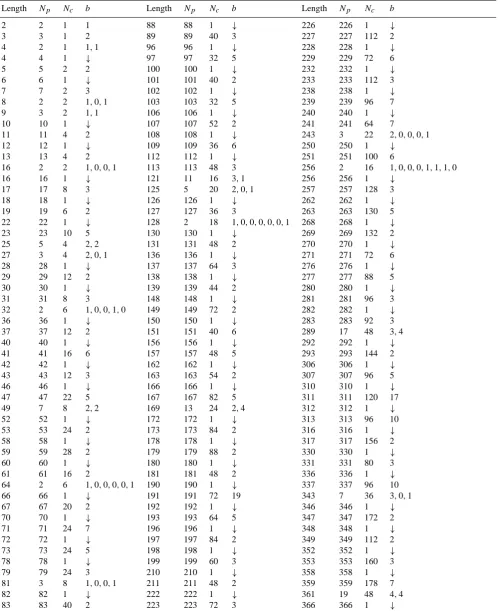
Table 1 lists alternating codes for the first few hundred code lengths, one code per code length. The codes are ex-pressed in terms of number of phases p, generating coef-ficientsb=(b0, ..., bm−1)and code length. As an example,
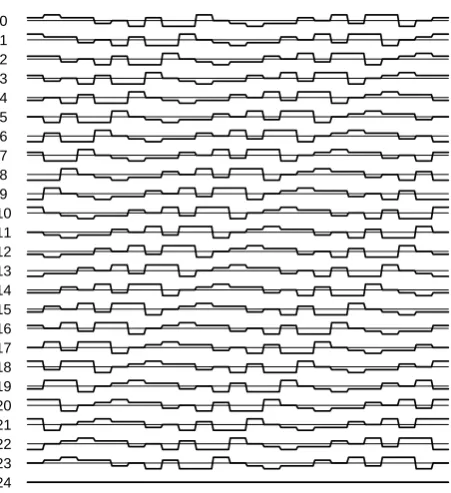
Fig. 2 shows a 25 baud alternating code set. A program for generating weak and strong alternating codes is avail-able at: http://mep.fi/ac, the program is also availavail-able as an online supplement at http://www.ann-geophys.net/26/2237/ 2008/angeo-26-2237-2008-supplement.zip.
7 Discussion
It is also possible to use truncated polyphase alternating codes in a similar manner as binary phase alternating codes, in order to have smaller number of bauds.
It has been shown in Lehtinen et al. (1997) that the non-randomized binary strong alternating codes have as bad a co-variance behaviour as possible (in the sense explained there). That behaviour was shown to depend only on the conditions that for the corresponding weak code the sum of elements of
[image:5.595.313.539.58.305.2]0 1 2 3 4 5 6 7 8 9 10 11 12 13 14 15 16 17 18 19 20 21 22 23 24
Fig. 2. The phases of a 25 baud 5-nary alternating code. The cyclic nature of the code set is evident. One can also see property 2, which implies that each code is conjugate symmetric.
any columnAi in the matrix that has the code sequencesAk
as rows, is 0, and that for anyi, j, the productAi⊗Ajof two columns is eitherUorAk for somek. As all the polyphase alternating codes presented in this paper also satisfy those conditions, the corresponding strong codes have bad covari-ance behaviour and will benefit from randomization. We note that it is possible to randomize any alternating code set with arbitrary phase factors.
As arbitrary waveform generators have become more com-mon in radar signal processing hardware, transmission of complicated codes such as the polyphase codes presented in this paper have become practical. Because these codes also have constant amplitude, there is no transmission power trade-off compared to binary phase codes. Given the fact that polyphase alternating codes have the same properties as bi-nary phase alternating codes, it should be relatively simple to modify existing correlators and analysis programs to use these new codes.
Table 1. Alternating codes with lengths up to 366. The number of phases is denoted byNp, the number of different code setsNcand the generator coefficients are denoted byb. Only one generatorbis given for each code length. The (p–1)-nary codes are generated from the next consecutive prime.
Length Np Nc b Length Np Nc b Length Np Nc b
2 2 1 1 88 88 1 ↓ 226 226 1 ↓
3 3 1 2 89 89 40 3 227 227 112 2
4 2 1 1,1 96 96 1 ↓ 228 228 1 ↓
4 4 1 ↓ 97 97 32 5 229 229 72 6
5 5 2 2 100 100 1 ↓ 232 232 1 ↓
6 6 1 ↓ 101 101 40 2 233 233 112 3
7 7 2 3 102 102 1 ↓ 238 238 1 ↓
8 2 2 1,0,1 103 103 32 5 239 239 96 7
9 3 2 1,1 106 106 1 ↓ 240 240 1 ↓
10 10 1 ↓ 107 107 52 2 241 241 64 7
11 11 4 2 108 108 1 ↓ 243 3 22 2,0,0,0,1
12 12 1 ↓ 109 109 36 6 250 250 1 ↓
13 13 4 2 112 112 1 ↓ 251 251 100 6
16 2 2 1,0,0,1 113 113 48 3 256 2 16 1,0,0,0,1,1,1,0
16 16 1 ↓ 121 11 16 3,1 256 256 1 ↓
17 17 8 3 125 5 20 2,0,1 257 257 128 3
18 18 1 ↓ 126 126 1 ↓ 262 262 1 ↓
19 19 6 2 127 127 36 3 263 263 130 5
22 22 1 ↓ 128 2 18 1,0,0,0,0,0,1 268 268 1 ↓
23 23 10 5 130 130 1 ↓ 269 269 132 2
25 5 4 2,2 131 131 48 2 270 270 1 ↓
27 3 4 2,0,1 136 136 1 ↓ 271 271 72 6
28 28 1 ↓ 137 137 64 3 276 276 1 ↓
29 29 12 2 138 138 1 ↓ 277 277 88 5
30 30 1 ↓ 139 139 44 2 280 280 1 ↓
31 31 8 3 148 148 1 ↓ 281 281 96 3
32 2 6 1,0,0,1,0 149 149 72 2 282 282 1 ↓
36 36 1 ↓ 150 150 1 ↓ 283 283 92 3
37 37 12 2 151 151 40 6 289 17 48 3,4
40 40 1 ↓ 156 156 1 ↓ 292 292 1 ↓
41 41 16 6 157 157 48 5 293 293 144 2
42 42 1 ↓ 162 162 1 ↓ 306 306 1 ↓
43 43 12 3 163 163 54 2 307 307 96 5
46 46 1 ↓ 166 166 1 ↓ 310 310 1 ↓
47 47 22 5 167 167 82 5 311 311 120 17
49 7 8 2,2 169 13 24 2,4 312 312 1 ↓
52 52 1 ↓ 172 172 1 ↓ 313 313 96 10
53 53 24 2 173 173 84 2 316 316 1 ↓
58 58 1 ↓ 178 178 1 ↓ 317 317 156 2
59 59 28 2 179 179 88 2 330 330 1 ↓
60 60 1 ↓ 180 180 1 ↓ 331 331 80 3
61 61 16 2 181 181 48 2 336 336 1 ↓
64 2 6 1,0,0,0,0,1 190 190 1 ↓ 337 337 96 10
66 66 1 ↓ 191 191 72 19 343 7 36 3,0,1
67 67 20 2 192 192 1 ↓ 346 346 1 ↓
70 70 1 ↓ 193 193 64 5 347 347 172 2
71 71 24 7 196 196 1 ↓ 348 348 1 ↓
72 72 1 ↓ 197 197 84 2 349 349 112 2
73 73 24 5 198 198 1 ↓ 352 352 1 ↓
78 78 1 ↓ 199 199 60 3 353 353 160 3
79 79 24 3 210 210 1 ↓ 358 358 1 ↓
81 3 8 1,0,0,1 211 211 48 2 359 359 178 7
82 82 1 ↓ 222 222 1 ↓ 361 19 48 4,4
Even with the new codes, there are still gaps in the avail-able code lengths (Fig. 1). This raises the question of whether there could also be alternating codes for the missing lengths. We have done a complete search of codes with columns from the Fourier-matricesFp for all numbers up top=15. For
numbers followed by a prime there is indeed a unique code. On the other hand, for the numbers 8, 9, 14 and 15 no al-ternating codes were found. These are the first composite numbers not followed by a prime. This small search hints to the possibility that there are nop-nary alternating codes of lengthp(at least codes formed fromFp), except whenpor
p+1 is a prime.
Acknowledgements. Support for J. Vierinen was provided by the
Academy of Finland (application number 213476, Finnish Pro-gramme for Centres of Excellence in Research 2006-1011).
Topical Editor K. Kauristie thanks M. Sulzer and another anony-mous referee for their help in evaluating this paper.
References
Lehtinen, M.: Statistical theory of incoherent scatter measurements, EISCAT Tech. Note 86/45, 1986.
Lehtinen, M. S., Huuskonen, A., and Markkanen, M.: Randomiza-tion of alternating codes: Improving incoherent scatter measure-ments by reducing correlations of gated ACF estimates, Radio Sci., 32, 2271–2282, 1997.
Lidl, R. and Niederreiter, H.: Finite Fields, 2nd ed., Cambridge University Press, 1997.
Markkanen, M. and Nygr´en, T.: Long alternating codes: 2. Practical search method, Radio Sci., 32, 9–18, 1997.
Sulzer, M. P.: Recent incoherent scatter techniques, Adv. Space Res., 9, 153–162, 1989.