CHAPTER 6
CHAPTER 6
Level Cash Flows: Annuities and Perpetuities
Quick Links
Quick Links
Multiple Cash Flows
Cash Flows That Grow at a Constant Rate
Future Value of Multiple Cash Flows
Solving future value problems with multiple cash flows.
1. Draw timeline to ascertain each cash flow is placed in correct time period.
2. Calculate future value of each cash flow for its time period.
3. Add up the future values.
Exhibit 6.1: Future Value of
Exhibit 6.1: Future Value of
Two Cash Flows
Exhibit 6.2: Future Value of
Exhibit 6.2: Future Value of
Three Cash Flows
Multiple Cash Flows
Multiple Cash Flows
Many business situations call for computing
present value of a series of expected future cash flows.
Determining market value of security.
Deciding whether to make capital investment
Process similar to determining future value of
multiple cash flows.
Next, calculate present value of each cash flow
using equation 5.4 from the previous chapter. Present Value of Multiple Cash Flows
Finally, add up all present values.
First, prepare timeline to identify magnitude and
timing of cash flows.
Exhibit 6.3: Present Value of
Exhibit 6.3: Present Value of
Three Cash Flows
The Value of a Gift to the
The Value of a Gift to the
University
University
Suppose that you made a gift to your
university, pledging $1,000 per year for four
years and $3,000 for the fifth year, for a
total of $7,000. After making the first three
payments, you decide to pay off the final
two payments of your pledge because your
financial situation has improved. How much
should you pay to the university if the
Buying a Used Car
Buying a Used Car
For a student—or anyone else—buying a used car
The Investment
The Investment
Decision
Decision
You are thinking of buying a business, and your investment adviser presents you with two possibilities. Both businesses are priced at $60,000, and you have only $60,000 to invest. She has provided you with the following annual and total cash flows for each business,
along with the present value of the cash flows discounted at 10 percent:
Cash flow ($ thousands)
Annuities and Perpetuities
Individual investors may make constant payments on
home or car loans, or invest fixed amount year after year saving for retirement.
Many situations exist where businesses and
individuals would face either receiving or paying constant amount for a length of period.
Level Cash Flows
Annuity: any financial contract calling for equally
spaced level cash flows over finite number of periods.
Annuities and Perpetuities
Perpetuity: contract calling for level cash flow
payments to continue forever.
Ordinary annuities: constant cash flows occurring
at end of each period.
Level Cash Flows
Present Value of an Annuity
Can calculate present value of annuity same way
present value of multiple cash flows is calculated.
Instead, simplify equation 5.4 in chapter 5 to
obtain annuity factor.
Results in equation 6.1 that can be used to
calculate the annuity’s present value.
Level Cash Flows
Exhibit 6.3: Present Value of
Exhibit 6.3: Present Value of
Three Cash Flows
(6.1) i i) (1 1 1 CF i factor) value Present (1 CF annuity an for factor value Present CF PVA n n
Level Cash Flows
Level Cash Flows
Level Cash Flows
A financial contract pays $2,000 at the end of each year for three years and the appropriate discount rate is 8% percent? What is the present value of these cash flows?
Present Value of Annuity example
n 3
1 1
Present value factor = = = 0.7938 (1+i) (1+0.08)
Finding Monthly or Yearly Payments Example
Level Cash Flows
Level Cash Flows
You have just purchased a $450,000 condominium. You were able to put $50,000 down and obtain a 30-year
fixed rate mortgage at 6.125 percent for the balance. What are your monthly payments?
n 360
Monthly interest rate = 6.125 % / 12 months = 0.51042 %
1 1
Present value factor = 0.1599589 (1+i) (1.0051042)
1 - Present value factor PV annuity factor =
i
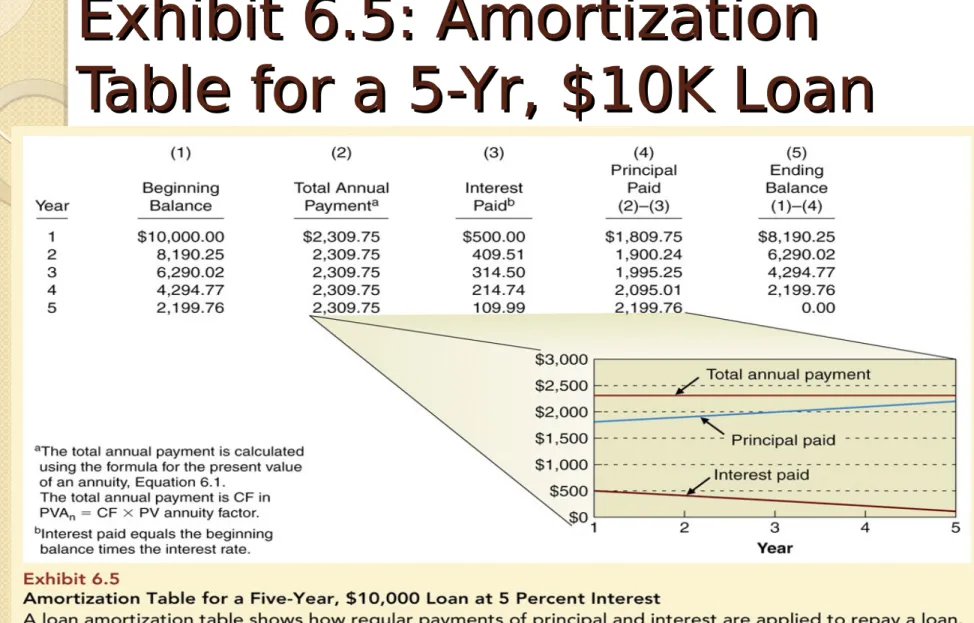
Preparing a Loan Amortization Schedule
Amortization: the way the borrowed amount
(principal) is paid down over life of loan.
Monthly loan payment is structured so each
month portion of principal is paid off; at time loan matures, it is entirely paid off.
Level Cash Flows
Exhibit 6.5: Amortization
Exhibit 6.5: Amortization
Table for a 5-Yr, $10K Loan
Amortized loan: each loan payment contains
some payment of principal and an interest payment.
Preparing a Loan Amortization Schedule
Loan amortization schedule is a table showing: loan balance at beginning and end of each
period.
payment made during that period.
Level Cash Flows
Future Value of an Annuity
Future value annuity calculations usually involve
finding what a savings or investment activity is worth at some future point.
E.g. saving periodically for vacation, car,
house, or retirement.
We can derive the future value annuity equation
from the present value annuity equation (equation 6.1). This results in equation 6.2.
Level Cash Flows
Future Value of an Annuity Equation (6.2) i 1 i) (1 CF i 1 -factor value Future CF annuity an for factor value Future CF FVA n n
Level Cash Flows
Exhibit 6.6: Future Value of
Exhibit 6.6: Future Value of
4-Yr Annuity
Level Cash Flows: Annuities
Level Cash Flows: Annuities
and Perpetuities
and Perpetuities
Finding the Interest Rate
◦
The present value of an annuity equation
can be used to find the interest rate or
discount rate for an annuity
◦
To determine the rate-of-return for an
annuity, solve the equation for
i
◦
Using a calculator is easier than a
Perpetuities
A perpetuity is constant stream of cash flows that
goes on for infinite period.
In stock markets, preferred stock issues are
considered to be perpetuities, with issuer paying a constant dividend to holders.
Equation for present value of a perpetuity can be
derived from present value of an annuity equation with n tending to infinity.
Level Cash Flows
Perpetuities CF i 0) (1 CF i i) (1 1 1 CF annuity an for factor value Present CF PVA
Level Cash Flows
Perpetuities - Example
Level Cash Flows
Level Cash Flows
Suppose you decided to endow a chair in finance. The goal of the chair is to provide the chair holder with $100,000 of additional financial support per
year forever. If the rate of interest is 8 percent, how much money will you have to give the university
foundation to provide the desired level of support?
PVA CF $100,000
= = = $1,250,000 i 0.08
Exhibit 6.7: Ordinary
Exhibit 6.7: Ordinary
Annuity versus Annuity Due
Annuity Due
Annuity transformation method shows relationship
between ordinary annuity and annuity due.
Each period’s cash flow thus earns extra period
of interest compared to ordinary annuity.
Present or future value of annuity due is
always higher than that of ordinary annuity.
Level Cash Flows
Level Cash Flows
Annuity Due Example
The value of the annuity due shown in Exhibit 6.7B is:
Level Cash Flows
Level Cash Flows
In addition to constant cash flow streams, one
may have to deal with cash flows that grow at a constant rate over time.
These cash-flow streams called growing annuities
or growing perpetuities.
Cash Flows That Grow at a
Cash Flows That Grow at a
Growing Annuity
Business may need to compute value of multiyear
product or service contracts with cash flows that increase each year at constant rate.
These are called growing annuities.
Example of growing annuity: valuation of growing
business whose cash flows increase every year at constant rate.
Cash Flows That Grow at a
Cash Flows That Grow at a
Growing Annuity
Use this equation to value the present value of
growing annuity (equation 6.5) when the growth rate is less than discount rate.
1
i
(6.5)
g
1
1
g
-i
CF
PVA
n 1 n
Cash Flows That Grow at a
Cash Flows That Grow at a
Growing Annuity Example
Cash Flows That Grow at a
Cash Flows That Grow at a
Constant Rate
Constant Rate
A coffee shop will be in business for 50-years. It produced $300,000 this year and the discount rate used by similar businesses is 15 percent. The cash flows will grow at 2.5 percent per year. What is the estimated value of the coffee shop?
1
50
CF = $300,000 (1 0.025) = $307,500
$307,500 1.025
Growing Perpetuity
When cash flow stream features constant growing
annuity forever.
Can be derived from equation 6.5 when n tends
to infinity and results in the following equation:
Cash Flows That Grow at a
Cash Flows That Grow at a
Constant Rate
Constant Rate
1
CF
PVA = (6.6) i - g
Growing Perpetuity Example
Cash Flows That Grow at a
Cash Flows That Grow at a
Constant Rate
Constant Rate
0
1 CF ×(1+g)
CF
PVA = =
Your account reports that a firm’s cash flow last year was $450,000 and the appropriate discount
rate for the club is 18 percent. You expect the firm’s cash flows to increase by 5 percent per year and
Interest rates can be quoted in financial markets
in variety of ways.
Most common quote, especially for a loan, is
annual percentage rate (APR).
APR represents simple interest accrued on loan
or investment in a single period; annualized over a year by multiplying it by appropriate number of periods in a year.
Calculating the Effective Annual Rate (EAR)
Correct way to compute annualized rate is to
reflect compounding that occurs; involves calculating effective annual rate (EAR).
Effective annual interest rate (EAR) is defined as
annual growth rate that takes compounding into account.
Calculating the Effective Annual Rate (EAR)
EAR = (1 + Quoted rate/m)
m– 1 (6.7)
m is the # of compounding periods during a year.
EAR conversion formula accounts for number of
compounding periods, thus effectively adjusts annualized interest rate for time value of money.
EAR is the true cost of borrowing and lending.
Effective Annual Rate (EAR) Example
Effective Annual Interest Rate
Effective Annual Interest Rate
Your credit card has an APR of 12 percent (1
percent per month). What is the effective annual interest rate?
EAR = (1 + 0.12/12)12 – 1
= (1.01)12 – 1
= 1.1268 – 1
Examples: Calculating
Examples: Calculating
EAR
EAR
Lender A: 10.40% compound monthly
Lender B: 10.90% compound annually
Lender C: 10.50% compound
quarterly