Materials
Specification references
3.4.1 a) b) c) d) (i) 3.4.2 a) b) c) d) (i) (ii) e) f)
M0.2, M0.4
M2.2, 2.3
M3.1, M3.4, M3.8
M4.3
Introduction
At GCSE you met Hooke’s law, which states that that the force needed to stretch a spring is directly proportional to the extension of the spring from its natural length. This, however, applies only up to the spring’s elastic limit. If too much force is applied, the spring will exceed its elastic limit and be permanently extended.
This worksheet aims to extend your knowledge and emphasise the fact that different materials behave in different ways. You will be introduced to the Young modulus, which is the ratio of the tensile stress to the tensile strain, and is a constant for a given material provided the limit of proportionality has not been surpassed.
Learning outcomes
After completing the worksheet you should be able to:
understand Hooke’s law and the elastic limit
understand and distinguish between tensile strain and tensile stress
understand the terms elastic strain energy and breaking stress
understand that the energy stored in a loaded wire or spring F x
(area under force−extension graph)
describe plastic behaviour, fractures, and brittle behaviour with reference to force–extension graphs
interpret simple stress–strain curves
define the Young modulus
Background
Materials have various properties that can be calculated or displayed graphically. Among these properties, you may be required to calculate the tensile stress, tensile strain, Young modulus, energy stored in a stretched wire or spring, and energy stored per unit volume. These can be calculated using their respective equations but some can also be found from certain graphs, as shown below.
tensilestress (Pa or N m−2) , σ
tensile strain ε (no unit) , ε
Young modulus (Pa or N m−2) , E
The equations for the stress and the strain can be substituted into that for the Young
modulus, which gives the equation: E
The Young modulus of a material can also be found from the gradient of a stress–strain graph; this graph will be different for different materials. Figure 1 shows the curves for steel, glass, and copper. The steeper the gradient of the graph, the larger the Young modulus for that material is.
Figure 1
The elastic potential energy stored in a spring or wire force or tension extension
For a loaded wire, EP F x
For a stretched spring, EP F x
Figure 2
If the graph is a straight line, the area is equal to the area of a triangle, but if the graph is a curve you would need to estimate the area. This can be done by calculating the area of one square on the graph and counting the number of squares under the curve.
Worked example 1
Question
A load of 20 N on a metal wire of length 3.0 m and cross-sectional area 8.0 10−7 m2
produces an extension of 0.10 mm. Calculate
a the tensile stress in the wire
b the tensile strain
c the Young modulus of the metal
d the elastic potential energy stored in the wire when it is extended.
You need to be particularly aware of units in this type of question. Values can be quoted either in standard form, or in mm for extension or mm2 for cross-sectional
area. The units for length and area need to be converted to m (length) or m2 (area)
before being used in a calculation or the answer will be wrong.
Answer
Step 1
Write out the values given in the question, converting them where necessary.
F 20 N
L 3.0 m
A 8.0 10−7 m2
a Step 2
Calculate the tensile stress.
σ
2.5 107 Pa
b Step 3
Calculate the tensile strain.
ε
3.3 10−5
c Step 4
Calculate the Young modulus.
E
7.5 1011 Pa
d Step 5
Calculate the stored elastic potential energy in the stretched wire.
elastic energy stored F x
20 1.0 10−4
Worked example 2
Question
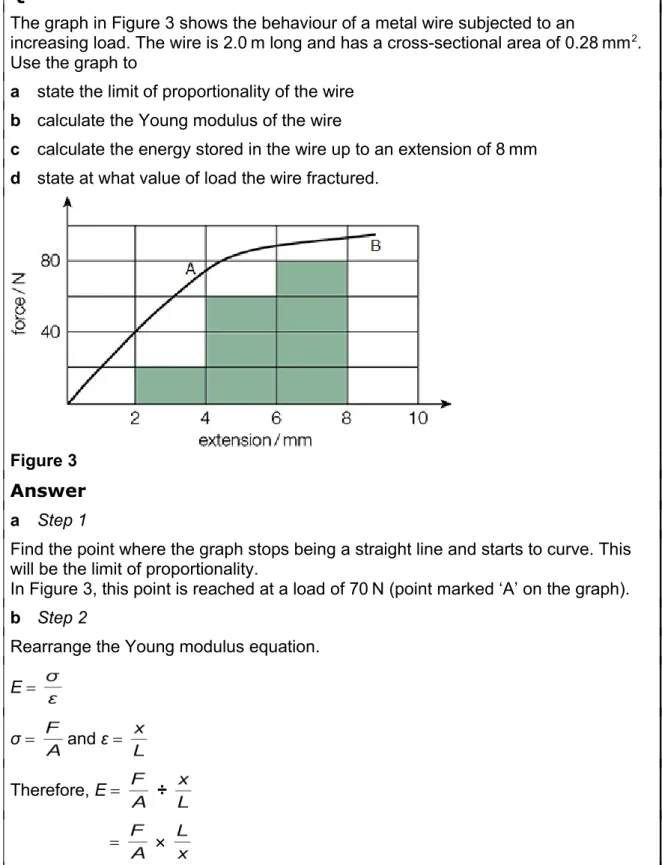
The graph in Figure 3 shows the behaviour of a metal wire subjected to an
increasing load. The wire is 2.0 m long and has a cross-sectional area of 0.28 mm2.
Use the graph to
a state the limit of proportionality of the wire
b calculate the Young modulus of the wire
c calculate the energy stored in the wire up to an extension of 8 mm
d state at what value of load the wire fractured.
Figure 3 Answer a Step 1
Find the point where the graph stops being a straight line and starts to curve. This will be the limit of proportionality.
In Figure 3, this point is reached at a load of 70 N (point marked ‘A’ on the graph).
b Step 2
Rearrange the Young modulus equation.
E
σ and ε
Therefore, E ÷
is equal to the gradient of the force–extension graph, thus E gradient
Step 3
Find the gradient of the linear portion of the graph. In this case it’s important to convert the x-axis values to metres before calculating the gradient since the value will be used in the calculation. If you take the points (2,40) and (0,0):
gradient
2.0 104 N m−1
Step 4
Use the gradient of the graph to calculate the Young modulus, using the equation you found in Step 2. Remember to convert the cross-sectional area from mm2 to m2.
E gradient
2.0 104
1.4 1011 Pa
c Step 5
In this case you do not have enough information to calculate the stored elastic potential energy in the extended wire. Instead you can estimate it by calculating the area of one square and counting the number of squares under the curve (up to 8 mm on the x-axis).
Energy stored area under graph area of 1 square number of squares Area of 1 square 20 2 10–3 40 10–3
Number of squares 8 4 12 whole squares Total area 12 40 10−3 0.48 J
d Step 6
The value of load at which the wire fractured can be found from the graph as the point where the curve becomes almost level.
Fracture occurs at approximately 90 N.
1 Calculate the stress in a wire of cross-sectional area 2.0 10 m when it is subject to a force of 12 N. (1 mark)
2 Calculate the strain produced in a metal bar of Young modulus 1.2 1011 N m−2
when it is subject to a tensile stress of 1.8 106 N m−2. (2 marks)
3 a Calculate the force which will produce an extension of 0.30 mm in a steel wire with a length of 4.0 m and a cross-sectional area of 2.0 10−6 m2. (2
marks)
Young modulus of steel 2.1 1011 Pa
b Calculate the energy stored in the stretched wire. (2 marks)
4 A load of 15 N produces an extension of 0.10 mm in a metal wire 10 m in length. If the Young modulus of the metal is 1.8 1011 Pa, calculate
a the cross-sectional area of the wire (2 marks)
b the diameter of the wire. (2 marks)
5 A wire with a length of 2.0 m and a cross-sectional area of 7.0 10−8 m2 is hung
vertically from a support on the ceiling and stretched by suspending various loads from its lower end. The results are shown in Table 1.
Table 1
Load / N 0 10.0 20.0 30.0 35.0 40.0 45.0
Extension / mm 0 1.4 2.8 4.2 4.9 5.8 8.0
a Use the data to plot a graph of load against extension. (4 marks)
b Draw an arrow labelled E to indicate the limit of proportionality. (1 mark)
c Calculate the gradient of the straight-line portion of the graph. (2 marks)