185
Copyright © 2016. Vandana Publications. All Rights Reserved.
Volume-6, Issue-6, November-December 2016
International Journal of Engineering and Management Research
Page Number: 185-192
A study of Marketing Strategies Adopted by Software Companies in
Vidharbha Region
Mr. Satish Rewatkar1, Dr. A. K. Mansuri2
1Research Scholar, R.T.M. Nagpur University, Nagpur, Maharashtra, INDIA 2
Ph. D. Guide & HOD of Commerce Department, G S College of Commerce, Wardha, Maharashtra, INDIA
ABSTRACT
In the current dynamic business environment, there is a growing quest for enhancing the business performance by the Business organizations to remain active and competitive in market. In this quest, even profit-seeking companies have recognized the importance of Value Addition in their offerings to customers to enhance their Customer Satisfaction and Customer Retention. Besides retaining the existing customers, even the importance of extending and widening the customer base, is being felt by the business organizations. Companies marketing strategy plays a vital role in this. Emerging new technologies and social media also influence the way companies do their marketing today. Different perspectives and definitions of marketing strategies are reflected in various literatures. The primary aim of this research paper is to “Study the Marketing Strategies adopted by Software Companies in Vidharbha Region”.
Keywords— Marketing Strategies, Customer Satisfaction, Impact of Brand, Customer Relationship Management
I.
INTRODUCTION
India, a relative laggard among developing countries in terms of economic growth, seems to have found such an opportunity in the IT revolution as an increasingly favored location for customized software development. India’s success at software has led to speculation about whether other developing countries can emulate its example, as well as whether this constitutes a competitive challenge to software companies in the developed world. The Indian software company consists of a large and growing number of firms using NASSCOM membership as a measure. Many of the firms entered the industry during or just before the economic liberalization in 1991, and few have exited. A growth of 22 per cent for the past five years is proof of the fact that the Indian software product industry is thriving, and that the country is entering the product era. Today, around 2,400 organizations are contributing USD 2 billion to the overall software company revenues, enabling India to emerge as a global software products hub. Exports of software products alone are expected to grow to USD 1.3 billion in
FY2011, an increase of 13 per cent over the previous year. The domestic software products market is expected to reach 158 billion in FY2011, recording a growth of 14 per cent over the 2010 revenues of 140 billion. The most remarkable software company of the last 3 decades is that of India. Supported by a technological revolution India became an increasingly favored location for customized software development.
Marketing of software firm consists of creating value, delivering value and communicating value to customers. This requires constant analysis of customer needs and technology up gradation. Marketing of software products is different from the traditional product due to uniqueness inherent in the product. (Nigam, 2011) [1]. The strategy of a software firm truly determines the phases it will undergo. The computer software industry is undergoing some major changes which are making an impact on software vendor business models, as well as marketing and sales tactics. A successful marketing strategy can change the present and future of any software firm. In such a competitive scenario where every software company is competing with each other, strong strategy enables them to have a competitive advantage over others. This case illustrates the determining factors of the successful marketing strategy for the software firm and its impact on the future of the firm.
186
Copyright © 2016. Vandana Publications. All Rights Reserved.
items are sold out in the market. So the business cyclecontinues going further. It is required to facilitate the marketing activities without activities moreover. It is important to work in close coordination with production. Production alone is not going to fill the need. Production without marketing get to be futile for the organization and marketing without production is impractical. So also, marketing is identified with different activities like fund, research and human resource activities (Kotler, 2009) [4]. The fundamental concern of this research paper here is with the marketing activities of software companies in Vidharbha region.
1.1 About Software Companies in Vidharbha
Initially, in 1980’s, Software companies was offering only IT enabled Services to clients in US and Canada but slowly and steadily it became the business transformation and services center at Nagpur. An International cargo hub, (MIHAN), is being developed at Nagpur. MIHAN will be used for handling heavy cargo coming from South-East Asia and Middle-East Asia. Project will include 10,000 core (US$1.9 billion) Special Economic Zone (SEZ) for IT companies.
This will be the biggest development project in India so far. More than 118 companies in Vidharbha including 97 registered with STPI. Nagpur region having Parsodi Information Technology Park, Software Technology park at Sadar, Special Economic Zone (SEZ) for Information Technology (IT) companies, Lambent IT Park at Besa. The companies started to made Customized software application, accounting software, web page designing, software application for manufacturing unit, distributors, wholesalers, retailers, Hospitals, for SME’s Enterprise Resource Planning called ERP application.
II.
OBJECTIVES OF THE STUDY
2.1 To Study the Marketing Strategies adopted by Software Companies in Vidharbha Region.
2.2 To Study the Satisfaction level of customer with respective software product and service provide by them. 2.3 To study the impact of Brand on purchase of software product.
2.4 To study the impact of Relationship Management on the software companies in Vidharbha region.
2.5 To analyze the implementation of different Marketing Strategies and their success.
2.6 To study the Customer Retention toward software companies in Vidharbha region.
III.
HYPOTHESIS OF THE STUDY
3.1 Marketing Strategies had worked successfully
3.2 Customers are satisfied with software product and their services
3.3 Brand having an impact while purchasing the software product by customer
3.4 Relationship Management had good impact on the software companies in Vidharbha region
3.5 Implementations of Marketing Strategies were successful
3.6 Customer retention is more towards older software companies
The primary data have been collected from the 60 officials from the 20 software companies of the Vidharbha region and 200 clients of the software companies and the secondary data have been collected from the various research papers, website and books.
IV.
LITERATURE REVIEW
According to Proctor (2005), marketing is the procedure by which organizations make client enthusiasm for merchandise or administrations. It produces the strategy that underlies deals methods, business communication, and business improvements [5]. It is a coordinated procedure through which organizations assemble solid client connections and make esteem for their clients and for themselves.
Marketing strategy is more important for software companies now than it has ever been. The computer software industry is undergoing some major changes which are impacting software vendor business models, as well as marketing and sales tactics. (Source: www.software-marketing-advisor.com, 2012). A single case study is applied that analyzes the global marketing strategy of a small software firm with five employees, that globalized instantly and that serves global business-to-business markets by using an Internet-based sales channel strategy. (Fuerst, 2010) [6].
In the view of Kotler (2010), marketing strategy, when imagined as the greater wicker container, comprising of components identifying with production, distribution, promotion and pricing, will direct comprehend the importance of this research study [7].
According to Fatima Abogila Mohamed Matog, Dr. Deva Raj Baduu, 2014, Predicting customer satisfaction in the field of software is key point. This has to be addressed and find the possible innovative solutions to achieve the customer satisfaction in the field of software products. To attain Customer-oriented business philosophy the company has to follow customer-focus, customer centrism, relationship marketing and other necessary customer centric fundamental concepts [8].
Brand Awareness is related to the strength of the brand node or trace in memory. Brand awareness is “the likelihood that a brand name will come to mind and the ease with which it does so” (Keller 1993 p. 3). Brand awareness is used to measure brand equity in many marketing studies (see Aaker 1991; Berry 2000; Keller 1993; Kim et al. 2002; Yoo and Donthu 2001; Yoo et al. 2000). Aaker (1991) states that brand awareness can be viewed as a continuum ranging from brand recognition at the lowest level, to brand recall at the mid-level, to top-of-mind recall and, finally, the dominant brand.
187
Copyright © 2016. Vandana Publications. All Rights Reserved.
conceptualizing, measuring, and managing brand equity isa seminal article in this area of research.
According to Keller (1993), brand equity occurs when the consumer is familiar with the brand and holds some favorable, strong and unique brand associations in memory. The structure of memory association can be explained with a type of associative model formulation (see Anderson 1983). Consumers may associate a brand with a particular product feature, color, logo, spokesperson, or auditory cues.
According to Russell, S. Winner (2001), Customer Relationship Management is the new Mantra of marketing. Companies like Oracle have come up with products and services that can track customers through the World Wide Web and be able to predict their future moves needs and wants. Kotler (2003) uses customer relationship management interchangeably with customer relationship marketing. He says that customer relationship management’s aim is to produce high quality equity which he called customer equity. Rust, et al (2001) further distinguishes the three drivers of customer equity, value equity, brand equity and relationship equity. Rust, et al (2001) described Value Equity as the customers’ objective assessment of utility of an offering based on perception of its benefits relative to its costs.
Implementation is the process that turns plans into action assignments and ensures that such assignments are executed in a manner that accomplishes the plan‟s stated objectives. Kotler (1984) cited in Noble (1999b). Implementation was found to be a highly complex and interactive process with many variables impinging upon it – more of a „spring‟ than a simple cascade. Many factors influence the flow and content of the „spring‟ (Wernham, 1985).
It is clear that a poor or vague strategy can limit implementation efforts dramatically. Good execution cannot overcome the shortcomings of a bad strategy or a poor strategic planning effort (Hrebiniak, 2006). Gupta (1987) classifies Strategic Business Units (SBU’s) strategic contexts into two dimensions: strategic mission (such as a “build ‟strategic mission and a “harvest‟ strategic mission) and competitive strategy (such as differentiation and low cost). Walker and Ruekert (1987) divided business strategy behaviors into three types: prospectors, differentiated defenders and low cost defenders. These distinctions are based on the strategy categories introduced by Miles and Snow (1978; prospectors, defenders, analyzers, reactors) and by Porter (1980); overall cost leadership, differentiation and focus.
In order to analyze strategy implementation, the researchers reviewed here make use of a variety of theories, including agency theory (Govindarajan & Fisher, 1990), organization theory (Govindarajan & Fisher, 1990), psychology (Kim & Mauborgne, 1991, 1993), social system theory (Walker & Ruekert, 1987), social learning theory (Govindarajan, 1988), expectancy theory (Guth & MacMillan, 1986; Judge & Stahl,1995). The more exotic of these theories provide surprising and useful additional insights regarding strategy implementation: Guth and MacMillan (1986) point out that a richer, if more complex;
explanation for individual managers‟ commitment to a strategy comes from the expectancy theory of motivation.
The strategies for Customer retention discussed by Roopa Singh, Imran Akhtar Khan (2012) are Proper Email Communication / Marketing; Understand the value of lifetime, Analyze and sell, Customer Feedback and Solicit Complaints Regularly, Give Surprises to Customers [9]. With the understanding of the behavior of the customers and satisfying them provides the benefit to the business in the long term. Establishing good relationship with them by providing better services will create customer loyalty and hence more visits over time. This will bring more profit.
V.
VALIDATION OF HYPOTHESIS
Hypothesis1: Marketing Strategies had worked
successfully
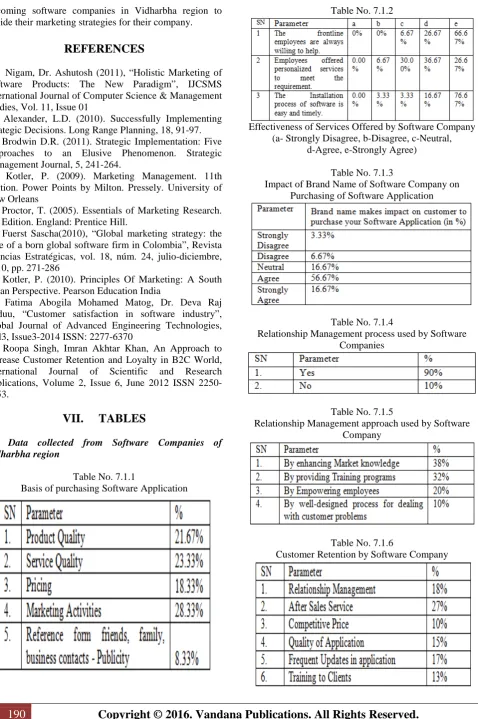
From the quantitative analysis table no 8.1.1 and 8.2.1, it was found that 28% of software companies stated that customer is willing to purchase their software application because of marketing activities and at the same time 24% clients of the software companies confirmed that they had purchased the software application because of marketing activities of the software company. Hence marketing strategies had worked successfully.
In the literature, Levitt (2010) also stated that marketing activity is a very general term that refers to the commercial functions involved in transferring goods and services from a producer to a consumer. It is commonly associated with endeavors such as branding, selling, and advertising, but it also encompasses activities and processes related to production, product development, distribution, and many other functions. Furthermore, on a less tangible level, marketing facilitates the distribution of goods and services within a society, particularly in free markets. Evidence of the pivotal role that marketing plays in free markets is the vast amount of resources it consumes: about fifty percent of all consumers, in fact, pay for marketing-related activities. Therefore, it can be concluded that the marketing strategies of software companies in Vidharbha region had worked successfully. Hence both the statements do not contradict with each other and no gap exists in between them.
By understanding the similarity between primary and secondary data findings, the researcher was able to successfully prove this research hypothesis that “marketing strategies had worked successfully”.
Hypothesis2: Customers are satisfied with software product and their services
188
Copyright © 2016. Vandana Publications. All Rights Reserved.
application were easy and timely. The same has beenconfirmed by the 46.5% clients of the software companies agreed 34% strongly agreed to the fact that the installation process of software application were easy and timely.
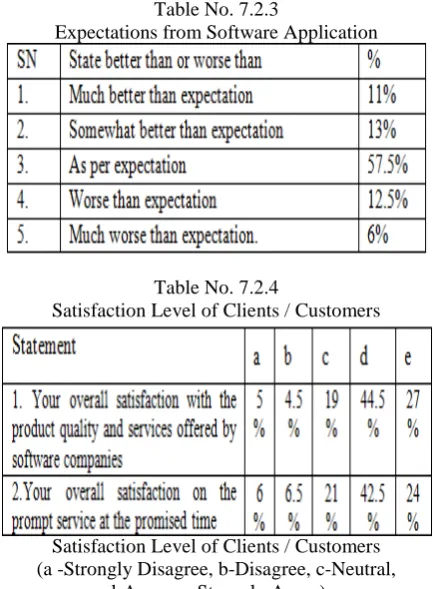
According to the table 8.2.3, 57.5% of clients of the software companies stated that they found software applications per their expectations. 13% of the respondents stated that they found software application somewhat better than their expectation. 11% of the respondents found the software application is much better than then their expectation which shows the satisfaction towards product quality provided by the software companies.
According to the table 8.2.4, 44.5% of clients of the software companies were agreed that they were satisfied with the product quality and services offered by software companies, 27% of the respondents strongly agreed. Also 42.5% of the clients of the software companies agreed and 24% strongly agreed to the fact that they have overall satisfaction on the prompt service at the promised time. Hence Customers are satisfied with software product and their services
In the literature, Kotler et al (2009) also stated that a fruitful strategy has three foundations required to make upper hand, such as building customer relationships, customer satisfaction, quality, value and service. Therefore, in order to gain a competitive advantage software companies are focusing on improving the quality and services as well as on the prompt service at the promised time to their customers. Therefore, it can be concluded that customers are satisfied with the quality and services offered by software companies in Vidharbha region.
Hence both the statements do not contradict with each other and no gap exists in between them. By understanding the similarity between primary and secondary data findings, the researcher was able to successfully prove this research hypothesis.
Hypothesi 3: Brand having an impact while purchasing the software product by customer
From the table no 8.1.3 and 8.2.5, it has been found that 56.67% of software companies agreed and 16.67% strongly agreed to that brand name makes impact on customer to purchase their software application. The same has been confirmed by the clients of the software companies that they 30% of clients agreed 29% strongly agreed to the fact that brand name make impact on customer to purchase the software application. Hence Brand having an impact while purchasing the software product by customer.
In the literature, Kotler and Armstrong (2007) also stated that in the modern society brands not only represent the product or company but also have a strong association with perceived quality, consumers’ life style, social class, taste etc. Some consumers make a purchase decision for software prior to product or dealer contact, based on prior experience or a thorough online information search. A brand name has a value; this depends on the quality of its products in the market and the satisfaction or content of the customer in its products and services. This provides the trust of the customers in
the brand. If customers trust a brand quality, it makes a positive connection to the brand and customers will have a reason to become a loyal to the brand. Therefore, it can be concluded that brand have an impact while purchasing the software product by customer. Hence both the statements do not contradict with each other and no gap exists in between them. By understanding the similarity between primary and secondary data findings, the researcher was able to successfully prove this research hypothesis.
Hypothesis4: Relationship Management had good impact on the software companies in Vidharbha region
From the table no 8.1.4, 8.1.5 and 8.2.6 it has been found that the 90% software companies were used relationship management process. In which 38% of the software companies stated that they enhancing market knowledge of their employees, 32% by providing training programs to the clients, 20% and 10% of respondents done it by empowering the employees and by well-design process for dealing with customer problems respectively. This was observed by the clients of the software companies, 52% of clients observed enhancing market knowledge approach in relationship management, 26.5% of the clients of the respondents observed that the software companies have done this by well-designed process for dealing with customer problems. 23.5% observed training programs to the clients. 19% of the clients observed the relationship approached by empowering their employees, software companies empowering their employees. Here relationship management approached done by the software companies were acknowledged by the clients of the software companies.
According to the table no 8.1.6 and 8.2.7, 18% of the software companies stated that the relationship management activities were used for customer retention which has been proved by the 21% of the clients of the software companies stated that because of relationship management process of the software companies they were retained. Hence Relationship Management had good impact on the software companies in Vidharbha region.
In the literature, Kotler (2000) also stated that relationship marketing has the aim of building long-term mutually satisfying relations with key parties (customers, suppliers, distributors and other partners), in order to earn and retain their long-term preference and business. Relationship marketing builds strong economic, technical and social ties among the parties and it cuts down on transaction cost and time, transaction move from being negotiated each time to being a matter of routine. Therefore, relationship marketing strategy is a strategy that tries to create competitive. Therefore, it can be concluded that relationship management had good impact on the software companies in Vidharbha region. Hence both the statements do not contradict with each other and no gap exists in between them. By understanding the similarity between primary and secondary data findings, the researcher was able to successfully prove this research hypothesis.
189
Copyright © 2016. Vandana Publications. All Rights Reserved.
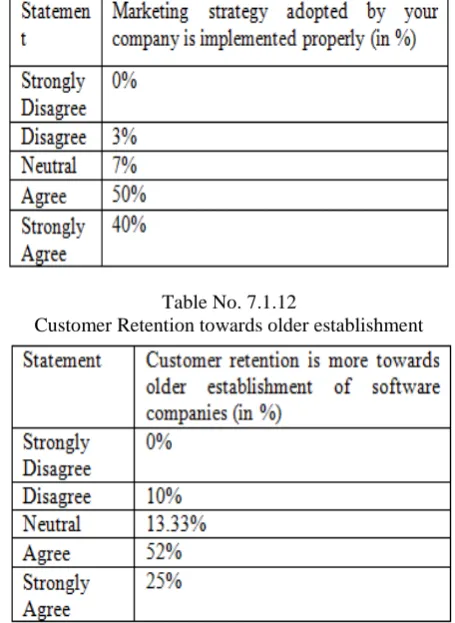
From the table no 8.1.7, 8.1.8, 8.1.9 and 8.1.10,it has been found that the marketing strategies were decided by the software companies as per the market situation (50%) and yearly basis (37%). The reviews of the adopted marketing strategies were taken as per the market situation (40%) and on quality basis (33%). Depending on the reviews of the market situation software companies modified their marketing strategies as per market situation (47%), on quarterly (20%) and yearly basis (20%). And it was agreed (50%) and strongly agreed (40%) to that the marketing strategy adopted by your company is implemented properly
From the quantitative analysis table no 8.1.11 and 8.2.1, it was found that 28% of software companies stated that customer is willing to purchase their software application because of marketing activities and at the same time 24% clients of the software companies confirmed that they had purchased the software application because of marketing activities of the software company. This shows that the implementation of marketing strategies was successful.
In the literature, it was stated that effective marketing implementation starts with managing the marketing activities. Measuring and control are all parts of good management. For example, using a simple chart to monitor the initiatives will increase the implementation effectiveness. On the other hand, the heart of the implementation of a marketing plan is the execution, the actual "doing" of the planned marketing activities. Initiatives don't get completed by stating them on paper--they require action, management and follow up (Chiefoutsiders.com, 2016). Therefore, it is very essential for any software company to implement its marketing strategy properly and make it run efficiently.
Therefore, it can be concluded that implementations of marketing strategies were successful by software companies in Vidharbha region. Hence both the statements do not contradict with each other and no gap exists in between them. By understanding the similarity between primary and secondary data findings, the researcher was able to successfully prove this research hypothesis.
Hypothesis6: Customer retention is more towards older software companies
From the table no 8.1.6 and 8.2.7, , it has been found that 27% of software companies were stated that After Sales Service, 18% used relationship management, 17% stated that frequent updates in software application, 15% stated that quality of their software applications, 13% of the of software companies believe in training to clients about handling of software application and 10% of the software companies stated that the competitive price offering to customers made the customer retains to their companies. The same has been acknowledged by 37.5% of the clients of the software companies by stating that After Sales Services is the factor that encouraged them to be retained with the company and 21% of the clients of the software companies stated that because of relationship management process of the software companies they were retained. 19% of the clients stated that Quality of
Application encouraged them to be retained with that company. Whereas, 8%, 7.5% and 7% of the clients stated that they were retained due to training activities of the software company, competitive price of the software application provided by the software company and frequent updates in the software application respectively.
From the table no 8.1.12 and 8.2.8, it has been found that the 52% of the software companies were agreed and 25% strongly agreed to that their retention were more towards older software companies. The same has been confirmed from the clients of the software company from which 40% of the clients were agreed and 30% were strongly agreed to the fact that that their retention were more towards older software companies. Hence Customer retention is more towards older software companies. In the literature, Buchanan (2011) also stated that After Sales Support /Service is important if company wants to retain customers and also want to keep reputation of their product and reputation of company high as a good product followed by poor after sales support leads to failure. So a sales person in software company does put lot of efforts, time and money to bring a customer on board and after sales support if lacking will make everything go down the drain because end of the customer satisfaction leads to broad approach through word of mouth, customer testimonials and reviews.
Therefore, it can be concluded that customer retention is more towards older software companies through after sales service. Hence both the statements do not contradict with each other and no gap exists in between them. By understanding the similarity between primary and secondary data findings, the researcher was able to successfully prove this research hypothesis.
VI.
CONCLUSION
From the above study and validation of hypothesis, it is concluded that the Marketing Strategies adopted by Software Companies in Vidharbha Region had work successfully. In order to gain a competitive advantage software companies are focusing on improving the quality and services as well as on the prompt service at the promised time to their customers. Therefore, it can be concluded that customers are satisfied with the quality of the software application and services offered by software companies of Vidharbha region. With the study of the software companies of the Vidharbha region and their customers, it can be concluded that brand have an impact while purchasing the software product by customer and also the relationship management had good impact on the software companies in Vidharbha region.
190
Copyright © 2016. Vandana Publications. All Rights Reserved.
upcoming software companies in Vidharbha region todecide their marketing strategies for their company.
REFERENCES
[1] Nigam, Dr. Ashutosh (2011), “Holistic Marketing of Software Products: The New Paradigm”, IJCSMS International Journal of Computer Science & Management Studies, Vol. 11, Issue 01
[2] Alexander, L.D. (2010). Successfully Implementing Strategic Decisions. Long Range Planning, 18, 91-97. [3] Brodwin D.R. (2011). Strategic Implementation: Five Approaches to an Elusive Phenomenon. Strategic Management Journal, 5, 241-264.
[4] Kotler, P. (2009). Marketing Management. 11th Edition. Power Points by Milton. Pressely. University of New Orleans
[5] Proctor, T. (2005). Essentials of Marketing Research. 4th Edition. England: Prentice Hill.
[6] Fuerst Sascha(2010), “Global marketing strategy: the case of a born global software firm in Colombia”, Revista Ciencias Estratégicas, vol. 18, núm. 24, julio-diciembre, 2010, pp. 271-286
[7] Kotler, P. (2010). Principles Of Marketing: A South Asian Perspective. Pearson Education India
[8] Fatima Abogila Mohamed Matog, Dr. Deva Raj Baduu, “Customer satisfaction in software industry”, Global Journal of Advanced Engineering Technologies, Vol3, Issue3-2014 ISSN: 2277-6370
[9] Roopa Singh, Imran Akhtar Khan, An Approach to Increase Customer Retention and Loyalty in B2C World, International Journal of Scientific and Research Publications, Volume 2, Issue 6, June 2012 ISSN 2250-3153.
VII.
TABLES
7.1 Data collected from Software Companies of Vidharbha region
Table No. 7.1.1
Basis of purchasing Software Application
Table No. 7.1.2
Effectiveness of Services Offered by Software Company (a- Strongly Disagree, b-Disagree, c-Neutral,
d-Agree, e-Strongly Agree)
Table No. 7.1.3
Impact of Brand Name of Software Company on Purchasing of Software Application
Table No. 7.1.4
Relationship Management process used by Software Companies
Table No. 7.1.5
Relationship Management approach used by Software Company
Table No. 7.1.6
191
Copyright © 2016. Vandana Publications. All Rights Reserved.
Table No. 7.1.7Decision of Marketing Strategies by Software Company
Table No. 7.1.8 Review of Marketing Strategy
Table No. 7.1.9
Modifications in Marketing Strategies
Table No. 7.1.10
Implementation of Marketing Strategy adopted by Software Company
Table No. 7.1.11
Basis of purchasing Software Application
Table No. 7.1.12
Customer Retention towards older establishment
7.2 Data collected from Clients of Software Companies
Table No. 7.2.1
Reason for purchasing Software Application purchase from Software Company
Table No. 7.2.2
192
Copyright © 2016. Vandana Publications. All Rights Reserved.
Table No. 7.2.3Expectations from Software Application
Table No. 7.2.4
Satisfaction Level of Clients / Customers
Satisfaction Level of Clients / Customers (a -Strongly Disagree, b-Disagree, c-Neutral,
d-Agree, e-Strongly Agree)
Table No. 7.2.5
Impact of Brand Name on purchase of Software Application
Table No. 7.2.6
Relationship Marketing approach
Table No. 7.2.7 Customer Retention
Table No. 7.2.8