467
Copyright © 2011-15. Vandana Publications. All Rights Reserved.
Volume-5, Issue-3, June-2015
International Journal of Engineering and Management Research
Page Number: 467-474
Effect of Fuel Injection Pressure On Combustion Characteristics of CI
Engine Using Alternate Fuels
K. Naresh1, Shaik Hussain2 1,2
Department of Mechanical Engineering, Malla Reddy Engineering College, Hyderabad, INDIA
ABSTRACT
The depletion, increasing demand and price of the petroleum promoted extensive research worldwide on alternative energy resources for internal combustion engines. There were several studies which reveal the significance of research on biodiesel as a substitute fuel to a diesel fuel. It has proven that biodiesel is one of the promising renewable, alternative and environmentally friendly biofuels that can be used in diesel engine with little or no modification in the engine. The stringent emission laws, depletion of fossil fuels and relation of fuels with government policies have forced the world to find alternatives to fossil fuels. Numerous vegetable oils suitability has been investigated for use in internal combustion engines. The effects of different fuels on the performance characteristics of engines have been extensively reported. The high viscosity and low volatility of these vegetables oils are the major problem for their use in the diesel engines. However use of different biodiesels in an engine results in variability in the engine performance and emission due to physical and chemical characteristics of fuel. The effect of these physio-chemical properties on fuel supply system such as fuel pump and fuel filter have already been reported.
In this work an attempt is made to improve the combustion characteristics of the engine fueled with biodiesel. Hence a detailed investigation is carried out on the underlying combustion and heat release characteristics. The experimental work is conducted on 4S, single cylinder, water cooled and DI stationary diesel engine. In this work bsfc and thermal efficiency are computed, for different in cylinder pressure and peak heat release rate.
Keywords---- Alternate Fuels, Vegetable Oils, Biodiesel, Exhaust emissions, Combustion characteristics
I.
INTRODUCTION
The oils that are extensively studied include Sunflower, Soya bean, Peanut, Rapeseed, Rice bran, karanji etc. one of the disadvantages of using these oils in diesel engines is nozzle deposits, which drastically
affects the engine performance and emissions. The refining process of vegetable oil gives better performance compared to crude vegetable oil. Goering et al studied the characteristic properties of eleven vegetable oils to determine which oils would be best suited for use as an alternative fuel source. Of the eleven oils tested, corn, rapeseed, sesame, cottonseed, and soya bean oils had the most favorable fuel properties. There is an improvement in the engine performance when these modified vegetable oils are used instead of base vegetable oils. This improvement in performance is attributed to good atomization of these modified fuels in the injector nozzle and a significant reduction in the viscosity. The performance of the non-edible oils like Rice bran oil and cotton seed oil was found satisfactory [1].
468
Copyright © 2011-15. Vandana Publications. All Rights Reserved.
known techniques are proposal to reduce the viscositylevels of vegetable oil namely dilution, pyrolysis, Micro emulsion and Trans esterification [3].
A lot of researchers have reported that with the use of vegetable oil ester as a fuel in diesel engines, a diminution in harmful exhaust emissions as well as equivalent engine performance with diesel fuel were achieved. The high oxygen content in biodiesel results in the improvement of its burning efficiency, reduction of particulate matter (PM), carbon monoxide (CO), and unburned hydrocarbon (UHC), but at the same time produces higher NOX emissions. It is estimated that the burning of neat biodiesel would produce about 10% more NOX than that of petroleum based diesel fuel. Also, decreasing of carbon dioxide (CO2) by using biodiesel contributes to reduce greenhouse effect [4]. There are various problems connected with vegetable oils being used as fuel in diesel engines. These problems are owing to high viscosity, density, iodine value and poor volatility of the vegetable oil. Researchers clearly prove that trans-esterification is the best way to use vegetable oil as a fuel in existing diesel engines. After trans-esterification, the alkyl ester usually called biodiesel still has higher density and viscosity. These can cause advances in the start of injection timing. High viscosity and surface tension of biodiesel affect atomization by increasing the mean droplet size which in turn increases the spray tip penetration. The higher mean droplet size of biodiesel is due to the lower Weber number which is again due to high surface tension. The researchers have found that viscosity is the main dominating effect, where as density is the lowest on mean droplet size and hence to get better fuel atomization viscosity should be the first choice of fuel’s physical property to be decreased. The above mentioned problem can be solved by blending biodiesel with diesel fuel which will decrease the viscosity [5].
The other way to improve atomization is injecting biodiesel at higher pressures which in turn increase the atomization process by increasing dispersion of biodiesel spray. Several studies have shown that the injection pressure affects the injection and combustion characteristics, and engine performance of diesel engines when using biodiesel [6].
The objective of this study is to investigate the performance, combustion characteristics and heat release rate phenomena of a compression ignition engine running with biodiesel.
II.
TEST ENGINE AND FUEL
PROPERTIES
Experiments were conducted on a Kirloskar AV-1 stationary diesel engine of the I.C. Engines laboratory. The specifications of test engine are given in table 1.
TABLE1ENGINESPECIFICATIONS Parameter Specification Number of cylinders 01
Number of strokes 04
Fuel Diesel
Rated power and speed 5.2 KW/7 hp @ 1500 RPM Cylinder bore & stroke 87.5 & 110 mm
Compression Ratio 17.5:1 Dynamometer arm length 185 mm
Dynamometer type Eddy current Type of cooling Water cooled
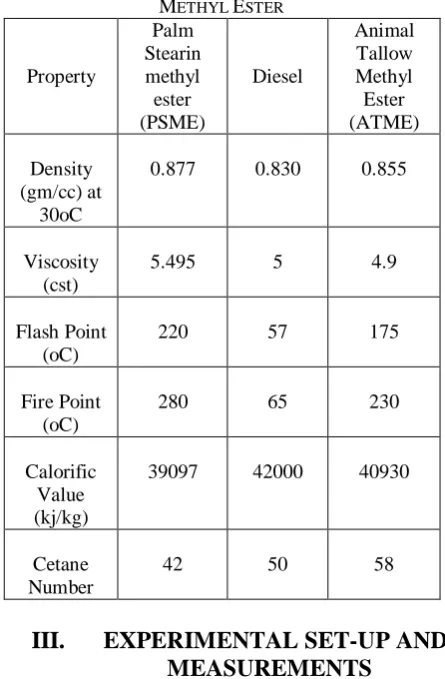
The properties of diesel, palm Stearin methyl ester and Animal Tallow methyl ester are given in following table 2.
TABLE 2COMPARISON OF PROPERTIES OF PALM
STEARIN METHYL ESTER,DIESEL AND ANIMAL TALLOW
METHYL ESTER
Property Palm Stearin methyl ester (PSME) Diesel Animal Tallow Methyl Ester (ATME) Density (gm/cc) at 30oC
0.877 0.830 0.855
Viscosity (cst)
5.495 5 4.9
Flash Point (oC)
220 57 175
Fire Point (oC)
280 65 230
Calorific Value (kj/kg)
39097 42000 40930
Cetane Number
42 50 58
III.
EXPERIMENTAL SET-UP AND
MEASUREMENTS
469
Copyright © 2011-15. Vandana Publications. All Rights Reserved.
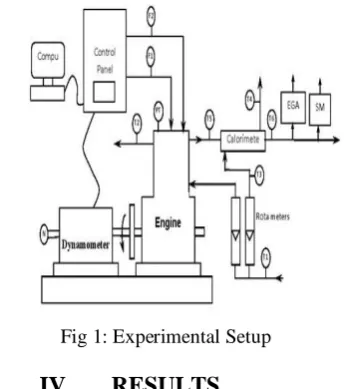
rotometer and exhaust emission measurement with Multigas analyzer (MN-05).
.
Fig 1: Experimental Setup
IV.
RESULTS
The experiments are conducted for variable loads like 0, 2, 4…. Up to 16 kg at engine speed of 1500 rpm for Hemispherical type piston and flat type piston with injection pressures of 180, 200, 220, 240 bar using fuels ass palm Stearin Methyl Ester (PSME), Animal Tallow Methyl Ester (ATME) and also on diesel with normal pressure on 4 stroke, single cylinder, water cooled, diesel engine connected to eddy current dynamometer in computerized mode in order to study the performance of engine. The performance parameters such as Brake Thermal Efficiency (ηbth), Brake Specific Fuel Consumption (bsfc) and Exhaust Gas Temperature (EGT) and Emission parameters such as carbon monoxide (CO), Carbon Dioxide (CO2), unburnt hydrocarbon (UHC), Nitrogen Oxide (NOX), and Oxygen (O2) and also combustion characteristics are evaluated in this project. These performance and emission parameters of oils are compared to those of pure diesel.
471
Copyright © 2011-15. Vandana Publications. All Rights Reserved.
The experimental discussions from the abovegraphs for the engine performance at the different injection pressures of 180, 200, 220, 240 bars for Palm Stearin Methyl Ester (PSME), Animal Tallow Methyl Ester (ATME) and diesel for hemispherical piston are given below.
• Brake Specific Fuel Consumption:-
Figures 4.2, 4.5, 4.8, 4.11 show comparison of brake power with brake specific fuel consumption in case of diesel with PSME and ATME for hemispherical piston at injection pressures of 180, 200, 220, 240 bars. From the graph it has been found that BSFC is decreasing for all the pressures. For ATME piston at a pressure of 240 bar the BSFC has lower value of 0.245 kg/Kw-hr. At a pressure of 240 bar we have observed that the BSFC value for PSME piston is slightly higher which is 0.4 kg/Kw-hr comparing with diesel which is 0.267 kg/Kw-hr. At rated load, BSFC for PSME piston at pressure of 240 bar is higher by 49.81% compared to diesel. This observed phenomenon due to higher viscosity of the fuel.
• Brake Thermal Efficiency:-
Figure 4.3, 4.6, 4.9, 4.12 show comparison of brake power with brake thermal efficiency in case of diesel with PSME and ATME for hemispherical piston at injection pressures of 180, 200, 220, 240 bars. From the graph it has been found that brake thermal efficiency is increasing for all the pressures. For PSME piston at a pressure of 240 bar the brake thermal efficiency has lower value of 23%. At a pressure of 240 bar we have observed that the brake thermal efficiency value for ATME piston is slightly higher which is 35.67% comparing with diesel which is 32.05%. This is attributed to lower calorific value, lower viscosity coupled with density of the fuel.
• Exhaust Gas Temperature:-
Figures 4.4, 4.7, 4.10, 4.13 show comparison of brake power with exhaust gas temperature in case of diesel with PSME and ATME for hemispherical piston at injection pressures of 180, 200, 220, 240 bars. From the graph it has been found that exhaust gas temperature is increasing for the pressures. Exhaust gas temperature
for ATME piston at a pressure of 240 bar has lower. However exhaust gas temperature for PSME piston at a pressure of 200 bar has higher value compared to diesel. So ATME piston at 240 bar pressure has higher performance compared to other fuels due to reduction in exhaust heat lost.
472
Copyright © 2011-15. Vandana Publications. All Rights Reserved.
The experimental discussions from the above graphs for the combustion characteristic at the different injection pressures of 180, 200, 220, 240 bars for Palm Stearin Methyl Ester (PSME), Animal Tallow Methyl Ester (ATME) and diesel for hemispherical piston are given below.
• Effect of Injection Pressure on Combustion Characteristic:-
Figures 14, 16, 18, 20 show comparison of crank angle with cylinder pressure in case of diesel with PSME and ATME for hemispherical piston at injection pressures of 180, 200, 220, 240 bars. The maximum rise of cylinder pressure during combustion nearer to TDC (i.e. 325o-450o crank angle). ATME piston at 220 bar is having higher in cylinder pressure compared to all other fuels at different pressures. The results show that peak cylinder pressure of engine running with bio-diesel is slightly higher than engine running with diesel. The main cause for higher peak in cylinder pressure in the CI engine running with bio-diesel is because of the advanced combustion process initiated by is flow ability of bio-diesel due to physical properties of the bio-diesel. In addition, owing to the presence of oxygen molecule in bio-diesel, the hydro carbons achieve complete combustion resulting in higher in cylinder pressure
• Variation of Cylinder Pressure with Brake Power:-
473
Copyright © 2011-15. Vandana Publications. All Rights Reserved.
different pressures and peak pressures is decreased withpreheating.
• RESULTS AND DISCUSSIONS ON ENGINE EMISSIONS
• Carbon Dioxide:-
Figures 22, 23,24, 25 show comparison of brake power with CO2 in case of diesel with PSME and ATME for hemispherical piston at injection pressures of 180, 200, 220, 240 bars. ATME piston at a pressure of 240 bar has lower CO2 emissions for all loads compare to other fuels at different pressures for both the pistons. CO2 emissions for PSME piston at a pressure of 220 bar at rated load is higher by 38.21% compared to diesel.
This is because of excess supply of oxygen is the influencing criterion.
V.
CONCLUSIONS
In this work the experiments are conducted at varied injection pressures using hemispherical piston geometry. These experiments are conducted using diesel, PSME and ATME to evaluate engine performance, emissions and combustion characteristics of CI diesel engine.
The conclusions drawn from these works are as follows:
• The BSFC for PSME at an injection pressure of 180, 200, 220, 240 bar is higher than that of diesel. The PSME for hemispherical piston at injection pressure of 240 bar is 49.81% higher than that of normal diesel, this is due to higher viscosity.
• The Brake Thermal Efficiency for ATME at an injection pressure of 240 bar is higher than that of normal diesel. This is because of lower calorific value of fuel, lower viscosity coupled with density of the fuel. • The CO emissions for ATME at an injection pressure of 240 bar at rated load is higher by 85.99% compared to diesel. This is as a result of incomplete combustion of fuel.
• The CO2 emissions for PSME at injection pressure of 240 bar at rated load is higher by 5.95% compared to diesel. The oxygen % is more in the combustion chamber for bio-diesel compared to diesel, so there will be better combustion in the combustion chamber.
• The NOX emissions for PSME at an injection pressure of 200 bar at rated load is higher by 11.59% compared to diesel. This is owing to higher peak combustion temperature in the combustion chamber influences this factor.
• The HC emissions for PSME at an injection pressure of 180 bar is lower by 7.67% compared to diesel.
• The in-cylinder pressure for ATME at injection pressure of 220 bar is having higher in cylinder pressure compared to diesel near to TDC i.e. 3250-4500 crank angle. The main cause for higher peak in cylinder pressure in the CI engine running with bio-diesel attributable to the advanced combustion process initiated by easy flow- ability of bio-diesel due to the physical properties of bio-diesel.
474
Copyright © 2011-15. Vandana Publications. All Rights Reserved.
REFERENCES
[1] L. Labecki, L.C.Ganipppa. Effect of injection parameters and EGR on Combustion and emission characteristics of rapeseed oil and its blends in diesel engines, april2012, fuel 98(2012) 15-28.
[2] Orkun Ozener, Levent Yuksek, Alp Tekin Ergenic, Muammer Ozkan. Effect of soya bean biodiesel on a DI engine performance, emissions and combustion characteristic, december2012.
[3] Sanjay patil, Dr. M.M.akarte. Effect of injection pressure on CI engine Performance fuelled with biodiesel and its blends, International journal if Scientific & Engineering Research, volume3, issue3, march2012, ISSN 2229-5518.
[4] G.R. Kanan, R.Anand. Effect of injection pressure and injection timing on DI diesel engine fuelled with biodiesel from waste cooking oil, august2012, Biomass and Bioenergy 46 (2012) 343-352.
[5] Cenk sayin, metin gumus, Mustafa canakci. Effect of fuel injection pressure on the injection, combustion and performance characteristics of a DI diesel engine fueled with canola oil methyl esters-diesel fuel blends. Biomass and Bioenergy 46 (2012) 435-446.