The Thirty-Third AAAI Conference on Artificial Intelligence (AAAI-19)
Learning Attribute-Specific Representations for Visual Tracking
Yuankai Qi,
1Shengping Zhang,
1Weigang Zhang,
1,2Li Su,
2Qingming Huang,
1,2Ming-Hsuan Yang
3 1Harbin Institute of Technology, Weihai, China2University of Chinese Academy of Sciences, Beijing, China 3University of California at Merced, America
{yk.qi, s.zhang, wgzhang}@hit.edu.cn,{suli, qmhuang}@ucas.ac.cn, [email protected]
Abstract
In recent years, convolutional neural networks (CNNs) have achieved great success in visual tracking. Most of existing methods train or fine-tune a binary classifier to distinguish the target from its background. However, they may suffer from the performance degradation due to insufficient training data. In this paper, we show that attribute information (e.g., illu-mination changes, occlusion and motion) in the context fa-cilitates training an effective classifier for visual tracking. In particular, we design an attribute-based CNN with multiple branches, where each branch is responsible for classifying the target under a specific attribute. Such a design reduces the ap-pearance diversity of the target under each attribute and thus requires less data to train the model. We combine all attribute-specific features via ensemble layers to obtain more discrimi-native representations for the final target/background classifi-cation. The proposed method achieves favorable performance on the OTB100 dataset compared to state-of-the-art tracking methods. After being trained on the VOT datasets, the pro-posed network also shows a good generalization ability on the UAV-Traffic dataset, which has significantly different at-tributes and target appearances with the VOT datasets.
1
Introduction
Visual tracking has attracted increasing attention in the past decades due to its key roles in numerous applications such as automatic driving, surveillance, and video analysis. While considerable effort has been devoted to developing robust al-gorithms, tracking a target in a complex environment is still a challenging task due to factors such as heavy occlusion, shape deformations, fast motion, etc.
Recently, features learned from CNNs have shown ef-fectiveness for numerous vision tasks (Ren et al. 2016; Jiang et al. 2018b; Wang et al. 2018; Fan et al. 2018; Chen et al. 2018). Several CNN-based trackers have since been proposed (Nam and Han 2016; Valmadre et al. 2017; Danelljan et al. 2017; Yun et al. 2017; Park and Berg 2018; Luo et al. 2018; Zhang et al. 2018) for visual tracking and achieved state-of-the-art performances. Most of these meth-ods formulate visual tracking as a target/background clas-sification problem and train CNNs to perform the
classi-Copyright c2019, Association for the Advancement of Artificial Intelligence (www.aaai.org). All rights reserved.
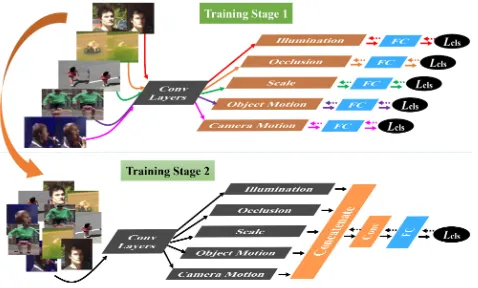
Figure 1: The proposed attribute-based CNN is trained by two stages. In the first stage, five attribute branches are trained individually to learn representations under differ-ent attributes. In the second stage, two ensemble layers are trained to learn how to effectively combine attribute-specific representations together.
fication. As like other applications, their success relies on the amount of the training data. However, existing tracking datasets, such as VOT (Kristan et al. 2015), OTB100 (Wu, Lim, and Yang 2015) and UAV123 (Mueller, Smith, and Ghanem 2016), are far smaller than image classification datasets such as ImageNet (Russakovsky et al. 2015). The insufficient training data may cause the trained model inef-fective when facing all kinds of tracking challenges, such as illumination changes, occlusion, and motion. In this paper, we show that tracking challenges (also known as attributes) are able to facilitate the training of the network with insuffi-cient training data.
attributes of each frame. We further train ensemble layers to adaptively combine all attribute-specific representations as a strong representation for the final target/background classi-fication as shown in the bottom panel of Figure 1.
It is worth noticing that the training procedure of the pro-posed attribute-based CNN is not straightforward because the classification loss of a training sample with any attribute will be backwardly propagated toallthe five branches. Thus, a simple end-to-end training cannot guarantee each branch to learn to classify data with the corresponding attribute. To address this problem, we propose a two-stage training method as illustrated in Figure 1. In the first stage, we train the attribute branches one-by-one with a temporary fully-connected (FC) layer for binary classification of sam-ples with a specific attribute. In the second stage, we only train the ensemble layers to learn how to combine attribute-specific representations effectively. Experiments show that the two-stage training method helps to achieve better perfor-mance than a simple end-to-end training.
The contributions of this paper are summarized below:
• We propose an attribute-based CNN framework for visual tracking, which exploits attribute information of video frames to overcome the problem of lacking sufficient training data in visual tracking.
• We develop a two-stage training method to enable each branch to learn a specific representation and effectively combine attribute-specific representations of all branches for the final target/background classification.
• We carry out experiments on the large challenging UAV-Traffic and OTB100 datasets to demonstrate the gener-alization ability and the effectiveness of the proposed method against state-of-the-art tracking algorithms.
2
Related Work
In this section, we present a brief review of recent CNN-based tracking methods. For algorithms utilizing hand-crafted features, we refer the readers to the surveys (Zhang et al. 2013; Smeulders et al. 2014). As CNNs achieve great suc-cess on many computer vision tasks (Ma et al. 2015; Ren et al. 2018; Sun et al. 2017; Jiang et al. 2018a; Yang et al. 2018; Liu et al. 2018; Huang et al. 2018), numerous visual ob-ject tracking methods based on CNNs have been proposed, which roughly fall into two categories according to whether the stem of the network has parallel structures: one-stream CNN and multi-stream CNN.
One-stream CNN-based trackers.Reinforcement learning is utilized in ADNet (Yun et al. 2017) to learn an action-decision network so as to track a target by making a se-ries of actions, e.g., translation moves and scale changes, to the target candidate. MDNet (Nam and Han 2016) adopts a network with multiple target/background classification branches at the last layer, where each branch is responsi-ble for only one video, so that it is aresponsi-ble to reduce the am-biguity caused by objects that are targets in some training videos but are backgrounds in others. SANet (Fan and Ling 2017) incorporates recurrent neural network into CNNs to model the structure information within an object in addition
to the traditional semantic information. To efficiently com-pute correlation filters from large feature maps obtained by pre-trained image classification CNN models (e.g., VGG-M (Chatfield et al. 2014)), ECO (Danelljan et al. 2017) refor-mulates learning a large filter as learning a coefficient matrix and a compact set of basis filters. These one-stream CNNs aim to learn a set of parameters that can distinguish the tar-get from its background under all kinds of attributes, which is rather hard due to large appearance difference of the same target under different attributes and the deficiency of training data.
Multi-stream CNN-based trackers.In (Tao, Gavves, and Smeulders 2016), the CNN is designed with two symmet-rical streams (also known as the Siamese network) to learn a similarity function of two input images: one target tem-plate and one target search region. Later, an asymmetri-cal Siamese network is proposed (Valmadre et al. 2017) to simultaneously learn CNN features and correlation fil-ters by introducing a differentiable correlation filter layer. To enhance the representation capability, spatial and tempo-ral content differences between the first frame and the cur-rent frame are modeled in (Song et al. 2017) by two parallel residual streams after some common convolutional layers. The CNN in (Han, Sim, and Adam 2017) also has multi-ple streams in later layers, but these streams with different number of layers aim to maintain multi-level target repre-sentations. Different from the goals of the above mentioned multi-stream networks, our multi-stream CNN is proposed to address the problem of lacking sufficient training data by exploiting the attribute information in video frames.
3
Proposed Method
In this section, we first present the architecture of the pro-posed attribute-based CNN, and then describe the two-stage training method. Finally, we apply the attribute-based CNN to visual tracking.
3.1
Attribute-Based Neural Network
The architecture of the proposed attribute-based CNN is shown in the bottom panel of Figure 1. It starts with sev-eral convolution layers borrowed from VGG-M (Chatfield et al. 2014), which are used to capture common low-level information (e.g., edges and texture) across objects. Then, five attribute branches are followed to learn representations under corresponding attributes. We adopt the five attributes provided by the VOT datasets (Kristan et al. 2013; 2014; 2015), namely target motions, camera motions, illumination variations, occlusions, and scale changes, which are able to cover most of the 11 attributes defined by the OTB100 dataset (Wu, Lim, and Yang 2015). In addition, the attributes of the VOT datasets are annotated for every frame, which al-lows us to divide training data into different attribute groups to train the corresponding branches.
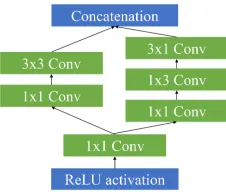
Figure 2: Architecture of each attribute branch. The ReLU layers after each Conv layer are omitted for clarity. Each number in the bracket denotes the number of channels of the output feature map.
process a frame using only one branch. Instead, we propa-gate an input image region through all attribute branches and train the ensemble layers to adaptively combine all attribute-specific representations together to obtain a comprehensive and discriminative representation. The output of ensemble layers is fed to the FC layer for the final target/background classification.
As for the architecture of each branch, we adopt the in-ception structure as shown in Figure 2 inspired by the re-cent success of CNNs in image classification (Szegedy et al. 2017). The first 1×1 Conv layer is used to capture common representations under that attribute. Then it is divided into two flows by using another two 1×1 Conv layers with half channels to decrease the dimensionality in the filter space. This is based on the success of embeddings: even low di-mensional embeddings might contain a lot of information about a relatively large image patch (Szegedy et al. 2015). We implement 3×3 filters in two ways in the flows to per-ceive region fields with different sizes: one using the tradi-tional 3×3 filter and the other one using the cascade of 1×3 and 3×1 filters. Their outputs are concatenated together as an attribute-specific representation.
3.2
Two-Stage Training
A simple end-to-end training cannot guarantee each branch to learn to classify data of the corresponding attribute be-cause the classification loss of a training sample with any attribute will be backwardly propagated to all the five branches. To address this problem, we propose a two-stage training strategy to first train the attribute branches and then learn the ensemble layers.
We use the VOT datasets (Kristan et al. 2013; 2014; 2015) excluding the ones that appear in the OTB100 dataset as training data. In stage 1, all frames are divided into five groups according to their attribute labels. In stage 2, the five groups are merged into one bigger group. In each frame,Ppositive andQnegative samples are cropped such that the positive and negative samples have > 0.7 and 6 0.5 Intersection-over-Union (IoU) overlap ratios with the ground-truth bounding boxes, respectively.
Stage 1: training attribute branches. The five attribute branches are trained one by one. Specifically, we remove
both the ensemble layers and the last FC layer from the pipeline, and add a new FC layer at the end of each branch as shown in the top panel of Figure 1. These FC layers are responsible for target/background classification. Given training samples of an attribute as input, low-level feature maps are first extracted and then fed into the corresponding branch for forward-backward propagation with the softmax-loss. The stochastic gradient descent (SGD) method with momentum is utilized for optimization. The momentum and weight decay are set to 0.9 and 0.0005, respectively. Each branch converges after approximate 200 iterations with a fixed learning rate of the value 0.001.
Stage 2: training ensemble layers. Once the attribute branches are ready, we start to train the ensemble layers in order to effectively combine these attribute-specific repre-sentations for the final target/background classification. In this stage, we remove the FC layers which are added into each attribute branch in Stage 1, and plug back the ensem-ble layers and the FC layer as shown in the bottom panel of Figure 1. The parameters of the five branches are fixed. The learning rates of ensemble layers and the last FC layer are set to 0.001. We adopt the softmax-loss for training. The train-ing data and the SGD parameters are the same as in Stage 1. The network converges after approximate 150 iterations.
3.3
Tracking with Attribute-Based CNN
As discussed in the design of the attribute-based CNN (see Section 3.1), there is no need to recognize attributes in the testing phase. Once we learn the attribute branches and en-semble layers, the last FC layer is re-trained from scratch to construct a tracker on a test image sequence. For that, positive and negative samples are extracted from the start-ing frame, where they have>0.7 and60.3 IoU overlap ra-tios with the ground truth bounding box, respectively. Mean-while, the ensemble layers are fine-tuned with a relatively small learning rate 0.0001 to adapt to new appearances of the target.
When thet-th frame arrives, we randomly sampleM tar-get candidatesx1,· · ·,xM around the target position in the
last frame. The candidate with the maximum target classifi-cation score is selected as the tracking result
x∗t = argmax
i=1,···,M
Θ(xi), (1)
where Θ(·) outputs the target score using the learned at-tribute network. During tracking, the ensemble layers and the last FC layer are updated every 20 frames using positive and negative samples collected in previous frames.
4
Experimental Results
Figure 3: Examples of challenging videos in the UAV-Traffic dataset.
Our unoptimized implementation runs at about one frame per second on a computer with an Intel I7-4790 CPU, 16G RAM, and a GeForce TITAN 1080Ti GPU card. The sample parametersP, Q, Mare set to32,96, and256, respectively.
4.1
Evaluation Protocols
To fully assess our method, we carry out extensive ex-periments on two datasets: (I) The object tracking bench-mark dataset OTB100 (Wu, Lim, and Yang 2015), which contains 100 sequences involving 11 tracking challenges, such as illumination changes, in-plane and out-of-plane ro-tations, scale variation, and occlusion, low resolution, etc. (II) The unmanned aerial vehicle dataset for traffic, UAV-Traffic (Du et al. 2018), collected by ourselves under dif-ferent weather (daylight, night, and fog), flying altitude (10∼30m, 30∼70m, and >70m), and camera view (front-view, side-(front-view, and bird-view). The UAV-Traffic dataset contains 37,084 frames of 50 videos involving 8 challenges: background clutter, camera rotation, object rotation, small object, illumination variation, object blur, scale variation, and large occlusion. 74%of videos contain at least 4 visual challenges, and 27%of frames contribute to long-term track-ing videos. Examples of challengtrack-ing videos in the dataset are shown in Figure 3.
Following the standard paradigm of the OTB100 bench-mark, experimental results are reported using success plots and precision plots in the one-pass evaluation (OPE). The success rate of a tracker is the proportion of successful frames with an overlap rate larger than a given threshold. Trackers are ranked based on the area under the curve (AUC) in success plots and are ranked based on the center location error at a threshold of 20 pixels in precision plots.
4.2
Evaluation of Attribute Branches
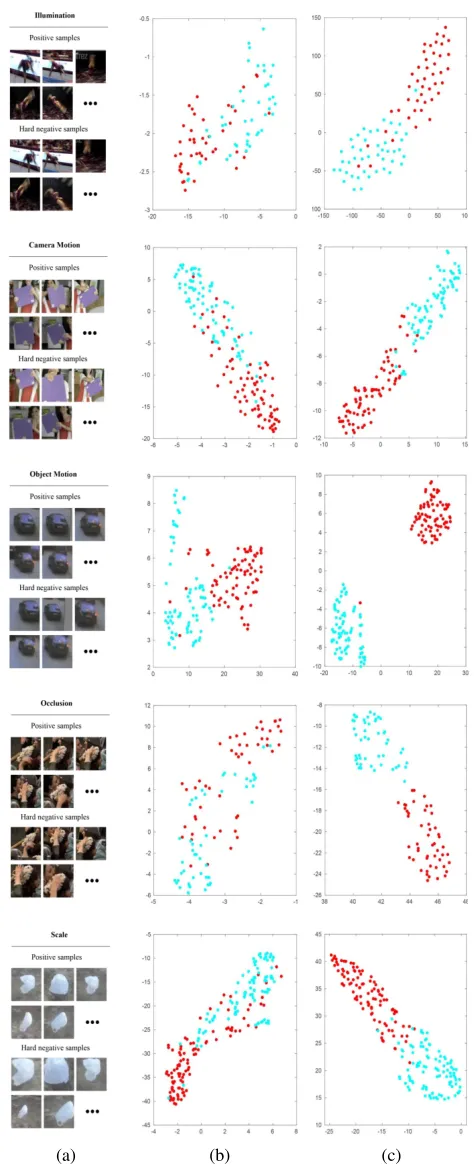
In Figure 4, we visualize the representations learned by indi-vidual attribute branches against those learned by a baseline that has the same architecture as each branch but is trained using data with all attributes. Figure 4(a) shows five groups of positive and hard negative samples, each of which is dom-inated by one main attribute. Figure 4(b) and (c) present the features obtained by the baseline and by attribute branches after being projected to the 2D space via the t-SNE tech-nique (Laurens and Hinton 2008), respectively. It shows that
(a) (b) (c)
given an image with a specific attribute, the branch corre-sponding to that attribute generates more discriminative fea-tures than the network trained using data with all kinds of attributes.
In Table 1, we further quantitatively compare the effec-tiveness across branches to verify that each branch special-izes in the resulting attribute. The evaluation is conducted on five typical videos which are dominantly challenged by dif-ferent attributes. The results show that each attribute branch achieves better performance on the video dominated by the same attribute than other branches.
Table 1: Tracking results in terms of average success rate on five VOT videos (A: Skating, B: Bolt1, C: Tiger2, D: CarScale, E: Basketball), which are not used for training and denoted with the sequence names in the OTB100 dataset for clarity, each of which is challenged by one dominant at-tribute as indicated after the video name. The results are ob-tained by using five branches separately.
Branch Illu Mot Occ Scale Cam A: Illu 69.7 64.4 62.6 67.3 62.4 B: Mot 74.3 76.4 69.5 74.4 70.8 C: Occ 52.2 52.9 54.0 51.2 51.2 D: Scale 41.4 61.2 55.3 62.2 60.8 E: Cam 56.8 59.3 62.8 63.8 70.6
4.3
Evaluation of Two-Stage Training
To evaluate the effectiveness of the proposed two-stage training method, we compare its tracking results on the OTB100 dataset against that obtained by training all branches together. The results are presented in Table 2. The proposed two-stage training method achieves consistent im-provement of about 2% in terms of both the precision and AUC metrics.
Table 2: Tracking results on the OTB100 dataset using the proposed two-stage training method and training all branches as a whole, respectively.
Two-stage Training Training As a Whole
Prec. 90.5 88.6
AUC 67 65.8
4.4
Comparisons to State-of-the-Art Trackers
We compare the proposed ANT algorithm to seven state-of-the-art trackers: ECO (Danelljan et al. 2017), CFNet (Val-madre et al. 2017), ADNet (Yun et al. 2017), CCOT (Danell-jan et al. 2016), MDNet (Nam and Han 2016), HDT (Qi et al. 2016), and SINT (Tao, Gavves, and Smeulders 2016). For fair comparison, all these trackers are run on the same plat-form as ours.
Quantitative evaluation We present the tracking perfor-mance in terms of success plots and precision plots on the
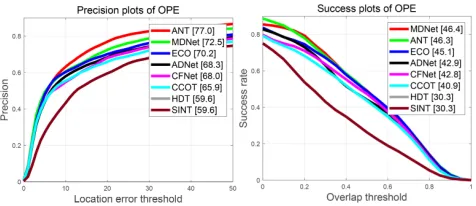
Figure 5: Precision and success plots on the OTB100 dataset.
OTB100 dataset in Figure 5. The plots show that ANT al-gorithm performs favorably against state-of-the-art trackers such as ECO, CCOT, and MDNet. Specifically, the ANT al-gorithm ranks top 2 in terms of either the precision plots or the success plots, and the performance gap between ANT and ECO is only 0.3%in terms of the precision plots.
In Figure 6, we present the tracking results on the UAV-Traffic dataset. This dataset is much more challenging than the OTB100 dataset as its best results are nearly 20%lower than that on OTB100 (precision: 77.0 vs. 90.8, success: 46.4 vs 68.7). On such a challenging dataset, the ANT algorithm achieves the best performance in terms of the precision plots, which is 4.5% higher than the runner-up MDNet. At the same time, the performance of ANT in terms of the success plots is very close to the best one. In addition, as the UAV-Traffic dataset has significantly different attributes compared to the training datasets, these tracking results demonstrate the good generalization ability of the proposed network.
Figure 6: Precision and success plots on the UAV-Traffic dataset.
Qualitative evaluation. We present sample tracking re-sults of the evaluated methods in Figure 7. For presentation clarity, only results of the top seven performing trackers are shown.
cam-Figure 7: Bounding box comparison on several challenging videos (from top to bottom, left to right: BlurBody, Girl2, Drag-onBaby, Ironman, S1701, S0602, S1301, S0103, and S1303). The first four sequences are taken from OTB100 and the last five from the UAV-Traffic dataset.
era shaking. In this video, both ANT and CCOT methods are still able to precisely locate the target, while other track-ers such as CFNet and MDNet locate the target with much background as shown in frame236. The effectiveness of the ANT algorithm benefits from the camera motion branch as evaluated in Figure 4 and Table 1.
Occlusion.The target in the UAV-Traffic sequence S0103
undergoes occlusions by trees. Only our ANT method and MDNet are able to track the target, while other trackers such as ECO and CCOT falsely locate on background out of the view as shown in frames75and152. Similar performance
can be observed in the OTB100 sequenceGirl2, where the target girl suffers occlusions by a man walking with a bi-cycle. This can be attributed to the particular branch which learn discriminative representations in occlusion scenarios as evaluated in Figure 4 and Table 1.
Ta-ble 1, the object-motion branch in our attribute network is able to capture discriminative information in such a scene.
Scale.In the UAV-Traffic sequence S1701, the size of the target bus varies largely and the observation view changes from bird-view to side-view, which cause huge appearance variations. In such a challenging scene, the proposed ANT method locates the target more accurately than others such as MDNet and ECO, as shown in frames200and324. Con-sidering that MDNet and ECO use the same basal network as ours and referring to the branch evaluations in Table 1, the performance gain of the ANT algorithm can be mainly attributed to the attribute network, which learns specific rep-resentations under various challenges.
Illumination.The target inIronmanhas drastic movements in a dark night with large illumination changes in the back-grounds. In such a poor lighting condition, the ANT al-gorithm accurately locates the target in most frames while other trackers drift far away as shown in frames129and165. Similar performance can be observed in the UAV-Traffic se-quencesS1301andS1303. As evaluated in Table 1, the illu-mination branch contributes most in such situations.
5
Conclusion
To address the problem of lacking sufficient training data in CNN-based tracking methods, this paper proposes an attribute-based CNN framework with multiple branches. Each branch is separately trained to learn an attribute-specific representation. The representations of all branches are combined together to obtain a more discriminative repre-sentation to handle complicated tracking challenges. To the best of our knowledge, the proposed algorithm is the first to learn attribute-specific representations for visual track-ing. Extensive experimental results on a large number of sequences demonstrate the effectiveness and the generaliza-tion ability of the proposed method.
6
Acknowledgments
This work was supported in part by National Natural Science Foundation of China: 61620106009, 61332016, U1636214, 61872112, 61472389 and 61672497, Key Research Pro-gram of Frontier Sciences, CAS: QYZDJ-SSW-SYS013, Shandong Provincial Natural Science Foundation, China: ZR2017MF001, the NSF CAREER Grant (No. 1149783), and gifts from Adobe and Nvidia.
References
Chatfield, K.; Simonyan, K.; Vedaldi, A.; and Zisserman, A. 2014. Return of the devil in the details: Delving deep into convolutional nets. InBritish Machine Vision Conference, 1–8.
Chen, J.; Chen, X.; Ma, L.; Jie, Z.; and Chua, T.-S. 2018. Temporally grounding natural sentence in video. In Pro-ceedings of the Conference on Empirical Methods in Natu-ral Language Processing, 162–171.
Danelljan, M.; Robinson, A.; Khan, F. S.; and Felsberg, M. 2016. Beyond correlation filters: Learning continuous
con-volution operators for visual tracking. InEuropean Confer-ence on Computer Vision, 472–488.
Danelljan, M.; Bhat, G.; Khan, F. S.; and Felsberg, M. 2017. ECO: efficient convolution operators for tracking. In Pro-ceedings of the Conference on Computer Vision and Pattern Recognition, 6931–6939.
Du, D.; Qi, Y.; Yu, H.; Yang, Y.; Duan, K.; Li, G.; Zhang, W.; Huang, Q.; and Tian, Q. 2018. The unmanned aerial vehi-cle benchmark: Object detection and tracking. InEuropean Conference on Computer Vision, 375–391.
Fan, H., and Ling, H. 2017. Sanet: Structure-aware net-work for visual tracking. InProceedings of the IEEE Con-ference on Computer Vision and Pattern Recognition Work-shops, 2217–2224.
Fan, L.; Huang, W.; Gan, C.; Gong, B.; Ermon, S.; and Huang, J. 2018. End-to-end learning of motion represen-tation for video understanding. InProceedings of the IEEE Conference on Computer Vision and Pattern Recognition, 6016–6025.
Han, B.; Sim, J.; and Adam, H. 2017. Branchout: Regu-larization for online ensemble tracking with convolutional neural networks. InProceedings of the IEEE Conference on Computer Vision and Pattern Recognition, 521–530. Huang, W.; Fan, L.; Harandi, M.; Ma, L.; Liu, H.; Liu, W.; and Gan, C. 2018. Towards efficient action recognition: Principal backpropagation for training two-stream networks.
IEEE Transactions on Image Processing.
Jiang, W.; Ma, L.; Chen, X.; Zhang, H.; and Liu, W. 2018a. Learning to guide decoding for image captioning. In Pro-ceedings of the AAAI Conference on Artificial Intelligence, 6959–6966.
Jiang, Y.; Yang, Z.; Xu, Q.; Cao, X.; and Huang, Q. 2018b. When to learn what: Deep cognitive subspace clustering. InACM Multimedia Conference on Multimedia Conference, 718–726.
Kristan, M.; Pflugfelder, R. P.; Leonardis, A.; Matas, J.; and et al. 2013. The visual object tracking vot2013 challenge results. In International Conference on Computer Vision Workshops, 98–111.
Kristan, M.; Pflugfelder, R. P.; Leonardis, A.; Matas, J.; and et al. 2014. The visual object tracking vot2014 challenge results. InEuropean Conference on Computer Vision Work-shops, 191–217.
Kristan, M.; Matas, J.; Leonardis, A.; Felsberg, M.; and et al. 2015. The visual object tracking vot2015 challenge results. InInternational Conference on Computer Vision Workshops, 564–586.
Laurens, v. d. M., and Hinton, G. 2008. Visualizing data using t-SNE. Journal of Machine Learning Research
9(Nov):2579–2605.
Liu, H.; Ji, R.; Wang, J.; and Shen, C. 2018. Ordinal constraint binary coding for approximate nearest neighbor search. IEEE Transactions on Pattern Analysis Machine In-telligence.
learning. InProceedings of the International Conference on Machine Learning, 3292–3301.
Ma, L.; Lu, Z.; Shang, L.; and Li, H. 2015. Multimodal convolutional neural networks for matching image and sen-tence. InIEEE International Conference on Computer Vi-sion, 2623–2631.
Mueller, M.; Smith, N.; and Ghanem, B. 2016. A benchmark and simulator for UAV tracking. InEuropean Conference on Computer Vision, 445–461.
Nam, H., and Han, B. 2016. Learning multi-domain con-volutional neural networks for visual tracking. In Proceed-ings of the IEEE Conference on Computer Vision and Pat-tern Recognition, 4293–4302.
Park, E., and Berg, A. C. 2018. Meta-tracker: Fast and robust online adaptation for visual object trackers. InEuropean Conference on Computer Vision, 587–604.
Qi, Y.; Zhang, S.; Qin, L.; Yao, H.; Huang, Q.; Lim, J.; and Yang, M. 2016. Hedged deep tracking. InProceedings of the IEEE Conference on Computer Vision and Pattern Recogni-tion, 4303–4311.
Ren, W.; Liu, S.; Zhang, H.; Pan, J.; Cao, X.; and Yang, M.-H. 2016. Single image dehazing via multi-scale convo-lutional neural networks. InEuropean Conference on Com-puter Vision, 154–169.
Ren, W.; Ma, L.; Zhang, J.; Pan, J.; Cao, X.; Liu, W.; and Yang, M.-H. 2018. Gated fusion network for single image dehazing. InIEEE Conference on Computer Vision and Pat-tern Recognition.
Russakovsky, O.; Deng, J.; Su, H.; Krause, J.; Satheesh, S.; Ma, S.; Huang, Z.; Karpathy, A.; Khosla, A.; Bernstein, M. S.; Berg, A. C.; and Li, F. 2015. Imagenet large scale visual recognition challenge.International Journal of Com-puter Vision115(3):211–252.
Smeulders, A. W. M.; Chu, D. M.; Cucchiara, R.; Calderara, S.; Dehghan, A.; and Shah, M. 2014. Visual tracking: An experimental survey.IEEE Transactions on Pattern Analysis and Machine Intelligence36(7):1442–1468.
Song, Y.; Ma, C.; Gong, L.; Zhang, J.; Lau, R. W. H.; and Yang, M. 2017. CREST: convolutional residual learning for visual tracking. InInternational Conference on Computer Vision, 2574–2583.
Sun, X.; Huang, Z.; Yin, H.; and Shen, H. T. 2017. An integrated model for effective saliency prediction. In Pro-ceedings of the AAAI Conference on Artificial Intelligence, 274–281.
Szegedy, C.; Liu, W.; Jia, Y.; Sermanet, P.; Reed, S. E.; Anguelov, D.; Erhan, D.; Vanhoucke, V.; and Rabinovich, A. 2015. Going deeper with convolutions. In Proceed-ings of the IEEE Conference on Computer Vision and Pat-tern Recognition, 1–9.
Szegedy, C.; Ioffe, S.; Vanhoucke, V.; and Alemi, A. A. 2017. Inception-v4, inception-resnet and the impact of resid-ual connections on learning. InProceedings of the AAAI Conference on Artificial Intelligence, 4278–4284.
Tao, R.; Gavves, E.; and Smeulders, A. W. M. 2016. Siamese instance search for tracking. InProceedings of the
IEEE Conference on Computer Vision and Pattern Recogni-tion, 1420–1429.
Valmadre, J.; Bertinetto, L.; Henriques, J. F.; Vedaldi, A.; and Torr, P. H. S. 2017. End-to-end representation learning for correlation filter based tracking. InProceedings of the IEEE Conference on Computer Vision and Pattern Recogni-tion, 5000–5008.
Vedaldi, A., and Lenc, K. 2015. Matconvnet: Convolutional neural networks for MATLAB. InACM Multimedia, 689– 692.
Wang, B.; Ma, L.; Zhang, L.; and Liu, W. 2018. Reconstruc-tion network for video capReconstruc-tioning. In Proceedings of the IEEE Conference on Computer Vision and Pattern Recogni-tion, 7622–7631.
Wu, Y.; Lim, J.; and Yang, M.-H. 2015. Object tracking benchmark.IEEE Transactions on Pattern Analysis and Ma-chine Intelligence37(9):1834–1848.
Yang, Z.; Xu, Q.; Cao, X.; and Huang, Q. 2018. From com-mon to special: When multi-attribute learning meets person-alized opinions. InProceedings of the AAAI Conference on Artificial Intelligence, 515–522.
Yun, S.; Choi, J.; Yoo, Y.; Yun, K.; and Choi, J. Y. 2017. Action-decision networks for visual tracking with deep rein-forcement learning. InProceedings of the IEEE Conference on Computer Vision and Pattern Recognition, 1349–1358. Zhang, S.; Yao, H.; Sun, X.; and Lu, X. 2013. Sparse coding based visual tracking: Review and experimental comparison.
Pattern Recognition46(7):1772–1788.