The Thirty-Third AAAI Conference on Artificial Intelligence (AAAI-19)
Multi-Labeled Relation Extraction with Attentive Capsule Network
Xinsong Zhang,
1Pengshuai Li,
1Weijia Jia,
2,1∗Hai Zhao
1∗1Department of Computer Science and Engineering, Shanghai Jiao Tong University, Shanghai 200240, China 2State Key Lab of IoT for Smart City, University of Macau, Macau 999078, China
{xszhang0320, pengshuai.li}@sjtu.edu.cn and{jia-wj, zhaohai}@cs.sjtu.edu.cn
Abstract
To disclose overlapped multiple relations from a sentence still keeps challenging. Most current works in terms of neu-ral models inconveniently assuming that each sentence is ex-plicitly mapped to a relation label, cannot handle multiple re-lations properly as the overlapped features of the rere-lations are either ignored or very difficult to identify. To tackle with the new issue, we propose a novel approach for multi-labeled relation extraction with capsule network which acts consid-erably better than current convolutional or recurrent net in identifying the highly overlapped relations within an individ-ual sentence. To better cluster the features and precisely ex-tract the relations, we further devise attention-based routing algorithm and sliding-margin loss function, and embed them into our capsule network. The experimental results show that the proposed approach can indeed extract the highly over-lapped features and achieve significant performance improve-ment for relation extraction comparing to the state-of-the-art works.
Introduction
Relation extraction plays a crucial role in many natural lan-guage processing (NLP) tasks. It aims to identify relation facts for pairs of entities in a sentence to construct triples like [Arthur Lee, place born, Memphis]. Relation extraction has received renewed interest in the neural networkera, when neural models are effective to extract semantic meanings of relations. Compared with traditional approaches which fo-cus on manually designed features, neural methods such as Convolutional Neural Network (CNN) (Liu et al. 2013; Zeng et al. 2014) and Recurrent Neural Network (RNN) (Zhang and Wang 2015; Zhou et al. 2016) have achieved significant improvement in relation classification. However, previous neural models are unlikely to scale in the scenario where a sentence has multiple relation labels and face the challenges in extracting highly overlapped and discrete relation features due to the following two drawbacks.
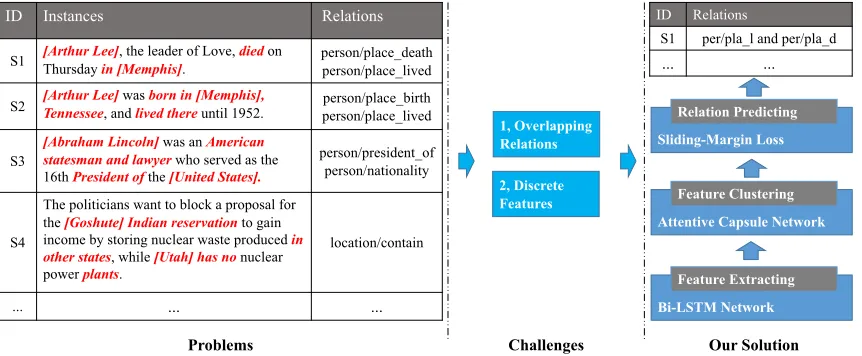
First, one entity pair can express multiple relations in a sentence, which will confuse relation extractor seriously. For example, as in Figure 1, the entity pair [Arthur Lee, Mem-phis] keeps three possible relations which areplace birth,
∗
Corresponding authors: Weijia Jia, Hai Zhao,{jia-wj, zhao-hai}@cs.sjtu.edu.cn
Copyright c2019, Association for the Advancement of Artificial Intelligence (www.aaai.org). All rights reserved.
place death and place lived. The sentence S1 andS2 can both express two relations, and the sentenceS3represents another two relations. These sentences contain multiple kinds of relation features which are difficult to be identi-fied clearly. The existing neural models tendentiously merge low-level semantic meanings to one high-level relation rep-resentation vector with methods such as max-pooling (Zeng et al. 2014; Zhang, Zhao, and Qin 2016) and word-level at-tention (Zhou et al. 2016). However, one high-level relation vector is still insufficient to express multiple relations pre-cisely.
Second, current methods are neglecting of the discretiza-tion of reladiscretiza-tion features. For instance, as shown in Figure 1, all the sentences express their relations with a few signifi-cant words (labeled italic in the figure) distributed discretely in the sentences. However, common neural methods handle sentences with fixed structures, which are difficult to gather relation features of different positions. For example, being spatially sensitive, CNNs adopt convolutional feature detec-tors to extract local patterns from a sliding window of vec-tor sequences and use the max-pooling to select the promi-nent ones. Besides, the feature distribution of “no relation (NA, others)” in a dataset is different from that of definite relations. A sentence can be classified to “no relation” only when it does not contain any features of other relations.
ID Instances Relations
S1 [Arthur Lee]Thursday in [Memphis], the leader of Love,. diedon person/place_death person/place_lived
S2 [Arthur Lee] Tennessee, and was lived thereborn in [Memphis], until 1952. person/place_birth person/place_lived
S3
[Abraham Lincoln] was an American statesman and lawyer who served as the 16thPresident of the[United States].
person/president_of person/nationality
S4
The politicians want to block a proposal for the [Goshute] Indian reservationto gain income by storing nuclear waste produced in other states, while[Utah] has nonuclear power plants.
location/contain
... ... ...
Sliding-Margin Loss
Attentive Capsule Network
Bi-LSTM Network
Our Solution Problems
ID Relations
S1 per/pla_l and per/pla_d
... ...
Challenges
Feature Extracting Feature Clustering Relation Predicting 1, Overlapping
Relations
2, Discrete Features
Figure 1: Problems, challenges and our solution for multi-labeled relation extraction. Words in brackets are entities and the italic red parts are key words that contain relation features. (The relation label in the right table is in abbreviation.)
be routed and clustered together to represent high-level rela-tion features. For better relarela-tion extracrela-tion, we further devise an attention-based routing algorithm to precisely find low-level capsules that contain related relation features. Besides, we propose a sliding-margin loss function to address the problem of “no relation” in multiple labels scenario. A sen-tence is classified as “no relation” only when the probabil-ities for all the other specific classes are below a boundary. The boundary is dynamically adjusted in the training pro-cess. Experimental results on two widely used benchmarks show that the proposed method can significantly enhance the performance of relation extraction. The contributions of this paper can be summarized as follows,
• We first apply capsule network to multi-labeled relation extraction by clustering relation features.
• We propose an attention-based routing algorithm to pre-cisely extract relation features and a sliding-margin loss function to well learn multiple relations.
• Our experiments on two benchmarks show our method gives new state-of-the-art performance.
Related work
Relation Extraction. Relation extraction is a critical task for the NLP in which supervised methods with human-designed features have been well studied (Mooney and Bunescu 2006; Mintz et al. 2009; Riedel, Yao, and Mc-Callum 2010; Surdeanu et al. 2012). Recent years, neu-ral models are widely used to remove the inconvenience of hand-crafted feature design. Both CNN and RNN have been well applied to relation extraction (Socher et al. 2012; Liu et al. 2013; Kim 2014; Zeng et al. 2014; Santos, Xi-ang, and Zhou 2015; Zhang and Wang 2015). From the CNN or RNN backbone, relation extraction can be fur-ther improved by integrating attention mechanism (Wang et al. 2016; Lin et al. 2016; Zhou et al. 2016; Zhu et al. 2017), parser tree (Xu et al. 2015; Miwa and Bansal 2016;
Xu et al. 2016), multi-task learning (Liu, Qiu, and Huang 2016) or ensemble models (Nguyen and Grishman 2015; Yang, Wang, and Li 2018). However, all the previous neural models simply represent relation features with one vector, resulting in unacceptable precisions for multi-labeled rela-tion extracrela-tion.
Capsule Network. Capsule network was proposed to improve the representational limitations of CNN and RNN (Hinton, Krizhevsky, and Wang 2011). Capsules with transformation matrices allow networks to learn part-whole relationships automatically. Consequently, a dynamic rout-ing algorithm (Sabour, Frosst, and Hinton 2017) was pro-posed to replace the max-pooling in CNN, which achieved impressive performance recognizing highly overlapping dig-its. Then, Xi, Bing, and Jin (2017) further tested out the ap-plication of capsule networks on the CIFAR data with higher dimensionality. Hinton, Sabour, and Frosst (2018) proposed a new routing method between capsule layers based on the EM algorithm. Recently, capsule network was applied to NLP tasks such as text classification (Zhao et al. 2018) and disease classification (Wang et al. 2018).
Different from the previous methods for multi-labeled re-lation extraction, we first introduce the capsule network to the task, especially, with two highlighted improvements, at-tentive routing algorithm and sliding-margin loss.
Method
This section describes our approach for multi-labeled rela-tion extracrela-tion with an attentive capsule network. As shown in Figure 2, our relation extractor comprises of three primary layers,
• Feature Extraction Layer.Given a sentenceb∗and two target entities, a Bi-LSTM network is used to extract low-level features of the sentence.
Abraham Lincoln was an
x1 x2 x3 xn Feature Extracting Layer
h1 h3
Relation Predicting Layer r1
...
... y1
h2 hn
Feature Clustering Layer r2
y2
rm ym
yna ...
...
u11 u1k
Attention-based Routing Algorithm
...
High-level Capsules
Low-level Capsules un1 unk
u21 u2k u31 u3k
... ... ... ...
Unite States
Figure 2: The architecture of our proposed relation extractor, illustrating the procedure for handling one sentence and predicting possible relations between [Abraham Lincoln] and [Unite States].his a set of hidden states of Bi-LSTM,uis a low-level capsule set andrrepresents high-level capsules.yindicates relation labels, andynaexpresses “no-relation”. The solid lines are determinate associations, and the dotted lines are possible ones.
relation representation for each relation with an attentive capsule network.
• Relation Predicting Layer. After computing the high-level representations of a sentence, we apply a sliding-margin loss function to predict possible relations includ-ing the label “no relation”.
Feature Extracting Layer
This layer encodes word tokens and extracts low-level se-mantic information.
Input Representation The input representations of our model include word embeddings and position embeddings. Word Embeddingsare distributed representations of words that map each word to a pdimensional real-valued vector word. The vectors are pre-trained in theskip−gramsetting ofword2vec(Mikolov et al. 2013).
Position Embeddingsare defined as the combination of the relative distances from the current word to the entities. For instance, in sentenceArthur Lee was born in Memphis., the relative distances from the word bornto [Arthur Lee] and [Memphis] are respectively 2 and -2. We also encode dis-tances to vectorsposition∈ Rq, whereqis the dimension of position embeddings. In our work, the position embed-dings are initialized randomly.
The word embeddings and position embeddings are con-catenated together as network input vector. We denote all the words in a sentence as an initial vector sequenceb∗ = {x1,· · · , xi,· · ·, xn}, wherexi ∈ Rp+q andnis the word number.
Bidirectional LSTM Recurrent Neural Network (RNN) is powerful to model sequential data and has achieved great success in the relation classification (Zhang and Wang 2015;
Zhou et al. 2016). RNN for our task is implemented as LSTM with four components (Graves 2013), one input gate it with corresponding weight matrix Wi, Ui, Vi, one for-get gate ft with corresponding weight matrixWf, Uf, Vf, one output gate ot with corresponding weight matrix Wo, Uo, Voand one cell ctwith corresponding weight ma-trixWc, Uc, Vc. All of those components are set to generate the current hidden statehtwith the input tokenxtand the previous hidden stateht−1. The whole procedure is
demon-strated with the following equations,
it=σ(Wi[xt] +Uiht−1+Vict−1+bi) ft=σ(Wf[xt] +Ufht−1+Vfct−1+bf)
ct=ittanh(Wc[xt] +Ucht−1+Vcct−1+bc) +ftct−1
ot=σ(Wo[xt] +Uoht−1+Voct+bo) ht=ottanh(ct),
whereσis the sigmoid function and all of the components have the same sizes as the hidden vectorh.
For many sequence modeling tasks, it is beneficial to have access to the future context as well as the past. Bidirectional-LSTM network extends the standard Bidirectional-LSTM network by in-troducing a second layer, in which the hidden states flow in an opposite temporal order. The model is, therefore, able to exploit features both from the past and the future. Conse-quently, we use Bi-LSTM including both forward subnet-work and backward subnetsubnet-work to capture global sequence information. The final state ofhtis shown by the equation ht= [
− → ht⊕
←− ht], where
− →
htis the forward state, ←−
Feature Clustering Layer
This layer clusters features with the help of an attention-based routing algorithm.
Feature Clustering with Capsule Network Capsule net-work has been proved effective in digital recognition, espe-cially for the highly overlapping digits (Sabour, Frosst, and Hinton 2017). In our work, a capsule is a group of neurons whose activity vector represents the instantiation parameters of a specific type of relation features. The length of the activ-ity vector represents the probabilactiv-ity that the relation features exist, and the orientation of the vector expresses the spe-cific property of one kind of features. Active capsules make predictions, via transformation matrices, for the instantiation parameters of higher-level capsules. While, high-level cap-sules are clustered from low-level capcap-sules, which contain local and trivial features. When multiple predictions agree, a higher level capsule becomes active.
For the task of relation extraction, we scatter all the low-level semantic information extracted by the Bi-LSTM into amounts of low-level capsules represented byu∈ Rdu. The
representation of each word token will be expressed by k low-level capsules. Each low-level capsule is applied with a nonlinear squash functiongthrough the entire vector,
ht= [u 0
t1;· · · ;u
0 tk]
utk=g(u 0
tk) =
||u0tk||2
1 +||u0tk||2 u0tk ||u0tk||,
where[x;y]denotes the vertical concatenation ofxandy. Amounts of low-level capsules can be clustered together to represent high-level relation features. Therefore, high-level capsulesr ∈ Rdr are computed with the following
equa-tions,
rj=g(
X
i
wijWjui),
wherewij are coupling coefficients that are determined by an iterative dynamic routing process andWj ∈ Rdr×du are weight matrices for each high-level capsule.
Attention-based Routing Algorithm With the capsule network, we can obtain high-level capsules which represent relation features. However, the traditional dynamic routing algorithm in (Sabour, Frosst, and Hinton 2017) does not fo-cus on the entity tokens, which have been proved important for relation extraction (Wang et al. 2016; Liu et al. 2018). Therefore, we propose an attention-based routing algorithm which focuses on the entity tokens when routing for related low-level capsules as in Algorithm 1. The coupling coeffi-cientswbetweeni-th capsule and all the capsules in the r sum to 1 and are determined by a “softmax” function whose initial logits arebij, thelogprior probabilities that capsuleui should be coupled to capsulerj. Besides, we propose atten-tion weightsαfor all the low-level capsules to maximize the weights of capsules from significant word tokens and min-imize that of irrelevant capsules. The weight of the capsule uiis computed by the entity featuresheand hidden statehit from which theuicomes. Thewandαare computed by
wij =
exp(bij)
P
j∗exp(bij∗)
αi=σ(hTeh i t),
whereheis the sum of hidden states of the two entities and T means the transpose operation. The sigmoid function nor-malizes the attention weights and maximizes the differences between significant capsules and irrelevant ones. Finally, the high-level capsulesrare computed with the Algorithm 1.
Algorithm 1Attention-based Routing Algorithm
Require: low-level capsules u, iterative number z, entity featuresheand hidden statesht
Ensure: high-level capsulesr
1: forall capsulesuiand capsulesrjdo 2: initialize the logits of coupling coefficients 3: bij= 0
4: end for
5: forz iterationsdo
6: wi= softmax(bi),∀ui∈u 7: αi=σ(hTehit),∀ui∈u
8: rj =g(PiwijαiWjui),∀rj ∈r
9: bij =bij+Wjuirj,∀ui∈uand∀rj∈r 10: end for
Relation Predicting Layer
In the capsule network, the length of the activity high-level capsules can represent the probability of relations. Sabour, Frosst, and Hinton (2017) applied a fixed margin loss for the classification of digit images. However, they can only set the margin empirically. Therefore, we propose a sliding-margin loss for the task of relation extraction, which learns the base-line of the margin automatically. Besides, to deal with the “no relation” (presented as NA in the figure 2) properly, the probabilities of all the existing relations for sentences labeled as NA should be under the lower bound of the mar-gin. The loss function for thej-th relation follows the below equation,
Lj=Yjmax(0,(B+γ)− ||rj||)2+
λ(1−Yj)max(0,||rj|| −(B−γ))2,
where Yj = 1 if the sentence represents relation rj, and Yj = 0if not.γis a hyper-parameter defining the width of the margin, andB is a learnable variable indicating the NA threshold of the margin, which is initialized by 0.5.λis the down-weighting of the loss for absent relations, which is the same as that in (Sabour, Frosst, and Hinton 2017). The total loss of a sentence is the sum of losses from all the relations. In the testing process, relation labels will be assigned to a sentence when its probabilities of these relations are larger than the thresholdB. Otherwise, it will be predicted as NA.
Experiments
distinguish highly overlapping relations? 3) Are the two pro-posed improvements both effective for relation extraction?
Dataset, Evaluation Metric and Baselines
Dataset. We conduct experiments on two widely used benchmarks for relation extraction, NYT-10 (Riedel, Yao, and McCallum 2010) and SemEval-2010 Task 8 dataset (Hendrickx et al. 2009). The NYT-10 dataset is gen-erated by aligning Freebase relations with the New York Times (NYT) corpus, in which sentences from the years 2005-2006 are for training while those from 2017 for testing. The dataset consists of amounts of multi-labeled sentences. The SemEval-2010 Task 8 dataset is a small dataset which has been well-labeled for relation extraction. The details of both datasets are shown in Table 1.
Datasets Train Sen. Test Sen. Multi-labeled Sen. Classes
NYT-10 566,190 170,866 45,693 53
Sem. 8,000 2,717 0 19
Table 1: Detail information for datasets.Sen.is the number of sentences.Sem.represents SemEval-2010 Task 8.
Evaluation Metric. We evaluate our method with a classi-cal held-out evaluation for NYT-10 and macro-averaged F1 for SemEval-2010 Task 8. The held-out evaluation evalu-ates our models by comparing the relation facts discovered from the test articles with those in Freebase, which pro-vides an approximation of the precision without the time-consuming human evaluation. Besides, we report both the aggregate Precision-Recall (PR) curves and macro-averaged F1 as quantitative indicators.
Baselines. We select following feature clustering methods as baselines.
Max-pooling+CNN clusters the relations extracted by CNN with max-pooling (Zeng et al. 2014).
Max-pooling+RNN clusters the relations extracted by RNN with max-pooling (Zhang and Wang 2015).
Avg+RNNaggregates the relation features with linear av-erage of all the hidden states of word tokens.
Att+RNNapplies a word-level attention to aggregate re-lation features instead of linear average (Zhou et al. 2016).
Att-CapNet (CNN-based)integrates our attentive cap-sule network with a CNN relation extractor.
Att-CapNet (RNN-based)is our method.
Experimental Settings
In our experiments, word embeddings are pre-trained with theword2vectool. For NYT-10, we pre-train the word em-beddings on NYT-10 in the skip−gram setting. In or-der to compare with the previous works on SemEval-2010 Task 8, we use the same word vectors proposed by (Turian, Ratinov, and Bengio 2010) (50-dimensional) to initialize the embedding layer. Additionally, we also use the 100-dimensional word vectors pre-trained inGlovesetting (Pen-nington, Socher, and Manning 2014). Besides, we concate-nate the words of an entity when it has multiple words. Po-sition embeddings are initialized randomly and updated in
training. We use Adam optimizer (Kingma and Ba 2015) to minimize the objective function. L2 regularization and dropout (Srivastava et al. 2014) are adopted to avoid overfit-ting. To train our model efficiently, we iterate by randomly selecting a batch from the training set until convergence. We use a grid search to determine the optional parameters. Ta-ble 2 lists our hyper-parameter setting1.
Parameters NYT-10 Sem.
batch size 50 50
word dimensionp 50 50
position dimensionq 5 5
hidden state dimensionsh 256 256 capsule dimensions [du, dr] [16,16] [16,16]
iterationsz 3 3
sliding-marginγ 0.4 0.4
down-weightingλ 1.0 0.5
learning rate 0.001 0.001
dropout probability 0.0 0.7
L2 regularization strength 0.0001 0.0
Table 2: Parameter settings
Overall Performance
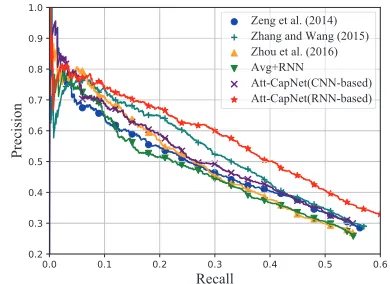
We compare our method with the previous baselines on the two datasets respectively. For the dataset NYT-10, the performance of all the methods is compared in Figure 3. The figure draws the PR curves of all the baselines. Appar-ently, we can see, 1) our Att-CapNet (RNN-based) model achieves the best PR curve, which outperforms the other baselines at nearly all range of the recall. 2) our Att-CapNet (CNN-based) model is slightly better than the method Max-pooling+CNN (Zeng et al. 2014). 3) RNN models tenden-tiously outperform CNN ones for their strong ability of ex-tracting low-level relation features from the sequence. 4) our attentive capsule network is effective for relation extraction integrated with either CNN or RNN.
Figure 3: The PR curves of all the baselines on NYT-10
1
A detailed comparison of baselines with precision, recall, F1 and PR curve areas is shown in Table 3, which indicates, 1) our Att-CapNet (RNN-based) obtains better results on all the indicators than the baselines and increases F1 scores by at least 3.2% over the other baselines. 2) Att-CapNet (CNN-based) is slightly better than Max-pooling+CNN (Zeng et al. 2014). 3) the previous feature extractors such as RNN and CNN are all improved by integrating with our attentive capsule network.
Methods Precision(%) Recall(%) F1(%) PR Zeng et al. (2014) 28.5 56.3 37.8 0.35 Zhang and Wang (2015) 28.9 57.0 38.4 0.34 Zhou et al. (2016) 26.9 54.9 36.1 0.34
Avg+RNN 25.7 55.1 35.1 0.33
Att-CapNet (CNN-based) 29.9 55.0 38.8 0.36 Att-CapNet (RNN-based) 30.8 63.7 41.6 0.42
Table 3: Performance of all the baselines on NYT-10. PR represents precision-recall curve area.
We further conduct paired t-test (10-fold, F1 score) to evaluate the statistical significance of our results in terms of p-value and confidence intervals. Table 4 shows that all the p-values are less than 5.0e-02 and the increases in F1 score are at least 2.2%. Therefore, all our performance improve-ments are statistically significant.
Baselines p-value CI (Confident level 95%)
Zeng et al. (2014) 1.0e-02 [0.023, 0.051] Zhang and Wang (2015) 1.2e-02 [0.022, 0.041] Zhou et al. (2016) 2.4e-05 [0.052, 0.077]
Avg+RNN 1.1e-04 [0.044, 0.064]
Table 4: The statistical significance in the difference be-tween Att-CapNet (RNN-based) and the baselines. CI rep-resents confidence intervals.
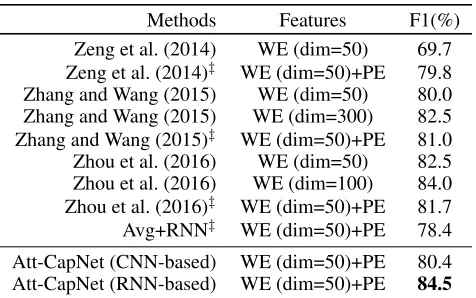
From the results in Table 5 on SemEval-2010 dataset2, we can have the following observations, 1) our Att-CapNet (RNN-based) outperforms all the other feature clustering methods. 2) Att-CapNet (CNN-based) is better than the tra-ditional CNN model with max-pooling. 3) RNN models are better than CNN ones under the same settings. 4) our atten-tive capsule network is more useful than the other feature clustering methods such as max-pooling or word-level at-tention.
Effect of Our Method on Multi-labeled Sentences
To evaluate the effect of our method on the multi-labeled sentences, we randomly select 500 sentences, which have more than one labels, from NYT-10 for testing. The pre-vious methods cannot predict multiple relations, and all of them can only obtain a low recall rate of about 0.40. There-fore, we define a threshold confident score for all the pre-vious methods to make them predict multiple relations. We
2
We compare our method with previous works which do not de-pend on the parser information and external data such as WordNet.
Methods Features F1(%)
Zeng et al. (2014) WE (dim=50) 69.7 Zeng et al. (2014)‡ WE (dim=50)+PE 79.8
Zhang and Wang (2015) WE (dim=50) 80.0
Zhang and Wang (2015) WE (dim=300) 82.5 Zhang and Wang (2015)‡ WE (dim=50)+PE 81.0 Zhou et al. (2016) WE (dim=50) 82.5 Zhou et al. (2016) WE (dim=100) 84.0 Zhou et al. (2016)‡ WE (dim=50)+PE 81.7
Avg+RNN‡ WE (dim=50)+PE 78.4
Att-CapNet (CNN-based) WE (dim=50)+PE 80.4 Att-CapNet (RNN-based) WE (dim=50)+PE 84.5
Table 5: Performance of all the baselines on SemEval-2010 Task 8. WE, PE respectively stand for word embedding and position embedding. Methods with ‡ are our implementa-tions. The other results are reported in their papers.
tune the threshold to ensure that all the previous methods can achieve maximum F1 scores3. As shown in Table 6, our
Att-CapNet (RNN-based) achieves the best precision, recall and F1. Our methods can recall more relation labels in the scenario where a sentence contains different relations.
Methods Precision(%) Recall(%) F1(%)
Max-pooling+CNN 88.4 91.9 90.1
Max-pooling+RNN 89.3 91.8 90.5
Att+RNN 88.8 90.6 89.7
Avg+RNN 86.9 90.5 88.6
Att-CapNet (CNN-based) 87.3 93.0 90.1
Att-CapNet (RNN-based) 89.9 93.7 91.8
Table 6: Performance of all the baselines on selected 500 multi-labeled sentences from NYT-10.
Effect of Various Modules
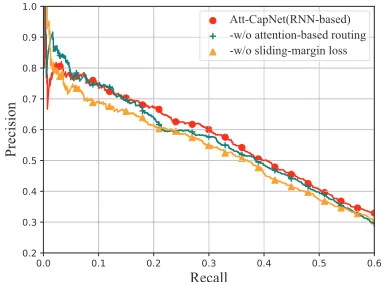
In this subsection, we evaluate various modules of our method including attention-based routing algorithm and sliding-margin loss function. Our main method outperforms the other variants, although the variants may still prove useful when applied to other tasks. We apply our model Att-CapNet (RNN-based) and its two sub-models, which are without the attention-based routing algorithm (dynamic routing) and sliding-margin loss (fixed-margin loss), to the two datasets respectively. The results shown in Table 8 and Figure 4 indicate, 1) our main model and the two variants are better than the best baseline feature clustering method under the same settings. 2) our attention-based routing algorithm and sliding-margin loss are both useful for capsule network, which significantly enhance the performance of relation ex-traction.
3
Sentences Labels RNN
Max-pooling Avg. Att. Att-CapNet S1: Twenty years ago, another[Augusta]native,[Larry Mize], shocked Greg
Norman in a playoff by holing a 140-foot chip for birdie on the 11th hole to win the masters in a playoff.
PB 0 0 0 1
PL 0 1 1 1
S2: Brothers or cousins except for its drummer, Oscar Lara, the band originally comes from[Sinaloa],[Mexico], but has lived in San Jose, California, for nearly 40 years.
LC 1 0 0 1
CA 0 1 1 1
S3: The white house in April sharply criticized the speaker of the house, Nancy Pelosi, for visiting[Syria]’s capital,[Damascus], and meeting with president Bashar Al-Assad, even going so far as calling the trip “bad behavior”, in the words of vice president Dick Cheney.
LC 0 0 0 1
CA 0 0 1 1
CC 1 1 0 1
Table 7: A case study of selective multi-labeled sentences for the four feature clustering methods based on RNN. The entities are labeled in the bold brackets. “PB”, “PL”, “LC”, “CA” and “CC” are relation labels in the dataset, which are “person/place birth”, “person/place lived”,“location/contain”, “country/administrative divisions” and “country/capital” respectively.
Methods Features F1(%)
Zhou et al. (2016) WE (dim=50)+PE 81.7
Att-CapNet (RNN-based) WE (dim=50)+PE 84.5 -w/o attention-based routing WE (dim=50)+PE 83.6 -w/o sliding-margin loss WE (dim=50)+PE 82.3
Table 8: Performance of Att-CapNet (RNN-based) with var-ious modules on SemEval-2010 Task 8.
Case Study
We present practical cases in NYT-10 test set to show the effectiveness of our feature clustering method (Att-CapNet) compared to max-pooling, linear average (Avg.) and word-level attention (Att.) with the same feature extracting net-work (RNN). Table 7 shows three multi-labeled sentences for relation extraction by all the four methods from which we can conclude that, 1) Att-CapNet method has recognized all the labeled relations. 2) the other three methods can only give one confident prediction. 3) a few methods even cannot recognize any relations such as max-pooling for the sentence
S1. 4) our feature clustering method is more capable to rec-ognize highly overlapping relations.
Conclusions and Future Work
In this paper, we propose a novel capsule-based approach for multi-labeled relation extraction to handle the highly over-lapping relations and improve the capability of clustering relation features. To our best knowledge, this is the first at-tempt that applies capsule network to solve the challenging task. The proposed model consists of a concise pipeline. First, we extract low-level semantic information with Bi-LSTM. Then, the low-level features are clustered to be high-level relation representations with attentive capsule network. Finally, sliding-margin loss is proposed to train the model reasonably with all the relations including the “no relation”. Our experiments show that the proposed approach achieves significant improvement for multi-labeled relation extrac-tion over previous state-of-the-art baselines.
Figure 4: The PR curves of the Att-CapNet (RNN-based) with various modules on NYT-10
In future, our solutions of features clustering can be gen-eralized to other tasks that deal with overlapping and dis-crete features. For instance, a possible attempt might be to perform reading comprehension.
Acknowledgments
This work is supported by National China 973 Project No. 2015CB352401; Chinese National Research Fund (NSFC) Key Project No. 61532013 and No. 61872239. FDCT/0007/2018/A1, DCT-MoST Joint-project No. (025/2015/AMJ), University of Macau Grant Nos:
MYRG2018-00237-RTO, CPG2018-00032-FST and
References
Graves, A. 2013. Generating sequences with recurrent neu-ral networks.arXiv preprint arXiv:1308.0850.
Hendrickx, I.; Kim, S. N.; Kozareva, Z.; Nakov, P.; ´
O S´eaghdha, D.; Pad´o, S.; Pennacchiotti, M.; Romano, L.; and Szpakowicz, S. 2009. Semeval-2010 task 8: Multi-way classification of semantic relations between pairs of nomi-nals. InProceedings of the Workshop on Semantic Evalua-tions.
Hinton, G. E.; Krizhevsky, A.; and Wang, S. D. 2011. Trans-forming auto-encoders. InProceedings of the ICANN. Hinton, G. E.; Sabour, S.; and Frosst, N. 2018. Matrix cap-sules with em routing. InProcessings of the ICLR.
Kim, Y. 2014. Convolutional neural networks for sentence classification. InProceedings of the EMNLP.
Kingma, D., and Ba, J. 2015. Adam: A method for stochastic optimization. InProcessings of the ICLR.
Lin, Y.; Shen, S.; Liu, Z.; Luan, H.; and Sun, M. 2016. Neu-ral relation extraction with selective attention over instances. InProceedings of the ACL.
Liu, C.; Sun, W.; Chao, W.; and Che, W. 2013. Convolution neural network for relation extraction. InProceedings of the ADMA.
Liu, T.; Zhang, X.; Zhou, W.; and Jia, W. 2018. Neural rela-tion extracrela-tion via inner-sentence noise reducrela-tion and trans-fer learning. InProceedings of the EMNLP.
Liu, P.; Qiu, X.; and Huang, X. 2016. Recurrent neural network for text classification with multi-task learning. In
Proceedings of the IJCAI.
Mikolov, T.; Chen, K.; Corrado, G.; and Dean, J. 2013. Ef-ficient estimation of word representations in vector space.
arXiv preprint arXiv:1301.3781.
Mintz, M.; Bills, S.; Snow, R.; and Jurafsky, D. 2009. Dis-tant supervision for relation extraction without labeled data. InProceedings of the Joint Conference of the ACL and the IJCNLP.
Miwa, M., and Bansal, M. 2016. End-to-end relation ex-traction using LSTMs on sequences and tree structures. In
Proceedings of the ACL.
Mooney, R. J., and Bunescu, R. C. 2006. Subsequence ker-nels for relation extraction. InProceedings of the NIPS. Nguyen, T. H., and Grishman, R. 2015. Combining neural networks and log-linear models to improve relation extrac-tion.arXiv preprint arXiv:1511.05926.
Pennington, J.; Socher, R.; and Manning, C. 2014. Glove: Global vectors for word representation. InProceedings of the EMNLP.
Riedel, S.; Yao, L.; and McCallum, A. 2010. Modeling rela-tions and their menrela-tions without labeled text. InProceedings of the ECML-PKDD.
Sabour, S.; Frosst, N.; and Hinton, G. E. 2017. Dynamic routing between capsules. InProceedings of the NIPS. Santos, C. N. d.; Xiang, B.; and Zhou, B. 2015. Classifying relations by ranking with convolutional neural networks. In
Proceedings of the ACL.
Socher, R.; Huval, B.; Manning, C. D.; and Ng, A. Y. 2012. Semantic compositionality through recursive matrix-vector spaces. InProceedings of the joint conference on EMNLP and CoNLL.
Srivastava, N.; Hinton, G. E.; Krizhevsky, A.; Sutskever, I.; and Salakhutdinov, R. 2014. Dropout: a simple way to pre-vent neural networks from overfitting. Journal of Machine Learning Research15(1):1929–1958.
Surdeanu, M.; Tibshirani, J.; Nallapati, R.; and Manning, C. D. 2012. Multi-instance multi-label learning for rela-tion extracrela-tion. InProceedings of the Joint Conference on EMNLP and CoNLL.
Turian, J.; Ratinov, L.; and Bengio, Y. 2010. Word repre-sentations: a simple and general method for semi-supervised learning. InProceedings of the ACL.
Wang, L.; Cao, Z.; de Melo, G.; and Liu, Z. 2016. Relation classification via multi-level attention cnns. InProceedings of the ACL.
Wang, Q.; Qiu, J.; Gao, D.; Gao, J.; et al. 2018. Recurrent capsule network for relations extraction: A practical applica-tion to the severity classificaapplica-tion of coronary artery disease.
arXiv preprint arXiv:1807.06718.
Xi, E.; Bing, S.; and Jin, Y. 2017. Capsule network perfor-mance on complex data. arXiv preprint arXiv:1712.03480. Xu, K.; Feng, Y.; Huang, S.; and Zhao, D. 2015. Se-mantic relation classification via convolutional neural net-works with simple negative sampling. InProceedings of the EMNLP.
Xu, Y.; Jia, R.; Mou, L.; Li, G.; Chen, Y.; Lu, Y.; and Jin, Z. 2016. Improved relation classification by deep recurrent neural networks with data augmentation. InProceedings of the COLING.
Yang, D.; Wang, S.; and Li, Z. 2018. Ensemble neural re-lation extraction with adaptive boosting. InProceedings of the IJCAI.
Zeng, D.; Liu, K.; Lai, S.; Zhou, G.; Zhao, J.; et al. 2014. Re-lation classification via convolutional deep neural network. InProceedings of the COLING.
Zhang, D., and Wang, D. 2015. Relation classification via recurrent neural network.arXiv preprint arXiv:1508.01006. Zhang, Z.; Zhao, H.; and Qin, L. 2016. Probabilistic graph-based dependency parsing with convolutional neural net-work. InProceedings of the ACL.
Zhao, W.; Ye, J.; Yang, M.; Lei, Z.; Zhang, S.; and Zhao, Z. 2018. Investigating capsule networks with dynamic routing for text classification. InProceedings of the EMNLP. Zhou, P.; Shi, W.; Tian, J.; Qi, Z.; Li, B.; Hao, H.; and Xu, B. 2016. Attention-based bidirectional long short-term mem-ory networks for relation classification. InProceedings of ACL.
![Figure 2: The architecture of our proposed relation extractor, illustrating the procedure for handling one sentence and predictingpossible relations between [Abraham Lincoln] and [Unite States]](https://thumb-us.123doks.com/thumbv2/123dok_us/9700869.1953266/3.612.96.520.53.256/architecture-proposed-relation-extractor-illustrating-procedure-predictingpossible-relations.webp)