The Thirty-Third AAAI Conference on Artificial Intelligence (AAAI-19)
Solving Multiagent Planning Problems with Concurrent Conditional Effects
Daniel Furelos-Blanco
∗ Department of ComputingImperial College London London, SW7 2AZ, United Kingdom
Anders Jonsson
Dept. Information and Communication Technologies Universitat Pompeu Fabra
Roc Boronat 138, 08018 Barcelona, Spain [email protected]
Abstract
In this work we present a novel approach to solving concur-rent multiagent planning problems in which several agents act in parallel. Our approach relies on a compilation from con-current multiagent planning to classical planning, allowing us to use an off-the-shelf classical planner to solve the original multiagent problem. The solution can be directly interpreted as a concurrent plan that satisfies a given set of concurrency constraints, while avoiding the exponential blowup associated with concurrent actions. Our planner is the first to handle action effects that are conditional on what other agents are doing. Theoretically, we show that the compilation is sound and complete. Empirically, we show that our compilation can solve challenging multiagent planning problems that require concurrent actions.
Introduction
Concurrent multiagent planning is a branch of multiagent planning in which several agentscollaborateto solve a given problem. Collaboration takes the form ofconcurrentorjoint
actions that are executed together by multiple agents. Con-current multiagent planning is challenging for several rea-sons: the number of concurrent actions is worst-case expo-nential in the number of agents, and restrictions are needed to ensure that concurrent actions are well-formed. Usu-ally, these restrictions take the form of concurrency con-straints(Boutilier and Brafman 2001; Crosby 2013), which model both the case for which two actions must occur in parallel, and for which theycannotoccur in parallel.
In spite of recent progress in multiagent planning, there are relatively few multiagent planners that can reliably han-dle concurrency. CMAP (Borrajo 2013), MAPlan (Stolba, Fiser, and Komenda 2016) and MH-FMAP (Torre˜no, On-aindia, and Sapena 2014) can all produce concurrent plans, but are not designed to handle more complex concurrency constraints. Crosby, Jonsson, and Rovatsos (2014) associate concurrency constraints with the objects of a multiagent planning problem and transform the problem into a sequen-tial, single-agent problem that can be solved using a clas-sical planner. Shekhar and Brafman (2018) adapt this ap-proach usingcollaborative actions, i.e. single actions that
in-∗
The work was conducted while at Universitat Pompeu Fabra. Copyright c2019, Association for the Advancement of Artificial Intelligence (www.aaai.org). All rights reserved.
volve the minimum number of agents necessary to perform a given task. Brafman and Zoran (2014) extend the distributed forward-search planner MAFS (Nissim and Brafman 2014) to support concurrency constraints while preserving privacy. Maliah, Brafman, and Shani (2017) propose MAFBS, which extends MAFS to use forward and backward messages.
In this paper we describe a planner that can handle arbitrary concurrency constraints, as originally proposed by Boutilier and Brafman (2001) and later extended by Ko-vacs (2012). Our approach is similar to previous approaches in that we transform a multiagent planning problem into a single-agent problem with much fewer actions, avoiding the exponential blowup associated with concurrent actions. The concurrency constraints of Boutilier and Brafman are sig-nificantly more expressive than those of Crosby (2013), en-abling us to solve multiagent problems with more complex interactions (e.g. effects that depend on the concurrent ac-tions of other agents). We show that our planner is sound and complete, and perform experiments in several concurrent multiagent planning domains to evaluate its performance.
The remainder of this paper is structured as follows. We first introduce the planning formalisms that we need to describe our planner. Next, we describe the compilation from multiagent planning to single-agent planning. We then present the results of experiments in several domains that re-quire concurrency. Finally, we relate our planner to existing work in the literature, and conclude with a discussion.
Background
In this section we describe the planning formalisms that we use: classical planning and concurrent multiagent planning.
Classical Planning
We consider the fragment of classical planning with con-ditional effects and negative conditions and goals. Given a fluent setF, aliterallis a valuation of a fluent inF, where
l=fdenotes thatlassigns true tof ∈F, andl=¬fthatl
assigns false tof. A literal setLiswell-definedif it does not assign conflicting values to any fluentf, i.e. does not contain bothf and¬f. LetL(F)be the set of well-defined literal sets onF, i.e. the set of all partial assignments of values to fluents. Given a literal setL∈ L(F), let¬L={¬l:l∈L}
be thecomplementofL. We also define theprojectionL|X
Astates ∈ L(F)is a well-defined literal set such that
|s|=|F|, i.e. a total assignment of values to fluents. Explic-itly including negative literals¬f in states simplifies subse-quent definitions, but we often abuse notation by defining a state sonly in terms of the fluents that are true ins, as is common in classical planning.
A classical planning problem is a tupleΠ =hF, A, I, Gi, whereFis a set of fluents,Aa set of actions,I∈ L(F)an initial state, andG∈ L(F)a goal condition (usually satis-fied by multiple states). Each actiona ∈Ahas a precondi-tionpre(a)∈ L(F)and a set of conditional effectscond(a). Each conditional effectCBE∈cond(a)has two literal sets
C∈ L(F)(the condition) andE∈ L(F)(the effect). An action a ∈ A is applicable in states if and only if pre(a)⊆s, and the resulting (triggered)effectis given by
eff(s, a) = [
CBE∈cond(a),C⊆s E,
i.e. effects whose conditions hold in s. We assume that eff(s, a)is a well-defined literal set inL(F)for each state-action pair(s, a). The result of applyingainsis a new state
θ(s, a) = (s\ ¬eff(s, a))∪eff(s, a). It is straightforward to show that ifsandeff(s, a)are inL(F), then so isθ(s, a).
Aplanfor planning problemΠis an action sequenceπ=
ha1, . . . , anithat induces a state sequencehs0, s1, . . . , sni
such thats0=Iand, for eachisuch that1≤i≤n, action
ai is applicable in si−1 and generates the successor state si = θ(si−1, ai). PlanπsolvesΠif and only ifG ⊆ sn, i.e. if the goal condition holds after applyingπinI.
Concurrent Multiagent Planning
The standard definition of multiagent planning problems (MAPs) is due to Brafman and Domshlak (2008). Formally, a MAP is a tupleΠ = hN, F,{Ai}
i∈N, I, Gi, whereN =
{1, . . . , n}is a set of agents andA1, . . . , Anare disjoint sets
of atomic actions of each agent. The fluent setF, initial state
Iand goal conditionGare defined as for classical (single-agent) planning. The definition and semantics of a planπare also identical to those for classical planning, except thatπis a sequence ofjoint actions, which we proceed to define.
LetA =A1∪ · · · ∪An be the set of all atomic actions.
A joint actiona={a1, . . . , ak} ⊆ Ais a subset of atomic
actions such that|Ai∩a| ≤1for eachi∈N, i.e. each agent
contributes at most one action toa, implyingk ≤ n. The precondition and effect ofaare defined as the union of the preconditions and effects of the constituent atomic actions:
pre(a) = k
[
j=1
pre(aj), eff(s, a) = k
[
j=1
eff(s, aj).
A joint actiona iswell-defined ifpre(a)andeff(s, a) are well-defined literal sets inL(F)for each states.
In general, nothing prevents two atomic actions a1 and a2of different agents from having conflicting preconditions
or effects. Hence any joint action that includes botha1and a2is not well-defined. Moreover, some atomic actions may
only be applicable together. For example, in the BOXPUSH
-INGdomain (Brafman and Zoran 2014), some boxes are too
heavy to push for a single agent, and a joint action is only applicable if enough agents push a box concurrently.
To ensure that joint actions are applicable and well-defined, researchers usually imposeconcurrency constraints
on joint actions, which can be either positive or negative:
• Apositive concurrency constraintstates that a subset of atomic actionsmustbe performed concurrently.
• Anegative concurrency constraintstates that a subset of atomic actionscannotbe performed concurrently.
In PDDL 2.1 (Fox and Long 2003), two actionsa1anda2
cannot be applied concurrently ifa1has an effect on a fluent f anda2has a precondition or effect onf. This concurrency
constraint requires no prior knowledge apart from the action definitions, but can only model negative concurrency.
Crosby (2013) defines concurrency constraints in the form of object affordances, i.e. integer intervals that determine how many agents can interact with an object concurrently. An object with affordance[1,1]can only be manipulated by one agent, while[2,10]requires manipulation by at least two and at most ten agents. This approach assumes that joint ac-tions are well-defined whenever object affordances are sat-isfied. Crosby, Jonsson, and Rovatsos (2014) extend the ap-proach to affordances onobject sets.
Boutilier and Brafman (2001) proposed an alternative def-inition of concurrency constraints, later extended by Ko-vacs (2012). The idea is to extend the preconditions of ac-tions withother actionsin addition to fluents. If an atomic actiona1has preconditiona2, thena2must be applied
con-currently witha1, while a precondition¬a2implies thata2
cannot be applied concurrently with a1. A joint action is
only applicable if the concurrency constraints (i.e. precondi-tions) ofallconstituent atomic actions hold, and applicable joint actions are assumed to be well-defined.
As a side effect of the latter approach, we can also add concurrency constraints to the conditional effects of atomic actions. We illustrate this idea using the TABLEMOVER do-main (Boutilier and Brafman 2001), in which two agents move blocks between rooms using two alternative strategies:
1. Pick up blocks and carry them using their arms.
2. Put blocks on a table, carry the table together to another room, and tip the table to make the blocks fall down.
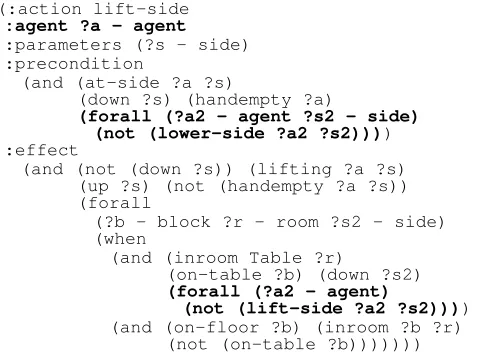
Figure 1 shows the definition of thelift-sideaction in the notation of Kovacs (2012), which is used by agent?ato lift side?sof the table. The precondition is that the side must be down (i.e. on the floor) and the agent cannot be hold-ing anythhold-ing. Moreover, the precondition also states that no other agent?a2can lower side?s2at the same time. When the action is applied,?sis no longer down but up, and?ais busy lifting?s. The action also has a conditional effect (rep-resented by thewhenclause): if some side?s2is not lifted by any agent?a2, then all blocks on the table fall to the floor. This conditional effect is what makes it possible to tip the table in order to implement the second strategy above.
(:action lift-side
:agent ?a - agent
:parameters (?s - side) :precondition
(and (at-side ?a ?s)
(down ?s) (handempty ?a)
(forall (?a2 - agent ?s2 - side) (not (lower-side ?a2 ?s2)))) :effect
(and (not (down ?s)) (lifting ?a ?s) (up ?s) (not (handempty ?a ?s)) (forall
(?b - block ?r - room ?s2 - side) (when
(and (inroom Table ?r)
(on-table ?b) (down ?s2)
(forall (?a2 - agent)
(not (lift-side ?a2 ?s2)))) (and (on-floor ?b) (inroom ?b ?r)
(not (on-table ?b)))))))
Figure 1: Definition of the TABLEMOVERactionlift-side us-ing the notation of Kovacs (concurrency constraints in bold).
Below we extend the notation for classical planning to in-corporate the concurrency constraints of Boutilier and Braf-man (2001). The idea is to viewA, the full set of atomic actions, as a set of fluents that can be true or false. We can now use a set of literals onA to model a joint action
a={a1, . . . , ak}: the fluents inAcorresponding to actions a1, . . . , akare true, while all other fluents inAare false. Let L(a)denote the literal set onAthat encodesa.
The next step is to define an extended fluent setF ∪A, as well as a set L(F ∪A)of well-defined literal sets on
F∪A. We can now encode a statesand a joint actionaas an extended states∪L(a), i.e. a literal set inL(F∪A).
To include concurrency constraints in the precondition and conditional effects of an action aj, we simply define
the preconditionpre(aj) ∈ L(F ∪A)and conditionC ∈
L(F ∪A) of each conditional effect CBE ∈ cond(aj)
as well-defined literal sets on extended fluents. Each effect
E∈ L(F)is defined exclusively on fluents as before. We can now define the semantics of a joint actiona =
{a1, . . . , ak}. Concretely,a satisfies the concurrency
con-straints if and only if the projected preconditionpre(aj)
|A
holds inL(a)for each j, 1 ≤ j ≤ k. If ais applicable, its precondition and effect in a statesare the union of the preconditions and effects of the constituent atomic actions:
pre(a) = k
[
j=1
pre(aj)
|F,
eff(s, a) = k
[
j=1
eff(s∪L(a), aj), ∀s.
Note that the effects of atomic actions are conditional on the extended states∪L(a). As before, we assume thateff(s, a)
is a well-defined literal set inL(F)for each pair of a states
and an applicable joint actiona.
We use a small example to illustrate the notation. Con-sider a MAP with two agents and action setsA1={a1, a2}
andA2={a3, a4}. The full set of actions isA=A1∪A2=
{a1, a2, a3, a4}. Assume thata1anda3are defined as
pre(a1) ={¬a4}, pre(a3) =∅,
cond(a1) ={{¬a3}B{f}}, cond(a3) ={∅B{g}}.
The joint actiona = {a1, a4} is not applicable since the
precondition¬a4 ofa1does not hold in the extended state L(a) ={a1,¬a2,¬a3, a4}. The joint actiona0 ={a1, a3}
is applicable and results in the effecteff(s, a0) ={g}in any state s. The joint actiona00 = {a1} is also applicable and
results in the effecteff(s, a00) ={f}in any states, since the condition¬a3in the conditional effect{¬a3}
B{f}ofa1
holds in the extended stateL(a00) ={a1,¬a2,¬a3,¬a4}.
Compilations for MAPs
In this section we describe an approach to solving a MAP
Π =hN, F,{Ai}
i∈N, I, Gi. The idea is to model each joint
actiona={a1, . . . , ak}using multiple atomic actions: one
set of actions for selecting a1, . . . , ak, one set of actions
for applying a1, . . . , ak, and one set of actions for reset-ting a1, . . . , ak. The result is a classical planning problem Π0 =hF0, A0, I0, G0isuch that the size of the action setA0 islinearin|A|, the number of atomic actions of agents.
Simulating a joint actionausing a sequence of atomic ac-tionsha1, . . . , akiis problematic for the following reason:
when applying an atomic actionai, we may not yet know
which atomic actions will be applied by other agents. Since those other actions may be part of the precondition and con-ditional effects ofai, it becomes difficult to ensure that the
concurrency constraints ofaiare correctly enforced.
Our approach is to divide the simulation of a joint actiona
into three phases: selection, application, and reset. In the se-lection phase, we use an auxiliary fluentactive-aito model
that the atomic actionaihas been selected. In the application
phase, since the selection of atomic actions is known, we can substitute each actionaiin preconditions and conditional
ef-fects with the auxiliary fluentactive-ai. In the reset phase,
various auxiliary fluents are reset. Note that each agent can apply at most one atomic action per time step, and agents collaborate to form joint actions whose constituent atomic actions are compatible and/or inapplicable on their own.
Fluents
We describe the fluents in PDDL format, i.e. each fluent is instantiated by assigning objects to predicates.
The set of fluentsF0 ⊇F includes all original fluents in
F, plus the following auxiliary fluents:
• Fluentsfree,select,applyandresetmodeling the phase.
• For each agenti, fluentsfree-agent(i),busy-agent(i)and done-agent(i)that model the agent state: free to select an action, selected an action, and applied the action.
• For each actionai ∈ Ai in the action set of agenti, a
fluentactive-ai which models thatai has been selected.
We useFactto denote the subset of fluents of this type.
By simple inspection, the total number of fluents in F0 is given by|F0|=|F|+ 4 + 3n+P
i∈N
Ai
The initial stateI0of the compilationΠ0is given by
I0 =I∪ {free} ∪ {free-agent(i) :i∈N},
i.e. the initial state on fluents inFisI, we are not simulating any joint action, and all agents are free to select actions. The goal condition is given byG0=G∪{free}, i.e. the goal con-ditionGhas to hold at the end of a joint action simulation.
Actions
For a literal setL ∈ L(F ∪A), let L|A/Fact denote the projection of L ontoA, followed by a substitution of the actions inA with the corresponding fluents in Fact. Note that bothL|F andL|A/Factare literal sets on fluents inF0, i.e. the dependence on actions inAis removed.
The first four actions in the setA0 allow us to switch be-tween simulation phases, and are defined as follows:
select-phase: pre ={free},
cond ={∅B{¬free,select}}. apply-phase: pre ={select},
cond ={∅B{¬select,apply}}. reset-phase: pre ={apply},
cond ={∅B{¬apply,reset}}. finish: pre ={reset,free-agent(i) :i∈N},
cond ={∅B{¬reset,free}}.
For each actionai ∈ Ai in the action set of agenti, we
define three new actions inA0:select-ai,do-aiandend-ai.
These actions represent the three steps that an agent must perform during the simulation of a joint action.
The actionselect-aicausesito select actionaiduring the
selection phase, and is defined as follows:
pre ={select,free-agent(i)} ∪pre(ai)
|F,
cond ={∅B{busy-agent(i),¬free-agent(i),active-ai}}.
The precondition ensures that we are in the selection phase, thatiis free to select an action, and that the precondition of
aiholds on fluents inF. The effect preventsifrom selecting
another action, and marksaias selected.
The actiondo-aiapplies the effect ofaiin the application
phase, and is defined as follows:
pre ={apply,busy-agent(i),active-ai} ∪pre(ai)
|A/Fact,
cond ={∅B{done-agent(i),¬busy-agent(i)}} ∪ {C|F∪C|A/FactBE:CBE∈cond(ai)}.
The precondition ensures that we are in the application phase, thataiwas previously selected, and that all
concur-rency constraints in the precondition ofaihold. The effect is
to apply all conditional effects ofai, where each condition C|F∪C|A/Factis generated fromCby substituting each ac-tionaj ∈Awithactive-aj. Agentiis also marked as done
to preventaifrom being applied a second time.
The actionend-airesets auxiliary fluents to their original
value, and is defined as follows:
pre ={reset,done-agent(i),active-ai},
cond ={∅B{free-agent(i),¬done-agent(i),¬active-ai}}.
a1
a2
b1
r1 r2
s1 Table s2
Figure 2: Initial state of a simple TABLEMOVERinstance.
The precondition ensures that we are in the reset phase and that ai was previously selected and applied (due to
done-agent(i)). The effect is to make agentifree to select actions again, and to markaias no longer selected.
Again, by inspection we can see that the total number of actions inA0is given by|A0|= 4 + 3P
i|A
i|=O(|A|).
Properties
Figure 2 shows an example instance of TABLEMOVER in which the goal is for agents a1 anda2 to move block b1
from roomr1 to room r2. An example of concurrent plan that solves this instance is defined as follows:
1(to-table a1 r1 s2)(pickup-floor a2 b1 r1)
2(putdown-table a2 b1 r1)
3(to-table a2 r1 s1)
4(lift-side a1 s2)(lift-side a2 s1)
5(move-table a1 r1 r2 s2)(move-table a2 r1 r2 s1)
6(lower-side a1 s2)
In this plan, agenta2 first puts the block on the table, and thena1 anda2 concurrently lift each side of the table and move the table to roomr2. Finally,a1lowers its side of the table, causing the table to tip and the block to fall to the floor. The following sequence of classical actions inA0 can be used to simulate the first joint action of the concurrent plan:
1(select-phase )
2(select-to-table a1 r1 s2)
3(select-pickup-floor a2 b1 r1)
4(apply-phase )
5(do-pickup-floor a2 b1 r1)
6(do-to-table a1 r1 s2)
7(reset-phase )
8(end-to-table a1 r1 s2)
9(end-pickup-floor a2 b1 r1)
10(finish )
We show that the compilation is both sound and complete.
Theorem 1(Soundness). A classical planπ0that solvesΠ0 can be transformed into a concurrent planπthat solvesΠ.
Proof. When fluentfreeis true, the only applicable action isselect-phase. The only way to makefreetrue again is to cycle through the three phases and end with thefinishaction. During the selection phase, a subset of actionsa1, . . . , ak
are selected, causing the corresponding agents to be busy. Because of the precondition free-agent(i)of thefinish ac-tion, each selected action ai has to be applied in the
The precondition ofaholds since the precondition of each
aion fluents inF is checked in the selection phase, during
which no fluents inF change values. The concurrency con-straints ofai are checked in the application phase when all
actions have already been selected. This also ensures that the conditional effects ofai are correctly applied. Finally,
aux-iliary fluents are cleaned in the reset phase. Hence the joint actionasatisfies all concurrency constraints and is correctly simulated by the corresponding action subsequence ofπ0.
Letπbe the concurrent plan composed of the sequence of joint actions simulated by the planπ0. Sinceπ0solvesΠ0, the goal conditionGholds at the end ofπ0, implying thatG also holds at the end ofπ. This implies thatπsolvesΠ.
Theorem 2 (Completeness). A concurrent plan π that
solvesΠcorresponds to a classical planπ0that solvesΠ0.
Proof. Leta = {a1, . . . , ak}be a joint action of the
con-current planπ. We can use a sequence of actions in A0 to simulateaby selecting, applying and resetting each action amonga1, . . . , ak. Sinceais part ofπ, its precondition and
concurrency constraints have to hold, implying that the pre-condition and concurrency constraints of each atomic action hold. Hence the action sequence is applicable and results in the same effect asa. By concatenating such action sequences for each joint action ofπ, we obtain a planπ0. Sinceπsolves
Π, the goal conditionGholds at the end ofπ, implying that
Gholds at the end ofπ0. This implies thatπ0solvesΠ0.
Extensions
The basic compilation checks concurrency constraints in the application phase. Here we describe an extension that checks negative concurrency constraints in the selection phase, al-lowing a classical planner to identify inadmissible joint ac-tions as early as possible, reducing the branching factor.
Assume that actionai has a negative concurrency
con-straint¬aj. As before, we can simulate this constraint using
the fluent¬active-aj. However,aj may be selectedafterai
in the selection phase, in which case¬active-ajholds when
selectingai. To prevent inadmissible joint actions from
be-ing selected, we introduce additional fluents in the setF0:
• For each actionai∈Aiin the action set of agenti, a
flu-entreq-neg-aiwhich indicates thataicannot be selected.
We now redefine the actionselect-aias follows:
pre ={select,free-agent(i),¬req-neg-ai} ∪pre(ai)
|F
∪ {¬active-aj :¬aj∈pre(ai)},
cond ={∅B{busy-agent(i),¬free-agent(i),active-ai}}
∪ {∅B{req-neg-aj:¬aj ∈pre(ai)}}.
To selectai,req-neg-ai has to be false. For each negative
concurrency constraint¬aj ofai, actionselect-aiadds
flu-entreq-neg-aj, preventingajfrom being selected afterai.
With this extension, we only need to checkpositive con-currency constraints in the application phase. We also rede-fineend-aisuch that fluents of typereq-neg-ai are reset in
the cleanup phase, using the opposite effect ofselect-ai. The
initial state and goal condition do not change since the new fluents are always false while no joint action is simulated.
The second extension is to impose a bound C on the number of atomic actions in the selection phase, resulting in a classical planning problemΠ0C = hF
0
C, A
0
C, I
0
C, G
0
Ci.
The fluent setF0
C ⊇ F0 extends F0 with fluents count(j), 0 ≤j ≤C. We add counter parameters to select and reset actions so that they can respectively increment and decre-ment the value of the counter. Crucially, no select action is applicable whenj =C, preventing us from selecting more thanCactions. The benefit is to reduce the branching factor by restricting joint actions to have at mostCatomic actions.
We leave the following proposition without proof:
Proposition 3. The compilationΠ0
Cthat includes both pro-posed extensions is sound.
Note that the compilation Π0
C is not complete. For
in-stance, consider a concurrent multiagent plan that contains a joint action involving 4 atomic actions. If C < 4, then the concurrent multiagent plan cannot be converted into an equivalent classical plan without exceeding the boundC.
Experimental Results
We tested our compilations in four concurrent domains: TABLEMOVER, MAZE, WORKSHOPand BOXPUSHING1.
In each domain, we used three variants of our compi-lations: unbounded joint action size, and joint action size bounded byC = 2andC = 4. In all variants, we used the extension that identifies negative concurrency constraints in the selection phase. The resulting classical planning prob-lems were solved using Fast Downward (Helmert 2006) in the LAMA setting (Richter and Westphal 2010). All experi-ments ran on Intel Xeon E5-2673 v4 @ 2.3GHz processors, with a time limit of 30 minutes and a memory limit of 8 GB. The MAZE domain (Crosby 2014) consists of a grid of
interconnected locations. Each agent in the maze must move from an initial location to a target location. The connection between two adjacent locations can be either a door, a bridge or a boat. A door can only be used by one agent at once, a bridge is destroyed upon first use, and a boat can only be used by two or more agents in the same direction.
The WORKSHOPdomain is a new domain in which the objective is to perform inventory in a high-security storage facility. It has the following characteristics:
• To open a door, one agent has to press a switch while an-other agent simultaneously turns a key.
• To do inventory on a pallet, one agent has to use a fork-lift to fork-lift the pallet while another agent examines it (for security reasons, labels are located underneath pallets).
• There are also actions for picking up a key, entering or exiting a forklift, moving an agent, and driving a forklift.
The BOXPUSHING domain (Brafman and Zoran 2014) consists in a grid of interconnected cells. Agents must push boxes from one cell to another. Boxes have different sizes and require different numbers of agents to push (1, 2 or 3).
1
We use two algorithms for comparison: Crosby, Jons-son, and Rovatsos (2014) and Shekhar and Brafman (2018), which we refer to as CJR and SB respectively. Both algo-rithms define concurrency constraints in the form of affor-dances on sets of objects. For example, the affordance on the object set{location,boat}in MAZEis defined as[2,∞]
in CJR, representing that at least two agents have to row the boat between the same two locations at once. SB define the same affordance as[2,2], only allowing the minimum num-ber of agents necessary to row a boat (i.e.2).
CJR do not separate atomic action selection from atomic action application. This is a problem since one of the atomic actions can delete the precondition of other atomic actions, thus canceling the formation of the joint action. For exam-ple, in the MAZEdomain, the action for crossing a bridge requires that the bridge exists, and destroys the bridge as an effect. Therefore, as this approach does not separate the se-lection from the application, this action can be done just by one agent at a time (and not by infinite agents as the prob-lem states). The same occurs in the BOXPUSHINGdomain. Instances where a medium or a large box must be moved cannot be solved with this approach because the first agent to “push” the box will move it. Thus, the box location pre-condition for the other agent(s) does not hold, so the box is not moved in the end. On the other hand, SB extend CJR with mechanisms to avoid this problem, deferring effects un-til after all agents have applied their atomic actions.
Moreover, concurrency constraints in the form of object affordances are not as expressive as those of Kovacs (2012):
• Actions cannot appear in conditional effects, making it impossible to model TABLEMOVER instances (SB present results from a simplified version without blocks).
• To define concurrency constraints, actions need at least one shared object, which is not the case in WORKSHOP.
In experiments, we used Fast Downward in the LAMA setting to solve the instances produced by CJR and SB.
Table 1 shows the results for the four domains. To provide an idea of how each planner behaves as a function of the number of agents, the table shows for each domain the same metrics for different numbers of agents.
In terms of coverage (i.e. number of solved instances), the compilation variant bounded to 2 performs the best (52, 61.9%). The unbounded compilation (∞) and the vari-ant bounded to 4 have similar coverage: 50 (59.5%) and 48 (57.1%) respectively. The performance of the variant bounded to 2 is not very good in BOXPUSHINGfor instances involving four agents because all of them require a large box to be pushed (i.e. three agents are required). Finally, SB and CJR are the approaches with the worst coverage: 27 (32.1%) and 11 (13.1%) respectively. The main reason is that they cannot solve TABLEMOVER and WORKSHOP
instances; CJR cannot solve BOXPUSHINGinstances either. Regarding execution time, the unbounded compilation and the compilation bounded to 2 are the fastest. The higher the number of agents, the longer it takes to compute a plan.
In terms of makespan (i.e. number of joint actions), our approach obtains the shortest plans. CJR and SB obtain longer plans because they only construct joint actions
as-sociated with specific concurrency constraints. Any atomic action that can be applied on its own thus becomes a joint ac-tion of size 1. In contrast, our approach can combine atomic actions arbitrarily and compress the solution while planning. The main reason that SB works better in BOXPUSHINGis due to the hardcoded representation of collaborative actions that involve a minimum number of agents. For example, to push a box that requiresb agents to move, SB defines col-laborative actions that involve exactlybagents, while in our case, a joint action involving more thanb agents will also satisfy the concurrency constraints. This results in a larger branching factor which in turn affects the performance.
Note however that such a minimalist representation of collaborative actions is not always complete. For example, we can define a MAZEinstance where three agents have to use a boat to cross a stream. If we only define collaborative actions that involve the minimum number of agents needed to row a boat (i.e. 2), such an instance becomes unsolvable since no sequence of 2 agents rowing the boat in different directions is capable of moving all three agents to the other side. In contrast, our approach can generate a joint action that allows all three agents to cross the stream concurrently. We also performed a scalability experiments in the MAZE
domain. We compare our approach (the ∞variant) to the naive approach of converting a MAP into a classical problem by creating a classical action for each combination of agents. The instances consisted of (1) a 3x3 grid, (2) a set of agents with the same initial and goal locations, and (3) a single path to the goal that consists of interleaved boats and bridges.
Table 2 shows the number of grounded actions and solu-tion time for varying numbers of agents. The naive approach cannot solve instances with 7 or more agents due to ground-ing, while our approach can solve instances with 100 agents.
Related Work
Several other authors consider the problem of concurrent multiagent planning. Boutilier and Brafman (2001) describe a partial-order planning algorithm for solving MAPs with concurrent actions, based on their formulation of concur-rency constraints, but do not present any experimental re-sults. CMAP (Borrajo 2013) produces an initial sequential plan for solving a MAP, but performs a post-processing step to compress the sequential plan into a concurrent plan.
Jonsson and Rovatsos (2011) present a best-response ap-proach for MAPs with concurrent actions, where each agent attempts to improve its own part of a concurrent plan while the actions of all other agents are fixed. However, their approach only serves to improve an existing concurrent plan, and is unable to compute an initial concurrent plan. FMAP (Torre˜no, Onaindia, and Sapena 2014) is a partial-order planner that also allows agents to execute actions in parallel, but the authors do not present experimental results for MAP domains that require concurrency.
Domain N Coverage Time (s.) Makespan # Grounded actions (×103)
2 4 ∞ CJR SB 2 4 ∞ CJR SB 2 4 ∞ CJR SB 2 4 ∞ CJR SB
MAZE 20 13 8 6 11 9 361.5 444.2 145.6 195.1 216.1 47.2 22.0 11.7 77.3 67.7 41.7 69.3 27.9 156.8 108.2
a= 10 10 8 6 5 7 6 250.2 575.6 170.4 228.4 323.1 48.3 25.0 12.2 79.6 69.8 39.9 67.4 26.1 119.3 102.1
a= 15 10 5 2 1 4 3 539.5 - - - - 45.4 - - - - 43.9 71.8 30.0 194.3 115.1
BOXPUSHING 20 9 15 16 - 18 5.2 36.4 143.3 - 305.8 11.2 11.3 12.9 - 20.5 3.5 5.7 2.5 - 2.0 a= 2 10 9 9 9 - 10 5.2 7.6 6.0 - 158.9 11.2 11.9 11.3 - 18.4 1.8 3.2 1.1 - 1.2
a= 4 10 0 6 7 - 8 - 79.7 319.9 - 489.5 - 10.5 15 - 23.1 5.2 8.2 3.8 - 2.9
TABLEMOVER 24 15 12 15 - - 263.4 336.7 341.1 - - 58.7 59.0 61.5 - - 7.4 13.1 4.6 -
-a= 2 12 10 10 11 - - 103.9 226.6 214.7 - - 63.5 62.0 64.5 - - 3.4 6.1 2.0 -
-a= 4 12 5 2 4 - - 582.4 - - - - 49.0 - - - - 11.5 20.1 7.2 -
-WORKSHOP 20 15 13 13 - - 134.3 301.4 52.5 - - 35.7 37.0 32.5 - - 18.0 31.0 11.5 -
-a= 4 10 8 8 8 - - 42.8 263.3 37.1 - - 37.3 43.9 37.3 - - 7.7 13.6 4.8 -
-a= 8 10 7 5 5 - - 238.8 362.3 77.1 - - 33.9 26.0 24.8 - - 28.2 48.3 18.1 -
-Table 1: Summary of results; see text for details.ais the number of agents,N is number of instances; time and length are averages for all planners that solved at least 5 instances. The number of grounded actions is an average over all instances.
#Agents # Grounded actions Time (s.)
Naive ∞ Naive ∞
2 48 100 0.089 0.226
4 992 260 0.494 0.226
6 31248 484 53.864 0.354
8 - 772 - 0.535
10 - 1124 - 0.758
50 - 21604 - 41.979
100 - 83204 - 289.887
Table 2: Scalability of our approach (∞) compared to the naive compilation in the MAZEdomain.
actions. As we have seen, these concurrency constraints are not as flexible as those of Boutilier and Brafman (2001).
Brafman and Zoran (2014) extended the MAFS multia-gent distributed algorithm (Nissim and Brafman 2014) to support actions requiring concurrency while preserving pri-vacy. Messages are exchanged between agents in order to in-form each other about the expansion of relevant states. Con-sequently, agents explore the search space together while preserving privacy. As pointed out by Shekhar and Braf-man (2018), it has two main problems: (1) it does not con-sider the issue of subsumed actions, and (2) it does not sup-port concurrent actions that affect each others preconditions. Maliah, Brafman, and Shani (2017) proposed MAFBS, which extended MAFS to use forward and backward sages. This approach reduced the number of required mes-sages and resulted in an increase in the privacy of agents.
Chouhan and Niyogi (2016, 2017) proposed a PDDL-like language for specifying problems involving required con-currency, which is very similar to the one by Boutilier and Brafman (2001). Their planner does not make assumptions on the number of agents required to perform a joint action; rather, the number of agents is determined from the capa-bilityof agents and the objects they are interacting with. For example, in a robot domain, the number of robots required to lift an specific object can depend on the weight of the object. Shekhar and Brafman (2018) extended the planner of Crosby, Jonsson, and Rovatsos (2014). Thus, it is also based on compiling the multiagent problem into a classical
prob-lem. With respect to previous work, they added collaborative actions and removed all collaborative actions that are sub-sumed by others (i.e. that do not involve a minimum number of agents). Besides, they showed that their approach can also be used in a distributed privacy preserving planner.
Compilations from multiagent to classical planning have also been considered by other authors. Muise, Lipovetzky, and Ramirez (2015) proposed a transformation to respect privacy among agents. The resulting classical planning prob-lem was then solved using a centralized classical planner as in our approach. Besides, compilations to classical planning have also been used in temporal planning, obtaining state-of-the-art results in many of the International Planning Compe-tition domains (Jim´enez, Jonsson, and Palacios 2015).
Conclusion
This paper proposes a new compilation for concurrent mul-tiagent planning problems. As far as we know, our algorithm is the first to handle concurrent conditional effects. In exper-iments we show that our approach is competitive with previ-ous work, and that it can solve concurrent multiagent plan-ning problems that are out of reach of previous approaches.
Since the number of atomic actions is exponentially smaller than the number of joint actions, a distributed action definition has the potential to scale to much larger instances, which we demonstrate in our experiments. It is not always easy to determine beforehand how many joint actions are needed; in MAZE, we may needkagents to cross a bridge together, requiring joint actions for2,3, . . . , kagents.
In future work, we would like to explore strategies for optimizing the makespan, improving scalability and intro-ducing the notion ofcapability(Chouhan and Niyogi 2017). We also want to automatically derive the bounds of our algo-rithm. Furthermore, privacy preserving is a central topic on multiagent planning; thus, this approach could be combined with suitable privacy-preserving mechanisms in the future.
Acknowledgments
References
Borrajo, D. 2013. Plan Sharing for Multi-Agent Planning. InDMAP 2013 - Proceedings of the Distributed and Multi-Agent Planning Workshop at ICAPS, 57–65.
Boutilier, C., and Brafman, R. I. 2001. Partial-Order Plan-ning with Concurrent Interacting Actions. J. Artif. Intell. Res. (JAIR)14:105–136.
Brafman, R. I., and Domshlak, C. 2008. From One to Many: Planning for Loosely Coupled Multi-Agent Systems. InProceedings of the Eighteenth International Conference on Automated Planning and Scheduling, ICAPS 2008, Syd-ney, Australia, September 14-18, 2008, 28–35.
Brafman, R. I., and Zoran, U. 2014. Distributed Heuristic Forward Search with Interacting Actions. InProceedings of the 2nd ICAPS Distributed and Multi-Agent Planning work-shop (ICAPS DMAP-2014).
Chouhan, S. S., and Niyogi, R. 2016. Multi-agent Plan-ning with Collaborative Actions. InAI 2016: Advances in Artificial Intelligence - 29th Australasian Joint Conference, Hobart, TAS, Australia, December 5-8, 2016, Proceedings, 609–620.
Chouhan, S. S., and Niyogi, R. 2017. MAPJA: Multi-agent planning with joint actions.Appl. Intell.47(4):1044–1058. Crosby, M.; Jonsson, A.; and Rovatsos, M. 2014. A Single-Agent Approach to Multiagent Planning. InECAI 2014 -21st European Conference on Artificial Intelligence, 18-22 August 2014, Prague, Czech Republic - Including Presti-gious Applications of Intelligent Systems (PAIS 2014), 237– 242.
Crosby, M. 2013. A Temporal Approach to Multiagent Plan-ning with Concurrent Actions.PlanSIG.
Crosby, M. 2014. Multiagent Classical Planning. Ph.D. Dissertation, University of Edinburgh.
Fox, M., and Long, D. 2003. PDDL2.1: An Extension to PDDL for Expressing Temporal Planning Domains.J. Artif. Int. Res.20(1):61–124.
Helmert, M. 2006. The Fast Downward Planning System.
J. Artif. Intell. Res. (JAIR)26:191–246.
Jim´enez, S.; Jonsson, A.; and Palacios, H. 2015. Temporal Planning With Required Concurrency Using Classical Plan-ning. InProceedings of the 25th International Conference on Automated Planning and Scheduling (ICAPS’15). Jonsson, A., and Rovatsos, M. 2011. Scaling Up Multiagent Planning: A Best-Response Approach. InProceedings of the 21st International Conference on Automated Planning and Scheduling, ICAPS 2011, Freiburg, Germany June 11-16, 2011.
Kovacs, D. L. 2012. A Multi-Agent Extension of PDDL3.1. In Proceedings of the 3rd Workshop on the International Planning Competition (IPC), 19–27.
Maliah, S.; Brafman, R. I.; and Shani, G. 2017. Increased Privacy with Reduced Communication in Multi-Agent Plan-ning. InProceedings of the Twenty-Seventh International Conference on Automated Planning and Scheduling, ICAPS 2017, Pittsburgh, Pennsylvania, USA, June 18-23, 2017., 209–217.
Muise, C.; Lipovetzky, N.; and Ramirez, M. 2015. MAP-LAPKT: Omnipotent Multi-Agent Planning via Compila-tion to Classical Planning. In Competition of Distributed and Multiagent Planners.
Nissim, R., and Brafman, R. I. 2014. Distributed Heuristic Forward Search for Multi-agent Planning. J. Artif. Intell. Res.51:293–332.
Richter, S., and Westphal, M. 2010. The LAMA Planner: Guiding Cost-Based Anytime Planning with Landmarks.
Journal of Artificial Intelligence Research39:127–177. Shekhar, S., and Brafman, R. I. 2018. Representing and Planning with Interacting Actions and Privacy. In Proceed-ings of the Twenty-Eighth International Conference on Au-tomated Planning and Scheduling, ICAPS 2018, Delft, The Netherlands, June 24-29, 2018., 232–240.
Stolba, M.; Fiser, D.; and Komenda, A. 2016. Potential Heuristics for Multi-Agent Planning. InProceedings of the Twenty-Sixth International Conference on Automated Plan-ning and Scheduling, ICAPS 2016, London, UK, June 12-17, 2016., 308–316.
Torre˜no, A.; Onaindia, E.; and Sapena, O. 2014. FMAP: Distributed cooperative multi-agent planning. Appl. Intell.