The Thirty-Third AAAI Conference on Artificial Intelligence (AAAI-19)
A Deep Reinforcement Learning Based Multi-Step
Coarse to Fine Question Answering (MSCQA) System
Yu Wang, Hongxia Jin
Samsung Research America
{yu.wang1, hongxia.jin}@samsung.com
Abstract
In this paper, we present a multi-step coarse to fine ques-tion answering (MSCQA) system which can efficiently pro-cesses documents with different lengths by choosing appro-priate actions. The system is designed using an actor-critic based deep reinforcement learning model to achieve multi-step question answering. Compared to previous QA models targeting on datasets mainly containing either short or long documents, our multi-step coarse to fine model takes the mer-its from multiple system modules, which can handle both short and long documents. The system hence obtains a much better accuracy and faster trainings speed compared to the current state-of-the-art models. We test our model on four QA datasets, WIKEREADING, WIKIREADING LONG, CNN and SQuAD, and demonstrate 1.3%-1.7%accuracy improve-ments with 1.5x-3.4x training speed-ups in comparison to the baselines using state-of-the-art models.
Introduction
Machine comprehension based question answering (QA) tasks have drawn lots of interests from the natural lan-guage understanding research community. During the past several years, lots of progresses have been made on build-ing deep learnbuild-ing based QA models to answer questions from large scale datasets including unstructured documents (Hermann et al. 2015; Hill et al. 2015; Onishi et al. 2016; Trischler et al. 2016; Nguyen et al. 2016). Currently, most of the state-of-the-art models for different QA datasets are based on recurrent neural networks which can process the sequential inputs, and with a (co-)attention structure to deal with the long term interactions between questions and document context (Xiong, Zhong, and Socher 2016; Chen, Bolton, and Manning 2016; Hermann et al. 2015; Kadlec et al. 2016). One disadvantage of these models is that their training and inference speeds are relatively slow due to their recurrent nature, and the other weakness is that they are still not good at dealing with very long documents and model of the models use the truncated documents as their inputs (Miller et al. 2016; Hewlett et al. 2016).
In (Choi et al. 2017), it introduces a coarse-to-fine ques-tion answering model to select the related sentences in the long document first, then find the answers from the selected
Copyright c2019, Association for the Advancement of Artificial Intelligence (www.aaai.org). All rights reserved.
sentences, which helps reduce the computational workload. The fast model can be implemented using bag-of-words (BoW) or convolutional neural network and the slow model uses an RNN based model. The model gives decent perfor-mance on long documents in WIKIREADING dataset, and shows significant speed-up compared to earlier models. This coarse to fine model, however, still have several disadvan-tages:
1.The model doesn’t perform as good as baseline models on the full WIKIREADING dataset including both short and long documents (Hewlett et al. 2016). One reason is because that the conventional RNN based models perform better on generating answers from the first few sentences of a doc-ument, hence can obtain the correct results on short docu-ments more accurately than a coarse-to-fine model .
2. Many wrong answers are actually from the same sen-tence containing the correct answer. By using a coarse-to-fine model on sentence level, it may still extract wrong an-swer by ignoring the correct one in the same sentence.
3. Some of the contextual information in document is still useful and necessary in order to find the correct answers. However, by only selecting the related sentence(s), the sys-tem may ignore some important information to make the correct judgment.
On the other hand, compared to the coarse-to-fine model which gives decent results on long documents, more ques-tion answering models focus on improving performance on relatively short documents. QANet (Yu et al. 2018) uses the convolutions and self-attentions to boost the training speed and gives one of the state-of-the-art results on the SQuAD1.1 dataset (Rajpurkar et al. 2016), which contains mainly short documents (average 122 tokens/document).
Due to these reasons, in this paper, we would like to in-troduce a novel mult-step coarse to fine question answer-ing (MSCQA) system which can handle both long and short documents. This new structure takes the advantages from both coarse-to-fine and QANet structures depending the lengths of documents. Furthermore, a false-positive de-tection mechanism is also designed to further improve the model performance.
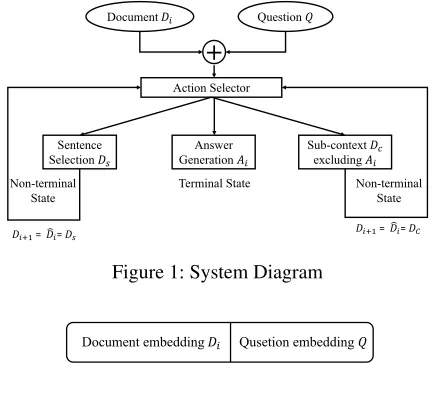
2. Select the related sentences and use them for next round (Non-terminal State)˙
3. Remove the inaccurate answer generate from the answer generation module, and use the rest of the document for next round (Non-terminal State).
The first two states are corresponding to the QANet an-swer generation module and a coarse sentence selector in the coarse-to-fine model. The last state is designed to han-dle the case where the predicted answer given by the answer generator is a false positive one, which should be removed from current document context to avoid confusion.
At each round of the decision making process, the system performs an action and reaches one out of the three states. If it is a non-terminal state, the system will continue to search the correct answer from the current context, otherwise it will generate the answer from the answer generation mod-ule, which is a terminal state. A detailed system description will be given in next section.
In this paper, we propose a DRL based multi-step coarse-to-fine QA (MSCQA) system, which mainly gives three con-tributions:
1. It is the first multi-step QA system which has the ca-pability to decide whether to generate a fine result or a coarse one based on the current context. By using this tech-nique, the model can handle both short and long documents in faster and a more robustness manner. To the best of our knowledge, we are the first one to do so.
2. Besides generating answers from coarse or fine con-text, the system also learn another ability to reject the false-positive answer given by the answer generator. This self-correctness ability makes the system more ”smart”.
3. The system achieves significant better QA accuracy compared to our baseline models on four QA datasets, and 1.5x-3.4x training speed-up due to the improved efficiency by reallocating of training data using three actions.
The System and Model Structure
In this section, the system structure of our multi-step coarse-to-fine QA system is given. The system contains four parts: the first one is a DRL based action selector, the second one is a sentence selection module (M1), the third one is an
an-swer generation module (M2) and the last one is the
sub-context generation module (M3). Both the sub-context and
sentence selection module are non-terminal states, and the answer generation module is a terminal state. Our system diagram is as given in Figure 1.
Action Selector
The action selector is designed to generate one action to pick one of the three modules at each time step. In order to model the process of selecting an action, we choose a deep rein-forcement learning (DRL) based algorithm to learn it auto-matically. Formulated as a markov decision process (MDP) , a DRL based model mainly contains four key elements: statest, actionat, rewardrtand policyπ. In a given a state stduring a stochastic process, the system is seeking its best actionatto perform in order to maximize its expected re-wards to be obtained, by following some policyπ. The main
Action Selector
Sentence Selection!"
Document!# Question$
Answer Generation%#
Sub-context!&
excluding%#
+
Terminal State Non-terminal State Non-terminal
State
!#'(=)!#=!" !#'(=!)#=!*
Figure 1: System Diagram
Document embedding!" Qusetion embedding#
Figure 2: Design of State
target of a DRL based model is to seek the best policyπ∗, hence the corresponding actiona∗, for an agent to perform. There are mainly three types of reinforcement learning al-gorithms: value-based, policy gradient and actor-critic. We choose the actor-critic based DRL model in order to obtain a relative stable training result for a large state space as in our system.
The definition of the statesstand the actionsatin our sys-tem will be given in the section. We will also discuss how to train the action selection module using our selected deep re-inforcement learning model,i.e.an Actor-Critic based DRL model.
States (st) The design of the state is as given in Figure 2, which is the input of the action selection module. It mainly contains two parts: one is the encoded document informa-tion, and the other is the question information. The encoded document (Diˆ ) at stepihave three different types of vari-eties:
Type 1: It contains the full document information in step
i,i.e.Diˆ =Di. At step 0, this document is the the same as the original given document (D),i.e.D0=D.
Type 2: It contains the selected sentences information,i.e. ˆ
Di = Ds = ∪Ki=isi, wheresi is theithselected sentence from the current documentDi, andKis the total number of sentences selected.
Type 3: It contains the current documentDiexcluding the
answerAipredicted byDi, i.e.Diˆ =Dc=Di\Ai. Again, the third type of state’s definition is based on the fact that most of the correct answers are within the topK possible answers, if the one with highest probability is not correct one. By defining three possible actions, it gives our system more potentials to find the correct answers both from document level (Type 1) and sentence level (Type 2) by re-jecting the incorrect answers (Type 3).
Word-level
Embedding!"
Character-level
Embedding!#
Self Attention Layer Convolutional Layer
Feedforward Layer
+
+
Document embedding$%/Question Embedding&
+
Word-level
Embedding!"
Character-level
Embedding!#
+
...[();(*;(+; …; (,-);(,]
Embedding Encoder Layer
Input Embedding Layer
Figure 3: Design of Input Embedding Layer and Embedding Encoder Layer
procedure to guarantee that the system infers the answer from the same given question.
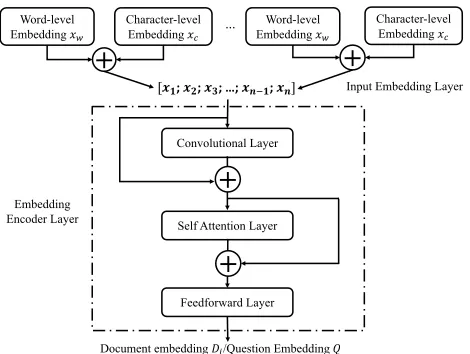
Both the document and question are encoded using two layers structure. The first layer is an input embedding layer and the second layer is an embedding encoder layer. The in-put embedding layer is used to generate each word’s repre-sentation by concatenating its word-level embeddingxwand character-level embeddingxc,i.e.xi =xw⊕xc∈Rd1+d2, whered1 is the dimension of word-level embedding,d2 is
the dimension of the character-level embedding, and“⊕” stands for the concatenation of two vectors. The word em-beddingxwuses the pre-trained GloVe (Pennington, Socher, and Manning 2014) embedding vector where d1 = 300,
and each character of the word is represented by a trainable d2= 200dimension vector. The character level word
repre-sentationxcis then generated by taking the maximum value of each row of the character matrix of a word. The word-level vector and character-word-level vector combine together as the input of the embedding encoder layer.
The embedding encoder layer takes the concatenated em-beddings of tokens in a document or question as its input x = [x1;x2;· · ·;xn], and pass through several layers as
illustrated in Figure 3. The set-up is similar to that in (Yu et al. 2018) except that here we only use one convolution layer to boost the training speed. The word vectorxfirstly passed a convolution layer, then passed by a self-attention layer, and finally a feed-forward layer. The convolution layer has a kernel sizeks, and the number of filters isdf. The self-attention layer adopt the multi-head self-attention mechanism as given in (Vaswani et al. 2017). The output of the last layer is the encoded document representationDˆiin a statestor the question representationQ, depending whether the input is a document or the given question.
Actions (at) As described earlier, three actions are defined in our system to be selected from at each time stept. Their definitions are given in Figure 4, and the three possible sce-narios are as given below:
Actiona1: The first action is to generate the answer
di-rectly. The answer generation module will read in the word
!": Generate Answer#$from current document%$ !&: Select related sentences%'=∪$*"+ ,
-!.: Remove the predicted answer#$from the current document%$
Figure 4: Design of Action
level embedding for the current context of documentDˆiand questionQ, then generate two probabilities for each word as the starting/ending point of the answer. The final answerAi will be given as the context between the words with highest starting and end probabilities.
Actiona2: The second action is the sentence selection
ac-tion. It will select the sentences with highest possibilities containing the correct answers. AssumingK sentences are selected at this step, the new document context will beDˆi= [ˆs1; ˆs2; ˆs3;...; ˆsK]. A detailed description will be given in
next section. This action will generate a non-terminal state. Actiona3: The last action is to remove the potential
an-swerAi generated from the current contextDiˆ , as the sys-tem believes that the answer is a false positive answer, it will remove it to avoid confusion.
It is worth noticing that all three actions corresponding to generating the three types of states as described before (a1 →M2,a2 →M1anda3 →M3). During the training,
our system can decide what is the best action to choose based on the expected rewards.
Rewards (rt) Another important elements in reinforce-ment learning is the rewardrt, which can greatly affect the performance and robustness of a DRL model. In our system, different rewards are designed for three types of action-state pairs:
1. If actiona1is selected,i.e.to generate the answer
di-rectly, the reward is then defined as the F1-score between generate answerAiand the ground truthA∗,i.e.:
r1=F1(Ai, A∗) if a=a1 (1)
2. If the action is chosen to select related sentences (a2),
then the reward is defined as whether the selected new con-textDiˆ =Ds =∪K
i=isi contains the ground truthA∗. If it contains the answer, the reward is 1, otherwise it is 0:
r2=
1
ifA∗⊆D
s=∪Ki=isi
0 otherwise (2)
3. If the action is chosen to remove the potential answer Ai generated from the current context Di, then reward is defined as if the new contextDiˆ =Dc =Di\Aicontains the ground truth answerA∗. If it contains the answer, the reward is 1, otherwise it is 0,i.e.
r3=
1 ifA∗⊆Dc=Di\Ai
0 otherwise (3)
Convolutional Layer!"##$$
Question embeddingQ Sentence embedding&'
+
Sentence distribution probability('
Embedding encoder layer Embedding encoder layer
Question Current Context)'
Figure 5: Structure of the Sentence Selector ModuleM1
Sentence Selection Module
M
1If the action selector choose action a2, our system will
trigger the sentence selection module M1, where
multi-ple answer-related sentences are picked out. Following re-cent work on sentence selection (Yu et al. 2014; Choi et al. 2017; Yang et al. 2016), a convolutional neural net-work fss
cnn is used to define a distribution over the sen-tences{s1,· · · , sN}, where N is the total number of
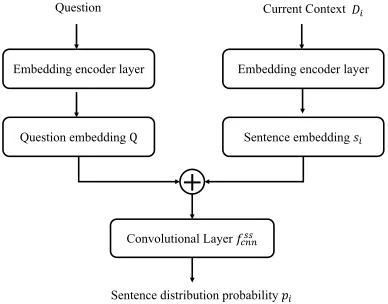
sen-tences in current document. Each of theN sentences in cur-rent document context together with the question embed-dingQ will be fed into the convolutional neural network, whose outputs are the probability distributions of all sen-tences p(s = si|x, d)(i = {1,· · ·, N}). To represent it mathematically:
p(s=si|Q, Di) =fcnnss (Q, Di) (4)
To explain it in detail, the embeddings of tokens in a ques-tion Qare concatenated with those in a sentence si, then used as the input tofss
cnn. The structure is as shown in Fig-ure 5. During the training process, the sentences with topK highest probabilities are selected and combined as the doc-ument context in next step,i.e. Dˆi = Ds = ∪Ki=isi. The predefined valueKis reduced by 1 at each action step,i.e. one fewer sentence is selected after one round. The convolu-tional layerfss
cnnis trained together in the system using the actor-critic’s loss functions which are given in next section.
Answer Generation Module
M
2If our system decides to answer the question directly based on current context Di by choosing action a1, the answer
generation module will be triggered. Currently, most of the state-of-the-art question answering models use RNN mod-els to encode the document and question and generate the answer. Here, we follow the QANET structure that gives the state-of-the-art result using single model on the SQuAD1.1 dataset (Rajpurkar et al. 2016). The structure contains a context-query attention layer, several model encoder layers and an output layer. The structure is as shown in Figure 6. Due to the space limitation, we only give a brief overview about the context-query attention layer and model encoder layer, all other details can refer to (Yu et al. 2018).
Context-Query Attention
Document embedding!"" Question Embedding#
Model Encoder$%
Model Encoder$&
Model Encoder$'
Concatenation Concatenation
Linear Linear
Softmax Softmax
Start Probability()*+,* Start Probability(-./
Ans:[()*+,*0+1, … , (-./0+1]
Figure 6: Structure of the Answer Generation ModuleM2
Context-Query Attention Layer This is a standard mod-ule in many earlier reading comprehension models (Weis-senborn, Wiese, and Seiffe 2017; Chen et al. 2017; Yu et al. 2018). Assuming that the encoded context and question em-beddings areDiandQ. The context-query attention is com-puted by using the similarity matrixS¯generated from each pair of context and query words by using their normalized similarities (after applying a softmax layer to each row of their original similarity matrixS). The context-to-query at-tentionAcan be computed asA= ¯S·QT, and the similarity function is a trilinear function:
f(q, d) =W0[q, d, qd] (5)
whereqis the word token in questionQ, anddis the word token in current contextDi,is the element-wise multipli-cation andW0is a trainable variable.
Similarly, by applying the softmax layer to each column of their original similarity matrixS, we can obtain a column normalized similarity matrixS¯¯. The query to context atten-tion can be computed asB = ¯S·S¯¯T ·DT
i .
Model Encoder Layer Here we follow the structure of model encoder layer designed in (Seo et al. 2016), where the input of the model encoder layer at each position is: [d, a, da, db], whereaandbare a row of attention matrix AandB. Similar to the embedding encoder for document and question as given previously, the model encoder block for answer generation also contains a convolutional layer, a self-attention layer and a feedforward layer. There are three repetitive encoder blocks which share the same weights be-tween each other. The final outputs of the last layer of model are the probabilities of the starting and ending positions,i.e.
pstart=sof tmax(W1[E0;E1])
pend=sof tmax(W2[E0;E2])
(6)
The final answer are the extracted tokens between the two words with highest starting probability pmax
start and ending
probabilitypmaxend. This generated answer is used to define the rewardr1, which will be further used to define our loss
Sub-context Selection Module
M
3Besides the answer generation module (actiona1), sentence
selection module (actiona2), the last module corresponding
to the state after conducting actiona3is the sub-context
se-lection module, which is also used to take care of the cases that the answerAigenerated by the current documentDihas a higher possibility as a false positive answer, hence should be eliminated.
Once our action selection module choose actiona3, the
sub-context selection module will be triggered. The system firstly generate an answerAi by calling the answer gener-ation module (M2) based on current document contextDi
at stepi, then return a new document contextDiˆ by remov-ing the answerAiand concatenating the sub-contexts before and afterAi,i.e.Dˆi=Di\Ai. This new document context is fed back to the action selection module as the document context in next round, that isDi+1= ˆDi.
Training
In this paper, we use the actor-critic based algorithm (Konda and Tsitsiklis 2000; Peters and Schaal 2008) to build our DRL model. Unlike the value based DRL approach like DQN (Mnih et al. 2015) or policy based approach like pol-icy gradient (Sutton et al. 2000), an actor-critic based model has a better performance on continuous state space in terms of convergence and stability. Due to the space limitation and the focus of this paper, we will not spend too much time on explaining the fundamental details of the actor-critic method and only a brief overview is given.
Actor-Critic In actor-critic based RL algorithm, two neu-ral networks are used to model the actor and critic separately. The actor model performs like the policy gradient method by taking statestas its input and generating action probabilities based on the policies: πθ(at|st). Comparatively, the critic model is similar to a value based approach (likeDQN): af-ter performing the actor model generated stateat, the system will reach a new statest+1, and the critic model can
gener-ate two values (i.e.expect rewards)vtandvt+1by takingst andst+1as inputs. It is worth noticing that there are two loss
functions for training actor neural network and critic neural network separately, which are defined as:
Lactor=−logπθ(at|st)(rt+γvt+1−vt)
Lcritic= (rt+γvt+1−vt)2
(7)
whereγis a discount factor in our DRL model. In their def-initions, we can find that the actor network aims to maxi-mize the expected rewards to be obtained, and the critic net-work is minimize the temporal difference error due during the stochastic learning process.
Remarks: Deep neural network (DNN) and Deep rein-forcement learning (DRL) based algorithms has been widely applied in a variety of applications in many sequential learn-ing tasks, like: system identification (Narendra, Wang, and Mukhopadhay 2016; Wang 2017), sequence tagging (Wang et al. 2018), slot filling (Wang, Shen, and Jin 2018); other NLP tasks like: conference resoluton (Clark and Manning 2016), information extractionand (Narasimhan, Yala, and
Barzilay 2016), semantic parsing (Andreas et al. 2016) and text games (Narasimhan, Kulkarni, and Barzilay 2015). There are also many approaches to boost their performance, like: adaptive boosting(R¨atsch, Onoda, and M¨uller 2001; Hastie et al. 2009) and multiple models (Wang and Jin 2018; Narendra, Mukhopadyhay, and Wang 2015; Narendra, Wang, and Chen 2014). In our algorithm, we only use a rela-tive standard actor-critic DRL algorithm as the stress of this paper is on the novelty of its application on a QA problem instead of a new DRL algorithm.
Experiment
Datasets
We conduct our experiment on four QA datasets which for machine comprehension based QA tasks: WIKIREADING, WIKIREADING LONG, CNN, and SQuAD1.1.
WIKIREADING (Hewlett et al. 2016) is a public question answering dataset generated from Wikidata and Wikipedia. It consolidated all Wikidata statements with the same item and property into a single (item, property, answer) triple, where answer is a set of values. Replacing each item with the text of the linked Wikipedia article (discarding unlinked items) yields a dataset of 18.58M (document, property, an-swer) instances.
In order to compare fairly to our baseline models and demonstrate system’s performance on long documents, we perform the same operation on the WIKIREADING datasets as in (Choi et al. 2017) to generate the WIKIREADING LONG dataset. From the WIKIREADING dataset, docu-ments with less than ten sentences are filtered, and only the Wikidata properties for which (Hewlett et al. 2016)’s best model obtains an accuracy of less than 60%are considered. This prunes out some properties such as GIVEN NAME, INSTANCE OF and GENDER. The resulting WIKIREAD-ING LONG dataset contains 1.97M instances (i.e. (docu-ment, property, answer) pairs), and only 31%of the answers are in the first sentence.
CNN is a question answering dataset containing news sto-ries with associated questo-ries collected from the CNN web-sites starting from April 2007 till April 2015. There are a total of 90,266 documents associated with more than 380k queries in the training dataset, and 1093 documents with more than 3k associated questions in test dataset. Each docu-ment companies on average 4 questions approximately. Each question is a sentence with one missing word/phrase which can be found from the accompanying document/context. It is a commonly used dataset to test the performance of models for machine comprehension based QA tasks.
are not in the context and answerable. In order to fairly com-pare with the baseline models which have never been tested on v2.0 data, we use the SQuAD1.1 in our experiment.
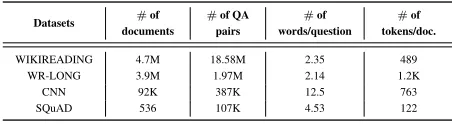
On average, each document in WIKIREADING contains 490 tokens, the filtered WIKIREADING LONG contains 1.2k tokens, those in CNN contains 763 tokens, and SQuAD only contains 122 tokens.
Table 1 shows a detailed statistics and comparison be-tween these four datasets.
Table 1: Statistics of Different QA Datasets
Datasets #of documents
#of QA pairs
#of words/question
#of tokens/doc.
WIKIREADING 4.7M 18.58M 2.35 489
WR-LONG 3.9M 1.97M 2.14 1.2K
CNN 92K 387K 12.5 763
SQuAD 536 107K 4.53 122
Experiment Setup
For the WIKIREADING (Hewlett et al. 2016) and WIKIREADING-LONG (Choi et al. 2017) datasets, we use the 70% of the data as the training dataset and 10% for validation and 20% for test. For he CNN dataset, we fol-low the original splits of the train, validation and test set, where 90,266 documents for training, 1,220 documents for validation and 1,093 documents for test. On the SQuAD1.1 (Rajpurkar et al. 2016)1, the results on the dev set is re-ported for the purpose of comparison with one of our base-line models,i.e.QANet, which is specifically designed for the SQuAD1.1 datasetl
The word embedding and character embedding size are 300 and 200 for the input embedding layer to generate the document and question embeddings as in Figure 3, the out-put size of the embedding encoder layer is set as 128 . The filter size of the convolutional neural network in the embed-ding encoder layer, the model encoder layer are set as 128 and and that in the sentence selection module is set as 100. The CNN kernel size is set as 7 for the embedding encoder layer and the model encoder layer, and set as 5 for the CNN network in sentence selection module.
For the actor-critic model to generate the corresponding actions, we use two Gated Recurrent Units (GRU) neural networks (Chung et al. 2014) to model the actor and critic separately. Both of the models take the current statest,i.e. the concatenation of current documentDi and question Q as their inputs. The actor GRU generates three action prob-abilities, and the critic GRU generates an expected reward value based on the given input. The GRU state cells is cho-sen as 512 for both networks, and the learning rate is 0.0001. The discounted factor in defining loss functionsL1andL2
is chosen asγ = 0.9. AdaDelta (Zeiler 2012) optimizer is selected to smooth the convergence of gradient during train-ing.
1
The SQuAD1.1’s test portal is replaced by SQuAD2.0 cur-rently, hence we test our model on the dev dataset in SQuAD1.1 to compare with our baseline models which only have public re-sults on SQuAD1.1
Evaluation Metrics
The main evaluation metric of our experiment is the exact match (EM) accuracy, the proportion of predicted answers match exactly to their ground truth. During the training, if the system choose actiona1, our system triggers the
termi-nal state-answer generation module and obtain a predicted answer. If the system choose action a2 anda3, the system
will loop back the selected sentencesDsor the sub-context Dc, and use it as the document contextDi+1for the action
selector in next step. To constrain the training and evaluation time, up toK= 5action steps is allowed for each question-document pair. If the system still doesn’t select the action to trigger the answer generation module (M2) after 5 rounds,
we will force the system to call theM2module and generate
an answer based on the extracted document contextD5, then
evaluate on this answer.
Model and Baselines
Two baseline models are used to compare with our system as shown below:
Baseline model 1: The first baseline we choose is a re-implementation of the coarse-to-fine model by (Choi et al. 2017). In this work, the author uses the sentence selector as a coarse selector, and generate the answer based on the selected sentences. The sentence selector is the same as our moduleM1, and the answer generator model is a GRU based
sequence to sequence model as described in (Choi et al. 2017). Since in our model, we also use sentence selector as one of the three states, it is necessary to compare our model with this model to demonstrate the need of an action selec-tor and other two states. When re-implementing this base-line model, we use the convolutional neural network model as its sentence selection model, and hard attention for the document summary. The predefined number of selected sen-tences isK= 5.
Baseline model 2: The second baseline we choose is the QANet given by (Yu et al. 2018), which also gives strong performance on the SQuAD dataset. Since our answer gen-erator model follows the structure of QANet, it is also nec-essary to compare our model with this baseline model for all datasets. When re-implementing this baseline model, we choose the number of convolutional layer in embedding en-coder layer as 1 and don’t use any data augmentation for training.
ORACLE: This model select the sentence containing the answer string (coarse) and generate the answer using QANet.
Answer Accuracy Results
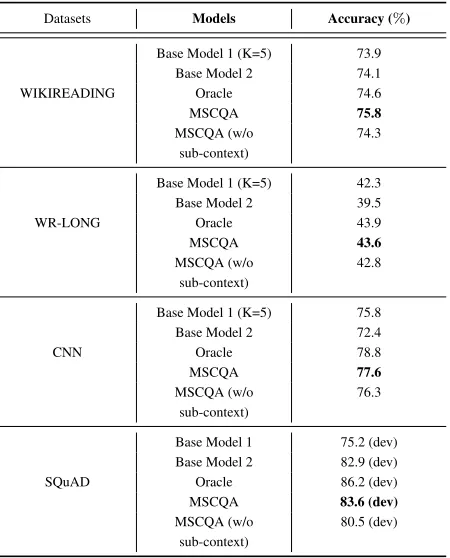
Table 2 gives an accuracy comparison between the baseline models and our proposed model. To demonstrate the impor-tance of learning to reject the false-positive answers, we also build another comparative model without actiona3and the
Table 2: Answer prediction accuracy on the test set (dev set for SQuAD1.1)
Datasets Models Accuracy (%)
Base Model 1 (K=5) 73.9
Base Model 2 74.1
WIKIREADING Oracle 74.6
MSCQA 75.8
MSCQA (w/o sub-context)
74.3
Base Model 1 (K=5) 42.3
Base Model 2 39.5
WR-LONG Oracle 43.9
MSCQA 43.6
MSCQA (w/o sub-context)
42.8
Base Model 1 (K=5) 75.8
Base Model 2 72.4
CNN Oracle 78.8
MSCQA 77.6
MSCQA (w/o sub-context)
76.3
Base Model 1 75.2 (dev) Base Model 2 82.9 (dev)
SQuAD Oracle 86.2 (dev)
MSCQA 83.6 (dev)
MSCQA (w/o sub-context)
80.5 (dev)
1. It can be observed that our MSCQA performs better than all other baseline models on four QA datasets includ-ing both long and short documents. One reason is because that the model can efficiently choose the correct actions to perform by considering the length of the document. The pro-portions of choosing different actions on four datasets are given in Table 4.
2. The MSCQA model performs better than MSCQA without sub-context on all datasets, which shows that impor-tance of removing the false-positive answers using another actiona3.
3. Base model 1 has relative better performance on long documents ( WR-LONG, CNN) compared to base model 2, and worse performance on shorter documents (WIKIREAD-ING, SQuAD). The MSCQA model can handle both cases well by taking the advantages from two baseline models
Speed Comparison
We further compare the training speed with two baseline models on four datasets. The results are shown as in Table 3. From Table 3, it shows that the MSCQA model im-prove the training speed by 1.5x-3.4x compared to the base-line models. It is worth noticing that the basebase-line models are among the fastest QA models on WIKIREADING and SQuAD datasets. The speed-ups are mainly from the im-provement on the model’s efficiency by choosing appropri-ate actions based on documents’ lengths.
Table 3: Comparison of Training Speed on Different Datasets
Datasets Models Training
Speed(samples/sec)
Base Model 1 112
WIKIREADING Base Model 2 89
MSCQA 186
Base Model 1 66
WR-LONG Base Model 2 38
MSCQA 129
Base Model 1 83
CNN Base Model 2 67
MSCQA 173
Base Model 1 146
SQuAD Base Model 2 102
MSCQA 213
Table 4: Proportions of Three Actions
Datasets Choosinga1(%) Choosinga2(%) Choosinga3(%)
WIKIREADING 67 22 11 WR-LONG 48 39 13 CNN 55 26 19 SQuAD 76 8 16
Evaluation on Action Selector
To further evaluate how well the DRL based action selec-tor performs in our MSCQA model structure, we show the statistics of proportions of three different actions chose by our system during test in Table 4 . These numbers are calcu-lated based as:
pai= P#of times choosing actionai
#of actions selected at all steps (8)
Based on the statistics given in Table 4, one can conclude that:
1. When the datasets contain more longer documents, the system tend to select actiona2in order to firstly select
sen-tences in a coarse manner.
2. When the datasets contain more shorter documents, the system tend to select actiona1in order to answer the
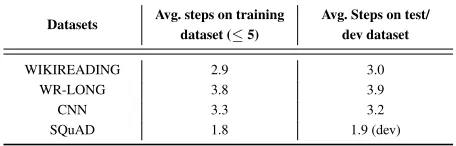
ques-tion directly without coarsely select some sentences. In order to better understand the DRL action selector’s be-havior, we use Table 5 to show the average number of steps performed during training and test/dev on each dataset.
It can be observed that, datatsets containing more long documents with higher average tokens per document tend to have more average action steps. By combining Table 4 and 5, it is shown that the multi-step DRL structure with multiple actions is useful for our model to choose a more suitable module to perform, in order to get a better performance.
Conclusion
Table 5: Number of Action Steps on Different Datasets
Datasets Avg. steps on training dataset (≤5)
Avg. Steps on test/ dev dataset
WIKIREADING 2.9 3.0
WR-LONG 3.8 3.9
CNN 3.3 3.2
SQuAD 1.8 1.9 (dev)
actions. The system shows decent results on four different QA datasets in terms of accuracy and training speed. It also gives a new concept of using DRL model to guide a multi-step QA reasoning process, which is more close to human-being’s judgment behavior. In the future, we would like to investigate more on refining the design of system by adding more possible actions and states, such that the system can behave even smarter and faster.
References
Andreas, J.; Rohrbach, M.; Darrell, T.; and Klein, D. 2016. Learning to compose neural networks for question answer-ing.arXiv preprint arXiv:1601.01705.
Chen, D.; Fisch, A.; Weston, J.; and Bordes, A. 2017. Read-ing wikipedia to answer open-domain questions. In Pro-ceedings of the 55th Annual Meeting of the Association for Computational Linguistics (Volume 1: Long Papers), vol-ume 1, 1870–1879.
Chen, D.; Bolton, J.; and Manning, C. D. 2016. A thorough examination of the cnn/daily mail reading comprehension task.arXiv preprint arXiv:1606.02858.
Choi, E.; Hewlett, D.; Uszkoreit, J.; Polosukhin, I.; Lacoste, A.; and Berant, J. 2017. Coarse-to-fine question answer-ing for long documents. InProceedings of the 55th Annual Meeting of the Association for Computational Linguistics (Volume 1: Long Papers), volume 1, 209–220.
Chung, J.; Gulcehre, C.; Cho, K.; and Bengio, Y. 2014. Em-pirical evaluation of gated recurrent neural networks on se-quence modeling. arXiv preprint arXiv:1412.3555.
Clark, K., and Manning, C. D. 2016. Deep reinforcement learning for mention-ranking coreference models. arXiv preprint arXiv:1609.08667.
Hastie, T.; Rosset, S.; Zhu, J.; and Zou, H. 2009. Multi-class adaboost.Statistics and its Interface2(3):349–360.
Hermann, K. M.; Kocisky, T.; Grefenstette, E.; Espeholt, L.; Kay, W.; Suleyman, M.; and Blunsom, P. 2015. Teaching machines to read and comprehend. InAdvances in Neural Information Processing Systems, 1693–1701.
Hewlett, D.; Lacoste, A.; Jones, L.; Polosukhin, I.; Fan-drianto, A.; Han, J.; Kelcey, M.; and Berthelot, D. 2016. Wikireading: A novel large-scale language understanding task over wikipedia. In Proceedings of the 54th Annual Meeting of the Association for Computational Linguistics (Volume 1: Long Papers), volume 1, 1535–1545.
Hill, F.; Bordes, A.; Chopra, S.; and Weston, J. 2015. The goldilocks principle: Reading children’s books with explicit memory representations.arXiv preprint arXiv:1511.02301.
Kadlec, R.; Schmid, M.; Bajgar, O.; and Kleindienst, J. 2016. Text understanding with the attention sum reader net-work. In Proceedings of the 54th Annual Meeting of the Association for Computational Linguistics (Volume 1: Long Papers), volume 1, 908–918.
Konda, V. R., and Tsitsiklis, J. N. 2000. Actor-critic algo-rithms. InAdvances in neural information processing sys-tems, 1008–1014.
Miller, A.; Fisch, A.; Dodge, J.; Karimi, A.-H.; Bordes, A.; and Weston, J. 2016. Key-value memory networks for di-rectly reading documents.arXiv preprint arXiv:1606.03126.
Mnih, V.; Kavukcuoglu, K.; Silver, D.; Rusu, A. A.; Ve-ness, J.; Bellemare, M. G.; Graves, A.; Riedmiller, M.; Fidjeland, A. K.; Ostrovski, G.; et al. 2015. Human-level control through deep reinforcement learning. Nature 518(7540):529.
Narasimhan, K.; Kulkarni, T.; and Barzilay, R. 2015. Lan-guage understanding for text-based games using deep rein-forcement learning. arXiv preprint arXiv:1506.08941.
Narasimhan, K.; Yala, A.; and Barzilay, R. 2016. Improving information extraction by acquiring external evidence with reinforcement learning. arXiv preprint arXiv:1603.07954.
Narendra, K. S.; Mukhopadyhay, S.; and Wang, Y. 2015. Improving the speed of response of learning algorithms us-ing multiple models. arXiv preprint arXiv:1510.05034.
Narendra, K. S.; Wang, Y.; and Chen, W. 2014. Stability, ro-bustness, and performance issues in second level adaptation. InAmerican Control Conference (ACC), 2014, 2377–2382. IEEE.
Narendra, K. S.; Wang, Y.; and Mukhopadhay, S. 2016. Fast reinforcement learning using multiple models. InDecision and Control (CDC), 2016 IEEE 55th Conference on, 7183– 7188. IEEE.
Nguyen, T.; Rosenberg, M.; Song, X.; Gao, J.; Tiwary, S.; Majumder, R.; and Deng, L. 2016. Ms marco: A human generated machine reading comprehension dataset. arXiv preprint arXiv:1611.09268.
Onishi, T.; Wang, H.; Bansal, M.; Gimpel, K.; and McAllester, D. 2016. Who did what: A large-scale person-centered cloze dataset.arXiv preprint arXiv:1608.05457.
Pennington, J.; Socher, R.; and Manning, C. 2014. Glove: Global vectors for word representation. InProceedings of the 2014 conference on empirical methods in natural lan-guage processing (EMNLP), 1532–1543.
Peters, J., and Schaal, S. 2008. Natural actor-critic. Neuro-computing71(7-9):1180–1190.
Rajpurkar, P.; Zhang, J.; Lopyrev, K.; and Liang, P. 2016. Squad: 100,000+ questions for machine comprehension of text. arXiv preprint arXiv:1606.05250.
R¨atsch, G.; Onoda, T.; and M¨uller, K.-R. 2001. Soft margins for adaboost. Machine learning42(3):287–320.
Sutton, R. S.; McAllester, D. A.; Singh, S. P.; and Mansour, Y. 2000. Policy gradient methods for reinforcement learning with function approximation. InAdvances in neural infor-mation processing systems, 1057–1063.
Trischler, A.; Wang, T.; Yuan, X.; Harris, J.; Sordoni, A.; Bachman, P.; and Suleman, K. 2016. Newsqa: A machine comprehension dataset. arXiv preprint arXiv:1611.09830. Vaswani, A.; Shazeer, N.; Parmar, N.; Uszkoreit, J.; Jones, L.; Gomez, A. N.; Kaiser, Ł.; and Polosukhin, I. 2017. At-tention is all you need. InAdvances in Neural Information Processing Systems, 5998–6008.
Wang, Y., and Jin, H. 2018. A boosting-based deep neural networks algorithm for reinforcement learning. InAmerican Control Conference (ACC).
Wang, Y.; Patel, A.; Shen, Y.; and Jin, H. 2018. A deep rein-forcement learning based multimodal coaching model (dcm) for slot filling in spoken language understanding (slu).Proc. Interspeech 20183444–3448.
Wang, Y.; Shen, Y.; and Jin, H. 2018. A bi-model based rnn semantic frame parsing model for intent detection and slot filling. InProceedings of the 2018 Conference of the North American Chapter of the Association for Computa-tional Linguistics: Human Language Technologies, Volume 2 (Short Papers), volume 2, 309–314.
Wang, Y. 2017. A new concept using lstm neural net-works for dynamic system identification. InAmerican Con-trol Conference (ACC), 5324–5329.
Weissenborn, D.; Wiese, G.; and Seiffe, L. 2017. Making neural qa as simple as possible but not simpler. In Proceed-ings of the 21st Conference on Computational Natural Lan-guage Learning (CoNLL 2017), 271–280.
Xiong, C.; Zhong, V.; and Socher, R. 2016. Dynamic coat-tention networks for question answering. arXiv preprint arXiv:1611.01604.
Yang, Z.; Yang, D.; Dyer, C.; He, X.; Smola, A.; and Hovy, E. 2016. Hierarchical attention networks for document clas-sification. In Proceedings of the 2016 Conference of the North American Chapter of the Association for Computa-tional Linguistics: Human Language Technologies, 1480– 1489.
Yu, L.; Hermann, K. M.; Blunsom12, P.; and Pulman, S. 2014. Deep learning for answer sentence selection. arXiv preprint arXiv:1412.1632.
Yu, A. W.; Dohan, D.; Le, Q.; Luong, T.; Zhao, R.; and Chen, K. 2018. Fast and accurate reading comprehension by combining self-attention and convolution. InInternational Conference on Learning Representations.