167 Copyright © 2011-15. Vandana Publications. All Rights Reserved.
Volume-5, Issue-1, February-2015
International Journal of Engineering and Management Research
Page Number: 167-171
Quality Interval Single Sampling Plan Using Vague Parameter
Dr. S. Srikrishna
Department of Mathematics, SSN College of Engineering, Chennai, INDIA.
ABSTRACT
The purpose of this paper is to present the quality interval acceptance single sampling plan when the fraction of nonconforming items is a vague number. In this paper the quality interval acceptance sampling of the plan has been discussed by means of vague quality decision region and vague probability of quality region, whose vague values depends on the ambiguity proportion parameter having a higher and lower bounds. Finally, I have concluded the discussion by a numerical example, whose values are represented by a vague triangular set.
Keywords--- Statistical quality control, Quality interval acceptance single sampling, vague number.
I.
INTRODUCTION
In the classical set theory introduced by Cantor, German mathematician values of elements in a set are only one of 0 and 1. That is, for any element there are only two possibilities in or not in the set. The theory cannot handle the data with ambiguity and uncertainty.
Zadeh proposed fuzzy theory in 1965. The most important feature is that fuzzy set A is a class of objects that satisfy a certain property each object x has a membership degree of A, denoted by μA(x). This membership function has the following characteristics: The single degree contains the evidence for both supporting and opposing x. It cannot only represent one of the two evidences but it cannot represent both at the same time too.
In order to deal with this problem, Gau and Buehrer proposed the concept of vague set in 1993 by replacing the values of an element in a set with a subinterval of [0, 1]. Namely a true membership function tv(x) and false membership function fv(x) are used to describe the boundaries of membership degree. These two boundaries form a subinterval (tv(x), 1-fv(x)) of [0, 1]. The vague set theory improves description of the object in real world, becoming a promising tool to deal with inexact, uncertain or vague knowledge. Many researchers have applied this theory to many situation such as fuzzy
control decision making, knowledge discovery. And the tool has presented more challenging than with the fuzzy set theory in applications.
Statistical quality control is an efficient method of improving a firm and process quality of production. Sampling for acceptance or rejection of a lot is an important field in statistical quality control.
Acceptance single sampling is one of the sampling methods for acceptance or rejection which is long with classical attribute quality characteristic. In sampling plans, the fraction of defined items is considered as a crisp value but in practice, the fraction of defined items value must be known exactly. Many times these values are estimated or it is provided by experiment. The vagueness present in the value of p with personal judgement experiment or estimated may be treated by means of vague set theory. As known vague set theory is a powerful mathematical tool for modelling uncertainty with the evidence of both supporting and opposing, we define the imprecise proportion parameter as a vague number. With this definition, the number of non conforming items in the sample following a poisson distribution will have the vague parameter.
Classical acceptance sampling plans have been studied by many researchers. They are thoroughly
elaborated by Schilling (1982). Single sampling by attributes with relaxed requirements were discussed by
Ohta and Ichihashi (1988),and
Grzegorzewski(1998,2001b). Grzegrozewski
(2000b,2002) also considered sampling plan by variables with fuzzy requirements. Sampling plan by attributes for vague data were considered by Hrniewicz (1992). Fuzzy quality management were discussed by Chakraborty (1988, 1992, 1994a), Ohta and Ichihashi (1988) and Kanagawa and Ohta (1990).
168 Copyright © 2011-15. Vandana Publications. All Rights Reserved.
II.
PRELIMINARIES AND
DEFINITIONS
2.1 Basic Concepts of Vague Set.
Let U be the universe of discourse U {u1, u2, ...,
un}. A vague set A� [Chen and Shiy-Ming (2003), Lu.A
and Nu.W (2004:2005)] in U is characterized by a truth membership function tA,� tA�: U→[0,1] and a false membership function fA,� fA�: U→[0,1], where tA,�(ui) is
a lower bound of the grade of membership of ui derived
from the evidence for ui. fA,�(ui) is a lower bound on the
negation of grade of membership of ui derived from the
evidence against ui such that tA�(ui) + fA�(ui)≤1. The
grade of membership of ui
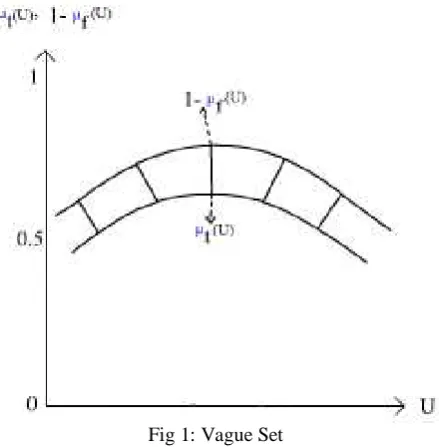
Fig 1: Vague Set
Definition 2.2.
Let A� be a vague set of the universe of discourse U with truth membership function tA,� and the false membership function fA,� respectively. The vague set A� is convex [Chen and Shiy-Ming (2003), Lu.A and Nu.W (2004:2005)], if and only if for every u
in the vague set A� is bounded by a subinterval [tA�(ui), 1−fA�(ui)]. For example, a
vague set A� in the universe of discourse U is shown in the figure 1:
i in U, tA�(λu1+ (1− λ)u2)≥min�tA�(u1), tA�(u2)� 1−fA�(λu1+ (1− λ)u2)≥min�1−fA�(u1), 1−
fAu2, where λ∈ [0, 1].
Definition.2.3.
A vague set A� of universe of discourse U is called a normal vague set [Chen and Shiy-Ming (2003), Lu.A and Nu.W (2004:2005)], if ui
In the following, we present the arithmetic operation of triangular vague set.
∈ U, 1−fA �(U)= 1. That is fA,�(ui)=0.
Definition 2.4.
A vague number [Chen and Shiy-Ming (2003), Lu.A and Nu.W (2004:2005)] is a vague subset in the universe of discourse U that is both convex and normal.
2.5: Arithmetic Operation of Triangular Vague sets. Let us consider the triangular vague set A�, where the triangular vague set A� can be parameterized by a tuple 〈[(a,b, c);μ1], [(a,b, c);μ2]〉, where µ1 is the
truth membership for (a,b,c) and µ2 is the negation of
false membership for (a,b,c). For convenience, the tuple can also be abbreviated into 〈[(a,b, c);μ1,μ2]〉, where 0≤µ1≤µ2≤µ3≤µ4≤1 are as follows:
A
�⨁B�=〈[(a1,b1, c1);μ1,μ2]〉⨁〈[(a2, b2,c2);μ3,μ4]〉 =〈[(a1+ a2, b1+ b2, c1
+ c2); min(μ1,μ3); min(μ2,μ4)]〉 A
�⨂B�=〈[(a1,b1, c1);μ1,μ2]〉⨂〈[(a2, b2,c2);μ3,μ4]〉 =〈[(a1× a2, b1× b2, c1
× c2); min(μ1,μ3); min(μ2,μ4)]〉
Based on the above two operations, we now define the multiplication of two vague matrices. Let P� and Q� be the two matrices whose entries are triangular vague sets represented as p�ij=〈��pij1, pij2, pij3�;μ1ij;μij2�〉, where μij1 is the truth membership of �p1ij, pij2, pij3� , μij2 is the negation of false membership of �pij1, pij2, pij3� and
q�ij=〈��q1ij, qij2, q3ij�;μij3;μij4�〉 , where μij3 is the truth
membership of �q1ij, qij2, q3ij� and μij2 is the negation of false membership of �q1ij, qij2, q3ij� respectively given by
P
�=�p�ij�=�
p�11 p�12 ⋯ p�1n p�21 p�22 ⋯ p�2n
⋮
p�n1 p�n2⋮ ⋯⋮ p�nn⋮ �
Q�=�q�ij�=�
q�11 q�12 ⋯ q�1n q�21 q�22 ⋯ q�2n
⋮ q�n1
⋮ q�n2
⋮ ⋮
⋯ q�nn �.
Then the multiplication of P� and Q� is defined by
P
�⨂Q�=⨁k�p�ik⨂q�kj� Definition 2.6.
Let x be a random variable having the poisson mass function P(x) stands for the probability that x∈X,
then P(x)=p(x) =e−λλx
x! , x=0, 1, 2, ... and the parameter λ>0. Now if λ�> 0 for λ is a fuzzy number, then p�(x) to
be fuzzy probability that X=x, we can find α-cut of this fuzzy number as p�(x) =�e−λx!λx/λϵλ[α]for every α∈[0, 1]. Let X be a random variable having the fuzzy probability distribution and p� in the definition (1) be small, which means that all p∈p�[α] are sufficiently small, then p�[a, b][α] is given by
p�[a,b][α] =�∑b e−λx!λx
169 Copyright © 2011-15. Vandana Publications. All Rights Reserved.
III.
ACCEPTANCE SAMPLING
PLAN WITH VAGUE
PARAMETER
Suppose that we want to inspect a lot with a large size of N. First take a randomized sample of size ‘n’ from the lot, then inspect all items in the sample and the number of defective items (d) will be count down. If the number of observed defective items is lesser than equal to acceptance number then the lot will be accepted, otherwise the lot rejection. If the size of lot be large the random variable d had a binomial distribution with parameter n and p in which p indicates the lot s defective items. However there exists the size of sample be large and p is small then random variable‘d’ has a Poisson distribution with λ=np. So, the probability for the number of defective items to be exactly equal to d is
p(d) =e−npd!(np)d
and the probability of acceptance of the lot (pa) is
pa= p(d≤e) =∑ e
−np(np)d
d! c
d=0 .
Suppose we want to inspect a lot with the large size of N, such that the proportion of damaged item is not known precisely, so we represent this parameter with a vague number p� with the evidence of both favourable and non favourable as follows: p�=��p1,p2,p3�,μt, 1−
μf.
A single sampling plan with a vague parameter if defined by the sample size n and acceptance number c and if the number of observation defective product is less than or equal to c, the lot will be acceptance. If N is a large number, then the number of defective items in this sample (d) has a binomial distribution with a vague value and if P� is a small, then random variable (d) has a vague value whose parameter λ�=nP� and so the vague probability for number of defective items in a sample
size that is exactly equal to d is defined by means of α -cut given by
P
�(d-defective)=�P�(α),μtp�(α), 1− μfp�(α)�, where P�(α) =
�P1[α],P2[α]� and P1[α] = min�e−λλd
d! |λϵnP�(α)� P2[α] = max�e−λλd
d! |λϵnP�(α)�
and the vague acceptance probability is given by
P
�=�P�a,μtp�
a, 1− μfp�a�
Where P�ais a triangular number P�a= (Pa1, Pa2, Pa3 )
defined by P�a =�∑ e−λλd
d! c
d=0 |λϵλ�[α]�.
This triangular number P�a can be determined by means
of α-cut,
P�a(α) = [P1a(α), P2a(α)] and
Pa1(α) = min��e −λλd
d! c
d=0
|λϵλ�(α)�
Pa2(α) = max��e −λλd
d! c
d=0
|λϵλ�(α)�
IV.
QUALITY INTREVAL SINGLE
SAMPLING PLAN WITH
VAGUE PARAMETER
In this section, Quality Decision Region and Quality Region are represented as a vague number and are defined as follows:
4.1 Vague Quality Decision Region
Vague Quality Decision Region is defined as
D�qd =〈D�qd,μtD�qd,1− μfD�qd〉 represented as a vague
triangular number. The triangular number D�qd =
�dqd1, dqd2, dqd3� can be determined by means of α - cut
as follows:
D
�qd(α) =�D1
qd(α), D2qd(α)� D1qd(α) = min�(P
∗−P1)|λϵλ�(α)� Dqd2 (α) = max�(P∗−P1)|λϵλ�(α)�
And the vague quality decision region is derived from the vague probability of acceptance is as follows:
P�(p1<𝑝𝑝< p∗) =�P�a,μtp�a, 1− μfp�a�,
where P�ais a triangular number P�a= (Pa1, Pa2, Pa3 ) defined
by P�a =�∑ e−λλd
d! c
d=0 |λϵλ�[α]�, p1<𝑝𝑝< p∗.
This triangular number P�a can be determined by means
of α-cut,
P�a(α) = [P1a(α), P2a(α)] and
Pa1(α) = min��e −λλd
d! c
d=0
|λϵλ�(α)�
Pa2(α) = max��e −λλd
d! c
d=0
|λϵλ�(α)�
4.2 Quality Region with Vague Parameter
The vague probability for the quality region is
D�qd =〈D�qr ,μtD�qr, 1− μfD�qr〉 represented as a vague
triangular number. The triangular number D�qr =
�dqr 1, dqr 2, dqr 3� can be determined by means of α - cut
as follows:
D�qr(α) =�D1qr(α), D2qr(α)� Dqr1 (α) = min�(P2−P1)|λϵλ�(α) = nP�(α)� Dqr2 (α) = max�(P2−P1)|λϵλ�(α) = nP�(α)�
And the vague quality decision region is derived from the vague probability of acceptance is as follows:
P
�(p1<𝑝𝑝< p2) =�P�a,μt
p
�a, 1− μfp�a�,
where P�ais a triangular number P�a= (Pa1, Pa2, Pa3 ) defined
by P�a =�∑ e−λλd
d! c
d=0 |λϵλ�[α]�, p1<𝑝𝑝< p2.
This triangular number P�a can be determined by means
of α-cut,
170 Copyright © 2011-15. Vandana Publications. All Rights Reserved.
Pa1(α) = min��e −λλd
d! c
d=0
|λϵλ�(α)�
Pa2(α) = max��e −λλd
d! c
d=0
|λϵλ�(α)�
V.
EXAMPLE
Example 5.1.
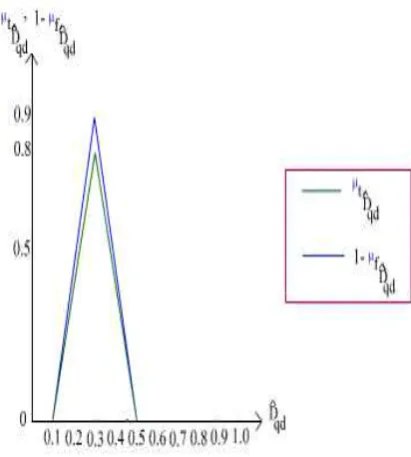
A company fixes MAPD as 6% and varying AQL from 1 to 5%. Therefore vague quality decision region is described as follows:
For the D�qd values obtained as 0.05, 0.04, 0.03, 0.02, 0.01, whose favourable degrees of freedom and negation of non favourable degrees of freedom are respectively 0.8, 0.9, we get using 0-cut and 1-cut , the vague value for quality decision region as
D�qd=<(0.01,0.03,0.05);0.8;0.9>. The following figure
depicts the vague quality decision region with
D�qd=<(0.01,0.03,0.05);0.8;0.9>.
Fig 5.1: Vague Quality Decision Region
Example 5.2.
A company fixes LQL as 10% and varying AQL from 4 to 8%. Therefore vague probability for quality region is described as follows:
For the D�qr values obtained as 0.06, 0.05, 0.04, 0.03, 0.02, whose favourable degrees of freedom and negation of non favourable degrees of freedom are respectively 0.8, 0.9, we get using 0-cut and 1-cut , the vague value for quality region as
D�qr =<(0.02,0.04,0.06);0.8;0.9>. The following figure
depicts the vague quality decision region with
D�qr=<(0.02,0.04,0.06);0.8;0.9>.
Fig 5.2: Vague Probability for Quality Region
VI.
CONCLUSION
This paper have presented the quality interval acceptance single sampling plan when the fraction of nonconforming items is a vague number. In this paper the quality interval acceptance sampling of the plan has been discussed by means of Vague Quality Decision Region and vague Probability of Quality Region, whose vague values depends on the ambiguity proportion parameter having a higher and lower bounds. Numerical Example was illustrated for vague quality decision region and vague probability of quality region whose values are represented by a vague triangular set.
REFERENCES
[1] T. K. Chakraborty,, A class of single sampling plans based on fuzzy optimization, Opsearch,29(1), 11-20, 1992.
[2]T. K. Chakraborty, Possibilistic parameter single sampling inspection plans, Opsearch, 31(2), 108-126, 1994a.
[3]E.G. Schiling, Acceptance Sampling Quality Control Dekker, New York 1982.
[4] H. Ohta ,H. Ichihashi Determination of single-sampling attribute plans based on membership function, Int. J. Prod, Res 26, 1477-1485,1998,.
171 Copyright © 2011-15. Vandana Publications. All Rights Reserved.
Eds. Wilrich P. Th. Lenz H. J. Springer, Heidelberg, PP. 36- 46, 2001 b.
[7] P. Grzegorzewski A soft design of acceptance sampling plans by variables, in: technologies for contrueting intelligent systems, Eds, speringer, vol. 2. pp. 275-286, 2002.
[8] A. Kanagawa and H. Ohta, A design for single sampling attribute plan based on fuzzy sets theory, Fuzzy Sets and Systems, 37, 173-181, 1990.
[9] Chen., and Shyi-Ming., “Analysing Fuzzy System Reliability using Vague Set Theory”, International Journal of Applied Science and Engineering, Vol 1:No.1, 82 – 88, 2003.
[10] Lu.A and Ng.W., “ Managing Merged Data by Vague Functional Dependencies”, Proceeding of Conceptual Modeling ER – 2004, 259 – 272, 2004. [11] Lu. A and Ng.W., “ Vague Sets or Intuitionistic Fuzzy Sets for Handling Vague Data which one is better”, Proceeding of Conceptual Modeling ER – 2005, 401 – 416, 2005.