Modelling competency standards to facilitate accreditation:
a pathways perspective
Geoffrey G. Roy
Edith Cowan University, Perth, Australia [email protected]
Jocelyn Armarego Murdoch University, Perth, Australia
Abstract: Accreditation forms the basis of many professional societies, with members able to present themselves as competent to provide a range of services. Within Engineering in Australia, there is growing interest in developing formalized processes with international recognition. Current interest in accreditation management includes development of a methodology to map between curricula of engineering programs and the appropriate competency standards, as well as assessment of the education and experience of those not undertaking accredited programs. An additional incentive is the increase in diversity of education pathways into the engineering workforce, which need to be assessed. This paper focuses on the achievement of Engineers Australia’s Stage 1 Competency as a Professional Engineer. The goal of the paper is to offer a proposal for a process that can be used to document and analyse complex competency frameworks. We show that the modelling process can identify whether the assessed elements are sufficient to achieve accredited status or highlight areas requiring further development. The value of this work is the relative ease with which a program or a person may be assessed against the competency standard, once a suitable model has been developed.
Introduction
Pathways into the engineering profession in Australia are defined by Engineers Australia (EA). There are three levels of recognition: Professional Engineer, Engineering Technologist and Engineering Associate. These levels are also recognized internationally through the Washington, Dublin and Sydney Accords respectively (International Engineering Alliance, 2011).
There are two particularly important areas of accreditation management that require detailed examination, viz the development of:
• A methodology for academic institutions to implement their own assessment procedures. These can also be used to document and support their curriculum design and management procedures, and as well assisting with the development of accreditation documentation for EA. This interest is also being driven by initiatives from within the Australian Government (e.g. AQF (AQF Council, 2001) and TEQSA (DEEWR, 2009)) as well as individual universities anxious to provide improved processes to achieve required graduate outcomes;
• A process that will permit persons who do not hold an EA-accredited qualification to present their claim for accreditation or to increase their professional standing based on an assessment of their prior qualifications and work experience. This process should also be able to identify areas of non-compliance that may be able to direct candidates towards additional studies or work experience that would then allow them to meet the accreditation requirements.
Pathways in Engineering Education in Australia
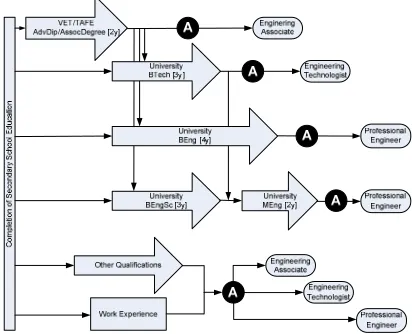
conditions that can be applied to them, while the titles given to various courses should be taken as
being generic only. The key points of assessment (from EA) are indicated by the symbol.
Figure 1: Schematic of Engineering Education Pathways (adapted from Godfrey & King (2011) p ix) One of the barriers identified in an ALTC report on Engineering (Godfrey & King, 2011) as hampering the operation of some of the pathways, as indicated in Figure 1, is the need to assess the quality of prior engineering learning with the accreditation standards of the degree to be undertaken. Therefore, while there are often defined pathways to allow persons to progress from one qualification to another, these are generally not automatic, and depend on individual assessments.
This paper proposes a process by which a course or a person can be mapped against the accreditation standard. Once appropriate models have been developed, a variety of analyses can be used to inform the status of the claims for accreditation as well as curriculum development and individual study planning.
The assessment of a program of study that is to be accredited by EA addresses a wide range of criteria including the resources (physical, financial and staffing) that the institution can provide to support the program. The underlying primary criteria are described in the Stage 1 Competencies (Engineers Australia, 2011) as outlined in Table 1, for the Professional Engineer in this case. Each of these competency statements is further subdivided into a number of competency elements that provide a more detailed set of competency items (80 or so all up). There are similarly structured frameworks for the Engineering Associate and the Engineering Technologist.
Table 1: Engineers Australia Stage 1 Competencies for Professional Engineers (summary)
1. KNOWLEDGE AND SKILL BASE
1.1. Comprehensive, theory based understanding of the underpinning natural and physical sciences and the engineering fundamentals applicable to the engineering discipline.
1.2. Conceptual understanding of the, mathematics, numerical analysis, statistics, and computer and information sciences which underpin the engineering discipline.
1.3. In-depth understanding of specialist bodies of knowledge within the engineering discipline. 1.4. Discernment of knowledge development and research directions within the engineering discipline. 1.5. Knowledge of contextual factors impacting the engineering discipline.
1.6. Understanding of the scope, principles, norms, accountabilities and bounds of contemporary engineering practice in the specific discipline.
2. ENGINEERING APPLICATION ABILITY
2.1. Application of established engineering methods to complex engineering problem solving. 2.2. Fluent application of engineering techniques, tools and resources.
2.3. Application of systematic engineering synthesis and design processes.
2.4. Application of systematic approaches to the conduct and management of engineering projects.
3. PROFESSIONAL AND PERSONAL ATTRIBUTES
3.1. Ethical conduct and professional accountability
3.2. Effective oral and written communication in professional and lay domains. 3.3. Creative, innovative and pro-active demeanour.
While the competency elements provide the primary assessable items, they are often quite broad and not always easily measurable. The items provide more specific examples of how elements might be demonstrated and are hence more easily assessed. It is our view that it may be easier to assess at the item level, and then aggregate to the elements for the required holistic assessment advocated by EA.
It needs to be emphasized that program accreditation goes much further than just an assessment of the curriculum. In particular it includes an evaluation of the commitment and the capability of the institution to deliver the academic program in an effective way and at an appropriate standard. In this paper we limit our interest to the curriculum aspects.
For persons seeking accreditation without having completed a recognized (by EA) program of study, or wishing to establish appropriate prior knowledge or skill from work experience or studies in the VET sector, the Stage 1 Competencies become the primary criteria. This means that the required competencies need to be formally assessed from a portfolio that could provide the evidence. This may include completed units of study, completed non-accredited courses, work episode reports and other substantive documentation of prior knowledge and work experience.
In both situations the requirements set out by EA provide some flexibility in interpretation and application. In particular EA (Engineers Australia, 2003) does not require that every competency element must be demonstrate in every detail, but rather in a holistic way.While the current model of accreditation operated by EA provides for flexible approaches to the style and operational pedagogies of teaching programs, what is not as clear are the approaches that can be used to facilitate the preparation and submission of documentation for assessment for accreditation, and how the assessments are actually carried out.
It is understood that there are value judgments to be made, and reasonably so given the complex nature of the assessment processes and the range of knowledge and skills required. To improve the potential for persons in the various pathways to achieve accreditation, it is very desirable that the accreditation processes be better defined and supported.
Measurement of Competency
In our view competency is best described as the ability to perform a given task in a given context and the capacity to transfer knowledge and skills to new tasks and situations – the skilled application of understanding (Mayer, 1993). This is more than simply the capacity to perform a specific task.
Taking this view implies that competencies can exists, or be developed, at different levels.
Competencies thus exist on a scale of achievement, consistent with scales of learning outcomes that have been described by Bloom (1956) and Dreyfus & Dreyfus (1980) , among many others in the area of learning theory.
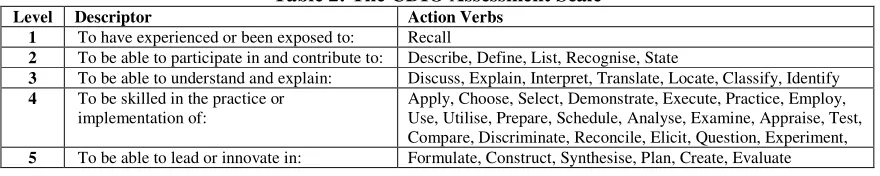
The definition of these scales is usually built on sets of chosen verbs, or verb phrases (descriptors) that attempt to delineate the different levels on the scale for the domain of knowledge being assessed. It is also usual that the scales are ordinal to facilitate mapping to a small range of outcome levels. There are various approaches, with the CDIO model (Crawley, 2001) often adopted as a workable example for use in an engineering context. This scale has five levels as shown in Table 2, with a level of 5 interpreted as being demonstrated by an experienced engineer, perhaps after 3 or 4 years of post-graduation work experience, and hence would rarely be achieved in an undergraduate course of study. Each descriptor includes one, or more, action verbs that further characterise and discriminate the levels of achievement.
Table 2: The CDIO Assessment Scale
Level Descriptor Action Verbs
1 To have experienced or been exposed to: Recall
2 To be able to participate in and contribute to: Describe, Define, List, Recognise, State
3 To be able to understand and explain: Discuss, Explain, Interpret, Translate, Locate, Classify, Identify
4 To be skilled in the practice or implementation of:
Apply, Choose, Select, Demonstrate, Execute, Practice, Employ, Use, Utilise, Prepare, Schedule, Analyse, Examine, Appraise, Test, Compare, Discriminate, Reconcile, Elicit, Question, Experiment,
A Formal Framework
A competency framework is generally defined as a hierarchical tree structure, or ontology, of competency items. The competency tree can be described as a simple directed acyclic graph containing nodes with children (i.e. sub-trees), and nodes without children , (i.e. the most elemental statements of competency). This is defined:
| Eq ( 1 )
The sources that may contribute to a competency framework ( ) might represent the units of study included in a program, or the career episode reports that document the work experience of a person, or some combination of both. The sources map to the competencies, with a strength of the mapping defined on a monotonic ordinal scale 0,1..N:
, Eq ( 2 )
A zero value means that there is no contribution from the source to the competency. A value in the range 1..N would represent a level on the chosen assessment scale. Note that the mapping is taken to be bidirectional, so that it implies:
Eq ( 3 )
This definition provides the capability to identify both forward and backward traces in the mapping, which are important for auditing purposes. Tracing provides the capability to demonstrate evidence of which sources contribute to each competency (a backward trace), and which competencies the sources contribute to (a forward trace).
The goal in the mapping process is to produce an estimate of if, and how, each competency is achieved (and at what level of achievement) from the set of contributing sources. In attempting to make this judgment some process of aggregation is required. We can now define the achieved competency value (V) for each competency element when aggregated over a set of sources:
! " max ! Eq ( 4 )
where the values (V) are assessed on a monotonic ordinal N-point scale with the conditions that each competency makes an approximately equivalent contribution to the whole framework; each source is assessed on the same achievement scale; and if a competency is achieved at some level in at least one source then it is achieved at that level in an overall sense.
The final aspect of this development is to establish the required benchmark for achievement, for which we will use term target. The target values are those set by the accrediting authority. Typically these are described within the competency framework using the descriptors discussed earlier. With these descriptors, and the chosen assessment scale, we need to arrive at a set of target values &, to match the set of competency elements . This process requires both teaching and discipline expertise and will use the chosen descriptors to identify the appropriate level on the assessment scale as a guide. With these target values in place then we can say that a nominated competency element is satisfied if:
V C)*! + V T)*! Eq ( 5 )
This gives the primary assessment criterion for the course or persons being assessed for accreditation.
Charting and Auditing Aggregated Assessments
(a) (b)
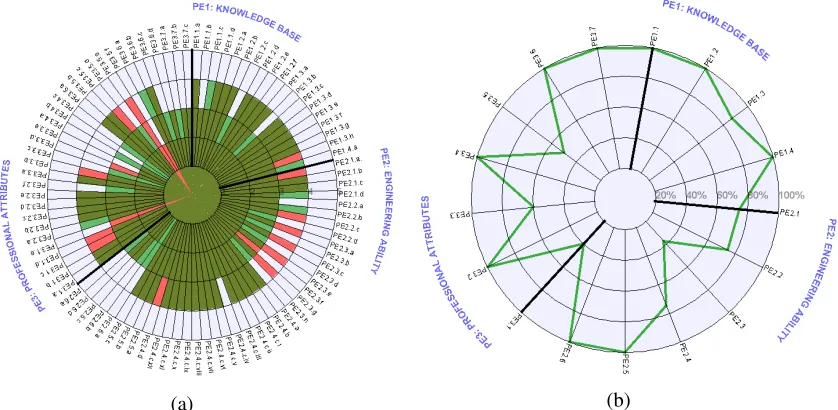
Figure 2: (a) The Competency Profile, (b) The Compliance Chart
Figure 2(a) illustrates a composite competency profile chart showing how an example program assessment matches a required target profile. The items assessed in this case are the sub-components of those listed previously in Table 1. The data used here has been generated from an analysis of a course of study for a BEng degree: the targets being an interpretation of the EA requirements and the actual achievements from a detailed analysis of all units comprising the program. The exposed red items indicate which competencies are less than the required targets; the pale green items indicate where the targets have been exceeded by the assessed sources. Another paper in these proceedings (Rassau & Roy, 2011) provides an example of how this type of data can be prepared.
Another way of measuring how well a program satisfies the required competency framework is to define a measure of compliance. The concept of compliance is to measure, at one (or more) levels higher than the actual assessments (in the competency tree), how well the competency framework is satisfied by the assessments. We can define compliance formally:
- C./! "
n 1C)*| V C)*! + V T)*!2 n3C)*4 · 100%
Eq ( 6 )
where the set of elements are the children of the node in the competency tree. The resulting compliance chart is shown in Figure 2(b), with compliance computed at level 2 in the EA competency framework. In this example the compliance chart indicates that out of the 17 aggregated competencies: 9 have 100% compliance (where the graph reaches the outer border of the chart); 4 have compliance between 75% and 90%; and 4 have compliance between 40% and 60%. Such a result may be judged to be acceptable in a holistic sense.
Summary
The modelling process presented here provides a range of support tools for curriculum-competency mapping. It will be through a mapping process like this that there will be opportunities to better support persons in the various pathways to accreditation and professional standing.
The example applications presented provide a clear picture of how well a course, or candidate, may meet the required performance or target for the competency framework. Given it is usual (as it is in the case of EA) for assessments for accreditation to be done in a holistic way, then we can expect that not all competency elements will need to be satisfied. Both the institutions seeking accreditation, and the assessors undertaking the task, need some guidance and support for this task. We suggest that the modelling process described in this paper may go some way towards this goal. This framework is able to present a consistent and repeatable assessment process and provides a clear set of outcomes for what might otherwise be less objective assessment task.
It also needs to be said that the effort required to develop a formal model as described in this paper is not insignificant. To be successful sufficient resource must be allocated to develop the model framework and to complete the assessments required. It is also most likely that assessments will be done by a team of people, including both academic and professional stakeholders, to provide the necessary moderation for a reliable outcome. The payoffs will appear if the model becomes an integral part of the long term planning and review processes and can be reused for subsequent accreditation projects. A completed formal accreditation exercise has demonstrated this competency mapping approach as providing a sound foundation for future program review, improvement and graduate outcome tracking.
References
AQF Council. (2001). Australian Qualifications Framework. 2011, from http://www.aqf.edu.au
Bloom, B. S. (1956). Taxonomy of Educational Objectives. Susan Fauer Co Inc.
Crawley, E. F. (2001). The CDIO Syllabus: A Statement of Goals for Undergraduate Engineering Education. Massachusetts Institute of Technology, Cambridge
DEEWR. (2009). Tertiary Education Quality and Standards Agency. Retrieved April, 2011, from http://www.deewr.gov.au/HigherEducation/Policy/teqsa/Pages/Overview.aspx
Dreyfus, S. E., & Dreyfus, H. L. (1980). A Five-Stage Model of the Mental Activities Involved in Directed Skill Acquisition. University of California, Berkeley
Engineers Australia. (2003). Australian Engineering Competency Standards. Engineers Australia , Canberra
Engineers Australia. (2011). National Generic Stage 1 Competency Standards. Engineers Australia , Canberra
Godfrey, E., & King, R. (2011). Curriculum Specification and Support for Engineering Education:
Understranding attrition, academic support, revised competencies, pathways and access. Australian Learning &Teaching Council, Sydney
International Engineering Alliance. (2011). Washington Accord. Retrieved June, 2011, from http://www.washingtonaccord.org
Mayer, E. (1993). Putting General Education to work: the key competencies. Australian Education Council, Committee to advise AEC and MOVEET. Australian Education Council
Rassau, A., & Roy, G. G. (2011). Profiling Graduate Outcomes for State 1 Professional Engineers. Paper presented at the AAEE 2011, Perth.