MURDOCH RESEARCH REPOSITORY
This is the author’s final version of the work, as accepted for publication
following peer review but without the publisher’s layout or pagination.
The definitive version is available at
McGill, T., Armarego, J. and Koppi, T. (2012) The
teaching-research-industry-learning nexus in information and
communications technology. ACM Transactions on Computing
Education, 12 (1).
Copyright: © 2012 ACM
The Teaching–Research–Industry–Learning Nexus in Information and
Communications Technology
TANYA MCGILL, Murdoch University
JOCELYN ARMAREGO, Murdoch University TONY KOPPI, University of Wollongong
The teaching-research nexus concept has been extensively examined in the higher education literature, and the importance of industry linkages in information and communications technology (ICT) education has also been widely discussed. However, to date there has been little recognition of the full extent of relationships between aspects of teaching, learning, research and industry and of the synergy possible from exploiting these relationships. Koppi and Naghdy [2009] introduced the concept of the teaching-research-industry-learning (TRIL) nexus in ICT education and this paper attempts to advance understanding of the concept by exploring the literature that underpins it. The paper contributes to a clearer understanding of the nature of the relationships involved as they apply to ICT education, and makes comprehensive recommendations to support strengthening the TRIL nexus in ICT education.
Categories and Subject Descriptors: K.3.2 [Computer and Information Science Education] General Terms: Human Factors
Additional Key Words and Phrases:
ACM Reference Format:
DOI =
1. INTRODUCTION
The teaching-research nexus concept has been extensively examined in the higher education literature [e.g. Griffiths 2004; Hattie and Marsh 1996], and has been touched on in various formal [e.g. White and Irons 2007; White and Irons 2009] and informal [e.g. Davis and White 2005; Reed et al. 2000] ways in the information and communications technology (ICT) literature. The importance of industry linkages in ICT education has also been widely discussed [e.g. Bruhn and Camp 2004; Koppi and Naghdy 2009]. However to date there has been little recognition of the full extent of relationships between aspects of teaching, learning, research and industry and of the synergy possible from exploiting these relationships.
Koppi and Naghdy [2009] first introduced the concept of the teaching-research-industry-learning (TRIL) nexus in ICT education. It emerged from the results of an Australian Learning and Teaching Council (ALTC) Discipline Scoping Study that included among its findings that ICT graduates and employers felt that graduates were not well prepared for industry, and that universities and industry should work together for a better curriculum. In addition, academics said they wanted better relations with industry. Thus, in addition to the well explored relationships between teaching and research, the importance of bringing industry into the mix was acknowledged.
Many ICT academics consulted in the Discipline Scoping Study [Koppi and Naghdy 2009] considered the notion of the TRIL nexus important, yet found it hard to articulate what the implications might be. Koppi and Naghdy argued that greater understanding of the concept was needed. They recommended that strengthening of the TRIL nexus would lead to curriculum improvements. This paper attempts to advance understanding of the concept by exploring the literature that underpins it. The broader academic literature is first briefly considered, followed by a focus on the TRIL concept in ICT education. The paper concludes with a discussion of the implications for practice of the TRIL nexus, and makes comprehensive recommendations to support strengthening the TRIL nexus in ICT education.
2. TRIL NEXUS LITERATURE
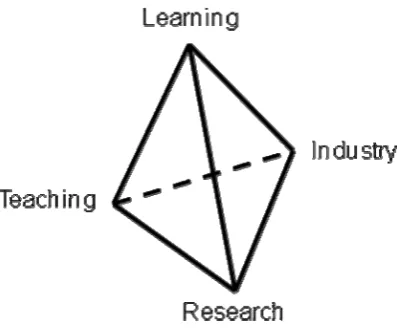
Fig. 1. The TRIL nexus depicted as a 3D tetrahedron to show each component connected to the others
2.1 Literature on the Relationship between Research and Teaching and Learning
The literature on the relationship between research and teaching and learning covers three main areas: definitions and categorizations of the teaching-research nexus concept; research exploring the relationships involved; and recommendations for achieving the benefits of fostering the teaching-research nexus. Each of these areas is elaborated on below.
A major problem in the discussion of the teaching-research component of the TRIL nexus is the variety of interpretations of the teaching-research nexus concept. The teaching-research nexus is often associated with the process of enriching teaching practice by including aspects of an academic’s current research, or that of colleagues, in order to support student learning and one’s teaching practice [Nexus Project 2001]. This suggests an embedding of ‘learning’ within teaching-research. However, the term has been used to represent many different forms of the concept. In their extensive review of the literature on the teaching-research nexus, Trowler and Wareham [2007] found that, although it was often unclear whether authors were referring to the influence on teaching and learning of students doing research, staff doing research, staff practices being informed by research, the curriculum being informed by contemporary research, and/or the research culture of a particular context, there were common features. They identified seven dimensions of use of the term ‘teaching-research nexus’. These include:
Learners do research
Teachers do research
Teachers and learners research together
Research is embedded in the curriculum
Research culture influences teaching and learning
The nexus, the university and its environment – where both teaching and research are linked into the commercial environment and local communities
Teaching and learning influences research - including increased focus on pedagogical
research.
They also suggested that the ‘educational ideology’ in relation to teaching (either in the discipline or in the school/department) will determine how the teaching-research nexus is defined.
Several researchers have developed models and categorizations to describe and differentiate between different forms of the teaching-research nexus. Boyer’s [1990] work on the scholarship of teaching introduced the relationship between research and teaching, with learning implied as an outcome of teaching. Shore, Pinker, and Bates [1990] supported this view and proposed that learning, as a shared process of inquiry, is the vital link between research and teaching.
Neumann’s [1992] analysis of interviews of academic administrators distinguished a nexus between teaching and research where the sum total of knowledge, expertise and skill acquired in the conduct of research of the academics provides the framework for what is taught and offered to undergraduate and postgraduate students. This nexus was identified as operating on three levels: the tangible nexus; the intangible nexus and the global nexus:
where the first point of contact with new developments is in the learning material presented to students
The intangible nexus relates to the development in students of a questioning approach and attitude towards knowledge
The global nexus describes the interaction between teaching and research at the school or department level, so that the research activity of the department determines the areas of broad concentration for teaching and the advanced specialist courses needed for students at the more senior undergraduate levels.
Griffiths [2004] further teased out the nature of the relationships involved by making the distinction between a direct relationship between the research of teachers and student learning, and broader, more diffuse ways of learning based on research experience, and noted that each may be embedded weakly or integrally in teaching. He also noted that the relationships may be uni- or bi-directional. For example, teaching can place academics’ research into broader contexts so that they remain in touch with broader developments in their discipline.
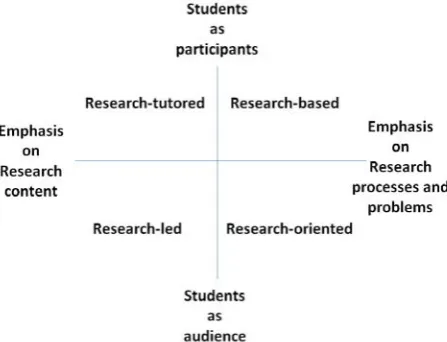
Building on the ideas of Griffiths [2004], Healey [2005] identified students as audience or participants, and the emphasis on research as content or process. A particular approach to integrating research and teaching can therefore be situated in one of these four quadrants. Figure 2 illustrates this comprehensive categorization.
Fig. 2. Students in the teaching-research nexus [Healey 2005]
Robertson [2007] addressed the strength of the relationship – from weak (teaching and research as separate tasks) through to transmission (enthusiasm and research results transmitted to students). A middle, hybrid, state emphasizes basic knowledge and first steps to research participation.
The type of literature described so far has contributed to a better understanding of the possible ways that research can interact with teaching and learning, it does not however provide evidence of the value of the teaching-research nexus.
Empirical studies of the teaching-research nexus have tended to be correlational studies that investigate links between research productivity in the form of publication counts and teaching effectiveness as measured by student ratings Several studies have undertaken meta-analyses of the results that have been published [Allen 1996; Feldman 1987; Hattie and Marsh 1996]. Whilst two of these suggest that there is a small positive correlation between research outcomes and teaching effectiveness, the study by Hattie and Marsh [1996] found that there was no relationship. Hattie and Marsh [1996] argued that ‘the common belief that teaching and research were inextricably entwined is an enduring myth’ (p. 529).
Whilst the empirical evidence is not overwhelming, the consensus of opinion in the literature is that strong benefits can flow from strengthening the relationship between research and teaching and learning. Hattie and Marsh [1996] conclude their meta-analysis article with a substantial list of recommendations to help universities strengthen the nexus between research and teaching. Other notable sources of recommendations on how the potential benefits can be achieved include those of Boyer Commission on Educating Undergraduates in a Research University [1998] and Jenkins and Healey [2005].
The Boyer Commission [1998] criticized research-intensive universities for not focusing on research as a core component of learning, and suggested making inquiry-based learning the standard. Their 10 recommendations included providing research opportunities for first-year students, enhancing oral and written communication, and educating graduate students as apprentice teachers.
Jenkins and Healey [2005] focused on the institutional level, and presented a comprehensive list of 18 strategies that address the following aspects of the linkage:
Developing institutional awareness and institutional mission
Developing pedagogy and curricula to support the nexus
Developing research policies and strategies to support the nexus
Developing staff and university structures to support the nexus.
It appears that universities are taking note: Brew [2010] reported that there has been a shift to more use of research-based curricula and increases in involvement of students in research at all levels. However, she acknowledged that the need to accommodate large numbers of students, particularly those from other countries and cultures, mitigates against this trend.
The literature discussed in this section highlights the many levels at which the teaching-research nexus can and should operate, reinforcing the complexity of the concept. Despite the lack of strong quantitative evidence to support the importance of the relationship between research and teaching [Hattie and Marsh 1996], the overwhelming consensus of opinion in the literature is that strong benefits can flow from strengthening the relationship. Recommendations such as those of the Boyer Commission [1998] with respect to student participation in research from the outset of their studies, and Hattie and Marsh’s [1996] strategies to enable teachers to facilitate better integration of teaching, learning and research, suggest some directions for achieving the potential benefits. Many authors have also identified the need for the integration of teaching and research strategies at both institutional and subject level, an approach intended to accommodate the particular cultures of subject disciplines [Boyer Commission on Educating Undergraduates in a Research University 1998; Lapworth 2004]. This discussion can be extended to consider the literature on the role of the industry component of the TRIL nexus.
2.2 Literature on the Industry Component of the TRIL Nexus
The quality of the relationships and resulting free flow of information are as, or more, important than the actual commercialization of a research product
Interactive partnerships are becoming the norm, rather than simple contractual
arrangements to develop a specific product
University and other forms of publicly-funded research provide the core support for knowledge transfer and innovation
While universities and industry are coming closer together, the distinctive qualities of each must be preserved
University-industry partnerships are increasingly regarded as an important policy instrument for regional development and are seen in an overall context of community engagement that extends from the local to the global
A more multi-disciplinary approach to university-industry relationships is emerging, along with recognition that social and cultural factors and the involvement of social scientists are also important in bringing about successful innovation.
An article in the Higher Education section of The Australian [Healy 2009] illustrates the concerns of peak business bodies that want closer links with academia in regard to the development of graduate capabilities. These interactions with industry have challenged academe to test the rhetoric that an industry-research nexus is crucial in an Australian context.
As one Australian example, the WIL report [Patrick et al. 2008] notes that, in their endeavours to extend the range of opportunities for students, Australian universities are currently exploring a range of authentic learning experiences (both within and outside of university settings). This is being undertaken through curriculum design that incorporates opportunities for students at both undergraduate and postgraduate level to engage with the professions through a range of approaches related to ‘real world learning’, ‘professional learning’ or ‘social engagement’. Undergraduate involvement with industry has largely focused on enabling smooth transitions from study into professional practice through provision for periods of workplace placements (e.g. WIL), and practicums, as well as industry-based projects [Boud and Solomon 2001].
Some of the key strengths of learning through workplace experiences that have been identified include the following [Billett 2001]:
Access to authentic work activities (both novel and routine)
Observation and listening (indirect guidance provided by the workplace itself and others in the workplace)
Access to more experienced co-workers (direct guidance – development of heuristics)
Practice (opportunities to reinforce, refine and hone).
This is despite a series of limitations to learning through practice that have been discussed [Billett 2001]:
Learning bad habits and dangerous or inappropriate shortcuts
The lack of opportunity to practise or extend
Lack of support and guidance
Undertaking tasks but not understanding what or why
Experiences that are personally or professionally confronting, and which inhibit the
development of positive occupational identity.
While postgraduate involvement with academic research may be considered the norm, little has been written about student involvement in research with industry. Geschwind [2007] describes a triangular relationship between industry, externally funded research projects and education. This relationship is presented as a win-win situation: students can participate in real, applicable research in close collaboration with industry. Many of the students also get their first job in the same firm, while the involved firms are content as they get skilled, motivated employees for a minimal cost, at the same time as they get their problems solved.
In effect, the greater involvement of industry in education can bring the four components of TRIL together by:
Enabling the development of industry relevant curricula
Providing more work-integrated learning and authentic (real-world) learning experiences for students, which would improve their employability
3. ICT EDUCATION AND THE TRIL NEXUS
Whilst the importance of relationships between teaching, learning, research and industry are recognized and discussed in the general higher education literature there has been less formal conceptualization of the relationships in the ICT domain. As with the broader literature the emphasis has primarily been on the teaching-research aspects of the TRIL nexus. White and Irons [2009] are amongst very few authors to at least touch on all components of the TRIL nexus. In addition to exploring the relationships between teaching and research in ICT higher education, they also briefly consider the role and value of internships where students work in R&D departments of companies. Similarly Grant and Wakelin [2009] extend their consideration of how research and scholarship inform teaching by considering the role of consultancy.
The next section discusses the ICT literature that relates to research aspects of the TRIL nexus, and is followed by a discussion of the literature relating to the industry aspects of the nexus. The papers discussed have been selected from widely available sources such as the ACM education journals and conferences, and are representative of the literature discussing aspects of the ICT TRIL nexus.
3.1 ICT literature on the relationship between research and teaching and learning
The categorization of approaches to integrating research into teaching proposed by Healey [2005] has been used in several studies of the teaching-research nexus in ICT education. White and Irons [2009] explicitly used it to classify the various examples of integration of research into teaching and learning provided by their participants. For example, classes where students are exposed to recent ICT research publications fall into the research-tutored category, and learning experiences where students are given a task that requires them to develop research skills are categorized as research-based.
Strazdins [2007] used three of Healey’s [2005] categories in his review of attempts to introduce research-based ICT education at the Australian National University: research-led, research oriented and research-based approaches. For example, he describes the introduction of a oriented bachelor of computer science degree, and the introduction of several research-led and research-based advanced courses. The research-oriented bachelor of computer science degree incorporated six advanced study courses that could include research projects with an academic supervisor. Research-led education was also featured in the Data Structures and Algorithms subjects via seminars, and in several other undergraduate and postgraduate courses.
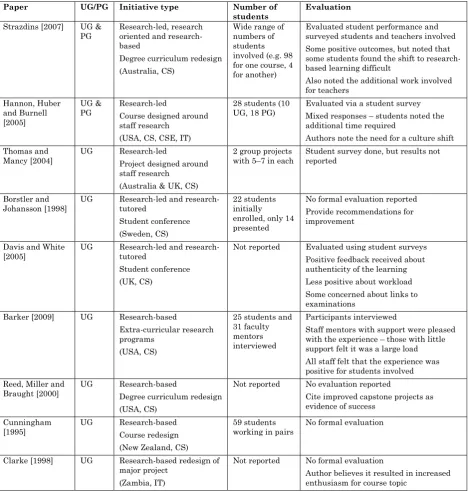
In addition to these attempts to formally classify innovations relating to the teaching- research aspects of the TRIL nexus, a wide range of examples of unclassified practices have been published in the ICT education literature. These cover the full range of types of ICT courses (from computer science to information systems and internetworking) and have been conducted in a wide range of countries. A number of these are discussed below, grouped using Healey’s [2005] categories; they are also summarized in Table 1.
The research-led category includes approaches where the teachers’ research is used to drive curriculum development. The purely research-led category is not well represented in the literature, most likely because it is the least innovative of the categories [Healey 2005] and therefore the least likely to be published. However, one example is provided by Hannon, Huber and Burnell’s [2005] development of a course on smart home technologies. This course was co-taught by faculty from two universities and offered to upper undergraduate, and beginning postgraduate students. The overlapping areas of expertise of the faculty allowed coverage of the broad range of advanced topics in the course.
Thomas and Mancy’s [2004] integration of their large database research into final year capstone projects is another purely research-led example. The two student projects they describe exposed students to the cutting edge research interests of the authors. As the software prototypes developed by the students were later used for research purposes, there was also a clear benefit to research. However, the student projects were not intended to teach the process of research.
initiatives can also be considered to be research-tutored, as the students engaged with the research via their writing and presentations.
Table 1: Examples of published ICT initiatives addressing the research, teaching and learning components of the TRIL nexus
Paper UG/PG Initiative type Number of
students Evaluation
Strazdins [2007] UG & PG
Research-led, research oriented and research-based
Degree curriculum redesign (Australia, CS)
Wide range of numbers of students involved (e.g. 98 for one course, 4 for another)
Evaluated student performance and surveyed students and teachers involved Some positive outcomes, but noted that some students found the shift to research-based learning difficult
Also noted the additional work involved for teachers Hannon, Huber and Burnell [2005] UG & PG Research-led
Course designed around staff research
(USA, CS, CSE, IT)
28 students (10 UG, 18 PG)
Evaluated via a student survey Mixed responses – students noted the additional time required
Authors note the need for a culture shift Thomas and
Mancy [2004]
UG Research-led Project designed around staff research
(Australia & UK, CS)
2 group projects with 5–7 in each
Student survey done, but results not reported
Borstler and Johansson [1998]
UG Research-led and research-tutored
Student conference (Sweden, CS)
22 students initially enrolled, only 14 presented
No formal evaluation reported Provide recommendations for improvement
Davis and White [2005]
UG Research-led and research-tutored
Student conference (UK, CS)
Not reported Evaluated using student surveys Positive feedback received about authenticity of the learning Less positive about workload Some concerned about links to examinations
Barker [2009] UG Research-based
Extra-curricular research programs
(USA, CS)
25 students and 31 faculty mentors interviewed
Participants interviewed
Staff mentors with support were pleased with the experience – those with little support felt it was a large load All staff felt that the experience was positive for students involved Reed, Miller and
Braught [2000]
UG Research-based Degree curriculum redesign (USA, CS)
Not reported No evaluation reported
Cite improved capstone projects as evidence of success
Cunningham
[1995] UG Research-based Course redesign
(New Zealand, CS)
59 students
working in pairs No formal evaluation
Clarke [1998] UG Research-based redesign of major project
(Zambia, IT)
Not reported No formal evaluation
Author believes it resulted in increased enthusiasm for course topic
Research-based initiatives are those where students learn by directly undertaking research. These are often combined with research-oriented approaches where the curriculum emphasizes the processes by which knowledge has been produced. A study by Russell [2006] found that students in computer science were only half as likely to have had hands-on research experiences as students from other sciences while at undergraduate level (e.g. 37% in computer sciences versus 72% in chemistry and 74% in environmental science). It is therefore essential that ways to effectively improve this are explored.
throughout the curriculum. This large scale redesign is similar to the effort described by Strazdins [2007], and both include research-oriented aspects in support of the research-based changes. Barker [2009] reports on two approaches that have been supported by the Computing Research Association’s Committee on the Status of Women (CRA-W): a 10 week program in which participants get involved in research at other universities, and a year long program in which students work with researchers at their own university. Both these programs target female undergraduate computer science students.
Cunningham [1995] and Clarke [1998] describe smaller scale research-based undergraduate courses or projects that involve students designing and conducting experiments. In Cunningham’s course students designed, conducted, and wrote up bibliometric experiments in order to gain experience with the scientific method and to encourage familiarity with both the scientific publishing process and the ICT research literature. Clarke used experiments to teach an empirical approach to designing human computer interaction (HCI).
This survey of the literature on the teaching-learning-research aspect of the TRIL nexus highlights several issues. Firstly it is clear that a wide range of approaches to strengthening the teaching-learning-research aspects of the TRIL nexus have been tried. These include research-led, research-tutored, research-based and research-oriented approaches. The main types of initiatives that have been reported are:
Redesign of degrees to incorporate more research-led and research-based education [e.g. Reed, Miller and Braught 2000; Strazdins 2007]
Development of new research-led courses [e.g. Hannon, Huber and Burnell 2005; Strazdins 2007; Thomas and Mancy 2004]
Introduction of student conferences [e.g. Borstler and Johansson 1998; Davis and White 2005]
Establishment of programs that supplement traditional degree structures by allowing
participants to get involved in research at either their own or other universities [e.g. Barker 2009]
Development of individual research-based courses [e.g. Clarke 1998; Cunningham 1995]. It also appears that the majority of initiatives that have been published relate to undergraduate rather than postgraduate students. This, however, is presumably not because undergraduate initiatives are more common, but rather because they are less common, and hence seem more worthy of sharing via publication. ICT academics expect postgraduate students to be exposed to research, but the recommendation of the Boyer Commission [1998] that students engage with research from the outset of their undergraduate studies has not been widely adopted in ICT education. White and Irons [2009] argue that the relationship may be considered more important in later years of study, but nevertheless suggest that active curriculum development should be undertaken to strengthen linkages in the early years of ICT study. Although the first two years are often very full of technical content, consistent with the Boyer Commission’s [1998] recommendations they argue that the groundwork for analysis and critical thinking needs to be laid early, and that this is best facilitated via the integration of research into teaching and learning.
It is notable that whilst all the studies that have been reviewed perceive positive outcomes from the initiatives, many have not undertaken any form of formal evaluation (see Table 1). This makes it difficult for others wishing to use similar teaching and learning approaches to plan and implement the most effective initiatives. In order to allow others to successfully build upon these published initiatives authors should attempt to include formal evaluations.
A further issue apparent from Table 1 is that the numbers of students involved in these reported initiatives are either small or not mentioned. The small numbers of students involved raises the issue of whether the initiatives are likely to be sustainable with larger groups. Whilst research-led teaching may scale well, Strazdins [2007] comments on the view of some academics that it can be hard and time consuming to establish research-based assignments, and to get students working in groups on them. This is particularly the case when student numbers are large, and teaching loads are high. This additional effort is compounded by lack of reward for the supervisor if the time available for the research project is too short or the students are not adequately prepared to undertake research. It is important that the time commitment required is acknowledged and catered for.
with research. This was noted for both research-led and research-based initiatives. Some students were concerned about additional demands on their time [Davis and White 2005; Hannon, Huber and Burnell 2005], and about how their research activities related to traditional assessments such as exams [Davis and White 2005]. Strazdins [2007] notes that a research-based ICT education may not be suitable for all students, especially those of lower ability and at lower undergraduate levels, but Hannon, Huber and Burnell [2005] argue that a gradual culture shift is required, so that all students feel comfortable with the new approaches.
Despite these concerns, the consensus of those ICT academics who have attempted various forms of integration of research into their teaching and their students’ learning appears to be that, if the integration is done well, the benefits in terms of higher quality pedagogical outcomes and enhanced student and academic experience are considerable. These benefits can include increased enthusiasm and confidence, increased awareness and understanding of the discipline, and increased likelihood of pursuing postgraduate graduate studies [Barker 2009; Strazdins 2007]. It is, however, essential that further work is undertaken to determine the most effective ways to strengthen the teaching-research aspects of the TRIL nexus, and to explore how integration is accomplished effectively.
3.2 ICT literature on the industry component of the TRIL nexus
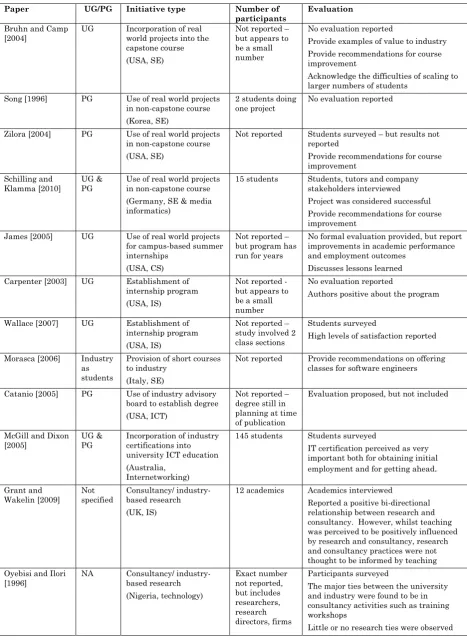
As previously mentioned, the establishment of industry links of various forms is generally assumed to have a positive impact on learning [Billett 2001; Geschwind 2007]: ICT graduates, academics and industry all recognize the value of greater industry involvement [Koppi and Naghdy 2009]. There has, however, been little formal consideration of, or attempts to categorize, these types of interactions in the ICT domain. This section considers a wide range of approaches that have been attempted, and reviews published articles describing attempts to implement the various kinds of industry links, as well as several that review the extent or success of such initiatives. These initiatives involve a wide range of types of ICT courses and have been conducted in a range of countries. The articles are also summarized in Table 2.
The argument has been made that students can be disadvantaged if their teachers don’t also undertake research (or at least keep up with research developments). But equally, as industry initiates so many of the developments in ICT, if the relationship with industry is neglected, students and academics may not be exposed to the latest developments. There are many examples in the literature of approaches to exposing students to various aspects of industry by providing some form of WIL (e.g. work placements, real-world experiences or industry related projects). Central to these approaches are team based projects. These may either be contrived to simulate the kinds of projects encountered in industry, or may be real-world projects from companies, universities, government departments or community organizations. An example of incorporation of real world projects into an undergraduate capstone course is provided by Bruhn and Camp [2004]. In this initiative an industry advisory board was used to help source projects, and the authors recommend this approach. Real world projects can also be incorporated into other courses at both undergraduate and postgraduate levels. Song [1996] and Zilora [2004] both describe initiatives where postgraduate students undertake software development for clients from industry as part of programming courses, and Schilling and Klamma [2010] report on a project management course where both undergraduate and postgraduate students develop prototype systems for clients from industry. James [2005] discusses a long standing initiative that allows students to take a summer campus-based internship where they work on projects for industry. All authors are positive about the benefits from such projects, which accrue to students who gain professional skills; industry which gains products; and academic staff who gain experience aligning curriculum with industry needs. It appears, however, that management of student projects for industry imposes significant burdens on faculty [Bruhn and Camp 2004; James 2005].
has also advocated a national internship scheme for enhancing the skills and work-readiness of Australian university graduates.
Table 2: Examples of publications addressing the industry, teaching and learning components of the TRIL nexus
Paper UG/PG Initiative type Number of
participants Evaluation Bruhn and Camp
[2004]
UG Incorporation of real world projects into the capstone course (USA, SE)
Not reported – but appears to be a small number
No evaluation reported
Provide examples of value to industry Provide recommendations for course improvement
Acknowledge the difficulties of scaling to larger numbers of students
Song [1996] PG Use of real world projects in non-capstone course (Korea, SE)
2 students doing
one project No evaluation reported
Zilora [2004] PG Use of real world projects in non-capstone course (USA, SE)
Not reported Students surveyed – but results not reported
Provide recommendations for course improvement
Schilling and
Klamma [2010] UG & PG Use of real world projects in non-capstone course (Germany, SE & media informatics)
15 students Students, tutors and company stakeholders interviewed Project was considered successful Provide recommendations for course improvement
James [2005] UG Use of real world projects for campus-based summer internships
(USA, CS)
Not reported – but program has run for years
No formal evaluation provided, but report improvements in academic performance and employment outcomes
Discusses lessons learned Carpenter [2003] UG Establishment of
internship program (USA, IS)
Not reported - but appears to be a small number
No evaluation reported
Authors positive about the program
Wallace [2007] UG Establishment of internship program (USA, IS)
Not reported – study involved 2 class sections
Students surveyed
High levels of satisfaction reported
Morasca [2006] Industry as students
Provision of short courses to industry
(Italy, SE)
Not reported Provide recommendations on offering classes for software engineers
Catanio [2005] PG Use of industry advisory board to establish degree (USA, ICT)
Not reported – degree still in planning at time of publication
Evaluation proposed, but not included
McGill and Dixon
[2005] UG & PG Incorporation of industry certifications into university ICT education (Australia,
Internetworking)
145 students Students surveyed
IT certification perceived as very important both for obtaining initial employment and for getting ahead.
Grant and
Wakelin [2009] Not specified Consultancy/ industry-based research (UK, IS)
12 academics Academics interviewed
Reported a positive bi-directional relationship between research and consultancy. However, whilst teaching was perceived to be positively influenced by research and consultancy, research and consultancy practices were not thought to be informed by teaching Oyebisi and Ilori
[1996] NA Consultancy/ based research industry-(Nigeria, technology) Exact number not reported, but includes researchers, research directors, firms Participants surveyed
The major ties between the university and industry were found to be in consultancy activities such as training workshops
Experiences and issues associated with offering work placements as part of undergraduate ICT degrees have been discussed by Carpenter [2003] and Wallace [2007], with both authors reporting on the value of their initiatives. Internships for postgraduate students do not however appear to be common, with a search of the ACM Digital Library providing no articles describing postgraduate work placements, although these are known anecdotally.
Another kind of linkage between ICT academics and industry can be forged via the provision of courses to industry. Morasca [2006] describes his experiences with the development and teaching of courses on software engineering methods to industry and notes that such courses provide a good two-way communication channel between academia and industry, with benefits not only to industry personnel who take the courses but to the instructors who can gain good insights into current practices and future trends. Similarly, the establishment and use of industry advisory boards has the potential to provide benefits in terms of curriculum. Catanio [2005] describes the use of an industry advisory board to design a graduate course targeted specifically at meeting industry needs, and emphasizes the benefits gained. As discussed above, the value of industry advisory boards in providing support for sourcing of projects and internships for students is also clear.
Certification has become a popular adjunct to traditional means of acquiring ICT skills, with many employers specifying a preference for those holding either vendor specific (e.g. Cisco Certified Network Associate (CCNA)) or vendor neutral (e.g. Certified Information Systems Security Professional (CISSP)) certifications. Certifications are designed to provide targeted skills that have immediate applicability in the workplace. Previous research has considered the benefits and risks of certification and its importance in obtaining employment, both from the student perspective [McGill and Dixon 2005] and from a workplace perspective [Cegielski 2004; Cegielski et al. 2003]. In a study of 145 undergraduate and postgraduate students who were undertaking studies towards CISCO certifications as part of their degree studies, McGill and Dixon [2005] found that certification was perceived as very important both for obtaining initial employment and for getting ahead if currently employed in the ICT industry. The potential benefits that students believed were most important related to real-world experience. Because of the common requirement for instructors involved in teaching towards certifications to be certified, and to maintain certification, instructors are more tied in with industry partners than might otherwise be the case. Therefore, whilst the merit of incorporating certifications into ICT education at universities has been hotly debated, one of the benefits is the linkages it provides with industry.
Engagement of academic staff with industry outside the teaching-related arena may take the form of consultancy and/or industry-based research activity, often linked to a sabbatical [Grant and Wakeliin 2009]. These activities can enable industry and the public at large to have access to the stock of knowledge and expertise in the university. They also provide practical experience to staff and bring out the relevance of teaching and research to current industrial needs [Oyebisi and Ilori 1996]. Faculty members at universities have a unique opportunity to share their intellectual property with industry because they bring value through their in-depth investigative techniques, rigorous methods, and objectivity. Industry consulting is attractive because it allows faculty members to supplement their salary and gain industry expertise at the same time [Baker et al. 2008]. Based on interviews with ICT academics, Grant and Wakelin [2009] concluded that there is a positive bi-directional relationship between research and consultancy. However, whilst teaching was perceived to be positively influenced by research and consultancy, research and consultancy practices were not thought to be informed by teaching.
This survey of the literature on the teaching-learning-industry aspects of the TRIL nexus demonstrates that a wide range of approaches to strengthening the teaching-learning-industry aspects of the TRIL nexus have been used. The main types of initiatives that have been reported on are:
Incorporation of real world projects into courses [e.g. Bruhn and Camp 2004; James 2005; Schilling and Klamma 2010; Song 1996; Zilora 2004]
Establishment of work placement or internship programs [e.g. Carpenter 2003; Wallace 2007]
Use of industry advisory boards for curriculum development [e.g. Catanio 2005]
Provision of short courses to industry [e.g. Morasca 2006]
Several papers have also reported on the extent and value of ICT academics undertaking consultancy and industry-based research [e.g. Grant and Wakeliin 2009; Oyebisi and Ilori 1996].
Whilst the majority of descriptions of initiatives relating to the research-teaching-learning aspects of the TRIL nexus have been focused on undergraduate students, the literature on the industry aspect includes a range of both undergraduate and postgraduate initiatives. There appears to be a strong awareness of the value to both kinds of students.
Consistent with the studies reviewed in Section 3.1, the numbers of students included in the initiatives are often small (see Table 2), and whilst recommendations are usually included, little formal evaluation has been undertaken. This makes it difficult for others wishing to use similar teaching and learning approaches to plan and implement their initiatives effectively. In particular, the scalability of approaches needs further consideration. For example, several papers mention companies who were not able to provide internships or projects despite initial offers [Bruhn and Camp 2004; Schilling and Klamma 2010]. If problems like this occur in small scale initiatives the implications are serious for larger mainstreamed integration of these approaches. The value of industry advisory boards in addressing this issue is clear. Industry advisory boards provide a very valuable source of curriculum advice, projects, and sites for internships. This integral role is recognized by accreditation bodies such as the Accreditation Board for Engineering and Technology (ABET) in the U.S., and the Australia and New Zealand ICT Accreditation Board. In addition, several papers mention that management of student projects for industry entails significant burdens on faculty [Bruhn and Camp 2004; James 2005]. If this is occurring when initiatives are small scale, universities must address it in terms of workload.
As can be seen from the review presented in this section, the majority of published literature on the industry aspects of the TRIL nexus comes from ICT academics who have tried something and want to share their experience, rather than more rigorous research. Despite the lack of formal evaluation of the impacts of ICT industry connections on teaching, learning and research, the consensus appears to be that the establishment and maintenance of industry links is associated with positive outcomes for students, academics and industry. The benefits to students can include performance and employment outcomes [James 2005], and the benefits to academics can include opportunities to refresh their knowledge and access to research projects and funding [Grant and Wakeliin 2009; Oyebisi and Ilori 1996]. Industry can also benefit through obtaining access to academic expertise, and to promising graduates [Grant and Wakeliin 2009]. Whilst graduates, academics and industry all recognize the value of greater industry involvement [Koppi and Naghdy 2009], further research is, however, required to determine the most effective ways to realize these potential benefits.
4. RECOMMENDATIONS AND CONCLUSION
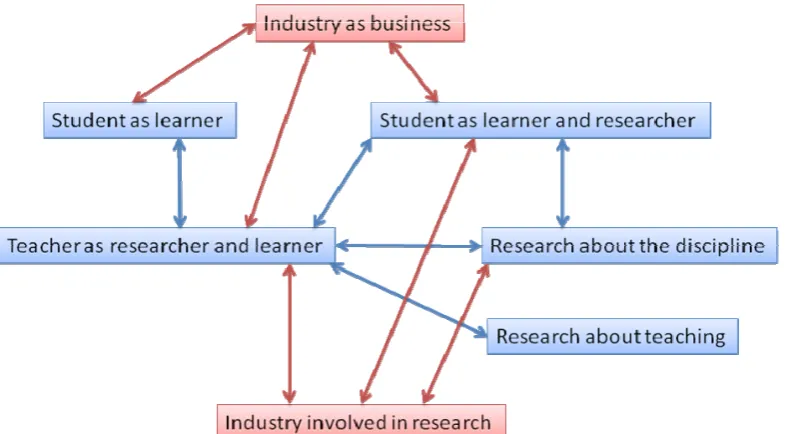
Concepts identified in the literature regarding the nexus between research and teaching and the involvement of industry are shown in Figure 3, which also shows some key connections between academia, industry, research and learning. There are numerous possible connections between these components, and it can be argued that the greater the connections, the richer the potential learning experience.
The review of the ICT literature on initiatives to strengthen aspects of the TRIL nexus presented in this paper has indicated that a substantial number of these connections are starting to be emphasized in a wide range of ICT schools around the world, but as is discussed below, further attention is needed to strengthen these relationships and obtain the potential benefits discussed in the literature.
approach is taken. The initiatives at the Australian National University that involved redesign of several degrees [Strazdins 2007] provide an exemplar of this approach. This kind of initiative should be extended to also include the industry aspects of the TRIL nexus.
Fig. 3. Connections between the TRIL components
Figure 3 shows that the academic teacher has the greatest number of connections, being involved in teaching and research and therefore also being a learner (learning being a product of research). Teaching may be about the discipline only (without including research) or include discipline research whereby student learning is about the discipline and research. The teacher may also undertake research into teaching, the outcome of which should promote student learning. One way in which research into teaching can promote student learning is if it leads to greater student exposure to research [Boyer Commission on Educating Undergraduates in a Research University 1998; Brew 2010; Hattie and Marsh 1996]. Teachers have been the drivers behind most of successful initiatives discussed in this paper, and they will most likely continue to be so. Sharing of information on initiatives and their evaluations is central to continued success. Paper such as those of Bruhn [2004] and Strazdins [2007] that provide an excellent discussion of the issues involved in successfully organizing initiatives contribute to this.
Industry is shown in Figure 3 to contribute to the learning of the student and teacher from both the industry and research perspectives, although the research is likely to be more applied and commercially focused. Industry itself also learns from the teacher, student and discipline-based research. The student projects described by Thomas [2004] provide an excellent example of the multi-directional nature of these relationships, with student projects not only benefiting students, but having clear benefits to research, as the products were used in research later.
The essential conclusion, as depicted in Figure 3, is that the connections between academia and industry, as identified from the literature review, reinforce learning and research in many and various ways and can provide a wide range of benefits to the people and organizations involved. A number of the papers considered in this study have made recommendations to help others undertake initiatives to strengthen aspects of the TRIL nexus. The following lists draw from these recommendations, and also include recommendations based on the analysis undertaken as part of this paper. The first list focuses on recommendations that are applicable to ICT courses of all sorts:
Where possible, consider the degree as a whole and redesign the degree, not just individual courses in isolation. In order to be truly successful initiatives should reach across the curriculum.
Build up from inquiry/problem-based approaches and teaching of research-related skills in earlier courses [Reed, Miller and Braught 2000; Strazdins 2007]. Research-based approaches can then be incorporated in the more advanced courses. Not all new students will have learning approaches that are consistent with the approaches described in this paper. These will however develop over time as the students progress through their degree.
The research and industry aspects of the TRIL should not be considered in isolation. Redesign efforts should attempt to integrate both, but a balance appropriate to the university and its stakeholders needs to be achieved. For example, research intensive universities may favor a stronger research focus, whereas universities with a more applied focus and stronger links to local industry may shift the balance toward industry.
Industry advisory boards should play a strong role in supporting attempts to strengthen the TRIL nexus. Their involvement is recognized as very important by accreditation boards. Their value includes curriculum and content advice, provision of guest lectures, and support in obtaining student projects and sites for internships.
In order to determine the most effective ways to strengthen the TRIL nexus, more sharing of innovative practices and their evaluations is needed. Seminars, conferences and scholarly papers all provide useful venues for this.
Many of the research-based, research-oriented and industry focused initiatives require
students to demonstrate strong teamwork skills. Active attention to this is important; therefore, teachers must proactively address team work skills [Zilora 2004].
Many of the approaches described in this literature review are labor intensive. Workload issues need to be addressed early to ensure success [Bruhn and Camp 2004; James 2005].
Sabbatical leave is currently a valuable tool for allowing staff to dedicate time to research activities. Extending this to allow academic staff to undertake consultancy or work in relevant enterprises will strengthen their ability to provide appropriate industry exposure to students [Oyebisi and Ilori 1996].
Having appropriate staff expertise is essential to the success of attempts to strengthen the TRIL nexus [Thomas and Mancy 2004]. Different academics will possess different degrees of research strength and different levels of interest and connection with industry. This needs to be taken into account, and built upon.
The following recommendations provide further more specific lower level advice relevant to particular approaches:
Strazdins [2007] recommends the following approach for designing research-based
assignments: first introduce the future frontiers of an area and relate them to the current state of the art. The assignment should then be designed to make progress towards the frontier.
It is not possible to cover all content in research-led courses to the same depth. Hannon, Huber and Burnell [2005] recommend that within each topic one area is selected to be covered in depth.
Hannon, Huber and Burnell [2005] recommend continuing to use a textbook in research-led courses where possible. The textbook will support the use of academic papers, which may be too advanced for students if used in isolation.
There is a need to allow sufficient time for students to undertake projects and assignments that are research or industry related. The ‘real life’ complexities require more ‘elapsed time’ to negotiate [Borstler and Johansson 1998; James 2005]. It is also essential that tasks are of a manageable size [Schilling and Klamma 2010; Strazdins 2007].
In order to maintain positive links with organizations that supply student projects, faculty must ensure that promises made to customers are met. This requires that faculty responsibilities are clearly defined, and workload issues are addressed [James 2005].
It is important to cater for part time students in work placement situations. Not all students are able to commit to full time off campus placements. Options must be considered to allow part time students to have a meaningful experience.
the relationships involved has emerged. As this paper has shown, the literature provides a wealth of studies that trial innovative approaches to strengthening the TRIL nexus. However there has been little formal evaluation of these approaches, and no direct comparisons with traditional approaches. Future research should address these aspects.
REFERENCES
ALLEN, M. 1996. Research productivity and positive teaching evaluations: Examining the relationship using meta-analysis. Journal of the Association for Communication Administration 2, 77-96.
BAKER, G.A., WYSOCKI, A.F., HOUSE, L.O. AND BATISTA, J.C. 2008. Industry-Academic partnerships - benefit or burden? International Food and Agribusiness Management Review 11, 1, 91-117.
BARKER, L. 2009. Student and faculty perceptions of undergraduate research experiences in computing. ACM Transactions on Computing Education 9, 1, Article 5.
BILLETT, S. 2001. Learning in the Workplace: Strategies for Effective Practice. Allen & Unwin, Sydney.
BORSTLER, J. AND JOHANSSON, O. 1998. The students conference - A tool for the teaching of research, writing, and presentation skills. In Proceedings of the 3rd Annual Conference on Integrating Technology into Computer Science Education ACM, Dublin City Unversity, Ireland, 28- 31.
BOUD, D. AND SOLOMON, N. 2001. Work-based Learning: A New Higher Education? Open University Press, Buckingham.
BOYER COMMISSION ON EDUCATING UNDERGRADUATES IN A RESEARCH UNIVERSITY 1998. Reinventing undergraduate education: A blueprint for American research universities, from http://naples.cc.sunysb.edu/Pres/boyer.nsf/.
BOYER, E.L. 1990. Scholarship reconsidered: Priorities of the professoriate. University of Princeton Press, Princeton. BREW, A. 2006. Research and teaching: beyond the divide. Palgrave Macmillan, London.
BREW, A. 2010. Imperatives and challenges in integrating teaching and research. Higher Education Research & Development 29, 2, 139-150.
BRUHN, R., E. AND CAMP, J. 2004. Capstone course creates useful business products and corporate-ready students. SIGCSE Bulletin 36, 2, 87-92.
CARPENTER, D.A. 2003. Meaningful information systems internships. Journal of Information Systems Education 14, 2, 201-209.
CATANIO, J.T. 2005. Developing LaSalle's IT graduate certificate program partnered with industry. In Proceedings of the 6th Conference on Information Technology Education ACM, Newark, NJ, USA, 19-23.
CEGIELSKI, C.G. 2004. Who values technology certification? Communications of the ACM 47, 10, 103-105.
CEGIELSKI, C.G., REBMAN, C.M. AND REITHEL, B.J. 2003. The value of certification: an empirical assessment of the perceptions of end-users of local area networks. Information Systems Journal 13, 1, 97-107.
CLARKE, M.C. 1998. Teaching the empirical approach to designing human-computer interaction via an experimental group project. SIGCSE Bulletin 30, 1, 198-201.
CUNNINGHAM, S.J. 1995. An introduction to research and the CS/IS professional literature for undergraduates. SIGCSE Bulletin 27, 4, 5-8.
DAVIS, H.C. AND WHITE, S. 2005. A research-led curriculum in multimedia: learning about convergence. In Proceedings of the 10th Annual Conference on Innovation and Technology in Computer Science Education ACM, Caparica, Portugal, 29-33.
FELDMAN, K.A. 1987. Research productivity and scholarly accomplishment of college teachers as related to their instructional effectiveness. Research in Higher Education 26, 3, 227-298.
GESCHWIND, L. 2007. Teaching, research and industry links – a case study of young higher education institutions in Sweden. In Proceedings of the International Colloquium: Policies And Practices For Academic Enquiry, Winchester, UK, from http://portal-live.solent.ac.uk/university/rtconference/2007/resources/lars_geschwind.pdf.
GRANT, K. AND WAKELIIN, S.J. 2009. Re-conceptualising the concept of a nexus? A survey of 12 Scottish IS/IM academics’ perceptions of a nexus between teaching, research, scholarship and consultancy. Teaching in Higher Education 14, 2, 133-146.
GRIFFITHS, R. 2004. Knowledge production and the research-teaching nexus: the case of the built environment disciplines Studies in Higher Education 29, 6, 709-726.
HAGAN, D. 2004. Employer satisfaction with ICT graduates. In Proceedings of the Sixth Australasian Computing Education Conference R. LISTER AND A. YOUNG Eds., Dunedin, New Zealand 119–123.
HANNON, C., HUBER, M. AND BURNELL, L. 2005. Research to classroom: experiences from a multi-institutional course in smart home technologies. In Proceedings of the 36th SIGCSE Technical Symposium on Computer Science Education ACM, St. Louis, Missouri, USA, 121-125.
HATTIE, J. AND MARSH, H.W. 1996. The relationship between research and teaching: a meta-analysis. Review of Educational Research 66, 4, 507-542.
HEALEY, M. 2005. Linking research and teaching:exploring disciplinary spaces and the role of the inquiry-based learning. In Reshaping the University: New Relationships between Research, Scholarship and Teaching, R. BARRETT Ed. Open University Press, Maidenhead, 67-78.
HEALEY, M., JORDAN, F., PELL, B. AND SHORT, C. 2010. The research-teaching nexus: a case study of students' awareness, experiences and perceptions of research. Innovations in Education and Teaching International 47, 2, 235-246.
HEALY, G. 2009. Business wants graduates who can cope. In The Australian: Higher Education Supplement, from http://www.theaustralian.news.com.au/story/0,25197,25201576-12332,00.html.
JAMES, R.H. 2005. External sponsored projects: lessons learned. SIGCSE Bulletin 37, 2, 94-98.
JENKINS, A. AND HEALEY, M. 2005. Institutional strategies to link teaching and research The Higher Education
Academy, York, U.K., from http://www.heacademy.ac.uk/assets/York/documents/resources/resourcedatabase/id585_institutional_strategies_to_li
nk_teaching_and_research.pdf.
JENKINS, A.J., BLACKMAN, T., LINDSAY, R.O. AND PATON-SALTZBERG, R. 1998. Teaching and research: student perceptions and policy implications. Studies in Higher Education 23, 2, 127-141.
KENNAN, M.A., CECEZ-KECMANOVIC, D., WILLARD, P. AND WILSON, C.S. 2008. IS knowledge and skills sought by employers: a content analysis of Australian IS early career online job advertisements. Australasian Journal of Information Systems 15, 57–78.
KOPPI, T. AND NAGHDY, F. 2009. Managing educational change in the ICT discipline at the tertiary education level, from
http://www.altc.edu.au/carrick/webdav/site/carricksite/users/siteadmin/public/grants_dbi_report_changeICT_uow_ma r09.pdf
LAPWORTH, S. 2004. Integrating research and teaching strategies: implications for institutional management and leadership. Perspectives: Policy and Practice in Higher Education 8, 4, 103-107.
LINDSAY, R., BREEN, R. AND JENKINS, A. 2002. Academic Research and Teaching Quality: The views of undergraduate and postgraduate students Studies in Higher Education 27, 3, 309-327.
MCGILL, T. AND DIXON, M. 2005. Information technology certification: A student perspective. International Journal of Information and Communications Technology Education 1, 1, 19-30.
MEEK, L. AND DAVIES, D. 2009. Policy dynamics in higher education and research: concepts and observations. In Higher Education, Research and Innovation: changing dynamics, V.L. MEEK, U. TEICHLER AND M.-L. KEARNEY Eds. International Centre for Higher Education Research, Kassel.
MORASCA, S. 2006. Courses for software professionals as two-way communication channels between academia and industry. In Proceedings of the Third International Summit on Software Engineering Education ACM, Shanghai, China, 25-28.
NEUMANN, R. 1992. Perceptions of the teaching-research nexus: a framework for analysis. Higher Education 23, 2, 159-171.
NEUMANN, R. 1994. The teaching-research nexus: applying a framework to university students' learning experiences. European Journal of Education 29, 3, 323-339.
NEXUS PROJECT 2001. Centre for educational development and interactive resources, University of Wollongong, from http://www.uow.edu.au/cedir/nexus/index.htm.
OYEBISI, T.O. AND ILORI, M.O. 1996. Industry-academic relations: an assessment of the linkages between a university and some enterprises in Nigeria. Technovation 16, 4, 203-209.
PATRICK, C., PEACH, D., POCKNEE, C., WEBB, F., FLETCHER, M. AND PRETTO, G. 2008. The WIL [Work Integrated Learning] report: a national scoping study Queensland University of Technology, Brisbane, from http://www.altc.edu.au/resource-wil-work-integrated-learning-griffith-2009.
PAULING, J.W. AND KOMISARCZUK, P. 2007. Review of work experience in a Bachelor of Information Technology. In Proceedings of the Ninth Australasian Computing Education Conference, Ballarat, Victoria, 125-132.
REED, D., MILLER, C. AND BRAUGHT, G. 2000. Empirical investigation throughout the CS curriculum. SIGCSE Bulletin 32, 1, 202-206.
ROBERTSON, J. 2007. Beyond the 'research/teaching nexus': exploring the complexity of academic experience. Studies in Higher Education 32, 5, 541-556.
RUSSELL, S.H. 2006. Evaluation of NSF support for undergraduate research opportunities: Synthesis report SRI
International, from
http://www.sri.com/policy/csted/reports/university/documents/URO%20Synthesis%20for%20Web.pdf.
SCHILLING, J. AND KLAMMA, R. 2010. The difficult bridge between university and industry: a case study in computer science teaching. Assessment & Evaluation in Higher Education 35, 4, 367-380.
SEROW, R.C. 2000. Research and teaching at a research university. Higher Education 40, 4, 449-463.
SHORE, B., PINKER, S. AND BATES, M. 1990. Research as a model for university teaching. Higher Education 19, 1, 21-35.
SMEBY, J.-C. 1998. Knowledge production and knowledge transmission: The interaction between research and teaching at universities. Teaching in Higher Education 3, 1, 5-20.
SONG, K.-S. 1996. Teaching software engineering through real-life projects to bridge school and industry. SIGCSE Bulletin 28, 4, 59-64.
STRAZDINS, P. 2007. Research based education in computer science teaching. In ANU Computer Science Technical Reports Australian National University, from http://cs.anu.edu.au/techreports/2007/TR-CS-07-05.html.
THOMAS, R.C. AND MANCY, R. 2004. Use of large databases for group projects at the nexus of teaching and research. In Proceedings of the 9th Annual Conference on Innovation and Technology in Computer Science Education ACM, Leeds, United Kingdom, 161-165.
TROWLER, P. AND WAREHAM, T. 2007. Re-conceptualising the 'teaching-research nexus'. In Proceedings of the Annual HERDSA Conference 2007: Enhancing Higher Education Theory and Scholarship, Adelaide, Australia.
TROWLER, P. AND WAREHAM, T. 2008. Tribes, territories, research and teaching: Enhancing the teaching-research nexus The Higher Education Academy, from http://www.heacademy.ac.uk/assets/York/Trowler_Final_Report.pdf UNIVERSITIES AUSTRALIA 2008. A national internship scheme: enhancing the skills and work-readiness of Australian
university graduates, from http://www.universitiesaustralia.edu.au/documents/publications/discussion/National-Internship-scheme-May08.pdf.
WALLACE, P. 2007. Using collaboration to provide students with an internship experience in an information systems course. Journal of Information Systems Education 18, 2, 145-148.
WHITE, S. AND IRONS, A. 2009. Relating research and teaching: learning from experiences and beliefs. In Proceedings of the 14th Annual Conference on Innovation and Technology in Computer Science Education ACM, Paris, France, 75-79.