The Thirty-Third AAAI Conference on Artificial Intelligence (AAAI-19)
Frame and Feature-Context Video Super-Resolution
Bo Yan,
∗Chuming Lin, Weimin Tan
School of Computer Science, Shanghai Key Laboratory of Intelligent Information Processing, Fudan University
{byan, cmlin17, wmtan14}@fudan.edu.cn
Abstract
For video super-resolution, current state-of-the-art ap-proaches either process multiple low-resolution (LR) frames to produce each output high-resolution (HR) frame separately in a sliding window fashion or recurrently exploit the pre-viously estimated HR frames to super-resolve the following frame. The main weaknesses of these approaches are: 1) sep-arately generating each output frame may obtain high-quality HR estimates while resulting in unsatisfactory flickering arti-facts, and 2) combining previously generated HR frames can produce temporally consistent results in the case of short in-formation flow, but it will cause significant jitter and jagged artifacts because the previous super-resolving errors are con-stantly accumulated to the subsequent frames.
In this paper, we propose a fully end-to-end trainable frame and feature-context video super-resolution (FFCVSR) net-work that consists of two key sub-netnet-works: local netnet-work and context network, where the first one explicitly utilizes a sequence of consecutive LR frames to generate local feature and local SR frame, and the other combines the outputs of local network and the previously estimated HR frames and features to super-resolve the subsequent frame. Our approach takes full advantage of the inter-frame information from mul-tiple LR frames and the context information from previously predicted HR frames, producing temporally consistent high-quality results while maintaining real-time speed by directly reusing previous features and frames. Extensive evaluations and comparisons demonstrate that our approach produces state-of-the-art results on a standard benchmark dataset, with advantages in terms of accuracy, efficiency, and visual quality over the existing approaches.
The goal in image and video super-resolution (SR) is to reconstruct a high-resolution (HR) image or video from its down-sampled low-resolution (LR) version. Super-resolution approaches commonly serve as an important step for a variety of computer vision applications including im-age and video compression (Li et al. 2017; Kappeler et al. 2016a), medical imaging (Yang et al. 2012), object recog-nition (Yang et al. 2018), satellite imaging (Demirel and Anbarjafari 2011), face recognition (Gunturk et al. 2003), etc. To recover high-frequency details, single image
super-∗
This work was supported by NSFC (Grant No.: 61772137; 61522202).
Copyright c2019, Association for the Advancement of Artificial Intelligence (www.aaai.org). All rights reserved.
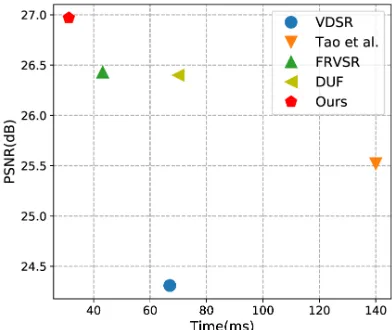
Figure 1: The proposed approach consistently outperforms state-of-the-art video super-resolution methods in terms of reconstruction quality and efficiency (x4 SR on Vid4).
resolution needs to fully exploit spatial statistics, while tem-poral correlations from multiple input frames are required to be exploited in order to improve reconstruction in the case of video super-resolution. Therefore, how to effectively ex-ploit temporal redundancies becomes the key issue for video super-resolution.
addition, such approaches have high computational cost be-cause each input frame is processed several times.
To address the above issues, (Sajjadi, Vemulapalli, and Brown 2018) proposed a frame-recurrent video super-resolution model that recurrently exploits the previously es-timated HR frames to super-resolve the subsequent frame. This approach is able to generate temporally consistent re-sult because the current super-resolving frame will refer to those previously HR estimates. However, only referring to previously inferred HR frames will produce significant jit-ter and jagged artifacts because the previous super-resolving errors are constantly accumulated to the subsequent frames. The above issues motivate us to develop a new approach for video super-resolution by introducing frame and feature as context to simultaneously improve the super-resolution quality and temporal consistency. Specifically, we design a novel end-to-end trainable video super-resolution frame-work that consists of two key sub-netframe-works: local netframe-work and context network. The local network explicitly utilizes a batch of LR frames to generate local feature and local SR frame. Then, the context network combines the outputs of local network and the previously estimated HR frames and features to super-resolve the subsequent frame, which guides the network learning alignment between frames to maintain consistency. This framework offers three advantages:
• The inter-frame information from multiple LR frames can be effectively exploited by local network to generate high-quality SR frames (local SR frame) and reference features (local feature) that provides the context network higher-quality data to work with.
• By utilizing the context information from previously pre-dicted HR frames and features and the outputs of local network, our framework naturally encourages the video super-resolution model to generate temporally consistent results, making it to learn alignment between SR frames.
• It has low computational cost due to its recurrent nature of using previous frames and features and no motion com-pensation block.
Benefiting from the property of combining context infor-mation from previous frames and features, the resulting ar-chitecture produces the most consistent results while con-taining finer details in each SR frame. Our model is fully convolutional and no other prior information such as optical flow estimation and motion compensation. To demonstrate the effectiveness of the proposed framework, we conduct ablation study for analyzing the importance of each compo-nent of our model. Besides, we compare our FFCVSR with several latest video super-resolution approaches and show that it produces state-of-the-art results on a standard bench-mark dataset, with advantages in terms of accuracy, speed, and visual quality over the existing algorithms (see Fig. 1). Furthermore, based on the characteristics of our framework, we propose a suppression-updating algorithm to effectively solve the problem of error accumulation of high frequency information. Finally, we also apply our trained model to real scenes to demonstrate its good abilities of generalization and practicability.
Related Works
Over the past decades, a large number of image and video super-resolution approaches have been developed, ranging from traditional image processing methods such as Bilin-ear and Bicubic interpolation to example-based frameworks (Timofte, De, and Gool 2014; Jeong, Yoon, and Paik 2015; Xiong et al. 2013; Freedman and Fattal 2011), self-similarity methods (Huang, Singh, and Ahuja 2015; Yang, Huang, and Yang 2010), and dictionary learning (Perezpellitero et al. 2016). Some efforts have devoted to study different loss functions for high-quality resolution enhancement (Sajjadi, Scholkopf, and Hirsch 2017). A complete survey of these approaches is beyond the scope of this work. Readers can refer to a recent survey (Walha et al. 2016; Agustsson and Timofte 2017) on super-resolution approaches for details. Here, we focus on discussing recent video super-resolution approaches based on deep network.
Benefiting from the explosive development of convolu-tional neural network (CNN) in deep learning, CNN based approaches have refreshed the previous super-resolution state-of-the-art records. Since (Dong et al. 2014) uses a sim-ple and shallow CNN to imsim-plement single super-resolution and achieves state-of-the-art results, following this fash-ion, numerous works have proposed various deep net-work architectures. Most of the existing CNN based video resolution approaches regard the task of video resolution as a large number of separate multi-frame super-resolution subtasks. They exploit a sequence of consecutive LR frames to generate a single HR estimate. (Kappeler et al. 2016b) uses an optical flow method to warp video frames LRt−1 andLRt+1 onto the frame LRt. Then, these three
frames are combined to feed into a CNN model that out-puts the HR frameSRt. Similar to (Kappeler et al. 2016b),
(Caballero et al. 2017) uses a trainable motion compensa-tion network to replace the optical flow method in (Kap-peler et al. 2016b). Following this fashion, Taoet al.(Tao et al. 2017) propose a network comprising motion estimation, motion compensation, and detail fusion to process a batch of LR frames and output HR estimate.
Different from the above mentioned approaches, (Sajjadi, Vemulapalli, and Brown 2018) proposes a frame recurrent video super-resolution (FRVSR) framework that combines the previous HR estimates to generate subsequent frame. This method warps the SRt−1 frame onto the SRt based
on the optical flow information estimated fromLRt−1and LRt. Then, it uses a trainable super-resolution network to
fuse the warpedSRt−1 andLRt, yielding theSRtframe.
Therefore, there are two loss items in their loss function, the mean squared error betweenSRtandHRt, and the warped
LRt−1andLRt. The FRVSR has advantage of producing
temporally consistent results in the case of short information flow, but it will cause jitter and jagged artifacts because the previous super-resolving errors are constantly accumulated to the subsequent frames.
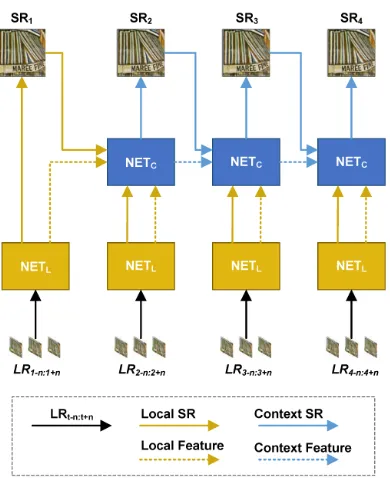
Figure 2: Overview of the proposed FFCVSR framework. It consists of two trainable components: local networkN ETL
(shown in yellow) and context networkN ETC (shown in
blue). The N ETL produces local frame SRLocalt and
lo-cal featureFLocal
t by processing a sequence of LR frames.
Then, theN ETCoutputs the super-resolved resultSRtand
an additional outputFt. During training, the loss is applied
on the output ofN ETL andN ETC, and back-propagated
through bothN ETLandN ETCfor jointly training them.
Method
To overcome the aforementioned problems, we pro-pose a frame and feature-context video super-resolution (FFCVSR) approach to reasonably combine both previ-ous frames and features for accurate and fast video super-resolution. We will dedicate to state the proposed approach in detail in following subsections.
FFCVSR Framework
1. Overview of the Proposed FFCVSR Framework:To better understand our FFCVSR, we start out with the intro-duction of FFCVSR architecture, as illustrated in Fig. 2. It consists of two trainable components: local networkN ETL
(shown in yellow) and context network N ETC (shown
in blue). Given a sequence of LR frames, the local net-work N ETL outputs local frame SRtLocal and local
fea-tureFLocal
t by exploiting inherent inter-frame information
in the form of local correlations, helping the following con-text networkN ETC to recover lost high-frequency details.
Considering the super-resolved results should maintain tem-poral consistency, the context networkN ETCnot only
ex-ploits the local frameSRLocal
t and previous SR frameSRt
but also combines the local featureFtLocaland previous SR feature Ft, yielding visually pleasing and temporally
con-sistent results. We will investigate the importance of each
component by performing ablation study in the experiment, providing several insights for further designing better video super-resolution approach. Note that our FFCVSR frame-work has no motion compensation module commonly used in previous methods, which has additional advantage of re-ducing the computational cost. This processing flow is sum-marized in Algorithms 1.
Algorithm 1 Frame and Feature-Context Video Super-Resolution
Input: A sequence of consecutive LR frames,LRt−n:t+n.
T is the updating step. T = 50 in our experiment. Output: Estimated high-resolution frame,SRt.
fort= 1→V ideoLendo ift == 1then
SRt←SRLocalt
Ft←FtLocal
else
(SRt, Ft)←N ETC(SRt−1, Ft−1, SRLocalt , FtLocal)
end if end for
%Suppression updating algorithm ift mod T == 0then
SRt−1←SRLocalt
Ft−1←FtLocal
else
SRt−1←SRt
Ft−1←Ft
end if
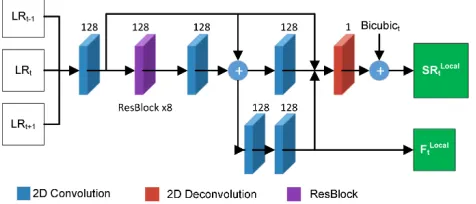
2. Architecture of Local Network:The proposed local networkN ETLis shown in Fig. 4. It exploits inherent
inter-frame information in the form of local correlations and out-puts local frame and feature by processing a sequence of LR frames. For demonstration convenience, we only show three consecutive LR frames including current frame that needs to be super-resolved. Our simple N ETL consists of
5 convolutions (kernel size=3×3, stride=1), 1 deconvolu-tion (kernel size=8×8, stride=4), and 8 ResBlocks (Lim et al. 2017). The ResBlock in purple (shown on the right side of Fig. 3) contains two convolutions with skip connection. We use the sum of the deconvolution result and the Bicubic interpolation result ofLRtas the outputSRLocalt . The
out-putFLocal
t is produced by adding a new side output with two
convolution operations. LetT = (LRt, HRt), t= 1, . . . , N
denotes the training data set, where LRt is the input LR
frame and HRt denotes the corresponding ground truth
high-resolution frame. We useWL to denote the collection
of all network layer parameters in N ETL. Thus, the local
frame and feature can be given by:
SRLocalt , FtLocal=N ETL(LRt−1, LRt, LRt+1;WL).
(1) 3. Architecture of Context Network:The proposed con-text network N ETC is shown in Fig. 3. It produces the
HR estimate SRt and feature Ft by exploiting the
Figure 3: Architecture of the proposedN ETC. It produces the HR frameSRtand featureFtby exploiting the context
informa-tion from previously predicted HR frames and features (i.e.,SRt−1, Ft−1) and the outputs ofN ETL(i.e.,SRLocalt , FtLocal).
Figure 4: Architecture of the proposed local network N ETL. It processes a sequence of LR frames to output local
frameSRLocal
t and local featureFtLocal.
(SRLocal
t , FtLocal), where the context information means
that generating HR estimate will refer to previous HR frames and features to maintain temporal consistency. OurN ETC
consists of 5 convolutions (kernel size=3×3, stride=1), 1 de-convolution (kernel size=8×8, stride=4), 4 ResBlocks, and 2 space-to-depth transformations (shown in yellow) (Sajjadi, Vemulapalli, and Brown 2018). Here, we use space-to-depth transformation to reduce the computational cost. We use the sum of the deconvolution result and local frame SRLocalt as the final outputSRt. We also provide another output of
featureFtfor super-resolving subsequent frame by adding
a new side output with two convolution operations. We use WCto denote the collection of all network layer parameters
inN ETC. Thus, the estimated HR frame and feature can be
given by:
SRt, Ft=N ETC(SRt−1, Ft−1, SRLocalt , F Local t ;WC).
(2)
Loss Function
The proposed local network N ETL and context network
N ETC in our FFCVSR framework are seamlessly
com-bined and jointly trained with the loss function defined as:
Loss(WL, WC) =
SRLocalt −HRt
2
2+kSRt−HRtk 2 2. (3)
The loss is applied on the output ofN ETL andN ETC,
and back-propagated through bothN ETLandN ETC. Note
that there is no need for defining additional loss function to constrain the output of featuresFLocal
t andFt, because
as training progresses, both of them gradually provide high-quality data required by theN ETCnetwork.
Suppression Updating Algorithm
There is a key observation that the super-resolved video has significant jitter and jagged artifacts when using the previ-ously inferred HR frames as reference information to gener-ate subsequent frame, because the previous super-resolving errors are constantly accumulated to the subsequent frames. The Fig. 10 provides intuitive image examples for showing this observation. To overcome this problem, based on the characteristics of our FFCVSR framework, we propose a simple suppression-updating algorithm to effectively solve the problem of error accumulation of high frequency infor-mation. Specifically, we replace theSRt−1 andFt−1 out-putted by N ETC withSRLocalt and FtLocal outputted by
N ETLat each interval of T frames, respectively (see also
Algorithms 1), because after several iterations, the outputs of N ETChave accumulated a considerable amount of
super-resolving error while the outputs of N ETL still maintain
accurate information from current LR frame without intro-ducing accumulative error from previous SR frames. In the experiment, we observe thatT = 50can produce favorable results.
Training and Inference
Our training dataset consists of 2 high-resolution videos (4k, 60fps):VeniceandMyanmar downloaded from harmonic1.
The lengths of these two videos are 1,077 seconds and 527 seconds, respectively. We select them as training set because they contain more than 140 different scenes including hu-man, natural scene, building, traffic, etc. To produce HR videos, we firstly downscale the original videos by factors of 4 (960×540), 6 (640×360), 8 (480×270), 12 (320×180), and 16 (240×135) to obtain the high-resolution ground truth with a variety of receptive fields. Then, we extract patches of size128×128to produce the HR videos. To produce the
1
input LR videos, we downsample them to the original 1/4 size using bilinear interpolation.
During training, we extract clips of 10 consecutive frames from the videos. We avoid the clips containing keyframes that have large scene changes. The extracted LR patches are randomly flipped horizontally and vertically for data augmentation. Besides, the order of sequences is also ran-domly reversed. We employ the brightness channelyto train the proposed model. The parameters are updated with ini-tial learning rate of 10−4 before 300K iteration steps and changed to 10−5 at the following 50K. The loss is mini-mized using Adam optimizer (Kingma and Ba 2015) and back-propagated through both networksN ETLandN ETC
as well as through time. After repeatedly minimizing the loss on the training data, the resulting network is capable of di-rectly producing the full video frames, without needing any additional post-processing operations.
When super-resolving the first frameSRt=1in each clip, the local networkN ETL upsamples it at both training and
testing time. At the same time, we regard the local frame and feature as the previously inferred frame and feature and feed them into the the context network N ETC to produce
SRtandFt. This simple technique that reuses the outputs of
N ETLto deal with the first frame without prior information
can encourage the network to exploit local information from LR frames during early training instead of only depending on the previously inferred HR estimates. Our architecture is fully end-to-end trainable and does not require pre-training sub-networks.
During inference, the trained model can process videos with arbitrary length and size due to the fully convolutional property of the networks. We can obtain the enhanced video by performing a single feedforward inference over frame by frame. In the following section, we report the reconstruction accuracy, efficiency, and visual quality of the model.
Experiments and Analyses
In this section, we introduce compared methods and uti-lized dataset, and report the performance of our proposed approach. Firstly, we conduct ablation experiments to inves-tigate the importance of each component of our approach, providing insight into how the performance of our FFCVSR varies with context information. Then, we compare our ap-proach with current state-of-the-art methods on the standard Vid4 benchmark dataset (Liu and Sun 2011) in terms of visual quality, objective metric, temporal consistency, and computational cost. Following (Caballero et al. 2017), the evaluation metrics of Peak signal-to-noise ratio (PSNR) and structural similarity (SSIM) are computed on the brightness channel on the 4-video dataset Vid4. Thirdly, we detail the suppression-updating algorithm for depressing iteration er-ror of high-frequency information. Finally, real-world exam-ples are provided to verify the effectiveness of our approach. All experiments are carried out for 4x upscaling.
We conduct our experiments on a machine with an Intel i7-7700k CPU and an Nvidia GTX 1080Ti GPU. Our frame-work is implemented on the TensorFlow platform.
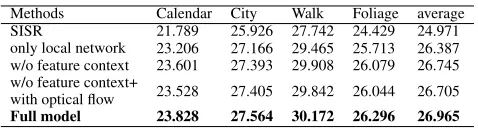
Table 1: Experimental result of ablation study. Average video PSNR of different architectures on Vid4.
Methods Calendar City Walk Foliage average SISR 21.789 25.926 27.742 24.429 24.971 only local network 23.206 27.166 29.465 25.713 26.387 w/o feature context 23.601 27.393 29.908 26.079 26.745 w/o feature context+
with optical flow 23.528 27.405 29.842 26.044 26.705 Full model 23.828 27.564 30.172 26.296 26.965
Ablation Analysis
Our architecture consists of two key components: local net-workN ETL and context networkN ETC. We experiment
with different design options to illustrate the contribution of each component to the video super-resolution result in terms of objective metric and visual quality. To explore the perfor-mance of local network in the proposed architecture shown in Fig. 2, we remove the context network and use “only lo-cal network” to denote the resulting model,i.e., blue arrows are removed in Fig. 2. Besides, we also explore the effective-ness of utilizing features including local feature (blue dashed arrow in Fig. 2) and context feature (yellow dashed arrow in Fig. 2) in the proposed framework. Thus, we remove the local feature and context feature from the architecture and use “w/o feature context” to denote it. Finally, we use “Full model” to denote our complete model includingN ETLand
N ETC. Since optical flow method (Sajjadi, Vemulapalli,
and Brown 2018) is widely employed in prior art, we in-corporate it into our architecture to test whether it improves the recovering ability of our model. Here, we use “w/o feature context + with optical flow” to denote the model that removes feature information and introduces optical flow method. We also compare our model with a single im-age super-resolution (SISR) baseline, which is obtained by only feeding the current frameLRtinto the local network.
Quantitative Comparison: The quantitative results are reported in Table 1. The “only local network” model that ex-ploits temporal information from input consecutive frames outperforms SISR baseline, which demonstrates that ex-ploiting temporal redundancies is helpful to recover high-frequency details for video super-resolution. The “w/o feature context” model utilizing previously estimated HR frames further improves the performance of “only local network”. This result implies that propagating information from previous HR frames to the following step helps the model to recover lost fine details. The complete model “Full model”, simultaneously exploiting previously inferred frames and features, obtains the best results on all videos from Vid4. The result well demonstrates the effectiveness of introducing local and context features.
Table 2: Quantitative comparison with state-of-the-art approaches. Values marked with a star are referenced from the corre-sponding publications. Obviously, our approach outperforms other methods in terms of PSNR, SSIM, and computational cost.
Methods BayesSR* DESR* VSRNet* VESPCN* VDSR* Tao et al.* FRVSR DUF Ours x4 PSNR 24.42 23.50 22.81 25.35 24.31 25.52 26.43 26.40 26.97
x4 SSIM 0.72 0.67 0.65 0.76 0.67 0.76 0.80 0.80 0.83
time (ms) - - - - 73.2 140 43.2 70 31.2
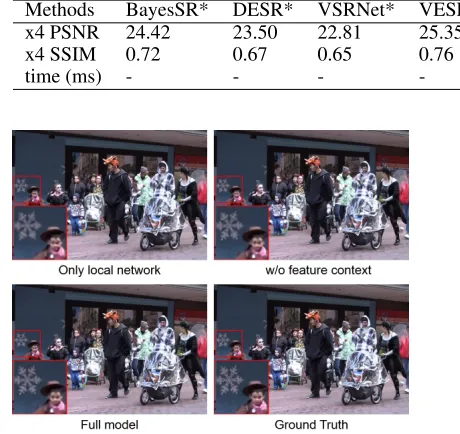
Figure 5: A visual comparison of oblation study. The “Full model” produces the best result having fine details.
Figure 6: Visual comparison with state-of-the-art ap-proaches (x4 SR).
flow method not only improves the reconstruction accuracy of the model, but also decreases its computational cost. All the above experiments show that the proposed architecture for video super-resolution is reasonable and appropriate.
Visual Comparison:Figure 5 shows a visual compari-son of oblation study with different design options for our framework. We can observe that the “Full model” is capable of recovering finer details and generating visually satisfac-tory results. Compared with “only local network” and “w/o feature context” methods, the recovered result produced by “Full model” is both sharper and closer to the ground truth, as shown in the white snow in Fig. 5.
Comparison with prior art
We compare the proposed approach with various state-of-the-art video super-resolution methods, including VDSR (Kim, Lee, and Lee 2016), BayesSR(Liu and Sun 2011), DESR(Liao et al. 2015),VSRNet(Kappeler et al. 2016b), VESPCN (Caballero et al. 2017), Tao et al. (Tao et al. 2017),FRVSR(Sajjadi, Vemulapalli, and Brown 2018), and DUFwith 16 layer (Jo et al. 2018) on the Vid4 benchmark
Figure 7: Demonstration of temporal profiles for comparing temporal consistency of different approaches.
dataset in terms of PSNR and SSIM. For all competing ap-proaches except FRVSR and DUF, the PSNR and SSIM val-ues are directly referenced from the corresponding publica-tions by authors. Since FRVSR and DUF are the newest ap-proaches, we implement them on the TensorFlow platform. For fair comparison, these two implements are trained and tested on the identical dataset used by our approach.
Quantitative Comparison: Table 2 reports the PSNR and SSIM produced by our approach and previous state-of-the-art methods on Vid4. It is obvious that our proposed ap-proach substantially outperforms the current state-of-the-art methods by a large margin in terms of reconstruction accu-racy and efficiency. Comparing with the current best results, our approach surpasses them by more than 0.5 dB in PSNR and 0.03 score in SSIM. This implies that our approach pro-duces the most accurate result and our architecture is rea-sonable and appropriate for video super-resolution.
Quality Comparison:Fig. 6 demonstrates quality com-parison of different approaches. From the close-up images, we observe that the proposed approach produces better structural detail than other competing methods. This result indicates that our strategy of exploiting previously inferred information in terms of frame and feature is essential such that the resultant SR images look much closer to the ground truth.
Temporal Consistency
Figure 8: Real-world examples to evaluate the practical abil-ity of different approaches.
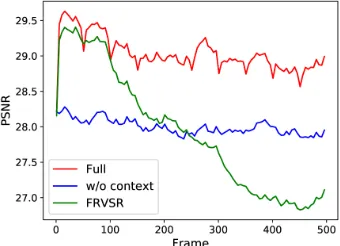
Figure 9: Performance of FRVSR, our full model, and “only local network” on HongKong as a function of the num-ber of previous frames processed. Our suppression-updating algorithm can effectively depress iteration error of high-frequency information from previous frames processed.
truth. In contrast, our approach produces the most temporal coherence result that looks much closer to the ground truth.
Computational Efficiency
Figure 1 and Table 2 illustrate the comparison result of putational efficiency. Note that the running times of com-pared approaches including BayesSR (Liu and Sun 2011), DESR (Liao et al. 2015), VSRNet (Kappeler et al. 2016b), VESPCN (Caballero et al. 2017) are not listed in Table 2, because their running times are not stated in correspond-ing publications. The result clearly shows that our model is much more efficient than other approaches. It averagely takes 31.2 ms with our unoptimized TensorFlow implemen-tation on an Nvidia GTX 1080Ti when running on Vid4 to generate a single HR image for 4x upsampling. Bene-fiting from directly taking advantage of previous features and frames, our approach is able to maintain real-time speed while producing high-quality temporal-coherency result.
RealWorld Examples
To evaluate the performance of our approach on real-world data, following (Caballero et al. 2017), a visual comparison result is reported in Fig. 8. From the close-up images, we ob-serve that our approach is able to recover the fine details and
Figure 10: Illustration of iteration error of high-frequency information.
remove the blur artifacts, even though the model is trained on a set of LR-HR frame pairs, where the LR frames are obtained by performing bicubic down-sampling.
Suppressing Iteration Error of High-Frequency
Information
Because the previous super-resolving errors are constantly accumulated to the subsequent frames, the super-resolved video has significant jitter and jagged artifacts when using previously inferred HR frames. Fig. 9 illustrates the perfor-mance of FRVSR, our full model, and “only local network” (without context network) on HongKong2 as a function of the number of previous frames processed. It shows that the reconstruction accuracy of FRVSR approach is high in the early stage and decreased slightly in the low range of in-formation flow (less than 100 frames), but it decreases dra-matically when the number of previous frames processed is over 100, even worse than our “only local network”. In con-trast, benefiting from the proposed suppression-updating al-gorithm, our full model and “only local network” are not af-fected by the number of previous frames processed and both achieve stable performance. Interestingly, the “full model” outperforms “only local network” method in all frames, which intuitively demonstrates the key contribution of the context network N ETC. Fig. 10 shows a visual
compar-ison of iteration error of high-frequency information. Our approach effectively removes the unpleasing flickering arti-facts existed in FRVSR method.
Conclusion
In this paper, we presented a frame and feature-context video super-resolution approach. Instead of only exploit-ing multiple LR frames to separately generate each out-put frame, we propose a fully end-to-end trainable frame-work consisting of local netframe-work and context netframe-work to simultaneously utilize previously inferred frames and fea-tures. Furthermore, based on the characteristics of our framework, we propose a suppression-updating algorithm to effectively solve the problem of error accumulation of high frequency information. Extensive experiments includ-ing ablation study demonstrate that our approach signifi-cantly advances the state-of-the-art on a standard benchmark dataset and is capable of efficiently producing high-quality temporal-consistency video resolution enhancement.
2
References
Agustsson, E., and Timofte, R. 2017. Ntire 2017 chal-lenge on single image super-resolution: Dataset and study. InIEEE Conference on Computer Vision and Pattern Recog-nition Workshops (CVPRW’2017), 1122–1131.
Caballero, J.; Ledig, C.; Aitken, A.; Acosta, A.; Totz, J.; Wang, Z.; and Shi, W. 2017. Real-time video super-resolution with spatio-temporal networks and motion com-pensation. InIEEE Conference on Computer Vision and Pat-tern Recognition (CVPR’2017), 2848–2857.
Demirel, H., and Anbarjafari, G. 2011. Discrete wavelet transform-based satellite image resolution enhancement.
IEEE Transactions on Geoscience and Remote Sensing
49(6):1997–2004.
Dong, C.; Chen, C. L.; He, K.; and Tang, X. 2014. Learning a deep convolutional network for image super-resolution. In
Proceedings of European Conference on Computer Vision (ECCV’2014), 184–199.
Dong, C.; Chen, C. L.; and Tang, X. 2016. Accelerat-ing the super-resolution convolutional neural network. In
Proceedings of European Conference on Computer Vision (ECCV’2016), 391–407.
Freedman, G., and Fattal, R. 2011. Image and video upscal-ing from local self-examples.ACM Transactions on Graph-ics (TOG’2011)30(2):12:1–12:11.
Gunturk, B. K.; Batur, A. U.; Altunbasak, Y.; and Mersereau, R. M. 2003. Eigenface-domain super-resolution for face recognition. IEEE Transactions on Image Process-ing (TIP’2003)12(5):597.
Huang, J. B.; Singh, A.; and Ahuja, N. 2015. Single im-age super-resolution from transformed self-exemplars. In
IEEE Conference on Computer Vision and Pattern Recogni-tion (CVPR’2015), 5197–5206.
Jeong, S.; Yoon, I.; and Paik, J. 2015. Multi-frame example-based super-resolution using locally directional self-similarity. IEEE Transactions on Consumer Electron-ics61(3):353–358.
Jo, Y.; Oh, S. W.; Kang, J.; and Kim, S. J. 2018. Deep video super-resolution network using dynamic upsampling filter-swithout explicit motion compensation. InIEEE Conference on Computer Vision and Pattern Recognition (CVPR’2018). Kappeler, A.; Yoo, S.; Dai, Q.; and Katsaggelos, A. K. 2016a. Super-resolution of compressed videos using convo-lutional neural networks. InIEEE International Conference on Image Processing (ICIP’2016), 1150–1154.
Kappeler, A.; Yoo, S.; Dai, Q.; and Katsaggelos, A. K. 2016b. Video super-resolution with convolutional neural networks. IEEE Transactions on Computational Imaging
2(2):109–122.
Kim, J.; Lee, J. K.; and Lee, K. M. 2016. Accurate image super-resolution using very deep convolutional networks. In
IEEE Conference on Computer Vision and Pattern Recogni-tion (CVPR’2016), 1646–1654.
Kingma, D., and Ba, J. 2015. Adam: A method for stochastic optimization. International Conference on Learning Repre-sentations (ICLR’2015).
Li, T.; He, X.; Qing, L.; Teng, Q.; and Chen, H. 2017. An iterative framework of cascaded deblocking and super-resolution for compressed images. IEEE Transactions on Multimedia (TMM’2017)PP(99):1–1.
Liao, R.; Tao, X.; Li, R.; Ma, Z.; and Jia, J. 2015. Video super-resolution via deep draft-ensemble learning. InIEEE International Conference on Computer Vision (ICCV’2015), 531–539.
Lim, B.; Son, S.; Kim, H.; Nah, S.; and Lee, K. M. 2017. Enhanced deep residual networks for single image super-resolution. In IEEE Conference on Computer Vision and Pattern Recognition Workshops (CVPR’2017), 1132–1140. Liu, C., and Sun, D. 2011. A bayesian approach to adaptive video super resolution. InIEEE Conference on Computer Vision and Pattern Recognition (CVPR’2011), 209–216. Perezpellitero, E.; Salvador, J.; Ruizhidalgo, J.; and Rosen-hahn, B. 2016. Psyco: Manifold span reduction for super resolution. In IEEE Conference on Computer Vision and Pattern Recognition (CVPR’2016), 1837–1845.
Sajjadi, M. S. M.; Scholkopf, B.; and Hirsch, M. 2017. En-hancenet: Single image super-resolution through automated texture synthesis. In IEEE International Conference on Computer Vision (ICCV’2017), 4501–4510.
Sajjadi, M.; Vemulapalli, R.; and Brown, M. 2018. Frame-recurrent video super-resolution. In IEEE Conference on Computer Vision and Pattern Recognition (CVPR’2018). Tao, X.; Gao, H.; Liao, R.; Wang, J.; and Jia, J. 2017. Detail-revealing deep video super-resolution. In IEEE In-ternational Conference on Computer Vision (ICCV’2017), 4482–4490.
Timofte, R.; De, V.; and Gool, L. V. 2014. Anchored neigh-borhood regression for fast example-based super-resolution. In IEEE International Conference on Computer Vision, 1920–1927.
Walha, R.; Drira, F.; Lebourgeois, F.; Alimi, A. M.; and Gar-cia, C. 2016. Resolution enhancement of textual images: a survey of single image-based methods. IET Image Process-ing10(4):325–337.
Xiong, Z.; Xu, D.; Sun, X.; and Wu, F. 2013. Example-based super-resolution with soft information and decision. IEEE Transactions on Multimedia (TMM’2013)15(6):1458–1465. Yang, J.; Wang, Z.; Lin, Z.; Cohen, S.; and Huang, T. 2012. Coupled dictionary training for image super-resolution. IEEE Transactions on Image Processing (TIP’2012)21(8):3467–78.
Yang, X.; Wu, W.; Liu, K.; Kim, P. W.; Sangaiah, A. K.; and Jeon, G. 2018. Long-distance object recognition with image super resolution: A comparative study. IEEE Access
PP(99):1–1.