Photo:
Ther
e is no evidence that Indonesia’
s for
est moratorium has ef
fectively r
educed the conversion of for
est in Indonesia to non-for
est/degraded for
est land. © Ser
Introduction
There is increasing recognition in ape range states of the importance of ensuring that environmental considerations are empha-sized in both national policies and legisla-tion. While this demonstrates an evolving acknowledgment of the importance of the environment, this shift in focus has not always been driven from within countries. This chapter provides examples of how national governments in emerging econo-mies are responding to the environmental impacts of economic development. It demon-strates how these responses were influenced by global processes, financial institutions and international organizations and thus the role of outside influences in catalyzing the response within three great ape range states: Guinea, Gabon, and Indonesia.
CHAPTER 8
Case studies of national responses
to the impacts of extractive
The first section presents details on an on-going process in the Republic of Guinea to develop a national strategy for biodiver-sity offsets. The strategy will be developed to offset the impact of extractive industries on critically endangered (CR) and endangered (EN) species. It will be supported by a con-servation trust fund to provide resources to manage biodiversity offset projects in per-petuity. The second section presents detail on the evolution of Gabon’s leading legislative and regulatory frameworks that prescribe industry behavior in relation to tropical for-est conservation. The final section looks at Indonesia’s recent decision to implement a national logging moratorium and places it within the context of the evolution of forest management in relation to orangutans.
Offsetting mining impact
in the Republic of Guinea
– protecting chimpanzees
The Republic of Guinea is situated on the West African coast, between Sierra Leone,
Liberia, Côte d’Ivoire, Mali, Senegal, and Guinea Bissau. Guinea has a human pop-ulation of approximately 11 million (CIA, 2013c), with an enormous wealth of min-eral and other natural resources. It has one-third of the world’s known bauxite reserves (aluminum ore) and significant iron ore, gold, diamond, and uranium reserves. In spite of the country’s mineral wealth, hydropower, and agricultural resources, it is a poor country that has struggled with political instability, a weak economy, and the impacts of long-term political insta-bility in neighboring Liberia and Sierra Leone. It is estimated that 47% of the popu-lation fall below the poverty line, and the country is ranked 178 out of a total of 187 countries in the world with comparable data for human development (UNDP, 2013).
This section describes an approach that national and international environmental nongovernmental organizations (NGOs) are urging the Government of Guinea, and pri-vate sector companies, to undertake that will maintain a focus on conservation objec-tives when the country’s mineral reserves are exploited. It presents details of an innova-tive process to develop a national strategy for biodiversity offsets to compensate for the residual impacts of extractive industries on biodiversity in Guinea. This approach would also include an endowment fund to finance the implementation of a national strategy for biodiversity offsets. The concept for this approach was first launched in a report funded by the Arcus Foundation entitled “Towards a strategic national plan for bio-diversity offsets for mining in the Republic of Guinea, West Africa With a Focus on Chimpanzees” (Kormos and Kormos, 2011b). The approach was subsequently summa-rized in a report to the World Bank in 2012 proposing a strategy for great ape conserva-tion in Africa (Kormos et al., 2012).
The main findings, summarized from this chapter, show that:
FiguRE 8.1
The Republic of Guinea
GUINEA-BISSAU
THE GAMBIA
G U I N E A
G U I N E A
Conakry
ATLANTIC OCEAN
SENEGAL THE GAMBIA
SIERRA LEONE
LIBERIA MALI
GUINEA-BISSAU
0 100 200 km
There is interest from large mining com-panies based in developed countries in a national-level biodiversity offset strategy that provides clear guidelines, and in designing and implementing biodiversity offsets, but they require further details before they are willing to fully engage in the process.
Working in partnership with the private sector does not ensure that investments, available funding streams, or activities are predictable.
Private sector financing for an endow-ment is likely, but providing full funding for an endowment up front may prove challenging.
The Government of Guinea favors a national strategy for biodiversity offsets focusing on all EN and CR species rather than a separate strategy exclusively for chimpanzees.
The private sector often needs to offset residual damage from their activities on more than one EN or CR and so they also prefer a strategic national plan for biodiversity offsets in general and not just one CR or EN species.
Offsetting extractive industry
impact at the macro level
Widespread mineral extraction activities in Guinea are threatening key habitats and species including chimpanzees. Several companies operating in Guinea are applying for funding from the International Finance Corporation (IFC) and Equator banks, and are therefore exploring ways to meet IFC Performance Standard 1 (PS11; regarding man-agement of environmental and social risks) and Performance Standard 6 (PS62; regarding biodiversity and sustainable management of living natural resources), as well as meet-ing their own commercial targets. Offsettmeet-ing
EN and CR species is considered a last resort to compensate for residual impacts to species after all other mitigation measures have been exhausted. Species offsets are nevertheless being considered by almost all companies working in chimpanzee habitat in Guinea since environmental impact assessments (EIA) have determined that there will be residual impacts of mining on chimpanzees, in most cases.
The IFC’s reviewed PS1 (see Chapter 1) allows for the offset option to be applied to project areas that include CR and EN spe-cies, whereas PS6 provides the framework for responding to the risks and impacts to biodiversity identified by the assessments required under PS1. However, developing offsets on a project-by-project basis with-out an overarching national framework and strategy guiding biodiversity offset projects, and without taking into account the cumu-lative impacts of development activities, could lead to a series of uncoordinated, iso-lated, and ineffective conservation projects (C. Kormos, unpublished data).
Offsets are designed to ensure that any residual loss of EN or CR species that occurs despite an industrial development project’s best efforts at mitigation is fully compensated through an off-site conservation project pro-tecting an equivalent number of species else-where. PS6 notes that offsets should achieve conservation outcomes that can “reasona-bly be expected” to achieve no net loss of biodiversity, though in the case of Critical Habitat, offsets must not only achieve no net loss, but must achieve a net gain (see Chapter 1 and Annex I).
outside their project area will be able to sustain a certain number of EN or CR species displaced by development activity. However, if there are several other development projects planned nearby which may reduce or eliminate that habitat, that assumption may not be valid and an offset would have to be larger. In many countries, extractive industries and infrastructure development are advancing at a fast pace and multiple large-scale projects are being developed in the same area at the same time, sometimes adjacent to each other, so an offset assess-ment based on impacts from a single project will fail to take into account the cumulative impacts. Offset projects should therefore be based on an assessment of the cumulative impacts from development in the region surrounding the project.
Another risk with a project-by-project approach is a lack of coordination between offset projects and failure to integrate off-sets into a broader conservation strategy. Ideally offset design and implementation should be coordinated so that offsets con-tribute to a recovery strategy for EN and CR species. Such a strategy would aim to target priority sites within a recovery strategy first. It would aim to create connectivity between conservation sites so that larger and there-fore more robust areas are protected. It could also aim to protect sites that comple-ment each other and are strategically placed in areas representative of the nation’s bio-diversity. The end result of implementing offsets on a project-by-project basis with-out a framework for coordination could be protection of multiple smaller, isolated off-set projects that are not viable in the long term. A strategic plan for offset sites has the additional benefits of being more efficient; this avoids duplication of efforts in conduct-ing inventories and other biological studies, increasing impact of funding through joint finance mechanisms (such as conservation trust funds).
Towards a national strategy
for biodiversity conservation
that incorporates mining
impacts on species in Guinea
In the Republic of Guinea, mining compa-nies are confronted with the question of how to define critical habitat for chimpan-zees, how to mitigate the negative effects of activities on chimpanzees, and how and where to design offsets for residual impacts after all mitigation has been carried out. A number of mining companies are working with conservation organizations and experts to address these issues. They are engaging with different experts and different NGOs on a project-by-project basis.
International and national NGOs pro-posed a more strategic response to the impacts of industrial activities in Guinea due to the:
failure to assess the cumulative impacts of mining on biodiversity;
lack of coordination between biological inventories and site selection for offset projects;
absence of sharing methodologies for mitigation strategies or offset method-ologies; and
absence of framing offset plans within larger species recovery plans or Guinea’s national biodiversity strategy.
Recommendations were made to stake-holders in Guinea for a new approach to offsets in 2011; action was taken to build consensus and seek endorsement for this approach, and to generate donor commit-ments to fund its implementation. The new approach to offsets has two key components. The first is the development of a national strategy for offsets, based on an assessment of cumulative impacts on great apes and other EN and CR species, including a con-sensus, peer reviewed and transparent methodology for determining offset needs, prioritizing offset sites, aggregating offsets,
“
An offsetassessment based on impacts from a single project will fail to take account of the cumulative impacts from other development in the region.
integrating offsets with existing biodiversity strategies in the country, and defining “no-go” zones where industrial development should not occur. Chimpanzees have been identified as a useful starting point for the national strategy as they are an important flagship as well as an umbrella species, and they are found on most concessions.
The second component is an independ-ent conservation trust fund to support the national strategy. It would include an endow-ment, funded by those private sector entities that incur offset obligations due to their devel-opment projects in Guinea. The fund is con-sidered critical to the success of the national strategy approach for a number of reasons:
Funding for conservation offsets must be permanent (because the impact on EN and CR species and their habitat is likely to be permanent) and a trust fund – or a “foundation,” its nearest equiva-lent in civil law countries – is one of the few available financial mechanisms to ensure permanence.
Conservation trust funds are independ-ent of governmindepend-ent (they may have gov-ernment representation on trust fund boards, but never a majority of govern-ment board members). The independ-ence of the trust fund ensures that there is a permanent entity dedicated to over-seeing the financing and management of offsets in Guinea. This helps shelter offset projects from political pressure, and also creates a mechanism that the private sector entities can use to avoid having to manage offset projects them-selves in perpetuity.
Conservation trust fund endowments can be registered offshore, with a secre-tariat located in country.
Conservation trust funds are a multi-sector mechanism (thereby increasing transparency), which is useful given that the issues in Guinea relating to
devel-opment and to EN species also involve multiple sectors (government, NGOs, private sector, multilateral development banks etc.).
Key activities to promote a
national offset strategy and
finance mechanism in Guinea
The first key activity was to make the case for the need for a national strategy for bio-diversity offsets in Guinea. The Kormos and Kormos (2011b) report was circulated in Guinea, and the authors engaged subse-quently in a process of consultation, deliber-ation, and strategizing for the development of the offset strategy and a supporting financ-ing mechanism. This consultation process brought together key stakeholders involved in mining and biodiversity conservation in Guinea at a range of meetings and work-shops, including a workshop in Washington DC, meetings in Europe, and a workshop in Conakry in 2012.
The Washington DC workshop provided initial confirmation from a larger group of stakeholders that the national offset strategy/ trust fund was worth pursuing. The work-shop in Conakry later in 2012 went further in approving recommendations supporting a national offsets strategy and trust fund approach. This approval is “in principle,” i.e. non-binding, with no funding com-mitments but was a necessary first step to open the door for discussions within govern-ment and with potential donors on how to advance implementation of this approach.
A number of lessons emerged during workshops and meetings with stakeholders, and several areas were highlighted that will require further investigation and research before all stakeholders are willing to fully commit to this process. These include techni-cal issues with respect to the offsets design and the conservation trust fund, as well as the need to consider unforeseen developments
“
Funding forconservation offsets must be permanent and a trust fund is one of the few available financial mecha-nisms to ensure permanence.
in the region, and globally, that must be taken into account. These lessons learned and areas requiring further work are high-lighted below.
Broader biodiversity concerns
The Government of Guinea clearly stated its preference for national offset planning that would extend beyond chimpanzees to include all EN and CR species (while acknowledging the importance and usefulness of a chim-panzee focus). Government officials from the Ministry indicated that a broader plan-ning exercise was necessary to ensure that this work would be fully consistent with and nested in Guinea’s national biodiversity strategy. They suggested that an entirely chimpanzee focused approach would not be received well by the Guinean public, cre-ating the perception that chimpanzees are more important to the government than social issues. The sense was that this con-cern could be alleviated by a broader focus on biodiversity, which is generally important for human wellbeing. Mining companies also emphasized their preference for a multi-species plan for potential biodiversity offset locations given that they often have require-ments to offset their residual impacts on more than one species and would prefer to choose sites where they can manage these multiple offsetting needs.
The Government of Guinea was also interested in broadening the scope of the conservation trust fund so that it covers all conservation efforts in country, including the entire protected areas network. Broadening the scope of the fund’s mission is feasible. However, narrowly focusing the conserva-tion trust fund’s activities early on to support-ing offset projects would give the fund the greatest likelihood of success, both in terms of maintaining a clear operational and stra-tegic focus and in terms of raising the financ-ing from the private sector. Broadenfinanc-ing the
fund’s activities beyond offsets would be more appropriate once the success of the fund has been established.
Legal frameworks
Guinean officials informally considered whether offsets should be a requirement under Guinean law. The impetus for offsets is currently generated by the IFC perform-ance standards (and potentially by require-ments from other development banks/aid agencies), Equator banks and their perform-ance standards, and the internal standards of individual companies. Companies that do not have internal requirements or that choose not to borrow from a bank that has an offset requirement currently have no obligation to offset in Guinea. As highlighted in Chapter 1, in relation to the review of the PS6, the IFC retains considerable discretion as to when to apply their offset requirement. Companies need not apply to the IFC for funding nor are internal corporate safe-guard policies binding. As a result, offsets are currently more of a voluntary undertaking than a truly binding requirement.
Financial concerns
One question raised by the workshop in Conakry had to do with the tax implica-tions of a mining company’s contribution to a conservation trust fund. Participants noted that tax implications would differ depending on whether the contribution was deemed a business expense or a charitable contribution, and, depending on how the contribution was considered, could reduce the Guinean government’s revenues. Clarifying this point would be important as trust fund planning goes forward.
Partnerships
Both bilateral and multilateral development organizations play a critical role in this
ini-“
Offsets arecurrently more of a voluntary undertaking than a truly binding requirement.
tiative. At a political level they provide a measure of political risk insurance to private sector borrowers. At a financial level they have the capacity to provide critical seed money to develop this initiative. While the private sector can and should support this initiative, development agencies have a clear role in supporting both capacity building and national strategic planning in Guinea. Development agencies can thus be lever-aged to complement the private sector fund-ing, creating a productive public–private partnership.
A number of bilateral and multilateral funding agencies, including the Agence Française de Devéloppement (AFD) and the Fonds Français pour l’Environnement Mondial (FFEM), and the Global Environ-ment Facility (GEF) of the World Bank, have expressed interest in this work. AFD and FFEM are exploring funding to develop a national offset policy in Guinea. Although discussions with funding agencies are still preliminary, financial institutions are watch-ing this process with interest.
NGO presence in Guinea is very limited: Guinée Ecologie is the only domestic civil society organization with a clear biodi-versity conservation focus. Together with the international NGOs working in Guinea, they have been leading much of the impetus to develop a national offset strategy.
Although a number of the world’s larg-est mining companies have shown interlarg-est in the idea of a national offset strategy, sup-port for this approach in smaller or less high profile mining companies is untested. The theory is that a strong partnership consisting of the Government of Guinea, NGOs, development agencies, and very large companies could work to raise stand-ards for all development projects and pro-vide the institutional framework to make it easier for the private sector as a whole to comply (e.g. by helping to fund the imple-mentation of a national strategy). Whether
this bears out will only become clear as the project progresses.
Private sector response, risk, and
predictability
While this is still somewhat speculative, it appears from communications with mining companies that they appreciate the greater efficiency of a national planning approach given that it avoids a certain amount of redundancy in the conservation planning and analysis they have to do and can help develop common environmental perform-ance standards for the entire mining sector, therefore creating a more level playing field and increasing transparency. Large mining operations in developing countries are inher-ently complex undertakings and large-scale problem solving is a perpetual challenge for these operations. Mining companies seem to appreciate that a national approach is designed to address a conservation problem at scale, rather than making short-term marginal contributions such as a grant for a three- to five-year conservation project that is not likely to continue when funding ends. This initiative therefore appears to resonate with mining companies in that it attempts to take a larger scale view of the conservation challenge.
Even after all mitigation has taken place, there will be unavoidable residual impacts on endangered species from mining oper-ations in Guinea, especially for great apes. To achieve best practice, permanent fund-ing for an offset project should be in place at the time the development project begins, or soon thereafter. Mining companies may be understandably reluctant to provide an endowment to fund their offset projects before they commence mining and gener-ate a revenue stream. This could be resolved by mining companies making a binding commitment to fully fund their offset project costs on an annual basis for a predetermined
“
A nationalplanning approach can help develop common environ-mental perfor-mance standards for the mining sector, creating a more level playing field and increasing transparency.
period, such as three to five years, and to fully fund the endowment at the end of that period.
Conclusion – Guinea
No country has yet implemented a national biodiversity strategy to offset the impact of extractive industries on wildlife. However, as a result of the launch of this approach in Guinea, consensus is emerging that the con-cept has value across a range of actors that include financial institutions, government, NGOs, and the private sector. The process of developing a national biodiversity offset strategy in Guinea has highlighted a number of unresolved issues and areas needing fur-ther work. Nonetheless, interest from the pri-vate sector and multi- and bilateral funders has been significant, and, with continued effort, Guinea could be the first nation to develop a comprehensive biodiversity off-set strategy for CR and EN species. Such a strategy would be part of a broader national biodiversity plan, and present a strategy for one of the options for achieving conserva-tion targets.
Evolving environmental
policies in Gabon that
influence extractive
industry practice
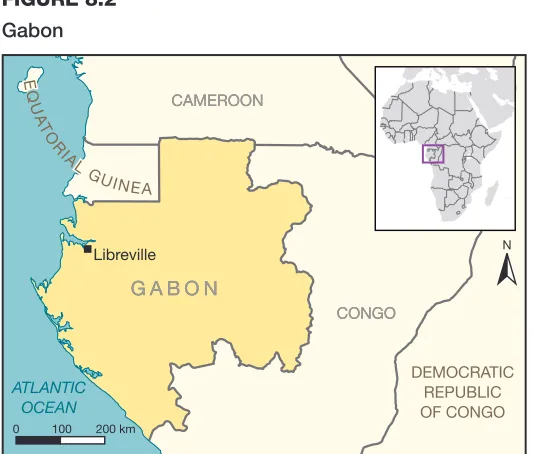
Gabon is situated along the western coast of Central Africa, bordering Cameroon, the Republic of Congo, and Equatorial Guinea. Gabon’s low human population (approx. 1.6 million in July 2013) and extensive mineral and oil reserves have enabled it to achieve relative wealth in comparison to other sub-Saharan countries. It enjoys a per capita income four times that of most sub-Saharan African nations; however, high income inequality prevails with a large proportion of the population living below the poverty line. In 2010, the economy was reliant on oil for about 50% of its GDP, about 70% of revenues, and 87% of goods exports (CIA, 2013b). Gabon harbors 13% of the African tropical forest belt and its combination of low human population and natural mineral and oil wealth have been cited as reasons for why it has maintained high forest coverage and biodiversity (CIA, 2013b).
This case study presents an overview of the evolution of environmental and protected area legislation as it pertains to extractive industries and business-as-usual models of economic development. It also outlines more recent moves by the Gabonese govern-ment to incorporate green macroeconomic models as it looks to diversify its economic development away from oil and mineral extraction. Key findings indicate that:
Scientists and international conservation organizations have been instrumental in informing the development of a bio-diversity conservation policy framework. High political support has been critical
in the establishment of protected areas and a protected area authority, as well as for the promotion of a green economy. FiguRE 8.2
Gabon
E Q
U AT
O R
IA L G
UINEA
CONGO
CONGO
CAMEROON
CAMEROON
G A B O N
G A B O N
Libreville
E Q
U AT
O R
IA L G
UINEA
DEMOCRATIC REPUBLIC OF CONGO
ATLANTIC OCEAN
0 100 200 km
Creation of a protected area network resulted in the cancellation of logging concessions.
Iterative changes in implementation of legislation and importance of the envi-ronment within government structures were a product of intervention at the highest political levels influenced by international press, public relations, and conservation organizations.
Despite strong legislation and pro envi-ronmental policies, there have been significant declines in key mammal pop-ulations across their ranges, primarily as a result of poaching.
The case study also provides details on the evolution of the legislative framework that culminated in the creation of a national parks law, how interaction with extractive industries influenced the creation of this policy environment, and how this ultimately in turn impacted extractive industry prac-tice. This is then followed by detail on the creation of a policy direction for Gabon that incorporated green economic development models and presents some of the emerging impacts of this relatively recent move.
Establishment of a legislative
framework for conservation
of biodiversity in Gabon
In 1993, after the Earth Summit held in Rio de Janeiro in 1992, the government of the late President Omar Bongo passed an Environment Law obliging all major indus-trial and development projects to undertake EIAs. This was further strengthened in 2001 when a new Forestry Code was signed into law. The new Forestry Act made it obligatory for all forestry permits to develop sustainable harvest management plans along the lines of the norms being promoted at the time by the Forest Stewardship Council
(FSC, see Chapter 4). This was followed in July 2002 by the creation of 13 national parks, covering 11% of Gabon’s terrestrial eco-systems. The decision by President Bongo to create the national parks estate was con-sidered significant by conservation organi-zations because it was perhaps the first time in history that a nation had decided to estab-lish such an extensive and well-planned network in one go. Second, the parks had been designed by scientists to optimize the protection of Gabon’s vast intact ecosystems and its exceptional biodiversity, ensuring that areas of the highest and most significant biodiversity were protected.
The decision also resulted in the cancel-ling of 13 000 km2 of logging concessions in order to convert them to protected areas for conservation. While the role of conservation organizations in lobbying the highest levels of government to protect important eco-systems is considered to have been critical, it is likely that the decision was also influ-enced by the fact that Gabon’s oil reserves had peaked by 2002 and the government had to consider alternative sustainable sources of funding. With ecotourism cited as a poten-tial and significant source of economic development, the importance of protecting potentially lucrative tourism sites would not have been lost on the President.
The Gabonese government consolidated its commitment to biodiversity conservation in 2007 with the passing of a National Parks Law that created a National Parks Agency – Agence Nationale des Parcs Nationaux
are possible, as well as the procedure for declassification should it be decided that it is in the national interest to undertake mining or oil exploration in an area that falls within a park. It also provides for the definition of buffer zones where any anthropogenic activ-ity requires authorization by ANPN, as well as peripheral zones. ANPN has the power of veto over projects supported by EIAs under-taken by extractive industries within these peripheral zones, if there are likely to be negative impacts on the national parks.
Although no other Gabonese law is so prescriptive regarding relations with other land-use options, making it much easier to manage parks than forestry, agriculture, mining, or oil concessions, the government maintained the right to allow extraction of mineral wealth and to degazette protected areas if it were in the national interest.
Oil exploration, dam building,
and the creation of robust
national parks legislation
The content of the national parks law in relation to extractive industries was likely influenced by the actions of a Chinese oil company, Sinopec. In the summer of 2006, Sinopec moved into the northern section of Loango National Park to undertake seismic surveys. Authorization for the exploration had been issued by the Ministry of Mines, Petroleum, and Hydrocarbons, with some agreement from the Ministry of Environ ment, although it is not clear whether the person in the Ministry of Environment had the author-ity to allow exploration in a national park. The Wildlife Conservation Society (WCS), who were working in the area at the time, not only informed the President of the presence Photo: The Gabonese
of the oil company in a national park, but were also able to ascertain that an EIA had not been conducted. The attention of the international press (Haslam, 2006) and an appeal to the highest levels of government were factors that resulted in a presidential order halting the exploratory work by Sinopec until an EIA had been completed. Changes in government, notably the appoint-ment of the Deputy Prime Minister in charge of environment, elevated the impor-tance of the Ministry of Environment. This created a more balanced dynamic between the Ministry of Environment and what had been considered to be the traditionally richer and more powerful Ministry of Mines, Petroleum, and Hydrocarbons.
The initial EIA that Sinopec completed was presented at a public hearing, imple-menting for the first time the EIA condi-tions outlined in the 1993 Environment Law. However, it lacked detailed assessments of potential impacts of seismic activities and did not present any concrete mitigation actions in its Environmental and Social Management Plan. The subsequent rendi-tion was developed in partnership with two international conservation NGOs – WCS and the World Wide Fund for Nature (WWF) who had been asked by the Director General of the Environment to work with Sinopec to conduct an adequate EIA. The final EIA included unprecedented detail in the Envi-ron mental and Social Management Plan. It resulted in the first on-shore seismic cam-paign in a Central African rainforest that did not use chainsaws to cut seismic lines or helipads – rather field teams on foot used machetes to trace lines just 1 m wide, cut-ting nothing above a 10 cm diameter. They avoided areas used by gorillas in the dry sea-son by delaying their work in these areas until the gorillas had moved out, and the impact of operations was evaluated by inde-pendent scientists (Rabanal et al., 2010; Wrege et al., 2010).
The ongoing evolution of the Gabon ese government’s reconciliation of biodiversity conservation and economic development was highlighted when the President con-vened a conference, attended by the entire government, including Parliament, Senate, and also civil societies, to resolve the actions of extractive industries in areas of important biodiversity already under pro-tection. The conference focused on the actions of SINOHYDRO, another Chinese company contracted to assess the possibil-ity of building a hydroelectric power dam to provide electricity to the planned Belinga iron ore mine in northeast Gabon. In 2008, SINOHYDRO constructed a road to the Koungou waterfalls on the Ivindo River, in the Ivindo National Park. This site had previously been the focus of a campaign spearheaded by an Italian NGO “Trust the Forest” and the Gabonese NGO “Brain Forest” to preserve the waterfalls from log-ging by Rougier Gabon.
national debate that culminated in the confer-ence called by the President. SINOHYDRO’s perceived attack on Ivindo National Park was actually no more than a feasibility study and resulting tensions would likely have been avoided through the systematic applica-tion of the environmental and park laws. A decision was taken to stop the work at Koungou, underlining that the implementa-tion of these laws was a reality. This incident highlighted the tension created by poor implementation of legislation, and how the engagement by senior government officials and politicians to enforce legislation was necessary to ensure that due process was fol-lowed. The ensuing national debate served to strengthen environmental law implemen-tation. Despite these successes in ensuring the enforcement of environmental legislation, there continue to be wildlife losses.
Green Gabon
In 2009, presidential candidate Ali Bongo Ondimba made sustainable development one of three pillars of his election cam-paign. “Green Gabon,” a catchphrase in his election manifesto, encompasses all that Gabon has done in the years and decades after Rio. It presents a novel integrated long-term vision to develop Gabon sustainably, by finding a balance between Industrial Gabon, Services Gabon, and Green Gabon (Republic of Gabon, 2013). Immediately after the elections, President Bongo Ondimba created an interministerial Climate Council that the President personally chairs. The Ministry of Economy was transformed into the Ministry of Economy and Sustainable Development, further emphasizing the shift in focus with respect to the economic devel-opment of Gabon.
The National Climate Change Plan integrates climate/low carbon emission con-siderations into the 26 sectorial development plans that were developed on the back of the
2009 election manifesto. Carbon emission savings that have resulted from the political decisions to oblige forestry companies to adopt sustainable harvest practices (Govern-ment of Gabon, in press), as well as from the creation of the national parks, are con-sidered to be about 350 million tons lower over the 2000–10 period compared to the 1990–2000 period (Government of Gabon, in press). Conservative values assigned to emissions reductions in voluntary schemes such as the Amazon Fund indicate that this represents a contribution of around US$2 billion to the global efforts to mitigate climate change (Government of Gabon, in press). The climate plan not only integrates climate/low carbon emission considerations into 26 sectorial development plans, it also acknowledges that a national land-use plan is critical to ensuring Gabon continues to develop sustainably. This plan was under development at the time of writing and is intended ultimately to define national land-use strategy by law. The plan is expected to indicate areas to be set aside for conserva-tion, forestry, agriculture, mining, infrastruc-ture, and urban expansion. The General Secretary of the Government is overseeing the development of the plan with technical aspects managed by the Climate Council and the National Parks Agency. The first draft of the national land-use plan is due for release by early 2014.
including all extractive industries, to do an annual sustainable development report and to offset any negative impacts on carbon emissions, biodiversity, and ecosystem serv-ices and community capital. A new agency will be created to ensure adequate implemen-tation of this law. Examples of companies applying the draft law as they develop new projects include Olam, who are developing a series of oil palm and rubber plantations in Gabon. A specific agreement with the Gabonese Government obliges Olam to obtain certification from the Round Table on Sustainable Palm Oil (RSPO) for their entire Gabonese oil palm plantation estate, and this signals the commitment of both parties to move towards more environmentally respon-sible action. Olam have, in partnership with the government, selected low carbon/low biodiversity areas for plantation development; calculated carbon emissions and under-taken voluntary offsets. They have engaged
PROFOREST to undertake high conserva-tion value forest (HCVF) assessments result-ing in the allocation of over 40% of their concessions to conservation areas, and have solicited full prior informed consent from local populations before initiating their projects (Rainforest Foundation, 2012). Today, all industrial projects undergo an effective impact assessment and all of Gabon’s planned oil palm developments will be RSPO compli-ant and will include HCVF evaluations and set-asides as well as ape management plans.
Conclusion – Gabon
Today Gabon has 30 000 km2 of FSC certified forestry permits and annual deforestation rates are less than 0.01% (Bayol et al., 2012). National parks cover 11% of the country and a further 10% of the land surface area has protected status in the form of wildlife reserves and Ramsar sites. The government
has a stated policy of zero tolerance for wild-life crime but, despite this, there has been a decline in forest elephants of 18% between 2002 and 2011 (Maisels et al., 2013). As a result of much higher elephant declines in other regions of the tropical forest belt, in the DRC in particular, Gabon is now home to over half the surviving population (Maisels
et al., 2013). Apes have also suffered over the last two decades from population decline, linked primarily to Ebola (Walsh et al., 2003) and hunting for bushmeat, current estima-tions place populaestima-tions of gorillas at 20 000 (F. Maisels, personal communication, 2013). These declines raise questions about the capacity to implement legislation effectively, a common problem across all ape range states.
However, the robust policy environment provides the framework for operation, and the intervention and involvement of the highest levels of politics and lobbying by international conservation agencies were key factors in its evolution. The modification of industry behavior, reassigning logging concessions to areas of lower biodiversity importance, and consideration of the devel-opment of a national green economy
frame-work point to some of the successes of this process. It is, however, too early to ascer-tain whether the recently developed susascer-tain- sustain-able development framework will become the main driver of economic development. Unless economic returns become the real-ity, political support may turn back to busi-ness as usual models of operation to ensure Gabon generates the necessary revenue for its future development. Emphasis is being placed on opportunities that arise from cli-mate change. How centrally wildlife conser-vation, and ape conservation in particular, factor into this scenario, considering the current lack of substantial return from tour-ism, is still to be seen.
The case of logging and
implementing a forestry
moratorium in Indonesia
Indonesia is an archipelago in Southeast Asia comprising 17 508 islands, the largest of which are Borneo (shared with Malaysia and Brunei) and Sumatra. Indonesia has a human population density of 251 million over 1.8 million km2 (CIA, 2013a). Its primary exports are oil and gas, timber/plywood, and manufacturing products. Indonesia is considered to be the third largest emitter of greenhouse gases (GHG). Eighty percent of those emissions are due to deforestation. The Norwegian government embarked on a process to support Indonesia in reducing its GHG; establishing and implementing a two-year logging moratorium (May 2011) was part of a deal in which Indonesia would receive US$1 billion from Norway. During a CNN interview in June 2011, President Susilo Bambang Yudhoyono reiterated his commit-ment and that of his governcommit-ment to pro-tecting Indonesia’s remaining forest and preventing further destruction. “Our philos-ophy is that we can achieve both, economic growth and environmental protection, and VIET NAM
LAO PDR
CAMBODIA
EAST TIMOR
I N D O N E S I A
I N D O N E S I A
M A L A Y S I A
AUSTRALIA AUSTRALIA
I N D O N E S I A
I N D O N E S I A
Djakarta
EAST TIMOR VIET NAM
THAILAND
M A L A Y S I A CHINA
MYANMAR LAO PDR
CAMBODIA
PHILIPPINES
PACIFIC OCEAN
INDIAN OCEAN
SOUTH CHINA SEA
0 300 600 km
N
my government is committed to doing that” (CNN, 2011).
His acknowledgement of the impor-tance of reconciling two disparate issues was further reinforced by Indonesia’s com-mitment to reduce its GHGs by 26% by 2020 as outlined in a presidential decree in September 2011 (Presidential Regulation, September 20, 2011). The logging morato-rium was extended for another two years on May 15, 2013 (Inpres 6/2013). This case study examines the experience of implementing the forestry moratorium, highlighting the complexity of such an undertaking in a context that has traditionally exploited its forest resource through extraction. Key find-ings include:
There is no evidence that Indonesia’s for-est moratorium has effectively reduced the conversion of forest in Indonesia to non-forest/degraded forest land. The Indonesian forest moratorium has
not led to any significant reduction in either loss of orangutan habitat or loss of orangutan populations.
It goes on to present details on the tra-jectory of forest loss and degradation over the last decades in the context of the polit-ical changes. It subsequently covers the evolution of the logging moratorium and outlines some of the challenges to its effec-tive implementation.
The evolution of forest
management in Indonesia
Forest management in Indonesia is strongly influenced by the political dynamic and changes in the country’s development strat-egy aiming to boost the national economy. During the last 50 years forest manage-ment policies can be divided into three main periods, each with distinct priorities and approaches. Until the rise to power of
President Soeharto (apparently his preferred spelling, ‘Suharto’ is more commonly used in the international English press) in 1966 the focus was on agricultural expansion that had limited impact on forest areas in Indonesia. The following period, which ended with the fall of the Soeharto regime in 1998, was earmarked by extensive forest exploitation and the development of timber and oil palm plantations as well as increased mining operations. The year 1998 was the beginning of a new era in Indonesia – the so-called Reformation era – that has been marked by the decentralization and decon-centration of authority to manage natural resources, including forest resources, from central to local government.
The period until 1998
Up until 1966, circa 77% (1 470 000 km2) of Indonesian land was covered by dense tropical rain forest. The rise of the late President Soeharto (New Order Regime) in 1966 changed the situation dramatically. Triggered by the Agrarian Act 1960 and the Forestry Act 1967 that declared almost all for-ests as state property under the full control of the Indonesian Government (Simorangkir and Sardjono, 2006), and the Forest Invest-ment Law 1967 that enabled foreign com-panies to operate in Indonesian forests, the so-called “timber boom” era started with the expansion of large-scale logging opera-tions all across the country. This period lasted for around two decades and reached its peak in the early 1980s when the country became one of the largest producers and exporters of tropical timber/logs world-wide. By 1983, the government had granted concession permits totaling 651 400 km2 of forest3 to 560 logging concessions (World Rainforest Movement, 1998).
(timber/log) to “higher-value” secondary products, particularly plywood. The pro-motion of the plywood industry that was supported by the log export ban (established in 2001) was triggered by the increasing world demand for plywood, particularly from East Asia. Until that time, the Philippines had been the main source for plywood, but had lost most of its forest owing to over-exploitation. Plywood production increased rapidly over a very short period of time, and Indonesia became the world’s largest plywood producer, with a 75% global market share by the late 1980s. The contribution of the plywood sector to Indonesia’s exports increased significantly from almost nil in 1977 to 54% by the beginning of the 1990s (Manurung, 2002).
The latter half of the 1980s was charac-terized by the development of large-scale industrial timber plantations (HTI, Hutan Tanaman Industri) for producing both hard-wood and softhard-wood for the pulp and paper industry. The Government of Indonesia pushed towards the target of establishing 62 500 km2 of plantation forest by 2000 (Handadhari et al., 2002), which was influ-enced by three factors. First, after decades of over-logging of the natural forest there was an acute shortage of timber as raw material for plywood. A study disclosed that acute timber shortages encouraged many companies to use timber from illegal sources from 1985–97 (Kartodihardjo and Supriono, 2000). Second, since the 1970s there has been increasing global demand and price Photo: The extensive use
for pulp; and third, planting fast-growing tree species was seen as the “right” strategy for “regreening” vast areas of degraded and bare land caused by extensive logging oper-ations. In less than a decade (1991–98) the plantation forest area extended from 2000 to 19 000 km2 (Ministry of Forestry, 2013).
During the 1980s Indonesia also saw the beginning of massive forest conversion into oil palm plantations that was driven by strong global demand. The government eagerly supported oil palm expansion as a strategic way to support the development of remote inland regions and to improve the liveli-hood of rural populations (Bangun, 2006). Planting oil palm was also meant to “re-green” unproductive and bare land exposed by logging and other extractive industries. Until the early 1970s, palm cultivation was primarily carried out by large plantation companies. In 1974, however, the price and demand for palm oil in the international market peaked and efforts were made to increase production by attracting small private companies and farmers into this business through a scheme called the Nucleus Estate Scheme, where state-owned planta-tion companies helped farmers to grow oil palms and provide access to processing mills. This led to a significant increase in the number and size of oil palm plantations across Indonesia. From the end of the 1970s to 1997, the area of oil palm plantation increased from c. 4000 to 22 500 km2, with the largest expansion through forest clearing in Sumatra and Kalimantan (Susila, 1998; Bangun, 2006). The clearing of natural for-est for oil palm and HTI intensified with the issuance of Government Regulation No. 7/ 1990 that allows plantation companies to convert “unproductive forest areas” into new plantation areas and harvest the timber during the land clearance. As the definition of “unproductive” was very vague and tech-nically difficult to determine in the field, this regulation perversely encouraged the
plan-tation companies to expand their conces-sion areas – more than they could manage – by clearing relatively good forest areas to reap the benefit of harvested timber and then abandon the land without replanting it (Kartodihardjo and Supriono, 2000).
Deforestation resulting from plantations, large-scale agriculture, and mining was exacerbated by the extensive use of fire in forest clearance, particularly in plantation development. Forest and land fires are challenges Indonesia has struggled with for centuries, resulting from human activities such as slash-and-burn agriculture. However, before the 1980s, even in dry periods, the scale and intensity of forest and land fires was limited with minimal environmental impacts. In subsequent decades, the exten-sive use of fire in land conversion and clearance and poor forest logging practices4 have changed the situation dramatically (Bappenas, 1999; Gouyon and Simorangkir, 2002). Especially during the El Niño events in 1982/83, 1987, 1991, 1994, and 1997/98, wide-spread forest and land fires broke out, devas-tating 10 000 km2 of forest (Simorangkir and Sumantri, 2002). The 1997 fires were consid-ered the worst in Indonesia (and the South-east region) over the last 15 years, resulting in 100 000 km2 of forest being burnt. The fires burning in 2013, primarily in peat swamps and the burning of the peat itself, and for the clearing of land for oil palm plantations, were considered the worst since 1997 (which caused an official state of emergency in Sarawak as well as the Malaysian peninsular) and caused health hazards in cities around the Malaysian peninsula (Vidal, 2013a).
Reformation era
by the central government in Jakarta and the profits from resource exploitation were mainly diverted to the central government and powerful individuals.
Following the collapse of the New Order Regime in 1998, provinces and districts started to voice their disagreement and dis-appointment with the system and demand more independence and rights in governing their natural resources. The issuance of Act No. 22/1999 and Government Regula tion No. 25/2000 paved the way for decentrali-zation and the devolution of authority and
responsibility for natural resource manage-ment from central to regional (provincial and district) government. This was done in the belief that decentralization would strengthen local government, improve the livelihoods of rural people in the provinces, and lead to better governance of natural resources. The reality, however, was a dra-matic acceleration of uncontrolled logging, both legal and illegal, the encroachment and conversion of forestland into planta-tions, forest clearance for mining operaplanta-tions, the creation of road networks through large areas of tropical rainforest and extensive use of fire in land clearance across Indonesia.
In part, this can be attributed to a lack of capacity and preparation for the changes. More importantly, however, decentraliza-tion created perverse incentives that led to further acceleration of environmental deg-radation and land conversion as provinces and districts were now expected to generate their own revenues. Increasingly they have been forced to turn to the exploitation of forests, creation of large-scale oil palm plan-tations, and expansion of mining opera-tions. Data from the Ministry of Forestry show that the HTI area increased between 1995–2007 from 11 300 to 70 700 km2, while another study estimated that, up to 2009, 99 700 km2 of HTI had been established (Forest Watch Indonesia, 2011).
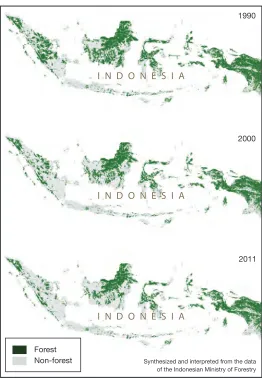
The decades-long overexploitation, fol-lowed by the clearance and degradation of natural forests, has resulted in immense destruction of natural forests in the last 50 years. In total, since the beginning of the “timber boom” in the 1960s more than 963 000 km2 of Indonesian forestland has been degraded, of which 546 000 km2 is within state forest areas, including produc-tion forests and conservaproduc-tion and protecproduc-tion forests, and 417 000 km2 is outside of state for-est areas (Nawir, Murniati, and Rumboko, 2007). It is estimated that Indonesia has one of the highest rates of deforestation in the world and loses 18 700 km2 of forest each I N D O N E S I A
I N D O N E S I A
I N D O N E S I A
Synthesized and interpreted from the data of the Indonesian Ministry of Forestry
2011 2000 1990
I N D O N E S I A
I N D O N E S I A
I N D O N E S I A
Forest Non-forest
FiguRE 8.4
Diminishing forest coverage in Indonesia
year to logging, agriculture, settlement and infrastructure development, and fire (FAO, 2006). The rapid deforestation in Indonesia can clearly be seen by comparing forest cov-erage over time as presented in Figure 8.4.
Forest loss and orangutans
Forest loss negatively impacts orangutans both directly and indirectly. Orangutans are often killed during logging activities as well as during land clearance operations, espe-cially when fire is used. Forest clearance also leads to complete loss of orangutan hab-itat, resulting in their death or forcing groups to migrate to other areas.
Over the past 20 years, 40 000 km2 (from a total of 130 000 km2) of orangutan habitat has been destroyed or converted for other purposes (Nellemann et al., 2007), and the annual rate of habitat loss in Sumatra and Kalimantan runs at 1–1.5% and 1.5–2%, respectively (Singleton et al., 2004). UNEP studies, illustrated in Figure 8.5, show that between 1930 and 2004 large areas of critical orangutan habitat were lost and the frag-mented forests that remain are becoming increasingly isolated (Nellemann et al., 2007).
The opening of the forest increases the vulnerability of orangutans to illegal hunt-ing for consumption and commercial trade, as further discussed in Chapter 7. Orangutans are often killed/captured opportunistically when loggers are clearing the forest. Moreover, as the forest becomes increasingly degraded and food becomes scarce, the apes start to enter villages or plantations around the degraded forest, where they are killed by vil-lagers or farmers that perceive orangutans as crop raiding pests (Meijaard et al., 2011). This has contributed significantly to the sharp decline of orangutans.
It is estimated (Nellemann et al., 2007; Meijaard et al., 2011) that, in the last 35 years, about 50 000 orangutans have been lost as their habitat has been destroyed. Currently only 6650 Sumatran and around 55 000 Bornean orangutans remain in the wild. Of these populations, approximately 70% live outside of protected areas (WWF, 2013). Although the species are classified by the IUCN as EN and CR, respectively, and are listed on CITES Appendix I (see the Intro-duction), and therefore benefit from legal protection, the laws are inadequately enforced and their habitats continue to be destroyed.
FiguRE 8.5
Change of orangutan habitat distribution and size in Borneo 1930–2004
© Hugo Ahlenius, UNEP/GRID-Arendal http://www.grida.no/graphicslib/detail/orangutan-distribution-on-borneo-indonesia-malaysia_11d2
1930 1999 2004
M AL A
Y SI A
M AL A Y SI A
M AL A Y SI A
I N DO N E SI A
Orangutan distribution in Borneo
I N DO N E SI A I N DO N
The logging moratorium in
Indonesia:
quo vadis
?
With the extensive forest destruction and land-use transformation that has taken place in Indonesia over the last few decades, along-side the increasing global awareness of cli-mate change, Indonesia has been branded as one of the largest GHG emitters in the world. The country has been under severe inter-national and domestic pressure to improve their land-use management practices.
Within this context, the Indonesian President announced, in 2009, a voluntary commitment to reduce the country’s carbon footprint by 26%, whilst achieving 7% eco-nomic growth.6 In May 2011 the commit-ment was put into action with the issuance of the Presidential Instruction (Inpres) No. 10 for the Suspension of Granting New Licenses and Improvement of Natural Primary Forest and Peatland Governance, effective until May 2013, and renewed for another two years until May 2015. The Inpres, or more com-monly called “the Moratorium,” aims to cut the country’s emissions by reducing the conversion of primary forest and peatland for other purposes, particularly monoculture plantations. It is not intended to stop the future exploitation and use of peatland and forest areas, but rather to give the government time to evaluate and reorganize its devel-opment strategies. The area to be excluded from conversion is specified in an indicative map – as part of the Moratorium – that was prepared collaboratively by key government agencies under the coordination of the Ministry of Forestry and is revised at least every six months. Between June 2011 and January 2013 the indicative map was revised three times.
The implementation of the Moratorium, though, faces serious challenges (Murdiyarso
et al., 2011; Wells, Neil, and Paoli, 2011; Wich, Koh, and Noordwijk, 2011a).7 First, from a legal point of view the Moratorium is a
non-legislative document and simply provides a set of presidential instructions to concerned government agencies. As such, there are no legal consequences if the instructions are not implemented. Moreover, the Moratorium includes almost all key government agencies (three ministries, five agencies) and pro-vincial and district heads but excludes the Ministry of Agriculture and the Ministry of Energy and Mineral Resources, both of which are engaged in deforestation. The exclusion of these ministries obviously limits the effectiveness of the Moratorium. Second, the definition of forest types and the scope and areas included under the Moratorium are not clear:
The Moratorium is limited to the “state forest area” (kawasan hutan) and applies only to “primary forests,” defined as “natural forests untouched by cultiva-tion or silvicultural systems applied in forestry.” This means that all forested areas outside of the state forest area, as well as logged-over and secondary forests within state forest areas – some of which have high biodiversity – are exempt from the Moratorium and can be converted into new plantations. In fact, the estab-lishment of industrial timber plantations through the conversion of secondary forests is perceived by the Ministry as for-est improvement. As of 2009, Indonesia had a total of 866 000 km2 of state forest areas, of which 452 000 km2 are primary forest and 414 000 km2 secondary forest. There are also 53 000 km2 of forested areas outside the state forest area (Ministry of Forestry, 2009a) and, as stated earlier, 70% of orangutans live outside protected forests.
With regard to peatlands, it is prohibited to undertake new conversion of any peatlands deeper than 3 m, either within or outside of state forests. Yet, this is actually redundant as the exclusion of
“
TheMorato-rium excludes the Ministry of Agriculture and the Ministry of Energy and Mineral Resources, both of which are engaged in deforestation.
such peatlands was already stipulated in other government regulations before the Moratorium was put in place. Currently there is talk of changing the threshold from 3 m to 0.5 m, which will be very difficult to apply as the maps showing peat-depth are inaccurate and for many parts of the country do not actually exist. Clarifying this issue is critical as peat-land covers huge areas across all of the Indonesian islands, which are partly for-ested or covered by woody vegetation. The indicative map includes protection
and conversion forests, which is redun-dant as they are already protected under other regulations (e.g. Forestry Law 41/ 1999). Of the 664 000 km2 covered by the first indicative map, around two-thirds (439 000 km2) are already protec-tion and conservaprotec-tion forests (see below) (Ministry of Forestry, 2008; Murdiyarso
et al., 2011).
Third, the Moratorium excludes certain activities that are potentially destructive, as it only applies to applications for new con-cession areas and:
still allows the clearance of forest areas by companies that already have a “prin-cipal permit” (ijin prinsip) to develop a plantation;8
permits companies to apply for an exten-sion of concesexten-sion permits that are close to expiration;
allows for the expansion of existing plan-tations into new forest areas, without applying for a new concession permit, under “special conditions” that are not clearly defined; and
the use and conversion of primary for-est and peatlands for activities related to mineral mining and other strategic industries, such as oil and gas, energy, rice, and sugar cane is exempted from the
Moratorium. Although this is econom-ically and socially understandable and perhaps justifiable, it could seriously undermine the Moratorium in its appli-cation. In the past, such development activities have often led to the destruc-tion of huge forest areas and/or peat-land with disastrous consequences to the environment.
When the Moratorium was issued, the number of companies that already held a principal permit and those that had applied for expansion was unknown. It is common-ly believed that in the months before the Moratorium came into force many princi-pal permits were issued, particularly by district governments.
These challenges, together with a lack of reliable and accurate data and insuffi-cient coordination and agreement between key government agencies, have led to con-tinued debate over the areas to include in the indicative map and how to enforce the commitments made. Many environmental groups support strict implementation of the Moratorium and even a total ban on forest and peatland conversion. Conversely, there are strong lobbies from the forest and tree plantation industries that are advocat-ing for easadvocat-ing the Moratorium. This has significant support from local governments who argue that they need to use the forest resources within their districts/provinces to achieve economic development.
One of the earliest analyses of the Moratorium, and perhaps one of the few reliable ones (Murdiyarso et al., 2011), esti-mated the spatial extent of the Moratorium as 664 000 km2, of which around 439 000 km2 are protection and conservation forests. Since the latter are already protected by other laws, in reality the Moratorium provides addi-tional protection to only 225 000 km2 of forest areas, of which only 72 000 km2 are primary forests (others are peatlands).
“
TheMorato-rium allows for the use and conversion of primary forest and peatlands for activities related to mineral mining, oil and gas.
There is no evidence that the Morator-ium has effectively reduced the conversion of forest in Indonesia. By January 2013 little sign of improvement and improved trans-parency in the process of granting permits and forest governance was discernible. The constant changes to the indicative map con-tinue to create strong business uncertainties and have reportedly enabled many compa-nies to continue their practice of clearing and converting forested areas to do so. Many violations have been observed in the field, such as opening and converting peatlands that are included in the indicative map (Forest Watch Indonesia, 2012).
Conclusion – Indonesia
Ultimately, the Moratorium has not improved conservation of the orangutan. It does not impact orangutans in conservation areas, as these were legally protected before the Mora-torium, and the lack of law enforcement means that there has been no change in their conservation in these areas.9 With respect to the protection of orangutans outside conser-vation areas, particularly secondary forest and other forests outside the state forest areas, the Moratorium does not offer any protection. Although the Indonesian government’s recognition of the importance of environ-mental protection demonstrates an awareness of the role of conservation, this commit-ment does not translate easily to effective policy development and implementation. The creation and implementation of the forestry moratorium highlights the inter-action of international environmental con-siderations, business interests, and political process, and has resulted in little change to rates of deforestation across Indonesia. Effective policy implementation requires a combination of law enforcement and recognition of the importance of environ-mental protection across Indonesia’s entire political spectrum.
Conclusion
All ape range states are at various stages of dynamic economic transformation. The con-flict that often arises between the drive for economic development and the importance of environmental conservation is particu-larly challenging considering the limited resources, capacity, and data available to not only inform but also implement meaningful policies. The conflicting time frames of often short-term economic gains versus the envi-ronmental benefits that can be felt over the long term are also difficult to reconcile.
In Indonesia and Gabon the interven-tions of the heads of state were significant factors in enabling the creation of the policy framework and the debate for attaining both environmental protection and economic development. The potential for meaning-ful implementation of policy is significantly hampered, however, when loopholes and weak enforcement are exploited by govern-ment agents and the private sector, or when inadequate and poorly planned measures are adopted. This disconnect points to a fundamental aspect of natural resource protection in ape range states that needs to be addressed. Environmental protection needs to be considered as a central component of all economic development strategies and initiatives, and not as an add-on or a second-ary consideration handed to less powerful departments or organizations to enforce.
It could be argued that the role of exter-nal partners, working together with local agencies, is to provide data and monitor and leverage change in implementation, while providing a level of transparency that can help reduce potential corruption. The impact of international conservation organizations on the evolution of Gabon’s environmental protection legislation con-tinues to inform and influence subsequent implementation. The critical impact of the changes to PS6 of the IFC to the initiation
“
Environmentalprotection needs to be considered as a central component of all economic development strategies and initiatives, and not as an add-on or a secondary consideration.
of a national biodiversity offset planning process will impact, on an on-going basis, the availability of nations to safeguard and finance conservation of areas that include CR and EN species. Monitoring the impacts of legislation, policy, and law enforcement on biodiversity and conservation areas is critical for a balance between exploitation and con-servation of natural resources to be found and maintained, to keep a balance between the often conflicting activities. Finally, the on-going global process of climate change, payment for ecosystem services, and other mechanisms to finance the protection of forests and peatlands will continue to influ-ence environmental protection action at state level.
It is clear, however, that the on-going loss of forest cover, increase in pressure on nat-ural resources, and decline in ape populations and other species highlight the importance of resolving the challenges to effective man-agement of these areas. It is critical that all partners work together to:
1. find the appropriate strategies and mech-anisms for reconciling economic develop-ment and environdevelop-mental conservation; 2. empower stakeholders at national and regional level to implement those strat-egies; and
3. enable those strategies and mechanisms to be sustained, through broader engage-ment beyond the confines of nation states.
Nations, and specifically weak govern-ment departgovern-ments responsible for forest conservation and management, cannot be held responsible alone for the protection of fragile resources and ecosystems. This must be brought into a much broader consideration of the consequences of extractive industries on economies and environment, and thus include multiple players with engagements and responsibilities.
Acknowledgments
Principal authors: Helga Rainer and Annette Lanjouw Contributors: Cyril Kormos, Rebecca Kormos, Niel Makinuddin, Erik Meijaard, PNCI, Dicky Simorangkir, and Serge Wich
Endnotes
1 PS1 Assessment and Management of Environ-mental and Social Risks and Impacts: http://www1. ifc.org/wps/wcm/connect/3be1a68049a78dc8b7e 4f7a8c6a8312a/PS1_English_2012.pdf?MOD= AJPERES
2 PS6 Biodiversity Conservation and Sustainable Management of Living Natural Resources: http:// www1.ifc.org/wps/wcm/connect/bff0a28049 a790d6b835faa8c6a8312a/PS6_English_2012.pdf? MOD=AJPERES
3 Based on Consensus Forest Land Use Plan/TGHK in 1987 the 1.47 million km2 forestland was divided into permanent forestland (75.49%) and conversion forest (24.51%). From the permanent forestland 19.95% was protection forest, 13.08% conservation areas, 22.44% production forest, and 20.02% lim-ited production forest. The conservation areas and protection forest cannot be used for any kind of exploitation, while the production forest mainly for timber harvesting, and conversion forest can be converted for other purposes, such as plantation. 4 Forest exploitation does not lead directly to fire out-break. Poor logging practices, however, will degrade forest areas into very poor, light dense secondary forests and grass/bushland, making them more susceptible to fire.
5 Maps produced by Indrawan Suryadi, December 2012, based on satellite imagery interpretation and official data about forest coverage from the Indo-nesian Ministry of Forestry.
of state forest area will reduce the effectiveness of the moratorium in reducing emissions but will not affect the effort to reduce the deforesta-tion. As this chapter focuses on deforestation and forest degradation issues, such problems are not discussed here.
8 From obtaining a principal permit up to field operational activities, i.e. obtaining a concession permit and planting the concession area, a com-pany has to go through a long and complicated process and undertake specified activities; however, once the a principal permit has been issued the company can start to clear the forest and/or dry out the peatland.