_____________________________________________________________________________________________________
*Corresponding author: Email: [email protected];
9(1): 1-9, 2019; Article no.JERR.52970 ISSN: 2582-2926
Implementation of Building Information Modelling
(BIM) Practices and Challenges in Construction
Industry in Qatar
Ayman Mohammed
1*, Syed Ali Hasnain
1and Abdul Quadir
21Centre of Excellence in Sustainable Building Design, School of Energy, Geosciences,
Infrastructure and Society, Heriot-Watt University, EH14 4AS, Edinburgh, UK.
2
Department of Civil Engineering, National Institute of Technology, Kurukshetra, Haryana, 136 119, India.
Authors’ contributions
This work was carried out in collaboration among all authors. Author AM designed the study, performed the statistical analysis, wrote the protocol and wrote the first draft of the manuscript. Authors SAH and AQ read and approved the final manuscript.
Article Information
DOI: 10.9734/JERR/2019/v9i117008
Editor(s):
(1) Dr. Tian-Quan Yun, Professor, School of Civil Engineering and Transportation, South China University of Technology, China.
Reviewers:
(1) Orchidea Maria Lecian, Sapienza University of Rome, Italy. (2)Smitha Yadav, National Institute of Construction Management and Research, India. (3)Alcinia Zita Sampaio, University of Lisbon, Portugal. Complete Peer review History:http://www.sdiarticle4.com/review-history/52970
Received 28 September 2019 Accepted 02 December 2019 Published 21 December 2019
ABSTRACT
The present research is aimed to identify the barriers in implementation of building information modelling (BIM) practices and challenges in construction industry in Qatar. Construction industry has been one of the lowest performing industries around the world. Recent growth in infrastructure projects in the past three decades has led to criticism of many problems. In view of improving the image of the industry, most commonly criticized issues are lack of innovation, industry wide fragmentation and low performance in delivery of projects. A collaborative working environment is required to solve these issues. In the past few years, development and use of information technology in AEC industry has increased to support the requirement of an integrated working environment. With revolution in use of technology, BIM seems to offer solution to most problems faced by the industry. BIM presents computer aided process to manage entire construction project from design phase to disposal of the built structure. Construction boards and private market forces
in US and UK have reported low awareness and implementation about BIM. Recent improvements have not achieved the required level of deployment. Construction industry in Qatar
issues in dealing with upsurge of infrastructure projects. Construction sector in Europe, US, UK and Singapore after witnessing the advantages of BIM started pushing for higher implementation. Expected use of BIM in Qatar will be less than E
As BIM offers solution to the issues faced by construction industry in Qatar, it will be beneficial to examine current status of implementation, barriers and challenges faced by the construction sector in its implementation in Qatar.
Keywords: Architecture; engineering and construction; construction industry; Modelling (BIM).
1. INTRODUCTION
“BIM is the development and use of a computer software model to simulate the construction and operation of a Facility. The resulting model, a Building Information Model (BIM), is a data object oriented, intelligent and parametric digital representation of the facility, from which views and data appropriate to various users’ needs can be extracted and analyzed to generate information that can be used to make decisions and improve the process of delivering the facility”, [1]. BIM has been defined in diverse ways by various disciplines in the Archit Engineering and Construction (AEC) industry. Most suitable definition is the one which says that BIM is process instead of being an object, which represents it on a broader context rather than being particular software [2]. It is a human approach to change the current procedures of design, construction and facility management of a structure. From the Building SMART alliance a
Fig
BIM
in US and UK have reported low awareness and implementation about BIM. Recent improvements have not achieved the required level of deployment. Construction industry in Qatar
issues in dealing with upsurge of infrastructure projects. Construction sector in Europe, US, UK and Singapore after witnessing the advantages of BIM started pushing for higher implementation. Expected use of BIM in Qatar will be less than European, US and UK markets at government level. As BIM offers solution to the issues faced by construction industry in Qatar, it will be beneficial to examine current status of implementation, barriers and challenges faced by the construction sector
engineering and construction; construction industry; Building Information
“BIM is the development and use of a computer software model to simulate the construction and operation of a Facility. The resulting model, a Building Information Model (BIM), is a data-rich, object oriented, intelligent and parametric digital representation of the facility, from which views appropriate to various users’ needs can be extracted and analyzed to generate information that can be used to make decisions and improve the process of delivering the [1]. BIM has been defined in diverse ways by various disciplines in the Architect, Engineering and Construction (AEC) industry. Most suitable definition is the one which says that BIM is process instead of being an object, which represents it on a broader context rather than being particular software [2]. It is a human hange the current procedures of design, construction and facility management of a structure. From the Building SMART alliance a
unique description is published which indicates BIM is an acronym of three distinctly interlinked roles [3].
Fig. 1 depicts the manner in which BIM may be linked with its functional associations as defined by Building SMART International (BSI). It further clarifies that BIM is an activity rather than a particular software tool.
1.1 Requirement of BIM as in Integral Part of Integrated Design and Delivery Solution (IDDS)
Implementation of BIM requires a scrutiny and prospective re-engineering of the practices that would have an impact on them along with the participation of the practitioners in the respec practices [4]. As stated by Egan, 1998, Construction industry is looking for principles that would help to implement lean construction [5]. But there has been limited assessment into
Fig. 1. BIM and linked functions
Building Information
Modelling
Building Information
Model
Building Information Management
BIM
in US and UK have reported low awareness and implementation about BIM. Recent improvements faces similar issues in dealing with upsurge of infrastructure projects. Construction sector in Europe, US, UK and Singapore after witnessing the advantages of BIM started pushing for higher implementation. uropean, US and UK markets at government level. As BIM offers solution to the issues faced by construction industry in Qatar, it will be beneficial to examine current status of implementation, barriers and challenges faced by the construction sector
Building Information
unique description is published which indicates BIM is an acronym of three distinctly interlinked manner in which BIM may be linked with its functional associations as defined by Building SMART International (BSI). It further clarifies that BIM is an activity rather than a
Requirement of BIM as in Integral Part Integrated Design and Delivery
Mohammed et al.; JERR, 9(1): 1-9, 2019; Article no.JERR.52970
significant correlation between the issues that would enable implementation of BIM and IDDS (Integrated Design and Delivery Solutions). IDDS has been proposed as a way forward to set higher goals that enable arriving at a stage where BIM will not be seen as a way forward but a fundamental requirement to improve the performance indicators of the construction projects. International Council for Research and Innovation in Building and Construction (CIB) with its headquarters in Rotterdam [6].
A study was conducted to determine the ways to reduce the gap between people, processes and technology in order to implement BIM as a constituent of IDDS along with examination of the current and future circumstances along with its determinants. Fig. 2 depicts the implementation of BIM as an intermediate stage with overall objective of IDDS [7].
Four key aspects are studied i.e. collaborative processes, enhanced skills, integrated information and automated systems; and knowledge management to study the determinants of implementation of IDDS [8]. The cultural implementation of IDDS has been found to be the most challenging in terms of the need to develop trust in the areas which are presently found to be the areas of risk desquamation and wariness. Further a concise look at the current situation and description of the conceivable future of the key four aspects in implementation of IDDS was done [9].
1.1.1 Collaborative processes
Current processes can be categorized as a amassing of silo-mentalities with documents information exchange programmes which rarely encourages participation among various professions and causes the agility to become sporadic. Decisions made autonomously prevent the professionals involved to gain experiences in collaborative working environments. Hence individual decisions lack holistic approach and skill induction. Collaboration schemes currently available rarely make sharing of the real knowledge a reality, whereas procurement routes i.e. PFI (Private finance initiative) assure a higher level of cooperation among engineers, designers, contractors and suppliers. Such procurement routes prompt effective communication and integration, even in projects with iterative requirements, without compromising feedback of the stakeholders and incorporation of their ideas [10].
1.1.2 Enhanced skills
Project teams' skills are often associated with its management and construction material management whereas the increased complexity of the projects and facilities management thereafter requires diversified skills and willingness to share them. Fewer professionals are able to convey. However, such experience based verdict is drastically deteriorating. A minority of work-force use advance Information technology along with its effects on collaboration [11]. Few organizations strive for continuous improvement and development of skills that foster integration: aimed to hire the professionals with experiences from shared technical knowledge to follow collaborative approach. In addition, the availability of collaborative data with understanding from past projects and acknowledgement of the current requirements will encourage collaborative working in different project stages [12]. Managers, Clients and stakeholders will essentially create organizational behaviour and project management that adopt IDDS. To execute professionals are required to practice the foremost advantages of implementation of IDDS and its endurance. The same time the role of contractors appreciating IDDS, as an opportunity rather than a burden in influencing on the early adoption of new techniques such as off-site assembly and storage, cannot be ignored. Hence, educational institutions may also gain advantage by utilizing collaboration tools as significant learning tools, offering students to learn its applicability through project activities and technology for IDDS [13].
1.1.3 Integrated information and automation systems
Fig. 2. BIM as an integral part of process [7]
integrity of models [15]. Information exchange in the current BIM solution imitates a usual document exchange system, controlled by examinations and discussions of its various versions, however with the drawback of not being able to collaborate the activities at the site.
1.1.4 Knowledge management
Knowledge management systems are dictated by legal staffs that doesn’t include internal experts/stakeholders. Currently the ‘competitive advantage’ is being misused by the organizations which are among the first few to develop the information systems. Current corporate cultures hide instead of addressing and solving the issues. Grasping the reuse of acquired experiences from projects is limited, in addition to the organization’s workforce. The future of firms lies in managing the knowledge by codifying the accumulated information which includes knowledge as per the current trends and the strategic policies [16].
2. RESEARCH METHODOLOGY
It is a preplanned technique through which a process is employed to resolve a research question. It accounts for the overall work done by the researcher to examine a research question and the logic behind gaining its solution. Research methodology reconciles among the research questions and their answers which are obtained by data collected. An author also agrees with it which says “Methodology justifies and guarantees the process of mediation”, thus helping the researcher to achieve the results with justification [8]. The research related to
engineering are usually done by employing the fundamental and applied methodology (Leahey 2007). The type of research methodology applied to the AEC field is descriptive and Analytical.
2.1 Descriptive and Analytical Methods
The descriptive method aims at describing the basics and the current circumstances of the subject that is under observation. In this kind of research the researcher has very limited or no control on the finding of the research.
However, Analytical method is based on the factual findings from the data collected and their critical assessment. In the current research a survey questionnaire was developed for collection of data. Questionnaire comprised of 13 questions ranging from multiple choice, form type, scale and scoring questions.
Narrative method asks for the life experiences of their lives and. This information is restored by the researcher in a narrative order of events. To sum up the researcher combines views from participant’s life and researcher’s own experiences in a collaborative narration [10].
2.2 Data Collection Methods
Mohammed et al.; JERR, 9(1): 1-9, 2019; Article no.JERR.52970
other researchers (Hox and Boeije 2005). This research requires data from the construction field applicable to a particular location. Since the primary data is useful for such a research, mode of data collection will be primary.
Primary data can be collected using many different procedures. Although the most commonly used methods are interviews and questionnaires. Interviews rely on verbal information recorded from the conversation between the interviewer and the person being interviewed. Interviews are used for subjective aims and require rigorous investigation. Samples can be controlled well when interviews are used for collecting data. This method requires more time and is expensive for the interviewer. Interviews can easily be biased depending upon the pattern of sampling (Hox and Boeije 2005). Questionnaire on the other hand is used when the number of samples required is large and data collection time period is limited. This method is motivated by objective approach to achieve the results. It aims at obtaining generalized data from a specific sample of population. Questionnaires are inexpensive, they can be distributed in a particular group of interest and they allow respondents laxation in time during which they can answer (Velikova et al. 1999). Due to above mentioned incentives and their adaptability to the current research questionnaires will be used to gather data from employees working in the AEC/FM industry in Qatar. This method is selected due to its objective approach and requirement of gathering data from the industry in Qatar. Data gathered through an online survey will be generalized using quantitative analysis.
2.3 Sampling Technique
Employees of construction firms working in Doha were approached through personal contacts and anonymous distribution of the online survey link. Respondents include employees (engineers, quantity surveyors and architects), contractors,
management professionals, and research students. Reminders were sent to the participants for them to obtain their answers. Data from the samples was collected through Informed Consent. Participants were assured of privacy for their responses and informed how their responses were to be used.
2.4 Limitations of the Research
The limitations include current state of the initiatives from the Qatari government as there is no precedent for defining the guidelines. Samples size has been small as the response rate (41%) is small when compared to the number of people (125) who were sent this questionnaire.
3. RESULTS AND DISCUSSION
Most of the respondents worked for contractors, followed by consultants and public organizations. Few organizations could demand BIM models which may compel the subcontractors to use BIM for their projects. I feel that consultants could take a lead in terms of implementing BIM by partnering with their counterparts.
Size of organizations where respondents worked was mostly large firm (above 200 employees). Major percentage of the other respondents worked for Medium sized firms (51-200 employees). Only few of the respondents worked for small (1-20 employees) sized firms. Since the major participant organizations are of large size, it could be difficult for them to introduce BIM initially but they could begin with by training small groups. Small and medium sized companies could introduce by providing training to their employees as well.
Most of the employees worked for the firms that were construction contractors. Other main firms where the respondents worked were providing project management services. Only few firms provided the designing, supplier and facilities
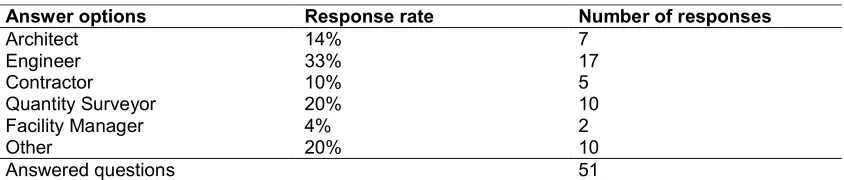
Table 1. Profession of participants
Answer options Response rate Number of responses
management services. Project managing companies work on behalf of the client and can explain the potential benefits to the clients. I think they can pursue the clients and mandate use of BIM for execution of their works.
In terms of demographics the participation in the survey has been diverse. I have been able to get responses from all stake holders. Most respondents of the survey were engineers working in construction firms. It is followed by quantity surveyors and other (Human resource,
finance and academics) professionals. Rest of the respondents were Architects and contractors.
Types of organizations where the respondents worked were mostly contracting firms.
Most of the respondents worked for contractors, followed by consultants and public organizations. Few organizations could demand BIM models which may compel the subcontractors to use BIM for their projects. I feel that consultants could take a lead in terms of implementing BIM by partnering with their counterparts.
Size of organizations where respondents worked was mostly large firm (above 200 employees). Major percentage of the other respondents worked for Medium sized firms (51-200 employees). Only few of the respondents worked for small (1-20 employees) sized firms. Since the major participant organizations are of large size, it is could be difficult for them to introduce BIM initially but they could begin with by training small groups. Small and medium sized companies could introduce by providing training to their employees as well.
Most of the employees worked for the firms that were construction contractors. Other main firms where the respondents worked were providing project management services. Only few firms provided the designing, supplier and facilities management services. Project managing companies work on behalf of the client and can explain the potential benefits to the clients. I think they can pursue the clients and mandate use of BIM for execution of their works.
3.1 Experience and Awareness
Contractor respondents were found to be most experienced among the respondents. Other most experienced profession were the quantity engineers and surveyors. Architects and facility managers were found to have least average experience. I think high experience of contractors is the barrier to change the traditional method of dealing with projects.
Average experience of the architects was highest among the BIM users. Contractors, Engineers and quantity surveyors followed architects. Facility Mangers had the lowest experience in BIM. This means that when BIM is implemented, architects will be the most experienced professionals. But the most projects were executed using BIM in firms where engineers work. It means the engineers will be leading the implementation of BIM and their training is most important.
Most respondents used CAD software with the 2D and 3D being most popular among them. Use of 2D CAD was most popular after 2D and 3D CAD. Very few participants used 3D CAD. This shows that modelling is rarely used by professionals at the moment.
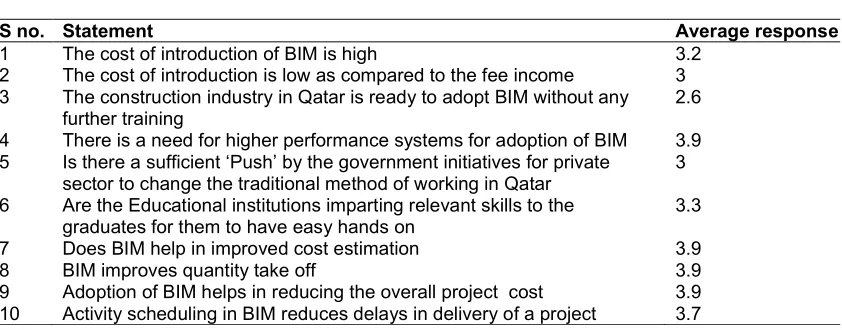
Table 2. Rate the following statements on a scale of 1 to 5
S no. Statement Average response
1 The cost of introduction of BIM is high 3.2 2 The cost of introduction is low as compared to the fee income 3 3 The construction industry in Qatar is ready to adopt BIM without any
further training
2.6 4 There is a need for higher performance systems for adoption of BIM 3.9 5 Is there a sufficient ‘Push’ by the government initiatives for private
sector to change the traditional method of working in Qatar
3 6 Are the Educational institutions imparting relevant skills to the
graduates for them to have easy hands on
This question was a scaling question where the participants were required to give their rating to a statement. Scale can be rated from 1 to 5 where 1 means ‘strongly disagree’, 2 means ‘Disagree’, 3 means ‘might agree/disagree’, 4 means ‘agree’ and 5 means ‘strongly agree’. Average response to statement 1 is more than 3 which signifies that more than half of the respondents think that introducing BIM is expensive for them. Average response to second statement is 3, which means respondents are not sure if th
introducing BIM is low compared to the amount of fee income earned. Average response to statement 4 is 2.6, it shows that respondents feel that the professionals in the industry require training for implementation of BIM. Average response to statement 4 is 3.9, it means the participants feel that there a requirement of higher performance systems for introduction of BIM, which might be a barrier to practicing BIM. Statement 5 discusses the current public initiatives that may help in implementation. average response of 3.02 is seen, which means the participants have an opinion that there is a lack of initiatives by the government in Qatar which may help in implementation. Statement 6 has an average response of 3.25 which means that the participants are not sure if the graduates taught in Qatar educational institutions are imparted with relevant skills to adopt BIM. Average response to statement 7 is 3.86 which suggests respondents agree that implementation of BIM would help in better cost estimatio Response to statement 9 deals with overall project cost. An average response of 3.94 is found, this shows that the respondents agree that using BIM reduces the overall project cost.
Fig. 3. Distribution of respondents aware of BIM
0 5 10 15 Architects Engineers 6 13 7
Have heard about BIM
Mohammed et al.; JERR, 9(1): 1-9, 2019; Article no.
This question was a scaling question where the participants were required to give their rating to a statement. Scale can be rated from 1 to 5 where 1 means ‘strongly disagree’, 2 means ‘Disagree’, 3 means ‘might agree/disagree’, 4 means ‘agree’ ‘strongly agree’. Average response to statement 1 is more than 3 which signifies that more than half of the respondents think that introducing BIM is expensive for them. Average response to second statement is 3, which means respondents are not sure if the cost of introducing BIM is low compared to the amount of fee income earned. Average response to statement 4 is 2.6, it shows that respondents feel that the professionals in the industry require training for implementation of BIM. Average ement 4 is 3.9, it means the participants feel that there a requirement of higher performance systems for introduction of BIM, which might be a barrier to practicing BIM. Statement 5 discusses the current public initiatives that may help in implementation. An average response of 3.02 is seen, which means the participants have an opinion that there is a lack of initiatives by the government in Qatar which may help in implementation. Statement 6 has an average response of 3.25 which means s are not sure if the graduates taught in Qatar educational institutions are imparted with relevant skills to adopt BIM. Average response to statement 7 is 3.86 which suggests respondents agree that implementation of BIM would help in better cost estimation. Response to statement 9 deals with overall project cost. An average response of 3.94 is found, this shows that the respondents agree that using BIM reduces the overall project cost.
Statement 10 is associated with the delays in delivering a construction project. An average response of 3.73 is observed which shows that the participants agree that they can reduce the delays encountered in delivering a project if BIM is implemented.
3.2 Knowledge about BIM
Most of the respondents were aware of BIM; it could be due to its popularity as future of the industry. Currently most popular BIM tool is AutoCAD, second most used BIM tool is Revit. This shows that employees in Qatar know only basic BIM tools.
Most participants were aware only of basic BIM (3D), there knowledge about 4D, 5D and 6D was limited. Only contractors knew about attributes of BIM other than 3D.
It has been understood from the responses that the respondents are aware of BIM as something but have rarely been taught about it. It even shows lack of interest to acquire knowledge and skills about BIM generally.
Response rate helps us to identify the percentage of participants who are aware of a new technique that is coming into the construction industry. Most of the participants had heard about BIM, only 16% of them had never heard about it. In order to create awareness among all professions the advantages should be explained in industrial training to reduce the percentage of employees who have no idea about BIM.
Fig. 3. Distribution of respondents aware of BIM
Engineers Contractors Facility
Manager
Others Quantity
Surveyors 13 6 4 2 3 15 7 6 3 4
Have heard about BIM CAD Users
; Article no.JERR.52970
Statement 10 is associated with the delays in project. An average response of 3.73 is observed which shows that the participants agree that they can reduce the delays encountered in delivering a project if BIM
Most of the respondents were aware of BIM; it could be due to its popularity as future of the industry. Currently most popular BIM tool is AutoCAD, second most used BIM tool is Revit. This shows that employees in Qatar know only icipants were aware only of basic BIM (3D), there knowledge about 4D, 5D and 6D was limited. Only contractors knew about attributes of It has been understood from the responses that the respondents are aware of BIM as something rarely been taught about it. It even shows lack of interest to acquire knowledge and Response rate helps us to identify the percentage of participants who are aware of a new technique that is coming into the try. Most of the participants had heard about BIM, only 16% of them had never heard about it. In order to create awareness among all professions the advantages should be explained in industrial training to reduce the percentage of employees
The number of architects and contractors who were aware of BIM were 6 out of 7. This shows that there are not many people who are aware of BIM among contractor and architect respondents. Out of 15 engineers 13 were aware of BIM which was the highest among all professions. Four out of six facility managers, three out of 4 quantity surveyors and two among others were aware of BIM. This shows that the majority of participants had heard about BIM in their profession but they might not be users themselves.
When asked about most appropriate definition of BIM, most of the respondents answered selected the Level II & Level III definitions of BIM. This shows that participants were aware of the potential of BIM in terms of its ability to eliminate clashes, calculate cost and quantity, activity scheduling and facility management. At the same time there is no willingness to adopt and bring about industry wide acceptance of BIM. One reason for such an attitude is the approach of professionals to quickly gain experience themselves and lack of vision for the industry they work in.
3.3 Opinion about BIM
Last section comprises of ten statements which were designed to check the perception of employees about BIM. It is found that the cost of introduction is not the reason for low adoption rate. The participants did not show any signs of awareness about the potential commercial benefit of BIM after its implementation. In fact they seem to be completely unaware of it. Most of the participants felt that there was a need of training the employees about BIM. Almost all respondents have a perception that BIM requires higher performance systems. The respondents neither accepted nor rejected presence of government initiatives to implement BIM. This is due to absence of government support to implementation. The respondents were not satisfied with the efforts of the educational institutions. Most participants agreed with advantages of BIM namely cost effective estimation, quantity estimation and reduction in overall project cost. Participants felt that the delays in delivery of projects could be reduced using BIM.
4. CONCLUSION AND FUTURE
RECOMMENDATIONS
Results from the survey provided data related to implementation of BIM in Qatar. Respondents
from Qatar shared an insight of the current level of the domestic BIM implementation. Data gathered helped in actual evaluation of the current BIM trends and in achieving the objectives of research.
Statistical interpretation of the collected data helped to fulfil the research objectives. It has provided an excellent insight into the current status of implementation of BIM in AEC/FM industry in Qatar. The barriers, potential impact on construction activities and how can they be facilitated in the construction industry in Qatar. Due to constraints of time and small sample size, collected data for the current research may not represent the true status of the whole industry in Qatar with regard to implementation of BIM. It is recommended that research findings are reinvestigated with bigger time period and larger sample size to conduct the research. This requires cooperation from the government and leading private firms. In addition it may be better to research each profession separately as it would produce more accurate general findings. Qatar has many ongoing construction projects and newly built structures. It is recommended that research should be carried out on effective Facility Management (FM) using BIM tools. Even though this topic often receives less attention, it is the most relevant to Qatari construction industry. It is recommended that the case studies research is carried out on successful and pilot projects. It will help in realization of the benefits of BIM as a lifecycle management tool.
COMPETING INTERESTS
Authors have declared that no competing interests exist.
REFERENCES
1. Al-Mannai S. Challenges of building information modeling in a construction company in Qatar; 2011.
2. Attallah SO, Kandil A, Cai H, El-Gafy M. An agent based modeling and life cycle analysis based approach for enhancing construction sustainability in Qatar; 2012. 3. Ballard G, Howell G. What kind of
production is construction, translated by; 1998.
4. Bazjanac V. Impact of the U.S. National Building Information Model Standard (NBIMS) on Building Energy Performance Simulation; 2008.
Mohammed et al.; JERR, 9(1): 1-9, 2019; Article no.JERR.52970
International Journal of Project Management. 2005;23(5):360-365.
6. Caroll S. BIM's time-saving business benefits - Texas construction, [Online]; 2007.
Available:http://texas.construction.com/opi nions/better_biz/archive/0704.asp
7. Clark-Carter D. Doing quantitative psychological research: From design to report. Psychology Press/Erlbaum (UK) Taylor & Francis; 1997.
8. Clough P, Nutbrown C. A student's guide to methodology, Sage; 2012.
9. Cox A, Townsend M. Strategic procurement in construction. Thomas Telford Limited; 2009.
10. Creswell JW. Research design: Qualitative, quantitative and mixed methods approaches. Sage Publications, Incorporated; 2013.
11. Cunningham D, Duffy T. Constructivism: Implications for the design and delivery of instruction. Handbook of Research for Educational Communications and Technology. 1996;170-198.
12. Eastman C, Teicholz P, Sacks R, Liston K. BIM handbook: A guide to BIM for owners', managers, designers, engineers and contractors. Wiley Publication, ISBN, 978-0; 2008.
13. Eastman C, Teicholz P, Sacks R, Liston K. BIM handbook: A guide to building information modeling for owners, managers, designers, engineers and contractors. Wiley.com; 2011.
14. Egan J. The Egan report-rethinking construction. Report of the Construction Industry Task Force to the Deputy Prime Minister. London; 1998.
15. Howard R, Björk BC. Building information modelling–Experts’ views on standardisation and industry deployment. Advanced Engineering Informatics. 2008; 22(2):271-280.
16. Latham M. Constructing the team: final report of the government/industry review of procurement and contractual arrangements in the UK construction industry. The Stationery Office, London; 1994.
© 2019 Mohammed et al.; This is an Open Access article distributed under the terms of the Creative Commons Attribution License (http://creativecommons.org/licenses/by/4.0), which permits unrestricted use, distribution, and reproduction in any medium, provided the original work is properly cited.
Peer-review history:
![Fig. 2. BIM as an integral part of process [7]](https://thumb-us.123doks.com/thumbv2/123dok_us/9829898.1969113/4.612.207.413.101.262/fig-bim-integral-process.webp)