R. C. Bhagat (2018) / Biodiversity and Systematic Checklist of Moth Caterpillars, Belonging to Family Crambidae, Erebidae and Tortricidae, Affecting Host Crops and Plant Species in Jammu & Kashmir State (India)
56 International Journal of Current Research in
Biosciences and Plant Biology
Volume 5 ●Number 11 (November-2018) ● ISSN: 2349-8080 (Online)
Journal homepage: www.ijcrbp.com
Original Research Article doi: https://doi.org/10.20546/ijcrbp.2018.511.006
Biodiversity and Systematic Checklist of Moth Caterpillars, Belonging
to Family Crambidae, Erebidae and Tortricidae, Affecting Host Crops
and Plant Species in Jammu & Kashmir State (India)
Ramesh Chander Bhagat*
P. O. Box No. 1250, G.P.O., Residency Road, Srinagar, Kashmir -190001, Jammu & Kashmir, India
*Corresponding author.
A r t i c l e I n f o A B S T R A C T
Date of Acceptance: 12 October 2018
Date of Publication: 06 November 2018
In this paper, a total of 55 species of 43 genera of moth caterpillars, covering three super- families, including 3 families and 9 families, affecting more than 59 species of host crops and plant species, has been dealt with. The number of various species, under different families and sub-families of caterpillars are: Crambidae-Crambinae (2 spp.), Evergestinae (2 spp.), Glaphyriinae (1 sp.), Pyraustinae (6 spp.) and Spilomelinae (5 spp.); Erebidae- Aractiinae (10 spp.) and Lymantriinae (12 spp.); Tortricidae- Olethreutinae (8 spp.) and Tortricinae (9 spp.). The highest number of caterpillar species i.e., 21, has been found to be affecting 28 spp. of medicinal/ aromatic plants. This is followed by 12 spp., damaging fruit trees / crops (berry, drupaceous, pome), with 10 spp. on apple trees / crops. 9 spp. of caterpillar are associated with mulberry plantations (Morus). It is followed by a total of 6 spp. each, damaging food crops, vegetable crops and animal fodder / forage. 3 spp. of caterpillars are known to damage wood / timber trees, 2 spp. each affect aquatic weed, oil seed crop and ornamental plants, 1 sp. feeding on dye-yielding plant. An up-to- date systematic checklist of moth caterpillar species associated with crops and plant species, has been provided. Apart from this, species diversity of moth caterpillars on host / food plants, has been given.
K e y w o r d s
Checklist Diversity
Host crops / plants Moth caterpillars
Introduction
The adult moths lay eggs on the host / food plant crop species on which the larval stages, known as caterpillars feed. In Jammu & Kashmir State, the caterpillars of moth species affecting host plants and crops belong to families and subfamilies are: Crambidae (Crambinae, Evergestinae,
R. C. Bhagat (2018) / Biodiversity and Systematic Checklist of Moth Caterpillars, Belonging to Family Crambidae, Erebidae and Tortricidae, Affecting Host Crops and Plant Species in Jammu & Kashmir State (India)
57
The habits and morphology of Crambid caterpillars are greatly variable and diverse, feed on living host plants as leaf-roller, leaf-webbers (subfamily Spilomelinae, Pyraustinae), leaf-miners, borers, root and seed-feeders, and sometimes in combinations. The caterpillars of Crambinae, such
as Chilo, are of great economic importance,
damaging maize and Sorghum in J & K State. The members of Evergestinae and Glaphyriinae feed on plants of family Brassicaceae, including Brassicas vegetables or cole crops in this region.
The caterpillars of subfamily Aractiinae are often quite hairy, sometimes referred to as ‘woolly bears’. These feed on wide range of grasses, crops, shrubs and trees. The Lymentriine caterpillars are characterized by the presence of ‘tooth brush’ or tuft of hairs or tussocks or clump of bristles on their back. These caterpillars are voracious defoliators, like gypsy moth as serious pest of forestry and horticultural importance in this region.
The majority of Tortricid moth caterpillars are leaf-rollers and feed on between rolled or folded leaves (Tortriciinae). However, the Olethreutrine caterpillars (codling moth and oriental fruit moth) bore into plants, shoots, stem, etc. including important pests of valuable fruit crops, such as apple, pear, quince, peach and walnut in this region.
Materials and methods
The database incorporated in this paper pertains to 55 species of moth caterpillars damaging more than 59 species of host crops and plant species of Jammu and Kashmir State. The J & K State is situated in the northern part of Indian sub-continent, in vicinity of Karakoram and Western Himalayan ranges. This State is divided into three geographically and climatically different Provinces, viz. Jammu (sub-tropical), Kashmir (temperate) and Ladakh (cold desert). J & K State is of great zoo-geographical importance as well as rich in biodiversity. In this paper, an attempt has been made for the first time to consolidate vast scattered data on moth caterpillars, under families as Crambidae, Erebidae and Tortricidae of J & K State, feeding on diverse host /
food plants species, occurring in vast areas and localities.
The data pertaining to taxa has been updated in the light of latest nomenclatural / systematic changes. For the purpose of updating faunal taxa and their biodiversity, relevant published works (national, international), besides online information on taxonomic surveys and recent checklists of the world, have been consulted. For changes in the systematics of taxa, important and latest papers and online databases followed are: Robinson (1999), Robinson et al. (2001), Brown (2006), Lafontaine et al. (2006), Zahiri et al. (2011), Beccaloni et al. (2016), Anonymous (2017a, 2017b) and Ziegler (2017). The faunal records of valid caterpillar species, affecting different valid host plants species, are given in the annotated Systematic checklist. The synonymies of the taxa are given in the parentheses, below respective valid faunal species. This checklist also provides the references pertaining to authors recording / describing taxa from different regions and localities of Jammu and Kashmir State. These references are in the form of code numbers, cited at the end of the Checklist.
Results and discussion
Annotated systematic checklist of Crambid, Erebid and Tortricid moth caterpillars and their associated host crops / plant species
Super family: Noctuoidea
Family 1. Erebidae
Subfamily 1. Arctiinae (Tiger moths)
1. Aloa lactinea (Cramer) (Red Tiger Moth, Red
hairy caterpillar)
(= Amsacta lactinea Cramer) [5, 24, 56] Host / food plant: Morus spp. (Mulberry)
2. Amata passalis (Fabricius) [5, 24]
Host / food plant: Mulberry plantations
3. Argina cribraria (Clerck) [52]
R. C. Bhagat (2018) / Biodiversity and Systematic Checklist of Moth Caterpillars, Belonging to Family Crambidae, Erebidae and Tortricidae, Affecting Host Crops and Plant Species in Jammu & Kashmir State (India)
58
4. Callindra principalis principalis (Kollar)
(= Panaxia principalis) [43] (= Euprepaia principalis Kollar)
(= Callimorpha principalis ladakensis Reich) (= Callindra principalis ladakensis Reich) Host / food plant: Prunus cerasus (Cherry)
5. Pericellia ricini (Fabricius) (Castor hairy
caterpillar [13]
Host / food plants: Eichhornia crassipes (Water hyacinth)
6. Spilarctia luteum (Hufnagel) (Buffish yellow
moth)
(= Spilosoma lutea Hufnagel) [6] Host / food plant: Oryza sativa (Paddy)
7. Spilarcita obliqua (Walker) [13]
Host / food plant: Eichhornia crassipes
8. Spilosoma obliqua (Walker) (Jute hairy
caterpillar, Bihar hairy caterpillar) [17, 45] (= Diacrsia obliqua Wlaker) [5, 24, 31, 52] Host / food plants: Ablemoschus moschatus,
Artremisia vulgaris, Cannabis sativa,
Chenpodium ambrosiodes, Clerodendrum sp.,
Cheilocostus speciosus (=Costus speciosus),
Cynoglossum lanceolatum (= Cynoglossum
micranthum), Chrysanthemum indicum,
Helianthus tuberosum, Pulses (Kharif),
Mulberry trees (Morus spp.), Mentha arvensis,
Plumbago indica, Ocimum, Pogostemon,
Reinwardtia indica (= Reinwardtia trigyne),
Withania somnifera.
9. Spilosoma? dalbergiae Moore (Hairy
caterpillar) [24]
Host / food plants: Mulberry plantations
10. Utetesia pulchella (Linnaeus) (Crimson-
speckled moth) [51, 52]
Host / food plants: Crotalaria madurensis, Crotalaria retusa
Subfamily 2: Lymantriinae (Tussock Moths)
11. Daplasa irrorata Moore [24]
Host / food plants: Mulberry plantations
12. Eublemma olivacea Walker (Brinjal leafroller)
[31]
Host / food plant: Solanum torvum
13. Euproctis (Euproctis) chrysorrhoea (Donovan)
(Brown tail tussock moth)
(= Nygmia phaeorrhoea Donovan) [42]
Host / food plants: Malus domestica (Apple),
Pyrus communis (pear), Prunus domestica
(plum)
14. Euproctis fratena Moore (Reddish brown hairy
caterpillar) [52]
Host / food plants: Rosa damascene (Damask rose), Rosa centifolia (Centifolia rose)
15. Euproctis similis (Fussli) (Gold-tailed moth)
[11]
(= Prothesia bsimilis Fussli) [42, 43]
Host / food plants: Apple, Rosa centifolia, pear, plum
16. Euproctis sp. [8, 15]
Host / food plants: Brassica rapa (Field mustard), Solanum melongena (Brinjal)
17. Leucoma sericea Moore [3, 10, 46]
Host / food plants: Juglans regia (Walnut),
Parrotiopsis jacquemontiana, Populus spp.
(Poplars), Salix spp. (Willows).
18. Lymantria obfuscata Walker (Gypsy moth) [3,
14, 16, 19, 28, 29, 32, 37, 43, 44, 48, 50]
Host / food plants: Alnusnitida, apple, Prunus
armeniaca (apricot), Brassicas vegetable,
Prunus dulcis (= Prunus amgydalus) (almond),
Prunus avium (cherry), Cydonia oblonga
(Quince), Prunus persica (peach), Pyrus
communis (pear), Prunus domestica (plum),
Populus spp. (poplars), Quercus spp.(oak),
Robinia pseudoacacia (Black locust tree),
willows and walnut.
19. Orvasca irrorata (Moore)
(= Euproctis irrorata Moore) [5]
Host / food plants: Mulberry plantations
20. Porthesia xanthorrhoea Kollar [35]
(= Euproctis (Prothesia) xanthorrhoea Kollar) [49]
Host / food plants: Paddy, Glycine max
(Soybean)
21. Somena scintillans Walker (Yellow-tailed
tussock moth) [20]
(= Euproctis scintillans Walker) [19, 52, 56]
(= Porthesia scintillans Walker) [5, 24]
Host / food plants: Apple, Mulberry plantations, Damask rose and Centafolia rose
22. Varmia indica (Walker) [3]
R. C. Bhagat (2018) / Biodiversity and Systematic Checklist of Moth Caterpillars, Belonging to Family Crambidae, Erebidae and Tortricidae, Affecting Host Crops and Plant Species in Jammu & Kashmir State (India)
59 Superfamily 2: Pyraloidea
Family: Crambidae
Subfamily: Crambinae
23. Chilo partellus (Swinhoe) (Maize stem borer,
Spotted stalk/ stem borer) [2, 9]
Host / food plants: Zea mays (Maize), Sorghum
sp.
24. Diatraea sp. [43]
Host / food plant: Apple
Subfamily 2. Evergestinae
25. Crocidolomia parvonana (Fabricius) (Cabbage
cluster caterpillar)
(= Crocidolomia binotalis Zeller) [26] Host / food plants: Brassicas vegetables
26. Evergestis forficalis (Linnaeus) [8]
Host / food plants: Brassicas vegetables
(Brassica oleracea acephala, B. o. capitata, B.
o. gonglyloides), Field mustard.
Subfamily 3. Glaphyriinae
27. Hellula undalis (Fabricius) [26]
Host / food plant: Brassicas vegetables, cabbage and cole crop
Subfamily 4. Pyraustinae
28. Cnaphalocrocis medinalis (Guence) (Rice
leaf-roller/ leaf-folder) [ 4]
Host / food plant: Rice (Paddy)
29. Glyphodes pyloalis Walker [5, 24, 34, 41]
Host/ Food plants: Mulberry plantations
30. Glyphodes vertumnalis (Guence) [52]
Host /food plant: Rauwolfia serpentina
31. Leucinodes orbonalis (Guence) (Brinjal fruit /
shoot borer) [1, 8, 12, 21, 26, 31]
Host / food plants: Solanum melongena
(Brinjal), Potato tuberosum (potato) and
Solanum ferox.
32. Pleuroptya sp. (Mother of Pearl moth) [6]
Host / food plant: Paddy
33. Pyrausta inornatalis (Fernald) (Pyrusta or small
pink moth) [31]
Host / food plant: Pergularia daemia
Subfamily 5: Spilomelinae
34. Dichocrosis punctiferalis (Guence) (Yellow
peach moth/ Castor capsule Borer) [22, 31, 53] Host / food plants: Abrus precatorius, Psidium
guajava (Guava)
35. Margaronia pyloalis Walker [47]
(= Diaphania pyloalis Walker)
Host / food plants: Mulberry plantations
36. Maruca testulalis (Geyer) [ 26]
Host / food plant: Vegetables (unknown)
37. Spoladea recurvalis (Fabricius) (But webworm
moth) [26]
Host / food plants: Amaranthus, Spinacia
oleracea (Spinach)
38. Sylepta derogata (Fabricius) (Common
leaf-roller) [26, 31]
Host / food plants: Abelmoschus esculentus
(okra) and other Malvaceous plants.
Superfamily 3: Tortricoidea
Family: Tortricidae
Subfamily: Olethreutinae
39. Cryptophlebia illepida (Butler) [22]
Host / food plant: Guava
40. Cydia pomonella (Linnaeus) (Codling moth)
[38, 40, 54, 55]
(= Laspeyresia pomonella L) [30]
(= Corpocaspa pomonella L) [43]
Host / food plants: Apple, pear, quince and walnut
41. Eucosma glaciata Meyrick (Poplar shoot borer)
[50]
Host / food plants: Populus spp. (Poplars)
42. Eucosma zelota Meyrick [3]
Hosts / food plants: Pear, rose
43. Grapholitha molesta (Busch) (Oriental Fruit
moth) [43]
[= Carpocaspa molesta (Busch)]
[= Lasperesia molesta (Busch)]
R. C. Bhagat (2018) / Biodiversity and Systematic Checklist of Moth Caterpillars, Belonging to Family Crambidae, Erebidae and Tortricidae, Affecting Host Crops and Plant Species in Jammu & Kashmir State (India)
60
(peach), pear, quince
44. Olethrutes nr. cellifora ( Meyrick) [33, 36]
Host / food plant: Punica granatum
(Pomegranate)
45. Olethreutes sp. [11, 36]
Host / food plant: Pomegranate
46. Rhopobota naevana Hubner (Holly tortrix
moth) [3]
Host / food plant: Rose
Subfamily 2: Tortricinae
47. Acleris nr. hastiana (Linnaeus) [3]
Hosts / food plants: Crataegus sp., Rose
48. Archips argyrospilus (Walker) (Fruit- tree
leaf-roller moth) [43]
Hosts / food plants: Apple, apricot, pear) and walnut
49. Archips micaceana (Walker) [3, 52]
Hosts / food plants: Atropa belladonna, Cherry,
Crataegus, Vitis vinifera (grapes), plum, rose,
quince, willow.
50. Archips podana (Scopoli) (Large fruit tree
tortrix) [3]
Hosts / food plants: Rose, willow.
51. Archips pomivora Meyrick (Apple leaf-roller)
[7, 23, 27]
Host / food plant: Apple
52. Archips subsidiaria (Meyrich) [3, 36]
Hosts / food plants: Cherry, Crataegus, grapes, plum, quince, rose, willow.
53. Argyrotaenia franciscana (Walsingham)
(Orange tortrix / apple skin worm)
(= Tortix franciscana Walsingham) [43]
Hosts / food plant: Apple
54. Pandemis dryoxesta (Mayrick) [3]
Hosts / food plants: Cherry, Crataegus, grapes, rose, quince.
55. Tortrix sp. [32]
Host / food plant: Walnut
Key to the numericals in long brackets [ ] in the above listed taxa:
1 = Abrol and Singh (2003); 2 = Ahad et al. (2008); 3 = Ahmad and Bhat (1987); 4 = Ahmad et al. (2006); 5 = Anon (1997); 6 = Bahaar and Bhat
(2011); 7 = Bhagat et al. (1994); 8 = Bhat et al. (2011); 9 = Bhat (1987); 10 = Bhat (1989); 11 = Bhat (1991); 12 = Bhagat et al. (2005); 13= Bhatia and Sharma (2008); 14 = Chandra and Sidhu (2009); 15 = Chauhan (2016); 16 = Dharmadhikari et al. (1985); 17 = Gupta and Narendran (2007); 18 = Gupta and Tara (2013); 19 = Gupta and Tara (2014); 20 = Gupta et al. (2015); 21 = Ishar et al. (2007); 22 = Kaul and Kesar (2003); 23 = Koul et al. (1999); 24 = Khan et al. (2004); 25 = Khan and Manobrullah (2003); 26 = Kumar et al. (2013); 27 = Malik et al. (1972); 28 = Msoodi (1991); 29 = Masoodi (1992); 30 = Masoodi et al. (1987); 31 = Mathur and Srivastava (1967); 32 = Mir and Wani (2005); 33 = Mir et al. (2012); 34 = Mittal et al. (2011); 35 = Munshi et al. (1970); 36 = Parry and Pawar (1988); 37 = Pandey and Dewivedi (2005); 38 = Pawar and Parry (1989); 39 = Pawar et al. (1980); 40 = Pawar et al. (1982); 41 = Ramegowda et al. (2012); 42 = Rishi (1966); 43 = Rishi (1968); 44 = Roonwal (1977); 45 = Sadhotra and Tripathi (2008); 46 = Salim (1991); 47 = Sharma and Tara (1985); 48 = Sheikh (1975); 49 = Singh and Gangrade (1976); 50 = Singh and Singh (1986); 51 = Srivastava (1977); 52 = Srivastava (1982); 53 = Tara and Sharma (2009); 54 = Tuhan et al. (1981) ; 55 = Zaki (1999); 56 = Zeya et al. (2000).
The above systematic checklist revealed that a total of 55 species, under 43 genera of moth caterpillas, belonging to family Crambidae (Superfamily Pyraloidea), Erebidae (Noctuoidea) and Tortricidae (Tortricoidea), is prevalent in vast areas and localities of Jammu & Kashmir State. The various caterpillar species, belonging to these families and Superfamilies, covered as many as 9 subfamilies. The total number of species, under various families found as: 12 spp. (Lymantriidae), 10 spp. (Arctiinae), 9 spp. (Tortriinae), 8 spp. (Olethreutinae), 6 spp. (Pyraustinae), 5 spp. (Spilomelinae), 2 spp. (Crambinae), 2 spp. (Evergestinae) and 1 sp. (Glaphyrinae).
R. C. Bhagat (2018) / Biodiversity and Systematic Checklist of Moth Caterpillars, Belonging to Family Crambidae, Erebidae and Tortricidae, Affecting Host Crops and Plant Species in Jammu & Kashmir State (India)
61
valuable agricultural crops (food, fruits, vegetables and oil seed), medicinal/ aromatic plants, ornamental / flowering plants, animal fodder / forage, mulberry plantation, dye-yielding plant and aquatic weed.
The above given annotated systematic checklist shows very diverse nature of a total of 55 species of moth caterpillars belonging to 43 genera, under 3 super-families and 3 families, viz. Noctulidea-Erebidae, Pyraloidea-Crambidae and Tortricoidea-Tortricidae. These species have been found to be distributed over as many as 9 sub-families, under these families and super-families. The caterpillar taxa are known to have wide range of host / plant species, including agricultural crops and other economically important plant species. The 55 species of moth caterpillars feed on more than 59 species of host plants crops. These are: agricultural cops (food, fruits, vegetables, oil seed); medicinal / aromatic plants, ornamental / flowering plants; animal fodder / forage, dye-yielding plant; wood / timber trees; mulberry plantations and aquatic weed.
Species diversity of caterpillars, affecting host crops / plant species:
(1) Affecting agricultural and horticultural
crops
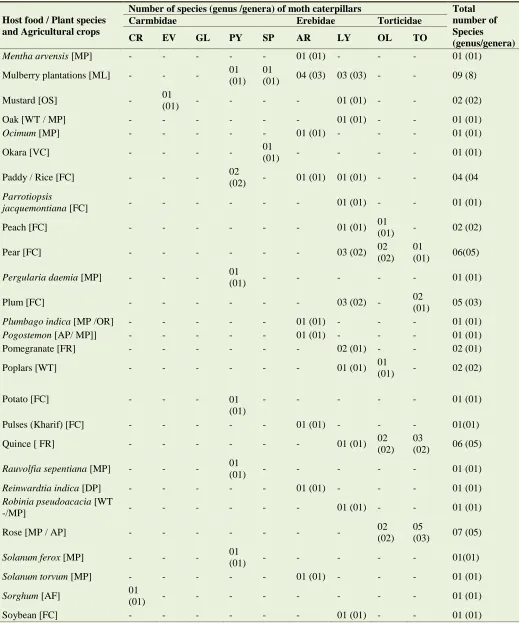
A total of 6 species of moth caterpillars under sub-families – Aractiinae (2 spp.), Pyraustinae (2 spp.), Crambinae (1 sp.) and Lymantriinae (1 sp.), severely affecting the food crops of this region. These include 2 species of caterpillars associated with paddy and 1 species each devouring pulses, maize, potato and soybean. The vegetable crops of this region such as brassicas / cole crops, okra and brinjal, are found to be attacked by 4 spp., 1 sp. and 2 spp. of caterpillars respectively. These species belong to the sub-families, viz. Spilomelinae (2 spp.), Lymantriinae (2 spp.), Pyraustinae (1sp.) and Glaphyriinae (1 sp.). Brassica rapa (field mustard) or oil seed crop serves food for 2 spp. of caterpillars
as Euproctis sp. (Lymantriinae) and Evergestis sp.
(Evergestinae) (see Checklist and Table 1).
As many as 12 species of fruit trees / crops have been found to be devoured by 19 spp. of moth caterpillars, under sub-families like Lymantriinae (6 spp.), Olethreutinae (6 spp.), Tortricinae (6 spp.) and Crambinae (1 sp.) In J & K State the apple trees/ crops are affected by highest number of caterpillar species i.e 10. This followed by pear, quince and walnut, affected by 6 spp. each of moth caterpillar species (lymantriines, crambines, olethreutines and tortricines).
The plum and cherry tree / crop, are damaged by 5 species each of caterpillars, belonging to sub-families, viz. Lymantriinae, Aractiinae and Tortricinae. 3 spp. of tortricine caterpillars, have been found to be damaging grape fruit trees in this region. The fruit tree / crops as almond, apricot, guava, peach and pomegranate, have been found to be damaged by 2 spp. each of caterpillars, pertaining to sub-families- Lymantriinae, Olethreutinae, Spilomelinae and Tortricinae (see Table 1).
(2) Affecting medicinal / aromatic plants
Twenty eight species of medicinal / aromatic plants are affected by 21 spp. of moth caterpillar species, belonging to family Erebidae (9 spp.), Crambidae (5 spp.) and Tortricidae (7 spp.) (Table 1).
Rosa spp. are affected by 7 tortricid species, besides these, damasak rose and centifolia rose are damaged by 2 spp. each of caterpillars, belonging to sub-family Aractiinae and Lymantriinae. After
Rosa spp., the highest number of caterpillar species as 4 each known to be damaging medicinal plants like Crataegus spp. and willows. These caterpillar species belong to sub-family Lymantriinae and Tortricinae. Medicinal plants, viz. Ablemoschus
moschatus and Crotalaria madurensis, are affected
R. C. Bhagat (2018) / Biodiversity and Systematic Checklist of Moth Caterpillars, Belonging to Family Crambidae, Erebidae and Tortricidae, Affecting Host Crops and Plant Species in Jammu & Kashmir State (India)
62
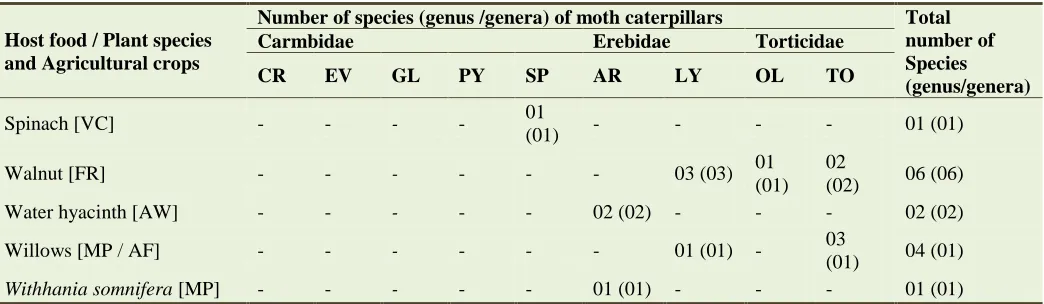
Table 1. Species Diversity of Erebid, Cambid and Tortricid Moth caterpillars, under different Sub-families, affecting
various host /food plants, including agricultural crops and economically important plant species in Jammu and Kashmir State (AR= Aractiinae; CR= Crambinae; EV= Evergestinae; GL= Glaphyriinae; LY= Lymentriinae; OL= Olethrentinae; PY= Pyraustinae; SP= Spilomelinae; TO= Tortricinae).
Host food / Plant species and Agricultural crops
Number of species (genus /genera) of moth caterpillars Total number of Species (genus/genera)
Carmbidae Erebidae Torticidae
CR EV GL PY SP AR LY OL TO
Ablemoschus moschatus
[MP/AP] - - - -
01
(01) 01 (01) - - - 02 (02)
Abrus-precatorius [MP] - - - - 01
(01) - - - - 01(01)
Almond [FR] - - - 02 (02) - - 02 (02)
Alnusnitida [OR] - - - 01 (01) - - 01 (01)
Amaranthus [MP] - - - - 01
(01) - -- - - 01 (01)
Apple [FR] 01
(01) - - - 04 (03)
02 (02)
03
(02) 10 (08)
Apricot [FR] - - - 01 (01) - 01
(01) 02 (02)
Artemisia vulgaris [MP] - - - 01 (01) - - - 01 (01)
Atropa belladonna [MP] - - - 01
(01) 01(01)
Brinjal [VC] - - - 01
(01) - - 01 (01) - - 02 (02)
Brassicas vegetables [VC] - 02
(02) 01
(01) - - - 01 (01) 04 (04)
Cannabis sativa [MP] - - - 01 (01) - - - 01(01)
Centifolia rose [MP/ AP] - - - 01 (01) 01 (01) - - 02 (02)
Chenopodium ambroisides
[MP] - - - 01 (01) - - - 01 (01)
Cheilocostus speciosus
[MP] - - - 01 (01) - - - 01 (01)
Cherry [FR] - - - 01 (01) 01 (01) - 03
(02) 05 (04)
Chrysanthemum indicum
[OR] - - - 01 (01) - - - 01 (01)
Clerodendrum [MP] - - - 01 (01) - - - 01 (01)
Crataegus sp. [MP] - - - 04
(03) 04 (03)
Crotalaria madurensis [MP] - - - 02 (02 - - - 02 (02)
Crotalaria retusa [MP] 01 (01) - - - 01 (01)
Cynoglossum- lanceolatum
[MP] - - - 01 (01) - - - 01 (01)
Damasak rose [MP / AP] - - - 01 (01) 01 (01) - - 02 (02)
Grapes [FR] - - - 03
(02) 03 (02)
Guava[FR] - - - - 01
(01) - -
01
(01) - 02 (02)
Helianthus tuberosum [FC
-/AF] - - - - - 01 (01) - - - 01 (01)
Maize [FC] 01
R. C. Bhagat (2018) / Biodiversity and Systematic Checklist of Moth Caterpillars, Belonging to Family Crambidae, Erebidae and Tortricidae, Affecting Host Crops and Plant Species in Jammu & Kashmir State (India)
63
Table 1. Contd……….
Host food / Plant species and Agricultural crops
Number of species (genus /genera) of moth caterpillars Total number of Species (genus/genera)
Carmbidae Erebidae Torticidae
CR EV GL PY SP AR LY OL TO
Mentha arvensis [MP] - - - - - 01 (01) - - - 01 (01)
Mulberry plantations [ML] - - - 01
(01) 01
(01) 04 (03) 03 (03) - - 09 (8)
Mustard [OS] - 01
(01) - - - - 01 (01) - - 02 (02)
Oak [WT / MP] - - - - - - 01 (01) - - 01 (01)
Ocimum [MP] - - - - - 01 (01) - - - 01 (01)
Okara [VC] - - - - 01
(01) - - - - 01 (01)
Paddy / Rice [FC] - - - 02
(02) - 01 (01) 01 (01) - - 04 (04
Parrotiopsis
jacquemontiana [FC] - - - - - - 01 (01) - - 01 (01)
Peach [FC] - - - - - - 01 (01) 01
(01) - 02 (02)
Pear [FC] - - - - - - 03 (02) 02
(02) 01
(01) 06(05)
Pergularia daemia [MP] - - - 01
(01) - - - 01 (01)
Plum [FC] - - - - - - 03 (02) - 02
(01) 05 (03)
Plumbago indica [MP /OR] - - - - - 01 (01) - - - 01 (01)
Pogostemon [AP/ MP]] - - - - - 01 (01) - - - 01 (01)
Pomegranate [FR] - - - - - - 02 (01) - - 02 (01)
Poplars [WT] - - - - - - 01 (01) 01
(01) - 02 (02)
Potato [FC] - - - 01
(01)
- - - 01 (01)
Pulses (Kharif) [FC] - - - - - 01 (01) - - - 01(01)
Quince [ FR] - - - - - - 01 (01) 02
(02) 03
(02) 06 (05)
Rauvolfia sepentiana [MP] - - - 01
(01) - - - 01 (01)
Reinwardtia indica [DP] - - - - - 01 (01) - - - 01 (01)
Robinia pseudoacacia [WT
-/MP] - - - - - - 01 (01) - - 01 (01)
Rose [MP / AP] - - - - - - - 02
(02) 05
(03) 07 (05)
Solanum ferox [MP] - - - 01
(01) - - - 01(01)
Solanum torvum [MP] - - - - - 01 (01) - - - 01 (01)
Sorghum [AF] 01
(01) - - - - - 01 (01)
R. C. Bhagat (2018) / Biodiversity and Systematic Checklist of Moth Caterpillars, Belonging to Family Crambidae, Erebidae and Tortricidae, Affecting Host Crops and Plant Species in Jammu & Kashmir State (India)
64
Table 1. Contd……….
Host food / Plant species and Agricultural crops
Number of species (genus /genera) of moth caterpillars Total number of Species (genus/genera)
Carmbidae Erebidae Torticidae
CR EV GL PY SP AR LY OL TO
Spinach [VC] - - - - 01
(01) - - - - 01 (01)
Walnut [FR] - - - - - - 03 (03) 01
(01) 02
(02) 06 (06)
Water hyacinth [AW] - - - - - 02 (02) - - - 02 (02)
Willows [MP / AF] - - - - - - 01 (01) - 03
(01) 04 (01)
Withhania somnifera [MP] - - - - - 01 (01) - - - 01 (01)
AF= Animal fodder/ forage; AP= Aromatic plant; AW= Aquatic weed; DP= Dye-yielding plant; FC= Food tree/ crop; FR=
Fruit tree/ crop; ML=Mulberry plantations (Morus spp.); MP= Medicinal plant; OR= Ornamental / flowering plant; OS= Oil-
seed yielding plant; VC= Vegetable plant; WT= Wood/ timber tree.
(3) Affecting animal fodder/ forage, dye-yielding
plant, wood/ timber trees, mulberry
plantations and aquatic weed
Six species of caterpillar affect animal fodder / forage crops (Helianthus tuberosum, Salix spp. and
Sorghum sp.). Salix spp. are affected by 3 spp. of
Tortricine (Archips) and 1 sp. of Lymantriine (
Lymantria ), besides Aractiine ( Spilosoma ) and
Crambine ( Chilo) damage H. tuberosum and
Sorghum respectively. Spilosoma obliqua is
responsible for damaging dye-yielding plant,
Reinwardtia indica in this region. The important
timber/ wood trees of this region, viz. oak and poplars, have been found to be attacked by L.
obfuscata and Eucosoma glaciata, and Parrotiopsis
jacquemontiana is affected by Leucoma sericea.
9 spp., under 8 genera of moth caterpillar, under sub-family Aractiinae (4 spp.), Lymantriinae (3spp.), Pyraustinae (1 sp.) and Spilomelinae (1 sp.), have been found to be damaging mulberry plantations (Morus spp.) in this region. 2 spp. of Aractiine, belonging to genus Spilarctia, are affecting aquatic weed, water hyacinth in this region.
Conflict of interest statement
Authors declare that they have no conflict of interest.
References
Abrol, D. P., Singh, J. P., 2003. Relative efficiency of some insecticides against brinjal and shoot borer, Leucinodes orbonalis Guen and their impact on fruit yield. J. Asia Pacific Entomol. 6(1), 83-90.
Ahad, Ishtiaq, Bhagat, R. M., Ahmad, H., Monobrullah, 2008. Population dynamics of maize stem borer, Chilo partellus Swinhoe in upper Himalayas of Jammu Region. J. Biol. Sci. 16, 137-138.
Ahmad, D., Bhat, M.R., 1987. Insect pests of apple trees in Kashmir. Geobios New Rep. 6, 60-63. Ahmad, H., Shankar, Uma, Monobrullah, M.,
Khan, R. B., 2006. Screening of rice cultivars against rice-leaf folder, Cnaphalocrocis
medinalis (Guence) in Jammu. Environ. Ecol. 3,
673-675.
Anonymous, 1997. Pests of mulberry and their management In: Brief Report: Central Sericultural Research and Training Institute, Pampore, Central Silk Board (Ministry of Textiles, Govt. India), Pampore, Kashmir. pp. 36-38.
Anonymous, 2017a. Global Biodiversity Information Faciity. www.gbif. org./ species Anonymous, 2017b. Marrku Savelas’s website for
Lepidoptera. www.ftp.funet. fi
R. C. Bhagat (2018) / Biodiversity and Systematic Checklist of Moth Caterpillars, Belonging to Family Crambidae, Erebidae and Tortricidae, Affecting Host Crops and Plant Species in Jammu & Kashmir State (India)
65
rice-fields of Kashmir (J & K), India. Asian J. Biol. Sci. 4, 563-569.
Beccaloni, G.N., Scoble, M.J., Kitching, I.J. et al. 2016. The Global Lepidoptera Names. www. nhm.ac.uk/ ourscience / data / lepindex
Bhagat, K.C., Masoodi, M.A., Kaul, V.K., 1994. Notes on the incidence of Archips pomivora
Meynck (Lepidoptera: Tortricidae) as a new pest of apple in Kashmir. J. Insect Sci. 7(11), 112-113.
Bhagat, R. C., 2018. Diversity of Noctuid Caterpillars, belonging to sub-family Amphipyrinae, Catocalinae, Cuculiinae, Heliothinae, Noctuinae and Plusiinae on Host crops / plants of Jammu & Kashmir State. Int. J. Curr. Res. Biosci. Plant Biol. 5(1), 52-59.
Bhagat, R. M., Ishar, A.K., Arora, R. K., 2005. Estimation of avoidable losses and economies of insecticidal control against brinjal fruit and shoot borer, Leucinodes orbonalis Guen, Shashpa. 12(2), 129-130.
Bhat, D.M., Bhagat, R. C., Qureshi, A.A., 2011. A survey of insect pests damaging vegetable crops in Kashmir Valley (India), with some new records. J. Insect Res. 35(1), 85-91.
Bhat, M. R., 1987. Distribution and Host range of some insect pests in Kashmir. Geobios New Rep. 6(2), 176-178.
Bhat, M. R., 1989. Preliminary observation on
Leucoma sericea Moore (Lepidoptera:
Lymantriidae) a serious pest of Parrotiopsis
jaquemontiana Deve in Kashmir Forest. Indian
Forester. 115(3), 38-39.
Bhat, M.R., 1991. Distribution and host range of some insect pests in Kashmir. Geobios New Rep. 10, 160-161.
Bhatia, S., Sharma, S., 2008. Note on phytophagous insects associated with water hyacinth,
Eichhornia crassipes in Jammu. J. Insect Sci.
21(4), 411-412.
Brown, J. W., 2006. Scientific names of pest species in Tortricidae (Lepidoptera) frequently cited erroneously in Entomological literature. Amer. Entomol. 52, 182-189.
Chandra, K., Sidhu, A. K., 2009. Insects of Ladakh. ENVIS Newslet. 15 (1&2), 5-11
Chauhan, S., 2016. Introduction of new insect pests
on Apricot and its primary management options in cold and arid region of Ladakh. Indian J. Ecol. 43(2), 590-592.
Dharmadhikari, P., Ramaseshia, G., Achan, P.D., 1985. Survey of Lymantria obfuscata and its natural enemies in India. Entomophaga. 30(4), 399-408.
Gupta, R. K., Narendran, T. C., 2007. Field parasitism and biological characteristics of potent larval endoparasitoids of Spilosoma
obliqua Walker in Jammu & Kashmir, India. J.
Biol. Control. 21(1), 43-52.
Gupta, R., Tara, J. S., 2013. Studies of Lymantria
obfuscata Walker (Lepidoptera: Lymantriidae)
on apple plantations (Malus domestica Borkh) in Jammu region. Mun. Ent. Zool. 8(2), 749-753.
Gupta, R., Tara, J. S., 2014. First report on the infestation dynamics of Euproctis scintillans
Walker (Lepidoptera: Lymantriidae) on apple
(Malus domestica Borkh) and its relation with
important weather factors in Jammu, India. J. Entomol. Zool. Stud. 2(5), 285-288.
Gupta, R., Tara, J. S., Pathania, P. C., 2015. First report of yellow tail-Tussock Moth, Somena
scintillans Walker (Lepidoptera: Lymantriidae)
on apple plantation in Jammu, J. Insect Sci. 26(1), 130-133.
Ishar, A. K., Arora, R.K., Bhat, R. M., 2007. Seasonal abundance and impact of abiotic factors on the population build-up of
Leucinodes orbonalis Guenec on brinjal in
Jammu subtropics. J. Insect Sci. 20(1), 224. Kaul, V., Kesar, Y. K., 2003. Incidence and
management of Lepidopteran fruit borers of Guava (Psidium gujava L) in Jammu, India. J. Asia Pacific Entomol. 6(2), 201-205.
Koul, V.K., Masoodi, M.A., Bhat, O.K., Bhagat, K.C., 1999. Apple leaf-roller, Archips pomivora
Meyrick (Lepidoptera: Tortricidae) seasonal phenology, parasitism and management. SKUAST J. Res. 1(1), 89-94.
Khan, M. A., Dar, A., Zeya, S. B., Trag, A. R., 2004. Pest and Diseases of Mulberry and their Management. Bishen Singh Mahindra Pal Singh, Dehra Dun, India.
R. C. Bhagat (2018) / Biodiversity and Systematic Checklist of Moth Caterpillars, Belonging to Family Crambidae, Erebidae and Tortricidae, Affecting Host Crops and Plant Species in Jammu & Kashmir State (India)
66
screening of maize germ plasm against maize stem borer, Chilo partelus (Swinhoe) at intermediate zone of Rajouri (J & K). Insect Environ. 9 (1), 45-46.
Kumar, R., Mittal, V., Kumar, N., Ramamurthy, V. V., 2013. Taxonomic aid to major Crambid vegetable pests from North India (Lepidoptera: Crambidae). Mun. Ent. Zool. 8(2), 858-875. Lafontaine, J., Fibiger, M., 2006. Revised higher
classification of Noctuoidea (Lepidoptera). Can. Entomol. 138(5), 610-635.
Malik, R. A., Punjabi, A. A., Bhat, A. A., 1972. Survey and study of insect and non-insect pests of Kashmir. Horticulturist. 3, 29-44.
Masoodi, M. A., 1991. Biological studies on
Lymantria obfuscata Walker (Lepidoptera:
Lymantriidae) in Kashmir. Indian Forester. 117 (8), 644.
Masoodi, M. A., 1992. Consumption of various host foliage and their effect on development of
Lymantria obfuscata Walker in Kashmir. Indian
J. Forest. 15(2), 169-172.
Masoodi, M. A., Trali, A. R., Bhat, A. M., Tikoo, R. K., Nehru, R. K., 1987. Phenological studies on codling moth, Laspeyresia pomonella in Ladakh. Environ. Ecol. 5(2), 253-256.
Mathur, A. C., Srivastava, J. B., 1967. Record of some insect pest of medicinal and aromatic plants in Jammu & Kashmir. Indian Forester. 93 (9), 663-667.
Mir, G. M., Wani, M. A., 2005. Severity of infestation and damage to walnut plantation by important insect pests in Kashmir. Indian J. Plant Prot. 33(2), 188-193.
Mir, M. M., Umar, I., Mir, S. A., Rehman, M. U., Rather, G. H., Bandy, S. A., 2012. Quality evaluation of pomegranate crop- A review. Int. J. Agric. Biol. 14, 658-667.
Mittal, V., Illahi, I., Dhar, A., Khan, M. A., 2011. Natural enemies of mulberry pyralid, Glyphodes
pyloalis Walker (Lepidoptera: Pyralidae) in
temperate climate of Kashmir. J. Biol. Control. 25(1), 55-57.
Munshi, G. L., Singh, S., Singh, R., 1970. A new record of Porthesia xanthorrhoea Kollar (Lymantriidae: Lepidoptera) on Paddy in Jammu, J & K. Indian J. Entomol. 32(4), 390.
Parry, M., Pawar, A. D., 1988. Incidence of Tortix Moth, Archips subsidiaria (Meyreik) (Lepidoptera: Tortricidae): a polyphagous pest in Ladakh region of Jammu & Kashmir State. Plant Prot. Bull. 40(1), 32.
Pandey, A. K., Dwivedi, S. K., 2005. Insect pests and diseases of cold Arid Region, Ladakh. In: Crop Protection Management Strategies, Chap. 18 (Ed.: Prasad, D.). Daya Publishing House, Delhi. pp.276-287.
Pawar, A. D., Parry, M., 1989. Occurrence of codling moth Cydia pomonella (L.) in Nobra Valley and other areas of Ladakh (J & K). Indian J. Plant Prot. 17(2), 291-293
Pawar, A. D., Tuhan, N. C., Balasubramanium, S., Parry, M., 1980. Biological control of codling moth in Ladakh. Indian J. Plant Prot. 8(2), 189-191.
Pawar, A. D., Tuhan, N. C., Balasubramanium, S. Parry, M., 1982. Distribution, damage and biology of codling moth, Cydia pomonella L. Indian J. Plant Prot. 9(1), 111-114.
Ramegowda, G. K., Illahi, I., Mittal, V., Akhter, I., Dhar, A., Khan, M. A., 2012. Influence of a weather on the incidence and severity of lesser mulberry pyralid and mulberry lopper in Kashmir. J. Entomol. 9, 422-428.
Rishi, N. D., 1966. Studies on insect pests of Kashmir Orchards, with notes on their control. Kashmir Sci. 3(12), 119-124.
Rishi, N. D., 1968. Insect pests of Kashmir. Part I. Checklist of pests of horticultural importance. Kashmir Sci. 5(1-2), 243-257.
Robinson, G. S., 1999. Hosts- a database of the host plants of the world’s Lepidoptera. Nota Lepidoptera. 22, 35-47.
Robinson, G. S., Ackery, P. R., Kitching, P. T., Beccaloni, G. W., Herandez, L. M., 2001. Host plants of moth and butterfly caterpillars of the Oriental Region. SouthdeneSdh Bhd. Kaula Lumpur.
Roonwal, M. L., 1977. Life history and control of willow defoliator, Lymantria obfuscata
(Lepidoptera: Lymantridiidae). J. Indian Acad. Wood Sci. 8(2), 97-104.
R. C. Bhagat (2018) / Biodiversity and Systematic Checklist of Moth Caterpillars, Belonging to Family Crambidae, Erebidae and Tortricidae, Affecting Host Crops and Plant Species in Jammu & Kashmir State (India)
67
and Kashmir State. Bioscan. 3(4), 449-453. Salim, J., 1991. Infestation of Parrotiopsis
jacquemontiana by Leucoma sericea
(Lymantriidae) in Dachigam National Park, Kashmir. J. Bombay nat. Hist. Soc. 88m 470-474.
Sharma, B., Tara, J. S., 1985. Insect pests of mulberry plants (Morus sp.) in Jammu and Kashmir State. Indian J. Sericul. 24(1), 7-11. Sheikh, A. G., 1975. Effect of repeated defoliation
caused by Lymantria obfuscata on apple trees in Kashmir. Himal. Horticult. 5(3/4), 9-29.
Singh, O. P., Gangrade, G.A., 1976. New record of a Lymantriid moth on soybean. Sci. Cult. 42(12), 605.
Singh, P., Singh, S., 1986. Insect Pests and Diseases of Poplars. Forest Research Institute, Dehra-Dun, 74p.
Srivastava, J. B., 1977. The new host plants from
Utetesia pulchella (Arctiidae: Lepidoptera) and
Argina cribrana( Hypsidae : Lepidoptera), with
notes on the control of Insects. Sci. Cult. 43, 89-90.
Srivastava, J. B., 1982. Insect pests of medicinal plants and their control. In: Cultivation & Utilization of of Medicinal Plants (Atal, C.K. and Kapur, B.M.). Regional Research Laboratory, CSIR, Jammu, J & K. pp. 734-738.
Tara, J. S., Sharma, B., 2009. Studies on some Lepidopteran pests of guava, Psidium guajava
L. in Jammu. In: Chap. 14. Biodiversity and Environmental Management (Eds.: Joshi, B. D., Tripathi, C. P. M., Joshi, P.C.). A.P.H. Publishing Corporation, New Delhi. pp.101-106.
Tuhan, N. C., Pawar, A. D., Singh, P., Sharma, P. K., 1981. The present economic status of Codling moth, Cydia pomonella (L.) in Ladakh region (Jammu & Kashmir) and studies on its natural enemies. Plant Prot. Bull. India. 33(½), 7-12.
Zahiri, R., Holloway, J. D., Kitching, J., Lefontaine, D., Mutanen, M., Wahlbera, N., 2011. Molecular phylogenetics of Erebidae (Lepidoptera: Noctuoidea). Syst. Entomol. Doi: 10.1111/ j.1365-3113.2011.00607
Zaki, F. A., 1999. Incidence and biology of codlingmoth, Cydia pomonella in Ladakh (Jammu & Kashmir). Appl. Biol. Res. 1(1), 75-78.
Zeya, S. B., Khan, M. A., Malik, M. A., 2000. New records of insect pests of mulberry from Jammu & Kashmir, Indian J. Sericult. 39(1), 89-90. Ziegler, H. C., 2017. Butterflies and moths of
Palaearctic region (2005-2017). www.europlep.
How to cite this article:
Bhagat, R. C., 2018. Biodiversity and systematic checklist of moth caterpillars, belonging to Family Crambidae, Erebidae and Tortricidae, affecting host crops and plant species in Jammu & Kashmir State (India). Int. J. Curr. Res. Biosci. Plant Biol. 5(11), 56-67.