ISSN 2466-4294 (online) | rad-journal.org Vol. 3 | Issue 1 | pp. 18–22, 2018 doi: 10.21175/RadJ.2018.01.004 Original research paper
THE REGISTRATION OF Cs-134 BY GAMMA DETECTOR PAIRS AT AN ANGLE OF 90
*Nikola Svrkota
1, Jelena Mijušković
2, Nevenka M. Antović
2**1Centre for Ecotoxicological Research, Podgorica, Montenegro
2Faculty of Natural Sciences and Mathematics, University of Montenegro, Podgorica, Montenegro
Abstract. Three NaI(Tl) detectors and two pairs of NaI(Tl) detectors at an angle of 90 – from the six-crystal spectrometer PRIPJAT-2M (Faculty of Natural Sciences and Mathematics, University of Montenegro, Podgorica), were used to determine registration efficiencies for the most intense gamma rays in de-excitation of 134Ba, following
beta minus decay of 134Cs. The 134Cs liquid calibration standard was used for acquiring spectra over 18 000 s real time
in the energy range (200-3000) keV – in the integral, non-coincident and mode of double gamma-gamma coincidences. All the spectra from individual detectors and detector pairs in all the counting modes clearly showed peaks at the 605 and 796 keV. The experimental registration efficiency of the 605 keV gamma ray by individual detectors in different modes of counting was found to be with an average of 0.055 (integral), 0.032 (non-coincident) and 0.021 (double coincidences), whilst in the case of two detector pairs – 0.112 (integral), 0.065 (non-coincident) and 0.042 (double coincidences). In regards to the 796 keV, average detection efficiencies were 0.04 (integral), 0.026 (non-coincident) and 0.013 (double coincidences) – in the case of individual detectors, and 0.076 (integral), 0.048 (non-coincident) and 0.026 (double coincidences) – for the detector pairs. Obtained results are baselines for the future development of the coincidence method for 134Cs measurement – using multidetector systems with measuring
geometry close to 4π, with the 796 keV photopeak in a coincidence mode as appropriate for 134Cs detection in a sample
containing 137Cs and decay products of 226Ra and 232Th.
Key words:Cs-134, NaI (Tl) detector pairs, gamma coincidences
* The paper was presented at the Fifth International Conference on Radiation and Applications in Various Fields of Research
(RAD 2017), Budva, Montenegro, 2017.
1.INTRODUCTION
In European countries, where 137Cs was deposited significantly in 1986 (after the Chernobyl accident), the global fallout could be separated from the Chernobyl fraction by using 134Cs, i.e., the 134Cs/137Cs ratio (significantly different in the fallout from those two sources). Determining activities of two cesium isotopes in various samples and developing methods for their simultaneous measurements (see, for example, [1]), are still important, particularly after the accident at the Fukushima Daiichi Nuclear Power Plant. Therefore, measurements of 134Cs and 137Cs activity concentration in environmental samples are of considerable radioecological interest.
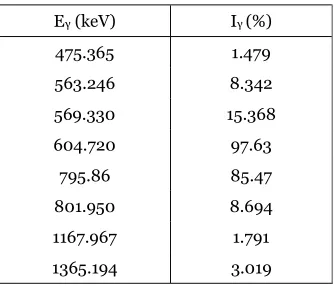
Cesium-134, a fission product with a half-life of 2.1 y, decays via beta minus to 134Ba. This decay is accompanied by the emission of 11 -rays (those with an intensity above 1 % are given in Table 1 2). Among these gamma rays, the most intense have the energies of 604.72 keV and 795.86 keV (i.e., 605 keV and 796 keV, respectively), and they can be used to register 134Cs in an environmental sample, in a standard gamma spectrometry by the systems equipped with one detector. At the same time, environmental samples
contain natural radionuclides 226Ra and 232Th and their decay products, whose decays are followed with the emission of gamma rays with comparable energy (taking into account the energy resolution), e.g. 609 keV and 583 keV, etc., as well as 137Cs (662 keV gamma rays). Therefore, some regions of gamma spectra could be recognized as unresolved peaks of a few -rays.
Table 1. The most intense gamma rays following beta minus decay of 134Cs 2
Eγ (keV) Iγ (%)
475.365 1.479
563.246 8.342
569.330 15.368
604.720 97.63
795.86 85.47
801.950 8.694
1167.967 1.791
19
To determine the activity of 134Cs, 137Cs and 90Sr/90Y in a mixture, a new coincidence method was proposed recently 1, as well as the spectrometer with plastic – for beta, and NaI(Tl) detector – for gamma ray detection.
The decay scheme (134Cs beta minus, i.e., de-excitation of 134Ba) shown in Fig. 1, clearly reveals a possibility to use gamma-gamma coincidences for 134Cs registration and determination of its activity concentration in a sample. Many gamma rays, in de-excitation of 134Ba nuclei, are in cascade transitions (2- (or more)-fold ones), and their registration is possible using a multidetector spectrometer and appropriate method. Among two-fold cascades, the most intense are those with the same last transition with the energy of 605 keV, in particular 796 keV + 605 keV, between the excited levels 1400.591 keV and 604.723 keV, and from the excited level 604.723 keV to the ground state of 134Ba, respectively.
Figure 1. De-excitation of 134Ba nucleus
It has been shown in many studies, various coincidence modes, as well as Compton suppression, are suitable for low-level gamma spectrometry, and expressed advantages in different situations (see, for example, 3).
In order to develop a coincidence method for 134Cs measurements by the multidetector (NaI(Tl)) system with geometry registration close to 4, based on registration of gamma-gamma coincidences, some test experiments have been performed recently, using the 6-crystal spectrometer PRIPYAT 4 (PRIPYAT-2M located at the Faculty of Natural Sciences and Mathematics, University of Montenegro, Podgorica). The registration of 134Cs by the NaI(Tl) detector pair at the angle of 180 (from the geometric spectrometer centre to the detectors centers) can be seen in ref. 5. In the present study, we consider its registration by NaI(Tl) detector pairs at the angle of 90 – in three different modes of counting.
2.EXPERIMENTAL
The PRIPYAT-2M spectrometer (Fig. 2), whose dimensions are 250 cm x 145 cm x 186 cm, consists of six identical scintillation units (NaI(Tl) crystal: 15 cm x 10 cm), passive shielding (iron and lead up to 15 cm), electronics in the CAMAC standard. A measuring chamber is a cube of a 17.5 cm side. The spectrometer has solid angle of 0.7x4 sr, resolution time for coincidences 40 ns, and the possibility to register coincidences with the multiplicity from two- to six-fold.
An average energy resolution of the detectors was found to be 9.5 % (for the 662 keV gamma line).
A schematic diagram of the PRIPYAT-2M is given in Fig. 3a, whilst a detector pair – in Fig. 3b.
Data acquisition, processing, presentation and archiving, are provided by the software PRIP, which also provides calibration of the spectrometric channels (energy, photoefficiency, total detection efficiency), selecting the coincidence-fold ranges and energy range. It gives spectra from individual detectors in the selected mode of counting, sum spectra, as well as information about registered energy, photopeak counts etc., after subtraction of the corresponding background (acquired in the same mode of counting), peak fitting, and summing (in the case of sum spectra).
Available modes of counting at the PRIPYAT spectrometer are
(a) integral mode (1_6) – registration of all signals/pulses, coincident and non-coincident,
(b) non-coincidence mode (1_1) – registration of non-coincident signals only,
(c) two coincidence modes: one (2_6) – registration of all coincident signals coming from the detectors without their separation, and the other – when -spectra of coincident signals (separate two-, three-, four-, five-, and six-fold) are produced simultaneously. In the last one, there is a possibility to select a coincidence range. So, if the range of 2 is selected, that means, for each detector, the spectrum of non-coincident signals, as well as the spectrum of double coincidences (-ray registered simultaneously, respecting the spectrometer resolving time, with the registration of another -ray by any other detector) are produced simultaneously.
Figure 2. Spectrometer PRIPYAT-2M
As can be seen from Fig. 3a, number of the detector pairs in the PRIPYAT system is 15 (12 with the angle between detectors of 90, and 3 – with the angle of 180). The detectors 4, 5 and 6, as well as the pairs 45 and 46 are considered here.
20
3519.1 s. The source spectra (in the integral,non-coincident and the mode of double coincidences), were analyzed after the background subtraction (3530 s in the integral, and 3520 s live measuring time in the coincidence mode).
a)
b)
Figure 3. Schematic diagram of the PRIPYAT-2M (a), detector pair (b)
3.SPECTRA
a)
b)
c)
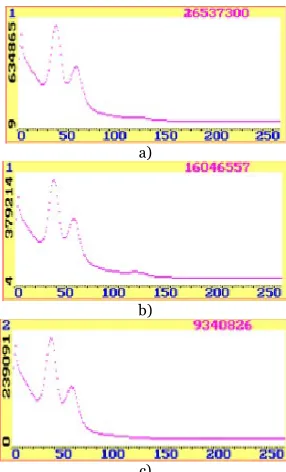
Figure 4. Spectra 134Cs (peaks 605 keV and 796 keV, around
channel 50), detector 5: in the integral ([1_6]) mode of counting (a), in the non-coincident ([1_1]) mode of counting
(b), in the mode of double coincidences ([2_2]) (c)
The 134Cs spectra from individual detectors contain pronounced photopeaks of the 605 keV and 796 keV gamma rays – in all the modes of counting. As an illustration, spectra from detector 5 in the whole energy range, are given in Fig. 4. The number of counts in the peak regions (605 keV and 796 keV) was 2 454 435 and 1 614 062, respectively (in the integral mode), 1 343 742 and 972 510, respectively (in the non-coincident mode), and 1 016 493 and 585 572, respectively (in the mode of double coincidences).
“Peaks” in the low energy region, partially cut-off, appear due to Compton scattering and registration of the gamma rays with lower energy (Table 1). This region, as well as the region after 796 keV (registration of more energetic gamma rays and summing effect) will be considered in a further study.
Although detector 4 participates in both selected pairs, sum spectra for the 46 detector pair (Fig. 5), in the energy range from 200 to 3000 keV (from 2 to 255 channel), showed number of counts in the peak regions higher than the pair 45. In the integral mode (Fig. 5a), the 605 keV and 796 keV peak regions contained 9 639 486 and 5 736 513 counts, respectively, while in the non-coincident mode (Fig. 5b) and the mode of double coincidences (Fig. 5c) – 5 703 381 and 3 623 689, 3 590 996 and 1 898 127 counts, respectively. It could be explained by the fact that the sixth one is the detector on which the source was placed, and it generally shows the highest number of counts in the peak regions 6.
a)
b)
c)
Figure 5. Sum spectra of 134Cs, detector pair 46: in the
integral mode of counting(a),in the non-coincident mode of counting (b), in the mode of double coincidences (c)
21
of 208Tl) – in the integral, non-coincident and the mode of double coincidences 7. The 662 keV gamma ray from 137Cs creates a close peak, as well – in the integral and non-coincident spectra.
On the other hand, the peak at energy of 796 keV is clear, particularly in the mode of double coincidences which previously showed the best signal-to-noise ratio – in both the (200-2000) keV and (300-3000) keV energy region (see, for example, 7). Therefore, a future development of the coincident method for 134Cs measurement in environmental samples should be based on analysing 796 keV photopeak in coincidence spectra, which is in concordance with findings of the other researchers (see, for example, 8).
4.REGISTRATION EFFICIENCIES
Photoefficiency (i.e., efficiency of registration in the full absorption peak) was determined from the spectral data using
,
IA
N
ε
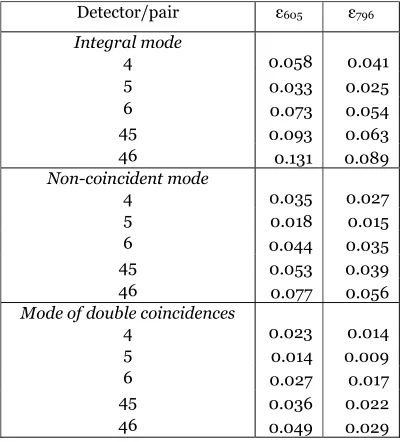
c (1)where Nc is the counting rate (after the background subtraction), I – gamma ray intensity, and A – activity of the 134Cs source. Experimental photoefficiencies for the single detectors and detector pairs are presented in Table 2.
Table 2. Efficiencies from individual and sum spectra in three modes of counting
Detector/pair ε605 ε796
Integral mode
4 0.058 0.041
5 0.033 0.025
6 0.073 0.054
45 0.093 0.063
46 0.131 0.089
Non-coincident mode
4 0.035 0.027
5 0.018 0.015
6 0.044 0.035
45 0.053 0.039
46 0.077 0.056
Mode of double coincidences
4 0.023 0.014
5 0.014 0.009
6 0.027 0.017
45 0.036 0.022
46 0.049 0.029
An average the 605 keV photoefficiency for individual detectors was found to be 0.055 in the integral mode of counting, 0.032 in the non-coincident mode of counting, and 0.021 in the mode of double coincidences. Two considered detector pairs (45 and 46) showed the average 605 keV photoefficiency of 0.112, 0.065 and 0.042, respectively.
In regards to the 796 keV, an average photoefficiency of individual detectors was found to be 0.04 in the integral mode of counting, 0.026 in the non-coincident mode of counting and 0.013 in the mode of double coincidences. The detector pairs 45 and 46, showed the 796 keV photoefficiency in an average of 0.076, 0.048 and 0.026, respectively.
For a comparison, the previous analysis of two NaI(Tl) detectors in the same system, at an angle of 180, in sum integral, non-coincident and spectrum of double coincidences showed the detection efficiency of 0.106, 0.067 and 0.042, respectively (605 keV), and 0.074, 0.035 and 0.018, respectively (796 keV) 5. As it can be seen from Table 2, the detector pair 46 (the angle between detectors ~90) is more efficient in registration both gamma rays – 605 keV and 796 keV, in all the modes of counting.
Ratios of the total and photopeaks count rates in the 134Cs spectrum and under the corresponding energy region in the background spectrum are given in Table 3 (individual detectors) and Table 4 (detector pairs 45 and 46). It should be noted that, as abovementioned, real measuring time of the 134Cs source was 18 000 s, while the background spectra were acquired over the time corresponding to the 134Cs live time of measurements.
Table 3. Ratios of the count rates in the 134Cs (Czech
Metrology Institute, 9031 – OL – 471/06) spectrum and under the corresponding energy region in the background spectrum in different modes of counting (1-6 - integral, 1-1
- non-coincidence, 2-2 - double coincidences – individual detectors
Mode of counting
Ratio of the total count
rates: 134Cs/ background
Ratio of the count rates in the 605 keV region:
134Cs/ background
Ratio of the count rates in the 796 keV region:
134Cs/ background
Detector 4
1-6 577 1085 1128
1-1 446 807 1041
2-2 1323 2479 2484
Detector 5
1-6 372 782 780
1-1 276 581 637
2-2 762 1616 1464
Detector 6
1-6 627 1432 1487
1-1 481 1135 1170
2-2 1518 3561 3202
22
and non-coincident). Therefore, although someadvantages of the integral, in compare to non-coincident mode of counting can be seen from Table 3 and Table 4, further the method development should be focused on a coincidence mode of counting, preferable of double coincidences, which are the most intense.
Table 4. Ratios of the count rates in the 134Cs (Czech
Metrology Institute, 9031 – OL – 471/06) spectrum and under the corresponding energy region in the background spectrum in different modes of counting (1-6 - integral, 1-1
- non-coincidence, 2-2 - double coincidences – sum spectra of detector pairs 45 and 46 in the energy range (200-3000)
keV
Mode of counting
Ratio of the total count
rates: 134Cs / background
Ratio of the count rates in the 605 keV region:
134Cs / background
Ratio of the count rates in the 796 keV region:
134Cs / background
Pair 45
1-6 513 950 981
1-1 404 727 838
2-2 1081 2100 1990
Pair 46
1-6 696 1282 1364
1-1 551 1016 1122
2-2 1552 3075 3028
5.CONCLUSIONS
Obtained spectra showed relatively high registration efficiency of individual detectors and two detector pairs at an angle of 90 from the PRIPYAT-2M spectrometer – for the 134Cs gamma rays in the integral, non-coincident and mode of double coincidences. Presented results are baselines for further development of the coincidence method for 134Cs measurement – using multidetector systems with measuring geometry close to 4π, with the 796 keV photopeak in a coincidence mode as appropriate for 134Cs detection in a sample containing 137Cs, as well as decay products of 226Ra and 232Th.
REFERENCES
1. Y. Unnoa, T. Sanamib, M. Hagiwarab, S. Sasakib, A. Yunokia, “Application of beta coincidence to nuclide identification of radioactive samples contaminated by
the accident at the Fukushima Nuclear Power Plant,”
Prog. Nucl. Sci. Tech., vol. 4, pp. 90 – 93, 2014. DOI: 10.15669/pnst.4.90
2. Recommended data, LNHB, Paris, France, 2017. Retrieved from: http://www.nucleide.org/DDEP_WG/ DDEPdata.htm;
Retrieved on: Jan. 15, 2018
3. E. L. Grigorescu, P. de Felice, A. C. Razdolescu, A. Luca, “Low-level gamma spectrometry using beta coincidence and Compton suppression,” Appl. Radiat. Isot., vol. 61, n0. 2-3, pp. 191 – 195, Aug-Sep. 2004.
DOI: 10.1016/j.apradiso.2004.03.044 PMid: 15177343
4. С. К. Андрухович, А. В. Берестов, В. И. Гутко,
А. М. Хильманович, “Высокочувствительные
многодетекторные гамма спектрометры
ПРИПЯТЬ,” Препринт Института физики,
АН БССР, Минск, Беларусь, 1995
(S. K. Andrukhovich, A. V. Berestov, V. I. Gutko, A. M. Hil’manovich, “High sensitive multidetector gamma spectrometers PRIPYAT,” Preprint of the Institute of Physics, AN BSSR, Minsk, Belarus, 1995.) 5. N. Svrkota, N. M. Antović, T. Andjelić, “Osnovi
koincidentnog metoda mjerenja cezijuma-134,” u
Černobilj, 30 godina posle, G. Pantelić, Ur., Beograd, Srbija:Društvo za zaštitu od zračenja Srbije i Crne Gore i Institut Vinča, str. 278 – 286, 2016. (N. Svrkota, N. M. Antović, T. Andjelić, “Basic research for coincidence method of Cs-134 measurement,” in
Chernobyl, 30 years after, G. Pantelić, Ed., Belgrade, Serbia:Society for Radiation Protection of Serbia and Montenegro and Vinča Institute, 2016, pp. 278 – 286.) Retrieved from: https://www.researchgate.net/publicat ion/309772261_Cernobilj_30_godina_posle; Retrieved on: Jan. 15, 2018
6. J. Mijušković, “Efikasnost detekcije 134Cs parovima
detektora pod uglom od 90 i 180,” Spec. rad, Univerzitet Crne Gore, Prirodno-matematički fakultet, Podgorica, Crna Gora, 2016. (J. Mijušković, “Detection efficiency of 134Cs by detector pairs at angles of 90 and
180”, Spec. Thesis, University of Montenegro, Faculty of Natural Sciences and Mathematics, Podgorica, Montenegrom 2016.)
7. N. M. Antović, N. Svrkota, “Detection efficiencies of
226Ra and 232Th in different modes of counting of the
PRIPYAT-2M spectrometer,” Nucl. Technol. Radiat. Prot., vol. 24, no. 2, pp. 109 – 118, Jul. 2009.
DOI: 10.2298/NTRP0902109A
8. M. C. Cook, M. J. Stukel, W. Zhang, J.-F. Mercier, M. W. Cooke, “The determination of Fukushima-derived cesium-134 and cesium-137 in Japanese green tea samples and their distribution subsequent to simulated beverage preparation,” J. Environ. Radioactiv., vol. 153, pp. 23 – 30, Mar. 2016.