partykit
: A Modular Toolkit for Recursive Partytioning in
R
Torsten Hothorn [email protected]
Institut f¨ur Epidemiologie, Biostatistik und Pr¨avention, Universit¨at Z¨urich
Achim Zeileis [email protected]
Institut f¨ur Statistik, Universit¨at Innsbruck
Editor:Cheng Soon Ong
Abstract
The R package partykit provides a flexible toolkit for learning, representing, summarizing, and visualizing a wide range of tree-structured regression and classification models. The functionality encompasses: (a) basic infrastructure for representing trees (inferred by any algorithm) so that unifiedprint/plot/predictmethods are available; (b) dedicated methods for trees withconstant fits in the leaves (or terminal nodes) along with suitable coercion functions to create such trees (e.g., byrpart,RWeka, PMML); (c) a reimplementation ofconditional inference trees(ctree, orig-inally provided in thepartypackage); (d) an extended reimplementation of model-based recursive partitioning(mob, also originally inparty) along with dedicated methods for trees with parametric models in the leaves. Here, a brief overview of the package and its design is given while more detailed discussions of items (a)–(d) are available in vignettes accompanying the package.
Keywords: recursive partitioning, regression trees, classification trees, statistical learning,R
1. Overview
• One ‘agnostic’ base class (‘party’) encompassing a very wide range of different tree types.
• Subclasses for important types of trees, e.g., trees with constant fits (‘constparty’) or with parametric models (‘modelparty’) in each terminal node (or leaf).
• Nodes are recursive objects, i.e., a node can contain child nodes.
• Keep the (learning) data out of the recursive node and split structure.
• Basic printing, plotting, and predicting for raw node structure.
• Customization via suitable panel or panel-generating functions.
• Coercion from existing object classes in R(rpart,J48, etc.) to the new class.
• Usage of simple/fast S3 classes and methods.
In addition to all of this generic infrastructure, two specific tree algorithms are implemented in partykit as well: ctree for conditional inference trees (Hothorn et al., 2006) and mobfor model-based recursive partitioning (Zeileis et al., 2008).
2. Installation and Documentation
Thepartykit package is an add-on package for theRsystem for statistical computing. It is available from the Comprehensive RArchive Network (CRAN) at http://CRAN.R-project.org/package=
partykit and can be installed from within R, e.g., using install.packages. It depends on R
(at least 2.15.0) as well as the base packages graphics, grid, stats, and the recommended sur-vival. Furthermore, various suggested packages are needed for certain special functionalities in the package. To install all of these required and suggested packages in one go, the command
in-stall.packages("partykit", dependencies = TRUE)can be used.
In addition to the stable release version on CRAN, the current development release can be installed from R-Forge (Theußl and Zeileis, 2009). In addition to source and binary packages the entire version history is available throughR-Forge’sSubversion source code management system.
Along with the package extensive documentation with examples is shipped. The manual pages provide basic technical information on all functions while much more detailed descriptions along with hands-on examples are provided in the four package vignettes. First, the vignette"partykit"
introduces the basic ‘party’ class and associated infrastructure while three further vignettes discuss the tools built on top of it: "constparty" covers the eponymous class (as well as the simplified
‘simpleparty’ class) for constant-fit trees along with suitable coercion functions, and"ctree"and
"mob" discuss the newctree andmobimplementations, respectively. Each of the vignettes can be
viewed within Rvia vignette(“name”, package = "partykit") and the underlying source code (inRwith LATEX text) is also available in the source package.
3. User Interface
The partykit package provides functionality at different levels. First, there is basic infrastructure for representing, modifying, and displaying trees and recursive partitions – these tools are mostly intended for developers and described in the next section. Second, there are tools for inferring trees from data or for importing trees inferred by other software intopartykit.
Algorithm Software implementation Object class Original reference CART/RPart rpart::rpart+as.party constparty Breiman et al. (1984) C4.5/J4.8 Weka/RWeka::J48+as.party constparty Quinlan (1993) QUEST SPSS/AnswerTree +pmmlTreeModel simpleparty Loh and Shih (1997) CTree ctree constparty Hothorn et al. (2006)
MOB mob, lmtree,glmtree, . . . modelparty Zeileis et al. (2008)
EvTree evtree::evtree constparty Grubinger et al. (2014)
Table 1: Selected implementations of tree algorithms that can be interfaced throughpartykit. The second column lists external software, R functions from other packages (with:: syntax) and frompartykit.
Gender 1 Male Female Age 2 Adult Child
Node 3 (n = 1667)
No Y es 0 0.2 0.4 0.6 0.8 1 Class 4
3rd 1st, 2nd Node 5 (n = 48)
No Y es 0 0.2 0.4 0.6 0.8
1 Node 6 (n = 16)
No Y es 0 0.2 0.4 0.6 0.8 1 Class 7
3rd 1st, 2nd, Crew
Node 8 (n = 196)
No Y es 0 0.2 0.4 0.6 0.8
1 Node 9 (n = 274)
No Y es 0 0.2 0.4 0.6 0.8 1 Class p < 0.001
1
3rd 1st, 2nd, Crew
Node 2 (n = 706)
Normal Male&Adult Preferential Female|Child Y es No 0 0.2 0.4 0.6 0.8 1 ● ● Class p < 0.001
3
2nd 1st, Crew
Node 4 (n = 285)
Normal Male&Adult Preferential Female|Child Y es No 0 0.2 0.4 0.6 0.8 1 ● ●
Node 5 (n = 1210)
Normal Male&Adult Preferential Female|Child Y es No 0 0.2 0.4 0.6 0.8 1 ● ●
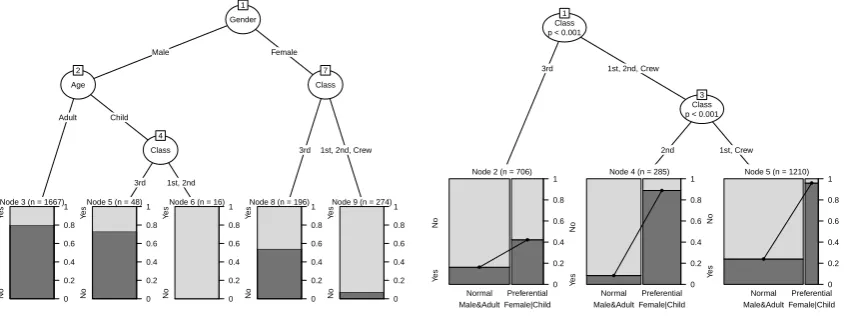
Figure 1: Tree visualizations of survival on Titanic: ‘rpart’ tree converted with as.party and visualized bypartykit (left); and logistic-regression-based tree fitted byglmtree(right).
are so-called coercion functions for transforming trees learned in other software packages (inside and outside of R) to the classes provided by partykit. Specifically, tree objects learned by rpart
(Therneau and Atkinson, 1997, implementing CART, Breiman et al., 1984) and byJ48fromRWeka (Hornik et al., 2009, interfacing Weka’s J4.8 algorithm for C4.5, Quinlan, 1993) can be coerced
by as.party to the same object class ‘constparty’. This is a general class that can in principle
represent all the major classical tree types with constant fits in the terminal nodes. Also, the same class is employed for conditional inference trees (CTree) that can be learned with thectreefunction directly withinpartykit or evolutionary trees from packageevtree (Grubinger et al., 2014).
Finally, the partykit function mobimplements model-based recursive partitioning (MOB) along with “mobster” interfaces for certain models (e.g.,lmtree, glmtree). These return objects of class
‘modelparty’ where nodes are associated with statistical models (as opposed to simple constant fits).
In principle, this may also be adapted to other model trees (such as GUIDE, LMT, or M5’) but no such interface is currently available.
All of these different trees (see Table 1 for an overview) use the same infrastructure at the core but possibly with different options enabled. In all cases, the functionsprint,plot, andpredictcan be used to create textual and graphical displays of the tree and for computing predictions on new data, respectively. As an example for the visualizations, Figure 1 shows two different trees fitted to the well-known data on survival of passengers on the ill-fated maiden voyage of the RMS Titanic: The left panel shows a CART tree with constant fits learned byrpart and converted topartykit. The right panel shows a MOB tree learned withpartykit with a logistic regression for treatment effects in the terminal nodes. Additionally, the are further utility functions, e.g.,nodeapplycan be employed to access further information stored in the nodes of a tree andnodeprunecan prune selected nodes.
4. Developer Infrastructure
The unified infrastructure at the core of partykit is especially appealing for developers who either want to implement new tree algorithms or represent trees learned in other systems.
Here, we briefly outline the most important classes and refer to the vignettes for more details:
‘partysplit’: Split with integer ID for the splitting variable, breakpoint(s), indexes for the kids.
‘partynode’: Node specification with integer ID, a ‘partysplit’, and a list of kids (if any) that are
‘partynode’ objects again.
‘party’: Tree with a recursive ‘partynode’ and a ‘data.frame’ (optionally empty), potentially plus
information about fitted values and ‘terms’ allowing to preprocess new data for predictions.
All classes have an additional slot for storing arbitrary information at any level of the tree. This is exploited by ‘constparty’, ‘simpleparty’, and ‘modelparty’ which store the observed response, point predictions, and fitted parametrics models, respectively.
5. Discussion and Outlook
Packagepartykit provides a toolkit for trees in Rthat gives emphasis to flexibility and extensibility. The infrastructure is easily accessible and accompanied by detailed manual pages and package vi-gnettes. The package facilitates the implementation of new algorithms or interfacing other software by providing common building blocks for computing on trees (representation, printing, plotting, predictions, etc.). Using these building blocks developers of tree software can focus on implement-ing the learnimplement-ing algorithm (selection of variables and split points, stoppimplement-ing criteria, prunimplement-ing, etc.). The package also provides functions for inferring trees where the computationally intensive parts are either in C (ctree) or employ R’s fitting functions (mob). The simple and lean base classes that separate data and tree structure are also appealing for storing forests – a first proof-of-concept reimplementation ofcforestis in the package with further extension planned. Users and developers that have questions or comments about the package can either contact the maintainers or use the forum onR-Forge athttps://R-Forge.R-project.org/forum/forum.php?forum_id=852.
Acknowledgments
References
Leo Breiman, Jerome H. Friedman, Richard A. Olshen, and Charles J. Stone. Classification and Regression Trees. Wadsworth, California, 1984.
Data Mining Group. Predictive model markup language, 2014. URL http://www.dmg.org/. Ver-sion 4.2.
Thomas Grubinger, Achim Zeileis, and Karl-Peter Pfeiffer.evtree: Evolutionary learning of globally optimal classification and regression trees inR. Journal of Statistical Software, 61(1), 1–29 2014.
Kurt Hornik, Christian Buchta, and Achim Zeileis. Open-source machine learning: Rmeets Weka. Computational Statistics, 24(2):225–232, 2009.
Torsten Hothorn. CRAN task view: Machine learning & statistical learning, 2014. URL http:
//CRAN.R-project.org/view=MachineLearning. Version 2014-12-18.
Torsten Hothorn, Kurt Hornik, and Achim Zeileis. Unbiased recursive partitioning: A conditional inference framework. Journal of Computational and Graphical Statistics, 15(3):651–674, 2006.
Torsten Hothorn, Kurt Hornik, Carolin Strobl, and Achim Zeileis.party: A Laboratory for Recursive Partytioning, 2015. URLhttp://CRAN.R-project.org/package=party. Rpackage version 1.0-20.
Wei-Yin Loh. Regression trees with unbiased variable selection and interaction detection. Statistica Sinica, 12(2):361–386, 2002.
Wei-Yin Loh. Fifty years of classification and regression trees. International Statistical Review, 82 (3):329–348, 2014.
Wei-Yin Loh and Yu-Shan Shih. Split selection methods for classification trees. Statistica Sinica, 7 (4):815–840, 1997.
James N. Morgan and John A. Sonquist. Problems in the analysis of survey data, and a proposal. Journal of the American Statistical Association, 58(302):415–434, 1963.
John R. Quinlan. C4.5: Programs for Machine Learning. Morgan Kaufmann, San Mateo, 1993.
RCore Team. R: A Language and Environment for Statistical Computing. RFoundation for Statis-tical Computing, Vienna, Austria, 2014. URLhttp://www.R-project.org/.
Terry M. Therneau and Elizabeth J. Atkinson. An introduction to recursive partitioning using the rpart routine. Technical Report 61, Section of Biostatistics, Mayo Clinic, Rochester, 1997. URL
http://www.mayo.edu/hsr/techrpt/61.pdf.
Stefan Theußl and Achim Zeileis. Collaborative software development usingR-Forge.TheRJournal, 1(1):9–14, May 2009.
Ian H. Witten and Eibe Frank. Data Mining: Practical Machine Learning Tools and Techniques. Morgan Kaufmann, San Francisco, 2nd edition, 2005.