JKernelMachines: A Simple Framework for Kernel Machines
David Picard [email protected]
ETIS - ENSEA/CNRS/Universit´e de Cergy Pontoise 6 avenue du Ponceau
95014 Cergy-Pontoise Cedex, France
Nicolas Thome [email protected]
Matthieu Cord [email protected]
LIP6 - UPMC Univ Paris 6 4 place Jussieu
75005 Paris, France
Editor:Cheng Soon Ong
Abstract
JKernelMachinesis a Java library for learning with kernels. It is primarily designed to deal with
custom kernels that are not easily found in standard libraries, such as kernels on structured data. These types of kernels are often used in computer vision or bioinformatics applications. We provide several kernels leading to state of the art classification performances in computer vision, as well as various kernels on sets. The main focus of the library is to be easily extended with new kernels. Standard SVM optimization algorithms are available, but also more sophisticated learning-based kernel combination methods such as Multiple Kernel Learning (MKL), and a recently published algorithm to learn powered products of similarities (Product Kernel Learning).
Keywords: classification, support vector machines, kernel, computer vision
1. Introduction
Support Vector Machines (SVM) are widely recognized as state-of-the art classifiers for supervised
learning problems. When using SVM, the similarity measure has to be a kernelfunction.
Effi-cient libraries already exist implementing SVM optimization algorithms (liblinear, libsvm, weka,
SHOGUN,etc). However, these solutions are generally limited to vectorial data and simple kernels
(linear or Gaussian for example). It is not straightforward to use them when dealing with structured data, for example, sets, graphs, or strings. Designing similarities for such inputs is essential in areas such as bioinformatic and computer vision.
For image classification or object detection tasks, state of the art methods rely on similarity
functions based on sets of features (edge, color, texture,etc) extracted locally on different image
been proposed in the computer vision community, for example by Bo and Sminchisescu (2009) or by T. Tuytelaars and Darrell (2011).
To sum it up, designing well adapted kernel functions is attracting a lot of research in the
com-munity. JKernelMachines is dedicated to facilitate the use of such exotic kernels. It is thus not
designed as an end user program, but as a library to be used in computer vision (or bioinformatics,
etc) pipelines. The goals of the library are to provide:
• An efficient framework for kernels:
– Easy and intuitive use of the library
– Very easy and rapid development of new kernels
• An effective SVM machine learning toolbox:
– Up to date learning algorithms (primal, dual) with kernel combinations (MKL)
– Good computational performances on current computer vision benchmarks
To fulfill these goals, JKernelMachines is designed as a pure Java implementation without any
further dependency than a standard JRE. It is licensed under the terms of GPLv3.
2. Description of the Library
The backbone of the library is the definition of data types and kernels. In order to use any type of input space, the library makes heavy use of the Java Generics. Kernels are defined on generic input space, with specific implementation delegated to child classes. Classifiers that use a kernel function will end up with the right similarity thanks to polymorphism.
2.1 Kernels
Given a sample of generic type T, the library provides a parent class for all kernel functions:
p u b l i c a b s t r a c t c l a s s K e r n e l<T> i m p l e m e n t s S e r i a l i z a b l e {
/∗ ∗ c o m p u t e t h e k e r n e l s i m i l a r i t y b e t w e e n tw o e l e m e n t s o f i n p u t s p a c e ∗/
p u b l i c a b s t r a c t d o u b l e v a l u e O f ( T t 1 , T t 2 ) ; }
To create a new kernel, one basically has to extend this class and implement the valueOf() method. For example, the source code below corresponds to the following kernel on bags of vectors of double:
K({xi}i,{xj}j) =
∑
xi∈{xi}i,xj∈{xj}j
e− kxi−xjk2
2 .
p u b l i c c l a s s D o u b l e B a g G a u s s i a n e x t e n d s K e r n e l<L i s t<d o u b l e[]>> {
p u b l i c d o u b l e v a l u e O f ( L i s t<d o u b l e[]> l 1 , L i s t<d o u b l e[]> l 2 ) {
d o u b l e sum = 0 . , d ;
f o r(d o u b l e[ ] t 1 : l 1 )
f o r(d o u b l e[ ] t 2 : l 2 ) {
f o r( d = 0 . , i n t i =0 ; i<t 1 . l e n g t h ; i ++){ d += ( t 2 [ i ]−t 1 [ i ] )∗( t 2 [ i ]−t 1 [ i ] ) ; } sum += Math . exp (−d / 2 . ) ;
}
r e t u r n sum ; }
Currently,JKernelMachinesprovides the following kernels:
• Standard kernels on vector (Linear, Gaussian, etc) for various types (int, double, etc)
• A wide variety of Gaussian kernels (χ2distance, subset of selected axes, etc)
• Combination of kernels (weighted sum and weighted product of generic minor kernels)
• Generic kernels on lists (ordered or unordered, weighted or not)
• Kernels defined by a custom Gram matrix and kernels with various caching strategies
2.2 Classifiers
Classifiers are also defined on generic data types, and use an instance of a specific Kernel. In order to be able to work on any type of input space, the data type of the samples are encapsulated in
a generic class called TrainingSample. This class contains the sample of generic type T and the
associated label (if the sample is labeled):
p u b l i c c l a s s T r a i n i n g S a m p l e<T> i m p l e m e n t s S e r i a l i z a b l e { T s a m p l e ;
i n t l a b e l; }
Training of an SVM classifier consists of calling the method train with a list of TrainingSample as parameters. For example, an SVM with GaussianKernel on vectors of double would be done as follows:
L i s t<T r a i n i n g S a m p l e<d o u b l e[]>> t r a i n = new A r r a y L i s t<T r a i n i n g S a m p l e<d o u b l e[ ]> >( ) ;
/ / add c o d e t o f e e d t h e l i s t w i t h l a b e l e d s a m p l e s
D o u b l e G a u s s L 2 k = new D o u b l e G a u s s L 2 ( ) ;
LaSVM<d o u b l e[]> l a s v m = new LaSVM<d o u b l e[ ]>( k ) ; l a s v m . t r a i n ( t r a i n ) ;
In this example, the evaluation of a new sample is as simple as:
d o u b l e[ ] s a m p l e ; / / add c o d e t o f i l l t h e s a m p l e
d o u b l e v a l u e = l a s v m . v a l u e O f ( s a m p l e ) ;
Currently,JKernelMachinesimplements the following algorithms:
• SVM: LaSVM from Bordes et al. (2005), LaSVM-I from Ertekin et al. (2011), SMO from
Platt (1999), Transductive SVM using S3VMLightfrom Joachims (1999)
• Density estimator: One-class SVM using SMO, Parzen window estimator
• Multiple kernel: SimpleMKL from Rakotomamonjy et al. (2008), TS-MKL from Kumar et al.
(2012), Gradient-descent basedℓp-Norm MKL from Kloft et al. (2011), Product combinations
of Gaussian kernels from Picard et al. (2012)
• Fast primal linear SVM on double vectors: Pegasos from Singer and Srebro (2007), SGD
from Bottou (2010), SGDQN from Bordes et al. (2009)
Since most of these algorithms are implemented using the Kernel interface, they can be used with any positive semi-definite implementation of the Kernel class. Examples are provided with the
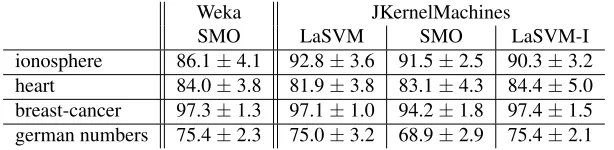
Weka JKernelMachines
SMO LaSVM SMO LaSVM-I
ionosphere 86.1±4.1 92.8±3.6 91.5±2.5 90.3±3.2 heart 84.0±3.8 81.9±3.8 83.1±4.3 84.4±5.0 breast-cancer 97.3±1.3 97.1±1.0 94.2±1.8 97.4±1.5 german numbers 75.4±2.3 75.0±3.2 68.9±2.9 75.4±2.1
Table 1: Mean accuracies forWekaandJKernelMachineson UCI data sets.
3. Validation
We first present results comparing JKernelMachinesto the well known Wekalibrary on common
data sets from the UCI repository. We used the example classCrossValidationExampleof package
fr.lip6.jkernelmachines.exampleto produce the results. Following the setup of Rakotomamonjy et al. (2008), 20 random splits were drawn (80% for train, 20% for test).
Table 3 summaries the results. On theionospheredata set,JKernelMachinesoffers significantly
better results thanWeka. Onheart,breast cancer andgerman numbers both libraries gave about
the same results. Regarding time, we found JKernelMachines implementation of LaSVM to be
significantly faster thanWeka(both libraries were fast enough).
Compared to other libraries more centered on kernels, like SHOGUN or OpenKernel,
JKernel-Machinesclearly aims at adding new kernels easily and reliably by allowing the user to set any code inside the kernel computation. For instance, SHOGUN allows to use kernels defined by a custom Gram matrix, which has to be computed before the optimization. The custom matrix method may not be easy to handle when the kernel is relying on a parametric feature extraction process, where the parameters are to be varied (e.g., filter banks in signal processing applications). Moreover, in case of online evaluation, a new custom matrix has to be computed for each incoming test sample
and manually set as the kernel used by the classifier, whereas aJKernelMachinesclassifier would
work without any modification. OpenKernel allows for more complex kernels using base kernels (including n-gram kernels) and combination, but again the data have to be in a specific file format generated in advance which leads to the same difficulties.
JKernelMachineswas used for PASCAL VOC challenges both in 2009 and in 2010,1and gave comparative results to other teams using the same features. The achievement in these challenges is two-folds: first, it validates the implementation of the learning algorithms. Second, it shows the li-brary is usable on real world challenges regarding computing resources. Some of these experiments were published in Picard et al. (2010).
References
L. Bo and C. Sminchisescu. Efficient match kernel between sets of features for visual recognition. InAdvances in Neural Information Processing Systems, December 2009.
A. Bordes, S. Ertekin, J. Weston, and L. Bottou. Fast kernel classifiers with online and active
learning. Journal of Machine Learning Research, 6:1579–1619, September 2005.
A. Bordes, L. Bottou, and P. Gallinari. Sgd-qn: Careful quasi-newton stochastic gradient descent.
Journal of Machine Learning Research, 10:1737–1754, July 2009.
L. Bottou. Large-scale machine learning with stochastic gradient descent. In Yves Lechevallier
and Gilbert Saporta, editors,Proceedings of the 19th International Conference on Computational
Statistics, pages 177–187, Paris, France, August 2010.
S. Ertekin, L. Bottou, and C. L. Giles. Ignorance is bliss: Non-convex online support vector
ma-chines. IEEE Transactions on Pattern Recognition and Machine Intelligence, 33(2):368–381,
February 2011.
T. Joachims. Transductive inference for text classification using support vector machines. InICML,
pages 200–209, 1999.
M. Kloft, U. Brefeld, S. Sonnenburg, and A. Zien. Lp-norm multiple kernel learning. Journal of
Machine Learning Research, 12:953–997, Mar 2011.
A. Kumar, A. Niculescu-Mizil, K. Kavukcuoglu, and H. Daume III. A binary classification
frame-work for two-stage multiple kernel learning. InProceedings of the 29th International Conference
on Machine Learning (ICML-12), pages 1295–1302, New York, NY, USA, July 2012.
D. Picard, N. Thome, and M. Cord. An efficient system for combining complementary kernels in
complex visual categorization tasks. InImage Processing (ICIP), 2010 17th IEEE International
Conference on, pages 3877–3880, 2010.
D. Picard, N. Thome, M. Cord, and A. Rakotomamonjy. Learning geometric combinations of
gaussian kernels with alternating quasi-newton algorithm. InEuropean Symposium on Artificial
Neural Networks, Computational Intelligence and Machine Learning, pages 79–84, 2012.
J. C. Platt. Fast training of support vector machines using sequential minimal optimization. In
Advances in Kernel Methods, pages 185–208. MIT Press, 1999.
A. Rakotomamonjy, F. R. Bach, S. Canu, and Y. Grandvalet. SimpleMKL. Journal of Machine
Learning Research, 9:2491–2521, November 2008.
Y. Singer and N. Srebro. Pegasos: Primal estimated sub-gradient solver for svm. InIn ICML, pages
807–814, 2007.
K. Saenko T. Tuytelaars, M. Fritz and T. Darrell. The nbnn kernel. InProceedings of 13th