Cognitive Task Analysis of Experts in
Designing Multimedia Learning Object
Guideline (M-Log)
Rafiza Abdul Razak [1], PunithavathyPalanisamy [2]
[1] Department of Curriculum & Instructional Technology Faculty of Education University of Malaya
50603 Kuala Lumpur, Malaysia [email protected]
[2] Centre for Instructional Design and Technology Open University Malaysia [email protected]
ABSTRACT
The purpose of this study was to design and develop a set of guidelines for multimedia learning objects to inform instructional designers (IDs) about the procedures involved in the process of content analysis. This study was motivated by the absence of standardized procedures in the beginning phase of the multimedia learning object design which is content analysis and the lack of awareness among IDs on steps to be followed during content analysis. The research design applied cognitive task analysis of experts via interview and the triangulation was done via content analysis. The findings are instructional design framework for IDs to follow and as a platform where IDs and SMEs collaboratively design the content for multimedia learning objects (M-LOG) to enhance the quality of multimedia learning objects.
Keywords: Learning objects, instructional design, multimedia learning, cognitive task analysis
INTRODUCTION
Cognitive task analysis (CTA) uses a variety of interview and observation strategies to capture a description of the knowledge that experts use to perform complex tasks. Complex tasks are defined as those where performance requires the integrated use of both controlled (conscious, conceptual) and automated (unconscious, procedural or strategic) knowledge to perform tasks that often extend over many hours or days (Clark et al, 2007). CTA is often only one of the strategies used to describe the knowledge required for performance. It is a valuable approach when advanced experts are available who reliably achieve a desired performance standard on a target task and the goal is to capture the “cognitive” knowledge used by them (Clark & Estes, 1996).
Analysts use CTA to capture accurate and complete descriptions of cognitive processes and decisions. The outcome is most often a description of the performance objectives, equipment, conceptual knowledge, procedural knowledge and performance standards used by experts as they perform a task. The descriptions are formatted so that they can be used as records of task performance and/or to inform novices in a way that helps them achieve the performance goal(s) in any context. CTA is most often performed before (or as an integral part of) the design of instruction, work, job aids and/or tests (Feldon, 2007).
Cognitive Task Analysis captures a description of the knowledge that experts apply in designing and developing multimedia learning objects guideline (M-LOG). This is important to facilitate knowledge elicitation in design and development of multimedia courseware, in order to prevent experts from unintentionally misrepresenting the conceptual knowledge on which they base their performance. Hence, CTA captures accurate and complete descriptions of cognitive processes and decisions in the design and development of multimedia courseware. The outcome is most often a description of the performance objectives, equipment, conceptual knowledge, procedural knowledge and performance standards used by experts in the design and development of M-LOG.
www.mojet.net
BACKGROUND OF THE STUDY
Emerging course standards require instructional designers to focus on the design of learning objects as much as the overall design of a course. Designers create new content or convert existing content into small, stand-alone reusable learning objects with metadata so that they can be stored in a learning object repository (Centre for Learning Technologies, 2000 in Reese, 2009). Emerging standards do not yet provide specific guidance on how to plan for or create learning objects, although some principles and guidelines available from existing literature can be use to aid in the design process.
The success of the program depends on the design and development of learning objects, developed in a way that will benefit the developer (instructional designer), administrator (teacher, trainer), and learner/user (company, organisation, school) (Beaudrie, 2001). A proper documentation of tasks as well as guidelines to be followed in the development of learning objects would aid the all the e-learning designers and developers to demonstrate consistent level of job performance.
In this study the researcher intended to design a set of guidelines to aid the instructional designer in the early process of building the learning objects. Each time an instructional designer creates a new LO using the guidelines, the process becomes easier and the amount of time is decreased.
LITERATURE REVIEW
Expert reviews on learning object content structure
This section of literature review was used as data for the design of the content design guidelines for multimedia learning object. The data is about the instructional components of LO which the LO author (instructional designer) need to be planned when analysing the content.
According to Chyung (2007) one of the first things to do in learning object development is to conduct a content analysis. The purpose of analysing instructional content using a taxonomy model is to determine the most appropriate methods and media to deliver the content. Optimally, designers should analyse the instructional content before determining which media ought to be used to deliver the content. During content analysis, you would analyse the type (domain) and level (sequence) of the content (Chyung, Treñas, 2009). From a content level analysis, instructional designers are able to state specific lesson objectives, instructional strategies, and assessment methods for use in the instructional steps required in the course.
During the analysis of content before storyboarding, the specific components of the LO must be addressed. The manner in which learners will be presented with the instruction is determined (the delivery media and learning activities), and the sequencing and aggregation of objectives (Chyung, Treñas, 2009). These tasks must be completed by the instructional designer before proceed into storyboarding.
Cisco focused on the identification of the cognitive level of the content as first step in content analysis. Cognitive level is an important designation that identifies how learners will remember or use the skills and knowledge that they acquire through completing the M-LOG (Cisco, 2003). When combined with the Learning objective, the cognitive level identifies what the learner is required to remember or do to demonstrate mastery of a given M-LOG.
There are many methods of classifying cognitive levels. The RLO strategy applies the best practices and research found in Dr. David Merrill’s component display theory and Dr. Benjamin Bloom’s Taxonomy of Educational Objectives (Cisco, 2003).
Merril (1983) in his component display theory has highlighted four types of content including concepts, facts, procedures, and principles. Another dimension of the matrix is three levels of performance, including remember, use
and find. After an additional item, processes, has been added to the types of content, the five items are often referred to as CFP3 (Clark 1999), which Cisco uses in its RLO strategy (2003).
Merrill identifies two levels of cognition: Remember and Use. Bloom identifies six levels, ranging from knowledge to evaluation. Declarative knowledge (knowing what) Procedural knowledge Procedural knowledge (knowing how) and situated knowledge (knowing when and how) are the three categories of e-learning contenet. She related three categories to acquisition (“remember”) and application (“use”) from Merrill’s content-performance index. This is clearly illustrated in Table 1.
www.mojet.net
Table 1. Content Taxonomy Models for E-learning Development
3 categories of e-learning content Type: Concept, Fact, Principle, Procedure, Process Level: Remember -> Use
Declarative knowledge (knowing what), Concepts and facts Procedural knowledge (knowing how) Procedures and processes Situated knowledge (knowing when and how). Principles
The above information focused on classifying the content and Learning objective. Cisco (2003) applied David Merrill’s and Bloom’s taxonomy while Chyung (2007) proposed content taxonomy based on David Merrill’s and Gagne’s three types of verbal information. The latter discussion focused on components or attributes which aM-LOG should be made of from design perspectives.
It has been quite frequently argued that instructional design principles should guide the design of M-LOG (Wiley, 2000). From an instructional design perspective, Gagne, Briggs, and Wager (1992) identified four basic elements that should be taken into account for lesson planning. These are:
1. “A statement of the objective of the lesson
2. A list of instructional events to be employed;
3. A list of the media, materials, and activities by which each event is to be accomplished;
4. Notes on the teacher roles and activities"
These elements of lesson planning as defined by Gagne, Briggs, and Wager (1992) are very close to the way Cisco (2003) approaches the concept of a M-LOG, that is, as a container of the learning objective, activities, and content. A similar approach to M-LOG design has been also adopted by Macromedia (Gallenson, Heins, &Heins, 2002). Finally, Plodzien, Stemposz, and Stasiecka (2006), based on a “model of effective learning,” identified four broad categories of aM-LOG’s structure: introduction, main content, summary, and evaluation.
These categories were further used as measures for evaluating the quality of M-LOG (Gallenson, Heins, &Heins, 2002). The researchers concluded that the presence of such instructional components within a learning object had a positive impact on the way users evaluated its quality (Plodzien, Stemposz, and Stasiecka, 2006). Thus, in this case, a learning object has many design similarities with a lesson plan as specified by Gagne, Briggs and Wager (1992).
Baruque and Melo (2003) extended the basic components of M-LOG proposed following attributes to be specified for each M-LOG: learning outcomes, content to be covered, evaluation method, example, practice, media and instructional approach. This last item can be chosen among the following cases: presentation, demonstration, collaborative learning, learning by discovery, problem solving, instructional games, simulation, tutorial and drill-and-practice. At this point, it is important for the instructional designer to consider the context in which the LO will be used. If it is under the constructivist perspective, the LO should not be tied to a specific learning objective (Baruque&Melo, 2004).
Baruque and Melo (2004), has used the content structure proposed by Clark (1998) and Cisco (2001). At the bottom level, each M-LOG relates to a cognitive level, such as principle, process, procedure, concept, and fact. In their paper, they have presented an example of documenting the content design for aM-LOG. As an example, the M-LOG “To categorize risk” is used will have following attributesBaruque and Melo(2004):
Learning Outcomes: The student should be aware of the company’s business risk categories and classify each risk scenario according to this list.
• Content to be covered: Definition of risk categories.
• Evaluation method: Pre and post tests with learner reflection.
www.mojet.net
• Example: Examples based on real or authentic situations within the company.
• Practice: A case study posing a problem which should be addressed by a group of students.
• Media: Text-based or multimedia tools for shared synchronous or asynchronous communication, tools for collaborative work (shared screens).
• Instructional approach: Collaborative learning and problem solving
Ally (2004) proposed three main components which a LO should consists of. First component is a pre-learning strategy such as a learning outcome, advance organizer and overview. The second component is a presentation strategy which includes the content, materials and activities to achieve the outcome for the LO. The content includes facts, concepts, principles and procedures in the form of text, audio, graphics, pictures, videos, simulation or animation. The third component is a post-learning strategy in the form of a summary and post-assessment to check the achievement of the learning outcome.
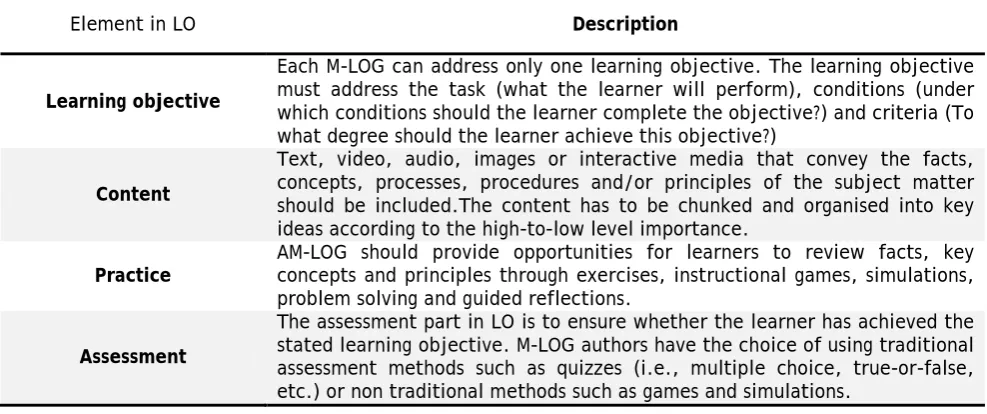
Thompson and Yonekura (2005) have produced a structural model which is similar to CISCO’s reusable information objects, more commonly known as RIOs with the goal of producing instructionally sound LOG. Their M-LOG model consists of useful and reusable digital components that: 1) state a learning objective, 2) present content, 3) provide opportunity for practice and 4) assess achievement of the objective. According to their model, all four elements must be present for a component to be considered aM-LOG. They have provided instructional guidelines for each of the component in the model that any author of M-LOG must take into consideration. The summary of the guidelines presented in the below table:
Table 2. Guidelines for Each Component in the Instructional Model of LO Proposed by Thompson and Yonekura (2005)
Element in LO Description
Learning objective
Each M-LOG can address only one learning objective. The learning objective must address the task (what the learner will perform), conditions (under which conditions should the learner complete the objective?) and criteria (To what degree should the learner achieve this objective?)
Content
Text, video, audio, images or interactive media that convey the facts, concepts, processes, procedures and/or principles of the subject matter should be included.The content has to be chunked and organised into key ideas according to the high-to-low level importance.
Practice AM-LOG should provide opportunities for learners to review facts, key concepts and principles through exercises, instructional games, simulations, problem solving and guided reflections.
Assessment
The assessment part in LO is to ensure whether the learner has achieved the stated learning objective. M-LOG authors have the choice of using traditional assessment methods such as quizzes (i.e., multiple choice, true-or-false, etc.) or non traditional methods such as games and simulations.
From the literature reviews discussed, it can be concluded that, a M-LOGshould have 5 main attributes which are 1.) introduction, 2.) content – chunking and content display methods have to be specified 3.) learning activities / practices 4.) summary and 5.) assessment / evaluation. The extracted elements from the literature reviews were used as the data for the content analysis guidelines for M-LOG.
RESEARCH METHODOLOGY
This section provides the applied research design, a description of the participants and an explanation of the data collection process and analysis. The purpose of this study was to contribute to a better understanding of how instructional designers make decisions about content design of learning objects. The examination was expected to reveal the kinds of decisions that instructional designers make when engaged in this type of activity. The study had two broad objectives: to document the process of designing aM-LOG and to illustrate the outcome of applying these
www.mojet.net
practices.To achieve its purpose the illustrative case study examined the following questions:
What are the guidelines of content analysis for M-LOG?
How effective were the guidelines in assisting the instructional designers in the content analysis of M-LOG?
The participants are instructional designers from an open and distance learning institution who involved in development of learning objects. There were five instructional designers in the learning object team whose main roles are analysing the content, create storyboard and visualise the storyboard with the multimedia programmer. This study analysed how the ID conducted the content analysis phase and the challenges they face during the process. The data collection procedures pertaining to each of these questions is presented as follows:
RESEARCH QUESTION 1: WHAT ARE THE GUIDELINES OF CONTENT ANALYSIS FOR M-LOG?
a. Job analysis via focus group interview with the instructional designers
Since the guidelines document is expected to train the ID for a specific job which is analysing content graphic artist, job analysis was choosen to identify the performance gap. Interview was used as the job analysis instrument. The researcher recorded the reflections of the respondents who are the Instructional designers involved in M-LOG development. The objective of this interview was to establish the gap occur in the performance of the instructional designers (ID) in content analysis.Therecorded interview and reflections were transcribed by the researcher.The interview questions were divided into 3 sections;
i. Section 1: Instructional designer’s background
The first section looked into the background of the interviewees in terms of academic qualifications, professional experience in the field of ID in e-learning.
ii. Section 2: Conducting Content Analysis before create storyboard
This section tried to get the insight about the process an ID goes through during analysing the content before storyboarding Learning Project.
iii. Section 3: The issues involved in the ID process
This section concerned more about the issues arise during the content analysis. b. Interview with the subject matter experts
Expert interviews have been conducted to gather information to be design the guidelines for content analysis. According to Begner and Menz (2002) in Flick (2009), the expert interview can be used for preparing the instrument in a study for other targeted group. In this study the findings from the expert interview were used the guidelines (instrument) for the instructional designers (targeted group).
Interviews with experts who involved in LO or any web-based content development were conducted. First interview was conducted with a Subject Matter Expert (SME) who is a Project Director of LO development project. She is also the director of the department which is involved in design and development of learning materials of Open University Malaysia. Second interview was conducted with the leader of e-content development team. She is the Assistant Manager of the department.
The experts were selected based on their experience in e-learning materials especially web-based material. The criteria used in the selection are:
1. Have more than 3 years experience in designing e-learning materials
2. Have conducted training on development of e-learning materials.
3. Well-versed with pedagogical theories and its implementation as well as application in e-learning especially web based learning.
www.mojet.net
c. Review of the existing literature and best practices
Literatures about expert reviews on M-LOG content structure were reviewed. The insights and information from the literature were used context knowledge (Flick, 2009) about the content development of the LOs. The findings from expert interviews were then triangulated (mapped) with the information extracted from the literature review to validate the information gathered from the experts.
Thematic analysis was used to derive themes emerge from the interviews and literatures reviews. Thematic coding was chosen because this study involved researching a particular issue or perspective of a process (what are steps involved in content analysis, how the particular guidelines assists the instructional designers in conducting content analysis).
GUIDELINE FOR MULTIMEDIA LEARNING OBJECTS
Step Explanation
Step 1: Planning : P Plan on how you going to do the introduction
The first step is to capture the attention of learner before the learning begins. Gaining attention is considered as one of the important instructional design inputs to be considered when designing the learning object. Among the ideas which can be used to gain attention are:
a. Use thought-provoking question or interest fact to capture student’s attention b. Use of video scenarios and relate the video to the content to be learned c. Present a problem or case and ask triggering questions
d. Use of newspaper transcripts or articles to explain a current situation and relate to the content to be learned
Step 2: Learning Outcome : O Identify the learning outcome(s)
It is advisable for each learning object to address one or two learning outcome (one is most advisable). Also identify the level of the learning outcome based on Bloom's taxonomy.
Level Sample verb Sample objective
Knowledge
Write, List, Label, Name,State, Define List the organelles of a cell
Comprehension
Explain, Summarise,Paraphrase, Describe, Illustrate
Explain the relationship between structure and function of cell organelles
Application
Use, Compute, Solve,Demontrate, Apply, Construct
Apply the principles of vector analysis to a two dimensional collision
Analysis
Analyse, Categorise,Compare, Contrast, Separate Contrast the geocentric and heliocentric models of the Solar System
Synthesis
Create, Design, hypothesise,Invent, Develop Develop a well-designed investigation to explore the period of a pendulum
Evaluation
Judge, Recommend, Critique,Justify Critique the essay about human cloning Example:
a. At the end of this learning object, you should be able to identify the level of management according to the task description.
www.mojet.net
Step 3: Content : C Identify nature of content
Identifying nature of content helps you in determining the display of content and learning task. David Merrill (1983) listed different types of content, including concepts, facts, processes, procedures, and principles, in his two-dimensional performance content matrix.
Facts - Remember the facts
Concept - Remember the definition and classify new examples.
Process - Remember the stages and solve a problem and make an inference. Procedure - Remember the steps and perform the procedure.
Principles - Remember the guidelines and use specific guidelines to solve a problem.
Step 4: Ideas : I Organise the content into key ideas
After you have identified the learning outcome and the nature of content, now you need to organise the content. In this step, you have to chunk the content into few key ideas. These key ideas should be well sequenced in order to avoid confusion when you organize and chunk your content each frame during design part.
An example of key idea: LO title: DNA structure
Key idea 1: present the building blocks of DNA Key idea 2 : show how the building blocks are linked
Key idea 3 : demonstrate how the DNA helix structure is build Step 5: Method: M Decide on content presentation method
Under each key idea plan the content presentation. Text, video, audio, images or interactive media that convey the facts, concepts, processes, procedures and/or principles of the subject matter should be planned here. Example:
Key idea 1: present the building blocks of DNA
Content presentation: animation and text
Step 6: Practice : P Plan the learning task
In step 4, you have identified the key ideas. In each key idea you should design learning tasks to provide some opportunities for learners to review facts, key concepts and principles through exercises, instructional games, simulations, problem solving and guided relections.
There are few types of learning tasks which will be provided in the content analysis document: a. Recalling facts/ concepts
b. Sequencing
c. Classiying / Categorising d. Problem solving e. Role play f. Case study
And also there are options for customizable learning task templates such as multiple choice questions, drag and drop, matching pairs, games, etc. You can choose any of the templates to design your learning task or you may design a new template.
Example:
Key idea 1: Present the building blocks of DNA
Learning task: Label the building block of DNA
Learning task template: drag and drop
Step7: Assess : A Plan assessment
A learning object should assess whether the learner has achieved the stated learning objective. You have the choice of using traditional assessment methods such as quizzes (i.e., multiple choice, true-or-false, etc.) or non-traditional methods such as games and simulations.
Example:
Description: Recall the role of each level of manager - Given descrption of task choose level of manager,
Choose correct task description of the certain level of manager.Aseessment method: Quiz - multiple choice
www.mojet.net
RESEARCH QUESTION 2: HOW EFFECTIVE WERE THE GUIDELINES IN ASSISTING THE INSTRUCTIONAL DESIGNERS IN THE CONTENT ANALYSIS OF M-LOGS?
A content analysis document was developed for the instructional designers (IDs) to record their findings from content analysis. First, the IDs were briefed about the guidelines. At the end of the briefing session, each ID was given a task of analysing a sub-topic which was selected from a print module developed by the institution and recording the analysis findings in the content analysis document. Another group session was conducted. At the session each ID was asked to present their content analysis findings and explain their own experience of analysing the content. In order to determine whether the guidelines were useful for them or not, another focus group interview session was conducted with the ID. This interview was focused on:
• Their experience in conducting content analysis using the guidelines and documenting their analysis findings.
• Feedback on how to improvise the guidelines.
Transcriptions obtained from the interview session were categorised according to recurring themes on participants’ experience in analysing the content and recording their findings in the content analysis document given to them. From the interview analysis, four categories were derived which shown in Table 9.
Table 3. Category of Themes Derived from the Focus Group Interview
Category Theme Description of theme
Perceived usefulness of the guidelines in performing content analysis for M-LOG.
Increased understanding More clear about the steps involved in content analysis.
Task become more structured and
organised By following the steps the process of analysing content becomes easy.
Perceived usefulness of the content analysis document
in recording analysis findings.
Decision making become easy Time and effort spent on thinking process is reduced.
Able to document the decisions
and thoughts Will be easy to refer when do the storyboard
Storyboarding is expected to become easier.
During storyboarding the ID can focus more on designing the instruction
since the decisions regarding the learning outcome, content structure,
learning tasks are already made.
Expected to be able to
communicate with the SME Since the ideas are on the document, SME could capture the ideas easily.
Suggested improvements to be made
Create an online database system to store the analysis documents.
The ID can save the document and can retrieve at any time to edit.
Provide access to SME to edit, verify and sign off the content analysis
document
SMEs have to be trained on
analysing content IDs can focus more on the designing part.
www.mojet.net
DISCUSSIONS
The interview conducted during job analysis revealed that the instructional designers who are involved in the M-LOG development tool demonstrated inadequate knowledge and skills to be performed during the content analysis and planning the design of M-LOG (part of design process). The interview with the instructional designers (before the guidelines) indicated that there was lack of awareness the purpose of analysing the content and produce a design plan (which is a part of content analysis deliverable) before create the storyboard. According to Chyung (2007) the purpose of analysing instructional content is to determine the most appropriate methods and media to deliver the content. The designer needs to conduct a content level analysis to determine the optimal range of the sequence of learning required for achieving the instructional goal (Chyung and Treñas, 2009). This statement was highlighted by the one of the SMEs who stated that during content analysis content should be break into few key ideas and for each key idea plan on the content delivery method and practice.
There is no standardisation in the procedures of analysing the content. The IDs have their own way of analysing the content. In the interview some IDs indicated that they planned learning activities during content analysis while some don’t. The guidelines have clearly set standard procedures for analysing content. So there would be no gaps among the IDs in the tasks performed during content analysis and the working process can be improved. In Wan Adli’s (2007) study, he highlighted that standard guidelines and template will lead to improvement in working process results in shorter development period.
The interview with the instructional designers has revealed another significant gap which is there is no documentation of the activities the IDs do before create the storyboard specifically identifying the cognitive level of the content and planning the design of the LO. In order to close the gap, the researcher developed a content analysis document. It was documentation tool in which the IDs would record the analysis findings. Baruque and Melo (2004) have suggested to generate content analysis document during the design phase before storyboard. According to them the document should include the specifications of the attributed in a LO which are learning outcome, content to be covered, evaluation method and instructional approach such as demonstration, cases study, problem solving etc (Baruque and Melo, 2004). There is an organisation which has taken the similar initiative. The Le@rning Federation (2007), a project team from Education Services Australia has proposed standard documentations for each phase in design and development of M-LOG to support production of our online curriculum content. One of the documents is the “design brief document”. The purpose of this document is to enable the designers to record the key concepts, learning outcomes and proposed learning experiences and activities for aM-LOG. This document provides the basis from which the M-LOG design specifications will be derived.
The design of the “design brief document” was little similar to the “content analysis document”. In the document developed by The Le@rning Federation (2007), key concepts are described. Each concept will be developed into M-LOG. Under each M-LOG, the learning outcome for the LO is identified followed by learning design consideration. The next section of the document is documenting the learning activities planned and their description. This document was very brief in design. The design of content analysis document was detailed in terms of providing options for the instructional designers to help them decide the suitable content presentation method and learning activities.
The guidelines and the content analysis document was an initial step to guide the instructional designers before they proceed into detailed design of the M-LOG (storyboarding). A similar initiative was taken by the e-learning research team in EwhaWomans University where the team developed an e-learning design and development tool, Learning DesignerTM. Learning DesignerTM is their attempt to assist content designers and developers to generate sharable and reusable M-LOG easily. Compared to the content analysis document developed in this study, Learning DesignerTMwas very detailed in design which provides assistance to build the content structure and create each asset. It also assist the designer to state an enabling objective and categorise this objective to be as knowledge or performance (skill) level of learning outcome, well or ill- structured learning required, and the difficulty level of this objective is novice, intermediate, and advance level (Kang et al., 2004). In addition proper learning activities with recommended screen templates are ready to be edited by the designer.
In the interview conducted to assess the effectiveness of the guidelines and content analysis document, the IDs in overall indicated that the guidelines and content analysis document helped them to save time and effort spent in deciding the instructional approaches (content presentation method, learning activities, and assessment). The similar finding was reported in the study by Wan AdliRidzwan Wan Hassan (2007). He developed an application for storyboarding for the instructional designers with the similar purpose with the researcher which is to guide the IDs in designing process of M-LOG. The participants in his study felt the application does help speed up content production
www.mojet.net
and improves their current working process. He found that by providing easy to use content template, the users were able to conduct their work more efficiently. The participants in this study indicated similar response. In the interview they have indicated that the guidelines and the content analysis document clearly informed them on what needs to be done during content analysis and by following the steps they could conduct the content analysis process efficiently.
CONCLUSION
This study has highlighted the importance of planning content design process before storyboarding. The guidelines developed had indeed helped the instructional designers from the particular institution
By limiting the study to developing the guidelines on how to conduct content analysis for M-LOG, other possible avenues of research relating to this study were revealed. The possibilities surfaced as a result of the data collection and analysis. A suggestion was made that to further develop the guidelines of instructional design framework for ID to follow during content storyboarding development for M-LOG. Responses also suggested a platform to promote the collaboration between SME and ID in developing the content for M-LOG where the SME provide inputs on the content analysis and questions for learning activities while ID design the presentations such as simulation, demonstration and the learning activities with feedback.
Some possible recommendations for future research include the role of SME in content design and development of M-LOG, optimising the interaction between SME and ID during the content design to eliciting and conceptualise the unfamiliar content by an instructional designer.
REFERENCES
Bannan, R. B., Dabbagh, N., Murphy, K. (2002). Learning object systems as constructivist learning environments: related assumptions, theories, and applications, in Wiley, D.A. (Eds.), The instructional use of learning objects. (pp.61-97). Bloomington: Agency for Instructional Technology and Association for Educational Communications and Technology.
Balatsoukas, P., Morris, A., & O’Brien, A. (2008). Learning objects update: Review and critical approach to content aggregation. Educational Technology & Society, 11 (2), 119-130. Retrieved April 18, 2010, from http://www.ifets.info/journals/11_2/11.pdf
Baruque. L, Porto, F., & Melo, R. (2003). Towards an instructional design methodology based on learning objects. In Uskov, V. (Eds.), Computers and advanced technology in education. Anaheim, CA: ACTA Press.
Baruque, L.B. & Melo, R.N. (2004). Learning theory and instruction design using learning objects .Journal of Educational Multimedia and Hypermedia. 13 (4), pp. 343-370. Norfolk, VA: AACE. Retrieved from http://www.editlib.org/p/7432
Beaudrie, B. (March, 2001). Prospective K-6 educators’ attitudes about technology. Paper presented at the Society for Information Technology and Teacher Education (SITE) International Conference, Orlando, Florida.
Cisco, 1999. Cisco systems reusable information object strategy. Retrieved March 18, 2009, from http://www.Cisco.com.
Chyung, Y. (2007). Learning object-based e-learning: content design, methods, and tools. Retrieved April 20, 2010 from http://www.elearningguild.com/pdf/2/061802dst-h.pdf
Chyung, Y., Treñas, A.S. (2009). Content analysis: Key to excellence in your blended Learning.
Learning Solutions Magazine.Retrieved January 23, 2010, from
http://www.learningsolutionsmag.com/articles/150/content-analysis-key-to-excellencein- your-blended learning-
www.mojet.net
Conover, A. (2008). A case study of the development and impact of online student services within community colleges. Doctoral dissertation. Retrieved August 14, 2009, from http://proquest.umi.com.newdc.oum.edu.my/pqdweb?index=2&sid=7&srchmode=1&vinst=PROD&fm t= &startpage=1&clientid=56581&vname=PQD&did=1483473831&scaling=FULL&ts=1274759385&vtype PQD&rqt=309&TS=1274759415&clientId=56581
Creswell, J. W. (1998). Qualitative inquiry and research design: Choosing among five traditions. Thousand Oaks, CA: Sage.
Department of civil service, New York State. (2010). Knowledge management strategies: Expert Interviews. Retrieved March 6, 2009, from
http://www.cs.state.ny.us/successionplanning/workgroups/knowledgemanagement/expertintervie ws.html
Dick, W., Carey, L., and Carey, J. O. (2001).The systematic design of instruction (5th ed.). Toronto: Addison-Wesley Educational Publishers Inc.
Duffy, T. M., &Cunnigham, D. J. (1996). Constructivism: Implications for the design and delivery of instruction. In D. H. Jonassen (Ed.), Handbook of Educational Communications and Technology (pp. 170 198). New York: Simon & Schuster Macmillan.
Duval, E., Verbert, K. (2008). ALOCOM: a generic content model for learning objects. Retrieved April, 2010 from https://lirias.kuleuven.be/bitstream/123456789/158914/4/fulltext.pdf
EDUCAUSE (2005). Learning objects. Retrieved 13 February, from, http://www.educause.edu/contnet.asp?page_id=2601&bhcp=1
Ellis, L., Salas, K.D. (2006). The development and implementation of learning objects in a higher education setting. Interdisciplinary Journal of Knowledge And Learning Objects,2. Retrieved February 20, 2010, from http://ijklo.org/Volume2/v2p001- 022deSalas.pdf
Flick, U. (2009). An introduction to qualitative research. London: SAGE Publications
Fraenkel, J.R., & Wallen, N.E. (2008). How to design and evaluate research in education. New York: McGraw-Hill.
Francis, D.E., Murphy, E. (2008). Instructional designers' conceptualisations of learning objects.Australasian Journal of Educational Technology.24(5). Retrieved 13 February, 2010 from www.ascilite.org.au/ajet/ajet24/francis.pdf
Gagne, R., Briggs, L. & Wager, W. (1992).Principles of instructional design (4th Ed.). Fort Worth, TX: HBJ College.
Gallenson, A., Heins, J., &Heins, T. (2002). Macromedia MX: Creating learning objects. [Macromedia white paper]. Macromedia Inc. Retrieved August 25, 2009, from http://download.macromedia.com/pub/elearning/objects/mx_creating_lo.pdf
Gibby, S., Quiros, O., Demps, E. & Liu, M. (2002).Challenges of being an instructional designer for new media development: A view from the practitioners. Journal of Educational Multimedia and Hypermedia, 11(3), 195-219. Norfolk, VA: AACE.
www.mojet.net
Harvey, B. (2005). Technical evaluation report: Instructional design and learning object. International Review of Research in Open and Distance Learning, 6(2).Retrieved March 15, 2009 from http://www.irrodl.org/index.php/irrodl/article/view/227/310
Herridge Group (2002). Learning objects and instructional design.Retrieved February 28, 2010, from http://www.herridgegroup.com/pdfs/Learning%20Objects%20&%20Instructional%20Design.pdf
Hoe, T.W. (2006). In search of effectiveness factors: A case study of the UniKL e-learning portal. Unpublished master’s thesis.Multimedia University, Cyberjaya.
Hung, D. (2001).Theories of learning and computer-mediated instructional technologies.Education Media International, 38 (4), 281-287.
Institute of Electrical and Electronics Engineers (IEEE), Learning Technology Standards Committee. (2002). IEEE standard for learning object metadata.New York, NY: Institute of Electrical and Electronics Engineer. (IEEE Standard 1484.12.1 - draft). Retrieved 4 March, 2009 from http://itsc.ieee.org/wg12files/LOM_1484_12_1_v1_Final_Draft.pdf
Kang, M., Lim, D.H. & Kim, M. (2004). Learning DesignerTM: A Theory-Based SCORM Compliant Content Development Tool. Journal of Educational Multimedia and Hypermedia, 13(4), 427-447. Retrieved February 28, 2010, from http://www.editlib.org/f/6584.
Karampiperis, P., Lin, T., Sampson, D., Kinshik. (2006). Adaptive cognitive based selection of learning objects. International Journal on Innovations in Education and Teaching.43 (2), 121-135
Kemp, J.E., Morrison, G.R., & Ross, S.M. (1998).Designing effective instructrion (2nd Ed.). New Jersey: Merril.
Keppell, M. (2000). Principles at the heart of an instructional designer: Subject Matter Expert Interaction. Proceedings ASCILITE Conference 2000.Coffs Harbour, 9-14 December. Retrieved April 20, 2010, from http://www.ascilite.org.au/conferences/coffs00/papers/mike_keppell.pdf
Krauss, F., Ally, M. (2005). A study of the design and evaluation of a learning object and implications for content development.Interdisciplinary Journal of Knowledge and Learning objects, 1.Retrieved January 20, 2009, from http://www.ijklo.org/Volume1/v1p001-022Krauss.pdf
Krueger, R.A., Casey, M.A. (2000). (Third edition) Focus groups: A practical guide for applied research. Thousand Oaks, CA: Sage.
Lim, G. (2007). Instructional design and pedagogical considerations for the ins-and-outs of learning objects . In Koohang, A. & Harman, K. (Eds.), Learning objects and Instructional Design (pp. 89-138). Santa Rosa, California: Informing Science Press.
Longmire, W. (2000). A primer on learning objects .Learning Circuits. Retrieved May 12, 2010, from http://www.learningcircuits.org/2000/mar2000/Longmire.htm.
Martinez, M. (2000). Designing learning objects to personalize learning. In Wiley, D. A (Ed.), The instructional use of learning objects : Retrieved September 15, 2009, from http://www.reusability.org/read/chapters/martinez.doc
www.mojet.net
Merrill, M. D. (1992). Constructivism and instructional design. In T. M. Duffy, & D. H. Jonassen (Eds.), Constructivism and the technology of instruction: A conversation (pp. 99-115). Hillsdale, NJ: Law-rence Erlbaum Associates.
Merrill, M. D. (1999.) Top of the top 10 in instructional design. Retrieved 10 March, 2009, from http://www.amazon.com/exec/obidos/ASIN/0877782989/o/qid=953680365/sr=8- 1/103-4305913-5208626
Mohamed Ally. (2004). Designing effective learning objects. In R. Mcgreal (Eds.), Online education using learning objects (pp. 87-97). New York: RoutledgeFalmer.
Mohan, P. & Daniel, B. (2004). The Learning objects ' Approach: Challenges and Opportunities. In Proceedings of World Conference on E-Learning in Corporate, Government, Healthcare, and Higher Education 2004 (pp. 2512-2520). Chesapeake, VA: AACE. Retrieved from http://www.editlib.org/p/11261.
Moore, N. (2000). How to do Research: The Complete Guide to Designing and Managing Research Projects (3rd ed.). London: Library Association Publishing.
Muzio,J.A., Tanya Heins,T., Mundell, R. (2002). Experiences with reusable e-learning objects: From theory to practice. Internet and Higher Education, 5, 21-34.
Myers, K. L. (1999). Is there a place for Instructional design in the information age? Educational Technology, 39(11), 50-53.
Noor, S.F.M., Yusof, N &Hashim, S.Z.M. (n.d).Issues of reusability of learning objects in web-based environment. Retrieved March 23, 2009, from http://eprints.utm.my/3058/1/siti_fadzilah.doc
Reese, A.A. (2009). A reusable learning object design model for elementary mathematics. Retrieved May 20, 2010, from http://www.bookpump.com/dps/pdf-b/9427214b.pdf
Reigeluth, C. M. (1983). Instructional design: What is it and why is it?, in Reigeluth, C., (Eds.), Instructional design theories and models: An overview of their current status. (pp. 4-31). NJ: Hillsdale
Reigeluth, C. M. (1999).Instructional design Theories and models: A new paradigm of instructional theory. NJ: Lawrence Erlbaum Associates.
Rosenberg, M. (2000).E-Learning: Strategies for delivering knowledge in the digital age. New York: McGraw Hill.
Plodzien, J., Stemposz, E., &Stasiecka, A. (2006).An approach to the quality and reusability of metadata and specifications for e-learning objects.Online Information Review, 30(3), 238–251. Retrieved
July 28, 2006,
from http://www.emeraldinsight.com/Insight/ViewContentServlet?Filename=/published/emeraldfulltexta rticle/df/2640300303.pdf.
Salas, K.D., Ellis, D. (2006). the development and implementation of learning objects in a higher education setting. Interdisciplinary Journal of Knowledge and Learning Objects, 2.Retrieved March 15, 2009, from http://ijklo.org/Volume2/v2p001-022deSalas.pdf
Sicilia, M. A., and Garcia, E. (2003).On the concepts of usability and reusability of learning objects.International Review of Research in Open and Distance Learning, 3(2). Retrieved March 15, 2009, from http://www.irrodl.org/content/v4.2/sicilia-garcia.html
www.mojet.net
Smith, P., and Ragan, T. J. (1999).Instructional Design (2nd Edition). New York: Wiley & Sons. The Le@rning Federation.(2007). Schools online curriculum content initiative.http://www.thelearningfederation.edu.au/for_jurisdictions/resource_development_process/res our e_development_process.html
Thompson, K., Yonekura, F. (2005). Practical guidelines for learning object granularity from one higher education setting. Interdisciplinary Journal of Knowledge and Learning objects, 1.Retrieved May 20, 2010, from http://ijello.org/Volume1/v1p163-179Thompson.pdf
Wall, L.J., Kelsey, K.D. (2004). When findings collide: Examining survey vs interview data in leadership education research. Journalof Southern Agricultural Education Research, 54 (1).Retrieved November 28, 2007, from http://www.jsaer.org/pdf/Vol54/54-01-180.pdf
Wiley, D. (2000). Connecting learning objects to instructional design theory: A definition, a metaphor and a taxonomy. In D.A. Wiley (Ed.).The Instructional Use of Learning Objects.Retrieved March 12, 2009, from, http://reusability.org/read/
Wiley, D. (2006). RIP-ing on learning objects . Retrieved March 10, 2009 from http://opencontent.org/blog/archives/230
www.mojet.net