Vol.3, Issue 1, March 2013
Vol.3, Issue 1, March 2013
Modern Journal of Language Teaching Methods (MJLTM)
ISSN: 2251 - 6204
www.mjltm.com
Editor – in – Chief
Hamed Ghaemi, Islamic Azad University, Iran
Editorial Board
Abednia Arman
, PhD in TEFL,
Allameh Tabataba’i University, Tehran,
Iran
Azizi Masoud
, PhD in Applied
Linguisitcs, University of Tehran, Iran
Basiroo Reza
, PhD in TEFL,
University of Tehran, International
Campus, Iran
Elahi Shirvan Majid
, PhD in TEFL,
Ferdowsi University of Mashhad, Iran
Fernández Miguel
, PhD, Chicago State
University, USA
Ghaemi Hamide
, M.A. in Speech and
Language
Pathology,
Mashhad
University of Medical Sciences, Iran
Grim Frédérique
M. A., Associate
Professor of French, Colorado State
University, USA
Izadi Dariush,
PhD candidate in
Applied
Linguistics,
Macquarie
University, Sydney, Australia
Kargozari
Hamid
Reza
,
PhD
Candidate in TEFL, Payame Noor
University of Tehran, Iran
Kaviani Amir
, Assistant Professor at
Zayed University, UAE
Kirkpatrick
Robert
,
Assistant
Professor of Applied Linguistics,
Shinawatra International University,
Thailand
Morady Moghaddam Mostafa,
PhD
Candidate in TEFL, University of
Tabriz, Iran
Ndhlovu Finex,
PhD, Linguistics
Programme,
University
of
New
England, Australia
Raddaoui
Ali
Hechemi,
PhD,
Associate
Professor
of
Applied
Linguistics, University of Wyoming in
Laramie, USA
Rezaei Saeed
, PhD in TEFL, Sharif
University of Technology, Tehran, Iran
Rolstad Kellie,
PhD, Associate
Professor of Education, University of
Maryland, USA
Shahbazirad Mohammad
, PhD in
English language and Literature,
Yerevan State University, Armenia
Weir George R. S.,
PhD in Philosophy
of
Psychology,
University
of
Strathclyde, Glasgow, UK
Zegarac Vladimir
, PhD, University of
Bedfordshire, UK
Vol.3, Issue 1, March 2013
Abstracting/Indexing
Index Copernicus 2011
Linguistics Abstract
EBSCO Publication
Lulu Publication
Directory of Open Access Journals
Vol.3, Issue 1, March 2013
Pro - Quest
Modern Language Association
Cabell's Directory
COPE
Vol.3, Issue 1, March 2013
TABLE OF CONTENTS
A Critical Analysis Of Morphology And Its Implications For Nativism
Suren Naicker……….……….6
Analysis Of Cultural Scripts Of Objections And Responses To Objections In
Persian And English Within Natural Semantic Metalanguage Framework
Seyede Zahra Hashemi………...…17
The Efficacy Of Error Analysis On Teaching Translation
Taher Sarhady………26
The Effect Of Giving The Gist Of Reading Passage In The Students' Mother
Tongue Before Teaching Reading On The Students' Reading Comprehension
Salman Asshabi………..33
EFL Learners’ Attitudes Towards Using Mind Mapping Technique In Their
Reading Comprehension
Mahsa Hariri and Abdorreza Tahriri
………
………....39
Vocabulary Learning Strategies In An ESP Context: A Case Of Engineering
Students
Abdorreza Tahriri and Shabnam Fallah……….……...48
The Influence Of Test Forms On Enhancing General Knowledge In The Iranian
High School Context: Do They Reflect Real Differences Among Learners?
Zahra Bakhtiari………..58
Language Teachers’ Voices: Establishing A Framework Of Language Teaching
Aptitude
Reza Rezvani and Tayyebe Mansouri………...66
The effect of sculptures of activities on grammar learning and retention of
Persian adult EFL learners, A comparison of deductive and inductive methods
Yaser Kheyrkahnia……….81
Vol.3, Issue 1, March 2013
A CRITICAL ANALYSIS OF MORPHOLOGY AND ITS
IMPLICATIONS FOR NATIVISM
Suren Naicker University of South Africa Department of Linguistics
ABSTRACT
In this article I explore some of the arguments pertaining to word-structure used by the nativists to bolster the idea that language is part of our genetic endowment. The focal point of this analysis will centre primarily on the arguments put forth by Steven Pinker in his various works, regarding the morphological constraints supposedly imposed on language by our genetically hard-wired language faculty. Peter Gordon’s work on English compounding will also be critically evaluated. I contend that these allegedly innate constraints are wrongly construed as such, and can easily be explained without postulating a ‘language acquisition device’, as contingent cultural and environmental factors suffice when trying to explain the morphological phenomena Pinker believes can only be explained by the innate constraints of universal grammar. Hence, this strand of the nativist’s paradigm needs to be seriously re-evaluated as the original conclusions drawn by theorists like Pinker and Gordon are flawed.
Introduction
Linguistic nativism has been built on an edifice ranging from armchair philosophical argumentation to rigorous empirical data. There are numerous strands of nativism, but the focus here is on word-structure, and on how influential scholars like Steven Pinker have bolstered their case for linguistic innateness with reference to the phenomenon of how phenomena such as derivational and inflexional morphology are constrained by a genetically hard-wired language faculty. Peter Gordon (1986) argues along similar lines, citing research done on compound words, claiming that innate restrictions preclude the compounding of morphologically complex modifiers.
Though this argument is only one strand of a particular theory with an increasingly parochial following, it is still a paradigm that is followed by the majority of linguistics scholars around the world. The concern here is that the mind-set that accompanies a theory of this kind can have negative consequences. In Grein and Weigand (2007), for example, Geoffrey Sampson explores some of the contentious upshots regarding a theory that tries to homogenise mankind, while ignoring the disparities. Language policy has also been informed the world over by this way of thinking. The belief is that if things as detailed as the rules pertaining to word-structure are part of a child’s innate machinery, then the educator’s role is merely to elicit this innate knowledge. This may have contributed to the rationale behind the failed outcomes-based education curriculum, which sees the teacher as a ‘facilitator’ who is not meant to teach, but merely to stimulate the expression of what is already innately there.
In the pedagogical context of teaching English as a foreign language, adherents to the critical period hypothesis believe that teachers’ jobs only ought to entail helping their students/learners to ‘get by’ in the target language by aiming for a basic level of communicative competence. This aim is because educators are trained in a paradigm based on the belief that it is impossible to attain native speaker competence after a certain age – this is a biologically constrained phenomenon (cf. Lenneberg, [1967], on whose work Chomsky draws and which he explicitly endorses). The various strands of nativism alluded to here are used to inform policies that are damaging to the country; linguistic pedagogy draws on theoretical underpinnings in linguistics,
Vol.3, Issue 1, March 2013
and aside from the pedagogical implications of the theory, the nativist paradigm is taking linguistics as a whole away from its scientific standing in the academic world.
Scholars such as Gordon (1986) and Pinker (1994; 1999) argue that phenomena such as compounding rules and the rules pertaining to morphological concatenation are not logically necessary, making their alleged ubiquity not only contingent, but in need of explanation. As mentioned, Gordon and Pinker explain the morphological restrictions found in their data by postulating a universal grammar that is part of our biological endowment. This article serves to re-evaluate this strand of linguistic innateness by pointing out the false predictions Pinker, Gordon (and others of their ilk) make with regard to morphology, and in light of that counter-evidence, proffer an explanation that is more commonsensically commensurable. Hence, this article calls for a paradigmatic re-evaluation of linguistic nativism as a whole. Nativism should either be more answerable to conspicuous counter-evidence, or embrace a theory that is more amenable to the counter-evidence shown in conflicting data.
The case for innate morphological constraints
Pinker (1994) claims that the restrictions pertaining to the structure of words lend evidence to nativism in the sense that children’s minds seem to be designed with the logic of word-structure built in. His first example is that of a pattern whereby the derivational affix can attach only to roots, not to stems (i.e. roots with at least one affix attached). When we try to attach a derivational affix to a stem, we get something like Darwinsian, which could refer to the works of Charles Darwin and his grandfather, Erasmus Darwin. However, this would sound ridiculous, not because it is illogical, but because there seems to be some sort of innate restriction on what affix can go where in a word. Later Pinker says that the restriction is that derivational suffixes cannot attach themselves to inflected roots.
Pinker (1999) discusses headless compound words, and draws conclusions that provide further evidence for his case. An example of a headed compound would be “barman”, with the -man part constituting the head. Hence, a “barman” is a kind of man, namely one that works in bars. Headless compounds are words like “walkman”. Here, -man cannot be the head because a “walkman” is neither a kind of man, nor is it a kind of walk, even though the rightmost morpheme is usually defined as the head of a compound.
Pinker (1994; 1999) explains that when a compound has a head, all the information regarding the head gets percolated up to the top-most node of the (morphological) tree, including the rules. When there is a headless compound, it is not clear where the information must come from, so the “percolation conduits” get blocked, and the default rule applies. That is the reason why we say “sabre-tooths” and “still-lifes”, not “sabre-teeth” and “still-lives” (Pinker, 1999; 1994).
Other research cited by Pinker includes Peter Gordon’s experiment with three-year-olds, commonly referred to as the “Jabba experiment” (Gordon, 1986). He showed them a puppet and said: “This is Jabba. Jabba eats mice. Jabba is a ___?”, to which the children replied: “Mice-eater”. Thereafter, he asked: “Jabba also eats rats. Jabba is also a ___?”, to which they replied: “Rat-eater”.
Now, Gordon asks, why do they use the plural “mice”, but not the plural “rats”? Given that not a single child ever used the inflected plural as the initial constituent of the compound, this could indicate that there is some sort of rule that they are applying. It is unlikely that they were told that this is so, as Motherese contains few or no compounds, especially of that kind; it is also unlikely that someone would have told them not to include inflected words in their compounds. Why do they not generalise the rule: “Create a compound by putting two words together”? Why should there be a restriction of this sort? Nativists like Gordon and Pinker would explain it as
Vol.3, Issue 1, March 2013
follows: If there were an innate rule of this kind to facilitate language acquisition, the child would already ‘know’ some of the things that cannot be said, like including an inflected word in the first part of a compound word, which is obviously why they avoid constructions of this sort.
Gordon concludes that these results were interesting because there seemed to be a consistent restriction in terms of what kind of word was allowed to be in the first part of a compound word. “Mice-eater”, for example, was an acceptable form to them; their answer to the first question would be just that. However, they never answered “rats-eater” to the second question; they always answered “rat-eater”. This is interesting, because if one goes solely on logic, then “rats-eater” ought not to be precluded, since “mice” and “rats” are both plural forms, and both (equally) morphologically complex.
The question, then, that Gordon posed is: What exactly makes forms like “rats-eater” ungrammatical? The reason he postulated was that the form “rats” is clearly derived from a rule: rat + -s. The word “mice”, however, is not; despite its morphological complexity, the word is learnt as a listeme, and therefore treated as such by the lexicon. Hence, “mice” in “mice-eater” is treated by the phonology as a simplex word. This, Gordon claims, must be an innate constraint placed on us by universal grammar, and we have fairly good reason to assume this, given that children as young as three consistently do it.
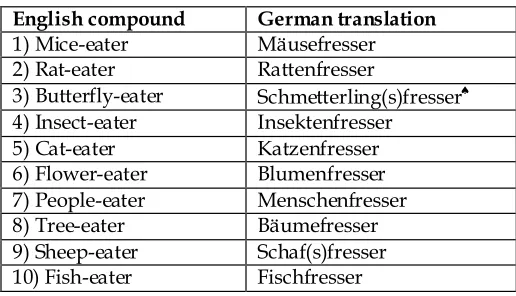
There are problems with this claim, however, since there are languages that do exactly that which is claimed by Gordon to be universally excluded by an innate constraint. German, for example, makes use of regular plural forms in compounds. Consider the set of data in the table below:1
Table 1: English and German compound words
English compound German translation
1) Mice-eater Mäusefresser 2) Rat-eater Rattenfresser
3) Butterfly-eater Schmetterling(s)fresser 4) Insect-eater Insektenfresser
5) Cat-eater Katzenfresser 6) Flower-eater Blumenfresser 7) People-eater Menschenfresser 8) Tree-eater Bäumefresser 9) Sheep-eater Schaf(s)fresser 10) Fish-eater Fischfresser
In German, -e(n) represents the plural suffix. To clarify, Table 2 shows the singular/plural forms of the (German) words used in the data above:
1
Data gathered by me from a native German informant who recently immigrated to Johannesburg, South Africa.
The bracketed “s” is referred to as a “fugen-s ” (gapping/bridging s), so-called because it is there to serve as a bridge between the two constituents, and does not in itself carry any semantic significance.
Vol.3, Issue 1, March 2013
Table 2: Singular and plural words in English and German
Singular Plural
1) Maus Mäuse 2) Ratte Ratten
3) Schmetterling Schmetterlinge 4) Insekt Insekten 5) Katte Katzen 6) Blume Blumen 7) Mensch Menschen 8) Baum Bäume 9) Schaf Schafe 10) Fisch Fische
In examples 9) and 10) of Table 1 (schaf(s)fresser and fischfresser), the singular form was preferred by my German informant; in examples 1) and 4) (mäusefresser and insektenfresser), both the singular and plural were judged to be acceptable forms, such that both mausfresser and insektfresser would not count as ungrammatical, though mäusefresser and insektenfresser are the more preferred of the two.
What is interesting about this is that examples 4 to 8 make use of the plural form in exactly the way Gordon would predict to be impossible, since here we have rule-derived words found in the position they should not be found in.
These ostensible counter-examples can be dealt with if it can be shown that the phonology treats these morphologically complex words as simplex; in other words, the phonology is blind to the morphological complexity of these forms. Now we know that irregular plurals are certainly treated by the phonology in the same way as simplex listemes, but if we can show that this is true of not only irregulars, but other complex forms as well, maybe we can save Gordon’s thesis from being refuted by these counter-examples.
Kaye (1993) has given us some novel insight into this issue of word structure. In discussing Kaye’s views, we will see why words cannot always be classified as either simplex or complex in a binary fashion. I will therefore now outline Kaye's approach to this phenomenon, based on his theory of government phonology, so as to gain a better understanding of the matter at hand:
We cannot assume that the phonology is per se blind to morphological complexity, since the [mz] (from “dreams”) is clearly a pseudo-cluster, and deemed both morphologically and phonologically complex.
It is clear, then, that at least some morphological structure is visible to the phonology. Kaye draws a distinction between what he calls analytic morphology and non-analytic morphology. Analytic morphology is morphology wherein the phonology is able to recognise a complex domain structure; non-analytic morphology is not able to. Let us first consider analytic morphology, which is visible to the phonology.
Analytic morphology
As mentioned, the [mz] cluster from “dreams” is invariably complex. What does this tell us about morphological penetration into phonology?
Vol.3, Issue 1, March 2013
Let us firstly assume that only morphological domains can be represented in the phonology. A compound like “black-board”, then, will have the following structure:
a) [[black] [board]]
Since there are three pairs of brackets, it reflects three phonological domains. These brackets represent how the phonological string is to be processed. To give an exact definition, we can use the CONCAT2 and φ (apply phonology) functions, so “blackboard” can be shown as follows:
b) φ (CONCAT (φ(black) φ(board)))
To translate this pseudo-formula into plain language: apply phonology to “black”, then to “board”, concatenate the result, and then apply phonology to that string. So, the brackets we see in example a) are actually not part of the phonological representation, but actually outline domains that are arguments to functions.
This consequently illustrates one type of structure that involves morphologically complex forms. It has the schema [[A][B]]. This is the case for most English compounds.
There is a second structure, involving two morphemes, but only two domains. The structure is [[A] B], and is interpreted as follows:
φ (CONCAT (φ(A), B))
To translate, we do phonology on A, and concatenate the result with B; then do phonology on the result. This is the case with English (regular) inflexional morphology. For example, consider the past tense of the word “seep”. Its structure is [[seep] ed]. With regard to government phonology, we could also illustrate this structure in more detail:
[[O N O N] O N]
x x x x x x x
s i: p d
Note that empty nuclei are to be found at the end of each domain, and are licensed to be silent by virtue of their domain-final position. Furthermore, the licensing principle states that all positions in a phonological domain need to be licensed, unless that position is the head of that particular expression. This is actually why the suffix does not form a domain by itself. We see here that the suffix consists of two positions: an onset position and a nuclear position, both being licensed. If “ -ed” were a domain, it is obvious that it would violate the licensing principle, which states that a phonological domain must have at least one unlicensed position – its head. The onset is licensed because, like all onsets, it is licensed by the nucleus to its right, which is itself p-licensed, i.e., licensed to be silent.
Analytic morphology also has a rather interesting property in that the distribution of empty nuclei is very restricted; in English, it is almost always found at the end of domains. Hence, this
2
Short for “concatenate”, a term borrowed from computer programming.
Vol.3, Issue 1, March 2013
provides us with a fairly reliable parsing cue, since a p-licensed empty nucleus signals the end of a domain, so if it occurs within a word, it shows that it is not a morphologically simplex one. So the pseudo-cluster [mz], from “dreams”, is so-called because:3
1. The vowel length is maintained (which would not be possible had it been an authentic cluster); and
2. [m] and [z] are not homorganic, which again is not possible for true clusters.
It is for this reason that much of analytic morphology is phonologically parsable.
So hitherto, we have considered two structures:
1. [[A][B]] 2. [[A] B],
and we have seen how morphology impacts on phonology in the form of these two domains.
Let us now turn to non-analytic morphology (which is invisible to the phonology).
Non-analytic morphology
If morphological structure was present in the form of domains, then to that extent morphology can have an impact on phonology. These domains have the effect of respecting the integrity of the internal domains. By this, Kaye means that when you append an affix, for example, the actual pronunciation of the root/stem does not change. Consider the “-ing” suffix, whose form can be shown as [[V]-ing]. To pronounce this, you just pronounce the verb on its own and attach the suffix. This procedure does not apply to all forms of morphology. For example, take the words “parenthood” and “parental”; the respective suffixes interact with the phonology in different ways, as is evident from the variable pronunciation of the aforementioned words. In fact, the “ -al” type of morphology is invisible to the phonology. In other words, the phonology reacts as if there were no morphology at all. Hence, the phonology would treat a word like “parental” in the same way it would treat a mono-morphemic word like “agenda”. So we can characterise the internal structure of a form like “parental” as follows:
[AB]
It is this kind of morphology that is referred to as non-analytic. And since the only effect morphology can have on phonology is the presence of internal domains, it follows that this kind of morphology can have no effect on phonology, since there are no internal domains. To further accentuate the disparity between analytic and non-analytic morphology, let us look at the morpheme “un-” (which is analytic), and the morpheme “in-” (which is non-analytic).
The prefix “un-” does not change its form, regardless of what consonant follows it. This property follows from its analytic morphology. Since the prefix “n” is not adjacent to the following onset, there is no restriction in terms of phonotactics. A word like “unreal”, then, can be represented as
[[un Ø] [ri:l Ø]],
where Ø represents the empty nucleus, whereby the first of which separates the two domains. The first empty nucleus provides us with a parsing cue, along with the nucleus in the following syllable, such that we are able to perceive the prefix as a separate structure. So a string segment
3
Other than the fact that it is separated by an empty nucleus.
Vol.3, Issue 1, March 2013
like “nØr” is phonologically parsable, and one can analyse the form as “un-real”.
With the prefix “in-”, the situation is different. Appending “in-” to a stem must yield a well-formed phonological domain on its own; this is because non-analytical morphology, by definition, has no internal domains. A non-analytic combination of morphemes is interpreted as follows:
φ (concat (A,B))
You concatenate the two strings and then apply phonology to the result. So a form like “in-rational” is not well-formed because “nr” is not a possible sequence. That is why the “n” has to be dropped, resulting in the form “irrational”.
Non-analytic morphology is therefore invisible to the phonology. There are no internal domains, or any other phonological indication of morphological complexity. Non-analytic forms have the same phonological properties as any simplex form. It is reasonable to assume, then, that any form manifesting non-analytic morphology is listed in the lexicon.
Irregular forms that exhibit morphological complexity are not phonologically parsable. This is because there are no phonological hints of their complex morphological structure. It is for this reason that irregular morphology is always non-analytic.
Therefore, with regard to the kind of compounds we are looking at, compounds can be classified into four groups, viz.:
Group 1: Analytic, singular (for example – “tree-eater”) Group 2: Analytic, plural (for example – “rats-eater”)
Group 3: Non-analytic, singular (for example – “linguistics-programme”) Group 4: Non-analytic, plural (for example – “mice-eater”)
In the groups above, “analytic/non-analytic” refers to the compound itself, and “singular/plural” refers to the modifying noun.
The relevance of his thesis is quite evident in that it may explain why the counter-examples to Gordon’s experiment are only pseudo-counter-examples. German, for example, does make use of compound words that contain a plural form. This seems, prima facie, a blatant refutation of Gordon’s claim. However, Kaye offers us some novel way to save the Gordon-hypothesis from refutation. My point here, however, is that Gordon’s argument as it stands is untenable, but can be saved in light of Kaye’s explanation, as the plural compound words have been shown to belong to our “Group 4” type words. However, German is peculiar in that the language has more irregular forms than regular ones, which leads one to the rather quaint conclusion that the ‘irregular’ plural seems to be more regular than the ‘regular’ plural inflexional suffix. Hence, the explanation for this phenomenon has nothing to do with genetic inheritance, but can be explained by appealing to the logic of word structure. Whether that is innate is a separate question, and Gordon would have to explain why languages do it differently. One could easily do so with a parameters-like explanation. However, an approach of this kind is scientifically unamenable and therefore vacuous; since this immunises one’s hypothesis from falsification, it degenerates the theory into a pseudo-scientific dogma. If there are other explanations that explain the same data more consistently and more logically, why should we accept the claim that this is unequivocally a result of innate constraints? For the nativists, they insist that innateness is the
Vol.3, Issue 1, March 2013
only logical explanation for the phenomenon Gordon refers to; Kaye has shown otherwise.4 This concludes the discussion of Kaye (1995).
A form like “mice-eater” is acceptable because the phonology is blind to its morphological complexity. A form may also not be irregular, and still be an acceptable part of the compound, as in the plural German compound words found in the data above. As Kaye has established, complex forms with no internal domains are treated by the phonology as if they were simplex. If German can be shown to exhibit non-analytic morphology with regard to using plural modifying nouns, they do not constitute true counter-examples; or rather, Gordon’s original hypothesis can be easily adapted to accommodate these facts without actually compromising the crux of his original thesis, which could now state that the restriction applies only to constituents that exhibit analytic morphology. For example, in a compound like rattenfresser, even though ratten is the (regular) plural of ratte, it actually is non-analytic, which means that the phonology is blind to the morphological complexity of the modifying noun.
The case against innate morphological constraints
Firstly, regarding the restriction on inflexional-derivational suffixes, Crystal (1971)5 expressed the preference of drawing a distinction between a “linguist” and a “linguistician”, such that a “linguist” should refer to a student of the discipline linguistics, whereas a linguistician should refer to someone who is involved in the discipline professionally. If someone had to encounter this distinction without any knowledge of the conventional usage of the term “linguist”, one would accept the terminology without any qualms, especially since a new-comer to the discipline is bombarded with so much jargon that he would expect to come across hitherto unfamiliar words. This example is a clear instance of what Pinker insists should “sound ridiculous” – we have an innate restriction that states that a derivational suffix like -ian can only attach itself to roots, and never to stems (Pinker, 1994: 135). According to Pinker, linguistician should also be an impossible construction that “sounds ridiculous”, since -ian attaches to the non-root stem linguist + ic. Would someone reading this accept it as an English word, or perceive it as something that violates our innate knowledge of word structure? Crystal certainly had no qualms about using it , and when I first read it, it did not even strike me as odd.
Later, Pinker says that the restriction is that derivational suffixes cannot attach themselves to inflected roots. This rules out the counter-examples just mentioned, but Sampson refers to a film called Heathers, about a group of girls all called Heather, and asks us to imagine this film having some sort of cult following. Would there be anything wrong in describing this as Heathersian? Or think of a hypothetical spoof of the film, in the same way one could see Austin Powers as having a rather James Bondian paradigm, one could see this spoof as having a … Heathersian paradigm. As a monolingual native speaker, I do not think this sounds ridiculous at all.
It might be true that we as English speakers prefer not to add derivational suffixes to inflexional suffixes, but there is a much better explanation than appealing to instinctive knowledge of word structure – one that provides an explanation based on culture and history. The -ian suffix is Latin, and words that use this suffix in English are taken from Latin. Later, -ian words were coined that had not existed in Latin, but the people who coined these words tried to make them sound as Latin as possible. Thinking in terms of Latin, it is not clear what it would mean to add an -ian suffix to a word inflected with
4
Kaye does indeed endorse one version of innateness, as does Popper, so I do not wish to imply that Kaye believes exactly what I am trying to show in this article as a whole; however, neither explains it the way Chomsky does, and Chomsky has explicitly rejected their versions of innateness.
5
He wrote this book with the expressed intention of giving an overview of the field to those who were not familiar with linguistics, but wanted to know what the field was about.
Vol.3, Issue 1, March 2013
-s. Hence, there was no possibility of this occurring, given that they were using Latin as their model. Now things have changed. In the 1960s, one had to provide proof of having passed a substantial Latin exam before a university application was even considered. When my father was in school, taking Latin right until matric was mandatory. Now, Latin is no longer seen as the language of the educated. In light of this fact, it seems viable that more words like Heathersian would be accepted, as they would not have to be based on the Latin model.
Pinker happened to be write at a time when the study of classical languages was fairly recent, yet obsolete enough for most people to not know the exact reason why there are these regularities among -ian words in English. “So, Pinker can announce that these regularities stem from unconscious biological instinct, and gullible readers may believe it” (Sampson, 1997: 97), but it seems quite evident that this is not the case in this instance.
Regarding the way compounds work in terms of headedness and percolation conduits, Pinker (1999) uses this explanation to apply to more than one phenomenon.6 He talks about how irregular verbs trigger “blocking” mechanisms that preclude the application of the rule (Pinker, 1999: 130-165). The way I understand it, this predicts that either a rule will be generated, or it will be blocked; if it is blocked, then it cannot be generated. For example, consider the incorrect past tense of the verb “sing”. This will be perceived as a morphologically complex word:
V
sing +ed
When a child encounters the correct past tense, “sang”, which now has to be rote-learned as a listeme, it “blocks” the application of the “add -ed” rule to this word, since “sang” and “singed” both have the same semantic content. Therefore, whereas the past tense may have been taken to be “singed”, it will now be over-ridden (or blocked) by the new word.
However, this does not happen. There is even a clear correlation between exposure to the irregular form and correct usage of it. Instead of saying that we have a “blocking mechanism” that precludes rules from applying, it makes far more sense to say that this is a result of exposure to stimuli from the environment, which, for example, can be explained by Ploch’s and Jensen’s notion of attestation (Ploch, 2001). Attestation refers to the fact that any form can be tested by a native speaker, and that phonological forms can be added and subtracted from the speaker’s set of attestations. Forms are ‘more normal’ if they are retrieved from long-term memory and put into short-term memory. If this is not done, then the form will be ‘less normal’; this may occur either because the form is not retrieved, not retrieved properly, or because the form may be entirely foreign altogether. This explanation, besides sounding more plausible from an a fortiori point of view, is also more in consonance with common sense. It seems rather unlikely that this could be explained by a binary mechanism that either triggers a rule or not; to interpret the phenomenon in this way seems incoherent.
Also, with regard to headed compounds, the same criticism applies. Pinker explains this phenomenon in terms of “percolation conduits” (1994: 142-143) that either allow a rule to “filter” to the top of the morphological node or not. The determining factor here is that of headedness. If
6
Note: This counter-argument attempts to refute nativism insofar as it rests on assuming the
grammaticality hypothesis to be true, even though I should point out that Prof. Ploch himself supports nativism, despite some disagreement with Chomsky’s and Pinker’s versions of it.
Vol.3, Issue 1, March 2013
the compound has a head, then the rules that apply to that head percolate up the morphological tree and apply to the compound as a whole. If it is headless, then the default rule applies to the compound. How, then, does one account for the fact that some native speakers may say either at different times, and sometimes not even be sure of which one to use? To explain this, Pinker (1994; 1999) now says it is a matter of exposure, and whether the speaker perceives the compound as having a head or not; and some may not be sure! Surely speaking about innate “percolation conduits” and blocking mechanisms is far less plausible than saying that we employ a more general learning strategy. Clearly then, we are once again not obliged to take this as support for nativism.
The third instance may seem like a more convincing case, but upon analysis is just as vacuous. Despite having tried to do everything to save Gordon’s hypothesis from refutation, it seems like there is still a problem with his claim. The Brown and LOB corpus,7 features a natural-speech sentence that reads as follows:
…the smaller European carriers, who have in the past been strong opponents of fares-cutting airlines…
The compound we see here is “fares-cutting”, which is a compound that has an analytically complex word as the first part of the word; this is precisely what Pinker and Gordon would predict to not be possible.8 There are more instances like the one above in the UK than in the USA, which is why Gordon, who is American, may have missed it; but that only lends further evidence to the notion that it is a cultural norm, not one constrained by genetic hard-wiring (Sampson, 1997).
In addition, the validity of Gordon’s experiment can be questioned for other reasons. His sample was based on a fairly homogenous group of children, all of whom were English first-language speakers, and all of whom were Americans. To draw the conclusion that these restrictions are universal to all human beings may be a bit premature. The reliability of this experiment may also be questioned, since there were also no follow-up tests done; it is at least possible that six months later some of the children in his sample may find the word “rats-eater” a well-attested form.
Conclusion
The purpose of this article was to critically assess the claims made particularly by two influential theorists adhering to the school of linguistic nativism. Having gone through Pinker’s and Gordon’s arguments for innate knowledge of word-structure, it seems reasonable to conclude that the inference drawn by them is flawed. It now seems quite clear that the inferences they make in terms of innate constraints on word-structure are not justified.
Before making inferences on human nature as a whole, it makes more sense to explore the applicability of the kinds of restrictions assumed to be built into the logic of word-structure. I have shown here that the predictions made by nativist scholars are not borne out even in other dialects of English and the more-closely-related German. Given the variety of languages in the world, it makes more sense to at least see if these properties are present in languages not related to the Germanic branch of the language tree. This is important because nativists are wont to make inferences from their research to human language and even human nature, which is a methodological flaw.
7
http://www.hd.uib.no/icame.html
8
In addition to this, Sampson refers to Stig Johannsen’s 1980 book Plural attributive nouns in present-day English, which is filled with even more counter-examples.
Vol.3, Issue 1, March 2013
Although morphology may be construed as a very specific sub-field of linguistics, the implications from studies such as the ones mentioned here fit into a much broader paradigm with numerous strands; this theory is commonly referred to as linguistic nativism. Linguistic theory informs policy in various domains, including that of language teaching. An ideology that promotes teaching and learning should never be based on what is quite evidently a flawed linguistic theory, certainly insofar as it pertains to the innate knowledge of word-structure. Furthermore, de-bunking this strand of the theory is one step in the direction of getting linguistics back on an empirical track, which shows an open-minded appreciation for the varieties of languages and cultures in the world.
Hence, there is ample scope for future research in this sub-field, and it remains to be seen whether the logic of word-structure in some way allows us to infer linguistic innateness. As it stands, this strand of the argument does not stand up to empirical testing, and perhaps the theory as a whole should be empirically and cross-linguistically tested. If the trend that has transpired in an analysis of this sort continues, it most certainly justifies a paradigmatic re-evaluation on nativism, and its concomitant conclusions.
REFERENCE
Crystal, D. (1971). Linguistics. New York: Penguin Books.
Gordon, P. (1986). Level-ordering and Lexical Development. Cognition, vol. 21, pp. 73–93. Grein, M. & Weigand, E. (eds.) (2007). Dialogue and Culture. Amsterdam: John Benjamins. Kaye, J. (1993). Derivations and Interfaces. Published in: Katamba, F., Durand, J. (1995). (ed’s). Frontiers of Phonology – Atoms, Structures, Derivations – pp. 301– 312. Essex: Longman Group Ltd.
Lenneberg, E. (1967). The Biological Foundations of Language. New York: John Wiley and Sons. Pinker, S. (1994). The Language Instinct. New York: Penguin Books.
Pinker, S. (1999). Words and Rules. London: Weidenfeld & Nicolson.
Ploch, S. (2001). Link Phonology: a functional explanation of non-monotonicity inphonology. Paper presented at the 37th conference of the Chicago Linguistics Society – 19 April 2001.
Sampson, G. (1997). Educating Eve. London: Cassell.
Vol.3, Issue 1, March 2013
ANALYSIS OF CULTURAL SCRIPTS OF OBJECTIONS
AND RESPONSES TO OBJECTIONS IN PERSIAN AND
ENGLISH WITHIN NATURAL SEMANTIC
METALANGUAGE FRAMEWORK
Seyede Zahra Hashemi Department of Foreign Languages,
Shiraz Branch, Islamic Azad University, Shiraz, Iran [email protected]
ABSTRACT
Language is the main medium for expressing other phenomena. It expresses the beliefs, values, and meanings which members of a society share, so it is more than a system of sounds, meaning units, and syntax. Wolfson (1989) refers to language as a social behavior. Social rules and cultural values are embedded in language and since they are not the same in different cultures they must be learnt by second and foreign language learners.
In this study a number of social functions in Persian are analyzed using the “natural semantic metalanguage” (NSM) framework developed by Wierzbicka (1991). The results are then compared and contrasted with those of English. The functions in focus are objections, and response to objections. The results of this study indicates that: the NSM is applicable to the communicative interaction routines in Persian, the cultural scripts can be used to develop an awareness of cultural differences in the learners, and the model in question is suitable for cross-cultural contrastive analysis.
Key words: social functions, natural semantic metalanguage, communicative competence, cultural script, contrastive analysis
1. Introduction
In different societies people speak various languages and they also use them in radically various ways. Wierzbicka (1991: 67) states, “. . . in different countries people speak in different ways-not only because they use different linguistic codes, involving different lexicons and different grammars, but also because their ways of using the codes are different”. It seems clear that mere knowledge of vocabulary and grammatical rules of a language is not enough for one to successfully communicate cross-culturally. The point is that only the ability to produce correct sentences does not constitute knowledge of a language.
According to Richards et al. (1992: 65) “the ability not only to apply the grammatical rules of language in order to form grammatically correct sentences, but also to know when and where to use these sentences” is called communicative competence. As Wolfson (1989) states Dell Hymes (1972) believes that communicative competence refers to the ability of native speakers to use the resources of their language in ways that are not only linguistically accurate but also socially appropriate.
Linguists say that every language represents a unique way of seeing and thinking about the world which is called culture. Wierzbicka (1996) believes that every culture having its own culture specific communication patterns is unique. Culture consists of a set of subconscious rules
Vol.3, Issue 1, March 2013
that shape people’s beliefs, ways of interacting, speaking, feeling and thinking. Different cultures have different conversational routines because their norms and values differ. Such cultural differences may cause miscommunication when people with different cultural backgrounds communicate. As Wolfson (1989: 14) points out, the cause of intercultural misunderstanding is twofold. On the one hand “people coming from different sociocultural backgrounds tend to have very different value systems” and on the other hand this diversity “is usually not well understood”.
It would be possible to find endless examples of misunderstandings since polite behavior in one culture differs from those of another. Asadi (1980), as quoted by Sahragard (2000:2) reports that an Iranian responded to an American’s complement on his coat with a translated ta’arof, i.e. ‘You can have it’ and the American nearly possessed it. There have also been reports that Iranians have gone hungry when they have used their ta’arof strategies of politely refusing hospitality with non-Iranian hosts.
In the light of developing a politeness theory, different scholars have come up with a variety of models. One of them is a pragmatic approach to describing rules of speaking. The first principles of this approach were laid down by Grice (1975). His cooperative principles (CP) assume that any communicative interaction between the speakers depends on such parameters as quantity, quality, relation, and manner. It was further developed by Leech (1983) to include features of politeness. His Politeness Principles (PP) rescued Grice’s Cooperative Principles by explaining exceptions to and apparent deviations from the CP. In 1987 Brown & Levinson developed an alternative framework for the universal analysis of politeness in all cultures which has been widely used to describe politeness in wideranging cultures.
All these approaches as Wierzbicka (1991) says have a basic problem: they are ethnocentric or put it in a better term, Anglocentric; what holds for speakers of English doesn’t necessarily hold for people generally. Wierzbicka (1991: 71) maintains,
It seems obvious that if we want to compare different cultures in terms of their true basic values and if we want to do it in a way that would help us to understand those cultures, we should try to do it not in terms of our own conceptual artifacts (. . .) but in terms of concepts which may be relevant to those other cultures as well.
1.1. Objectives of the Study
The overall objective of this study is to compare and contrast a small portion of communicative interaction routines in English and Persian in terms of cultural script model developed by Wierzbicka (1991); however, this study is also aimed at the following objectives:
1. To examine the applicability of the “Natural Semantic Metalangauge”, framework developed by Wierzbicka (1991) to a number of selected social functions in Persian. (Objections and objection response routines are the functions in focus.)
2. To compare and contrast the results of the above analysis with those of English, and
3. To see to what extent cultural script framework developed by Wierzbicka (1991) is suitable for cross-cultural contrastive analysis.
1.2. Review of literature
1.2.1. Wierzbicka’s “Cutlural Scripts” Model
James Down as Wierzbicka (1994: 28) cites, pointed out, “one of the greatest stumbling blocks to understanding other people within or without particular culture is the tendency to judge others’ behavior by our own standards”. It seems obvious that if we want to compare different cultures in a way that would help us to understand those cultures, we should try to do it not in terms of our own concepts, but in terms which may be relevant to those other cultures as well. Goddard (1998: 12) states that the possibility of translation between languages and the ability of people to
Vol.3, Issue 1, March 2013
learn and understand new languages indicate that there is “some universal framework for understanding”.
To understand societies’ ways of speaking Wierzbicka develops ‘cultural scripts’ model. She says, “We can’t do it without ethnocentric bias unless we have a universal language independent perspective” (1994: 1), the rules of speaking as she points out must be stated in terms of “lexical universals, that is, universal human concepts lexicalized in all languages of the world”. Wierzbicka (1991) claims that culture-specific ways of speaking can be described by means of ‘cultural scripts’ written in lexical and semantic universals.
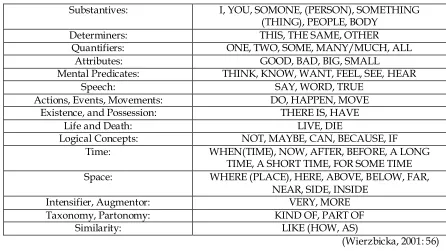
Every society has a shared set of specific cultural norms that as Wierzbicka (1994: 27) states “can be stated in the form of explicit cultural scripts”. Since cultural scripts can be formulated in lexical universals, they can be easily compared across languages. The key idea of the theory of cultural scripts is that widely shared and widely known ways of thinking can be identified in terms of some empirically established universal human concepts. Her model is not derived from one culture and one language, but is based on a great deal of cross-linguistic evidence. The set of universal human concepts which has emerged from cross-linguistic investigations undertaken by many scholars over the last few decades can be presented in the form of the following table (Table 1).
Table 1. Universal semantic primitives English Version
Substantives: I, YOU, SOMONE, (PERSON), SOMETHING (THING), PEOPLE, BODY
Determiners: THIS, THE SAME, OTHER Quantifiers: ONE, TWO, SOME, MANY/MUCH, ALL
Attributes: GOOD, BAD, BIG, SMALL
Mental Predicates: THINK, KNOW, WANT, FEEL, SEE, HEAR
Speech: SAY, WORD, TRUE
Actions, Events, Movements: DO, HAPPEN, MOVE Existence, and Possession: THERE IS, HAVE
Life and Death: LIVE, DIE
Logical Concepts: NOT, MAYBE, CAN, BECAUSE, IF Time: WHEN(TIME), NOW, AFTER, BEFORE, A LONG
TIME, A SHORT TIME, FOR SOME TIME Space: WHERE (PLACE), HERE, ABOVE, BELOW, FAR,
NEAR, SIDE, INSIDE Intensifier, Augmentor: VERY, MORE Taxonomy, Partonomy: KIND OF, PART OF
Similarity: LIKE (HOW, AS)
(Wierzbicka, 2001: 56)
To compare meanings expressed in different languages and cultures one has to be able to state them, as Wierzbicka (1991) points out, a semantic metalangauge independent of any particular language or culture and yet accessible and open to interpretation through any language can help. A metalanguage is a language that is used to describe or analyze another language. For this reason she proposes a ‘natural semantic metalanguage’ (NSM), based on a hypothetical system of universal semantic primitives shown in table 1.
3. Method 3.1. The Subjects
Subjects of the study constituted 100 undergraduate students studying at Shiraz Azad University.
Vol.3, Issue 1, March 2013
Their ages ranged from 18 to 27. They consisted of 50 males and 50 females, majoring in different academic subjects, such as architecture and computer. Those students studying English, Arabic, linguistics and majors related to language were not included in order to decrease the amount of interference.
The subjects were selected since they all had a supposedly full command of the language, and the culture. All of them were educated native speakers of Persian. They were asked for their age, sex, level of education and field of study. The subjects had to express what they would say in each situation in the questionnaire and what the possible answer would be.
3.2. Data for the Study
Persian data were elicited from the native speakers of the language. Two researcher-made questionnaires were used in the inquiry, an open questionnaire and a closed one. The open questionnaire which included 10 situations was used for the pilot study. Each situation consisted of two parts: 1) objections, and 2) objection responses.
Eighty undergraduate students, studying at Shiraz Azad University were the subjects in this stage of the study. They were asked to imagine themselves in the given situations and then write what they would say in each case and what the possible answer would be.
The closed questionnaire was prepared based on the data elicited from the pilot study and the intuition of the writer as a Persian native speaker. This questionnaire included the same 10 situations, and was administered to 100 subjects, 50 males and 50 females, at Shiraz Azad University. They were asked to mark the best and the most common choice in each situation. Then the frequency of all the choices was calculated, and to discover whether the sample data fit into the population distribution or not, and whether the differences in figures were large enough to say that they were truly different the Chi-square test at an 0.01 level of significance was applied. In most of the situations the results showed that the choices with the highest frequency could be considered as the commonest forms in Persian. In the cases where the Chi-square test didn’t prove significant the analysis relevant to all the choices was given. English data came from Wierzbicka (1991), Cross-cultural Pragmatics; and Wierzbicka (1987), English Speech Act Verbs.
3.3. Procedure of Data Analysis
The elicited Persian data were analyzed in terms of Natural Semantic Metalanguage (NSM) developed by Wierzbicka (1991). The central idea of her theory as Goddard (1997: 197) states is that all languages share a semantic code which “has a language like structure with lexicon and syntax”. The NSM is based on a small set of lexical and syntactic universals or near universals that can show the similarities and the differences between different cultures. In order to clarify the point , the following example will suffice.
Situation a. The text
You are in the bus line and want to get on the bus when a new comer tires to force his/her way and get on the bus. You don’t like it and want to stop him/her, so you make an objection.
b. Objection choices
A: xânom / ?âqâ če xabar ?ast? magar nemibinid saf ?ast? madam / sir what news is maybe not see + you line is (What’s the matter sir/ ma’am? Can’t you see the line?) B: dorost savâr šavid čerâ ?inqadr ?ajale mikonid?
right get on + you why this much harry do + you (Get on carefully. Why are you in such a hurry?)
Vol.3, Issue 1, March 2013
C: lotfan nowbat-râ ra?âyat konid.please turn OM observe do + you (Please observe your turn.)
D: če xabar ?ast? čerâ hol midahi? What news is why push give + you (What’s the matter? Why do you push me?)
e. Frequencies
Items A B C D
Frequencies 29 8 40 23
X2= 21.36 α= 11.344 P>0.01
d. Response choices
A: bebaxšid man ?ajale dâram. excuse me + you I hurry have + I (Excuse me. I’m in a hurry.)
B: delam mixâhad be šomâ rabti nadârad.
my heart want + it to you relation not have + it (I’d like. None of your business.)
C: hâlâ magar če šode, xob šomâ ?avval befarmâyid.
now maybe what has happened ok you first go on + you (So what? Ok, you get on first.)
e. Frequencies
Items A B C
Frequencies 29 9 62
X2= 42.98 α= 9.21 P>0.01
f. Representative dialogue for this situation
A: lotfan nowbat-râ ra?âyat konid. please turn OM observe do + you (Please observe your turn.)
B: hâlâ magar če šode, xob šomâ ?avval befarmâyid.
now maybe what has happened ok you first go on + you (So what? Ok, you get on first.)
g. Cultural script
A: (a) When I think something like this of a person: “This person is doing something
It is bad for him/her/me” (b) I feel something bad because of this (c) I don’t want it to be done
(d) I want this person to do something good (e) I think this person knows why I say this (f) I think this person will do it because of this B: (a) When I am doing something bad
(b) If a person wants me to do something good
(c) I know this person feels something bad because of this (d) I say: “Nothing bad happens because of this”
(e) I don’t want this person to think something bad about me (f) I say something to that person to feel something good
Vol.3, Issue 1, March 2013
4. Data analysis and results
4.1. Objections and Responses to Objections in Persian
Hornby (1987: 578) defines objection as a “statement or feeling of dislike, disapproval or opposition”. He states that when one objects to something, one says that he is not in favor of something; he is opposed to it and makes a protest against it.
An important aspect of communicative competence is to have control over the rules of speaking which contains rules of making appropriate objections and responding them accurately. Such rules are not universal; they are culture specific and vary considerably from one culture to another. So in order to interact successfully in a foreign speech community, one should know the relevant beliefs, ways of interacting, feeling, thinking and cultural norms which consist of the related rules of speaking. The underlying cultural norms are not usually objectively known to the native speakers. NSM is an approach by which implicit cultural norms can be brought into attention. So this approach is used to analyze and transcribe objections and responses to them in Persian in 10 situations.
4.2. Comparison of English and Persian Cultural Scripts 4.2.1. English and Persian Objections in Contrast
Speaking about, the verb “object” as an English speech act verb, Wierzbicka (1987) states that when an action is somehow bad in one’s eyes he performs an objection to stop it or to prevent it from achieving its goal. The person who objects might be able to stop or influence the course of that action by his well founded objection that is based on principles which any reasonable person would accept. However, he is not necessarily convinced that his attempt will be successful; he assumes that it might be.
The following cultural script is suggested by Wierzbicka (1987): (a) I say: something bad can be said about what X is doing (b) I don’t want it to be done
(c) I think that I can say why I say this
(d) I say this because I want to make it not be done
A close examination of the interaction routines in Persian shows that objections are more elaborated and complicated. This difference can be best shown by the components of scripts for objection routines in Persian. The result of the present study proves the following general cultural script for all 10 representative objections in the 10 situations:
(a) When I think something like this of a person: “This person is doing something
It is bad for him/her/me” (b) I don’t want it to be done (c) I can say why I think so (d) I say something
(e) I say this because I want to make it not be done (f) I think this person will not do it because of this
Component (a) gives us the idea that the negative view about an action is the target of the objection. Component (b) shows that the speaker wants to stop the action, so by expressing reasons he tries to convince the addressee that the action must be stopped (components c and e). Component (f) implies that compliance is taken for granted and that the speaker expects the addressee’s action to be controlled by his wishes. By contrasting the above cultural scripts, it is clear that the sixth component in Persian (component f) doesn’t exist for English speakers.
In Persian there are also some substrategies which are used in expressing objections. These substrategies accompany the above norm.
Vol.3, Issue 1, March 2013
a) Substrategy No. 1: Using irony(a) When a person is doing something bad (b) I don’t say in words what I think, feel or want (c) This person may feel something bad
(d) I say something else
The above cultural script reveals that sometimes it is beneficial to avoid direct objection for the sake of the addressee’s feelings.
b) Substrategy No. 2: Stating consequences
(a) When a person is doing something bad
(b) I say something bad happens to you because of this (c) This person may feel something bad because of this (d) I think this person will not do it because of this
Here the speaker tries to stop the action by revealing the threatening consequences and making bad feelings towards the action.
c) Substrategy No. 3: Stating directly
(a) When a person is doing something bad (b) I can say what I feel, think or want (c) I say: “You are doing something bad”
In this norm the speaker expresses his feeling directly since he wants to stop the action as soon as possible in order to prevent its negative effects.
d) Substrategy No. 4: Suggesting an alternative action (a) This person is doing something bad (b) I don’t want it to be done
(c) I want this person to do something else
The speaker expresses his negative view against what is going on by stating an alternative way. e) Substrategy No. 5: Asking for reasons
(a) I think this person is doing something bad (b) I ask: “why are you doing this”
Using this substrategy the speaker tries to convince the addressee that there is no good reason for doing such an act or not doing something else.
4.2.2. English and Persian Responses to Objections in Contrast
Another area where Persian cultural norms are different from those of English is responses to objections. Wierzbicka (1987) states that there are two general strategies, one is the acceptance strategy and the other one is the rejection strategy. If the addressee finds the objection reasonable, he accepts it, otherwise he rejects.
a) Strategy No. 1: Accepting
(a) I know that you want X not to happen
(b) I know that you can’t make me not do something if I say that I want it to happen (c) I think you want me to say if I want not to do it
(d) I say: I don’t want it to happen
(e) I say this because I want to make it not be done Wierzbicka (1987) refers to accepting as an act of ‘cooperation’. b) Strategy No. 2: Rejecting
(a) I know that you want X not to happen
(b) I know that you can’t make me not do something if I say I want it to happen (c) I say: “I want it to happen”
Vol.3, Issue 1, March 2013
(d) I say this because I want X to be doneThe above strategies show that in English personal autonomy is taken for granted and every individual knows that nobody can force him to do or not to do something.
The results of our study show that the general cultural norm in Persian is different. This difference can be best shown by the components of the cultural scripts. There are three general strategies for objection response routines in Persian.
a) Strategy No. 1: Rejecting by stating reasons (a) When I am doing something bad (b) If a person says something about it (c) It is good to say why I am doing it
(d) This person may not think something bad about me because of this (e) I don’t want this person to think something bad about me
As it is clear, components (c), (d), and (e) do not exist in Anglo-American cultural scripts. The addressee tries to seem reasonable in the eyes of the other party by bringing some evidence to show it. It is very important for the addressee to reduce other’s negative feelings, but in Anglo-American cultural scripts this is not taken into account.
b) Strategy No. 2: Rejecting by stating positive feelings (a) When I am doing something
(b) If a person says that it is bad to do it
(c) It is good to say something like this to this person: “Nothing bad will happen because of this
Something good may happen because of this”
(d) I don’t want this person to think something bad about me (e) I say this because I want to make this person feel good
The addressee tries to state his positive feelings towards the action and as result diminish the objector’s negative feelings about the action or the actor. Such elements are not present in the case of Anglo-American cultural scripts.
c) Strategy No. 3: Accepting
(a) When I am doing something bad
(b) If a person says to me “what you do is bad, don’t do it” (c) if I know that this person wants to make me do good things (d) It is good to say: “You say something good
I don’t do it”
(e) I say this because I want this person to think something good about me
This strategy is present in Anglo-American culture but the elements are not completely the same. For the Persian speaker the other’s feeling is considered very important, but for the American one the most important factor is self autonomy whether he accepts or rejects the objection.
5. Conclusions
This study was devoted to a comparison and contrast of Persian and English communicative interaction routines within the framework developed by Wierzbicka (1991). This natural semantic metalanguage framework was proved applicable to describe and analyze the communicative interaction routines in Persian. However, it should be noted that research in this area is still at an embryonic stage of development in Persian. So it is necessary to undertake further studies to open new avenues in the area. Wierzbicka’s cultural script model was also proved suitable for cross-cultural contrastive analysis.
Vol.3, Issue 1, March 2013
5.1. Implications
From the theoretical point of view this is one of the first studies that analyze some Persian interactional routines within the framework of scripts model developed by Wierzbicka (1991). This approach describes people’s ways of speaking in a qualitative, non-behavioral term and frees conversational analysis from ethnocentric bias and language bias. The findings can be used to clarify some areas of similarities and differences between a number of selected social functions in English and Persian as two languages with different cultural norms.
As for application, the results of this investigation can be used in language teaching to inform the learners of cultural values of the target language and its differences with the native one and as a result facilitate cross-cultural communication. To communicate effectively in a second language both interactors, whether the speaker or the listener, must be aware of expectations and cultural values of the language. So mere knowledge of vocabulary and grammatical rules of a language is not enough for one to successfully communicate cross-culturally; language can not be regarded as an entity seperate from culture. The students must be aware of the social and cualtural significance of the words and expressions employed, as a result it seems reasonable to include culture in the curriculum.
REFERENCES
Brown, P., and Levinson, S.C. (1987). Politeness: Some Universals in Language Usage. Cambridge: Cambridge University Press.
Goddard, C. (1997). “The universal syntax of sematnic pirmitives”. Language Sciences, 19(3): 197-207
Goddard, C. (1998). Semantic Analysis: A Practical Introduction. Oxford University Press.
Grice, H.P. (1975). “Logic and conversaiton.” in P. Cole and J. Morgan (eds). Syntax and Semantics,
3: 41-58. London: Academic Press.
Hornby, A.S. et al. (1987). Oxford Advanced Learner’s Dictionary of Current English. Oxford: Oxford University Press.
Leech, G.N. (1983). Principles of Pragmatics. London: Longman.
Richards, J.C. et al.(1992). Longman Dictionary of Language Teaching & Applied Linguistics. London: Longman.
Sahragard, R. (2000). Politeness in Persain: A Cutural Pragmatic Analysis. Unpublished Ph.D. Dissertation. University of Leicester.
Wierzbicka, A. (1987). English Speech Act Verbs: A Semantic Dictionary. Sydney: Academic Press. Wierzbicka, A. (1991). Cross-cultual Pragmatics: The Semantics of Human Interaction, Trends in Linguistics-Studies and Monographs 53. Berlin: Mouton De Gruyter
Wierzbicka, A. (1994). “Cultural Scripts: A Semantic Approach to Cutlural Analysis and Cross-cutlural Communication”, in Bouton, L. & Kachru, Y. (eds.) (1994), Pragmatics and Language Learning. Urbana: University of Illinois, 5: 1-24.
Wierzbicka, A. (1996). “Contrastive Sociolinguistics and the Theory of ‘Cultural Scripts’: Chinese vs. English”. In Marlis and Ulrich Ammon, (eds.), Contrastive Sociolinguistics: Contributions to the Sociology of Language. Sydney: J.A. Fishman.
Wierzibicka, A. (2001). “Australian cultural scirpts-bloody revisited”. Journal of Pragmatics, Australian National University.
Wolfson, N. (1989). Perspectives: Sociolinguistics and TESOL. Rowley, Mass: Newbury House Publishers.
Vol.3, Issue 1, March 2013
THE EFFICACY OF ERROR ANALYSIS ON TEACHING
TRANSLATION
Taher Sarhady
Sanandaj Technical University, Iran [email protected]
ABSTRACT
Error analysis developed as a branch of applied linguistics and as an alternative to contrastive analysis. It may be carried out in order to identify strategies learners use in language learning, recognize the causes of learner errors and obtain information on common difficulties in language learning as an aid to teaching and/or in the preparation of teaching materials. Despite the fact that it had its heyday in the 1960s, nowadays it can be illuminating for pedagogy due to its high practicality. Experience reveals that intermediate and even advanced foreign language learners have recourse to their mother tongue resources whenever they are in shortage of L2 patterns and vocabulary. The aim of this paper is to diagnose and remedy the university students’ problems in the process of translation. To do so, we have given students a test comprising a set of intentionally knotty Persian sentences to be rendered into English. The analysis of the data pool reveals that the majority of participants have transferred SL structures into the TL texts negatively. The outcome of the study can bring about valuable implications for teachers of translation how to balance their instruction based on the students’ present proficiency rather than they are exposed to overly subjective and abstract ideas and theories
Key Words: error analysis, contrastive linguistics, equivalence, schematic structure, interference, textual strategies, linguistic relativity
1. Introduction
The relationship of linguistics and pedagogy might have reached culmination in audiolingual method with the emergence of contrastive linguistics relying on American structuralism. Although the strong and weak versions of contrastive linguistics were doomed to failure, its moderate versi