111 DOI: 10.
Arterial Blood Flow Blockage Time Due to an Interaction between a Foreign
Second Phase and an Externally Originated Particle
Ramin Ehsani, Ahmadreza Rahmati*
Department of Mechanical Engineering, University of Kashan, Kashan, Iran
Received 11 March 2016; revised 52 May 2016; accepted 53 May 2016; available online 29 July 2019
ABSTRACT: A huge number of deaths in the world are the direct or indirect consequence of a disease which is called atherosclerosis. The disease could be due to an artery blockage by the interaction of an externally second phase with a particle which is entered to the bloodstream. The effect of some most important physical and geometrical affecting parameters on the blockage time of a microchannel due to the impact of a particle and a second moving second phase is investigated. Shan-Chen Lattice Boltzmann multi-phase model is used in present study. It is investigated that the small change in the Capillary number does not affect the dynamics of the mechanism and the procedure steps significantly. But, smaller Capillary numbers cause breaking up the second phase in to more parts and with these smaller parts, the risk of small capillaries blockage in the arterial section of bloodstream decreases significantly. The blockage time will increase by an increase in the ratio of particle size to the channel width and the initial size of the second phase to channel width ratio has the highest effect on the blockage time.
KEYWORDS: Lattice Boltzmann Method; Shan-Chen Method; Two-Phase Flow-Particle Interaction
INTRODUCTION
Multiphase fluid phenomena and flows occur when two or more fluids that do not readily mix share an interface. Multiphase phenomena and flows can involve single component multiphase fluids, e.g., water and its own vapor, and multi-component multiphase fluids, e.g., oil/water. Interactions between a two-phase flow and a particle which is suspended in that is so common in different industries. Emulsion stabilization [1], oil recovery [2], electronic fabrication [3], cosmetics [4], food industry [5], and petrochemical industry [6] are just some famous examples. Presence of clay particles in the oil/water emulsion in shale oil extracting is another important industrial challenges of such systems [7].
Broad range of this kind of flows includes also some biological issues of blood stream. Blood stream usually contains gas bubbles or liquid droplets which their interaction with solid impurities can cause mechanical problems by blocking vessels or displacing tissues [8]. The particles of most concern are fine particles less than 2.5 microns in diameter. Unlike larger particles, these smaller particles invisible to the naked eye can be breathed deep into the lungs and even pass into the bloodstream [9]. Atherosclerosis is responsible for almost 35% of annual death in developed countries [10]. The blockage of vessel could be happened when a second phase which presence in the blood flow (like gas bubbles, liquid droplets or even drug delivery capsules) interacts with a suspended particle.
dary
*Corresponding Author Email: [email protected]
Tel.: +989120686211; Note. This manuscript was submitted on March 10, 2019; approved on May 25, 2019; published online July 29, 2019.
Compared to particle-particle [11] and droplet-droplet [12] interactions, the open studies on particle-droplet interactions are relatively sparse. Mitra et al. [13] investigated the collision manners of a small solid particle against a large stationary droplet by conducting experiments and using the Volume of Fluid (VOF) numerical method. They analyzed the processes of the solid particle penetrating through the droplet. Shen [14] used the results of experiments to study the effects of the velocity of the droplet, size ratio of the droplet to particle, and temperature difference on liquid attachment during droplet-particle collisions. The authors found that the percentage of liquid attachment decreases against increasing droplet impact velocity. Bakshi et al. [15] conducted experiments to investigate the effects of droplet Reynolds number and particle-to-droplet size ratio on the behavior of a liquid film on a solid surface. Gac et al. [16] studied the influences of Weber number, capillary number and droplet to particle diameter ratio, on the interaction between a droplet and a particle. The authors used a Two-Color Lattice Boltzmann Method and found there could be three different collision behavior: coalescence, ripping and coating, and skirt scattering. Li et al. [17] investigated the interaction between a single or multi component flow and an immersed boundary using Lattice Boltzmann method. The authors used Shan-Chen multiphase flow model and tried to implement full satisfaction of no slip boundary condition. Yang and Chen [18] studied the interaction between a freely moving solid particle and a freely moving liquid droplet with periodic boundary conditions in upper and lower walls.
111
Nomenclature
ν Kinematic viscosity
Velocity ρ Density
Capillary number σ Surface tension
Diameter of particle τ Relaxation time
Discrete velocity ω Constant of model
Distribution function Subscripts
Force ads Adhesion
Model constant D Based on particle diameter
Diameter of droplet i Lattice direction
Indicator function L Based on droplet diameter
Time s Sound
Macroscopic velocity σ Component
Velocity ̅ Component
Width of the vessel Superscripts
Space coordinate eq Equilibrium
Greek Symbols σ Component
α Ratio * Dimensionless
μ Dynamic viscosity
The authors found two regimes to classify the collision behavior. In addition, it is found that the particle to droplet size ratio plays critical role in such interactions. Most of works in this field are done based on experimental studies which investigate the collision between a droplet and a large stationary droplet. In the first numerical simulation of the interaction of a particle and a droplet, Volume of Fluid (VOF) method is most used numerical method. Recently, some researches tried to simulate such an interaction using the powerful numerical method of Lattice Boltzmann. But, in these studies the effect of the walls are not considered and the boundary conditions are investigated as periodic boundaries. Or, the size of particle and droplet are much smaller that the width of the microchannel. In this study, the effect of some most affecting parameters on the full blockage time of a microchannel which experiences a collision between a free moving droplet and a stationary particle is investigated. It is tried to mimic the geometry of a small vessel by implementing a 2D geometry and changing some physical and geometrical parameters. The results could be used to understand the blockage of vessels by artificial external particles more deeply. They also could help in the design of some laboratory equipment which is used in the blood sample tests.
NUMERICAL METHOD
Here we implement the Multi-Component Multi-phase Shan-Chen Lattice Boltzmann model [19] in two dimensions. In the model, one distribution function is introduced for each of two fluid components.
Each distribution function represents a fluid component and satisfies:
( ) ( )
( ( ) ( )) (1)
Where ( ) is the th component density distribution function in the ith velocity direction and is a relaxation time in the BGK model, which is related to the kinematic
viscosity as ( ). The equilibrium
distribution function ( ) can be calculated as
( )
[
( )
]
(2)
In Equations 1 and 2 the s are the discrete velocities and for the D2Q9 model can be found in [20]. In Equation 2, is the density of the th component, which can be obtained from
∑ (3)
The macroscopic velocity is given by [21]
(4)
where is a velocity common to the various
components and defined as
∑ (∑ )
(∑ ) (5)
This velocity is regarded as the whole fluid’s velocity. In Equation 4,
112 It is the force acting on the th component, here including fluid–fluid cohesion and fluid–solid adhesion
. The cohesive force acting on the th component is
defined as [22]
( ) ( )
∑ ̅( )
(7)
where the and ̅ denote two different fluid components and is a parameter that controls the strength of the cohesion force. The surface force acting on the th component can be computed as follows [22]
( ) ( )
∑ ( ) (8)
Here ( ) is an indicator function that is equal to 1 or 0 for a solid or a fluid domain node, respectively. The interaction strength between each fluid and a wall can be adjusted by the parameters .
MODEL VALIDATION
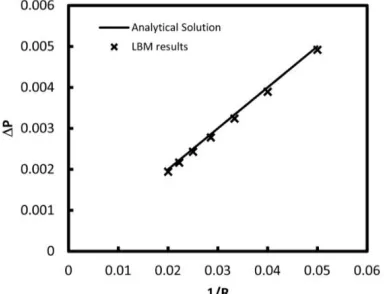
To validate the two phase model, the cohesion forces must guarantee a well-accepted law concerning these forces. Accordingly, Laplace law can serve to evaluate the model capability to predict surface tension between two phases. A square droplet of one phase is placed at the center of a computational domain while it is surrounded by another phase of the same density and viscosity. The four boundary conditions are considered to be periodic boundaries and the whole system is left to reach equilibrium after model execution. In Figure 1 where the vertical axis represents the pressure difference of two fluids across their boundary and the horizontal axis demonstrates the corresponding inverse of bubble radius, compliance with Laplace law has been shown. In fact, the highest percentage of error between results of this study and Laplace law is just 0.05%.
Fig. 1. Pressure difference between inside and outside of a droplet versus
curvature
PROBLEM DEFINITION
The investigated domain to study the arterial blood flow blockage time due to an interaction between a foreign second phase and an externally originated particle is illustrated by Figure 2.
Fig. 2. Schematic of problem
The initial length of the liquid droplet is L and the radius of the solid particle is D.
The particle is stationary and the droplet moves toward it. The width of the microchannel is W and to eliminate the effect of entrance and exit ports, the length of channel is considered as 6W.
The size of simulation domain is . A fully developed flow is considered at the entrance of microchannel with an average velocity of U. Bounce back boundary conditions are adopted for the upper and lower boundaries.
RESULTS
In this study the interaction between a second phase which could be a drug delivery capsule and a particle which could be entered to the blood stream via air pollution is investigated.
As important dimensionless numbers, particle diameter parameter , droplet diameter parameter , and capillary number Ca are defined as follows:
⁄ (10)
⁄ (11)
⁄ (12)
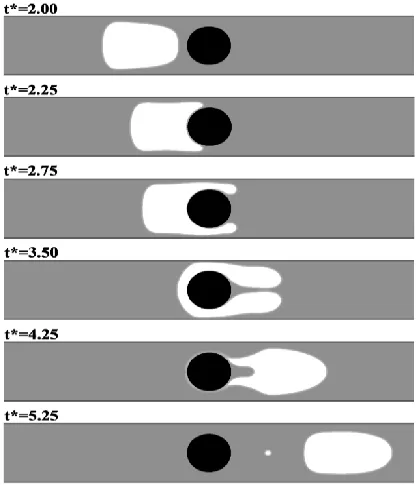
To study the dynamics of interaction between the droplet and the particle, the transient motion of the moving droplet is provided in Figure 3. The droplet experiences complicated deformation while passing the particle. First, the droplet splits by the particle and then merges in the rear side of the particle.
During these steps, the vessel will be fully blocked for a period of time.
In some cases, satellite droplets may be generated after the breakup of thin thread.
113
Fig. 3. Transient interaction, Ca=0.00045, =0.6, =0.8
A qualitative comparison between the results for Ca=0.00045 and the experimental results of Chung et al. [24] is illustrated in Figure 4. The behavior of second phase is the same in both cases and one dead zone is developed in the downstream of the particle.
The effect of Ca
First, the effect of Capillary number (Ca) on the mechanism of interaction and the full blockage time of vessel is investigated.
Fig. 4. Qualitative comparison with results of Chung et al. [24]
Fig. 5. Effect of Capillary number, =0.6, =0.8
The results for Capillary numbers of Ca=0.00065 and Ca=0.00085 are shown in Figure 5.
It is found from Figure 5 that the small change in the Capillary number does not affect the mechanism and the procedure steps significantly.
114 between results of different Capillary numbers. The probability of satellite droplets formation increases with a decrease in the amount of Capillary number. The final stage of interaction dynamic results are illustrated in Figure 6 for three different Capillary numbers. So, smaller Capillary numbers cause breaking up the second phase in to more parts and with these smaller parts, the risk of small capillaries blockage in the arterial section of bloodstream decreases significantly. As mentioned before, if the gas bubbles or liquid droplets form or induce in the arterial part of the bloodstream, they could cause major problems or even death. So, a treatment will be necessary to breakup these foreign members to smaller parts. The smaller parts could enter venous section of the bloodstream and finally leave the body via expiration in lungs.
The effect of
Another important parameter in this study is the ration between the diameter of the particle to the width of the microchannel.
The results for three different ratios of =0.4, =0.6, and =0.8 are shown in Figure 7.
Due to effect of particle on flow patters, it is expected to the effect of the presence of the particle on the second phase starts at the earlier time steps for the smaller . As the interaction between the particle and the second phase is just started at a time between t*=2.75 and t*=3.50 for =0.8, almost the all of the particle is covered by the second phase at the same t* for =0.4.
Fig. 6. Effect of Capillary number on satellite droplet formation
Fig. 7. Effect of the ratio of the particle size to channel width, Ca=0.00085, =0.8
A more detailed study of the dimensionless times of the beginning and the ending of the full blockage of the vessel is needed. The results are listed in (Table 1).
Table1
Dimensionless time of the start and the end of full blockage in various s.
0.4 0.6 0.8
Dimensionless time of the start 2.9 2.7 2.5
Dimensionless time of the end 3.7 3.9 6.1
Difference 0.8 1.2 3.6
Based on the results of (Table 1), there is a direct relationship between and the full blockage time of vessel. It means that, the larger particles in the bloodstream could block the vessel for a larger time if they goes to interact with a second phase.
The risk of experiencing problems caused by vessel blockage will increase also with presence of larger particles in the bloodstream.
The effect of
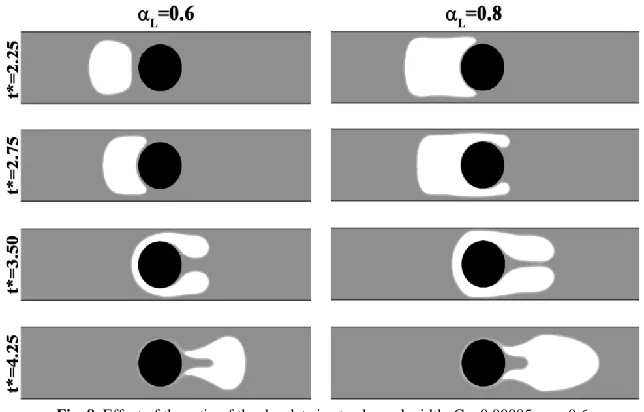
To study the effect of droplet length to channel width ratio, , two different cases of =0.6.0 and =0.8 are investigated and the results are shown in Figure 8.
An increase in cause the interaction between the droplet and the particle starts sooner.
The first point is about the dead zone development. The size of the dead zone is smaller for larger .
115 A more detailed study on the results of Figure 8 reveals that the full blockage time will increase by 70% when is
increased by just 34%. This increase probably cause to severe conditions inside the human body.
Fig. 8. Effect of the ratio of the droplet size to channel width, Ca=0.00085, =0.6
CONCLUSION
There are different ways which foreign particles, gas bubbles or liquid droplets could enter to the bloodstream. The interaction between these foreign members inside the vessels with each other can cause various situations. One of the most dangerous case is the full blockage of vessels or capillaries even for a short period of time. This blockage may cause severe damage to living organs or even death. A critical parameter in such a situation is the time of full blockage.
In this study, the effect of some parameters on the full blockage time of a vessel due to interaction between a second phase and a particle is investigated. It is found that the small change in the Capillary number do not affect the dynamics of the interaction significantly. Since the changes of the bloodstream velocity and heart pulsing damp in smaller vessels, the Capillary number is not considered as an important affecting parameter here.
But, the ratio between the diameter of particle to the width of the vessel will affect the full blockage time. In fact, the full blockage time increases with an increase in this ratio. There will be also a major difference if the ratio between the particle size to the channel width changes. The full blockage time of the vessel increases with an increase in this ratio.
REFERENCES
[1] Dickinson E. Food emulsions and foams: stabilization
by particles. Current Opinion in Colloid & Interface Science. 2010 Apr 1;15(1-2):40-9.
[2] Sullivan AP, Kilpatrick PK. The effects of inorganic
solid particles on water and crude oil emulsion
stability. Industrial & Engineering Chemistry
Research. 2002 Jul 10;41(14):3389-404.
[3] Tekin E, Smith PJ, Schubert US. Inkjet printing as a
deposition and patterning tool for polymers and inorganic particles. Soft Matter. 2008;4(4):703-13.
[4] Hunter TN, Pugh RJ, Franks GV, Jameson GJ. The
role of particles in stabilising foams and emulsions. Advances in colloid and interface science. 2008 Mar 18;137(2):57-81.
[5] Tambe DE, Sharma MM. Factors controlling the
stability of colloid-stabilized emulsions: I. An experimental investigation. Journal of colloid and interface science. 1993 Apr 1;157(1):244-53.
[6] Jansen F, Harting J. From bijels to Pickering
emulsions: A lattice Boltzmann study. Physical Review E. 2011 Apr 15;83(4):046707.
[7] Radnia H, Solaimany Nazar A, Rashidi A. Application
of nanoparticles for chemical enhanced oil recovery. Iranian Journal of Oil & Gas Science and Technology. 2018 Jan 1;7(1):1-9.
[8] Papadopoulou V, Tang MX, Balestra C, Eckersley RJ,
Karapantsios TD. Circulatory bubble dynamics: from physical to biological aspects. Advances in colloid and interface science. 2014 Apr 1;206:239-49.
[9] Cardoso EJ, Vasconcellos RL, Bini D, Miyauchi MY,
116
assess the effects of use and management on soil health?. Scientia Agricola. 2013 Aug;70(4):274-89.
[10] Melchionna S, Pontrelli G, Bernaschi M, Bisson M,
Halliday I, Spenser T. J, Succi S. Micro and Nano Flow Systems for Bioanalysis. 2013.
[11] Yang B, Chen S, Liu K. International Journal of Heat
Transfer. 2017; 104: 419-437.
[12] Munnannur A, Reitz RD. A new predictive model for
fragmenting and non-fragmenting binary droplet collisions. International journal of multiphase flow. 2007 Aug 1;33(8):873-96.
[13] Mitra S, Doroodchi E, Pareek V, Joshi JB, Evans GM.
Collision behaviour of a smaller particle into a larger stationary droplet. Advanced Powder Technology. 2015 Jan 1;26(1):280-95.
[14] Chen Z, MSc. Thesis, New Jersey Institute of
Technology. New Jersey. 2008.
[15] Bakshi S, Roisman IV, Tropea C. Investigations on
the impact of a drop onto a small spherical target. Physics of fluids. 2007 Mar 28;19(3):032102.
[16] Guerra CC, de Moraes Barros MC, Goulart AL,
Fernandes LV, Kopelman BI, dos Santos AM. Premature infants with birth weights of 1500–1999 g exhibit considerable delays in several developmental areas. Acta Paediatrica. 2014 Jan;103(1):e1-6.
[17] Li Z, Favier J, D'Ortona U, Poncet S. An immersed
boundary-lattice Boltzmann method for single-and
multi-component fluid flows. Journal of
Computational Physics. 2016 Jan 1;304:424-40.
[18] Yang B, Chen S. Simulation of interaction between a
freely moving solid particle and a freely moving liquid droplet by lattice Boltzmann method. International Journal of Heat and Mass Transfer. 2018 Dec 1;127:474-84.
[19] Shan X, Doolen G. Multicomponent
lattice-Boltzmann model with interparticle interaction. Journal of Statistical Physics. 1995 Oct 1;81(1-2):379-93.
[20] Chen S, Doolen GD. Lattice Boltzmann method for
fluid flows. Annual review of fluid mechanics. 1998 Jan;30(1):329-64.
[21] Shan X, Chen H. Lattice Boltzmann model for
simulating flows with multiple phases and
components. Physical Review E. 1993 Mar
1;47(3):1815.
[22] Martys NS, Chen H. Simulation of multicomponent
fluids in complex three-dimensional geometries by the lattice Boltzmann method. Physical review E. 1996 Jan 1;53(1):743.
[23] Lee M, Park W, Chung C, Lim J, Kwon S, Ahn KH,
Lee SJ, Char K. Multilayer deposition on patterned posts using alternating polyelectrolyte droplets in a microfluidic device. Lab on a Chip. 2010;10(9):1160-6.
[24] Chung C, Lee M, Char K, Ahn KH, Lee SJ. Droplet
dynamics passing through obstructions in confined