Iranian Journal of Economic Studies
Journal homepage: ijes.shirazu.ac.ir
Notability of Substantive Elements of Economics: The Groundwork for Evolution of Economic Thought
Yadollah Dadgar
Faculty of Economics and Political Sciences, Shahid Beheshti University, Tehran, Iran.
Article History Abstract
Received date: 20 November 2017 Revised date: 19 January 2018 Accepted date: 3 March 2018 Available online: 3 March 2018
The present study is an attempt to investigate the resurging evolution of economic thought, which is closely in direction with the eminence of substantive elements of economics. It presupposes that the substantive elements of economics produce a package which 1. Includes some epistemic doctrines, including rationality, efficiency, and equilibrium; 2. Has dynamic characteristics of economic theories; 3. Establishes an obvious interdisciplinary framework and systematic relationships with other social sciences; 4. Is compatible with mildness and moderation; 5. Entails institutional, social and ethical potentiality; 6. Has a pluralistic nature and potential for methodological reforms; and 7. Creates an outstanding analytical power through the application of the package in question. Considering the pluralistic nature of conventional economics, it constitutes mainstream and non-mainstream, and neoclassical and non-neoclassical paradigms. The Moreover, neoclassic paradigm includes both orthodox and non-orthodox approaches. The present study examines the efficacy of moderate and non-orthodox paradigms of conventional economics.
JEL Classification:
C33 Q47
Keywords:
Evolution of Economic Thought Substantive Elements
Conventional Economics
1. Introduction
Evolution of Economic Thought (EET) can be full of massages, lessons, and experiences. Taking a serious look at EET can improve the analytical ability and, in some cases, can enlarge economists' toolkit. An accurate investigation of can offer efficient guidelines for tackling economic problems in the 21st century. The domain of EET covers ancient times, medieval ages, the renaissance, enlightenment ages and the contemporary era. Therefore, EET is concerned with the ideas of ancient Greek philosophers, classical and neoclassical schools, socialism, Keynesianism, institutionalism, and behavioral approaches. A close study of EET can help economists gain a deeper insight into the nature of their science because examining the history of ideas can show us how we think the way we do. The current gap between EET and economics, however, is not in its desirable status. About 38 years ago, Heilbroner (1980), a famous economist,
concluded that modern economics has discovered many problems but no overarching problems. For instance, although it seems to have scientific rigor, it does not deal with the fundamental social issues, which typify economic thoughts of the past. The conclusion in question is relevant right now. It seems that bridging the gap between mainstream economics and EET, which has enlarged since 38 years ago, is in direction with Paretian improvement, and thus does provides economic justification.
EET ties the actual life to the old cultural and institutional environment. It is based on the belief that economic issues do not follow a simple linear path; rather, they indicate a complicated one. EET studies can assist researchers in evaluating theories through different approaches. It assumes that economics is an investigation of society and is a social science with important historical dimensions. Some researchers think that EET provides a democratic way of training, too (Hodgson, 2001; Kula, 1958; Lindsey and Teles, 2017). EET could be construed as a systematic- dynamic package of ideas, observations, theories, and policies. Thus, EET can be a fruitful field for practicing by economists to grasp major economic implications. Economics emerged from the conjunction of morality and engineering in the ancient Greek. Economy was a “good” issue and “good” was considered as what is compatible with nature. An ethical commitment was involved, too. The application of these ideas can boost the integrity of economics as well. Economics in framework offered by EET is a science of society (Lowry, 1979; Sen, 1997). It can increase the robustness of political economy, too (Coleman, 2005). It is believed that educating students on EET could equip them with an efficient language, which facilitates their deeper understanding of economics.
1939). This requires a profound study of EET along with economics and this paper is a feasibility in this regard.
2. Some Methodological and Conceptual Considerations
SEE is concerned with long-run robustness of economics too. Robustness is relied on low vulnerability, compatibility of theories with actual performance, and capability of correcting possible hardships in the mid run (Strawson, 2012; Krause and Arenhart, 2016). Regarding the present article, the following package is coinciding on SEE: 1. rationality, efficiency and equilibrium; 2. dynamic characteristics; 3. systematic relationships between economics and other disciplines; 4. mildness or moderation; 5. institutional and ethical compatibility; 6. pluralistic nature; and 7. an outstanding analytical power as the payoff of the package. The package in question, which has been easily released through a deep review of EET, can also be considered as an axiomatic framework in the present article. Economic theories, unsuccessful experiences of orthodox neoclassical paradigm (ONP), and evolutionary data have been used as supporting evidence in this regard. Then, EET has been reviewed based on the elements of the aforementioned package. For economics to keep substantive elements, it should be robust and insightful and should have compatible theories and invulnerable structure (Finley and Stewart, 1982; Rodrik, 2014 and 2016; Schwab, 1964; Shulman, 1987). Based on theories of robustness, there is a systematic relationship between social and non-social aspects of life. Some studies have shown that even environmental sustainability depends largely on a viable social system (Dadgar and Nazari, 2016; Medema and Samuels, 2013; Nilanjan, 2014; Sachs, 2015; Soderbaum, 2000). To the following parts, provide the readers with a partial explanation and brief analysis of SEE.
Rationality, efficiency, optimization and equilibrium
relax some assumptions, and rely on the second best solutions. Moderate economic paradigms can potentially achieve their desired targets through accepting assumptions that are more realistic. By moderate paradigms, it is meant that all economic approaches try to take into account the following methodological considerations: 1. relying on bounded rationality, 2. searching for accessible and not perfect information, 3. assuming uncertain circumstances in economic decision and economic analysis, 4. considering the role of different institutions and their socio-political correlations, and 5. welcoming pluralistic methods in economic analysis, and finally, moderate economic paradigm does have critical content in nature.
Dynamic and systematic framework
SEE is also concerned with the potentiality for dynamic trends and systematic framework. Economics has been labeled as the “queen of social sciences” due to its coordination in solving general problems in a systematic and dynamic framework (Lerner, 1972). Some studies have indicated that: there is a close correlation between social values and economic values (Kenter and Obrien, 2015; Novonty and Gibbons, 2001). Such a relationship has been observed in economic, sociological and experimental studies as well (Alvaredo et al, 2018; Dyachenko, 2014; Jimenez-Buedo and Miller, 2010; Pardi, 2014; Rizza, 2006). Furthermore, not only is the dynamic- systematic framework working in theoretical and methodological contexts, but also it has great impacts on actual economies. We live in an uncertain and ever-changing world, which is continually evolving in a novel way.
principle1. In order to have a better understanding of SEE, therefore, we need to know how economic schools and economic systems evolve. This can show the necessity for systematic examination of EET, because it ties tightly with historical evolutions (Hutchins and Hazlehurst, 1992; North, 2005). For instance, Keynes emphasized human psychology and Von Newman emphasized subjective and expected utility. Maurice Allais demonstrated the gap between real world and axiomatic utility, based on which Simon developed the idea of bounded rationality. Eventually and relying on all of these findings, Thaler (2017) modeled behavioral economics and received the Nobel Prize for it. These processes can effectively depict the central dimensions of SEE.
Moderation, institutional and ethical concerns
Methodologically speaking, one may confuse mainstream economics with conventional economics, or even wrongly use them interchangeably. Mainstream economics, however, is a neoclassical-Keynesian synthesis and conventional economics is a general term and includes a broad spectrum from extreme right wing to extreme left wing. According to EET, conventional economics includes diverse paradigms. Consequently, it encompasses orthodox, radical, and moderate schools of thoughts. As a result, new institutionalist, new Keynesian, new Marxist, and even feminist economists enumerate their school as the mainstream one.
Understanding the role of moderation, institutional and ethical frameworks can be helpful in decision-making. For instance, ONP relies on perfect market, perfect certainty, perfect information and perfect rationality. Actual life, however, is concerned with so many imperfections. Consequently, institutional and ethical elements of moderate economics can support economists and even be helpful in reforming ONP to tackle imperfections in question (World Bank Group, 2017). As Sen (1997) correctly stipulates, economics is an inseparable combination of engineering and ethics, and ignoring each element can destroy the discipline altogether.
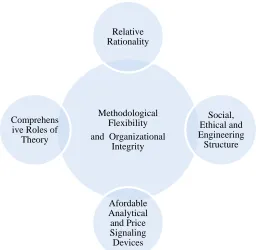
Infrastructural substantive groundwork underpinning methodological considerations:
Firstly, SEE is based on multidimensional nature of economics (Munda and Saisana, 2011). Secondly, it is concerned with the “ends-means debate”. Economic methodologists warn against confusing means with ends in economic analysis. For instance, using mathematics as an instrument can be fruitful in economic analysis. Applying mathematics as an end might be, however problematic. According to Marshal (1986), a famous economist and
1
mathematician, we can use mathematics as a language rather than as an engine of enquiring. Rosenberg stresses that: “economics more as a science of human behavior than a branch of mathematics” (Dadgar, 2013). Accordingly, scientific techniques, including mathematics, and econometric models are welcome as instruments for discovering the reality and not as an end in themselves (Brue, 1993).
Thirdly, based on moderate economics, science, in general, and economics, in particular, particularly are concerned with methods and approaches, and thus they are not sacred issues. According to logical positivism, which underlies theories of ONP, however, science is indeed a sacred phenomenon. Thus, any statement, which is scientific, is good and sacred, nonscientific statements, however, are meaningless (Copleston, 2003). North (1990) believes that a big price has been paid for the unquestionable acceptance of [orthodox] neoclassical theory.
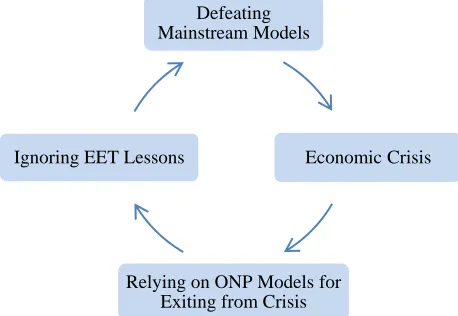
Fourthly, reliance on moderate economics and enough attention to pluralistic methodology can lead to a peaceful and democratic relationship with alternative paradigms. Moderate paradigms help reduce vulnerability of economic theories as well (Ekelund and Hebert, 2013; Jhingan, 2014; Lawson, 2015; Roth, 2015; Wolf and Resnick, 2012). Efficient economics does not suffer from vulnerability. Vulnerability of economics can be considered as the ratio of the number of failed predicted models to all the designed models in a specific period. According to EET, only moderate paradigms of economics can persist in economic crisis. Most models of ONP failed to predict accurately the 2007-2012 crises (Krugman, 2009). Surprisingly, ONP did not change their models after their failure in making a correct prediction (Cassidy, 2010; Fama, 1965; Vague, 2014). Since ONP assumptions are rarely, if ever, realistic, representing a more realistic picture of economics can be of great importance (Leeson and Subrik, 2006).
Figure 1. Infrastructural substantive groundwork (ISG)
ISG could be used for different economic paradigms with different hard cores. ONP, for instance, stresses on instrumental rationality and price signaling information. Likewise, Keynesian paradigms emphasizes the roles of government, institutional economists on the institutions, and so on (Arnsperger, 2008; Boland, 2005; Davis and Hands, 2012; Hands, 1993).
3. Along with EET
3.1 Adjustability with the 21st Century
The majority of economists agree that the 21st century is the era of rapid and comprehensive changes. Technological advancement, globalization, and emerging pluralistic ideas can be construed as issues behind the changes in question. Due to the accelerating changes of 1970s, some scholars have labeled the period as “Chrono-centrism” (Fowles, 1974), which shows centrality of time. The formations of two prominent phenomena in economics, namely path dependency and new institutionalism have been the byproducts of the aforementioned changes. The role of institutions is now beyond the scope defined by Coase (1990), North (1994), Powell and DiMaggio (2012), Simmie (2014), Arthur (1994), and Yunus (2017). Non-economic changes, including
Methodological Flexibility and Organizational
Integrity Relative Rationality
Social, Ethical and Engineering
Structure
Afordable Analytical and Price Signaling Devices Comprehens
genetic variation can also significantly affect economics in the 21st century (Boggs, 2015; Cooper and Isendahl, 2014; Mohi, 2014; Marx, 2014; Wimmer and Kossler, 2006). Everything is changing from one equilibrium to another. Therefore, an examination of dynamic trends in economics is the missing part of this discipline. Dynamic changes occur under the effects of globalization, knowledge-based economy, and climate change. Consequently, transformation of economics is affected by the domain of change, trend of change, direction of change, and speed of change. Institutional economists ascribe these changes to an institutional environment; cognitive experts connect them to learning, etc. (Acemoglu et al., 2012; Icon group, 2017; Kahneman, 2013; North, 2006; Park, 2015; Teyssiere and Kirman, 2007). Therefore, ONP, due to its static and timeless representation, is incapable of tackling the problems in the 21st century.
Typical prototype of comparing schools of thought
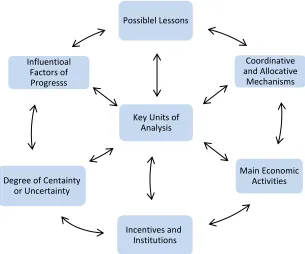
A semi-hypothesis of the present article is that resurgence of EET is in direction with sustainability of SEE. To receive helpful messages from EET, different schools of thought can be compared based on the following elements: 1. incentives and institutions; 2. unit of analysis; 3. main economic activities; 4. belief in certainty or uncertainty; 5. factors of progress; 6. allocative mechanisms; and 7. Possible lessons. In addition to personal perspective, evaluation of some EET works has assisted author to derive the following framework (Backhouse, 1994; Boland, 2014; Chang, 2014; Hands, 1993; Maki, 2013; Samuels et al., 2009). Figure 2 depicts the above elements in an EET comparing framework.
Figure 2. EET comparing framework
Considering possible lessons, classical school emphasizes fair-based and stable economy in the long- run, neoclassic school puts emphasis on happiness in the short run, and institutional school emphasizes institutions seriously. The great Message of Hicks (1941) can be considered as a serious lesson for economists of the 21st century: “A man who is a mathematician and nothing but mathematician does not do any harm. An economist who is nothing but an economist is a danger for his neighbors. Economics is not a thing in itself; it is the study of one aspect of man's life in society". This massage can in turn, be a good starting point for delving research in EET.
3.2 Typical Ideas and Experiences
Economists' ideas, regardless of their empirical truth, are more powerful than what is generally understood (Keynes, 1936). Past performances have provided incredible guidelines for today's activities (Campbell, 1998). A remarkable number of studies have emphasized the relationship between economic change and socio-political institutions (Abramovitz, 1986,; Denzau and North 1994; Martens, 2004; Zamagni, 2010; Zweynert, 2007). The next step is to link these findings to EET. EET can be divided into two sub-categories: pre- classic and afterwards. Pre-classical time includes economic thought of ancient Greek, medieval period, mercantilism and physiocracy. Before the 16th
Possiblel Lessons
Coordinative and Allocative
Mechanisms
Main Economic Activities
Incentives and Institutions Key Units of
Analysis
Degree of Centainty or Uncertainty
century, there were some economic ideas, but there was neither a specific school of thought, nor a well-defined economic science. During the early 16th century, mercantilism emerged as the first school of thought.
Before Christ through mediaeval ages
Hesiod (800 BC) has referred to the positive impacts of rule of law on economic development (Mises, 1998). Democritus, a Greek thinker (460 BC) has pointed to the role of time preference in political economy. Plato and Aristotle were concerned about economic coordination. Greek philosophers placed stress on natural law, household management, private property, and justice. Natural law is both a theory and a method of reasoning. It is a moral and at the same time a legal theory. Based on some previous studies, Greek philosophers provided the first fragment of systematic economic theory (Aristotle, 2012; Barry, 1975; Rothbard, 1995; Spengler, 1955). Therefore, as far as the substantive package of the present study is concerned, there is a significant relationship between EET in ancient Greece and the package in question.
In the middle Ages, EET was based on property rights and just prices. The doctrines of EET from the ancient time to the 16th century can be summarized as follows: 1. Economics was a social and ethical science. 2. Justice was considered as a condition for ensuring robustness of political economy. 3. Market process was relatively developed and contract law was enforced (Kaye, 1998; Samuels et al., 2003; Spengler, 1964; Udovitch, 1970). 4. The impact of philosophy, law, and religion on economics was influential. 5. The pluralistic framework of economics was easily comprehensible. Some economic thinkers focused on rational ideas, some on natural law, some on religious ideas, and some on a pragmatic view. Some economic thinkers, claimed to produce universal laws, some other concentrated on regional and local laws.
EET, Mercantilism and physicracy
Accumulation of gold (as economic wealth), promoting nationalism, and active government intervention are the main principles of mercantilism (1500 -1776). In reaction to mercantilism, physiocrat school appeared in the middle of the 18th century (Roughly, 1756). It puts emphasis on natural order, laissez-fair, and agriculture as the doctrines of physiocracy. Relying on laissez-fair, physiocrats believed in free market economy. Quesnay, the founding father of physiocracy, also believed in just prices. Just prices for him were set by natural market systems and not by government (Blaug, 1980 and 1990; Rubin and Colliot- Thelene, 2015; Vaggi, 1987). Despite some of their static ideas, physiocrats considered economics as a social science and built their models on a holistic philosophy and not on a mechanical-individualistic one.
revolution, experimental and mathematical evidence is necessary for justifying knowledge. Advocates of classical school believed that laissez-faire would be an efficient theory of public management, natural law would manage economic systems, and individuals would seek to maximize their self-interest thorough free market systems (Allen, 2009; Graphics, 2008; Medema and Samuels, 2013). In contrast to both mercantilism and physiocracy, classical school emphasized productivity of all factors of production. Adam Smith, as an incredible classical thinker, believed that people can exist in a social framework, and thus they need each other to conduct their affairs properly. He relied on individual selfish behavior, but believed that moral faculties can constrain selfishness of human being (Frey, 1992; Phillipson, 2012; Smith, 1976). The extension of economic theory to income distribution was among major contributions of Ricardo (Dobb, 1975; Ricardo, 2013). Stuart Mill, another prominent classical economist, proposed dynamic economic theory.
Marxism advanced in reaction to some difficulties associated with classical school, difficulties such as unjust income distribution and worker dissatisfaction. Marx believed that classical school and capitalism suffer from internal contradictions and will eventually demise (Holander, 2015; Hu, 2014; King, 1990; Marx, 1993; Piketty, 2014; Wolfson, 1979). Another critic of classical school was German historical school. It was the outcome of the dominance of German nationalism in the late 19th century. German economists believed that although classical doctrines were compatible with UK circumstances, they were not consistent with conditions in Germany. Therefore, they funded a school of thought, arguably consistent with German economy and its socio-political status. The doctrines of German school included active government and inductive approach. German economists believed that society is changing; therefore, classical doctrines are consistent with a specific period of time and place. They had a dynamic and evolutionary view. Instead of individualistic ideas, they had nationalistic and socially oriented ideas. Economy was organically related to the other parts of socio-political and cultural systems. They criticized unhistorical, static and deductive approaches to economic schools. Except for general theories of development, they rejected the universality of economic laws or theories (Balabkins, 2006; Dorfman, 1955; Lessnoff, 1994; Shionoya, 2000; Tawney, 1926).
assumptions, whose affordability could be questioned. Perfect competition, complete market efficiency, and absolute rationality of economic agents were among assumptions in question. Considering these unrealistic assumptions, some studies have indicated the fragility of the paradigm in question (Backhouse, 2010 and 2012; Dopfer, 2005; Dugger, 1995; Rutherford, 1996; Weeks, 2014).
The appearances of some signs of failure of traditional neoclassicism could be inferred as the initial ground for the advent of Institutionalism. Actual performances of economic systems did not reflect the optimistic trend suggested by the neoclassic models. Economies suffered from high unemployment, poverty, monopoly, and so on. Different approaches were used to exit from the status in question. The solution suggested by the radical approach was to abolish capitalism and to move in the socialist direction. Institutionalist solution was to undertake some social and institutional reforms. Adherence to institutions, holistic attitudes, evolutionary approaches, democratic reforms were among the main doctrines of traditional institutionalism. New institutionalists referred to the crucial role of property rights, and paid attention to the relationship between law and economics (Alasuutari, 2015; Lecourse, 2005; Samuels, 1989).
3.3 Analyzing the Findings
1. The study of EET can be considered as an in-depth review of conventional economics. EET is full of messages, lessons, theories, and experiences. The messages and lessons of EET can be used as guidelines for planning economic future. According to John Hicks (1969) and SCED Symposium (2010), there is a special relationship between economic performance and EET.
2. Based on the lessons drawn from EET, economics can be considered as a dynamic discipline (Stigler, 1949).
3. The study of EET is a precondition for the robustness and sustainability of economics. In other word, an in-depth review of EET can provide a new perspective on SEE because it indicates that moderate economic schools of thought are productive and extreme cases are questionable.
4. By concentrating on socio-institutional and ethical elements, some schools have assisted the moderation and Robustness of economics.
5. Exaggeration the role of mathematics by some paradigms (ONP, for instance), and de-mathematizing by some others (such as Austrian school) have impeded knowledge-based progress. The Findings of EET prove that the moderate economic paradigm has helped improvement of the discipline.
6. According to EET, over time, economic performance is fundamentally influenced by the way institutions evolve. Institutions can reduce uncertainty and affect economic performance. Consideration of EET along with institutions can: a) increase the efficiency of EET itself, b) assist policy makers in proper coordination of economy, and c) increase social stability of economics in actual life (North, 1990).
7. Different dimensions of economics are changing and their speed of change is changing too (Backhouse and Fontaine, 2010). Adherence to such economic changes requires an essential change in our conventional thinking (North, 2005).
8. Research has provided a quantitative account of practices in economics for the last 130 years. As the findings have revealed, the number of economic articles which include words and which denote other disciplines (such as history, psychology, and sociology) has sharply increased in 1920s, have dropped in 1970s and 1980, and have rapidly increased in 1990s and in the 21st century. The above research has used articles published in almost 95% of economic journals (Aromic, 2013).
9. Considering the SEE package used in the present study, the significant relationships between economics and other subsystems can be an indicator of invulnerability in economics itself (Wisner et al., 2004; Zakour and Gillespie, 2013).
economics. For Aristotle (2012), economics was characteristically ethical. Adam Smith was an expert in moral philosophy. Economists, such as Mill, List, Weber, Veblen, Keynes, Marshal, Knight, Buchanan, Arrow, Simon, and Sen concentrated on moral philosophy and the relationship between economics and ethics. Some economists have referred to economics as a moral science (Boulding, 1969; Crespo, 2013). According to Robbins (1935), economics is the science of ends, and thus it is potentially a moral discipline. Sen (1997) maintains that the gap between economics and ethics has led to major deficiencies in conventional economics. Economics has had its origin in ethics and engineering. In the actual trend; however, the dominance of engineering has marginalized the role of ethics in economics (Baldwin, 1959; Magnusson, 1994; Polanyi, 1971 and 1983; Sen, 2002; Vardi, 2012; Viner, 1978). Keynes was eager to create a kind of economic system, which can lead to a moral society (Brenkert, 1983; Hutchison, 2001; Skidelsky, 2010). This is an open list in continuation of the 21st century (Dadgar, 2015, 2016; Rodrik, 2015,2016).
4. Concluding Remarks
The main findings of this paper are:
1. An in-depth review of the EET would illustrate SEE as well. It warns about the rapid change in economics and entails a rethink to tackle its caveats. Based on the new theoretical findings of the present study, orthodox economists encounter decreasing marginal returns. EET demonstrates that the rules, which economists employ in their practice, change over time. A deep understanding of EET can indicate the trend for economic progress or economic regress. Thus, SEE out of EET, emphasizes on the efficacy of dynamic paradigms in economics.
2. EET can release a fundamental SEE through putting emphasis on economics as a social, moral and technical science and maintaining a relationship with other disciplines. Another economic message of EET is to consider ethics seriously. Ignoring professional ethics can lead to economic crisis.
3. EET reminds us that although the ethical orientation of economics in medieval era was helpful, imposing ideological aspects on it was problematic.
4. Based on EET, the two reasons behind unsustainability of mercantilism were ac static view of wealth and exaggeration about the role of government in economy. Similarly, inflexibility of natural law, in physiorats' opinion, did have a major role in downgrading that school of thought.
5. Based on EET, after the entrance of Newtonian calculus into economics, ONP neglected the complex aspects of real economics and reduced it into a mechanistic science.
7. An in-depth understanding of EET can help economists figure out the limits of economics. EET reminds us of the fact that social reality is different from natural reality. Social reality varies constantly, but natural reality is relatively fixed. Consequently, new realities require new models. EET mentions that although real circumstances have changed, ONP models have not, and that not all economic rules are universal. Based on EET, institutional settings of orthodox paradigms are poor; therefore, these paradigms require either reshaping of models or restructuring of institutional environments.
8. If it is claimed cognitive, historical and institutional aspects of economic models should be improved in order to reduce their vulnerabilities. The ONP models are mechanistic, non-cognitive, ahistorical, and have non-institutional framework. The findings of the present study can help economists in reforming ONP itself.
9. Taking lessons from EET will help economists establish a much more democratic, efficient, and sustainable discipline.
10. Knowledge of EET can help economists master a specific language used for analyzing other sciences as well.
11. Ignoring lessons and massages of EET will possibly lead to a) inability of economic models to predict properly the future; b) formation of a specific kind of vicious circle (Figure 3), and reaction of crisis; and c) creation of extreme and radical viewpoints.
Figure 3. ONP Vicious Circle Defeating
Mainstream Models
Economic Crisis
References
Abramovitz, M. (1986). Catching up, forging ahead and falling behind. Journal of Economic History, 46 (2), 385-406.
Acemoglu, D., Egorov, G., & Sonin, K. (2012). Dynamics and stability of constitutions coalitions and clubs. American Economic Review, 102 (4), 1446-1476.
Alasuutari, P. (2015). The discursive side of new institutionalism. Cultural Sociology, 9(2), 162-184.
Allen, R. (2009). The British Industrial Revolution in Global Perspective. Cambridge University Press.
Alvaredo, F., Chancel, L., & Pikitty, T. (2018). The World Inequality Report. Belknap.
Anderies, J. M., & Janssen, M. A. (2013). Robustness of social ecological systems. The Policy Study Journal, 41 (3), 513-536.
Aquinas, T. (1947). Summa Theologica. New York, Benziger Brothers.
Aristotle. (2012). Nicomachean Ethics. University of Chicago Press. Arnsperger, C. (2008). Critical Political Economy. New York, Routledge. Aromic, J. D. (2013). The formal return to openness: A quantitative contribution
to the history of economic thought. Journal of Applied Economics, 16 (2), 203-222.
Arrow, K. J., & Debreu, G. (1954). Existence of an equilibrium for a competitive economy. Econometrica, 22 (3), 265–290
Arthur, W. B. (1994). Increasing Returns and Path Dependence in Economy. University of Michigan Press.
Backhouse, R. (1994). New Direction in Economic Methodology (Economics as Social Theory). Routledge.
Backhouse, R. (2012). The Puzzle of Modern Economics, Science or Ideology? Cambridge University Press.
Backhouse, R., & Fontaine, P. (2010). The History of the Social Sciences since 1945. Cambridge University Press.
Balabkins, N. (2006). The German Historical School of Economics. Knowledge Product Publishing.
Baldwin, J. W. (1959). The Mediaeval Theories of Just Price. American Philosophical Society.
Banerjee, S., & Warrier, P. (2018). Macroeconomics. Sage Publishers.
Barnett, B., Shoho, A., & Cypres, A. (2012). The Changing Nature of Instructional Leadership in 21 Century. Information Age Publishing.
Barry, G. (1975). Economic Analysis before Adam Smith. New York, Barnes and Nobel.
Becker, G. (1976). The Economic Approach to Human Behavior. Chicago, University of Chicago Press.
Blaug, M. (1980). Methodology of Economics. Cambridge University Press. Blaug, M. (1990). On the historiography of economics. Journal of History of
Economic Thought, 12(1), 27-37.
Blaug, M. (1991). The Early Mercantilist, Brookfield, Edward Elgar.
Blaug, M. (1996). Economic Theory in Retrospect. Cambridge University Press.
Boehm, S., Gehrke, C., Kurz, H., & Sturn, R. (2002). Progress in Economic. Edward Elgar.
Boggs, G. (2015). Listening to 21-century literacies. Linguistics and Education, 29, 15-31.
Boland, L. (2005). Critical Economic Methodology. Routledge.
Boland, L. A. (2014). Model Building in Economics, Its Purposes and Limitations. Cambridge University Press.
Boulding, K. E. (1969). Economic as a moral science. American Economic Review, 19 (3), 1-12.
Bramson, A. L. (2010). Formal measures of dynamical properties: robustness and sustainability. Arlington, Conference Book, Fall Symposium, 16-25.
Brenkert, G. (1983). Marx’s Ethics of Freedom. Routledge.
Brue, S. L. (1993). The Evolution of Economic Thought. Dryden Press, Fifth Ed.
Brue, S. L., & Grant, R. (2011). The Evolution of Economic Thought. Southwestern, Cenage Learning.
Caldwell, B. (2013). Of positivism and the History of Economic Thought. SEA Presidential Address, Duke University Press.
Caldwell, B. (2014). The Market and Other Orders. The University of Chicago Press.
Campbell, J. L. (1998). Institutional analysis and the role of ideas in political economy. Theory and Society, 27 (3), 377-409.
Cassidy, J. (2010). Interview with Eugene Fama, the New York Times, January 13.
Chang, H. (2014). Economics, The User’s Guide. Pelican Publishers.
Coase, R. (1990). The Firm, the Market, and the Law. University of Chicago Press.
Coleman, W. (2005). Taking out the pins. Economic Papers, 24 (2), 107-115. Cooper, J., & Isendahl, C. (2014). Thinking back to look ahead. Global Change,
83, 20-24.
Copleston, F. (2003). Contemporary Philosophy. Continuum Publishers. Crespo, R. F. (2013). Philosophy of Economic, an Aristotelian Approach.
Springer Publishing.
Dadgar, Y. (2013). New Development in New Economy. Lambert Academic Press.
Dadgar, Y. (2015). History of economic thought and sustainability of political economy. International Conference, Lensing, Michigan State University, 26-29 June.
Dadgar, Y., & Nazari, R. (2016). The impact of good governance on environmental pollution in south-west Asian countries. Iranian Journal of Economic Studies, 5(1), 1-16
Dalbo, E., & Dalbo, P. (2014). Do the right thing: The effect of moral suasion on cooperation. Journal of Public Economics, 17, 28-38.
Davis, J., & Hands, W. D. (2012). The Elgar Companion to Recent Economic Methodology. Edward Elgar
Demartino, G. (2005). A professional ethics code for economists. Challenge, July 88-104.
Denzau, A. T., & North D. C. (1994). Shared mental models, ideologies and institutional. KYKLOS, 47(1), 3-31.
Dobb, M. (1975). Ricardo and Adam Smith. In A. S. Skinner & T. Wilson,
Essays on Smith, Clarendon Press.
Dopfer, K. (2005). The Evolutionary Foundations of Economics. Cambridge University Press.
Dorfman, J. (1955). The role of German historical school in American economic thought. American Economic Review, 45, 17-28.
Dugger, W. M. (1995). Douglas North’s new institutionalism. Journal of Economic Issues, 29 (2), 452-458.
Duppe, T., & Weintraub, E. R. (2014). Finding Equilibrium. Princeton University Press.
Dyachenko, E. L. (2014). Internationalization of Academic Journals.
Scientometrics, 101, 241-255.
Eagelton, T. (1990). The Ideology of the Aesthetic, Black Well.
Ekelund, R. B., & Hebert, R. (2013). A History of Economic Theory and Method. Walve Land Press.
Fama, E. F. (1965). Random walks in stock market prices. Financial Analysis Journal, 21 (5), 55-59.
Finley, F., & Stewart, J. (1982). Representing substantive structure. Science Education, 66(4), 593-611.
Fowles, J. (1974). Chronocentrism. Futures, 6(1), 65-68. Frey, M. (1992). Adam Smith’s Legacy. London, Routledge.
Friedman, M. (1962). Capitalism and Freedom. Chicago University Press. Gali, J. (2008). Monetary Policy, Inflation and the Business Cycle. Princeton
University Press.
Graphics, P. (2008). Classical Education Timeline Series: Late Renaissance to Industrial Revolution. Partheon Graphic Publisher.
Hands, W. D. (1993). Testing, Rationality and Progress. Rowman and Littlefield Publishers.
Heilbroner, R. (1980). Modern economics as a chapter in the history of economic thought. Challenge, February, 20-24.
Holander, S. (2015). Essays on Classical and Marxian Political Economy. Routledge.
Hu, T. (2014). How is Marxist Philosophy Connected with Reality? Journal of Chemical and Pharmaceutical Research, 6(7), 832-835.
Hunt, E. K., & Lautzenheiser, M. (2011). History of Economic Thought. M.E. Sharpe Publishing.
Hutchins, E., & Hazlehurst, B. (1992). Learning in the cultural process. In G.G. Langston et al, Artificial Life, Addison Wesley.
Hutchison, B. (2001). G. E. Moore’s Ethical Theory. Cambridge University Press.
Icon Group (2017). Cognitive Assessment and Training. Icon Publishers Jhingan, M. L. (2014). Advanced Economic Theory. Verinda Publications. Jimenez- Buedo, M., & Miller, M. (2010). Why a tradeoff. Theoria, 69,
301-321.
Kahneman, D. (2013). Thinking Fast and Slow. Farrar Straus Publishers. Kaye, J. (1998). Economy and Nature in 14th Century. Cambridge University
Press.
Kenter, J., & Obrien, L. (2015). What are shared and social values of ecosystem? Ecological Economics, 111, 86-99.
Keynes, J. M. (1936). The General Theory of Employment Interest and Money. London, MacMillan.
Keynes, J. M. (1939). Essays in Biography. London. King, J. E. (1990). Marxian Economics. Edward Elgar.
Klein, D. B. (1997). Convention, social order and the two coordination.
Constitutional Political Economy, 8, 319-335.
Krause, D., & Arenhart, J. R. B. (2016). The Logical Foundations of Scientific Theories. Routledge
Krugman, P. (2009). How Did Economists Get So Wrong? The New York Times, September 2.
Kula, W. (1958/2001). The Problems and Methods of Economic History. Alder Shot, Ash Gate.
Landreth, H., & Colander, D. (2001). History of Economic Thought. Southwestern College Press.
Lawson, T. (2015). Essays on the Nature and State of Modern Economists. Routledge.
Lecourse, A. (2005). New Institutionalism, Theory and Analysis. University Toronto Press.
Leeson, P. T., & Subrik, J. R. (2006). Robust political economy. Review of Austrian Economics, 19(2), 107-111.
Leijonhufvud, A. (1973). Life among the econ. Western Economic journal, 11(3), 327-337.
Lerner, A. (1972). The economics and politics of consumer sovereignty.
Lessnoff, M. (1994). The Spirit of Capitalism and Protestant Ethics. Alder Shot, Edward Elgar.
Lindsey, B., & Teles, S. (2017). The Captured Economy. Oxford University Press
Lowry, S. T. (1979). Recent literature on ancient Greek economic thought.
Journal of Economic Literature, 17 (1), 65-86.
Lucas, R. (1981). Studies in Business Cycle Theories. Cambridge, MIT press. Magnusson, L. (1994). Mercantilism, the Shaping of an Economic Language.
Routledge Publishing.
Maki, U. (2013). Mark Blaug’s unrealistic crusade for realistic economics.
Erasmus Journal of Philosophy and Economics, 6(3), 87-103.
Mandler, M. (2001). Dilemmas in Economic Theory. Oxford University Press.
Marshal, A. (1986). Principles of Economics. London, MacMillan. Marshal, A. (2012). Principles of Economics. Amazon, Kindle Edition.
Martens, B. (2004). The Cognitive Mechanics of Economic Development and Institutional Change. London, Routledge.
Marx, G. (2014). Twenty-One Trends for the 21 Century. Education, Inc. Publishers.
Marx, K. (1993). Capital a Critique of Political Economy. Penguin Classic Publishing.
McKenzie, R. B. (1983). The Limits of Economic Science. Boston, Kluwer Publishing.
Medema, S. G., & Samuels, W. J. (2003). The History of Economic Thought: A Reader. London and New York, Routledge.
Medema, S. G., & Samuels, W. J. (2013). Historians of Economics and Economic Thought. Routledge.
Mises, L. (1998). Human Action. Von Misses, Institute Publisher. Mohi, L. (2014). Rapid Change. CM Publishers.
Munda, G., & Saisana, M. (2011). Methodological considerations on regional sustainability assessment based on multi criteria and sensitivity assessment.
Regional Studies, 45(2), 261-276.
Nik-Khan, E. (2014). Neoliberal pharmaceutical science and the Chicago school of economics. Social Studies of Science, 44 (4), 489-517.
Nilanjan, G. (2014). Sustainability science for social, economic and environmental development. IGI Global Publishing.
North, D. (1990). Institutions, Institutional Changes and Economic Performance. Cambridge University Press.
North, D. (1994). Economic performance through time. American Economic Review, 84 (3), 359-368.
North, D. (2005). Understanding the Process of Economic Change. Princeton University Press.
Novonty, H., & Gibbons, M. (2001). Rethinking Science, Knowledge and the Public in an Age of Uncertainty. Blackwell Publishing Inc.
Pardi, T. (2014). From markets as politics to the politics of market. Economic Sociology, 15, 7-16.
Park, S. O. (2015). Dynamics of Economic Spaces in Global Knowledge-Based Economy. London, Routledge.
Phillipson, N. (2012). Adam Smith, an Enlightenment Life. Yale University Press.
Piketty, T. (2014). Capital in the Twenty First Century. Belknap Press.
Polanyi, K. (1971). Aristotle discovers economy, in Dalton, G., Essays of Polanyi. Boston, Beacon press.
Polanyi, K. (1983). The Great Transformation. Paris, Gallimard.
Powell, W. W., & DiMaggio, P. (2012). The New Institutionalism in Organizational Analysis. University of Chicago Press.
Reder, M. (1982). Chicago economics, permanence and change. Journal of Economic Literature, 20, 1-38.
Ricardo, D. (2013). On the Principles of Political Economy and Taxation. Heraklion Press.
Rizza, R. (2006). The relationship between economics and sociology.
International Review of Sociology, 16(1), 31-48.
Robbins, L. (1935). On the Nature and Significance of Economic Science. London MacMillan.
Robinson, J. (1964). Economic Philosophy. Penguin, Pelican books.
Rodrik, D. (2014). When ideas trump interest: Preferences, worldviews and policy innovations. Journal of Economic Perspectives, 28(1), 189-208. Rodrik, D. (2015). Economic rules: The Rights and Wrongs of the Dismal
Science. New York, W.W. Norton.
Rodrik, D. (2016). Ideas for a Sane World Economy. Princeton University Press Roncaglia, A. (2005). The Wealth of Ideas. Cambridge University Press. Rorty, R. (1984). The historiography of philosophy, in Rorty et al, Philosophy in
History. Cambridge University Press.
Roth, A. E. (2015). Who Gets What And Why? Houghton Mifflin Harcourt Publishers.
Rothbard, M. (1995). Economic Thought before Adam Smith. Edward Elgar Publishing.
Rotheim, R. (2014). New Keynesian Economics. Routledge.
Rubin, I., & Colliot-Thelene, C. (2015). History of Economic Thought. Pluto Press.
Rutherford, M. (1996). Institutions in Economics: The Old and New Institutionalism. Cambridge University Press.
Sachs, J. D. (2015). The Age of Sustainable Development. Columbia University Press.
Samuels, W. J., Biddle, J. E., & Davis J. B. (2003). A Companion to the History of Economic Thought. Blackwell Publishing.
Samuels, W.J., Biddle, J. E., & Emmet, R. B. (2009). Research in History of Economic Thought and Methodology. Emerald Group Publishing.
SCED Symposium (2010). Douglas C. North understands the process of economic change. Structural Change and Economics Dynamics, 21, 135-138.
Schwab, J. J. (1964). The Structure of the Discipline: Meaning and Significance. Chicago Rand McNally and Co.
Selznick, P. (1996). Institutionalism old and new administrative. Science Quarterly, 41, 270-77.
Sen, A. (1997). On Ethics and Economics. Black Well Publishing. Sen, A. (2002). Rationality and Freedom. The Belknap Press.
Shionoya, Y. (2000). The German Historical School, the Historical and Ethical Approach to Economics. Routledge.
Shulman, L. S. (1987). Knowledge and teaching. Harvard Educational Review, 57 (1), 1-22.
Simmie, J. (2014). The Path Dependence and New Path Creation in New Energy Technologies. Routledge.
Skidelsky, R. (2010). The Return of the Master. Public Affair-Publishing Center. Smith, A. (1976). The Theory of Moral Sentiments. Oxford Clarendon Press. Soderbaum, P. (2000). Ecological Economics. London, Earth Scan.
Spengler, J. J. (1955). Aristotle on economic imputation and related matters.
Southern Economic Journal, 21, 371-389.
Spengler, J. J. (1964). Economic thought of Islam: Ibn Khaldun. Comparative Studies in Society and History, 3, 264-306.
Stigler, G. J. (1949). Five Lessons of Economic Problems. London, Long Man. Strawson, P. F. (2012). Introduction to Logical Theory. Rutledge.
Tawney, R. H. (1926). Religion and the Rise of Capitalism. New York, Harcourt Brace & World.
Teyssiere, G., & Kirman A. (2007). Long Memory in Economics. Berlin, Springer.
Thaler, R. (2016). Misbehaving. W.W. Norton Thaler, R. (2017). Nobel Lecture. Swedish Academy
Udovitch, A. L. (1970). Partnership and Profit in Medieval Islam. Princeton University Press.
Vaggi, G. (1987). The economics of Francois Quesnay. Duke University Press. Vague, R. (2014). The Next Economic Disaster. University of Pennsylvania
Press.
Vardi, L. (2012). The Physiocrats and the World of the Enlightenment. Cambridge University Press.
Viner, J. (1978). Religious Thought and Economic Society. Durham, Duke University Press.
Weeks, J. (2014). The Irreconcilable of Neoclassical Macroeconomics. Routledge.
Wilfred, D., & McMaster, R. (2007). Revisiting institutionalist law and economics. Journal of Economic Issues, 41 (2), 557-565.
Wimmer, A., & Kossler, R. (2006). Understanding Change. London, MacMillan.
Wisner, B., Blaikie, P., Cannon, T., & Davis, I. (2004). At risk, Natural Hazards, Peoples Vulnerability and Disasters. New York, Routledge. Wolf, R. D., & Resnick, S. A. (2012). Contending Economic Theories. MIT
Press.
Wolfson, M. (1979). Three stages in Marx has thought. History of Political Economy, 11, 117-146.
World Bank Group (2017). World Development Report. World Bank Publishers
Yandle, B. (2010). Lost trust the real cause of the financial meltdown. The Independence Review, 14(3), 341-361.
Yunus, M. (2017). A World of Three Zones. Public Affair Publishers
Zakour, M. J., & Gillespie, D. F. (2013). Community Disaster Vulnerability. New York, Springer.
Zamagni, V. (2010). What is the message of understanding the process of economic change for economic historians? Structural Change and Economic Dynamics, 21, 157-163.