1. Background
ospital is a social community with mul-tiple objectives, specialized personnel, and fine division of labor. Caring for the patients is the main purpose of medical staff. This complex feature of hospital has made it a well-established place for studying human behavior (Park 2002). Ofasuc (1997) indicated that care quality depends on the quality of human resources. In-stitutions often need employees who are productive in
their duties and act even beyond their call of duty, espe-cially for handling critical jobs (Khaki 1997). Zeithaml believed that organization would be ensured only if its staff displayed commitment and dedication to the orga-nization and acted towards its benefits (Zeithaml & Para-suraman 1996).
Porter defined organizational commitment as “the level of engagement, participation, and cooperation of the individual with that given organization”. Buchanan identified commitment as an affective and prejudi-Amirashkan Nasiripour 1, Pouran Raeissi 2*, Amir Omrani 2, Omid Khosravizadeh 3, Samira Alirezaei 2
1. Department of Health Services Administration, School of Medical Sciences, Science and Research Branch, Islamic Azad University, Tehran, Iran. 2. Department of Health Management, School of Health Management and Information Sciences, Iran University of Medical Sciences, Tehran, Iran. 3. Health Management and Economics Research Center, Iran University of Medical Sciences, Tehran, Iran.
* Corresponding Author: Pouran Raeissi, PhD
Address: Department of Health Management, School of Health Management and Information Sciences, Iran University of Medical Sciences, Tehran, Iran.
Tel: +98 (21) 44869707
E-mail: [email protected]
The Relationship between Nurses’ Organizational Commitment
and Services Quality
Background: Organizational commitment and its significant impact on the job satisfaction and performance has been the subject of many studies. Regarding the importance of organizational behavior and its role in service quality, the purpose of this study was to explore the relationship between nurses’ organizational commitment and hospital services in order to improve its quality.
Methods: This study was a cross sectional survey and a total of 149 nurses and 237 patients from inpatient wards of hospitals affiliated to Tehran Social Security Organization were selected through cluster sampling. To collect data, two standard questionnaires (organizational commitment and quality of service) were used. Statistical analysis was performed using Spearman and Pearson correlation test
Results: Our findings indicated that the nurses’ organizational commitment was moderate (x=3.02 out of 5) and service quality was higher than average, Continuance (r=0.3, P=0.04), affective (r=0.33, P=0.03), normative commitment (r=0.34, P=0.05), and overall commitment (r=0.35, P=0.04) were significantly related to total service quality.
Conclusion: The enhancement of normative commitment through emphasis upon organizational values and recruitment, as well as enhancement of continuance commitment through career promotion methods and equal assessment will improve the service quality in hospitals.
A B S T R A C T
Keywords:
Organizational commitment, Service quality, Hospitalized patients, Commitment, Nurse’s commitment
Article info: Received: 20 Feb. 2015 Accepted: 02 Jul. 2015
cial dependence to organization’s values and objectives (Khaki 1997). Based on these definitions, affective com-mitment and values are indicative of normative commit-ment. Commitment is a multi-dimensional phenomenon developed by several investigators during much research (Moshabaki 1997). Huczynski and Buchanan believed that normative, affective, and continuance constituents of commitment, can impact the behavior (Maertz et al. 2007). Greenberg and Baron, along with other experts un-derscore organizational dimension within a three-dimen-sional perspective, consisting of affective, continuance, and normative commitment (Greenberg & Robert 2003).
From a different perspective, Allen and Meyer defined affective commitment as the emotional attachment, iden-tification, and involvement that an employee has with its organization and goals. Continuance commitment is the willingness to remain in an organization because of the investment that the employee has made with “nontrans-ferable” investments. Finally, normative commitment is considered as a feeling of obligation by the employee to continue the service because of values imposed by the society upon him or her (Allen & Meyer 1996).
When employees fail to carry out the assigned du-ties willingly, the service quality will suffer damages (Zeithaml & Parasuraman 1996). Vandenberg et al. stated that affective organizational commitment and commit-ment to customers help the organization provide service quality (Vandenberg 2007). Armstrong (quoted from Walton) stated that beyond all these (human resource) policies is a management philosophy, often embedded in a published statement, which acknowledges the legiti-mate claims of a company’s multiple stakeholders–own-ers, employees, customstakeholders–own-ers, and the public. At the center of this philosophy is a belief that eliciting employee’s commitment will lead to enhanced performance.
The evidence strongly supports this belief (Armestrang 1998). Chang et al. (2007) demonstrated the importance of nurses’ organizational commitment in occupational mobil-ity. Evans (2006) highlighted the effect of organizational commitment of medical staff in abandoning their jobs. In line with the relationship between organizational commit-ment and occupational performance (Steers 1977), Wang (2006) found a significant relationship between medical staff’s commitment to occupational culture and service quality. A research by Seggie and Achill (2006) on Chi-cago hospitals’ medical staff showed that organizational commitment had a significant effect on the service quality improvement.
Despite much research on organizational commitment, a few studies have addressed the relationship between organizational commitment and service quality. The present study examined the organizational commitment and service quality in several hospitals of Tehran, Iran. Hospital authorities could use the results to measure nurses’ organizational commitment and the consequent effect on service quality.
2. Materials & Methods
A cross-sectional survey study was carried out during winter and spring of 2008.The whole of Social Security hospitals was 14 and The study sample was recruited from 7 Tehran Social Security hospitals based on avail-able and cooperation of Labbafinejad, Hedayat, Ayatol-lah Kashani, Shahid Lavasani, Shariat Razavi, 15th of
Khordad of Varamin, and Eslamshahr. A total of 237 patients and 149 nurses were selected through cluster sampling from 32 care sections. We used standard Al-len and Meyer (1984) questionnaire (Janmar & Ferreira 2007) consisting of 3 components of affective, continu-ance, and normative commitments to measure nurses’ organizational commitment and consist of 24 question. The scoring method include: I quite agree=5; agree=4; I don’t have any idea=3; disagree=2; and I quite dis-agree=1. The reliability of the questionnaire was es-timated at 0.83 through the Cronbach α test The mea-surement tool for service quality was modified standard SERVQUAL (Curry & Sinclair 2002) questionnaire with 4 components of reliability, responsiveness, assur-ance, and empathy. The items of the questionnaire were graded according to 5-point Likert-type scale (Allen & Meyer 1990) (Badri & Madani 2005).
The reliability of the questionnaire was estimated at 0.89 through the Cronbach α test, and its validity through content validity. The judgment criteria as to the manner of organizational commitment composed a continuum of 5 degrees of very poor (R1=0-2.5), poor (R2=2.5-3), moderate (R3=3-3.5), relatively good (R4=3.5-4), and good (R5=4.1-5). Having collected the data, we used Spss18 software for descriptive statistics to calculate
measures of central tendency, and because data wasn’t normal, we use non-parametric Spearman test to deter-mine the organizational commitment correlation, service quality and its component.
3. Results
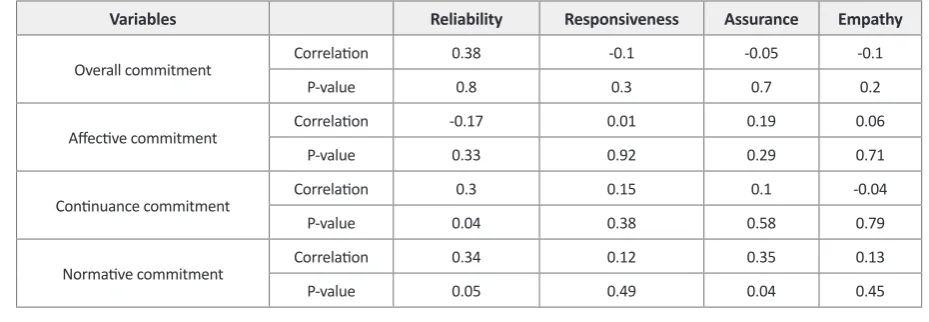
were females and 30% males; 14% had diploma with distinction, 81% BS, and 5% MS in nursing (Table 1). The means of nurses’ organizational commitment was estimated as moderate (X=3.2±0.26) and service quality to patients estimated as relatively good (X=3.5±0.2T2) (Table 2). Our findings indicated a positive and signifi-cant relationship between continuance commitments (P=0.04, r=0.3); normative commitment and reliability of service quality (P=0.05, r=0.34); normative commit-ment and assurance of service quality (P=0.04, r=0.35); and normative commitment and service quality (P=0.03, r=0.33) (Table 3).
4. Discussion
Our findings indicated that organizational commitment among hospital nurses was at moderate level. With re-spect to organizational commitment components, affec-tive and continuance commitments scored moderately, and normative commitment scored poorly, while affec-tive commitment was at the highest level and normaaffec-tive commitment at the lowest level. These results were con-sistent with the findings of Janmar and Ferreira (2007) study carried out in 6 hospitals in Portugal, in which they found the nurses’ organizational commitment at moderate levels. Poor and moderate organizational com-mitments were attributed to the lack of esprit de corps (common bond) among personnel (Maheshvari, Bhat, & Saha 2005). Different degrees of commitment depend on personal and occupational characteristics of the employ-ees (Shengwen 2007). Working with Isfahan’s Education
Department staff, Rahimpour (2004) found organization-al commitment level above average and relatively good.
Mozaffari (2001) reported teachers and school princi-pals’ organizational commitment at moderate levels, and Raschidpour (2001), working on Iranian Audit Organiza-tion, concluded good levels for all components of com-mitment except for continuance comcom-mitment, indicating more occupational alternatives for auditors. Maheshvari found lower levels of organizational commitment among general practitioners, but higher occupational commit-ment, which could be due to lack of team work and their individualistic orientations (Maheshvari, Bhat, & Saha 2005). Sheng Wen (2007) believed that individuals with different occupational and personality characteristics ex-hibit different levels of organizational commitment, evi-dent in the similarities and differences of organizational commitment in different studies (Shengwen 2007).
The present study found high levels of service qual-ity, in which the reliability and empathy components got the highest scores and responsiveness the lowest score. These findings are consistent with the findings of Nouri-hekmat (2006), who examined the service quality in Ra-soul-e-Akram Hospital, in which the reliability got the highest score. Our results were also consistent with those of Shahin (2003) and Lau et al. (2005) who recorded the lowest score for responsiveness.
Other results indicated a positive relationship between normative commitment and overall service quality, re-liability, and assurance, and also between continuance Table 1. Demographic characteristics of participant nurses.
Nurses demographic indexes No. Percent
Gender Female 106 70
Male 43 30
Education
Diploma with distinction 20 14
BS 117 81
MS 12 5
Client-CenteredNursingCare
Table 2. Mean, maximum, minimum, and standard deviation of all components of nurses’ organizational commitment.
Variables Mean Max Min SD
Overall commitment 3.02 3.5 2.4 0.2
Affective commitment 3.3 4.1 2.9 0.3
Continuance commitment 3.1 3.5 2.9 0.1
Normative commitment 2.7 2.8 2.6 0.1
commitment and reliability of the service quality which are consistent with Wang’s (2006) findings on a research in Taichang local hospitals in Taiwan. Since normative commitment restricts organizational mobility (Chang 2007), the more employees adjust to serving values, or-ganizational missions, and culture objectives, the less they incline to leave the organization (Wang 2006).
Similarly, organizational and leaders’ supports improve commitment (Lee & Fecci 2007); however, satisfaction with payments accompanied with no occupational alter-natives weakens organizational commitment (Vander-berg 2008). As Tella (2007) acknowledged, a reverse relationship exists between motivation and organiza-tional commitment. Presumably, employees with higher motivations and occupational dynamism enjoye higher levels of innovation, which is one of positive outcomes of lower commitment by the employees (Randel 1995). Thus, lower or even moderate levels of commitment would not be a disturbing factor and might arise from positive occupational factors such as motivation. How-ever in service jobs, commitment would impede perfor-mance and all services in the system because employees are in provider-user paradigm.
Regarding the relationship between continuance com-mitment and reliability and findings of Mehmandoust (2004) study in Pasteur Institute of Iran, there is a posi-tive relationship between continuance commitment and performance. Bandari (2005) in a study on Islamic Re-public of Iran Broadcasting personnel showed a direct link between continuance commitment and efficiency of the staff which was contrary to findings of Amini (2004) who found no relationship between these two variables. Omidvar (2002) found a relationship between affective commitment and performance, but nothing from
con-tinuance commitment or normative commitment. Owen (2006) also indicated that continuance commitment was negatively related to leaving the organization (Evans 2005). Stephanie and Huffman (2005) found a positive relationship between counseling and continuance com-mitment, which is indicative of the important role of participation in decision-making and morally improving continuance commitment (Stephaniue & Huffman 2005).
Walter (2006) proved the effect of performance on continuance commitment and Sharif (2006) found that continuance commitment would increase through im-proving skills and providing material recompenses (Vanderberg 2008). Based on the above research, orga-nizations could improve continuance commitment and consequently decrease the number of leaves and re-placements, and increase the staff effectiveness through giving their staff the opportunity for participation in decision-making and improving their jobs horizontally and vertically. Regarding the positive link between nor-mative commitment and service quality and the results of Sadeqi (2004) study, indicative of a positive relation-ship between normative commitment and performance among high school teachers, and also findings of Seggie and Achill’s (2006) study demonstrating a positive link between management’s commitment to service quality and performance, we conclude that organizational com-mitment plays a modifying role. In contrast, Siratdoust (2004) found no relationship between normative com-mitment and performance.
Chang (2006) showed that there was a strong nega-tive relationship between normanega-tive commitment and organizational leave, i.e. the more staff identifies with the organizational missions, visions, and objectives, the less they ask for leaving and replacing within the or-Table 3. Coefficient correlations of overall commitment, affective commitment, continuance commitment, normative commit-ment, with service quality components.
Variables Reliability Responsiveness Assurance Empathy
Overall commitment Correlation 0.38 -0.1 -0.05 -0.1
P-value 0.8 0.3 0.7 0.2
Affective commitment Correlation -0.17 0.01 0.19 0.06 P-value 0.33 0.92 0.29 0.71
Continuance commitment Correlation 0.3 0.15 0.1 -0.04 P-value 0.04 0.38 0.58 0.79
Normative commitment Correlation 0.34 0.12 0.35 0.13 P-value 0.05 0.49 0.04 0.45
ganization. According to Chang (2006), organizational leave plays an adjusting role against normative commit-ment, which causes replacement of staffs’ main field of activity (Chang et al. 2007). Thus, organizations should provide necessary conditions for improvement in nor-mative commitment among their employees to prevent such issues. Organizational support yields considerable impact on the improvement of organizational commit-ment as Lee and Fecci (2007) indicated a direct impact of organizational support on organizational commitment in a study on bank employees. Maertz et al. (2007) con-sidered organizational support in improvement of orga-nizational commitment as an effective measure.
Therefore, to improve the service quality in organiza-tions, organizational support variables play an indirect role, but among the positive occupational factors, mo-tivation inter alia, is negatively related to organizational commitment. According to Tella (2007), employees with higher motivation and occupational activity are more in-novative, which leads to lower employees’ commitment. Hence, lower or moderate commitment levels would not be much disturbing and might be due to positive factors as motivation, but in service jobs, this issue would im-pair service quality due to decrease in performance rate (Tella, 2007). Nazarian (2000) suggested that to improve organizational commitment, these organizations should provide better occupational and promotional opportuni-ties for their personnel and put the improvement of living quality in their agenda.
Taqavi (2004) divided effective factors on nurses’ performance into spiritual and material categories and showed that material category, especially job security wielded more impact on staff performance. Thus, given the positive and significant results of normative and con-tinuance commitment on service quality in hospitals, it is suggested that health organizations improve their nurses’ normative commitment through appreciating their occu-pational prestige in spiritual terms to consequently im-prove the care service quality. In doing so, we suggest constant evaluation of nurses’ performance and holding training sessions along with providing occupational pro-motions as well as avoiding the traps of organizational lethargic practices, and keeping the spirit of innovation.
Also, inculcating missions and organizational visions and values in a transparent way and internalizing them among employees through training and education would play an effective role in improving normative commit-ment and ultimately service quality. Since continuance commitment has been considered as one of the compo-nents related to service quality, it could be best improved
through job promotions, posing challenges against em-ployees via providing prospects of higher education, decreasing years of service in job groups, and a better promotion system.
Furthermore, holding training workshops of patient cares, patient safety, and especially emphasis upon post-hospitalization care to improve responsiveness and reli-ability have considerable effects. Psychological training sessions on nurse-patient relations to assure service qual-ity and creating empathy between nurses and patients would improve overall service quality too.
Conflict of interests
The authors declared no conflict of interest.
Acknowledgements
The authors appreciate management and nursing per-sonnel of Tehran Social Security hospitals who helped us in this research.
References
Allen, NJ & Meyer J 1996, ‘Affective, Continuance, Normative commitment to the organization: An examination of construct validity’, Vocational Behavior, vol. 49, no. 3, pp. 252-76. Allen, NJ & Meyer, JP 1990, ‘The measurement and antecedents
of affective, continuance and normative commitment to the organization’, Journal of Occupational Psychology, vol. 63, no. 1, pp. 1-18.
Amini, J 2004,[‘Correlative survey between organizational com-mitment and personals performance in Ministry of Country, Iran’ (Persian)] MSc. thesis, Science and Research Branch, Is-lamic Azad university.
Armestrang, J 1998, [‘Organizational commitment’ (Persian)], in MR Rabiei(trans.), Culture and Cooperation, vol. 6, pp. 46-48. Badri, MA, Abdulla, M & Al-Madani, A 2005, ‘Information
tech-nology center service quality: Assessment and application of SERVQUAL’, International Journal of Quality & Reliability Man-agement, vol. 22, no. 8, pp. 819-848.
Bandari, M 2005, [‘The relationship between Organizational commitment and effectiveness among management in politi-cal unit in Islamic republic of Iran broadcasting organization (Persian)]’ MSc. thesis, Central Tehran Branch, Islamic Azad University.
Chang, Y 2007, ‘Testing the relationship between three-compo-nent of organizational occupational commitment and organi-zational occupational turnover intention using a none-recur-sive model’, Vocational Behavior, vol. 70, no. 2, pp. 352-368. Curry, A & Sinclair, E 2002, ‘Assessing the quality of
physiother-apy services using servqual’, Health care Quality Assurance’, vol. 15, no. 5, pp. 197-205.
Evans, D 2006, ‘How social marketing works in health care’,
BMJ, vol. 10, no. 7551, pp. 227-332.
Janmar, F & Ferreira, M 2007, ‘Nurses organizational commit-ment: The Discounting power of Gender’, Nursing Administra-tion, vol. 31, no. 1, pp. 61-73.
Khaki, Q 1997, [‘The role of organizational behavior in produc-tivity’ (Persian)], Research Letter, vol. 5, no. 2, pp. 195-198. Lau, P & Khatibi, A 2005, ‘Service quality: A study of Luxury
hotels in Malaysia’, American Academy of Business, vol. 2, no. 2, pp. 10-46.
Lee, J & Fecci, R 2007, ‘Perceived organizational support & affec-tive commitment: The mediating role of organization-based-self-esteem in the context of job insecurity’, Organizational Be-havior, vol. 28, no. 6, pp. 661.
Maertz, C & Griffeth, R 2007, ‘The effects of perceived organiza-tional support and perceived supervision support on employ-ee turn-over’, Organizational Behavior, vol. 28, no. 8, pp. 1059. Maheshvari, S & Bhat, R 2005, ‘Directions for Reforms in the
Health Sector, Lesson from a State in India’, Health and Devel-opment Research, vol. 1, no. 283, pp. 33-51.
Mehmandoust, D 2004, [The survey of relationship between Organi-zational commitment and personals performance in Iran pastor in-stitute (Persian)], Iran Administration and Planning Organiza-tion PublicaOrganiza-tion, Tehran.
Moshabaki, A 1997, [‘The relationship between job Conscience with official revolution’ (Persian)], Research Letter, vol. 5, no. 2, pp. 200-209.
Nazarian, B 2000, [Survey the approaches to rise organizational commitment among personals in Electrical Distribution Com-pany (Persian)] MSc. thesis, Khorasgan Branch, Islamic Azad University.
Nourihekmat, S 2006, [To making Service quality gap model (servqual) in Rasoule Akram hospital (Persian)] MSc. thesis, Iran medical science university.
Ofasuc, A 1997, ‘Continuing education: Are conference and workshop the link for hospital employed?’, Nurse Student, vol. 35, no. 12, pp. 72-75.
Omidvar, S 2002, [‘The relationship between organizational commitment and principals Performance in Bandar Abbas Schools’ (Persian)] MSc. thesis, State management training center.
Park, J 2002, [Principleof health services: Hand book of preventive and social medicine (Persian)], in H Shojaei Tehrani (trans.), Samat Publication, Tehran.
Rahimpour Ataabadi, M 2009, [‘The survey of relationship be-tween position clarity and carrier commitment among Edu-cating and Breeding staffs of Isfahan’ (Persian)], MSc. thesis, Khorasgan Branch, Islamic Azad University.
Randel, DM 1995, [Organization commitment: This attitude to hu-man organization (Persian)], in E Farajvand (trans.), Zamine Publication, Tehran.
Sadeghi, M 2004, [‘The relationship between organizational commitment and female principals effectiveness in Tehran high schools’ (Persian)] MSc. thesis, Central Tehran Branch, Islamic Azad University.
Shahin, A & Amery, G 2003, ‘The role of servqual model in measurement of services quality gaps and comparison with foreign sample’, Official Revolution, vol. 71, no. 47, pp. 52-66. Seggie, S & Achill, N 2006, ‘Does management commitment to
service quality impact on frontline employees affective and performance outcomes’, Viewed 5 May 2008, http://www. Proques.com/ science/journal/02779536.
Shengwen, L 2007, ‘Personal characteristics, job characteristics, job satisfaction and organizational commitment of Taiwanese expatriates working in mainland china’ PhD thesis, Lynn Uni-versity.
Steers, R 1977, ‘Antecedents and outcomes of organizational commitment’, Administrative Science Quarterly, vol. 22, pp. 47-56.
Stephaniue, C & Huffman, A 2005, ‘A longitudinal examination of the influence of management’, Management, vol. 48, no. 1, pp. 58-69.
Taqavi, S 2004, [‘Nurses attitude about Impact of Quality Work Life on their performance in imam Khomeini Hospital’ (Per-sian)] MSc. thesis, Central Tehran Branch, Islamic Azad Uni-versity.
Tella, A 2007, ‘Work Motivation, Job satisfaction and Organi-zational commitment of Library personnel in Academic and research librarian in Oyo State Nigeria’, Library Philosophy and Practice, vol. 9, no. 2, p. 13.
Vanderberg, C & Terembty, M 2008, ‘The role of pay satisfac-tion & organizasatisfac-tional commitment in turn-over intensatisfac-tion: A tow-sample study’, Behavior and Psychology, vol. 22, no. 3, pp. 275-287.
Tamosaitis, WL 2006, ‘The Relationship Between Employee Performance Ratings and the Three Components of Organiza-tional Commitment for Technical Personnel in a Project Envi-ronment’ PhD thesis, The University Alabama in Huntsville.