An Improved Imperialist Competitive Algorithm
Based on a New Assimilation Strategy
Seyed Mojtaba Saif 1
Received (2015-08-05) Accepted (2016-03-16)
Abstract — Meta-heuristic algorithms inspired by the natural processes are part of the optimization algorithms that they have been considered in recent years, such as genetic algorithm, particle swarm optimization, ant colony optimization, firefly algorithm. Recently, a new kind of evolutionary algorithm has been proposed that it is inspired by the human evolution process. This new algorithm has been called Imperialist Competitive Algorithm (ICA). The ICA is a population-based algorithm where the population is represented by countries that are classified as colonies or imperialists. This paper is going to present a modified ICA with high accuracy, referred to here as ICA2. The ICA2 is tested with six well-known benchmark functions. Results show high accuracy and avoidance of local optimum traps to reach the minimum global optimal.
Two main operators of the ICA are Assimilation and Revolution. Assimilation policy is the more important than Revolution. This research focuses on an assimilation policy in the ICA to propose a meta-heuristic optimization algorithm for optimizing function with high accuracy and avoiding to trap in local optima rather than using original ICA.
Index Terms — evolutionary algorithm, optimization algorithm, imperialist competitive algorithm, assimilation policy.
I.INTRODUCTION
F
IND the optimal solution is a major challengein many scientific problems. The heuristic
algorithms have widely been used to reach
global optimum of different problems. Genetic Algorithm (GA) [2], Particle Swarm Optimization (PSO) [3], Ant Colony Optimization (ACO) [4], Differential Evolution (DE) [5], Gravitation Algorithm (GA) [6] and Firfly Algorithm [7] are some familiar meta-heuristic studies. Recently,
inspired by a socio-politically motivated, a meta-heuristic algorithm called Imperialist competitive
algorithm (ICA) is proposed by Atashpaz and Lucas [8]. The ICA is a multi-agent algorithm with each agent being a country [9]. In ICA, the
countries divided into two groups based on their
power, colonies and imperialists [8]. But these
algorithms have defects to deal with the local
optimum trap and the accuracy rate [1]. The local
optimum trap is an important shortcoming in
optimization. A local optimum is a solution that is optimal within a neighboring set of solutions.
This is in contrast to a global optimum, which is the optimal solution among all possible solutions
that may occur under different situations [10]. ICA is much more successful than other optimization methods to eradicate these problems [8, 9, and 10]. It has been used to solve different kinds of problems, such as PID controller design [11], initial and boundary-value problems [12] , a new hybrid data-clustering algorithm [13 ,14], economic problems [15,16,17] and many engineering problems [1,9,18,19,20].
The motivation of this study is to present a
meta-heuristic algorithm for optimizing with
high accuracy and avoiding to trap in local optima, based on the ICA, because of, ICA has
successful application in various fields and good
1- Department of Computer Engineering, Islamic
performance in comparison to other optimization methods [11]. Various attempts have been made to improve the ICA, include modifications in ICA [10,24,25,26,27] and a hybrid with local search or other optimization techniques [28,29,30,31,32,33].
This study focuses on the assimilation policy because the movement of colonies toward their
imperialist has the biggest influence of them all [24]. ICA2 with a new adaptive assimilation strategy avoids from trap of local optimum.
Organization of the paper is in order. Section
2 provides a precise description of the basic
ICA and reviews the developments on the ICA. Section 3 presents the proposed algorithm.
Experimental setup and results are discussed
in Section 4. Section 5 includes summary and conclusion.
II. IMPERIALIST COMPETITIVE ALGORITHM
ICA simulates the social political process of
imperialism and imperialistic competition. This
algorithm contains a population of agents or
countries. The Steps of algorithm are described as below [8].
1. Initializing
ICA starts with an initial population of randomly generated solutions {p1, p2, …, pN}, where each solution pi is called country and is
a 1×n array of variables to be optimized, and N denotes the number of countries. ICA computes the cost of each pi as Ci. Then sort ascending the initial population based on cost values. The most
powerful countries are selected as imperialists
(equation 1), and the others are divided among
imperialists, based on the power of each
imperialist (equation 2 ) . That is,
𝑃𝑃𝑃𝑃𝑃𝑃𝑃𝑃𝑃𝑃𝑃𝑃𝑖𝑖𝑖𝑖 = � max1≤𝑗𝑗𝑗𝑗≤𝑁𝑁𝑁𝑁
𝑖𝑖𝑖𝑖𝑖𝑖𝑖𝑖𝑖𝑖𝑖𝑖{𝐶𝐶𝐶𝐶𝑗𝑗𝑗𝑗}� − 𝐶𝐶𝐶𝐶𝑖𝑖𝑖𝑖 (1)
𝑁𝑁𝑁𝑁𝑁𝑁𝑁𝑁𝑖𝑖𝑖𝑖=𝑟𝑟𝑟𝑟𝑟𝑟𝑟𝑟𝑟𝑟𝑟𝑟𝑟𝑟𝑟𝑟𝑟𝑟𝑟𝑟(� 𝑃𝑃𝑃𝑃𝑃𝑃𝑃𝑃𝑃𝑃𝑃𝑃𝑖𝑖𝑖𝑖
∑𝑁𝑁𝑁𝑁𝑗𝑗𝑗𝑗=1𝑖𝑖𝑖𝑖𝑖𝑖𝑖𝑖𝑖𝑖𝑖𝑖 𝑃𝑃𝑃𝑃𝑃𝑃𝑃𝑃𝑃𝑃𝑃𝑃𝑗𝑗𝑗𝑗
�× [𝑁𝑁𝑁𝑁 − 𝑁𝑁𝑁𝑁𝑖𝑖𝑖𝑖𝑖𝑖𝑖𝑖𝑖𝑖𝑖𝑖])
(2)
Where Ci is the cost of ith imperialist and POWi is the power of ith imperialist. Also, NCi denotes the number of colonies assigned to empire i ,
where and Nimp is a constant value.
2. Moving
Two main operators of this algorithm are
Assimilation and Revolution. In this step, the algorithm assimilates a solution with low-quality
or a country with low power to a country with high power or the algorithm assimilates colonies
toward relevant imperialists. Each country is assumed to be a point in the search space.
Assimilation within an empire is achieved by moving all colonies toward their imperialist by
δ units (equation 3). The distance of such an
assimilation move is a random variable with
uniform distribution [8]:
𝛿𝛿𝛿𝛿~𝑈𝑈𝑈𝑈(0,𝛽𝛽𝛽𝛽×𝑑𝑑𝑑𝑑) (3)
Here, the d is the Euclidean distance between
imperialist and colony, and β is a parameter of ICA called assimilation coefficient. The value of β is in the half-closed interval (1, 2], and 2 is recommended. In addition to assimilation, the
revolution was used to change the position of
the colonies. Revolution is sudden changes in the position of some of the countries. According
to this strategy, a random amount of deviation
is in the direction of movement. The direction
of the assimilation move is the direction from
imperialist to colony plus a random variable θ ~ U(-γ , γ), where γ is a parameter of ICA, called revolution coefficient. The suggested value for γ is ∏/4 [22].
After moving a colony to a new position, its
cost is recomputed. If the cost of the colony is
smaller than the cost of the imperialist, exchange
colonies and their imperialist. A colony may
reach a position with lower cost than that of the
imperialist while moving toward the imperialist.
3. Imperialistic competition
Next, the cost (denoted by Qi) and the power
(denoted by Ei) of each empire are calculated. It is influenced by the power of imperialist country
(denoted by ci) and the colonies of an empire
(See equations 4 and 5) [8].
𝑄𝑄𝑄𝑄𝑖𝑖𝑖𝑖 =𝑐𝑐𝑐𝑐𝑖𝑖𝑖𝑖+𝜉𝜉𝜉𝜉𝑚𝑚𝑚𝑚𝑚𝑚𝑚𝑚𝑚𝑚𝑚𝑚𝑚𝑚𝑚𝑚 {𝑐𝑐𝑐𝑐𝑐𝑐𝑐𝑐𝑐𝑐𝑐𝑐𝑐𝑐𝑐𝑐(𝑐𝑐𝑐𝑐𝑐𝑐𝑐𝑐𝑐𝑐𝑐𝑐𝑐𝑐𝑐𝑐𝑚𝑚𝑚𝑚𝑖𝑖𝑖𝑖𝑚𝑚𝑚𝑚𝑐𝑐𝑐𝑐𝑐𝑐𝑐𝑐𝑜𝑜𝑜𝑜𝑚𝑚𝑚𝑚𝑚𝑚𝑚𝑚𝑒𝑒𝑒𝑒𝑖𝑖𝑖𝑖𝑒𝑒𝑒𝑒𝑚𝑚𝑚𝑚𝑖𝑖𝑖𝑖)} (4)
𝐸𝐸𝐸𝐸𝑖𝑖𝑖𝑖=�1≤𝑗𝑗𝑗𝑗≤𝑁𝑁𝑁𝑁max
𝑖𝑖𝑖𝑖𝑖𝑖𝑖𝑖𝑖𝑖𝑖𝑖{𝑄𝑄𝑄𝑄𝑗𝑗𝑗𝑗}� − 𝑄𝑄𝑄𝑄𝑖𝑖𝑖𝑖 (5)
Competition among all empires is achieved by taking the weakest colony away from the weakest empire and giving it to a chosen empire, where the probability of empire being chosen is
� max𝐸𝐸𝐸𝐸𝑖𝑖𝑖𝑖
1≤𝑗𝑗𝑗𝑗≤𝑁𝑁𝑁𝑁𝑖𝑖𝑖𝑖𝑖𝑖𝑖𝑖𝑖𝑖𝑖𝑖 𝐸𝐸𝐸𝐸𝑗𝑗𝑗𝑗
� [8] .
When an empire loses all its colonies, it is
assumed to be collapsed and will be eliminated.
At the end, the colonies will be under the control
of the most powerful empire.
The steps of implementing ICA are shown in
fig1 [8].
Figure 1 : Imperialist Competitive Algorithm [8]
III. REVIEWS THE DEVELOPMENTS ON THE ALGORITHMIC RESEARCH WITH
ICAS
In ICA, two operators are called assimilation and revolution, and one strategy called imperialistic competition are the main building
blocks [23], which are responsible to lead the search for a better solution. The movement of
colonies toward their imperialist has the biggest
influence of them all, since it occurs for all the
colonies during all the iterations, whereas the revolution happens with a low probability and the
imperialistic competition affects only one colony per iteration [24]. For this reason, researchers
have focused on the improving the assimilation
policy for improve ICA. There are several studies for improve ICA by modify assimilation [10, 24, 25, 26, 27]. Also, researchers have presented
several hybrid approaches consisting ICA and other algorithms for improve the performance of
ICA [28, 29, 30, 31].
Esmaeilzadeh [10] proposes a new
assimilation strategy based on this fact, which the imperialists also need to model, and they move
toward top imperialist state. In the modified ICA by Esmaeilzadeh, which referred to here as
ESICA, the imperialists assimilate toward the
best imperialist, and this movement affects all colony movements.
An improvement in the ICA by implementing an attraction and repulsion concept during the search for better solutions, the AR-ICA approach
is proposed in [24]. A concept of attraction
and repulsion is introduced to overcome the
premature convergence problem. This problem
is caused when the algorithm gets trapped in a
local optimum. In this method the algorithm
switches between the attraction and repulsion phase according to a threshold value for the
population diversity. The diversity guided
can be implemented in the ICA by varying the
assimilation coefficient according to the distance between the colony and its imperialist [24]. If the movement equation is reformed by
𝑃𝑃𝑃𝑃𝑃𝑃𝑃𝑃𝑃𝑃𝑃𝑃𝑖𝑖𝑖𝑖+1 =𝑃𝑃𝑃𝑃𝑃𝑃𝑃𝑃𝑃𝑃𝑃𝑃𝑖𝑖𝑖𝑖+𝐴𝐴𝐴𝐴.𝛿𝛿𝛿𝛿 (7)
𝐴𝐴𝐴𝐴=𝛾𝛾𝛾𝛾.𝑑𝑑𝑑𝑑 (8)
Where A determines the boundaries of the region, the next colony position can take place
Posi is the vector of the colonyies’ position on the ith iteration, δ is a random number normally distributed between [0, 1], and d is vector
containing the variables distance between the
colony and its imperialist. Then the diversity
guided adapted for the ICA is given by the
equation 10
𝛾𝛾𝛾𝛾=�𝛾𝛾𝛾𝛾2 𝑑𝑑𝑑𝑑>𝑑𝑑𝑑𝑑𝑑𝑑𝑑𝑑𝑑𝑑𝑑𝑑𝑑𝑑𝑑𝑑
Here, ddiv is the distance threshold value, and
γdiv is the number greater than 2.
The normal distributed assimilation is another improvement in the ICA for to control convergence rate of the ICA, and to overcome being trapped
in a local optima problem [25]. According to this strategy, the movement equation is
𝑃𝑃𝑃𝑃𝑃𝑃𝑃𝑃𝑃𝑃𝑃𝑃𝑖𝑖𝑖𝑖+1 =𝑃𝑃𝑃𝑃𝑃𝑃𝑃𝑃𝑃𝑃𝑃𝑃𝑖𝑖𝑖𝑖𝑖𝑖𝑖𝑖𝑖𝑖𝑖𝑖,𝑖𝑖𝑖𝑖+𝛿𝛿𝛿𝛿 (11)
Where Posimp,i is the vector of the imperialist’s
position on the ith iteration, δ denotes the amount
of movement chosen from a normal distribution
between [0,d]. To divert the search to less
explored regions, colonies are allowed to move
in their self-neighbors instead of the imperialist’s neighbor with a small probability [25]. It means
that the position of a colony is updated as 𝑃𝑃𝑃𝑃𝑃𝑃𝑃𝑃𝑃𝑃𝑃𝑃𝑖𝑖𝑖𝑖+1 =𝑃𝑃𝑃𝑃𝑃𝑃𝑃𝑃𝑃𝑃𝑃𝑃𝑖𝑖𝑖𝑖𝑖𝑖𝑖𝑖𝑖𝑖𝑖𝑖,𝑖𝑖𝑖𝑖+𝛿𝛿𝛿𝛿 .
In addition, the normal distributed assimilation, adaptive assimilation is presented
in [25]. In this strategy, an adaptive controller
based on the progress history was used in the
assimilation function. The movement vector
should be increased if the success rate is high, and it should be decreased if the success rate is
low. The success rate means that the proportion of colonies reached a better position [25]. The
ICA with adaptive assimilation called here as
Adapt_ICA.
The chaotic sequences can be used in
an assimilation function instead of random
sequences [26].
The Different types of the crossover operations
of genetic algorithm are used as an assimilation
policy for the improvement in the ICA [27, 31].
IV. THE PROPOSED APPROACH As mentioned in the previous section, there are three processes in the ICA, and the most important of them is the movement of colonies
toward their imperialist. The ICA performance can be improved significantly by modification in the assimilation process.
ES_ICA [10] proposes an assimilation strategy based on two assimilation types. The empire
movements are toward the best imperialist, and the colonies movements toward their imperialist
are assimilation types in the ES_ICA. A
pseudo-code for the ES_ICA algorithm is shown in
algorithm 1.
ICA2 can avoid the local optimum trap by
manipulations diversity. If the colony is near
its imperialist (the diversity is low), the colony is repelled by making a better exploration of the search space; if the colony is far from, its imperialist (the diversity is high), the colonies are
attracted to each other. Repellency and attraction
colonies can be implemented by varying the
assimilation coefficient. If the assimilation coefficient increases, a possibility for the colony to move away from the imperialist is created. By decreasing the assimilation coefficient, the
chance the colony diverges from the imperialist
will also decrease.
The probability of finding the optimal solution is higher in being close to the empire’s positions. The empires are local optimal solutions. When the
colonies are closer to its empire, the search must
be done carefully. Moreover, the search should
avoid the local optimum trap by preventing premature convergence through increased
diversity [25].
ICA2 defines a new assimilation policy based
on ES_ICA assimilation strategy and AR_ICA
assimilation strategy. In the ICA2, the moving step has been modified and improved by the empire’s movements toward the best imperialist and the colonies’ movements toward their imperialist. ICA2 will control colonies diversity adaptively (See algorithm 2). In the ICA2, the following equations represent the new position of a colony:
𝑋𝑋𝑋𝑋𝑛𝑛𝑛𝑛𝑛𝑛𝑛𝑛𝑛𝑛𝑛𝑛1=𝑋𝑋𝑋𝑋𝑜𝑜𝑜𝑜𝑜𝑜𝑜𝑜𝑜𝑜𝑜𝑜 +𝛽𝛽𝛽𝛽×𝑜𝑜𝑜𝑜1 (12)
𝑋𝑋𝑋𝑋𝑛𝑛𝑛𝑛𝑛𝑛𝑛𝑛𝑛𝑛𝑛𝑛2=𝑋𝑋𝑋𝑋𝑛𝑛𝑛𝑛𝑛𝑛𝑛𝑛𝑛𝑛𝑛𝑛1+𝛽𝛽𝛽𝛽×𝑑𝑑𝑑𝑑2 (13)
Where d1 is the vector with the distances between the colony and the imperialist and d2 is the distance vector between the colony and the
best imperialist. Xold is old position of colony
and Xnew2 is the colony final position .The β is
a parameter for adjusting the momentum and modifying the area that colonies randomly search
In algorithm 2, The γ is a constant value and The β is equal 2 when the distance between the
colonies to its empire is more than threshold, and if the distance between the colonies to its empire is less than threshold, to increase the diversity and prevent premature convergence, at 20
percent of the colonies the β value is increasing.
The area that colonies randomly search around its
imperialist expands if the β increases.
The ICA2 is presented if the algorithm 2
inserts at line 11 of the algorithm 1.
Algorithm 2 Assimilate of colonies
11.1 if(the distance between the colonies to its empire is more than threshold)
11.2 β=2;
11.3 else
11.4 Generate a pseudorandom scalar drawn from the standard uniform distribution on the open interval (0, 1), and assign it to P.
11.5 if(P>0.9)
11.6 β=2*γ;
11.7 else if(P>0.8)
11.8 β=γ;
11.9 else
11.10 β=2;
11.11 end
11.12 end
11.13 end
V. EXPERIMENTS AND RESULTS
Performance of ICA2 has been compared with
the following ICA-variant on a set of 6 numerical
benchmarks: the original ICA [8], the modified ICA by Esmaeilzadeh (ES_ICA) [10], the
AR-ICA [24], and the AR-ICA with adaptive assimilation (Adapt_ICA) [25].
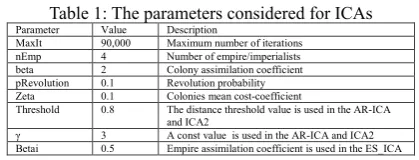
The parametric settings of the contestant
algorithms are summarized in Table 1.
Table 1: The parameters considered for ICAs
Parameter Value Description
MaxIt 90,000 Maximum number of iterations
nEmp 4 Number of empire/imperialists
beta 2 Colony assimilation coefficient
pRevolution 0.1 Revolution probability
Zeta 0.1 Colonies mean cost-coefficient
Threshold 0.8 The distance threshold value is used in the AR-ICA
and ICA2
γ 3 A const value is used in the AR-ICA and ICA2
Betai 0.5 Empire assimilation coefficient is used in the ES_ICA
The proposed ICA has been tested on 6
benchmark functions [34, 35] which were also
used for validating the well-known ICA variants
such as AR_ICA. All the benchmark functions (f1-f6) used in this study are minimization problems. f1– f4 are continuous unimodal functions, and f5-f6 are multimodal functions. The list of benchmark functions are summarized
in the Table 2 that the global optimal, the global minimum value (fmin), and the search range are shown in two, three, and four columns,
respectively, according to the definitions in [35].
All result tables report the average best cost of the objective function over 10 independent runs
for each algorithm. The termination condition
for the each run of an algorithm was to reach
90,000 iterations. The number of dimensions was 30 for all benchmark functions. The Wilcoxon
rank sum test was used for comparisons of the
Algorithm 1 Modify Imperialist Competitive Algorithm [10]
1 The empire allocated
2 Whileyou do not reach to a given number of repetitions in the problem do
3 Forall imperialists except best imperialist do
4 Ifimperialists gain a better position than before, then
5 Imperialists assimilate to the best imperialist with a moderate tune;
6 end
7 end
8 Forall empires do
9 Forall colonies belong to empire do
10 Assimilate colonies toward relevant imperialist with a predefined degree;
11 Assimilate colonies toward top imperialist with a predefined degree;
12 Revolve colonies;
13 end
14 Update colonies;
15 Forall colonies belong to empire do
16 Ifa colony gains a better position than its imperialist then
17 Exchange the imperialist and the best colony;
18 end
19 end
20 end
21 Imperialistic competition;
22 Display results;
results obtained with the ICA2 algorithm and
how they differed from the final results the other competitors in a statistically significant way. It is a nonparametric statistical test for two populations when samples are independent [35, 36]. The significance level was 5%.
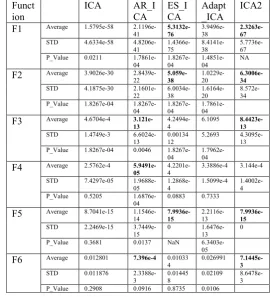
Table 3 shows the average value of the results obtained with the performing algorithm achieved from 10 independent runs for each algorithm and p-values computed for all the pairwise
comparisons concerning ICA2. To make the
comparison fair enough, all the ICA-variants
were made to run with the parameter summarized in Table 1. In Table 3, the P-values obtained from the Wilcoxons test indicate that the difference of
the mean values obtained with ICA2 and other
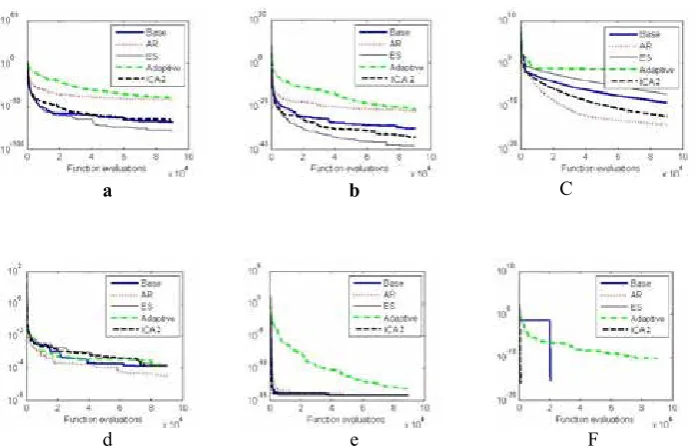
algorithms are statistically significant in most experiments. Convergence characteristics of
ICA2 along with other peer ICA-variants are
shown in Fig 2.
As evident from the Table 2, ICA2 version has outperformed most of the contender ICA
algorithms on all of the functions. ES_ICA
appears to be the best in simple unimodal functions (f1, f2) and the multimodal function
f5 where AR_ICA offers exceptionally good results for functions f3, f4, and f6. But ICA2 has performed almost equally well in all of the functions. ICA2 has achieved second rank for all function. Other ICAs are good only for some functions.
Functions f1 to f4 are continuous unimodal where the ICA2 won two ranks among all ICAs.
The f3 is the Rosenbrock functions which is unimodal for D = 2 and 3, but with an increase in complexity of the problem, a problem may
become multimodal in high dimensions [37].
The results evidently support that ICA2 can
show significantly improved performances in multimodal functions f5-f6. High-quality
mean solutions were obtained by ICA2 in the
Schewefels function (f5). ICA2 offered superior
performance among all ICAs except AR_ICA for
the Griewank function (f6).
In addition to the ICAs discussed earlier, ICA2 has also been compared with four other methods
of optimization algorithms having varied origins.
These algorithms include Fast Evolutionary
Programming (FEP) with Cauchy mutation [34], Particle Swarm Optimizer with Difference Means based on Perturbation (DMP-PSO) [35], adaptive Differential Evolution (JADE) with optional external archive [37], and Improved Artificial
Bee Colony algorithm for global optimization [38]. ICA2 manages to yield very competitive
results against some of these algorithms on most
of the test cases reported. Table 4 lists the results. The results of JADE, DMP-POS, FEP, and IABC are all quoted directly from [34, 35, 36, 37, and 38] directly.
VI. CONCLUSION
This paper proposes a new meta-heuristic
optimization algorithm that is based on ICA. In
this study, the goal is to present a meta-heuristic
optimization algorithm with high accuracy and to avoid trapping in local optimal with modification of the assimilation policy of the ICA. The
proposed assimilation provides the necessary
trade-off between exploitation and exploration to
detect the minimum global optima of unimodal and multimodal functional landscapes with
considerable accuracy. The performance of the
proposed approach is compared to various ICAs and other well-known meta-heuristics using
benchmark functions. Experiments are conducted to confirm the ability of the proposed algorithm.
ACKNOWLEDGMENT
This work was supported by the Safashahr
Table 2 Six benchmark functions used to test ICA2
Type Function Search
range Global Opt. fmin Name
Unimodal
𝑓𝑓𝑓𝑓1=� 𝑥𝑥𝑥𝑥𝑖𝑖𝑖𝑖2
𝐷𝐷𝐷𝐷
𝑖𝑖𝑖𝑖=1
[
-100,100]D [0]
D 0 Sphere
Unimodal
𝑓𝑓𝑓𝑓2=�|𝑥𝑥𝑥𝑥𝑖𝑖𝑖𝑖| +�|𝑥𝑥𝑥𝑥𝑖𝑖𝑖𝑖|
𝐷𝐷𝐷𝐷
𝑖𝑖𝑖𝑖=1
𝐷𝐷𝐷𝐷
𝑖𝑖𝑖𝑖=1
[-10,10]D [0]D 0 SchwefelsP2
.22
Unimodal
𝑓𝑓𝑓𝑓3=�[100(𝑥𝑥𝑥𝑥𝑖𝑖𝑖𝑖+1− 𝑥𝑥𝑥𝑥𝑖𝑖𝑖𝑖2)2+ (𝑥𝑥𝑥𝑥𝑖𝑖𝑖𝑖−1)2]
𝐷𝐷𝐷𝐷−1
𝑖𝑖𝑖𝑖=1
[-10,10]D [1]D 0 Rosenbrock
Unimodal
𝑓𝑓𝑓𝑓4=� 𝑖𝑖𝑖𝑖.𝑥𝑥𝑥𝑥𝑖𝑖𝑖𝑖4
𝐷𝐷𝐷𝐷
𝑖𝑖𝑖𝑖=1
+𝑟𝑟𝑟𝑟𝑟𝑟𝑟𝑟𝑟𝑟𝑟𝑟𝑟𝑟𝑟𝑟[0,1) [1.28,1.28]
-D
[0]D 0 Noise
Multimoda l
𝑓𝑓𝑓𝑓5=−20 exp ⎝
⎛−0.2�1� � 𝑥𝑥𝑥𝑥𝐷𝐷𝐷𝐷 𝑖𝑖𝑖𝑖2
𝐷𝐷𝐷𝐷
𝑖𝑖𝑖𝑖=1 ⎠
⎞
−exp�𝐷𝐷𝐷𝐷 � 𝑐𝑐𝑐𝑐𝑐𝑐𝑐𝑐𝑐𝑐𝑐𝑐1 (2𝜋𝜋𝜋𝜋𝑥𝑥𝑥𝑥𝑖𝑖𝑖𝑖)
𝐷𝐷𝐷𝐷
𝑖𝑖𝑖𝑖=1
�+ 20
+𝑒𝑒𝑒𝑒
[-32,32]D [0]D 0 Ackley
Multimoda
l 𝑓𝑓𝑓𝑓6=� 𝑥𝑥𝑥𝑥𝑖𝑖𝑖𝑖
2
4000− �cos�
𝑥𝑥𝑥𝑥𝑖𝑖𝑖𝑖
√𝑖𝑖𝑖𝑖�+ 1
𝐷𝐷𝐷𝐷
𝑖𝑖𝑖𝑖=1
𝐷𝐷𝐷𝐷
𝑖𝑖𝑖𝑖=1
[
-600,600]D [0]
D 0 Griewank
Table 3 Mean and standard deviation values obtained by ICA2 compared to those obtained with the other ICAs Funct
ion ICA AR_ICA ES_ICA Adapt_ICA ICA2
F1 Average 1.5795e-58 2.1196e
-41 5.3132e-76 3.9496e38 - 2.3263e-67
STD 4.6334e-58 4.8206e
-41 1.4366e75 - 8.4141e38 - 5.7736e67
-P_Value 0.0211 1.7861e
-04 1.8267e04 - 1.4851e04 - NA
F2 Average 3.9026e-30 2.8439e
-22 5.059e-38 1.0229e20 - 6.3006e-34
STD 4.1875e-30 2.1601e
-22 6.0034e38 - 1.6164e20 - 8.572e34 -P_Value 1.8267e-04 1.8267e
-04 1.8267e04 - 1.7861e04
-F3 Average 4.6704e-4
3.121e-13 4.2494e4 - 6.1095 8.4423e-13
STD 1.4749e-3 6.6024e
-13 0.0013412 5.2693 4.3095e13
-P_Value 1.8267e-04 0.0046 1.8267e
-04 1.7962e04
-F4 Average 2.5762e-4
5.9491e-05 4.2201e4 - 3.3886e-4 3.144e-4
STD 7.4297e-05 1.9688e
-05 1.2868e4 - 1.5099e-4 1.4002e4
-P_Value 0.5205 1.6876e
-04 0.0883 0.7333
F5 Average 8.7041e-15 1.1546e
-14 7.9936e-15 2.2116e13 - 7.9936e-15
STD 2.2469e-15 3.7449e
-15 0 1.6476e13 - 0
P_Value 0.3681 0.0137 NaN 6.3403e
-05
F6 Average 0.012801 7.396e-4 0.01033
4 0.026991 7.1445e-3
STD 0.011876 2.3388e
-3 0.014458 0.02109 8.6478e3
a b C
d e F
Fig 2: Sample convergence characteristics of the compared ICA-variant on six test function (a) f1 (b) f2 (c) f3 (d) f4 (e) f5 (f) f6
Table 4: Comparison of results obtained with ICA2 and five other evolutionary computation
algorithms
Function JADE(Zhang and Sanderson 2009)
mean (STD)
DMP-PSO (Kundu et al. 2014)
mean (STD)
FEP (Yao et al. 1999)
mean (STD) IABC (Gao and Liu 2011) mean (STD)
ICA2 mean (STD)
F1 1.3E-54 (9.2E-54) 2.78E-55 (5.64E-53) 5.7E04 (1.3E-04) 6.75e–57 (1.72e–56) 2.3263e-67 (5.7736e-67)
F2 3.9E-22 (2.7E-21) 8.96E-25 (3.30E-25) 8.1E-03 (7.7E-04) 6.47e–03 (9.25e–03) 6.3006e-34 (8.572e-34)
F3 3.2E-01 (1.1E00) 2.12E-06 (9.32E-06) 5.06E00 (5.87E00) 2.83e+02 (8.94e+01) 8.4423e-13 (4.3095e-13)
F4 6.8E-04 (2.5E-04) 1.41E-04 (2.46E-04) 7.6E-03 (2.6E-03) 9.53e–03 (2.45e–03) 3.144e-4 (1.4002e-4)
F5 4.4E-15 (0) 1.5E-14 (7.38E-15) 1.8E-02 (2.1E-03) 3.87e–14 (8.52e–15) 7.9936e-15 (0)
REFERENCES
[1] TALATAHARI, S., et al. Imperialist competitive algorithm combined with chaos for global optimization.
Communications in Nonlinear Science and Numerical
Simulation, 2012, 17(3): 1312-1319. doi:10.1016/j. cnsns.2011.08.021
[2] Holland, J. H. Adaptation in natural and artificial systems: An introductory analysis with applications to biology, control, and artificial intelligence. U Michigan Press. (1975).
[3] Kennedy, J., & Eberhart, R. Particle swarm optimization. In Proceedings of IEEE international conference on neural Networks, 1995, 4(2):.1942-1948.
[4] Dorigo, M., & Gambardella, L. M.. Ant colony system: a cooperative learning approach to the traveling salesman problem. Evolutionary Computation, IEEE Transactions on, 1997, 1(1): 53-66.
[5] Storn, R., & Price, K. Differential evolution-a simple and efficient adaptive scheme for global optimization over continuous spaces. Berkeley: ICSI, 1995.
[6] Webster, B., & Bernhard, P. J. A local search optimization algorithm based on natural principles of gravitation, 2003. http://hdl.handle.net/11141/117
[7] Yang, X. S. Firefly algorithms for multimodal optimization. In Stochastic algorithms: foundations and applications, Springer Berlin Heidelberg, 2009, (pp. 169-178). doi : 10.1007/978-3-642-04944-6_14
[8] Atashpaz-Gargari, E., & Lucas, C. Imperialist competitive algorithm: an algorithm for optimization inspired by imperialistic competition. In Evolutionary Computation, 2007. CEC 2007. IEEE Congress on, (2007, September), (pp. 4661-4667). IEEE. doi : 10.1109/ CEC.2007.4425083
[9] Kaveh, A. Advances in Metaheuristic Algorithms for Optimal Design of Structures. Springer International Pu. (2014),(page 349-355, ch 11) .doi: 10.1007/978-3-319-05549-7
[10] Esmaeilzadeh, M. (2013). A modified colonial competitive algorithm for optimizing convex functions.
International Journal of Intelligent Computing and
Cybernetics, 2013, 6(4):370-385. doi: 10.1108/
IJICC-02-2013-0006
[11] Atashpaz-Gargari, E., Hashemzadeh, F., & Lucas, C. Designing MIMO PID controller using colonial competitive algorithm: applied to distillation column process. In Evolutionary Computation, 2008. CEC 2008. (IEEE World Congress on Computational Intelligence). IEEE Congress on (2008, June),(pp. 1929-1934). IEEE. doi: 10.1109/CEC.2008.4631052
[12] Nemati, K., Shamsuddin, S. M., & Darus, M. An optimization technique based on imperialist competition
algorithm to measurement of error for solving initial and
boundary value problems. Measurement, (2014),48: 96-108. doi: 10.1016/j.measurement.2013.10.043
[13] Zarandi, M. H., Zarinbal, M., Ghanbari, N., & Turksen, I. B. A new fuzzy functions model tuned by hybridizing imperialist competitive algorithm and simulated annealing. Application: Stock price prediction.
Information Sciences, 2013,222, 213-228. Doi: 10.1016/j. ins.2012.08.002
[14] Niknam, T., Taherian Fard, E., Pourjafarian, N., & Rousta, A. An efficient hybrid algorithm based on modified imperialist competitive algorithm and K-means for data clustering. Engineering Applications of Artificial Intelligence, 2011,24(2): 306-317. doi: 10.1016/j. engappai.2010.10.001
[15] Kayvanfar, V., & Zandieh, M. The economic lot scheduling problem with deteriorating items and shortage: an imperialist competitive algorithm. The International
Journal of Advanced Manufacturing Technology, 2012,
62(5-8):759-773. doi: 10.1007/s00170-011-3820-6
[16] Karimi, N., Zandieh, M., & Najafi, A. A. Group scheduling in flexible flow shops: a hybridised
approach of imperialist competitive algorithm and
electromagnetic-like mechanism. International Journal of Production Research, 2011, 49(16): 4965-4977. doi : 10.1080/00207543.2010.481644
[17] Mohammadi-ivatloo, B., Rabiee, A., Soroudi, A., & Ehsan, M. Imperialist competitive algorithm for solving non-convex dynamic economic power dispatch. Energy, 2012, 44(1): 228-240. doi: 10.1016/j.energy.2012.06.034
[18] Ahmadi, M. A., Ebadi, M., Shokrollahi, A., & Majidi, S. M. J. Evolving artificial neural network and imperialist competitive algorithm for prediction oil flow rate of the reservoir. Applied Soft Computing, 2013,13(2): 1085-1098. doi: 10.1016/j.asoc.2012.10.009
[19] Meysam Mousavi, S., Tavakkoli-Moghaddam, R., Vahdani, B., Hashemi, H., & Sanjari, M. J. A new support
vector model-based imperialist competitive algorithm
for time estimation in new product development projects.
Robotics and Computer-Integrated Manufacturing, 2013,
29(1): 157-168. doi: 10.1016/j.rcim.2012.04.006
[20] Coelho, L. D. S., Afonso, L. D., & Alotto, P. A modified imperialist competitive algorithm for optimization in electromagnetics. Magnetics, IEEE Transactions on, 2012,48(2): 579-582. doi: 10.1109/TMAG.2011.2172400
[21] Lucas, C., Nasiri-Gheidari, Z., & Tootoonchian, F. Application of an imperialist competitive algorithm to the design of a linear induction motor. Energy Conversion and Management, 2010,51(7): 1407-1411. doi: 10.1016/j. enconman.2010.01.014
[22] Liu, J. Y. C., Su, C., & Chiu, C. T.. On the Convergence of Imperialist Competitive Algorithm. In Modelling Symposium (AMS), 2013 7th Asia (pp. 16-20). IEEE. doi: 10.1109/AMS.2013.9
[23] Xing, B., & Gao, W. J. Imperialist Competitive Algorithm. In Innovative Computational Intelligence: A Rough Guide to 134 Clever Algorithms , Springer International Publishing,2014 , 203-209. doi: 10.1007/978-3-319-03404-1_15
[24] Afonso, L. D., Mariani, V. C., & Dos Santos Coelho, L. Modified imperialist competitive algorithm based on
attraction and repulsion concepts for reliability-redundancy
optimization. Expert Systems with Applications, 2013, 40(9):3794-3802. doi: 10.1016/j.eswa.2012.12.093
Manufacturer–retailer supply chain coordination: A bi-level programming approach. Advances in Engineering Software, 2012,45(1):144-152. doi: 10.1016/j.advengsoft.2011.09.008
[26] Duan, H., Xu, C., Liu, S., & Shao, S. Template matching using chaotic imperialist competitive algorithm. Pattern recognition letters, 2010, 31(13):1868-1875. doi: 10.1016/j.patrec.2009.12.005
[27] Behnamian, J., & Zandieh, M. A discrete colonial competitive algorithm for hybrid flowshop scheduling to minimize earliness and quadratic tardiness penalties. Expert Systems with Applications, 2011, 38(12):14490-14498. doi: 10.1016/j.eswa.2011.04.241
[28] Ramezani, F., Lotfi, S., & Soltani-Sarvestani, M. A. A hybrid evolutionary imperialist competitive algorithm (HEICA). In Intelligent Information and Database Systems Springer Berlin Heidelberg, 2012 ,(pp. 359-368). doi: 10.1007/978-3-642-28487-8_37
[29] Lepagnot, J., Idoumghar, L., & Fodorean, D. Hybrid Imperialist Competitive Algorithm with Simplex Approach: Application to Electric Motor Design. In Systems, Man, and
Cybernetics (SMC), 2013 IEEE International Conference
on,(2013, October), (pp. 2454-2459). IEEE. doi: 10.1109/ SMC.2013.419
[30] Goldansaz, S. M., Jolai, F., & Zahedi Anaraki, A. H. A hybrid imperialist competitive algorithm for minimizing makespan in a multi-processor open shop. Applied Mathematical Modelling, 2013, 37(23): 9603-9616. doi: 10.1016/j.apm.2013.05.002
[31] Jula, A., Othman, Z., & Sundararajan, E. A hybrid
imperialist competitive-gravitational attraction search
algorithm to optimize cloud service composition. In
Memetic Computing (MC), 2013 IEEE Workshop on (2013,
April) (pp. 37-43). IEEE. doi : 10.1109/MC.2013.6608205 [32] Xu, J., He, H., & Man, H. DCPE co-training for classification. Neurocomputing, 2012, 86:75-85.
[33] Xu, J., & Man, H. Dictionary learning based on laplacian score in sparse coding. In Machine Learning and Data Mining in Pattern Recognition, Springer Berlin Heidelberg, 2011 ,(pp. 253-264).
[34] Yao, X., Liu, Y., & Lin, G. Evolutionary programming made faster. Evolutionary Computation, IEEE Transactions on, 1999, 3(2):82-102.
[35] Kundu, R., Das, S., Mukherjee, R., & Debchoudhury, S. An improved particle swarm optimizer with difference mean based perturbation. Neurocomputing, 2014,129, 315-333. doi : 10.1016/j.neucom.2013.09.026
[36] Wilcoxon, F. Individual comparisons by ranking methods. Biometrics bulletin, 1945,1:80-83.
[37] Zhang, J., & Sanderson, A. C. JADE: adaptive differential evolution with optional external archive. Evolutionary Computation, IEEE Transactions on, 2009, 13(5): 945-958. doi: 10.1109/TEVC.2009.2014613
[38] Gao, W., & Liu, S. Improved artificial bee colony algorithm for global optimization. Information Processing Letters, 2011, 111(17), 871-882. doi: 10.1016/j. ipl.2011.06.002
[39] Kaveh, A., & Talatahari, S. Optimum design of skeletal structures using imperialist competitive algorithm.