IJE TRANSACTIONS B: Applications Vol. 31, No. 11, (November 2018) 1935-1942
Please cite this article as: B. Karimi, M. Bashiri, E .Nikzad, Multi-commodity Multimodal Splittable Logistics Hub Location Problem with Stochastic Demands, International Journal of Engineering (IJE), IJE TRANSACTIONS B: Applications Vol. 31, No. 11, (November 2018) 1935-1942
International Journal of Engineering
J o u r n a l H o m e p a g e : w w w . i j e . i rMulti-commodity Multimodal Splittable Logistics Hub Location Problem with
Stochastic Demands
B. Karimi, M. Bashiri*, E. Nikzad
Department of Industrial Engineering, Shahed University, Tehran, Iran
P A P E R I N F O
Paper history: Received 21April 2018
Received in revised form 26August 2018 Accepted 26 October 2018
Keywords:
Capacitated hub location Multimodal transport Multi commodity Splittable
Discrete Chance Constraint
A B S T R A C T
This study presents a multimodal hub location problem which has the capability to split commodities by limited-capacity hubs and transportation systems, based on the assumption that demands are stochastic for multi-commodity network flows. In the real world cases, demands are random over the planning horizon and those which are partially fulfilled, are lost. Thus, the present study handles demands using a discrete chance constraint programming to make the model one step closer to the reality. On the other hand, commodity splitting makes it possible for the remaining portion of commodity flow to be transported by another hub or transportation system in such a way that demands are completely fulfilled as much as possible. The problem decides on the optimum location of hubs, allocates spokes to established hubs efficiently, adopts and combines transportation systems and then makes a right decision as to whether transportation infrastructure to be built at points lacking a suitable transportation infrastructure and having the potential for infrastructure establishment. A Mixed Integer Linear Programming (MILP) model is formulated with the aim of cost minimization. Also, the proposed sensitivity analysis shows that, the discrete chance constraint programming is a good approximation of the continuous chance constraint programming when an uncertain parameter follows a normal distribution. The results indicate the higher accuracy and efficiency of the proposed model comparing with other models presented in the literature.
doi: 10.5829/ije.2018.31.11b.18
NOMENCLATURE
Sets Parameters
F set of commodities eihm
k
A binary parameter is 1 if there is potential for infrastructure constructionof the transportation system type k for the m-th combined
transportation modality in path i to h, otherwise its value is zero.
K set of transportation modalities w ihm2 k
A binary parameter, equal to 1 if the infrastructure of the transportation system type k for the m-th combined transportation modality would have existed in path i to h, otherwise zero.
I set of nodes of the network including hubs and
spokes
2 u himk
A binary parameter, equal to 1 if the infrastructure of the transportation system type k for the m-th combined transportation modality would have existedin path h to i, otherwise zero.
H set of potential hub nodes (H⊂I) d jfs Demand of node j from commodity funder scenario s M set of available combined transportation
modalities af
Maximum occupied space for commodity of type f in the type k
transport system
S set of scenarios Cfh Fixed opening cost of a hub at node h
ccmk
The cost of building a transportation infrastructure for transportation system type k
in combined modality type m
MM A large positive integer
B. Karimi et al. / IJE TRANSACTIONS B: Applications Vol. 31, No. 11, (November 2018) 1935-1942 1936
1. INTRODUCTION
Hub location problems deal with transporting goods by intermediate node, instead of a direct connection between supply and demand nodes. In network design problems, direct connection between origins and destinations leads to cost increase, sever traffic congestion and the poor management of commodity flows. However, the related issues can be resolved by considering hubs and spokes connected to them. Generally, hub location problem allows to find the optimum number and location of hubs, and to allocate spokes to them. Another important issue is the good design of transportation systems that has a considerable effect on total network cost. The first mathematical model for hub location problem was first proposed by O'kelly [1]. Hub network applications are frequently
used in fields such as telecommunications,
transportation, and fast service delivery [2].
Multimodal transportation is to transport goods from origin to destination by a combination of two or more transportation modes. Each transportation mode has its own advantages in proportion to price, speed, commodity type, production volume, distance, etc. Therefore, multimodal transportation aims to take advantage of all transportation modes [3]. It necessitates establishing a suitable transportation infrastructure in all transportation system. One of the useful functions served by a hub is to be allowed the switch from one transportation mode to another one [4].
In the real world, because of existing of uncertain parameters such as demand, cost and time during the planning horizon, to make proper decisions at the start of planning horizon [5], stochastic programming should be used. Stochastic parameters can make the model one step closer to the reality and increase its flexibility [6].
Chance constraint programing (CCP) is often encountered applications when there is uncertainty in the data and parameters [7]. The CCP was first introduced by Charnes, Cooper and Symonds [8]. It is well known when the random input has a joint normal distribution, and it can be reduced to a convex problem. Thus, it can be solved efficiently via convex programing techniques [9]. Many problems in various areas, can be
formulated as the CCP. A series of applications has been reviewed in literature [10]. In recent years, more studies considered discrete distribution to define uncertain parameters. In a case when random variables are discretely distributed is extensively studied [11]. In some cases, scenarios are generated by sampling from a distribution with Monte Carlo sampling method. Therefore, these scenarios can be considered as approximation of general distribution [12]. We can find feasible solution and lower bounds for the original problem by such sample approximation methods. Furthermore, the required sample size is determined based on a polynomial function of 1/ α. Therefore, above problem is NP-hard in general [13]. By associating a binary variable to each scenario, the CCP with discrete distribution can be converted to a mixed-integer programing (MIP) formulation. It is clear that the number of binary variables will grow up by increasing the number of scenarios. The size of the resulted MIP reformulation of CCP is usually much larger than the original CCP problem [10]. Hence the difficulty of solving the resulted MIP reformulation will be increased, meanwhile the MIP reformulation is commonly solved by MIP solvers in the framework of Branch-and-Bound [14]. General format of Chance
Constraint can be defined as follows;
Ρ(Γx≥ ≥ε) 1 - α, x∈Ο.
Where I is an m ×d random
matrix and ε is a random vector taking values in Rm
and ο is a convex compact set, α (0,1)∈ is a prescribed risk level which is given by the decision maker, typically near zero, e.g., α= 0 . 01 or α= 0. 05. P denotes the probability [14].
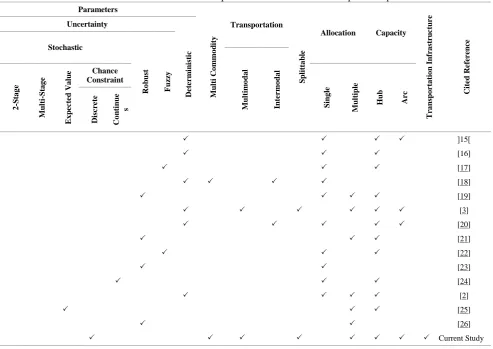
Table 1 presents a brief overview of scholarly literature and recent researches on hub and transportation problems, and makes a clear distinction between the present study and the previous works. Based on the literature survey reported in Table 1, the following gap as well as main contributions of this research are indicated :
• Proposing a multimodal splittable hub location for multi commodities.
• Considering discrete chance constraint programming to deal with uncertainty of demands.
Cuh Unit handling cost at hub h xijhfm
Is a positive variables that indicate the quantity of flow of commodity f from node i to node j passing through hub h, shipped by the combined modality m
uh Maximum handling capacity of hub h yh Is equal to 1, if the hub h is constructed, otherwise 0.
qihm k
Flow capacity of arc (i,h) for the k-th
transportation modality in combined modality type m
1 w ihmk
Isequal to 1 if the infrastructure of the transportation system of type
kfor the m-th combined transportation modalityin path i-his constructed, otherwise, 0.
q jhmk
Flow capacity of arc (j,h) for the k-th
transportation modality in combined modality
type m AX1 jfs
Is equal to 1 if the demand of destination point j for commodity type of f under scenario s has not been met and has been lost, otherwise 0.
N Total number of times a demand is allowed to
be lost under different scenarios AX jf
1937 B. Karimi et al. / IJE TRANSACTIONS B: Applications Vol. 31, No. 11, (November 2018) 1935-1942
• Analyzing of a discrete and continuous chance constraint for the proposed hub network design problem.
• Considering of a capacity for hubs as well as transportation systems in the network according to type of commodities.
• Considering of transportation infrastructures decisions in the proposed model.
The outline of this paper is organized as follows: the problem definition and assumptions are presented in the next section. In the third section, mathematical formulations of the problem are presented. Then, the model is solved for reasonable number of dimensions and the computational tests and results are reported. Section 5 contains sensitivity analyzes on the important parameters. The paper ends with a conclusion and direction for feature studies in the last section.
2. PROBLEM DESCRIPTION
2. 1. Problem Definition This section describes a multimodal hub location problem where the demands
are stochastic for multi-commodity network flows, based on the assumption that it has the capability to split commodities. As already mentioned, it is assumed that every node in the network has a level of demand for various products delivered by different origins using a transportation system. Along the route, products are integrated in the hubs and, if necessary, are transported to the intended destination by changing the transportation mode. It is worth noting that demand points receiving type-f product are no longer able to transport the same type to other points. Demands which are partially fulfilled are lost due to the long-term effects of strategic thinking on building hubs or using transportation systems with limited capacity. In order to avoid this issue, demands are considered random under different scenarios and are handled by a discrete chance
constraint programming method. Additionally,
commodity split makes it possible for the remaining portion of commodity flow to be transported by another hub or transportation system in such a way that demands are completely fulfilled as much as possible which resulting in cost reduction and its advantages.
TABLE 1. A brief overview of the capacitated hub location and transportation problem Parameters M u lt i C o m mo d it y Transportation S p li tt a b le
Allocation Capacity
T ra n sp o rt a ti o n In fr a st ru ct u re C it ed R ef er en ce Uncertainty D et er m in ist ic Stochastic R o b u st Fuzz y M u lt im o d a l In te rm o d a l 2 -S ta g e M u lt i-S ta g e E x p ec te d V a lu
e Chance Constraint S in g le M u lt ip le Hu b A rc D iscr et e C o n ti n u e s
[15]
[16]
[17]
[18]
[19]
[3]
[20]
[21]
[22]
[23]
[24]
[2]
[25]
[26]
B. Karimi et al. / IJE TRANSACTIONS B: Applications Vol. 31, No. 11, (November 2018) 1935-1942 1938
Since the existence of transportation infrastructure on the routes between origins and destinations for all transportation systems is impossible and unreal, this study creates conditions under which necessary transportation infrastructures are built at origin-hub and hub-destination points lacking a suitable transportation infrastructure and having the potential for infrastructure establishment.
2. 2. Assumptions We start itemizing the assumptions that we make:
• The number of hubs to be built is unspecified and it is a part of decision-making process .
• Commodity split is allowed by hubs or transportation systems.
• No direct connection is allowed between non-hub nodes.
• The use of transportation systems necessitates infrastructure existence or establishment.
• The internal capacity of hubs depends on product type. • The level of demands is considered to be random.
3. MATHEMATICAL MODEL
In this section, a mathematical model is proposed for the Multi-commodity multimodal splittable logistics hub location problem under uncertain parameters. The sets, parameters, and decision variables in the model are described in the beginning of this article.The mathematical MILP model of this problem is expressed in terms of minimizing the establishment and transportation costs, the operating costs of established hubs and constructing costs of new transportation infrastructures in the network as follows:
min cijhfm ijhfmx + Cfhyh i j h f m h
Cuh xijhfm i j h f m
1 ccm w
ihmk k i j km
(1)
Subject to : i j fmxijhfm u yh h ∀ ∈h H (2)
xijhfm- djfs MM ×(1 - AX1jfs) m
h
I,s S, f F
≤
i≠j
∀j ∈ ∈ ∈
(3)
- xijhfm+ djfs MM × AX1jfs j ihm
i I, s S, f F
≤
≠
∀ ∈ ∈ ∈
(4)
1 1
a x 0.5q × (w + w f ijhfm ihm ihm him
j f mk k k k k
2 2
+w ihm + u him ) i I, h H
k k
≤
∀ ∈ ∈
(5)
1 1
af xijhfm 0.5qjhm × (w jhm + w hjm
i fmk k k k k
2 2
+w jhm + u hjm ) j I, h H
k k
≤
∀ ∈ ∈
(6)
xijhfm MM × AXjf j I, f F i hm
≤ ∀ ∈ ∈ (7)
xjihfm MM × (1 - AXjf ) j I, f F i hm
(8)
AX1jfs N j I s f
≤ ∀ ∈ (9)
1
w ihm eihm i I,h H, k K, m M
k k
≤ ∀ ∈ ∈ ∈ ∈ (10)
1 2
w ihm + w ihm 1 i I, h H, k K, m M
k k
≤ ∀ ∈ ∈ ∈ ∈ (11)
1 2
w ihm + w him 1 i I, h H, k K, m M
k k
≤ ∀ ∈ ∈ ∈ ∈ (12)
1 2
whim + w ihm 1 i I, h H, k K, m M
k k
≤ ∀ ∈ ∈ ∈ ∈ (13)
1 2
w ihm = w him i I, h H, k K, m M
k k
∀ ∈ ∈ ∈ ∈ (14)
1
w ihm = {0,1}, yh= {0,1},xijhfm 0
k ≥ (15)
Objective function (1) computes total costs of hubs establishment and operating, flow of commodities and new transportation infrastructure in which should be minimized. Equation (2) guarantees that the total flow from different sources to the destination for different goods passing through a hub should not exceed its maximum operational capacity. Equations (3) and (4) determine scenarios when delivery is less than demands. Equations (5) and (6) ensure that the flow between a hub and spoke should not exceed the maximum capacity of the transit system. Equations (7) and (8) guarantee that demand points receiving type-f product are no longer able to transport the same type to other points and vice versa. Equation (9) ensures that the total
number of unserved demands under different
1939 B. Karimi et al./ IJE TRANSACTIONS B: Applications Vol. 31, No. 11, (November 2018) 1935-1942
rational constraints of establishing a new transportation infrastructure. Equation (15) defines types of variables.
4. SENSIVITY ANALYSIS
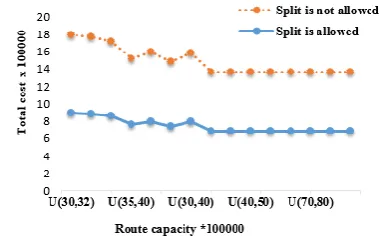
The model proposed in previous section has been implemented in GAMS 24.7.3 and solved by CPLEX on an Intel R core (TM) i7 CPU and 4.00 GB RAM. The model has been validated by using randomly generated data and solved, it is assumed that there are three types of products and two transportation modes together to create four combined transportation modes.This section examines the effect of important problem parameters, and verifies the accuracy of the proposed model by showing its high efficiency. For this purpose, four types of sensitivity analysis are conducted. Figures 1 and 2 illustrate the association of hub and route capacities with the total network cost for splittable and un-splittable commodities. At the same capacities, the total network cost for splittable commodities is much less than un-splittable ones. In Figure 3, the relationship between transportation route capacity and transportation infrastructure is investigated for both transportation systems. It shows that transportation infrastructure requires lower investment levels as route capacity increases. As shown in Figure 4, the number of splittable demands is reduced by an increase in the total number of allowable unserved demands. As shown in Figure 5, reduction occurs in the total transportation network cost by increasing of transportation modes. Figure 6 illustrates that total network cost can be decreased by increasing of allowable unserved demands. It is also shown that network cost progressively increases by demand fulfillment, and it reaches its maximum amount when no demand can be lost.
4. 1. Comparison of Discrete and Continuous Chance Constraint Programming In this section, we show that the proposed discrete chance constraint can be used as an approximation of continuous chance constraint.
Figure 1. Total costs with split and without spilt through hub
Figure 2. Total costs with spilt and without spilt through
different modes
Figure 3. The number of constructed infrastructures vs. route
capacity
Figure 4. The number of the lost demands vs. the number of
splits
Figure 5. The number of transportation modes vs. total
B. Karimi et al./ IJE TRANSACTIONS B: Applications Vol. 31, No. 11, (November 2018) 1935-1942 1940
Figure 6. The number of the lost demands vs. total network
cost
For this purpose, two parameters mean and variance of normal distribution are estimated based on the scenarios. Equations (16) and (17) are continuous chance constraint and the linearization of this constraint, respectively. In Equation (17), zα represents the point
of standard normal distribution, so that: p(z > z ) = 1- αα .
djfs I, f F
p( xijhfm ) α m
i j h≠
∀j ∈ ∈
(16)
I, f F
xijhfm- mean
m i j h
> zα δ
≠
∀j ∈ ∈
(17)
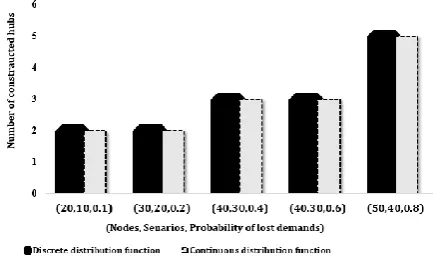
Figures 7 and 8 show the comparison between the results from the use of discrete and continuous chance constraints. It has been shown that the results of a discrete and continuous random variable on the variable of the construction of the hubs and the cost of constructing the hubs are the same. In other words, if using a continuous distribution as normal, the same result can be obtained from the use of discrete distribution on the number, type and the cost of constructing the hub, and in some way a discrete chance constraint approach is a good approximation of continuous distributions.
Figure 7. Comparison of the effect of using discrete or
continuous chance constraint on the cost of constructing a hub
Figure 8. Comparison of the effect of using discrete or
continuous chance constraint on the number of hubs constructed
5. CONCLUSIONS
This study presents a Mixed Integer Linear Programming (MILP) model to solve capacitated hub location problems where demands are stochastic for
multi-commodity network flows based on the
1941 B. Karimi et al./ IJE TRANSACTIONS B: Applications Vol. 31, No. 11, (November 2018) 1935-1942
example, type of packaging may be changed to implement the splitable multimodal network.The results obtained from computational experiments show that an increase in the number of the network nodes, scenarios or allowable unserved demands under different scenarios make the problem hard to be accurately solved by commercial solvers in a short time. Therefore, valid inequalities, relaxation methods or heuristic algorithms can be a suggestion to continue the present study for future research directions. Also, a multi-objective problem and multi-capacity hubs can be used to keep a balance between time, costs and environmental conditions for different transportation modes, and to prevent demands being lost as much as possible.
6. REFERENCES
1. O'kelly, M.E.," A quadratic integer program for the location of interacting hub facilities", European Journal of Operational Research, Vol. 32. No. 3, (1987), 393-404.
2. Alumur, S.A., Nickel, S., Rohrbeck, B. and Saldanha-da-Gama, F., "Modeling congestion and service time in hub location problems", Applied Mathematical Modelling, Vol. 55, No. 1, (2018), 13-32.
3. Ambrosino, D. and Sciomachen,A., "A capacitated hub location problem in freight logistics multimodal networks", Optimization Letters, Vol. 10, No. 5, ( 2016), 875-901.
4. Mohammadi, M., Jolai, F. and Tavakkoli-Moghaddam, R.,"Solving a new stochastic multi-mode p-hub covering location problem considering risk by a novel multi-objective algorithm", Applied Mathematical Modelling, Vol. 37, No. 24, (2013), 10053-10073.
5. Javadian, N., Modarres, S. and Bozorgi, A., "A bi-objectivestochasticoptimizationmodelforhumanitarian relief chain byusingevolutionary algoritms", International Journal of Engineering-Transactions A: Basics, Vol. 30, No. 10, (2017), 1526-1537.
6. Naderi, M.J. and Pishvaee, M.S.,"A stochastic programming approach to integrated water supply and wastewater collection network design problem", Computers & Chemical Engineering, Vol. 104, No. 1, (2017), 107-127.
7. Farina, M., Giulioni, L. and Scattolini, R., "Stochastic linear model predictive control with chance constraints–a review", Journal of Process Control, Vol. 44, No. 1,(2016), 53-67. 8. Charnes, A., Cooper, W.W. and Symonds, G.H.,"Cost horizons
and certainty equivalents: an approach to stochastic programming of heating oil", Management Science, Vol. 4, No. 3, (1958), 235-263.
9. Tan, X., Gong, Z., Chiclana, F. and Zhang, N., "Consensus modeling with cost chance constraint under uncertainty opinions", Applied Soft Computing, Vol. 67, No. 1, (2017), 721-727.
10. Elçi, Ö., Noyan, N. and Bülbül, K., "Chance-constrained stochastic programming under variable reliability levels with an application to humanitarian relief network design", Computers & Operations Research, Vol. 96, No.1, (2018), 91-107. 11. Küçükyavuz, S., "On mixing sets arising in chance-constrained
programming", Mathematical programming, Vol. 132, No. 1-2, (2012), 31-56.
12. Kınay, Ö.B., Kara, B.Y., Saldanha-da-Gama, F. and Correia, I., "Modeling the shelter site location problem using chance constraints: A case study for Istanbul", European Journal of Operational Research, Vol. 270, No. 1, (2018), 132-145. 13. Luedtke, J., Ahmed, S. and Nemhauser, G., "An integer
programming approach for linear programs with probabilistic constraints", in International Conference on Integer Programming and Combinatorial Optimization. Springer, (2007), 410- 423.
14. Zheng, X., Wu, B. and Cui, X., "Cell-and-bound algorithm for chance constrained programs with discrete distributions", European Journal of Operational Research, Vol. 260, No. 2, (2017), 421-431.
15. Ghodratnama, A., Tavakkoli-Moghaddam, R. and Baboli, A., "Comparing three proposed meta-heuristics to solve a new p-hub location-allocation problem", International Journal of Engineering-Transactions C: Aspects, Vol. 26, No. 9, (2013), 1043-1058.
16. Karimi, M., Eydi, A. and Korani, E., "Modeling of the capacitated single allocation hub location problem with a hierarchical approch", International Journal of Engineering-Transactions A: Basics, Vol. 27, No. 4, (2013), 573-586.
17. Bashiri, M., Mirzaei, M. and Randall, M., "Modeling fuzzy capacitated p-hub center problem and a genetic algorithm solution", Applied Mathematical Modelling, Vol. 37, No. 5, (2013), 3513-3525.
18. Rieck, J., Ehrenberg, C. and Zimmermann, J., "Many-to-many location-routing with inter-hub transport and multi-commodity pickup-and-delivery", European Journal of Operational Research, Vol. 236, No. 3, ( 2014), 863-878.
19. Boukani, F.H., Moghaddam, B.F. and Pishvaee, M.S.,"Robust optimization approach to capacitated single and multiple allocation hub location problems",Computational and Applied Mathematics, Vol. 35, No. 1, (2016), 45-60.
20. Serper, E.Z. and Alumur, S.A., "The design of capacitated intermodal hub networks with different vehicle types", Transportation Research Part B: Methodological, Vol. 86, No. 1, (2016), 51-65.
21. Meraklı, M. and Yaman, H., "A capacitated hub location problem under hose demand uncertainty", Computers & Operations Research, Vol. 88, No. 1, (2017), 58-70.
22. Zhalechian, M., Tavakkoli-Moghaddam, R. and Rahimi, Y.,"A self-adaptive evolutionary algorithm for a fuzzy multi-objective hub location problem: An integration of responsiveness and social responsibility", Engineering Applications of Artificial Intelligence, Vol. 62, No. 1, (2017), 1-16.
23. Zetina, C.A., Contreras, I., Cordeau, J.F. and Nikbakhsh, E., "Robust uncapacitated hub location", Transportation Research Part B: Methodological, Vol. 106, No.1, (2017), 393-410. 24. Ghezavati, V. and Hosseinifar, P., "Application of efficient
metaheuristics to solve a new bi-objective optimization model for hub facility location problem considering value at risk criterion", Soft Computing, Vol. 22, No.1, (2018), 195-212. 25. Correia, I., Nickel, S. and Saldanha-da-Gama., F. A.,"stochastic
multi-period capacitated multiple allocation hub location problem: Formulation and inequalities", Omega, Vol. 74, No. 1, (2018), 122-134.
B. Karimi et al./ IJE TRANSACTIONS B: Applications Vol. 31, No. 11, (November 2018) 1935-1942 1942
Multi-commodity Multimodal Splittable Logistics Hub Location Problem with
Stochastic Demands
B. Karimi, M. Bashiri, E. Nikzad
Department of Industrial Engineering, Shahed University, Tehran, Iran
P A P E R I N F O
Paper history: Received 21April 2018
Received in revised form 26August 2018 Accepted 26 October 2018
Keywords:
Capacitated hub location Multimodal transport Multi commodity Splittable
Discrete Chance Constraint
هدیکچ
قیرط زا اهلااک یزاسادج تیلباق و یهجودنچ لقن و لمح متسیس نتفرگ رظن رد اب روحم یبای ناکم هلاسم ،هلاقم نیا رد
تیفرظ نینچمه .تسا هدش هئارا ییلااکدنچ تلاح رد اضاقت ندوب یفداصت ضرف اب ،لقن و لمح یاه متسیس و اه باه
سیس و اه باه یفداصت ،ینامز قفا یط رد اهاضاقت ،یعقاو لئاسم رد .تسا هدش هتفرگ رظن رد دودحم لقن و لمح یاه مت
رد نیاربانب .دنور یم تسد زا اهاضاقت احلاطصا و دنوش یمن هدروآرب لماک روط هب اهاضاقت زا یخرب عطق روط هب و دنتسه
قت ،تیعقاو هب لدم ندرک رت کیدزن هچ ره یارب ،هلاقم نیا یفداصت تیدودحم شور زا هدافتسا اب و یفداصت تروص هب اضا
رد هک دوش یم ثعاب ،اهلااک یریذپادج ندوب زاجم ضرف نتفرگ رظن رد یفرط زا .تسا هتفرگ رارق یسررب دروم هتسسگ
متسیس ای باه کی قیرط زا لااک نایرج هدنام یقاب شخب ،لقن و لمح متسیس کی ای و باه ره تیفرظ لیمکت تروص
هب رضاح هلئسم .دومن یریگولج اهاضاقت ندش هدروآرب مدع زا ناکما دح ات ،بیترت نیا هب و ددرگ لاسرا رگید لقن و لمح
متسیس بیکرت و باختنا ،باه هب باه ریغ طاقن هنیهب صیصخت نییعت ،باه طاقن ثادحا یارب ناکم نیرتهب باختنا لابند
ثادحا دروم رد یریگ میمصت و لقن و لمح یاه لاح رد هک یلقن و لمح یاه متسیس یارب تخاسریز ثادحا مدع ای
یزیر همانرب تروص هب هلئسم نیا .دشاب یم ،دنتسه اراد ار ثادحا لیسناتپ و درادن دوجو اهنآ یارب یتخاسریز رضاح
تیساسح لیلحت نینچمه.تسا هدیدرگ لح و لدم ،هکبش هنیزه لک ندرک هنیمک فده اب طلتخم حیحص ددع یطخ یاه
یماگنه هتسویپ یفداصت تیدودحم شور زا یبوخ نیمخت هتسسگ یفداصت تیدودحم شور هک دهد یم ناشن ،هدش ماجنا
رد لدم رتلااب ییاراک و تحص رگنایب هلصاح جیاتن .دشاب یم ،دننکیم یوریپ لامرن عیزوت زا یعطق ریغ یاهرتماراپ هک
یم عوضوم تایبدا رد هدش هئارا یاه لدم اب هسیاقم دشاب
. doi: 10.5829/ije.2018.31.11b.18