© Shiraz University
IMPROVING SIMULTANEOUS SCHEDULING OF PRIMARY RESERVE
AND ENERGY UTILIZING FAST RAMP RATE CAPABILITY
OF GENERATING UNITS
*M. RAJABI MASHHADI
1, 2,
**M. S. GHAZIZADEH
3AND
M. H. JAVIDI
11 Dept. of Electrical Engineering, Ferdowsi University of Mashhad, Mashhad, I. R. of Iran 2 Khorasan Regional Electric Company, Mashhad, I. R. of Iran
3 Depts. of Electrical Engineering, Power and Water, University of Technology, Tehran, I. R. of Iran
Email: [email protected]
Abstract– Primary frequency regulation, as an ancillary service, is usually supported by
generation reserves. Modern generating units have special technical features; e.g. their governor operation mode can be selected, their ramp rate can be selected to be either normal or fast, etc. On the other hand, there are some technical constraints; e.g. some generating units cannot participate in primary frequency control at their capacity limits. In this paper, operational technical features and constraints of generating units are incorporated in a"simultaneous scheduling of energy and primary reserve" problem. To obtain the optimal scheduling, a heuristic iterative method based on genetic algorithm is proposed. The role of fast ramp rate and other capabilities and constraints on scheduling are investigated through simulation studies. Simulation results show that taking fast ramp rate of generating units into account not only reduces the total operation cost, but will also end up with a feasible solution, even in cases where previously proposed methods fail. Also, simulation results indicate that using fast ramp rate, results in the reduction of both the price of electricity and its volatility.
Keywords– Fast ramp rate, frequency control, primary reserve, primary frequency capacity limits, simultaneous
scheduling
1. INTRODUCTION
In restructured power systems, frequency regulation is considered as an ancillary service and is usually supported by the system operator using the resources made available by market participants. Generation reserve, usually called frequency control reserve, is the main resource for frequency control and is classified as primary, secondary and tertiary, according to the response time and how it is deployed [1, 2]. Primary reserve, as the fastest one, is supported by on-line generating units through their local droop characteristic in response to system frequency deviations from nominal value. Primary reserve has a response time of the order of seconds [3, 4]. Secondary generation reserve, provided based on a centralized strategy, has a response time of about a minute. The task of secondary reserve is to regulate the area-control error under load-following conditions [5, 6]. The tertiary reserve, which is supported by generation or demand flexibility, is aimed to return the area-control error to zero and to ensure that all operational constraints are satisfied. Tertiary control has a response time of the order of minutes and is centrally implemented [7].
In electricity markets, energy and reserve may be scheduled simultaneously or sequentially. However, as scheduling of energy and reserves are strongly coupled, simultaneous market-clearing procedure is considered to be more advantageous [7-9] and it increases the social welfare [9].
In this paper, we have focused on simultaneous scheduling of generation (energy) and primary reserve. The reserve should suffice for compensating large and sudden outages, in the form of losing one or more generating units, in an isolated power system.
O’Sullivan and O’Mulley [10] have introduced an iterative economic dispatch in which frequency deviations outside the allowable range triggered modifications of the scheduled energy and primary reserve. Papadogiannis and Hatziargyriou [11] have considered stability and network constraints in dispatch of primary reserve. The method is based on a decision tree solution algorithm. However, in both of the above mentioned approaches, generation (energy) is scheduled a priori and then the reserve is scheduled (sequential scheduling). A later approach for formulation of unit commitment, proposed by Restrepo and Galiana [7], considers both primary and tertiary reserve constraints simultaneously. In the same year, another paper by Galiana and his colleagues was published in which they showed that simultaneous scheduling increases social welfare [9]. The effects of generating unit characteristic changes on operation planning (provision of frequency reserves) have been considered in [12]. An improved speed governor of generating units that utilizes the short time overloading capability, which then enables generating units to contribute in a faster frequency restoration, has been presented by Thalassinakis and Dialynas [13]. They also proposed an efficient computational method for the optimal spinning reserve allocation, based on composite security criterion. Also, A. Kazemi and H. Andami [14] have considered the influence of system nonlinearities such as generation ramp rate constraint and governor dead band in load frequency control system. K. Afshar et al. [15] have suggested an approach for cost allocation and optimal reserve determination in the pool-based market in which customers can determine the risk level which they are willing to accept. Grey et al. [16] proposed an approach for rescuing frequency runaway; in their approach, the primary reserve is dispatched economically and securely such that the limits of transmission lines are not violated after losing a large generating unit.
In the previous works on the generation (energy) and primary reserve scheduling, a relation between primary reserve and post-contingency system frequency deviation has been assumed [7, 9], and the only issues that are considered are special constraints (e.g. system frequency limits, generation ramp rate and capacity constraints associated with primary frequency control). Modern generating units, utilizing special technical features, have affected the domain of the scheduling problem. The capability to select operation modes for the governor (active or passive modes) and the ramp rate for the generator (normal or fast ramp rates) are some special features that have not been considered in previous works. Furthermore, some generating units cannot contribute to frequency control at their capacity limits. This constraint has received relatively little attention in previous studies.
In this paper, the effects of real technical capabilities for modern generating units are taken into account in simultaneous scheduling of energy and primary reserve. Furthermore, the allowed range for participating in primary frequency control is considered in scheduling primary reserve. To obtain the optimal scheduling, a heuristic iterative method based on genetic algorithm is proposed. Simulations confirm that our formulation results in a more appropriate solution compared with the previously proposed methods.
In section 3, technical capabilities of modern generating units and primary frequency capacity limits are discussed. Problem formulation is done in section 4. Section 5 presents a heuristic method, based on Genetic Algorithm (GA) that is applied to solve the problem. Simulation results are discussed in section 6. Concluding remarks concerning our innovation and the proposed method are presented in Section 7.
2. TECHNICAL FEATURES OF GENERATING UNITS
considered in these investigations. In this section, these capabilities and limitations are introduced and their effects on formulating simultaneous scheduling of energy and primary reserve are considered.
a) Governor operation mode
Generally, most generating units have the capability of participating in primary frequency control [17]. On the other hand, many generating units cannot participate in primary frequency control due to governor malfunction, violation of allowed dead-band, lack of natural gas in winter for thermal units and etc. [18-21].Such generating units will not respond to frequency variation and will run at constant load [17].
In some of the modern generating units, the governor operation mode may be selected by the operator, in order to contribute the unit in frequency control or not (active or passive modes) [17, 22]. For example, in a typical modern gas turbine unit, the active and passive modes can be selected via the influent frequency mode command. In these generating units, the governor operation mode can be switched without the necessity to shut down the unit. This capability is implemented by defining adjustable parameters, such as time delay and frequency dead-band. In the case of a large system imbalance, such as the loss of a generating unit, the system frequency will deviate substantially. If the frequency deviation goes beyond the dead-band of the governor, the speed governors will be activated in contribution to system frequency. If frequency deviation lies inside the dead-band of the governor, or if time delay is not too short (typically more than 15 seconds), the speed governor will not be activated. Table 1 shows some typical values for time delay and dead-band limits in some typical gas turbines [22]. As it can be seen, these values for the passive mode are greater than those for the active mode.
Table1. Time delay and dead-band limits in active or passive modes in a typical gas turbine [22]
Modes Active mode Passive mode
Time delay(sec) 4 15
Dead-band limits(Hz) 0.015 0.4
For the generating units scheduled to contribute in primary frequency control, the operator sets the appropriate mode for the governor. The selected governor operation mode may be represented by a decision variable v; 1 for the active mode and 0 for the passive mode. A pre-set value, not a decision variable, may represent the governor operation mode of those generating units which are permanently operated in one mode (passive or active).
b) Primary frequency capacity limits
Some generating units cannot participate in primary frequency control at operating points close to their nominal operation limits [20-21]. In some generating units, the allowed range for participating in primary frequency control (gipr-max-gipr-min) is smaller than their nominal operation range (gimax-gimin). For
example, in a combined cycle power plant, because of the possible loss of the steam turbine when participating in primary frequency control, the allowed lower operation limit is considered to be greater than its nominal value (gimin). Furthermore, because of the steam turbine limitations in a combined cycle
power plant, the associated gas turbine(s) may not be operated close to the upper nominal operation limit, which implies that a value smaller than gimax should be considered as the upper operation limit, when
i R 1 − pr it r it it g g − 0
Fig. 1. Primary frequency capacity limits
t i g u v g v g g u v g v g it it it pr i it i it it it pr i it i , , ) ) 1 ( ( ) ) 1 ( ( max max min min ∀ ⎪⎭ ⎪ ⎬ ⎫ ≥ + − ≤ + − − − (1) t i r v r g g v r pr normal i it pr it it pr it it pr it , , 0 max ∀ ⎪⎭ ⎪ ⎬ ⎫ ≤ − ≤ ≤ − − (2)
Table 2 shows typical values of primary frequency capacity limits for different types of generating units [21].
Table 2. Typical primary frequency capacity limits for different types of generating units [21]
Power plant gmin(MW) gmax(MW) gpfmin(MW) gpfmax(MW)
Gas turbine 30 120 30 100
Combined cycle 30 105 75 105
Steam unit 75 150 75 135
The primary frequency reserve capacity limits bound the amount of primary reserve capacity for participating in primary frequency control. Figure 2 illustrates the relation between primary reserve ( pr
it
r )
and frequency deviation
Δ
f
tfor a typical unit [7].Fig. 2. Primary reserve characteristics of unit i [7]
When a large imbalance -such as loss of a generating unit- occurs, the system frequency will decline resulting in a negative deviation from its nominal value and an increment in generating unit output, proportional to the frequency deviation and the frequency regulation constant (governor droop) of the unit [10,11]. For frequency deviations less than b
it
f
Δ (the breaking frequency), generation increases linearly according to the governor droop; and for the frequency deviation beyond the breaking frequency, the primary reserve will be bounded by (git −git); where, git is equal to either maximum generation output limit during primary frequency control ( pr−max
i
g ) or the unit frequency regulation limit
( normal pr it it i
it r u v
g + − . . ), whichever is smaller. Variables pr it
r and git can be formulated by (3) [7] and (4).
t
i
f
f
if
g
g
f
f
if
f
R
r
b it t it it t b it t i prit
,
,
,
0
1
,∀
⎪
⎭
⎪
⎬
⎫
⎪
⎩
⎪
⎨
⎧
Δ
≤
Δ
−
≤
Δ
≤
Δ
Δ
−
=
(3))
,
min(
it it ipr max it it it inormal prit
u
v
g
g
u
v
r
g
=
−+
− (4)min i g max i g min − pr i
g pr−max
i
g
it
g ripr
b it
f
c) The capability of ramp rate selection
Some modern generating units can be operated with various ramp rates. In such units, the operator can select either normal or fast ramp rates during normal operation. Figure 3 shows normal and fast ramp rates for a typical gas turbine unit.
Fig. 3. Normal and fast loading ramp rates for a typical 159 Mw gas turbine unit [22]
We may define a binary variable (w) to represent the selected ramp rate. This decision variable w is assigned to 0 and 1 for normal and fast ramp rates, respectively. For such units, the primary reserve capacity limits as well as (git) in (2)-(4) should be modified to (5)-(8). For those generating units whose ramp rate cannot be adjusted, w is set to zero. Now, the primary reserve can be formulated using the following equations: t i w r w r v r g g v u r it pr fast i it pr normal i it pr it it pr it it it pr it , , ) ) 1 ( ( 0 max ∀ ⎪⎭ ⎪ ⎬ ⎫ + − ≤ − ≤ ≤ − − − (5) i,t , b it Δf t Δf if b it Δf t Δf b it Δf if t Δf b it Δf if , it g it gf it w it gn it w , it w Δf i R it g it gn it w t Δf i R pr it r ∀ ⎪ ⎪ ⎭ ⎪ ⎪ ⎬ ⎫ ≤ ≤ ≤ ≤ ≤ ⎪ ⎪ ⎩ ⎪ ⎪ ⎨ ⎧ − + − ⋅ − − − − = 2 1 2 0 1 ) ) 1 ( ) 1 ( ) )( 1 ( , 1 (6)
)
,
min(
it it ipr max it inormal pr it itit
u
v
g
g
r
u
v
gn
=
−+
− (7))
,
min(
it it ipr max it ifast pr it itit
u
v
g
g
r
u
v
where,
gn
itandgf
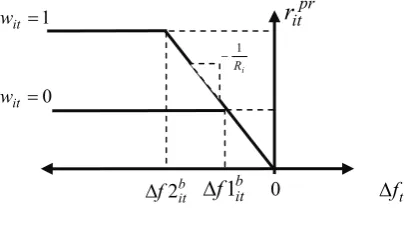
it represent the maximum generation output limits during primary frequency control for normal and fast ramp rates, respectively.Figure 4 depicts the primary reserve characteristics for generating units whose ramp rate can be selected. As it can be seen, when the fast ramp rate is selected (wit=1), the maximum available primary reserve capacity will be increased. On the contrary, the breaking frequency will be decreased from
b it
f1
Δ toΔf2bit. This effect of ramp rate selection capability is investigated in Section 6.1 for an hourly simultaneous scheduling of energy and primary reserve problem.
Fig. 4. Primary reserve characteristics of uniti for normal and fast ramp rates
3. PROBLEM FORMULATION
The aim of "simultaneous scheduling of energy and primary reserve" is to minimize the cost of energy and primary reserve over the scheduling horizon. This is expressed by (9), where the objective function includes operating and primary reserve costs. Operating costs include start-up, shut-down and running costs. It is assumed that the running cost of generating units are quadratic, as shown by (10), and the parameters associated with each unit are available to send to market operator[7].
}] ) ( { )}
, (
{ + + +∑ ∑
∑ ∑
i t
pr it pr it it
it it sd it it t i
su it
itC z C C g u C r
y
Min (9)
t i g
b g
a C u u g
Cit it it it it it it it( it) , ,
2 1 )
,
( = 0 + + 2 ∀ (10)
Generators may participate in the primary reserve market by submitting their bids, in the form of Eq. (11); which implies that each generator can submit different offers for normal and fast ramp rates. If generators select a fast ramp rate that is greater than the normal ramp rate, the corresponding ramping process will shorten the lifetime of the rotor [23]. Because of the reduction in rotor lifetime with fast ramp rate selection, the economic impact due to rotor fatigue is formulated in the second term of Eq. (11). In other words, each generator submits q0and q1for participating in primary frequency control with normal or fast ramp rates, respectively. Obviously, q1 is greater thanq0.
t i v u r q w q
w r
Citpr( itpr)=((1− it) 0itpr + it 1itpr) itpr it it,∀, (11)
The constraints for this optimization problem may be classified in three main groups. The first group mainly includes typical operating constraints of a unit commitment problem. These constraints are generating unit capacity limits and pre-contingency power balances, as in (1) and (12), respectively [7].
t d
g t
i it = ∀
∑ , (12) t
f
Δ
b
it
f1 Δ b it f2 Δ
1
=
it w
i R
1 −
pr it
r
0
=
it w
Also, the system and generating unit emission constraints in simultaneous scheduling of energy and primary reserve problem are general constraints. Generally, generating units must minimize the operation cost according to Eq. (9) such that system emission constraint and generating unit emission constraint are satisfied, which are formulated as in (13) and (14), respectively [24].
t EMS E
u g E
t i
su it it it
i ≤ ∀
∑ ∑[ ( ) + ] , (13)
t i i EMS E
u g E
t
su it it it
i( ) ] ( ), ,
[ ≤ ∀
∑ + (14)
The second group of constraints includes adequacy of primary reserve and the allowed negative frequency deviation in severe contingencies. Loss of a generating unit, belonging to a given set sk including all online units, is considered as a contingency. Under post contingency situation, the demand and generation should be balanced and the remaining online units should provide enough primary reserve for each contingency. This is considered as a constraint, formulated as in (15) [7]. However, to avoid load shedding by under-frequency relays, the under-frequency deviation should be limited to the allowed negative under-frequency deviation, as in (16) [7].
t
k
g
r
k k i s it s
i pr
it
≥
∑
,
∀
,
∑
∈ ∉
(15)
t f
ft ≥Δ ∀
Δ min,
(16)
Special constraints, related to the capabilities of modern generating units in primary frequency control such as selection of ramp rate and primary frequency capacity limits constitute the third group. Equation (8) defines the maximum generation output under primary frequency, considering the capability of ramp rate selection. The primary reserve, calculated through Eqs. (6) and (7), is limited by constraint (5). Given that this investigation is focused on the impacts of modern generating unit capabilities on primary frequency control, to simplify the problem, a single period scheduling problem is considered and the time-coupling constraints are not included. However, in a multi period scheduling problem, time time-coupling constraints may not be ignored.
4. SOLUTION METHOD FOR THE PROBLEM
The problem of hourly energy and primary reserve scheduling is a Mixed-Integer Non Linear Programming (MINLP) problem. There are various numerical optimization techniques that can be applied to solve this problem. In [7], unit commitment with primary reserve problem has been solved through converting MINLP into a Mixed Integer Linear Programming (MILP), to be solved by means of commercially available mixed integer software, such as GAMS. Genetic algorithm has been commonly applied to solve similar optimization problems [25-27]. In such problems, the number of feasible solutions increases exponentially with the problem size. Heuristic search techniques may be employed to reduce computational time.
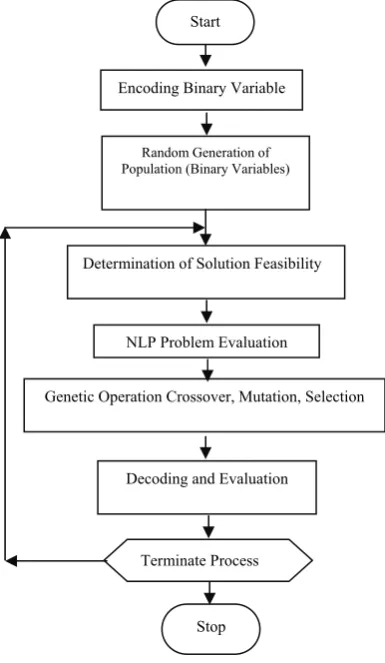
In this paper, to solve this MINLP problem, a heuristic iterative method based on genetic algorithm (GA) has been proposed. The flowchart of the proposed method is shown in Fig. 5. Although the method can be developed for a multi period scheduling, for simplicity, the flowchart only depicts the method for a single period (one hour) scheduling.
Start
Random Generation of Population (Binary Variables)
Terminate Process Determination of Solution Feasibility
NLP Problem Evaluation
Genetic Operation Crossover, Mutation, Selection
Decoding and Evaluation Encoding Binary Variable
Stop
are eliminated. Therefore, new random populations are generated. This would ensure that only feasible chromosomes are considered for solving the problem of simultaneous scheduling of energy and primary reserve. Major steps for the solution method are explained below:
Fig. 5. Flowchart of proposed method
a) Encoding binary variables
In this step, the binary variables (uit, vit and wit) are encoded. These binary variables generate eight different states in each hour for every generating unit. The only four possible variables of these states are shown in Table 3. Encoding of four possible states can be performed by using two bits for every generating unit (Table 4). Therefore, the initial population will be presented by chromosomes with dimensions of twice the number of generating units. Figure 6 shows a typical chromosome of the initial population.
Table 3. Possible states binary variables Feasibility
states
wit vit uit
states
1 0
0 0 0
Non-feasible 1
0 0 1
Non-feasible 0
1 0 2
Non-feasible 1
1 0 3
2 0
0 1 4
Non-feasible 1
0 1 5
3 0
1 1 6
4 1
1 1 0 1 ... 0 1 1 1 1 0 0 1
Fig. 6. Typical chromosome schematic
Table 4. Encoding of four possible states
Unit states
bit2 bit1
Feasible states
Unit is off 0
0 1
Unit is on without participating in primary frequency control 1
0 2
Unit is on with participating in primary frequency control by normal ramp rate 0
1 3
Unit is on with participating in primary frequency control by fast ramp rate 1
1 4
b) Determination of solution feasibility
For decreasing computational time, we have used a heuristic idea which can identify and eliminate some of the unfeasible chromosomes from the search domain of the optimization problem. In this step, feasible chromosomes satisfying relations (17) and (19) are investigated prior to scheduling of energy and primary reserve. Constraints (17) and (19) guarantee balancing of generation and load in the given schedule and adequacy of possible maximum primary reserves ( pr
it
rmax− ), respectively, for the given
schedule. (ritmax−pr
) is the maximum of primary reserve for participating units in primary frequency control at maximum allowed frequency deviation (
Δ
f
min) and is expressed by Eq. (18). These conditions assure that genetic algorithm works with feasible chromosomes. In this way, as a number of unfeasible solutions are eliminated, the computation time will be reduced.t
g
u
d
g
u
i it i t
i it i
≤
≤
∑
∀
∑
min max,
(17)⎭
⎬
⎫
⎩
⎨
⎧
−
+
−
Δ
−
=
− − − −−
min
(
1
*
min),
(
max min),
(
(
1
)
)
max fast pr
i it pr normal i it pr i pr i i pr
it
f
g
g
w
r
w
r
R
r
(18) k i it s i pr i itit
v
r
u
g
t
i
s
u
k
≥
∀
∈
∑
∉− min
,
,
max
(19)
c) NLP problem evaluation
In this step, by having feasible chromosomes in one population composed of binary variables, the scheduling problem is converted to a Nonlinear Programming (NLP) problem. Then, for cases in which NLP has a solution, the cost of the schedule is saved and unfeasible solutions are ignored.
5. SIMULATION RESULTS
In this section, the technical features role of modern generators technology on simultaneous scheduling of energy and primary reserve is investigated with simulation results. To do this, simulations have been performed on two isolated power systems. One of these two systems includes four generating units and the second includes seventeen generating units. Simulations are performed over a single period (an hour) and over a whole day including 24 periods. Different cases have been investigated. Simulation results for these systems are explained below:
a) Power system including four-generating units
Specifications of generating units, as well as the offers of these units for primary reserve with normal and fast ramp rates in three different cases are presented in Table 5 and 6, respectively. The energy and reserve cost functions are defined in (10) and (11), respectively, with the quadratic energy cost parameter
b
i assumed to be zero.System frequency and maximum allowed frequency deviation have been assumed to be 60 Hz and -0.6 Hz, respectively. Demand of the system has been assumed to be 170 MW. The droops of all units is assumed to be four percent. In all cases, loss of one generator (N-1 criteria) at a time has been considered as the security criterion.
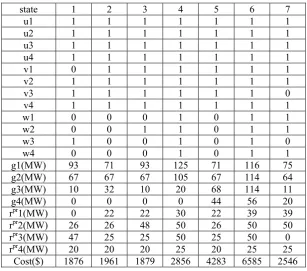
Table 7 illustrates the solutions obtained over a single period by the heuristic method based on GA. Simulations are performed for seven various states explained in subsections 6.1.1 and 6.1.2. Also, in subsection 6.1.3, the proposed method was performed on this power system over a period of 24 hours.
Table 5. Input data for the power system including four-generating units
Capacity limits Ramp rates Cost function
NO.
gmax
(MW)
gmin
(MW)
gpr-max
(MW)
gpr-min
(MW)
rnormal-pr
(MW)
rfast-pr
(MW)
a
($/MWh)
c
($/h)
1 155 10 140 65 22 45 9.8 10
2 200 40 200 40 26 52 10.7 10
3 250 10 235 80 25 50 15.6 10
4 100 0 100 20 20 40 40 10
Table 6. Primary reserve rates for the power system including four-generating units q0($/MWh) q1($/MWh) Case
unit1 unit2 unit3 unit4 unit1 unit2 unit3 unit4 I 0.1 0.1 0.1 0.1 1 1 1 1 II 0.1 0.1 0.1 0.1 5 5 5 5 III 0.1 0.1 0.1 0.1 1 1 5 1
Table 7. Simulation results for the power system including four-generating units
state 1 2 3 4 5 6 7 u1 1 1 1 1 1 1 1 u2 1 1 1 1 1 1 1 u3 1 1 1 1 1 1 1 u4 1 1 1 1 1 1 1 v1 0 1 1 1 1 1 1 v2 1 1 1 1 1 1 1 v3 1 1 1 1 1 1 0 v4 1 1 1 1 1 1 1 w1 0 0 0 1 0 1 1 w2 0 0 1 1 0 1 1 w3 1 0 0 1 0 1 0 w4 0 0 0 1 0 1 1 g1(MW) 93 71 93 125 71 116 75 g2(MW) 67 67 67 105 67 114 64 g3(MW) 10 32 10 20 68 114 11
g4(MW) 0 0 0 0 44 56 20
rpr1(MW) 0 22 22 30 22 39 39
rpr2(MW) 26 26 48 50 26 50 50
rpr3(MW) 47 25 25 50 25 50 0
rpr4(MW) 20 20 20 25 20 25 25
Population size and the maximum generation for termination of GA are 20 and 100, respectively. Crossover and mutation probabilities are considered to be 0.8 and 0.15, respectively.
1. Considering the role of fast ramp rate selection in a single period: In this section, the role of ramp rate limits selection is investigated in the scheduling of energy and primary reserve. In this investigation, it is assumed that all generating units can participate in primary frequency control at their maximum operating range. In other words, the primary frequency reserve capacity limits are relaxed in this investigation. Scheduling of energy and primary reserve for three different cases of offers (I), (II) and (III) in Table 6 are shown in Table 7 as states 1, 2 and 3, respectively. It can be seen in state 1(Table 7) that, while unit 3 participates in primary frequency control with fast ramp rate, unit 1 does not participate in primary frequency control.
If generators offer primary reserves with fast ramp rates at a very high price such as case II in Table 6 ( or in cases when they do not have the capability of participating in primary reserve with fast ramp rates), the primary reserve of generators participating in primary frequency control by normal ramp rate are scheduled (state 2 in Table 7).
In this approach, if a generator offers the price of primary reserve with the fast ramp rate much higher than that offered by other units (such as unit 3 in case III in Table 6), it will not be scheduled. Therefore, generating units offering lower price will priory be scheduled (such as state 3 in Table 7).
If the generating units do not have the capability of fast ramp rates or do not offer this capability, the scheduling may result in a solution with higher cost. This means that the operation cost may become higher than the cases in which generating units offer their reserve with fast ramp rate, even at higher prices. As an example, the load is assumed to be 250 MW and generators offer the prices of primary reserve with normal and fast ramp rates in accordance with case (I) in Table 6. The prices for fast ramp rates are assumed to be 10 times higher than those with normal ramp rates. The simulation results confirm that considering the capability of having fast ramp rates (state 4 in Table 7), the operation cost will be much lower (about 50 percent) than the operation cost for cases in which this capability (state 5 in Table 7) is not considered. In this condition, the generation level of unit 4 increases to 44 MW. This unit is more expensive than the other units. In other words, if generating units participate in frequency control with the capability of normal or fast ramp rate selection, total primary reserves of the available generating unit increases; So, in this condition, for satisfying the adequacy of primary reserve (constraint (15)), the system operator does not need to commit other generating units with more expensive operation cost. Also, if the system load is assumed to be 400 MW and generators offer their primary reserves with fast ramp rate, the scheduling results in a feasible solution (state 6 in Table 7). But in this system load, if the system operator does not utilize fast ramp rate capability for participating in primary frequency control, the solution will not be feasible. So, with increasing the system load, the system operator must mandatorily utilize fast ramp rate capability of the generating unit for participating in primary frequency control.
2. Consideration of primary frequency reserve limits: If we consider primary frequency reserve capacity limits in reserve, scheduling will change. Reserve scheduling and its cost for the data of case (I) in Table 6 is shown as state (7) in Table 7. Comparing states 1 and 7 in Table 7, it can be concluded that considering primary frequency reserve capacity limits not only affects the scheduling, but will also seriously affect the operation cost. Therefore, it can be concluded that considering primary frequency limits seriously affects simultaneous scheduling of energy and primary reserve.
levels of demand conditions including; Minimum load (8-hours), median load (12-hours) and peak load (4-hours), being equal to 120, 170 and 250, respectively. In this case, generators offer their primary reserve prices such as in case (I) in Table 6.
For this system, three alternatives of simultaneous scheduling of energy and primary reserve are considered.
I. Generating units participate in frequency control without governor operation mode (active or passive), fast ramp rate selection and primary frequency reserve capacity limits.
II. Generating units participate in frequency control utilizing the selecting capability of active or passive governor operation mode and normal or fast ramp rates.
III. Generating units participate in frequency control with their selection capability of active or passive governor operation mode and normal or fast ramp rates and also primary frequency reserve capacity limits.
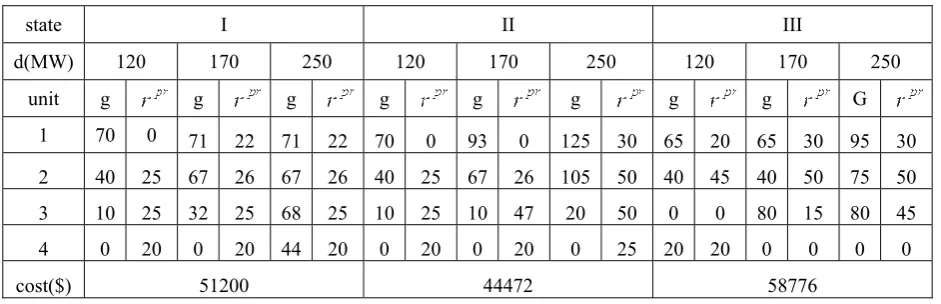
Scheduling of energy and primary reserve for three different cases is depicted in Table 8 as states I, II and III, respectively. It can be observed that when generating units do not have the capability of fast ramp rates (case I), the operation cost may be higher (approximately 15%) than the cases when generating units offer their primary reserve utilizing their fast ramp rate (case II). Also, when the primary frequency reserve capacity limits of generating units are considered (case III), the operation cost of energy and primary reserve will increase. Therefore, it can be concluded that considering primary frequency limits seriously affects simultaneous scheduling of energy and primary reserve.
Table 8. Generation levels and primary reserves (MW); four- generating units case; for a 24 hour period
state I IIIII
d(MW) 120 170 250 120 170 250 120 170 250
unit g g g g g g g g G
1 70 0 71 22 71 22 70 0 93 0 125 30 65 20 65 30 95 30
2 40 25 67 26 67 26 40 25 67 26 105 50 40 45 40 50 75 50 3 10 25 32 25 68 25 10 25 10 47 20 50 0 0 80 15 80 45 4 0 20 0 20 44 20 0 20 0 20 0 25 20 20 0 0 0 0
cost($) 51200 44472 58776
Fig. 7. Randomly load around 180 MW
Fig. 8. Energy price and its volatility for capabilities on only normal ramp rate (blue) and fast and normal ramp rates (red)
It can be observed in Fig. 8, if generating units utilize the selection capability of normal or fast ramp rates, the energy price and its fluctuations are decreased. Comparing these two cases, it can be seen that the average energy price by using only normal ramp rate and the selection capability of fast or normal ramp rates are equal to 11.69$/MWh and 10.71$/MWh, respectively. The domain of energy price fluctuations by using only normal ramp rate and the selection capability of fast or normal ramp rates are equal to 0.97 $/MWh and 0.25 $/MWh, respectively. This means by utilizing the selection capability of fast or normal ramp rates, total primary reserves of available generating unit increase and the system operator does not need to commit other generating units with more expensive operation costs. Therefore, by increasing the total primary reserve of generating units, the energy price and its fluctuations decrease.
b) Power system including 17-generating units
In this case, the scheduling of energy and primary reserve scheme has been applied to an isolated system including 17-generating units over a single period. Data and the characteristics of generating units are taken from [10]. For this system, three alternatives of simultaneous scheduling of energy and primary reserve are considered.
III. Generating units participate in frequency control with their capability of normal or fast ramp rates at primary frequency capacity limits.
In all cases, loss of one generator (N-1 criteria) at a time has been considered as the security criterion. Furthermore, in all the above cases, the primary reserve limits for the case of normal ramp are set to be equal to 50% of the primary reserve limits with fast ramp rate. The fast ramp rates are assumed to be equal
to those given in [10] ( fast pr
i pr
normal
i r
r − =0.5∗ − ). The maximum limits of primary reserve capacity are set to be equal to 90% of the maximum generation output and the minimum limits of primary reserve capacity are set to equal to twice the minimum generation output ( max 0.9 max
i pr
i g
g − = ∗ and min 2 min
i pr
i g
g − = ∗ ). All
units have a regulation droop of 5%. System frequency and maximum allowed frequency deviation are assumed to be 50 and 0.5Hz, respectively. The system load is assumed to be 1700 MW. It is also assumed that the primary reserve incremental costs of generating units with normal and fast ramp rates are set to one tenth and equal the linear generation cost components given in [10], respectively ( pr it
it a
q0 =0.1* and
it pr it a
q1 = ).
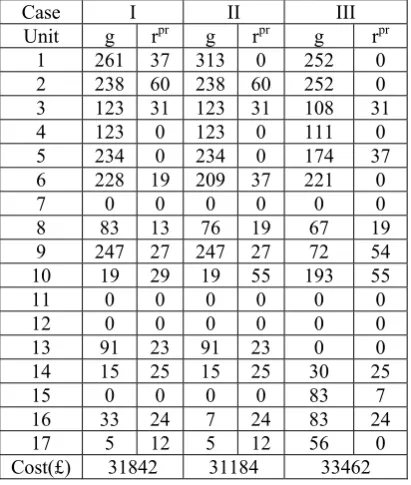
Table 9 illustrates the results obtained using the proposed heuristic method for the above three mentioned alternatives.
Table 9. Generation levels and primary reserves (MW); 17-generating units case Case
III III
Unit g g rpr rpr g rpr
1
261 37 313 2520 0
2
238 60 238 60 252 0
3
123 31 123 31 108 31
4
123 1230 1110 0
5
234 2340 1740 37
6
228 19 209 37 221 0
7 0 0 0 0 0 0
8
1383 76 19 67 19
9
247 27 247 27 72 54
10
19 29 19 55 193 55
11 0 0 0 0 0 0
12 0 0 0 0 0 0
13
91 23 91 23 0 0
14
15 25 15 25 30 25
15 0 0 0 830 7
16
33 24 247 83 24
17
125 125 56 0
Cost(£) 31842 31184 33462
The results confirm that if generating units participated in primary frequency control with the selection capability of normal and fast ramp rates (case II), the operation costs are less than case I. In case II, generating units 6, 8 and 10 participate in primary frequency control with fast ramp rate.
Considering cases II and III (Table 8), it can be observed that considering primary frequency reserve capacity limits in scheduling formulation not only affects the scheduling, but also its operation cost. Therefore, it can be concluded that considering primary frequency reserve capacity limits affects simultaneous scheduling of energy and primary reserve.
6. CONCLUSION
operating ranges and are limited. On the other hand, modern generating units benefit having the selection capability of operation modes such as participation modes in primary frequency control and normal or fast ramp rates. The effect of such capabilities and constraints on simultaneous scheduling of energy and reserve has not received enough attention in previous investigations.
In this paper, the constraints and capabilities associated with old and new generating technologies are explained and their effect on simultaneous scheduling of energy and primary reserve is investigated. In our study, only credible contingencies, and negative frequency deviations following each contingency have been considered.
To solve the problem a heuristic iterative method based on genetic algorithm (GA) has been proposed. To avoid unfeasible solutions, a new strategy for coding binary variables, which eliminates unfeasible states from the optimization process, is used. This strategy results in reduction of the computation time.
Simulation results confirm that considering the operational constraints and capabilities of generating units will not only result in a lower cost of supporting the required reserve, but also will end in a feasible solution. The method can also be developed and generalized for considering tertiary reserve. In addition, the results of simulations under conditions similar to Iran's electricity market show that the use of fast ramp rate led to serious reduction in the average energy price and its fluctuations. In other words, using the fast ramp rate may result in increasing the amount of total available primary reserve for competition, which in turn will result in reduction of the prices in the market.
NOMENCLATURE
Variables
it
g
scheduled generation of unit i during time period tit
g
maximum generation of unit i during time period t under primary frequency controlt
f
Δ
frequency deviation during time period t for the worst contingency bit
f
Δ frequency deviation during time period t when unit i is operated at its maximum
g
it. prit
r scheduled primary reserve of generating unit i during time period t
Binary variables (0/1)
it
u
the operation status of generating unit i during time period t (equals 1 if the unit is on and zero if it is off).it
v
the operation status of generating governor unit i during time period t (equals 1 if the governor is in active mode and zero if it is not.).it
w
ramp rate status mode (Equals 1 if the unit i is operated in fast ramp rate mode during time period t and zero if it is not.).it
y
equals 1 if unit i turns on during time period t and equals zero if it does not.it
z
equals 1 if unit i turns off during time period t and equals zero if it does not.Parameters
t
d
demand of the system during time period tit
a
linear generation cost parameter of unit i during time period t.it
0
it
C fixed generation cost of unit i during time period t.
)
(
it ig
E
emission function of unit i at time period t. suit
C start-up cost of unit i during time period t. su
it
E cost of unit i for Start-up emission during time period t. )
(i
EMS emission cap for unit i.
EMS system emission cap
sd it
C cost of unit i for shut-down during time period t. pr
it
q0 primary reserve rate during time period t in normal ramp rate state for unit i. pr
it
q1 primary reserve rate during time period t in fast ramp rate state for unit i.
min
f
Δ
maximum system frequency deviation allowed.max
i
g maximum generation output of unit i.
min
i
g minimum generation output of unit i.
max
− pr i
g maximum generation output of unit i during primary frequency control.
min
− pr i
g minimum generation output of unit i during primary frequency control. pr
normal i
r − normal ramp-up limit of unit i under primary frequency control. pr
fast i
r − fast ramp-up limit of unit i under primary frequency control.
i
R
droop of unit i.REFERENCES
1. Wood, A. J. & Wollenberg, B. F. (1996). Power generation operation and control. 2nd Ed. New York: Wiley. 2. Rebours, Y. G., Kirschen, D. S., Trotignon, M. & Rossignol, S. (2007). A survey of frequency and voltage
control ancillary – Part I: Technical features. IEEE Trans. Power Syst., Vol. 22, No. 1, pp.1106–1112.
3. Koessler, R. J., Feltes, J. W. & Willis, J. R. (1999). A methodology for management of spinning reserves requirements. Proc. IEEE Power Eng. Soc. Winter Meeting, Vol. 1, pp. 584–589.
4. Jalleli, N., Ewart, D. N., Fink, L. H. & Hoffmann, A. G. (1992). Understanding automatic generation control.
IEEE Trans. Power Syst., Vol. 7, No. 3, pp.1106–1112.
5. Singh, H. & Papalexopoulos, A. (1999). Competitive procurement of ancillary services by an independent system operator. IEEE Trans. Power Syst., Vol. 14, No. 2, pp. 498–504.
6. Muwaffaq Irsheid Alomoush, (2010). Load frequency control and automatic generation control using fractional-order controllers. Electrical Engineering. doi: 10.1007/s00202-009-0145-7.
7. Restrepo, J. F. & Galiana, F. D. (2005). Unit commitment with primary frequency regulation constraints. IEEE Trans. Power Syst., Vol. 20, No. 4, pp. 1836-1843.
8. Kirschen, D. GoranStrbac, (2004). Fundamentals of power system economics. John Wiley & Sons Ltd, England. 9. Galiana, F. D., Bouffard, F., Arroyo, J. M. & Restrepo, J. F. (2005). Scheduling and pricing of coupled energy
and primary, secondary, and tertiary reserves. Proceedings of the IEEE, Vol. 93, No. 11, pp. 1970-1984.
10. O’Sullivan, J. W. & O’Malley, M. J. (1999). A new methodology for the provision of reserve in an isolated power system. IEEE Trans. Power Syst., Vol. 14, No. 2, pp. 519–523.
11. Papadogiannis, K. A. & Hatziargyriou, N. D. (2004). Optimal allocation of primary reserve services in energy market. IEEE Trans. Power Syst.., Vol. 19, No. 1, pp. 652–659.
13. Thalassinakis, E. J. & Dialynas, E. N. (2007). A method for optimal spinning reserve allocation in isolated power systems incorporating an improved speed governor model. IEEE Trans. Power Syst., Vol. 22, No. 4, pp. 1629–1637.
14. Kazemi & H. Andami, (2009). A decentralized fuzzy logic enhanced variable structure controller applied to load frequency control system. Iranian Journal of Science and Technology, Transaction B: Engineering, pp. 295-303.
15. Afshar, K., Ehsan, M., Fotuhi-Firuzabad, M., Ahmadi-Khatir, A. & Bigdeli, N. (2008). A new approach for reserve market clearing and cost allocating in a pool model. Iranian Journal of Science and Technology, Transaction B: Engineering, pp. 593-602.
16. Grey, B. A., & Arun Sekar, G. R. (2007). Determination of spinning reserve deployment using an extended economic dispatch to include line flow limits and primary frequency regulation. IEEE 39th Southeastern Symposium on System Theory, pp. 37-41.
17. Kelefenz, G. (1986). Automatic control of steam power plants. Transl. Vladimir F. Tomek-3, ed. Mannheim, Wien, Zurich.
18. Kehler, J. H. (1999). Frequency regulation from steam turbine generators. Power Engineering Society Winter Meeting, IEEE, Vol. 1, pp. 775 – 776.
19. Asgari, M. H., Tabatabaei, M. J., Riahi, R., Mazhabjafari, A., Mirzaee, M. & Bagheri, H. R. (2008). Establishment of regulation service market in Iran Restructured Power System. Canadian Conference on Electrical and Computer Engineering, pp. 713-718.
20. Bilenko, V. A., Melamed, A. D., Mikushevich, E. E. & Nikol’skii, D. Y. (2009). Consideration of technological constraints and functional abnormalities in the algorithms of systems for automatically controlling the frequency and power of power units. Thermal Engineering, Vol. 56, No. 10, pp. 805–814.
21. Primary frequency control test results in power plants of Iran, (2009). IGMC reports. 22. The manual for Control System and O&M of V94.2 Gas Turbines, Ansaldo Company.
23. Sheathe, G. B. & Goel, K. S., L. (2004). Strategic self-dispatch considering ramping costs in deregulated power markets. IEEE Trans. Power Syst., Vol.19, No.3, pp. 1575- 1581.
24. Lu, B. & Shahidehpour, M. (2005). Unit commitment with flexible generating units. IEEE Trans. Power Syst., Vol. 20, No.2, pp.1022–1035.
25. Swarup, K. S. & Yamashiro, S. (2002). Unit commitment solution methodology using genetic algorithm. IEEE Trans. Power Syst., Vol. 17, No. 1, pp.87-91.
26. Lee, K. Y. & El-Sharkawi, M. A. (2008). Modern heuristic optimization techniques theory and application to power system. John Wiley & Sons, Inc., Hoboken, New Jersey.
![Table 2 shows typical values of primary frequency capacity limits for different types of generating units [21]](https://thumb-us.123doks.com/thumbv2/123dok_us/21040.2002260/4.595.229.378.428.522/table-typical-values-primary-frequency-capacity-different-generating.webp)
![Fig. 3. Normal and fast loading ramp rates for a typical 159 Mw gas turbine unit [22]](https://thumb-us.123doks.com/thumbv2/123dok_us/21040.2002260/5.595.110.476.154.440/fig-normal-fast-loading-ramp-rates-typical-turbine.webp)