IJE TRANSACTIONS A: Basics Vol. 32, No. 1, (January 2019) 36-45
Please cite this article as: N. Shahbazi, S. Tariverdilo, A. Amani Dashlejeh, Effects of Radial Imperfection on the Load Capacity of Round Hollow Structural Section Columns, International Journal of Engineering (IJE), IJE TRANSACTIONS A: Basics Vol. 32, No. 1, (January 2019) 36-45
International Journal of Engineering
J o u r n a l H o m e p a g e : w w w . i j e . i rEffects of Radial Imperfection on the Load Capacity of Round Hollow Structural
Section Columns
N. Shahbazi*a, S. Tariverdilob, A. Amani Dashlejehc
a,b Faculty of Engineering, Urmia University, Urmia, Iran
c Faculty of Engineering, University of Mohaghegh Ardabili, Ardabil, Iran
P A P E R I N F O
Paper history:
Received 13 November 2018
Received in revised form 4 December 2018 Accepted 03 Januray 2019
Keywords: Column Steel Structures Radial Imperfection Load Capacity Buckling
A B S T R A C T
Geometric imperfections such as radial imperfection, diamond shape, and local dimples could affect the buckling mode and load carrying capacity of axially compressed steel tubular columns. This paper experimentally investigates the effect of radial imperfection on the load carrying capacity of tubular columns. Test samples include 100 specimens with different values for diameter, length, thickness, imperfection amplitude and imperfection location. Considering applications of columns in buildings, bridges, and offshore jackets, diameter to thickness and slenderness ratios were varied between 20-90 and 17-181, respectively. Results showed that depending on the slenderness ratio and the severity of the imperfection, there was a significant difference between buckling loads of perfect and imperfect specimens.
doi: 10.5829/ije.2019.32.01a.05
NOMENCLATURE
𝐴 Area (mm2) LB Local Buckling (abbreviation) 𝐴𝑒 Effective area (mm2) 𝐿𝑒 Effective length (mm) 𝐴𝑔 Gross area (mm2) P Axial Load (kgf) 𝐶𝑐 Critical slenderness (mm/mm) 𝑃𝑐𝑟 Critical load (kgf)
D Diameter (mm) 𝑃𝑒𝑢 Global critical load, Euler load, 𝜋2𝐸𝐼 𝐿⁄2 (kgf) 𝐸 Elasticity modulus (kgf/cm2) 𝑃
𝑢 Ultimate axial load (kgf) 𝑒 Eccentricity of axial compression (mm) Q Quarter (abbreviation)
𝑒0 Eccentricity of axial compression in the unloaded state (mm) R Radial imperfection location (mm)
EP Elephant foot (abbreviation) 𝑟 Radius of gyration (mm)
𝐹𝑎 Allowable stress (kgf/cm2) t Thickness (mm)
𝐹𝑒 elastic buckling stress (kgf/cm2) ymax Maximum distance from cross section neutral axis (mm) 𝐹𝑦 Yield stress (kgf/cm2) Greek Symbols
GB Global buckling (abbreviation) 𝜆 Slenderness ratio (mm/mm)
𝐼 Moment of inertia (mm4) 𝜎 Stress (kg/cm2)
IL Imperfection location (abbreviation) 𝜎𝑐𝑟 Critical stress (kg/cm
2) 𝐾𝑛𝑙 Correction coefficient 𝜎𝑚𝑎𝑥 Maximum stress (kgf/cm
2)
𝑀 Bending moment (kgf.cm) 𝜎𝑃, 𝜎𝑒𝑃 Direct stress from compression P at centroid, and stress from flexure due to eccentricity (e) of load P (kgf/cm2)
ML Mid height (abbreviation) 𝜎𝑢 Ultimate stress (kgf/cm
2)
L Length (mm)
1. INTRODUCTION
Circular steel columns are widely used in different structures such as bridges, buildings, offshore structures, elevated tanks, oil jackets with different diameter to thickness and slenderness ratios. The problem of buckling behavior of imperfect columns has been an interesting topic for researchers for several decades. The theory of buckling capacity of hollow structural section columns was determined in classic theory (Timoshenko) [1] and Starnes [2] performed an experimental and numerical study on the buckling effect of circular, square and rectangular cutouts in hollow structural section (HSS) columns subject to axial compression.
Geometric imperfection could affect the buckling load of axially loaded steel tubular columns [3, 4]. Researchers have also tried to clarify the interaction between local and global buckling of HSS columns. Chajes [5] reviewed the importance of imperfection in the stability behavior of various types of structural elements [6]. Many surveys on the influence of initial imperfection on the stability of elastic systems were done by Koiter [7]. He clarified the concept of imperfection sensitivity [8].
Krishnakumar and Foster [9] investigated the load carrying capacity of HSS columns with local imperfections. Tafreshi and Colin [10] performed a numerical non-linear finite element study to evaluate the response of composite HSS columns subjected to combined loads, and carried out the post-buckling analysis to investigate the effect of imperfection magnitude on buckling load. Common types of tubular members include square, rectangular and circular hollow sections. Elliptical hollow sections have been recently entered to the construction market. These sections can show better performance than circular hollow sections, especially when the applied bending moment is about the stronger axis or in case of differing lateral load carrying systems in two directions. Some examples of the use of elliptical hollow sections compromise airports at Heathrow in London, UK and Barajas in Madrid, Spain. Previous studies investigated cross-section classification, cross-section design strength in compression and bending about both principal axes and combined shear and bending [11]. Shariati and Mahdizadeh [12] studied the buckling behavior of HSS columns with an elliptical cutout experimentally and numerically. Shu et al. [13] investigated the behavior of cold-formed stainless steel stub columns with square cross section, experimentally and theoretically. Ghanbari, et al. [14] also investigated steel circular tubes with imperfection under axial load experimentally. Guo et al [15] investigated the behavior of thin-walled HSS stub columns under axial compression. Kalantari and Razzaghi [16] implemented a parametric study on vertically stiffened cylindrical shells to investigate the buckling capacity using ANSYS
software. Rastgar and Showkati [17] monitored the construction of steel cylindrical tanks in one of the refinery site using a field survey and introduced the created imperfections. Most of these studies have investigated the imperfection effect on short columns with low slenderness and with limited number of samples, which cannot represent the behavior of structures and buildings’ columns.
This paper presents an experimental study on 100 specimens included radial geometric imperfection with 5 diameters (50.8, 38.1, 25.4, 20 and 13 mm), two magnitudes of imperfection (D/8 and D/4), different locations for imperfection (Mid-height and Quarter-height) and different slenderness ratios (17 to 181) and investigates the interaction between these imperfections and the columns load carrying capacity.
2. LOAD CARRTING CAPACITY OF TUBULAR COLUMNS
Load carrying capacity of tubular columns is controlled by interaction between its local and global buckling modes. This section reviews AISC 360 [18] requirement regarding global and local buckling of steel tubular columns.
The Euler elastic buckling load of columns is given by following equation:
𝑃𝑐𝑟= 𝜋2𝐸𝐼
(𝐿𝑒)2 (1)
Considering 𝜆 =𝐿𝑒
𝑟 and 𝑟 = √ 𝐼
𝐴, the corresponding stress will be
𝐹𝑒= 𝑃𝑐𝑟
𝐴 =
𝜋2𝐸
(𝜆)2 (2)
This elastic buckling load is only applicable to slender column. Considering the effect of residual stresses, AISC 360 [18] accounts for elasto-plastic buckling for columns with critical stress carrying capacity as follows:
- For slender columns with 𝜆 > 4.71√𝐹𝐸
𝑦 or 𝐹𝑒< 0.44𝐹𝑦
𝜎𝑐𝑟= 0.877𝐹𝑒 (3a)
- For short columns with 𝜆 ≤ 4.71√𝐹𝐸
𝑦 or 𝐹𝑒≥ 0.44𝐹𝑦
𝜎𝑐𝑟= [0.658 𝐹𝑦
𝐹𝑒] 𝐹𝑦 (3b)
Most of building columns could be categorized as short columns that experience inelastic buckling [19, 20].
According to AISC 360 [18], D/t or b/t ratios should be controlled in tubular sections. The effective section area (𝐴𝑒) in circular hollow sections with slender elements is calculated based on D/t ratio as follows:
- For 𝐷 𝑡 < 0.11
38 N. Shahbazi et al. / IJE TRANSACTIONS A: Basics Vol. 32, No. 1, (January 2019) 36-45
Ae= Ag (4a)
- For 0.11𝐸 𝐹𝑦<
𝐷 𝑡 < 0.45
𝐸 𝐹𝑦
𝐴𝑒= [0.038𝐸 𝐹𝑦(𝐷 𝑡⁄ )+
2
3] 𝐴𝑔 (4b)
For ST37 steel local buckling happens when D/t ratio is greater than 96.25(=0.11𝐸
𝐹𝑦). Considering practical applications and to remove the possibility of local buckling, in this study D/t ratio is taken smaller than 96.25 [21].
3. EFFECT OF IMPERFECTIONS ON THE LOAD CARRYING CAPACITY
Geometric imperfection causes eccentricity in the cross section. Eccentricity could give rise to perturbation in the stress pattern and cause a local increase in stress [22]. While axial tension reduces the possibility of formation of plastic hinging, axial compression steeply amplifies the perturbation in stress pattern and results in the formation of plastic hinge and failure of the column and decrease in column’s load carrying capacity [20].
Amplification of eccentricity due to axial compression could be formulated as follows:
𝑒 = 𝑒0𝐾𝑛𝑙 (5)
𝐾𝑛𝑙= 1 (1 − 𝑃 𝑃⁄ ⁄ 𝑒𝑢)= 𝑃𝑒𝑢⁄(𝑃𝑒𝑢− 𝑃) (6)
The eccentricity e of the compressive load P in a cross section increases the maximum stress from uniform compressive stress 𝜎𝑃 to 𝜎𝑚𝑎𝑥
𝜎𝑚𝑎𝑥= 𝜎𝑃+ 𝜎𝑒𝑃 (7)
𝜎𝑃= 𝑃 𝐴⁄ (8)
𝜎𝑒𝑃= 𝑃𝑒 𝑦𝑚𝑎𝑥⁄𝐼 (9)
where 𝑦𝑚𝑎𝑥 is the maximum distance on the section from its neutral axis, and I represents section's moment of inertia. The stress increase 𝜎𝑒𝑃 could be significant in a slender column even if the initial imperfection 𝑒0 is minor relative to the column length [23, 24].
In order to quantitatively capture the geometric interaction of local and global failure in design, one should limit the maximum stress in Equation (7), evaluated in the context of the nonlinearly amplified eccentricity, and in Equatios (5) and (6), to the local critical threshold [24-26].
4. EXPERIMENTAL PROGRAM
An experimental study was conducted in order to evaluate the effect of radial geometric imperfection on
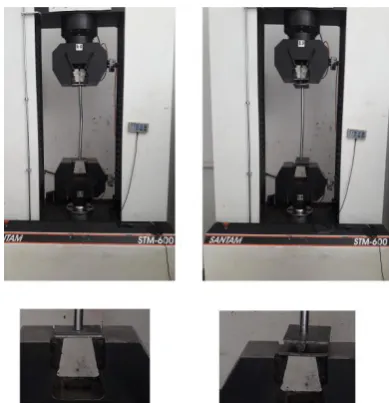
the load carrying capacity of tubular columns with different slenderness ratios and severities and locations of imperfection. The experimental setup is shown in Figure 1. The load was statically applied to the specimens with a hydraulic jack to 50000 kg with a loading rate of 2 mm/min as axial load. A linear variable differential transformers (LVDT) was placed at the end of the column to measure the axial displacement. The simply and pinned supports were used in two ends of specimens as shown in Figure 1.
HSS columns are widely used in tall buildings due to their aesthetic appearance. They are also used in parking buildings, bridges, offshore oil jackets, piers, air tanks, industrial buildings and etc. Tubular columns are known as economic sections because of their section properties (less material and better performance). So it is important to evaluate their buckling behavior. Different types of imperfection that can occur in tubular sections or thin-walled cylindrical shells include mechanical and geometric imperfections. Mechanical imperfections include residual stress, load eccentricity and lack of fit. Geometric imperfections, which is the goal of the current study, include initial bowing, radial imperfection, crack and diamond shape imperfections. Bjornsson [27] studied the initial imperfection effect on columns behavior with solving some examples.
Radial imperfection, which is studied in this paper, usually occurs as a result of impact and sometimes accompanies a hole. Radial imperfection causes a reduction in the moment of inertia and increases the eccentricity and consequently results in a decrease in load carrying capacity of the column by helping plastic hinge formation in the imperfection location. Steel balls with different diameters and a vise were used to impose imperfection with different amplitudes in experimental procedure.
Also to control the amplitude of imperfection, a caliper was used as shown in Figure 2.
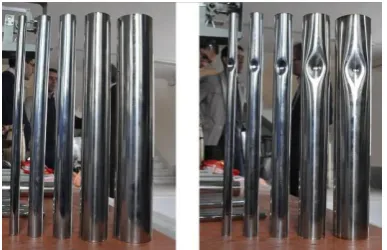
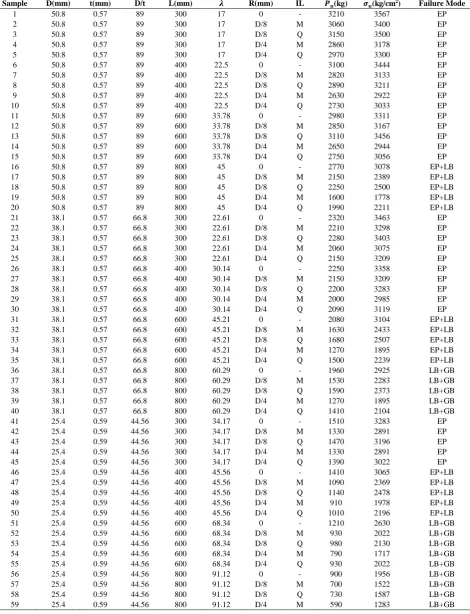
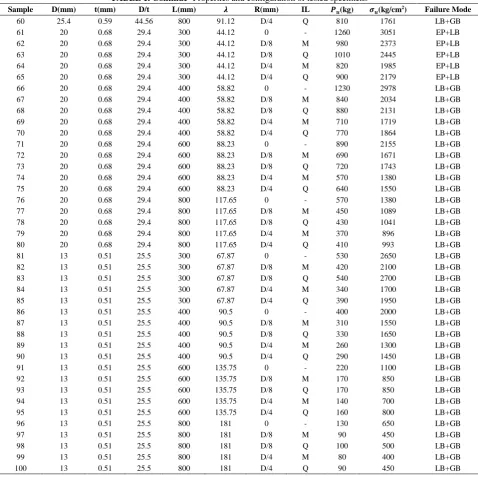
Experimental specimens should reflect properties of real columns. Therefore, 100 specimens were tested in this study with different heights (300, 400, 600, 800 mm), different severities of imperfection (D/8, D/4), different locations of imperfection (Mid-height and Quarter-height) and different diameters (50.8, 38.1, 25.4, 20, 13 mm) as shown in Figures 3 and 4. Properties of the specimens and experimental results are shown in Table 1.
5. RESULTS AND DISCUSSION
Different types of failure of HSS column include elephant foot failure, local buckling with elephant foot failure and local buckling with global buckling. Elephant foot failure occurs without buckling in columns with low slenderness. Elephant foot is actually a local failure in the support (Figure 5). According to Shariati et al. [12] and Ghanbari et al. [14], short columns (low slenderness) fail with elephant foot mode and imperfection is not detrimental on the compression member behavior. Results of these studies were in line with our results, but their specimen sizes did not cover common sizes for structural elements. Unfortunately, studies on slender columns has been very limited.
Figure 2. Tools used to impose imperfection
Figure 3. Specimens with different diameters and equal
lengths
Figure 4. Specimens with different imperfections and
diameters
Local buckling with elephant foot failure occurs in columns with medium slenderness. This failure starts with local buckling in the imperfection location (diamond shape failure) and then is accompanied by elephant foot failure mode (Figure 6).
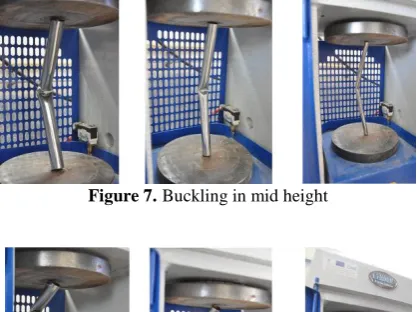
Local buckling with global buckling occurs in slender columns which are more prone to buckle. Depending on the amplitude of imperfection, local buckling can occur in the middle or quarter height (imperfection location) and results in global buckling (Figures 7 and 8).
Due to use of simple space frame plus bracing as the structural system in the most of common buildings (continuous columns and pinned connection of beams), it is predicted that simply support condition can result in realistic results. The load carrying capacity and failure types of samples with simply and pinned supports were tested and compared. Significant differences did not observe in the results. For example, elephant foot failure observed in both simply and pinned supported specimens with 50.8 mm diameter and 600 mm length (λ=33.78). Local buckling and elephant foot failure occurred in both simply and pinned supported specimens with 38.1 mm diameter and 600 mm length (λ=45.21). Also, both simply and pinned supported specimens with 20 mm diameter and 600 mm length (λ=88.23) failed due to local and global buckling.
According to the experimental results of 100 HSS columns with 5 different diameters, heights and imperfections, and based on their behavior and failure modes, they can be classified in three groups:
-Tubes with low slenderness (λ<33.78); Failure starts at one end of the column and continues with elephant foot mode until the columns load carrying capacity ceases. The decrease in load carrying capacity is not significant in this state (EP) (Figure 5).
40 N. Shahbazi et al. / IJE TRANSACTIONS A: Basics Vol. 32, No. 1, (January 2019) 36-45
TABLE 1. Properties and configuration of tested specimens
Sample D(mm) t(mm) D/t L(mm) 𝝀 R(mm) IL 𝑷𝒖(kg) 𝝈𝒖(kg/cm2) Failure Mode
TABLE 1. Continue- Properties and configuration of tested specimens
Sample D(mm) t(mm) D/t L(mm) 𝝀 R(mm) IL 𝑷𝒖(kg) 𝝈𝒖(kg/cm2) Failure Mode
60 25.4 0.59 44.56 800 91.12 D/4 Q 810 1761 LB+GB 61 20 0.68 29.4 300 44.12 0 - 1260 3051 EP+LB 62 20 0.68 29.4 300 44.12 D/8 M 980 2373 EP+LB 63 20 0.68 29.4 300 44.12 D/8 Q 1010 2445 EP+LB 64 20 0.68 29.4 300 44.12 D/4 M 820 1985 EP+LB 65 20 0.68 29.4 300 44.12 D/4 Q 900 2179 EP+LB 66 20 0.68 29.4 400 58.82 0 - 1230 2978 LB+GB 67 20 0.68 29.4 400 58.82 D/8 M 840 2034 LB+GB 68 20 0.68 29.4 400 58.82 D/8 Q 880 2131 LB+GB 69 20 0.68 29.4 400 58.82 D/4 M 710 1719 LB+GB 70 20 0.68 29.4 400 58.82 D/4 Q 770 1864 LB+GB 71 20 0.68 29.4 600 88.23 0 - 890 2155 LB+GB 72 20 0.68 29.4 600 88.23 D/8 M 690 1671 LB+GB 73 20 0.68 29.4 600 88.23 D/8 Q 720 1743 LB+GB 74 20 0.68 29.4 600 88.23 D/4 M 570 1380 LB+GB 75 20 0.68 29.4 600 88.23 D/4 Q 640 1550 LB+GB 76 20 0.68 29.4 800 117.65 0 - 570 1380 LB+GB 77 20 0.68 29.4 800 117.65 D/8 M 450 1089 LB+GB 78 20 0.68 29.4 800 117.65 D/8 Q 430 1041 LB+GB 79 20 0.68 29.4 800 117.65 D/4 M 370 896 LB+GB 80 20 0.68 29.4 800 117.65 D/4 Q 410 993 LB+GB 81 13 0.51 25.5 300 67.87 0 - 530 2650 LB+GB 82 13 0.51 25.5 300 67.87 D/8 M 420 2100 LB+GB 83 13 0.51 25.5 300 67.87 D/8 Q 540 2700 LB+GB 84 13 0.51 25.5 300 67.87 D/4 M 340 1700 LB+GB 85 13 0.51 25.5 300 67.87 D/4 Q 390 1950 LB+GB 86 13 0.51 25.5 400 90.5 0 - 400 2000 LB+GB 87 13 0.51 25.5 400 90.5 D/8 M 310 1550 LB+GB 88 13 0.51 25.5 400 90.5 D/8 Q 330 1650 LB+GB 89 13 0.51 25.5 400 90.5 D/4 M 260 1300 LB+GB 90 13 0.51 25.5 400 90.5 D/4 Q 290 1450 LB+GB 91 13 0.51 25.5 600 135.75 0 - 220 1100 LB+GB 92 13 0.51 25.5 600 135.75 D/8 M 170 850 LB+GB 93 13 0.51 25.5 600 135.75 D/8 Q 170 850 LB+GB 94 13 0.51 25.5 600 135.75 D/4 M 140 700 LB+GB 95 13 0.51 25.5 600 135.75 D/4 Q 160 800 LB+GB 96 13 0.51 25.5 800 181 0 - 130 650 LB+GB 97 13 0.51 25.5 800 181 D/8 M 90 450 LB+GB 98 13 0.51 25.5 800 181 D/8 Q 100 500 LB+GB 99 13 0.51 25.5 800 181 D/4 M 80 400 LB+GB 100 13 0.51 25.5 800 181 D/4 Q 90 450 LB+GB
42 N. Shahbazi et al. / IJE TRANSACTIONS A: Basics Vol. 32, No. 1, (January 2019) 36-45
Figure 7.Buckling in mid height
Figure 8.Buckling in quarter height
In comparison with the former class, the decrease in load carrying capacity of imperfect column is more noticeable (EP+LB) (Figure 6).
-Tubes with slenderness ratios greater than 60.29; Failure starts with forming of the plastic hinge in the imperfection location and continues with global buckling. In these columns the decrease of load carrying capacity is significant (LB+GB) (Figures 7 and 8).
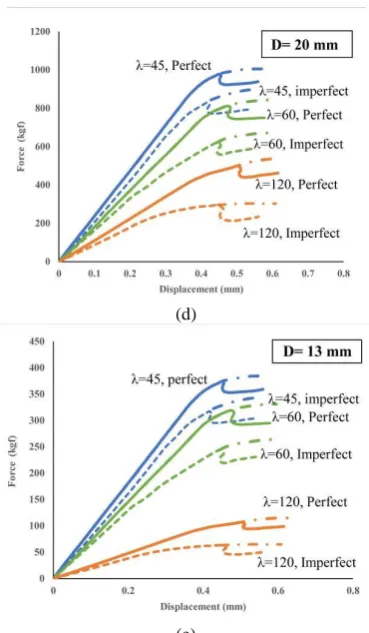
Force-displacement curves of the specimens with different diameters and slenderness ratios are shown in Figure 9. According to Figures 9a and 9b, for tubes with large diameters (D=50.8, 38.1 mm) and low slenderness and L/D ratios, deformation under the load is predominated by elephant foot failure at the end of column. In case of a severe imperfection, both elephant foot failure at the end and local buckling at the imperfect point will occur. Generally, imperfection does not have a significant influence on the load carrying capacity of these columns. By increasing the slenderness (λ), the section will show a different behavior, in which failure starts with local buckling in the imperfection location and continues with development of plastic hinge in that point and finishes with bifurcation. According to Figure 9c, for tubes with medium diameter (D=25.4 mm) and low slenderness and L/D ratios, deformation under the load is predominated by elephant foot failure at the end of column and imperfection does not have a significant influence. By increasing the slenderness (λ>40) failure starts with local buckling in the imperfection location and continues with the development of plastic hinge in this point and finally finishes with bifurcation. According to Figures 9d and 9e, for tubes with small diameters (D=20 or 13 mm), imperfection is detrimental and elephant foot
failure will not occur. Section fails with local buckling in the imperfection location which continues with plastic hinge development in the imperfection point and bifurcation.
Considering elephant foot failure in very short columns and elephant foot and local buckling failure in short columns, the decrease in their load carrying capacity is smaller than slender columns with local and global buckling. So, in a general classification, all columns can be classified in two groups as columns with slenderness ratio less than 40 and greater than 40. The imperfection severity effect on load carrying capacity of columns for different locations of imperfection is shown in Figure 10.
(a)
(b)
(d)
(e)
Figure 9. Force-Displacement curves of the specimens with
different diameter and slenderness
(a)
(b)
(c)
(d)
Figure 10. Effect of slenderness and imperfection on the
load carrying capacity
The results of this study have been shown in Figure 11, which aligns with the results of Somodi’s study [28] on flexural buckling resistance of high strength steel square columns. It is clear that the results of perfect specimens have good agreement with AISC360 [18].
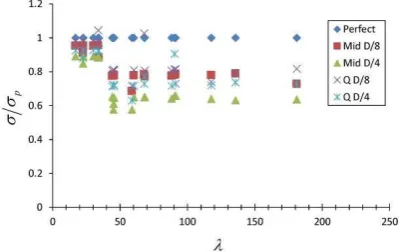
Considering experimental samples (100 samples) including perfect (P), sever imperfection in mid-height (IMH), low imperfection in mid-height (IML), sever imperfection in quarter-height (IQH) and low imperfection in quarter- height (IQL) in which low
Figure 11. Slenderness-Critical stress curves for
44 N. Shahbazi et al. / IJE TRANSACTIONS A: Basics Vol. 32, No. 1, (January 2019) 36-45
imperfection equals D/8 and sever imperfection equals D/4, the following graph shown in Figure 12 can be obtained.
For specimens with 17 < 𝜆 < 181, load carrying capacity decrease are 7-20%, 12-25%,15-30% and 22-45% for IQL, IML, IQH and IMH in comparison with the perfect specimens.
Figure 12.Slenderness and imperfection relation
6. CONCLUSION
According to the above results, column behavior in respect of imperfection influence can be classified in three groups:
- Very short columns: in which slenderness is less than 35 (λ<35), imperfection has a slight influence in decreasing the compression member’s load carrying capacity. Plastic hinge develops in one end or in imperfection location. The percentage of decrease in load carrying capacity is about 5-15%.
- Short columns: in which slenderness is in the range of 35-60 (35<λ<60). These columns have an elastic-plastic behavior under compression. Plastic hinge develops in imperfection location. The percentage of decrease in load carrying capacity is about 10-20%.
- Slender columns: in which slenderness is greater than 60 (60<λ<180). In these columns buckling occurs in the imperfection location and leads to column’s failure. The percentage of decrease in load carrying capacity in these columns is significant and is about 15-45%.
It should be noted that imposing the imperfection on the column cannot be very accurate, so there will be a slight difference between theoretic and experimental values.
7. REFERENCES
1. Timoshenko S.P., Gere J.M., “Theory of elastic stability”, 2nd ed. Singapore, McGraw-Hill, (1965).
2. Starnes, Jr. J. H., “The effects of cutouts on the buckling of thin shells”, Thin-shell structures, Prentice-Hall, (1974), 289-304.
3. Horton, W.H. and Durham, S.C., “Imperfections, a main contributor to scatter in experimental values of buckling load”,
International Journal of Solids and Structures, Vol. 1, No. 1,
(1965), 59-62, IN1-IN2, 63-70, IN3, 71-72.
4. Koiter, W.T., “The effect of axisymmetric imperfection on the buckling of cylindrical shells under axial compression”,
Academia van Wetenschappen-Amsterdam, Series B,No. 66,
(1963), 265-279.
5. Chajes, A., “Post-buckling Behavior”, Journal of Structural
Engineering, 109, (1983), 2450-2462.
6. Nishimori, F. “Influential mode of imperfection on carrying capacity of structures”, Journal of Engineering Mechanics, Vol. 115, (1989), 2150-2165.
7. Koiter, W.T., “About the stability of the elastic balance (in Dutch)”, Thesis Delft, Amsterdam, (1945).
8. Hutchinson, J. W. and Koiter, W. T., “Postbuckling theory”,
Applied Mechanics, Rev. 23, (1970), 1353-1366.
9. Krishnakumar, S. and Foster, C.G., “Axial load capacity of cylindrical shells with local geometric defects”, Experimental
Mechanics, (1991), 104-110.
10. Tafreshi, A., and Colin, G.B., “Instability of imperfect composite cylindrical shells under combined loading”, Composite
Structures, Vol.80, No. 1, (2006), 49-64.
11. Chan, T. M., and Gardner, L., “Flexural buckling of elliptical hollow section columns”, Journal of Structural Engineering,
(2009), 546-557.
12. Shariati, M., and Mahdizadeh Rokhi, M., “Buckling of steel cylindrical shells with an elliptical cutout”, International
Journal of Steel Structures, Vol. 10, No. 2, (2010), 193-205.
13. Shu, G., Zheng, B., and Shen, X., “Experimental and theoretical study on the behavior of cold-formed stainless steel stub columns”, International Journal of Steel Structures, Vol. 13, No. 1, (2013), 141-153.
14. Ghanbari Ghazijahani, T., Jiao, H., and Holloway, D., “Plastic buckling of dented steel circular tubes under axial compression: An experimental study”, Thin-Walled Structures, Vol. 92, (2015), 48-54.
15. Guo, L., Liu, Y., Jiao, H., and An, S. “Behavior of thin-walled circular hollow section stub columns under axial compression”,
International Journal of Steel Structures, Vol. 16, No. 3, (2016),
777-787.
16. Kalantari, Z., and Razzaghi, M. S., “Predicting the buckling Capacity of Steel Cylindrical Shells with Rectangular Stringers under Axial Loading by using Artificial Neural Networks”,
International Journal of Engineering (IJE), Transactions B:
Applications, Vol. 28, No. 8, (2015), 1154-1159.
17. Rastgar, M., and Showkati, H., “Field Study and Evaluation of Buckling Behavior of Cylindrical Steel Tanks with Geometric Imperfections under Uniform External Pressure”, International
Journal of Engineering, Transactions C: Aspects, Vol. 30, No.
9, (2017), 1309-1318.
18. “Specification for structural steel buildings”, American Institute of Steel Construction, Chicago: ANSI/AISC 360-16, (2016). 19. Salmon, C.G., Johnson, J.E., and Malhas, F.A., “Steel structures
design and behavior”, Prentice-Hall, (2009).
20. Greschik, G., “Global imperfection-based column stability analysis”, 48th structures, structural dynamics, and materials conference, April 23-26, (2007).
21. Gavrilenko, G.D., “Stability of cylindrical shells with local imperfections”, International Applied Mechanics, Vol. 38, No. 12, (2002), 1496–1500.
compressed cylindrical steel shells”, Computational Mechanic, Vol. 37, No. 3, (2006), 530–536.
23. Teng, J.G., and Rotter, J.M., “Buckling of pressurized axisymmetrically imperfect cylinders under axial loads”, Journal
of Engineering Mechanics, Vol. 118, (1992), 229-247.
24. Wullschleger, L., and Piening Meyer, H.R., “Buckling of geometrically imperfect cylindrical shells-definition of a buckling load”, International Journal of Non- Linear Mechanics, (2002), 645–57.
25. Gavrilenko, G.D., and Krasovski, V.L., “Stability of circular cylindrical shells with a single local dent”, Strength of Materials, Vol. 36, No. 3, (2004), 260–268.
26. Jiao, H., and Zhao, X.L., “Imperfection, residual Stress and yield slenderness of very high strength (VHS) circular steel tubes”,
Journal of Constructional Steel Research, Vol. 59, (2003),
233-249.
27. Bjornsson, T., “Structural analysis of columns with initial imperfections”, M.Sc. thesis, Faculty of Civil and Environmental Engineering, University of Iceland, (2017).
28. Somodi, B., “Flexural buckling resistance of high strength steel welded and cold-formed square closed section columns”, Thesis of dissertation, Faculty of Civil Engineering, Budapest University of Technology and Economics, (2017).
Effects of Radial Imperfection on the Load Capacity of Round Hollow Structural
Section Columns
N. Shahbazia, S. Tariverdilob, A. Amani Dashlejehc
a,b Faculty of Engineering, Urmia University, Urmia, Iran
c Faculty of Engineering, University of Mohaghegh Ardabili, Ardabil, Iran
P A P E R I N F O
Paper history:
Received 13 November 2018
Received in revised form 4 December 2018 Accepted 04 Januray 2019
Keywords: Column Steel Structures Radial Imperfection Load Capacity Buckling
هدیکچ
یلماکان یم یعضوم یگداتفادوگ و لکش یساملا ،یعاعش یلماکان نوچمه یسدنه یاه و شنامک دوم رب دنناوت
یربراب تیفرظ
یاهنوتس یربراب تیفرظ رب یعاعش یلماکان رثا هلاقم نیا .دنشاب راذگریثات یروحم یراشف یاهراب تحت کزانرادج یاهنوتس یم رارق یسررب دروم یهاگشیامزآ روط هب ار کزانرادج هزاس و اهلپ ،اهنامتخاس رد اهنوتس دربراک هب هجوت اب .دهد
،ییایرد یاه
تماخض هب رطق تبسن نیب بیترت هب یرغلا و
20 ات 90 و 17 ات 181 یم ناشن جیاتن .تسا هدش هتفرگ رظن رد هتسب هک دهد
هدمع توافت ،یلماکان تدش و یرغلا تبسن هب .دراد دوجو لماکان و لماک یاهنوتس یشنامک تیفرظ نیب یا
doi: 10.5829/ije.2019.32.01a.05