1
Surgery versus prolonged conservative treatment for sciatica
associated with lumbar disc herniation
Received: 22/9/ 2015 Accepted: 28/12/2015
Abstract
* Department of Neurosurgical,College of Medicine, Hawler Medical University, Erbil, Iraq. ** Department of Orthopedic,College of Medicine, Hawler Medical University, Erbil, Iraq. *** University of California, San Diego (UCSD), USA.
Introduction
Sciatica is characterized by radiating pain in an area of the gluteal region and leg caused by compression or irritation of one (or more) nerve root in the lumbar or sacral spine. It is sometimes also associated with sensory and motor deficits. Sciatica resulting from a lumbar intervertebral disc herniation is the most common cause of radicular leg pain in adult working populations.1 Such patients have a favorable natural history associated with resorption of extruded disc material, but surgical treatment is frequently considered
and performed in those with persistent or severe symptoms.2 The possibility that a patient with an intervertebral disc herniation will undergo surgery varies among healthcare providers due to their different opinions about the relative benefits of surgical and nonsurgical treatment.3 It also depends on the will of
the patient to undergo surgery and how much the patient can tolerate the sciatica pain while on conservative treatment. In general, Iraqi patients prefer conservative treatment rather than surgical. This has several reasons like the relative young Background and objective: There is little information available on comparing conservative versus immediate surgery results in the long run for patients with lumbar disc
herniation in the modern clinical practice. The aim of this study was to assess one-year outcomes of patients with sciatica resulting from a lumbar disc herniation treated surgically versus non-surgically in two hospitals in Erbil
Methods: A prospective comparative cohort study was conducted over two years (January 2010 to February 2012). A sample 100 patients, 50 treated surgically and 50
conservatively, were followed up for one year. All participants had baseline interviews with follow-up questionnaires filled in the next specially designed follow up visits along the study time at regular intervals of 2, 8, 28 and 52 weeks. The outcome included patient-reported symptoms of leg and back pain, functional status, satisfaction versus expectation and working capacity after treatment or overall disability degree.
Results: Change in the modified Roland back-specific functional status scale favored surgical treatment initially, and the relative benefit decreased but persisted over the follow-up period. Despite these differences, work and disability status at one year were
comparable among those treated surgically or non-surgically.
Conclusion: Surgically treated patients with a herniated lumbar disc had more complete relief of leg pain and improved function and satisfaction compared with non-surgically treated patients over one year. Nevertheless, improvement in the patient's predominant symptom and work and disability outcomes were closely similar regardless of treatment received.
Keywords: Herniated lumbar disc; Sciatica; Outcome research; Lumbar discectomy; Conservative management.
Methods
Between January 2010 and February 2012, we did a prospective comparative study of 100 patients with 6 to 12 weeks of severe sciatica associated with lumbar disc herniation (L4-L5) to determine whether a strategy of early surgery leads to better outcomes during the first year than does a strategy of conservative treatment for 6 months followed by surgery for patients
who do not have improvement from disabling sciatica. All the patients were assessed using the Roland Disability
Questionnaire for Sciatica13 and the 100-mm visual-analogue scale for back
and leg pain.14 Functional disability and intensity of back and leg pain were assessed at 2, 8, 28, and 52 weeks. The Roland-Morris disability scale (RMS) for disability secondary to low back pain is a validated and popular instrument in clinical practice and research. This list contains sentences that people have used to describe themselves when they have back pain. When a patient reads them, he/she may find that some stand out because they describe the patient’s status at the time he filled the questionnaire. The score of the RDQ is the total number of items checked – i.e. from a minimum of 0 to a maximum of 24. The patients were aged 18 to 65 years, had a radiological confirmation of disk herniation with lumbar radicular symptoms and signs for 6 to 12 weeks.
The diagnosis was based on MRI as the gold standard in the literature. We depended on the neurosurgeons and orthopedic surgeons participated in this study for the interpretation of the images to exclude variations of radiologist expressions and interpretation of the images and eliminate radiologists interpersonal bias. Exclusion criteria are
Cauda Equina Syndrome, muscle paralysis, grade 3 or less muscle weakness, previous spine surgery, spondylolisthesis, pregnancy and severe coexisting disease. From those 100 patients, 50 patients were treated by early surgery and 50 patients were treated by practice of modern neurosurgery and
orthopedics in Iraq compared with the United States and Europe. The majority of Iraqi patients prefer to go abroad to undergo surgery if they had to and when they are financially capable of bearing the extra expenses related to their travel. Another reason is word of mouth and other bad practice and surgery failure stories and rumors in the community that scares the patient away from the surgical option. This
also contributes to the delay in seeking the health provider services and support
higher failure rate related to late presentation and permanent deficit. The
main evidence for the relative benefit of surgical over nonsurgical treatment comes
from one randomized clinical trial performed over 30 years ago among 126
inpatients at a single referral hospital in Norway.4 It concluded that surgery was superior at one year and not significantly
better at four years compared with nonsurgical treatment. However, after ten
years, treatment outcomes were similar. The estimated annual incidence of sciatica in Western countries is 5 cases per 1000 adults.5 The prevalence of sciatica reported in the literature varies considerably ranging from 1.6% in the general population to 43% in the working population.6 The prognosis
of sciatica is good in most patients7 but up to 30% continue to have pain for one
3
conservative treatment. No ethical issue was encountered a long this study as all the treatment options were provided according to the most current protocols in the treatment of sciatica. A proper consent was signed by all the patients participated in this study explaining the study objectives and their rights.
one wound hematoma and one superficial wound infection. All complications resolved with conservative treatment. None of the patients had neurologic signs after surgery. After surgery, leg and concomitant back pain diminished quickly, whereas a slower
and linear recovery from pain were noted in the group receiving prolonged
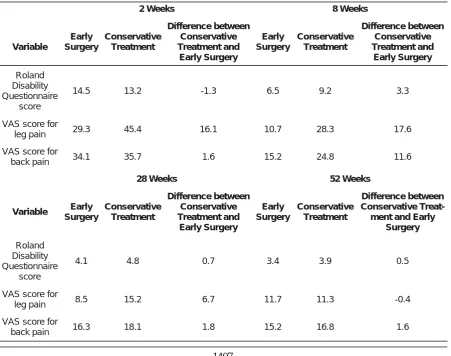
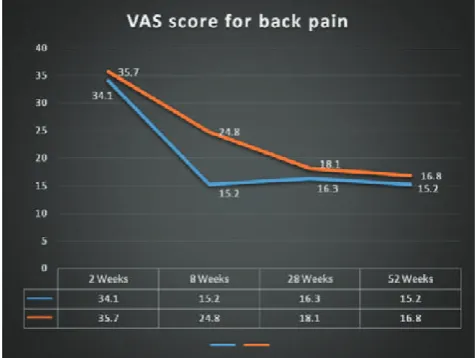
conservative treatment. After one year, the scores on the Roland Disability Questionnaire and the visual-analogue scale for leg pain had nearly equal recovery rates in the two groups. These results are shown in Table 1 and Figures 1, 2 and 3. Relief from leg pain occurred faster in the early-surgery group, but the maximum differences between the groups in the mean scores on the visual-analogue scale for leg pain were less than 20 mm on a 100 mm scale, and at one year the scores were nearly equal (Figure 3).
Results
Of the 50 patients who were treated with conservative treatment, 6 underwent surgery during the first year after a median period of 13 weeks because of intractable pain. In the early-surgery group, two patients had recurrent sciatica leading to a second surgical intervention, as compared with none recurrence in the conservative– treatment group who underwent surgery. Complications occurred in 3 patients of the surgical group; consisting of one dural tear,
Table 1: Variables at times of follow-up, 2, 8, 28 and 52 weeks.
2 Weeks 8 Weeks
Variable
Early Surgery
Conservative Treatment
Difference between Conservative Treatment and Early Surgery
Early Surgery
Conservative Treatment
Difference between Conservative Treatment and Early Surgery
Roland Disability Questionnaire
score
14.5 13.2 -1.3 6.5 9.2 3.3
VAS score for
leg pain 29.3 45.4 16.1 10.7 28.3 17.6
VAS score for
back pain 34.1 35.7 1.6 15.2 24.8 11.6
52 Weeks
Variable Early
Surgery
Conservative Treatment
Difference between Conservative Treatment and
Early Surgery
Early Surgery
Conservative Treatment
Difference between Conservative
Treat-ment and Early Surgery
Roland Disability Questionnaire
score
4.1 4.8 0.7 3.4 3.9 0.5
VAS score for
leg pain 8.5 15.2 6.7 11.7 11.3 -0.4
VAS score for
back pain 16.3 18.1 1.8 15.2 16.8 1.6
Figure 1: Roland Disability Questionnaire Score for surgical (orange line) versus non-surgical patients (yellow line)
Figure 2: (100-mm Visual-Analogue Scale) VAS Score for leg pain in surgical (blue line) versus non-surgical (red line) patients
5
At one year of follow-up, the difference between the groups in the mean scores for any outcome measurement was small, including leg pain. Thus, the major advantage of early surgical treatment is faster relief of sciatica. The scores on the Roland Disability Questionnaire did not reach the minimal clinically important difference of 4 points required to conclude that early surgery results in clinically superior outcomes.13,15 Weber compared
surgery with conservative care in a randomized clinical trial, which excluded
patients with “intolerable” pain, found the outcome of surgery was superior at one year follow-up, whereas after four years the results of surgery and conservative treatment no longer differed.16 Peul showed that the 1-year outcomes were similar for patients assigned to early surgery and those assigned to conservative treatment, but the rates of pain relief and perceived recovery were faster for those assigned to early surgery.17 Lequin concluded that after five years of follow-up, there were still no differences in pain and disability between the patients randomized for early surgery or prolonged conservative care.18
Rehabilitation of the patients at the hospital and home was supervised by
physiotherapists using a standardized exercise protocol. The patients were advised to resume their regular jobs when they were able, depending on the nature of their work. Treatment was aimed
mainly at enabling the patients to resume daily activities. If necessary, the
prescription of pain medication was adjusted according to existing clinical situation.
Surgical treatment indications
No predictive factors have been identified that can determine which patients are likely to improve on their own and which would be better served with surgery. Surgical indications in patients with a radiographically identified herniated disc that correlates with findings on the history and physical exam:
1. Failure of non-surgical management to control pain after 5-8 weeks: Most clinicians advocate waiting somewhere between 5-8 weeks from the onset of radiculopathy before considering surgery (assuming none of the items listed below applies)
2. “EMERGENT SURGERY”: (i.e. before the 5-8 weeks have lapsed). Indications: Caudaequina syndrome (CES):
Progressive motor deficit (e.g. foot drop). NB: paresis of unknown duration is a doubtful indication for surgery. However, the acute development or progression of
motor weakness is considered an indication for rapid surgical decompression
“Urgent” surgery may be indicated for patients whose pain remains intolerable in spite of adequate narcotic pain medication
3. Patients who do not want to invest the time in a trial of non-surgical treatment
if it is possible that they will still require surgery at the end of the trial.19
Surgical technique
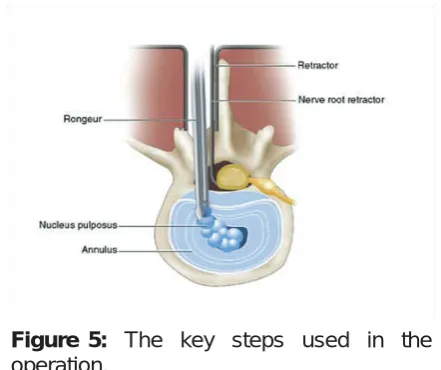
The symptomatic disk herniation was removed by a minimally invasive approach with the patient under general anesthesia. The goal of surgery was to decompress the nerve root and reduce the risk of recurrent disk herniation by performing an annular fenestration, curettage, and removal of loose degenerated disk material from the disk space with the use of a Rongeur, without attempting to perform a subtotal Discectomy (Figure 5).
Discussion
Figure 4 highlights the key steps used in the operation. After hemostasis is achieved, and adequate, counter tension-free traction is achieved with a nerve root retractor, a No. 11 blade can be used to incise the posterior longitudinal ligament carefully. The incision is made in a medial to lateral direction to direct the sharp end of the blade away from the dura. A pituitary rongeur was used to remove the disk material. A down-going Epstein curet or right-angled William’s instrument can be used to push down paracentral disk material into the now decompressed disk space. Demonstration taken from Jandial, Rahul; McCormick, Paul; Black, Peter M (2011-03-29). Core Techniques in Operative Neurosurgery: Expert Consult - Online (Kindle Locations 11164-11168). Elsevier Health Sciences. Kindle Edition.
Conclusion
In the present study, we conclude that early surgery for sciatica provides rapid relief of leg pain but with close differences in the clinical outcomes after one year in comparison with conservative treatment. However, early surgery is still a valid treatment option for a well-informed patient with sciatica.
7. Legrand E, Bouvard B, Audran M, Fournier D, Valat JP. Sciatica from disk herniation: medical treatment or surgery? Joint Bone Spine2007; 74:530–5.
8. Vroomen PC, Krom MC, Slofstra PD, Knottnerus JA. Conservative treatment of sciatica:
a systematic review. J Spinal Disord 2000; 13:463 –9.
9. Weber H, Holme I, Amlie E. The natural course of acute sciatica with nerve root symptoms in a double-blind placebo-controlled trial evaluating the effect of piroxicam. Spine (Phila Pa 1976) 1993; 18:1433–8.
10. Gibson JNA, Waddell G. Surgical interventions for lumbar disc prolapse. Cochrane Database of Systematic Reviews 2007.2.
11. Gregory DS, Seto CK, Wortley GC, Shugart CM. Acute lumbar disk pain: navigating evaluation and treatment choices. Am Fam Physician 2008; 78:835–42.
12. Wilco J, Mauritsvan T, Mark A, Sidney R, Marienke M, Raymond O, et al. Surgery versus conservative management of sciatica due to a lumbar herniated disc: a systematic review. Eur Spine J 2011; 20(4):513–22.
13. Patrick DL, Deyo RA, Atlas SJ, Singer DE, Chapin A, Keller RB. Assessing healthrelated quality of life in patients with sciatica. Spine1995; 20:1899–908.
14.Collins SL, Moore RA, McQuay HJ. The visual analogue pain intensity scale: what is moderate pain in millimetres? Pain 1997; 72:95–7.
15. Peul WC, van Houwelingen HC, van der Hout WB. Prolonged conservative treatment or ‘early’ surgery in sciatica caused by a lumbar disc herniation: rationale and design of a randomized trial. BMC Musculoskelet Disord 2005; 6:8. 16. Weber H. Lumbar disc herniation: a controlled,
prospective study with ten years of observation. Spine1983; 8:131–40.
17. Wilco C. Peul M, Hans C. Surgery versus Prolonged Conservative Treatment for Sciatica. N Engl J Med 2007; 356:22.
18. Lequin MB, Verbaan D, Jacobs WCH, Ronald B, Vandertop G, William P, et al. Surgery versus prolong conservative treatment of sciatica: 5-year results of randomized controlled trial. BMJ Open 2013; 3:e002534.
19. Greenberg S., Arredondo N. Handbook of Neu-rosurgery 2006. 6.
Conflicts of interest
The authors report no conflicts of interest.
References
1. Frymoyer JW. Back pain and sciatica. N Engl J Med 1988; 318:291–300.
2. Andersson GBJ, Brown MD, Dvorak J. Consensus summary on the diagnosis and treatment of lumbar disc herniation. Spine 1996; 24(suppl):75– 8.
3. Keller RB, Atlas SJ, Soule DN. Relationship between rates and outcomes of operative treatment for lumbar disc herniation and spinal stenosis. J Bone Joint Surg Am 1999; 81:752–62. 4. Weber H. Lumbar disc herniation: a controlled,
prospective study with ten years of observation. Spine 1983; 8:131–40.
5. Cherkin DC, Deyo RA, Loeser JD, Bush T, Waddell G. An international comparison of back surgery rates. Spine 1994; 19:1201–6.