Journal of Studies in Learning and Teaching English
Volume. 7, Issue. 1, Ser. 13, (2018), 47-68
The Effect of Using PRAAT Software on
Pre-Intermediate EFL Learners’ Supra
Segmental Features
Simin Aramipoor M.A Student of ELT Department Abadan Branch, Islamic Azad University
Abadan, Iran Bahman Gorjian∗
Associate Professor of ELT Department Abadan Branch, Islamic Azad University
Abadan, Iran Email: [email protected]
Abstract. The present study investigated the effect of using PRAAT as a free computer software package for the scientific analysis of speech in phonetics on pre-intermediate Iranian English as foreign language (EFL) learners’ supra segmental features (i.e., intonation and stress). The de-sign of the study was a Quasi-experimental research dede-sign with a pre and post-test. In doing so, 40 male and female majoring in English trans-lation with the age ranging from 19 to 37 years old were selected. They were studying EFL at the Islamic Azad University of Abadan, Iran. The participants were selected among 55 students through the Oxford Place-ment Test (OPT) and their level of proficiency was determined as the pre-intermediate level. Then they were divided into two experimental and control groups through convenience sampling method. Then they took a pre-test to evaluate their proficiency in supra segmental features (i.e. intonation and stress). The control group (n= 20) was exposed to the traditional method and the experimental group (n=20) was exposed to the use of PRAAT software in learning supra segmental features (i.e. intonation and stress). After the treatment sessions, both groups took the post-test that was a modified pre-test. Data were analyzed through Independent and Paired Samples t-tests. Result indicated the Received: January 2018; Accepted: April 2018
∗Corresponding author
47
Journal of Studies in Learning and Teaching English
Volume. 7, Issue. 1, Ser. 13, (2018), 47-68
The Effect of Using PRAAT Software on
Pre-Intermediate EFL Learners’ Supra
Segmental Features
Simin Aramipoor M.A Student of ELT Department Abadan Branch, Islamic Azad University
Abadan, Iran Bahman Gorjian∗
Associate Professor of ELT Department Abadan Branch, Islamic Azad University
Abadan, Iran Email: [email protected]
Abstract. The present study investigated the effect of using PRAAT as a free computer software package for the scientific analysis of speech in phonetics on pre-intermediate Iranian English as foreign language (EFL) learners’ supra segmental features (i.e., intonation and stress). The de-sign of the study was a Quasi-experimental research dede-sign with a pre and post-test. In doing so, 40 male and female majoring in English trans-lation with the age ranging from 19 to 37 years old were selected. They were studying EFL at the Islamic Azad University of Abadan, Iran. The participants were selected among 55 students through the Oxford Place-ment Test (OPT) and their level of proficiency was determined as the pre-intermediate level. Then they were divided into two experimental and control groups through convenience sampling method. Then they took a pre-test to evaluate their proficiency in supra segmental features (i.e. intonation and stress). The control group (n= 20) was exposed to the traditional method and the experimental group (n=20) was exposed to the use of PRAAT software in learning supra segmental features (i.e. intonation and stress). After the treatment sessions, both groups took the post-test that was a modified pre-test. Data were analyzed through Independent and Paired Samples t-tests. Result indicated the Received: January 2018; Accepted: April 2018
∗Corresponding author
48 S. Aramipoor and B. Gorjian
experimental group outperformed the control group. Implications of the study suggest that the EFL teachers can use PRAAT software to teach supra segmental features effectively.
Keywords:PRAAT Software, supra segmental features, pronunciation, EFL learners
1. Introduction
With the growing availability of computers into teaching and learning process, majority of second language (L2) teachers now have the options of using a wide variety of educational computer software to help their students to practice speaking and then to improve their pronunciation (Chou, 2005). Recently teachers of foreign languages have claimed that technology should not be ignored in languages classroom and should adopt it and find suitable computer software to facilitate the process of the second language (L2) learning and help their students to improve their pronunciation by a modern way (Andoh, 2012).
PRAAT is a free computer software package for analyzing the pho-netic structures and patterns of sounds. This software was designed by Paul Boersma and David Weenink (2018) at the University of Amster-dam. PRAAT is a Dutch word which means talk, and was developed by two phoneticians (i.e., Boersma & Weenink, 2018). PRAAT technol-ogy has been used widely in teaching pronunciation as a pedagogical tool. Several studies (e.g., Boves, Cucchiarini, Neri & Strik, 2002; Wil-son, 2005) showed that using technology might enhance learners’ moti-vation.
The PRAAT software can be a great tool to help non-native speak-ers to improve their pronunciations by practicing supra segmental fea-tures. PRAAT is simple to use, and L2 learners will be able to record their own voices and see a spectrogram with different types of analysis such as pitch, intensity and formants (Chou, 2005).
The Effect of Using PRAAT Software ... 49
utterances and it does not refer to certain vowels and consonants but it refers to whole syllables or a word is pronounced more prominence than the other words (Ladefoged & Johnson, 2010).
Harrison, Kondo, Lee, Meng, and Viscelgia (2009) highlighted the importance of supra-segmental features training for L2 learners since they must appropriate their oral productions for effective communica-tion. However, this learning process includes practice on sounds articula-tory motions design and collect systematic analysis of L2 supra segmen-tal features. In this area selected textual environments are important too, because it shows how supra segmental features convey information such as, part of speech, syntax, speech acts and semantics. In this area, stress and intonation are important for correct word pronunciations and effect on encoding information structure that helps the listener to iden-tify meaning words, phrase boundaries and speech acts.
Mott (1991) stated that English pronunciation could be a mixture of Germanic and Roman languages. Thus, L2 teachers must be able to solve these which problems with proper tools and materials. However, it seems that these features are too difficult for both EFL teachers and learners to deal with by using traditional approaches.
Teaching and learning English pronunciation is the most difficult and important to acquire not only for the students but for English teachers as well (Daryagasht & Khodabandehlou, 2014). Accordingly one prob-lem of Iranian EFL learners for acquiring good pronunciation is the lack of ability to produce and apply the supra segmental features (i.e., in-tonation and stress) corectly. In this case, the learners face the lack of ability to produce four types of intonation patterns (i.e., Falling, Rising, Falling-Rising, Rising-Falling). This may be due to the interference of their mother tongue (i.e., L1) or unfamiliarity with the importance of using correct intonation patterns of the native language (i.e., L2).
50 S. Aramipoor and B. Gorjian
learn and remember some of these stress and intonation rules in English language. In this case, PRAAT software could be used to practice supra segmental features (i.e., intonation and stress). Therefore, the students can record and hear their own pronunciations and improve it by modern tools.
This study aims to examine the effect of PRAAT software on learn-ing supra segmental features that help the EFL learners to improve their pronunciation after the experiment. The researcher focuses on the area of supra segmental that is, intonation and stress, because these are not paid attention by non-native speakers of English. It also deals with in-tonation, because intonation functions deal with distinguishing between question types and the way in which questions differ from statements and used to express speakers’ personal attitudes or emotion (Nasiri, Soltani Moghaddam, Sepehrinia & Zarea, 2012).
2. Literature Review
2.1. Using technology in education
Saka, Yildirim and Zayim (2006) claimed higher education institutions have concerned for supporting the use of technology in education sys-tem. There are many reasons both technical and societal to explaining why technologies have not been widely used; however, the major rea-son is the lack of motivation to adopt and use technology motivation in education process. In this area, technology adoption integrated the pro-cess of involving people, ideas, procedures, devices and organizations, for analyzing problems and devising, evaluating and managing solutions to those problems involved in all aspects of human learning.
The Effect of Using PRAAT Software ... 51 According to Carney, Kyza, Reiser, Sorsa, Steinmuller and Spillane (2000), teachers concern both technology match to the level of learners and the difficulty of access to use the academic technology. L2 teachers are also concerned chiefly with the ready and open-ended nature of the tasks, learners’ skills and background conceptual knowledge.
While the use of electronic communication technology as a medium of instruction is just beginning in basic education, it could be a dominant attitude over the next decade. The use of technology in the language classroom contributes to the L2 teacher training and the pedagogical strategies that help the teachers to use effective curriculum (Chapman & Mahlck, 2004).
2.2. Supra segmental features
Birjandi and Salmani- Nadoushan (2005) referred to the term supra segmental features as distinguishing different sound segments of English language. These features were considered the qualities of sound seg-ments; they are sometimes called segmental features. Phoneticians have classified supra-segmental features to five categories, include (a) stress, (b) tone, (c) intonation, (d) length, and (e) syllable.
Supra segmental features can be classified based on their linguistic domain, which is ranging from the shorter lexical (phonemic) level to the longer (sentential) level. In phonetics, the smallest segment is a phone; and phonology involves the analysis of speech into phonemes that corresponds to phonetic segments of analyzed speech. The supra segmental features of oral languages involve variation in syllable length, pitch, and loudness of speech sounds and they are more relevant to pronunciation rather than meaning. Typically, stress, length, intonation, syllabification and tone can be classified in supra segmental category, and speech divided into segmental and supra segmental (Goertel, 2013). 2.3. Research questions
This study focuses on the research questions as follows:
RQ1. Does PRAAT software enhance the learners’ pronunciation (i.e., supra segmental features) at the pre-intermediate level?
52 S. Aramipoor and B. Gorjian
PRAAT and the ones who are instructed through the traditional meth-ods (i.e., repetition, pattern practice, etc.) of teaching pronunciation?
3. Methodology
3.1. Participants
Participants of the study consisted of 40 male and female students ma-joring in English Translation, and their age ranged from 19 to 37 years old. The participants were selected among 55 EFL students at the Is-lamic Azad University of Abadan, Iran. They took the Oxford Place-ment Test (OPT) to assess their level of proficiency at pre-intermediate level. Then they were non-randomly divided into two groups based on convenience sampling method.
3.2. Instrumentations
The research tools in the present study are as follows:
The Effect of Using PRAAT Software ... 53 3. Post-test: At the end of the course, the post-test was used the same as the pre-test regarding the time and the number of items. The only difference of this test with the pre-test was that the order of items and the alternatives were changed to avoid reminding the items. The pre and the post-tests were performed as part of the classroom evaluation activities. The reliability value of the post-test was met again since the format was changed. It was calculated through KR-21 formula as (r=. 750).
3.3. Materials
The materials used in the study included reading passages extracted from the textbook. They were the rules of intonation patterns and stress placement. They had been selected from the following sources:
1. Four Corners: It was developed by Richards and Bohlke (2011). It consisted of twelve units. Moreover, two of them were taught on the oral test performance.
2.An introduction to phonetics:It was developed by Birjandi and Salmani-Nodoushan (2005). It consisted of eight chapters, just five of them were taught during the course.
3. http://www.nceltr.mq.edu.au/pdamep: This web site covers the na-ture of pronunciation and some theory that teachers should know to teach English pronunciation.
3.4. Data collection procedure
54 S. Aramipoor and B. Gorjian
After the pre-test, the researcher created a group on WhatsApp (i.e., the experimental group) to observe their practice through sending instruc-tion on using PRAAT in learning processes. They were also given the numeric identity (i.e.,age and initial word of first and last name) of each participant. Then they were taught the rules of intonation and stress in English languages through WhatsApp. The control group was taught the same materials in the classroom and the supra segmental activities were the use of repetition and pattern practice in groups or individually. In order to teach supra segmental features in the experimental group, the following phases were carried out:
Phase 1: In the first session, the participants received instruction on how to use place and manner of articulations and notice super-segmental features. Then the stress rules in English language were explained and the participants took a speaking pre-test, that focused on accuracy of stress and intonation in the participants’ oral performance by PRAAT software. The most important part of the study was the preparation of the pronunciation instruction in the treatment period that should be matched with the level of participants. After that, the researcher ensured that the experimental group had access to PRAAT software, and during the first week the researcher checked all the participants’ WhatsApp in their cell phones. This ensured the researcher that the students paid enough attention to lessons and practice based on the stress patterns. Phase 2: In the second session, the researcher explained the rules of intonation patterns in English language and introduced the basics of PRAAT software program. During the week, the researcher sent the in-formation on using PRAAT to check their intonation patterns according to the pamphlet by WhatsApp. Then the participants did the exercises and provided the researcher with appropriate feedback.
Phase 3: After 12 sessions of treatment, each 30 minutes, the participants took a speaking post-test, that focused on accuracy of supra segmental features with PRAAT. The experimental group received instruction and exercised through using WhatsApp to learn supra segmental features.
par-The Effect of Using PRAAT Software ... 55
ticipants’ oral performance. The post-test evaluated the participants’ progress and the effect of the two types of treatment on learning stress and intonation. Data were collected and analyzed through descriptive and inferential statistics to compare the means of the Iranian pre- in-termediate learners in both the experimental and control groups at the pre and post-tests.
The data were analyzed using the “SPSS”, version (17). The means of the pre-test for each group were analyzed separately in order to find the standard deviations of the scores in each group. Paired and inde-pendent samples t-tests were employed to see if there was a significant difference between the means of the groups’ scores. In this case, the effect of using PRAAT software on teaching supra segmental features among pre-intermediate EFL learners’ pronunciation and was assessed at a (0.05) level of significance.
4. Results
Data were analyzed through descriptive and inferential statistics. Since the participants in each group were fewer than 30, the K-S normality of test scores was used and the results are presented in Table 1.
Table 1: One-Sample Kolmogorov-Smirnov Test
��� ����� �� ����� ����� �������� ��� �� ���� � �������� ���������� ���� ������� �� �������� �� ����� ��������� �������� ���� ������ ��� ������������ ����� �������� ����������� ��� ��������� ������� ����� �������� �� ����� ����� ��������� ��������� �������� ���� ������ ���� � �������� ��������� �� ����� ��������� ��������� �� ������� �� �������� �� ������ ��� ���������� �� ��� ���� ���������� ���� ������������ ��� ��������� ��������� ��� ������������� �������� ��� ��� ����� �� ��� ��� ����� �� ��������� �� �������� ������ ��� ����������� ���� ���� ��������� ��� �������� ������� ����������� ��� ����������� ���������� �� ������� ��� ����� �� ��� ������� ���� ��� ���������� �������� �� ���� ��� ������������ ��� ������� ������ �� ��� ��� ��� ����������� ��� ���� ���� �������� ����� ��� ������� ������� ����� ��� ����� �� ��� �������� ��� ���� ����� ���� �������� ���������� �� ����� �� ��� ��� �������� ���������� �� ��� ������ �� ���� ������ ������ ��� ����� ������� ������� ������� ���� �������� �� ��� �� ����� ��� � ���������� ��������� ������� ��� ����� �� ��� ������� ������� �� ���� ����� ��� ����� �� ����� ����� �������� �� �������� ����� ��������� �������� ����� ���������������� ��� ��������� ������������� ��� ��� �������� �� � ������ ����� �� ������������ �� ������� ���� ���� �������� ������� ����������� ��� ����������� ����������� ����� ��� ������������ �� ���� ����� ���� ����� ���� ��� ��� ��� ��������� �� ���� ������ ��� ���� ��� ��� ������� ��� ��������� �� ����� �� ����� ������������ ������������������ ���� ��� ����� �� ����� ����� �������� ��� �� ����� �� ����� �� �������� �� ���������� ���� �� �������� ��� ������������ ���� � �������� ���������� ���� ������� �� �������� �� ����� ��������� �������� ���� ������ ��� ������������ ����� �������� ����������� ��� ��������� ������� ����� �������� �� ����� ����� ��������� ��������� �������� ���� ������ ���� � �������� ��������� �� ����� ��������� ��������� �� ������� �� �������� �� ������ ��� ���������� �� ��� ���� ���������� ���� ������������ ��� ��������� ��������� ��� ������������� �������� ��� ��� ����� �� ��� ��� ����� �� ��������� �� �������� ������ ��� ����������� ���� ���� ��������� ��� �������� ������� ����������� ��� ����������� ���������� �� ������� ��� ����� �� ��� ������� ���� ��� ���������� �������� �� ���� ��� ������������ ��� ������� ������ �� ��� ��� ��� ����������� ��� ���� ���� �������� ����� ��� ������� ������� ����� ��� ����� �� ��� �������� ��� ���� ����� ���� �������� ���������� �� ����� �� ��� ��� �������� ���������� �� ��� ������ �� ���� ������ ������ ��� ����� ������� ������� ������� ���� �������� �� ��� �� ����� ��� � ���������� ��������� ������� ��� ����� �� ��� ������� ������� �� ���� ����� ��� ����� �� ����� ����� �������� �� �������� ����� ��������� �������� ����� ���������������� ��� ��������� ������������� ��� ��� �������� �� � ������ ����� �� ������������ �� ������� ���� ���� �������� ������� ����������� ��� ����������� ����������� ����� ��� ������������ �� ���� ����� ���� ���� ���� ��� ��� ��� ��������� �� ���� ������ ��� ���� ��� ��� ������� ��� ��������� �� ����� �� ����� �� ���������� ������������������ ���� � ���������� � � ���������������������������������������������������� �������������������������������������������������������������������������������������������������� ������������������������������������������������������������������������������������������������� ������������� � � �
56 S. Aramipoor and B. Gorjian
Table 1 shows the participants of each group were fewer than 30; thus, a normality test of K-S was conducted and results indicated that the score distribution was normal (i.e., the significant value of the table is greater than (p¡.05). In other words, the parametric statistics such as t-test can be run to analyze data. Descriptive statistic of the pre-test is presented in Table 2
Table 2:Descriptive Statistics (Pre-tests)
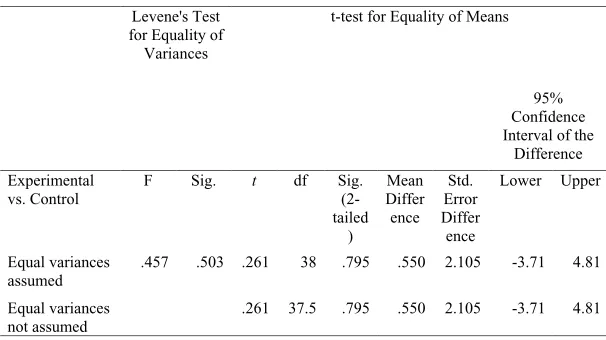
Table 2 shows the descriptive statistics of the participants’ tests in the pre-test. The mean score of the experimental group is 8.80 and the mean score of the control group is 8.25. In order to see if there is any significant difference between two groups in the pre-test and they have been homo-geneous before the treatment or not, an Independent Samples t-test was administered. The results are presented in Table 3.
Table 3: Independent Samples t-test (Pre-test)
Table 3 shows the observed t (.261) is less than the critical t (1.684) with df=38. In other words, the difference between the two groups’ means is not significant. Descriptive statistics of the post-test is shown in Table 4.
�� �� ��������� ��� �� ������� ����� � ����� ��� ������������ �� ���� ����� ���� ����� ���� ��� ����� � ��������� ���� �� ��� ��� ��������� ��� ������� ��������� ���� ��� ����� ������������ ��� ������ ������ ��� ���������� ����� �� ��� ����� �� ������� ���� �������� �� ����� ������ ��� ���������� ���������� ���� �� ������ ��� �� ��� �� ������� ����� ����������� ��������� �� ��� �������� �� ��������� �� ����� � ����� ������������� ���������� ����������� ����� � ����� ��� ����������� ���������� �� ��� ������������� ����� �� ��� ��������� ��� ���� ����� �� ��� ������������ ����� �� ���� ��� ��� ���� ����� �� ��� ������� ����� �� ����� �� ����� �� ��� �� ����� �� ��� ���������� ��������� ������� ��� ������ �� ��� �������� ��� ���� ���� ���� ����� ������� ������ ��� ��������� �� ���� �� ����������� ������� ������ ��� ������������� ��� ������� ��� ��������� �� ����� �� ����� ������������� ������� ������ ���������� ����� � ����� ��� �������� � ������ �� ���� ���� ��� �������� � ������� ���� ������ �� ����� ������ ��� ��������� ������� ��� ��� ������� ����� �� ��� ���������������������� ���������� �� ��� ��������� �� ����� �� ����� �� �� �� ��������� ��� �� ������� ����� � ����� ��� ������������ �� ���� ������ ���� ���� ���� ��� ����� � ��������� ���� �� ��� ��� ��������� ��� ������� �������� ���� ��� ����� ������������ �� ������ ������ ��� ���������� ����� �� ��� ����� �� ������� ���� �������� �� ����� ������ ��� ���������� ���������� ���� �� ������ ��� �� ��� �� ������� ����� ����������� ��������� �� ��� �������� �� ��������� �� ����� � ����� ������������� ���������� ����������� ����� � ����� ��� ����������� ���������� �� ��� ������������� ����� �� ��� ��������� ��� ���� ����� �� ��� ������������ ����� �� ���� ��� ��� ���� ����� �� ��� ������� ����� �� ����� �� ����� �� ��� �� ����� �� ��� ���������� ��������� ������� ��� ������ �� ��� �������� ��� ���� ���� ���� ����� ������� ������ ��� ��������� �� ���� �� ����������� ������� ������ ��� ������������� ��� ������� ��� ��������� �� ����� �� ����� ������������� ������� ������ ���������� ����� � ����� ��� �������� � ������ �� ���� ���� ��� �������� � ������� ���� ������ �� ����� ������ ��� ��������� ������� ��� ��� ������� ����� �� ��� ���������������������� ���������� �� ��� ��������� �� ����� �� ����� �� � ���������� � � ���������������������������������������������������� �������������������������������������������������������������������������������������������������� ������������������������������������������������������������������������������������������������� ������������� � � �
�� �� ��������� ��� �� ������� ����� � ����� ��� ������������ �� ���� ����� ���� ����� ���� ��� ����� � ��������� ���� �� ��� ��� ��������� ��� ������� ��������� ���� ��� ����� ������������ ��� ������ ������ ��� ���������� ����� �� ��� ����� �� ������� ���� �������� �� ����� ������ ��� ���������� ���������� ���� �� ������ ��� �� ��� �� ������� ����� ����������� ��������� �� ��� �������� �� ��������� �� ����� � ����� ������������� ���������� ����������� ����� � ����� ��� ����������� ���������� �� ��� ������������� ����� �� ��� ��������� ��� ���� ����� �� ��� ������������ ����� �� ���� ��� ��� ���� ����� �� ��� ������� ����� �� ����� �� ����� �� ��� �� ����� �� ��� ���������� ��������� ������� ��� ������ �� ��� �������� ��� ���� ���� ���� ����� ������� ������ ��� ��������� �� ���� �� ����������� ������� ������ ��� ������������� ��� ������� ��� ��������� �� ����� �� ����� �� ����������� ������� ������ ���������� ����� � ����� ��� �������� � ������ �� ���� ���� ��� �������� � ������� ���� ������ �� ����� ������ ��� ��������� ������� ��� ��� ������� ����� �� ��� ����������� ����������� ���������� �� ��� ��������� �� ����� �� ����� �� �� �� ��������� ��� �� ������� ����� � ����� ��� ������������ �� ���� ������ ���� ���� ���� ��� ����� � ��������� ���� �� ��� ��� ��������� ��� ������� �������� ���� ��� ����� ������������ �� ������ ������ ��� ���������� ����� �� ��� ����� �� ������� ���� �������� �� ����� ������ ��� ���������� ���������� ���� �� ������ ��� �� ��� �� ������� ����� ����������� ��������� �� ��� �������� �� ��������� �� ����� � ����� ������������� ���������� ����������� ����� � ����� ��� ����������� ���������� �� ��� ������������� ����� �� ��� ��������� ��� ���� ����� �� ��� ������������ ����� �� ���� ��� ��� ���� ����� �� ��� ������� ����� �� ����� �� ����� �� ��� �� ����� �� ��� ���������� ��������� ������� ��� ������ �� ��� �������� ��� ���� ���� ���� ����� ������� ������ ��� ��������� �� ���� �� ����������� ������� ������ ��� ������������� ��� ������� ��� ��������� �� ����� �� ����� �� ����������� ������� ������ ���������� ����� � ����� ��� �������� � ������ �� ���� ���� ��� �������� � ������� ���� ������ �� ����� ������ ��� ��������� ������� ��� ��� ������� ����� �� ��� ����������� ����������� ���������� �� ��� ��������� �� ����� �� ����� �� � ���������� � � ���������������������������������������������������� �������������������������������������������������������������������������������������������������� ������������������������������������������������������������������������������������������������� ������������� � � �
58 S. Aramipoor and B. Gorjian
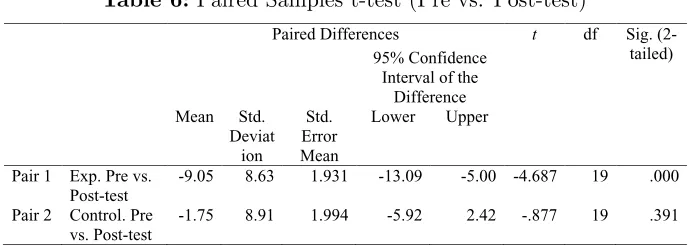
Table 6:Paired Samples t-test (Pre vs. Post-test)
Table 6 indicates that the observed t (-4.687) of the pair 1 (i.e., the ex-perimental group) is greater than the critical t (1.729) with df=19. Thus, the difference between the pre and post-test of the experimental group is significant. In contrast, the observed t (-.877) of the pair 2 (i.e., the control group) is less than the critical t (1.729) with df=19. Therefore, the difference between the pre-test and post-test of the control group is not significant. In addition, the treatment of WhatsApp enhanced learn-ing supra segmental features in the experimental groups more effectively than the control one.
5. Discussion
The two research questions are discussed to prepare appropriate answers for the research questions.
RQ1. Does PRAAT software enhance the learners’ pronunciation (i.e., supra segmental features) at the pre-intermediate level?
The results obtained from the descriptive statistics of the pre-test, comparing to the post-test indicated an increase in the mean scores of the experimental group in contrast to the mean scores of the control group in the post-test. The reason of this progress can be justified as the available and accessible exercises, which are usable in the experimental group. The drills in virtual manner such as WhatsApp can be done when the participants are free or when they are out of classroom. They also found out that good pronunciation could help them to convey right meanings for better communication. In this area also to motivate and encourage the subjects to pay attention of and to play more active role
The Effect of Using PRAAT Software ... 59
in the research program, they were told that the purpose of the extra instruction was to improve their knowledge of pronunciation such as supra segmental features that enable them to read and speak correctly as much as possible.
Esling, Fraser, Jenkins, Hancock & Herbert (2001) support the find-ings of this study and state the way we speak immediately may convey something about ourselves to the people around us. Learners with good pronunciation in English are better than learners whose pronunciation is difficult to understand, even if their grammar is perfect. The L2 learn-ers were often judged by their pronunciation; therefore, learnlearn-ers with poor pronunciation may be judged as incompetent, or lacking in knowl-edge. Because of this reason, most of the L2 learners find pronunciation as one of the main difficult aspects of English language to acquire; thus, L2 teachers need more attention to teaching pronunciation and should use appropriate materials in their language classrooms.
The EFL learners need to use modern and attractive techniques and tools to practice and work on their pronunciation outside the class-rooms. The findings of this study indicated that the use of PRAAT soft-ware might achieve the pedagogical goals like the motivation of the learn-ers to use PRAAT and play more active in the research program. The participants may be motivated to use this software and work on their pronunciation for later use. In this case, they could compare their pro-nunciation with the native speaker simply and try to match their oral production with the native speakers’ stress and intonation through using PTAAT. This enables them to identify their errors by visual analysis and improve their pronunciation as much as possible. Furthermore, they may learn how to use PRAAT for the purpose of self-autonomy in learning English pronunciation.
60 S. Aramipoor and B. Gorjian
leads to better communication. PRAAT software can provide learners with visual representations of a variety of speech sounds such as, stops, fricatives and liquids with spectrograms. PRAAT software also provides the participants with a variety of facilities that may improve the process of learning English language pronunciation.
In this study, the experimental group received a pamphlet prepared and gathered by the researchers and consisted of the rules of intona-tion and stress patterns in English languages in order to teach supra segmental features in the experimental group classes. Since limitations of time and the lack of appropriate materials, most of the L2 teachers do not work on learners’ pronunciation individually in their language classrooms and prefer to teach other parts of English language such as grammar and vocabulary. Peabody (2011) supports the findings of this study and states that intelligible pronunciation is only one of the es-sential skills for speaking English language, and it is often not or less emphasized in the classroom. Thus, to improve L2 learners’ pronuncia-tion, especially the learners whose pronunciation is less than desirable level is possible through pronunciation training by suitable material and techniques altogether. Shortage of time made the work on pronuncia-tion difficult for both L2 teachers and learners. In addipronuncia-tion to requiring lots of output to improve pronunciation, students cannot attend to all aspects of pronunciation at the same time.
The poor performance of the control group in the post-test compar-ing to the experimental group may be due to the lack of pronunciation drills, which are limited to the class hours. They were not exposed to enough exposure outside the classroom. This may affect their ability to follow the rules of applying stress placement and intonation patterns. Both groups were somehow the same in the pre-test since they were not significantly different. This may be due to the lack of ability to produce accurate stress and intonation patterns at the beginning of the research period. The amount of progress in both groups may be affected by either the L1 pronunciation interferences or unfamiliarity with the intonation and stress patterns.
The Effect of Using PRAAT Software ... 61
Persian language, lack of some consonants and vowels can make correct learners’ pronunciation difficult, for this reason, this knowledge can have significant effects to pedagogical techniques in language classes. English language consists of 44 sounds in which 24 of these sounds are conso-nantal and 20 of the others sounds are called vocalic. In this case, some of these consonant sounds are absent in Persian language, so L2 learners have to use alternatives for each of these absent consonants (e.g., /v/ used as /w/ and /t/, /s/, /d/ or /z/ for pronouncing / ? /or / ? /.
This study could be a help for the learners who are going to follow self-study programs and become autonomous learners through relying on their own activities. They may need to make learning pronunciation in-dependent and autonomous through PRAAT software. Wilson’s (2005) study is matched with the idea that PRAAT software may provide ap-propriate feedback in pronunciation classes and also provide autonomous environment to learning English language as much as possible. PRAAT can analyze the speech of any learners with different background knowl-edge. It could be useful with a combination of the appropriate teaching activities. This method can provide the EFL teachers with an opportu-nity to recognize the weaknesses of each learner. Thus, they can use the class time for working on learners’ pronunciation difficulty. Moreover, L2 teachers can increase the learners’ knowledge of some important ele-ments of English pronunciation such as intonation and word stress and practice on their weakness by effective and modern tools. Thus, learners may use PRAAT and have a sense that they can check their pronunci-ation without any anxiety in an attractive way at any time. Opposite to traditional teaching of pronunciation, the learners do not need the teachers’ guides and it means that they arrive at the belief that they themselves who should solve their pronunciation problems. In addition, the results gained from the diagram analysis by PRAAT software of oral performance of experimental group showed an increase in apply-ing some aspects such as intonation patterns and word stress in their pronunciation in the post-test in contrast to their pre-test.
pro-62 S. Aramipoor and B. Gorjian
nunciation?
In order to answer the second research question, the researcher com-pared the traditional and modern methods to teaching pronunciation to EFL learners and through the administration of the pre and post-tests. Results were gained through the comparison of pronunciation of both control and experimental groups before and after the treatment. In general, after the treatment on using PRAAT software there was an im-provement of applying supra segmental features (i.e., intonation, stress) in the experimental group who had a significant change in accuracy of their voice recorded by PRAAT software in the post-test compared to their ptest performance. Thus, the second null hypothesis was re-jected.
Most methods that the EFL teachers apply in their classrooms to improve their learners’ pronunciation refer to general points of phono-logical rules that the learners cannot understand and apply correctly to their pronunciation. The challenging area among EFL learners is reach-ing native like accent and this needs an appropriate pronunciation for better communication. In our Iranian context, unfortunately, many EFL teachers do not pay attention to teach appropriate pronunciation in their classrooms and they prefer to teach this aspect of teaching English lan-guage traditionally. These teachers should be able to speak like natives but many of these teachers need to learn comprehensible pronunciation since they have to be able to teach this aspect to their learners. While textbooks on pronunciation pedagogy are widely available, they are usu-ally designed for interactions that involve native-people and refer to ac-quire their communication strategies and cultural conventions as the target language as much as possible. In addition, the results indicated many language teachers do not have adequate knowledge of phonetics and phonology of L2 language system in our county. They also are not aware of negative transfer coming from L1. This may disappoint the learners to learn correct pronunciation. Accordingly, it is expected that EFL teachers try to identify educational problem and try to design or use useful activities on their classroom to improve learners’ pronunciation.
produc-The Effect of Using PRAAT Software ... 63
tions for suitable and effective communication with native people. In this case, the process of L2 pronunciation acquisition tends to be influ-enced by applied perceptions and productions of sounds in the L1. This may refer to the L1 (i.e., inter-lingual transfer) or of the target language (i.e., L2 or intra-lingual transfer). Negative transfer of L1 to L2 leads to speech productions wrongly. Thus, L2 teachers should apply useful methods to teaching supra segmental phonology in order to teach Iranian learners appropriate stress and intonation patterns. The PRAAT soft-ware could be helpful in teaching typology of supra segmental features through continuous matching with the native speakers’ pronunciation models.
Since there is a rise of technologies in our life, it is expected that EFL teachers try to match with modern world and the use of new tool in their courses to encourage their student to work on their pronunciation with attractive and modern way. Whichever the case, most teachers and learners still have problem to use technology on teaching and learning process and in this case the use of PRAAT software, for different reason such as lack of knowledge and confidence.
Betts (2013) supports the findings of this study and cites, the main limitation of the use of PRAAT software could be the challenge of train-ing instructors and learners to work and practice by this software. In fact, some learners might not still have an interest in technology or they might not be technology-user in adopting and using them in teaching and learning process. In this case, it might take a long time to adapt and apply modern tools in L2 language classes, so the EFL teachers can help their students to start using PRAAT to improve their pronunciation individually without any anxiety.
64 S. Aramipoor and B. Gorjian
make environment to provide the L2 learners with appropriate input to improve their pronunciation in real situations.
The modern method to teaching pronunciation, which refers to create something that has a relevance to the real classroom for preparing L2 learners to real situations. The best way is to observe the L2 learners and the best feedback would be from teachers and learners who had tried out the different tasks in practice. Without such a feedback, at this point the success of the material can only be based on self-assessment. As to originality, the teaching material includes both original ideas but also ideas of others that have been adopted and further developed, and naturally acknowledged. Many traditional methods are still valid and therefore some tasks might seem even conventional and some of these tasks are incomplete for English teaching. However, the L2 teacher may know his or her classes better than the material designers to choose the additional materials they wish to use in their language classrooms.
6. Conclusion
Teaching English pronunciation is not only the most important part but also it is the hardest part, thus the teachers should be aware of some techniques that make learning foreign language effortless. This study focuses on the use of computer technology and in this case PRAAT software to motivate and encourage EFL learners to practice on their pronunciation in private and free stress places.
The Effect of Using PRAAT Software ... 65
Another result that the researcher found in this study indicated apply-ing the use of PRAAT software and modern strategy may improve the L2 learners’ pronunciation when they record their voice by this software and learners are more interested and more comfortable with this modern method. The L2 teachers should solve the main problems by the combi-nation of modern and traditional altogether for more successful teaching and learning in their classrooms.
This research focused on the area of supra segmental such as intona-tion and stress. The results of this study will help EFL teacher to select a proper strategy that may facilitate the process of learning and focuses and works on intonation patterns and stress placement.
L2 teachers should be aware of mistakes and errors of L2 learners’ pronunciation and have an appropriate knowledge of the source of these problems. According to the results of this study, it is suggested that EFL teachers teach supra segmental features with explicit instruction and help their learners by using different strategies and methods to teach pronunciation individually and explain the importance of having proper pronunciation to the L2 learners for better communication.
Results can also help L2 teachers who wish to teach phonology, es-pecially supra segmental features, in a systematic way and in this case, the use of (PRRAT). This device provides the users with an autonomous environment that can help L2 teachers to work on learners’ pronuncia-tion.
Teaching and learning English pronunciation is the most difficult and important to acquire for the L2 learners, especially at the university level where they need to communicate with native people as much as they can. Therefore, the results of this study will help EFL learners to select a proper strategy that can facilitate the process of learning pronunciation.
66 S. Aramipoor and B. Gorjian
in stress-free and comfortable places.
This study evaluated the role of computer mediated (PRAAT) soft-ware in improving supra segmental features among pre-intermediate EFL learners.
It is strongly suggested that research be conducted with the same characteristics of this study including more participants. Future stud-ies can include other aspects of supra segmental features for achieving the better results and new teaching strategies. The areas which are very outstanding in the future research may be the study of inter and intra-lingual errors which affect the four language skills (i.e., listening, speak-ing, reading and writing). The effect of L1 and L2 in learning speaking skill in general and phonological patterns in particular could be a chal-lenging area of investigation. A future study is essential in which the immediate and delayed post-tests are conducted at different time inter-vals to show the effectiveness of instruction of research relation in shorter and longer periods. Variables other than the ones used in this study can help the investigation of the same issue. For instance, the same exper-iment with just male or female learners within the close age range is necessary to confirm the result of this study. This study lasted for three weeks and succeeding studies can allocate more time to the instruction of teaching supra segmental features by modern tool and new strategies.
References
[1] Abbasi, A. (2012). A phonetic-acoustic study of Sindhi-accented English for better English Pronunciation.International Journal. Social. Science
and Education, 2(2), 2223-4934.
[2] Andoh, C. B. (2012). Factors influencing teachers’ adoption and integra-tion of informaintegra-tion and communicaintegra-tion technology into teaching. Inter-national Journal of Education and Development using Information and
Communication Technology, 8(1), 136-155.
[3] Betts, D. (2013). Using PRAAT software in teaching pronunciation and prosodic features in English as a foreign language classrooms,Handbook
of Research for Educational Communications and Technology, 5(2), 8-12.
66 S. Aramipoor and B. Gorjian
in stress-free and comfortable places.
This study evaluated the role of computer mediated (PRAAT) soft-ware in improving supra segmental features among pre-intermediate EFL learners.
It is strongly suggested that research be conducted with the same characteristics of this study including more participants. Future stud-ies can include other aspects of supra segmental features for achieving the better results and new teaching strategies. The areas which are very outstanding in the future research may be the study of inter and intra-lingual errors which affect the four language skills (i.e., listening, speak-ing, reading and writing). The effect of L1 and L2 in learning speaking skill in general and phonological patterns in particular could be a chal-lenging area of investigation. A future study is essential in which the immediate and delayed post-tests are conducted at different time inter-vals to show the effectiveness of instruction of research relation in shorter and longer periods. Variables other than the ones used in this study can help the investigation of the same issue. For instance, the same exper-iment with just male or female learners within the close age range is necessary to confirm the result of this study. This study lasted for three weeks and succeeding studies can allocate more time to the instruction of teaching supra segmental features by modern tool and new strategies.
References
[1] Abbasi, A. (2012). A phonetic-acoustic study of Sindhi-accented English
for better English Pronunciation.International Journal. Social. Science
and Education, 2(2), 2223-4934.
[2] Andoh, C. B. (2012). Factors influencing teachers’ adoption and
integra-tion of informaintegra-tion and communicaintegra-tion technology into teaching.
Inter-national Journal of Education and Development using Information and
Communication Technology, 8(1), 136-155.
[3] Betts, D. (2013). Using PRAAT software in teaching pronunciation and
prosodic features in English as a foreign language classrooms,Handbook
The Effect of Using PRAAT Software ... 67
[4] Birjandi, P. and Salmani-Nadoushan, M. (2005).An introduction to
pho-netics. Tehran: Zabankadeh Publicans.
[5] Boersma, P. and Weenink, D. (2018). Praat: Doing phonetics by
com-puter [Comcom-puter program].Version 6.0.37. Retrieved June 21, 2018 from http://www.praat.org/
[6] Boves, L., Cucchiarini, C., Neri, A., and Strik, H. (2002). The pedagogy
technology interface in Computer assisted pronunciation training.Journal
of Computer assisted language learning, 15(5), 441-467.
[7] Chapman, D. and Mahlck, L. (2004). Adapting technology for school
improvement. International Institute for Educational Planning, UN-ESCO. Retrieved April 11, 2018 from www.unesco.org/iiep/
[8] Chou, P. (2005). Using the computer for practicing pronunciation in
ESL class. World Conference on E-Learning in Corporate, Government,
Healthcare, and Higher Education 2005 (pp. 581-583). Retrieved from http://www.editlib.org/p/21236/.
[9] Daryagasht, H. and Khodabandehlou, M. (2014). The impact of teaching absent consonants on Iranian female intermediate EFL learners’
pronun-ciation. International Research Journal of Applied and Basic Sciences, 8
(10), 1650-1656.
[10] Esling, J., Fraser, H., Jenkins, J., Hancock, M., and Herbert, J.
(2001). Teaching pronunciation: A handbook for teachers and trainers.In
Eighth International Conference on Spoken Language Processing, 53 (2), 6-110.
[11] Goertel, R. (2013). Prosodic elements to improve pronunciation in English
language learners.Applied Research on English Language, 2(2), 117-128.
[12] Ladefoged, P., & Johnson, K. (2010).A course in phonetics.Production
Service: Pre-Press PMG, Wadsworth 20 Channel Center Street Boston, USA, Sixth Edition.
[13] Mott, B. (1991).A course in phonetics and phonology for Spanish learner
of English. University of Barcelona, (pp. 15-417), Publiscions i editions: PPU.
[14] Nasiri, M., Soltani Moghaddam, M., Sepehrinia, S., & Zarea, A.
(2012). Teaching pronunciation: The lost ring of the chain, Journal of
Language Teaching and Research, 3(1), 215-219.
The Effect of Using PRAAT Software ... 67
[4] Birjandi, P. and Salmani-Nadoushan, M. (2005). An introduction to pho-netics. Tehran: Zabankadeh Publicans.
[5] Boersma, P. and Weenink, D. (2018). Praat: Doing phonetics by com-puter [Comcom-puter program].Version 6.0.37. Retrieved June 21, 2018 from http://www.praat.org/
[6] Boves, L., Cucchiarini, C., Neri, A., and Strik, H. (2002). The pedagogy technology interface in Computer assisted pronunciation training.Journal of Computer assisted language learning, 15(5), 441-467.
[7] Chapman, D. and Mahlck, L. (2004). Adapting technology for school improvement. International Institute for Educational Planning, UN-ESCO. Retrieved April 11, 2018 from www.unesco.org/iiep/
[8] Chou, P. (2005). Using the computer for practicing pronunciation in ESL class. World Conference on E-Learning in Corporate, Government, Healthcare, and Higher Education 2005 (pp. 581-583). Retrieved from http://www.editlib.org/p/21236/.
[9] Daryagasht, H. and Khodabandehlou, M. (2014). The impact of teaching absent consonants on Iranian female intermediate EFL learners’ pronun-ciation. International Research Journal of Applied and Basic Sciences, 8 (10), 1650-1656.
[10] Esling, J., Fraser, H., Jenkins, J., Hancock, M., and Herbert, J. (2001). Teaching pronunciation: A handbook for teachers and trainers.In Eighth International Conference on Spoken Language Processing, 53 (2), 6-110.
[11] Goertel, R. (2013). Prosodic elements to improve pronunciation in English language learners.Applied Research on English Language, 2(2), 117-128.
[12] Ladefoged, P., & Johnson, K. (2010).A course in phonetics.Production Service: Pre-Press PMG, Wadsworth 20 Channel Center Street Boston, USA, Sixth Edition.
[13] Mott, B. (1991).A course in phonetics and phonology for Spanish learner of English. University of Barcelona, (pp. 15-417), Publiscions i editions: PPU.
68 S. Aramipoor and B. Gorjian
[15] Nicolle, P. (2005). Technology adoption into teaching and learning by mainstream university faculty:A Mixed methodology study revealing the,
how, when, why, and why not. Pamela Stone Nicolle B.S., Louisiana State University, Northeast Louisiana University.
[16] Olson, D. (2014). Benefits of visual feedback on segmental production in the L2 classroom.Language Learning & Technology, 18(3), 1-25.
[17] Peabody, A. M. (2011). Methods for pronunciation assessment in com-puter aided language learning. (pp.1-176).Electrical Engineering and In-stitute of Technology of Massachusetts.
[18] Richards, J. C., & Bohlke, D. (2011). Four corners. Cambridge: Cam-bridge University Press.
[19] Saka, O., Yildirim, S., & Zayim, N. (2006). Technology adoption of med-ical faculty in teaching: differentiating factors in adopter categories. Ed-ucational Technology & Society, 9(2), 213-222.
[20] Wilson, I. (2005). Using Praat and Moodle for teaching segmental and supra segmental pronunciation.TESOL Quarterly, 3,33-43.
68 S. Aramipoor and B. Gorjian
[15] Nicolle, P. (2005). Technology adoption into teaching and learning by mainstream university faculty:A Mixed methodology study revealing the, how, when, why, and why not. Pamela Stone Nicolle B.S., Louisiana State University, Northeast Louisiana University.
[16] Olson, D. (2014). Benefits of visual feedback on segmental production in the L2 classroom.Language Learning & Technology, 18(3), 1-25.
[17] Peabody, A. M. (2011). Methods for pronunciation assessment in com-puter aided language learning. (pp.1-176).Electrical Engineering and In-stitute of Technology of Massachusetts.
[18] Richards, J. C., & Bohlke, D. (2011). Four corners. Cambridge: Cam-bridge University Press.
[19] Saka, O., Yildirim, S., & Zayim, N. (2006). Technology adoption of med-ical faculty in teaching: differentiating factors in adopter categories. Ed-ucational Technology & Society, 9(2), 213-222.