Volume. 6, Issue. 2, Ser. 12, (2017), 27-53
Unaccusative and Unergative Verb Acquisition:
Effects of Implicit, Explicit, and Mixed Oral
Corrective Feedback
Seyedeh Maryam MerajiPh.D Candidate
Department of Foreign Languages Shiraz Branch, Islamic Azad University
Shiraz, Iran
Email: mary [email protected] Firooz Sadighi∗
Professor
Department of Foreign Languages Shiraz Branch, Islamic Azad University
Shiraz, Iran
Email: [email protected]
Abstract. Persian L2 learners of English over-passivize the unac-cusatives. Therefore, it is necessary that teachers identify erroneous over-passivization of unaccusatives and provide the necessary explana-tion of the differences between unaccusatives and unergatives. Issues such as type of instructions provided by teachers in the Second Lan-guage Acquisition (SLA) classrooms still suffers from unanswered ques-tions. This study focused on the acquisition of the differences between unaccusatives and unergativesby intermediate and advanced learners before and after receiving oral Corrective Feedback (CF). 106 students who scored 1 standard deviation below and above the mean score of the quick Oxford placement test (SD= 6.11, mean= 36.94), and also passed an elimination test examining their knowledge of passive forma-tion rules, were selected as the participants. They were divided into 4 groups (3 experimental and 1 control) according to the type of oral CF they were supposed to receive and the university courses they had to enroll in. A Written Elicited Production Task (WEPT) and a Grammat-icality Judgment Task (GJT) were administered as the pre-tests. Each experimental group received one type of oral CF as the treatment (ex-plicit, im(ex-plicit, or mixed) and the control group received no CF. Then
Received: February 2017; Accepted: April 2017 ∗Corresponding author
27
Journal of Studies in Learning and Teaching English
Volume. 6, Issue. 2, Ser. 12, (2017), 27-53
Unaccusative and Unergative Verb Acquisition:
Effects of Implicit, Explicit, and Mixed Oral
Corrective Feedback
Seyedeh Maryam MerajiPh.D Candidate
Department of Foreign Languages Shiraz Branch, Islamic Azad University
Shiraz, Iran
Email: mary [email protected] Firooz Sadighi∗
Professor
Department of Foreign Languages Shiraz Branch, Islamic Azad University
Shiraz, Iran
Email: [email protected]
Abstract. Persian L2 learners of English over-passivize the unac-cusatives. Therefore, it is necessary that teachers identify erroneous over-passivization of unaccusatives and provide the necessary explana-tion of the differences between unaccusatives and unergatives. Issues such as type of instructions provided by teachers in the Second Lan-guage Acquisition (SLA) classrooms still suffers from unanswered ques-tions. This study focused on the acquisition of the differences between unaccusatives and unergativesby intermediate and advanced learners before and after receiving oral Corrective Feedback (CF). 106 students who scored 1 standard deviation below and above the mean score of the quick Oxford placement test (SD= 6.11, mean= 36.94), and also passed an elimination test examining their knowledge of passive forma-tion rules, were selected as the participants. They were divided into 4 groups (3 experimental and 1 control) according to the type of oral CF they were supposed to receive and the university courses they had to enroll in. A Written Elicited Production Task (WEPT) and a Grammat-icality Judgment Task (GJT) were administered as the pre-tests. Each experimental group received one type of oral CF as the treatment (ex-plicit, im(ex-plicit, or mixed) and the control group received no CF. Then Received: February 2017; Accepted: April 2017
∗Corresponding author
the WEPT and GJT were administered as the post-tests. The results revealed that while students had the ability to judge the grammaticality of the sentences with unergatives before receiving oral CF, they did not have such ability for sentences with unaccusatives, and it was only after receiving the oral CF when they acquired the required knowledge. Keywords:Unaccusative verbs, unergative verbs, oral corrective feed-back, L2 acquisition
1. Introduction
Unaccusative and unergative verbs
Perlmutter (1979) proposed Unaccusative hypothesis as a syntactic hy-pothesis that divides the intransitive verbs into two classes: unergatives and unaccusatives. According to this hypothesis, while the unaccusative verbs are verbs whose subjects have no responsibility for the action of the verb and the surface subject is not the real subject, unergative verbs are verbs with real subjects responsible for the action of the verb. Logical problem of unaccusative and unergative verbs acquisi-tion
As Sorace (1993) claimed, syntactic distinction between unaccusatives and unergatives varies in different languages. For example, Sorace ex-plained that in Italian, unaccusative verbs select the auxiliary “be” while unergative verbs select the auxiliary “have”. Another example was given by KarimiDoostan (1997), elaborating that Persian lets its native speakers alternate between causatives and unergatives by replacing the “do/KARDAN” with “be or become/ SHODAN”. Therefore, Persian speakers can use many simple or compound transitive verbs intransi-tively in their L1. In English, however, this alternation depends mainly on the transitivity or intransitivity of the verb, and when L2 learn-ers tend to resort to the verb ”SHODAN” construction (NP-be-V-en) in English, it will result in over-passivization of unaccusatives (Abbasi Bagherianpoor, 2010).
provide the learners with the necessary explanation of the differences between unaccusatives and unergatives.
Corrective feedback
Errors are an inevitable part of language learning; learners of either the first or the second language may commit errors in their language pro-duction. George (1972) perceived children’s errors as transitional forms. He referred to native speakers’ errors as slip of the tongue and consid-ered second language learners’ errors as the unwanted forms. According to the existing literature, we can find different approaches toward errors in a second language learning context (James, 2013; Littlewood, 1984; Maicusi, Maicusi, & Lopez, 2000).
In the behaviorist approach, an error is considered as a negative element that should be avoided; it is a sign, showing teaching is not effective, and therefore teachers should systematically prevent error oc-currence by intensive drilling, over-repetition, and over-teaching. An-other approach, with Chomsky’s (1965) ideas as its base, explains that errors lead to learners’ progress. In this mentalist approach, learners gain the necessary knowledge of the language by a trial and error pro-cess rather than over-learning. While the behaviorist approach regards errors as negative, the mentalist approach considers it as positive. In a cognitive approach, errors are viewed as reflections of social norms as well as learners’ cognitive processes; therefore, they are perceived as an outcome of the social-cognitive interaction.
The way a teacher recognizes the causes and origins of errors commit-ted by second/foreign language learners determines the attitude he/she may choose to deal with those errors. As Han (2002) and Lightbown and Spada (1999) described, behaviorists and audio-lingual proponents focused on the relationship between the negative transfer of the mother tongue experiences to the second language learning process. They be-lieved that the causes of errors can be found in the failed habit forma-tions that should be prevented; otherwise, errors may end with negative fossilization.
On the other hand, Chomsky’s (1965) universal grammar theory ex-plained that human beings are equipped with a biologically language learning ability which brings them the creativity in language learn-ing. This creativity can be explained by the systematic productions of learners which are perceived as a sign of progress in learning. So, errors made by language learners should not be prevented because they are indeed signs of learning, not symptoms of failure.
With errors being an inevitable part of learning a second language, teachers are driven into a pedagogical context in which providing learn-ers with feedback is really essential. The first definition of feedback in language learning defined it as any type of information provided for the learner after receiving the learner’s response to a question or to a task (Wager & Wager, 1985). This definition was too broad and included all post-response information given to the learner, therefore, researchers tried to find a more relevant definition which was more limited. As a result, it was defined as multiple strategies which do not immediately give the correct answers to students, and instead, provide elaborated responses that help learners complete the task successfully (Annett, 1969; Bilodeau, 1969; Narciss, 2008). Another was proposed by Lee-man (2007),he argued that feedback can be defined as a reaction to the learner’s utterance, but evidence can be given to the learner at any stage of his/her production.
the incorrectness of the learner’s utterance and ask for a reformulation (Campillo, 2003).
Oral corrective feedback
Lyster and Ranta (1997) drew on strategies from previous studies and added new strategies based on their analysis of teacher-student interac-tions and identified explicit correction, elicitation, clarification requests, recasts, metalinguistic feedback, and repetition of error corrective feed-back. While the explicit correction is considered an explicit corrective feedback strategy, the latter strategies provide the corrective feedback implicitly. Since these feedback strategies proved to be useful in teacher-student interactions, the following strategies were selected to be used as oral corrective feedback strategies of the study: recasts (which involve the teachers’ reformulation of all or part of the students’ utterance minus the error part); explicit feedback (which refers to the explicit provision of the correct form); clarification request ( which shows the student that either the teacher has misunderstood the utterance or the utterance is ill-formed and a reformulation is needed); metalinguistic feedback (in-volves comments or questions regarding the well-formedness of the stu-dents’ utterance without explicitly mentioning the correct form); elici-tation (which consists of three techniques: a. teacher utters a sentence then pauses and lets the student fill the required answer; b. teacher uses questions to elicit the correct forms; c. teacher occasionally asks students to reformulate their sentences.); repetition (is the teacher’s repetition of the students incorrect utterance) suggested by Lyster and Ranta (1997); and prompt or negotiation of form (in which the teacher withholds the reformulation and the student is encouraged to correct the error himself/herself) proposed by Lyster and Mori (2006).
Literature Review
Due to importance of corrective feedback in different language learning theories and the effects of feedback strategies on L2 grammar acquisition, many studies have been conducted on the issue (e.g., Bowles & Montrul, 2009; Kawaguchi and Ma, 2012; Zohrabi and Ehsani, 2014; Tamayo Maggi and Quishpe,2017).
Bowles and Montrul (2009) investigated the possible role of explicit teaching and negative evidence on a-personal (a grammatical feature of Spanish) learning. They explained that form-focused instruction either in the form of grammatical explanation or in the form of corrective feedback, during or even before exposure to L2, could provide students with explicit information. The researchers conducted their study by 72 participants who were divided into two groups: one group consisted of 12 native speakers of Spanish who lived in different countries at the time of the study and another group consisted of 60 low-intermediate language learners whose L1 was English. The participants of the second group were divided into two groups, one received instructions on the targeted structure and served as an experimental group while the other did not receive any instruction and just took the pre-and the post-tests. The results of the obtained data revealed that the researchers’ instruction had the desired effect, and after providing the learners with instruction and feedback, they were able to accept the grammatical forms more easily than the ungrammatical ones.
lin-guistic environment of non-native speakers and non-native speakers was comparable with that of native speakers and non-native speakers. The researchers concluded that the non-native-non-native combination either with high proficient learners or the low proficient ones provided a bet-ter outcome of corrective feedback compared with the non-native-native combinations. Kawaguchi and Ma also suggested that the low proficient level learners received the best type of corrective feedback along with the best type of negotiation of meanings from the high proficient level learners. Their results revealed that since all learners had fewer errors in their post-tests compared with their pre-test, the provided corrective feedback was considered to be positively effective.
Focusing on the effects of different types of corrective feedbacks on grammar accuracy and learners’ awareness, Zohrabi and Ehsani (2014) asked 60 pre-intermediate EFL students to translate simple present and simple past tense sentences from Persian to English. They taught present and the past tense before the administration of the translation test. After correcting the tests, they provided the explicit feedback group with explicit written feedback for their errors, and the implicit feedback group just had their errors specified and no corrective feedback was pro-vided. Based on the obtained results, Zohrabi and Ehsani concluded that the Iranian EFL learners’ English grammar improved after receiving the treatment.
Tamayo Maggi and Quishpe (2017) investigated the effects of corrective feedback on grammatical accuracy of students’ oral interactions. Their 18-week study involved twenty-eight participants in two classes. While class 1 received metalinguistic corrective feedback, class 2 received re-formulation. The results revealed that the provision of the two types of corrective feedback led to a significant correction of statements produced by students in specific linguistic structures. The researchers claimed that the performance of the group of students who received the metalinguistic corrective feedback was better than the group of students who received reformulation. The findings of this study suggested that language teach-ers should use more metalinguistic feedback for the treatment of EFL students’ errors when interacting orally.
Despite the studies conducted on the effectiveness of corrective feed-back (e.g. Bitchener, Young, & Cameron, 2005; Russell & Spada, 2006; Bowles & Montrul, 2009; Sauro, 2009; Tamayo Maggi and Quishpe, 2017), and the studies focused on acquisition of unaccusative and unerga-tive verbs (e.g. Oshita, 1997; Hirakawa, 2000; Park and Lakshmanan, 2007; Mortazavi, 2012; Abbasi Bagherianpoor, 2010; Rezai & Aria-manesh, 2012; Abbasi & MirjaniArjenan, 2014), the existing literature lacks thorough research on the effects of oral corrective feedback on the acquisition of unaccusative/unergative verbs and the aim of the present study is to fill this gap in the literature.
Objectives and Research Questions of the Study
Syntax acquisition plays an important role in second/foreign language acquisition. Although the literature on the use of corrective feedback strategies is extensive, it suffers from neglecting the role of feedback strategies on some specific parts of syntax like unergatives and unac-cusatives in EFL contexts with a non-Roman language as the L1.
information on the possible differences between L2 learners with differ-ent levels of proficiency (intermediate and advanced) and the type of corrective feedback which is more effective for learners of each profi-ciency level. Based on the above objectives and to fill the present gap of the applied linguistics literature, the present study seeks to answer the following research questions:
Q1. Does providing oral corrective feedback affect the Iranian EFL learners’ acquisition of unaccusatives and unergatives?
Q2. Which type of corrective feedback (implicit, explicit or mixed) is more effective in the acquisition of unaccusatives and unergatives? Q3.At which level of language learning (intermediate or advanced) can learners best take advantage of the corrective feedback while learning unergatives and unaccusatives?
Method
Participants
Participants of this study were 137 Iranian EFL learners chosen based on a combination of random and nonprobability sampling procedures. The participants were studying either teaching English as a foreign language or English translation at the Islamic Azad University and Payam-E-Noor University of Shiraz, and their age ranged from 19 to 40 years. The re-searchers selected their classes randomly from among the courses that they were teaching at the time of the study. From among the 137 par-ticipants, those who gained %66.66 of the Elimination Test score and did not participate in any other English classes outside the university were chosen for the study (106 participants). The selected participants were then randomly divided into 4 different groups according to different classes they had to enroll in and according to the type of oral correc-tive feedback they were supposed to receive, based on a nonprobability convenience sampling.
Instruments
study and evaluated the participants’ knowledge of passive construction in English. The test consisted of 9 fill-in-the-blank items and participants with 3 or more errors out of 9 were excluded from the study as their judgments were likely to be due to the lack of necessary knowledge of the passive forms. The reliability of the test was calculated at the pilot study stage of the study and the coefficient of equivalence was .94 which showed a high index of reliability.
Oxford Placement Test (OPT).OPT is a standard language profi-ciency placement test, consisting of two different parts (a grammar test and a listening test), each with 50 multiple choice items which evaluate learners’ correct use of English. Since the aim of the present study was to investigate the syntactic ability of the participants and not their lis-tening ability, the grammar test of OPT was used and the lislis-tening test was eliminated. Reliability of the test which was calculated at the pilot study stage of the study revealed a coefficient of equivalence of .89, and a reliability index of .94 which showed a high index of reliability.
Written Elicited Production Task (WEPT).The WEPT was taken from Hirakawa’s (2000) study and was designed to elicit information about EFL learners’ ability to distinguish passive structures from unac-cusative verbs in English. It targeted incorrect use of passive morphology to unaccusative verbs and consisted of 24 items. The test reliability was calculated and it was .81, which was acceptable.
Grammaticality Judgment Task (GJT). The GJT was adopted from Hirakawa’s (2000) study and aimed at evaluating participants’ abil-ity of distinguishing between unaccusatives and unergatives. Pseudopas-sive and resultative constructions were the structures which were used in the GJT in order to determine the participants’ ability to distinguish un-accusatives from unergatives and passives. The Cronbach’s Alpha index of reliability for the GJT was reported .75.
Procedures
responses and also the purpose of the study to the participants. Then, the participants completed the OPT and the ET. The results of ET were used to eliminate the participants who did not know the passive rules. The mean score and the standard deviation of all participants’ OPT scores were calculated (mean=36.94, SD= 6.11) and those partic-ipants who scored one standard deviation above and below the mean (i.e., participants with scores ranging from 43.05 to 30.83) were selected to complete the WEPT and the GJT. The participants of the study (N=106) were randomly divided into 4 different groups according to different classes they had to enroll in and according to the type of cor-rective feedback they were supposed to receive. While 3 groups were the experimental groups of the study and received implicit oral CF, explicit oral CF, and implicit and explicit oral CF, one group was the control group of the study and received no CF.
The participants of all 4 groups followed a similar procedure for data collection of the study. At the beginning they were all asked to complete the WEPT and the GJT in regular class hours. They had 40 minutes to answer the WEPT and 25 minutes for the OPT. The necessary in-struction for the tasks was provided by the researchers and in cases of clarification requests, some explanation was provided in the participants’ L1. For both tasks an additional 5 to 10 minutes were allowed in case the participants needed extra time to complete the task. The first ad-ministrations of the WEPT and the GJT were used as the pretests of the study. In the following sessions, the nature and concept of unergative and unaccusative verbs were taught to all groups, The WEPT and GJT were corrected and returned to the participants.
Participants of the groups chosen for the oral CF received their CF during a short one by one interview with the researcher. Each interview lasted 2-4 minutes and all interviews were conducted after the official class hours. Participants of the explicit oral CF received feedback in the form of comments regarding the well-formedness of the responses or the explicit provision of the correct response (Example 1).
Example 1:
remem-ber, “increase” is an unaccusative verb, so the answer is “increased”. Participant: Oh. I remember that.
– For this item, explicit corrective feedback was provided (i.e. the re-searcher provides the explicit provision of the correct form).
The implicit oral CF group received their CF in the form of recast, clarification request, repetition, elicitation, and metalinguistic feedback showing that a reformulation is needed (Example 2 and Example 3).
Example 2:
Researcher: I can’t understand. Why did you use “was died”? Participant: Because she was dead [Pause and stop answering]. Researcher: Excuse me? Can you explain it more?
Participant: Ehh[pause and think], wait, oh I think the answer is just “died”. Is it right?
– For this item, the corrective feedback was provided in the form of clar-ification request (i.e. the researcher shows the student that she has mis-understood, or the utterance is ill-formed and reformulation is needed).
Example 3:
Teacher: “Clothes were dried in the sun”? “were dried”?
Participant: Should I use present tense, or the sentence is not passive? Teacher: Do you remember the unaccusatives?
Participant: Eeee, no, not exactly.
Teacher: [The teacher briefly explains the characteristics of unaccusatives], now can you answer the question?
Participant: Oooh, now I can remember! it should be “dried”
The mixed oral CF group received a combination of both explicit and implicit CFs. Participants of the group with no CF received their papers and did not receive any type of feedback at all.
After providing the experimental groups with the feedbacks, and the control group with no feedback, the researcher asked all participants to return their the WEPT and the GJT papers (the same session they received the paper and the feedback). Eight weeks after the first admin-istration of the WEPT and the GJT, the tasks were administered again as the post-tests. Collecting the necessary data, the researcher checked and listed all the results for data analysis.
Data analysis.Items of the WEPT and the GJT had four types of verbs (transitive, unergative, alternating unaccusative and non-alternating un-accusative). The SPSS Version 16 was used to compare the participants’ performance in each type of verb in both pre- and post-tests by the t-test and ANOVA analysis.
Results
Results of WEPT
The WEPT was used to evaluate the participants’ knowledge of un-accusatives and unergatives at the beginning and at the end of the study. To provide answer to the first research question of the study, Paired samples t-test was run. The results are shown in Table 1. As the results in Table 1 show, the reported mean differences of all groups were negative, which indicates the score in the post-test was higher. The significant level of the no feedback group (the control group) was larger than .05, for the three verb types, indicating that the difference observed in no feedback group was not statistically significant. The significance level (p < .05) of all experimental groups indicated that the difference
40 S. M. Meraji and F. Sadighi
Table 1: Paired-samples t-tests on alternating unaccusative verbs of WEPT
The effect size was calculated for each experimental group to determine the relative magnitude of the difference between the scores of the pre-and post-tests of each group. The effect sizes of all experimental groups were considered as large effect sizes.
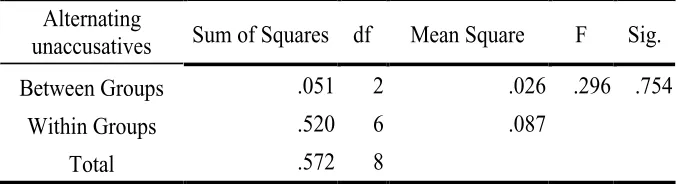
After comparing the pre-and post-test scores of each group and cal-culating the effect sizes, a One-way ANOVA with different types of cor-rective feedback received by the experimental groups as between-group factor( i.e. implicit, explicit or mixed), examined the difference in stu-dents’ gain sores from one group to others to answer the second research question of the study (Table 2).
The summarized results of One-way ANOVA, as presented in Table 2, in-dicated that no statistically significant difference was found (p=.754> .05). The results suggested that providing explicit/implicit/mixed
feed-back has no significant effect on the participants’ learning of unac-cusatives and unergatives.
18
WEPT was used to evaluate participants’ knowledge of unaccusatives and unergatives, at the
beginning and at the end of the study. To provide answer to the first research questionof the study, Paired samples t-test was run. The results are shown in Table 1.
Table 1
Paired-samples t-tests on alternating unaccusative verbs of WEPT Paired Differences
t df Sig.
(2-tailed) Effect size Mean SD
Std. Error Mean
95% Confidence Interval of the
Difference Verb Group Test Lower Upper alternating
unaccusative EO CF pre - post -1.214 .787 IO CF pre - post -1.229 .808 .149 -1.519 -.909 -8.167 27 .000 .711 .136 -1.506 -.951 -9.001 34 .000 .704 MO
CF pre - post -1.300 .675 .213 -1.738 -.817 -6.091 9 .000 .804 No CF pre - post -.091 .579 .101 -.296 .114 -.902 32 .374 -
non-alternating unaccusative
EO CF pre - post -1.107 .629 .119 -1.351 -.863 -9.316 27 .000 .771 IO CF pre - post -1.457 .611 .103 -1.667 -1.247
-14.113 34 .000 .854 MO
CF pre - post -1.600 .516 .163 -1.969 -1.231 -9.798 9 .000 .914 No CF pre - post -.152 .508 .088 -.331 .028 -1.715 32 .096 - unergative EO CF pre - post -.929 1.152 .218 -1.375 -.482 -4.264 27 .000 .402
IO CF pre - post -.771 1.003 .169 -1.116 -.427 -4.552 34 .000 .378 MO
CF pre - post -.900 .738 .233 -1.428 -.372 -3.857 9 .004 .623 No CF pre - post -.121 .696 .121 -.368 .126 -1.000 32 .325 - EO=Explicit Oral, IO=Implicit Oral, MO=Mixed Oral, CF =Corrective Feedback
Unaccusative and Unergative Verb Acquisition: ... 41
Table 2:One-way ANOVA analysis for mean of gain scores of all experimental groups
Results of GJT
The GJT was used to determine intermediate/advanced students ability to differentiate unergative verbs from unaccusative verbs. While a scale of (+2) represented the maximum score accepting a sentence, a scale of (-2) represents the maximum score rejecting the sentence. Therefore, pos-itive mean scores on the acceptable sentences and negative mean scores on the unacceptable sentences showed students’ ability to judge gram-maticality of the sentences correctly. Pseudopassive and resultative con-structions were the structures used in the GJT in order to determine in-termediate/advanced students ability to distinguish unaccusatives from unergatives.
Resultative structure.Resultatives aimed at examining students’ deep knowledge of unaccusative and unergative verbs. While resultatives are compatible with transitive objects and alternating unaccusative sub-jects, they are not compatible with unergative subjects. Therefore, a mean score of (-2) for unergative verbs and (+2) for unaccusative verbs showed the students’ maximum acquisition of unergative and un-accusative verbs, respectively.
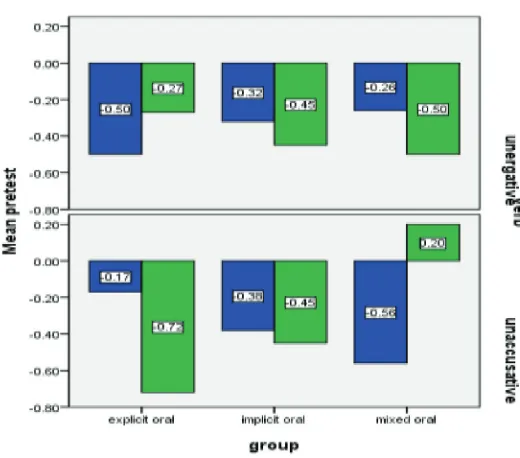
In Figure 1, the bar-graphs of the pre-test mean scores of the interme-diate and advanced level students of each group are illustrated.
19
difference observed in no feedback group was not statistically significant. The significance level
(p < .05) of all experimental groups indicated that the difference was statistically significant. The
effect size was calculated for each experimental group to determine the relative magnitude of the
difference between the scores of the pre- and post-test of each group. The effect sizes of all
experimental groups were considered as large effect sizes.
After comparing the pre- and post-test scores of each group and calculating the effect
sizes, a One-way ANOVA with different types of corrective feedback received by the
experimental groups as between-group factor( i.e. implicit, explicit or mixed), examined the
difference in students’ gain sores from one group to
others to answer the second research
question of the study (Table 2).
Table 2
One-way ANOVA analysis for mean of gain scores of all experimental
groups
Alternating
unaccusatives
Sum of Squares df
Mean Square
F
Sig.
Between Groups
.051
2
.026 .296 .754
Within Groups
.520
6
.087
Total
.572
8
The summarized results of One-way ANOVA, as presented in Table 2, indicated that no
statistically significant difference was found (p= . 754 > .05). The results suggested that
providing
explicit/implicit/mixed feedback has no significant effect on the participants’ learning
-Figure 1. Pre-test mean scores of verbs with resultative structure
As it is illustrated in Figure 1, the mean scores of the pre-test items focusing on unergative verbs indicate that all groups had the ability to determine the ill-formedness of the sentences with unergative verbs with the resultative structure. On the other hand, regarding the group performance on unaccusative verbs with resultative structure in the pre-test, the bar-graphs indicate that except the advanced level students of the mixed oral groups, all other groups failed to identify the well-formedness of the sentences.
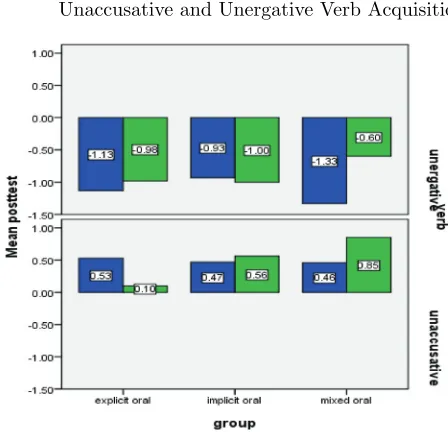
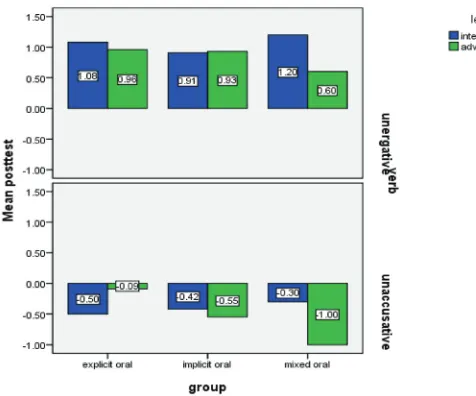
-Figure 2. Post-test mean scores of verbs with resultative structure structure
As it is illustrated in Figure 2, the mean scores of students’ judgments on the well-formedness of sentences with unergative verbs are higher compared to mean scores of the students’ judgments on the pre-test. Re-garding the unaccusative verbs, Figure 2 illustrates that while students’ judgments on pre-test indicated no or little ability of identifying the well-fromedness of sentences, the bars of the post-test are in the posi-tive side which showed students ability to differentiate the correct forms from the incorrect ones.
As the comparison of the bars direction and their magnitude from the pre-test to post-test indicate an improvement in all experimental groups, the mean differences of the pre- and post-tests of the different levels of the experimental groups were calculated (Table 3).
44 S. M. Meraji and F. Sadighi
Table 3:Mean differences of pre- and post-test scores of verbs with resultative structure
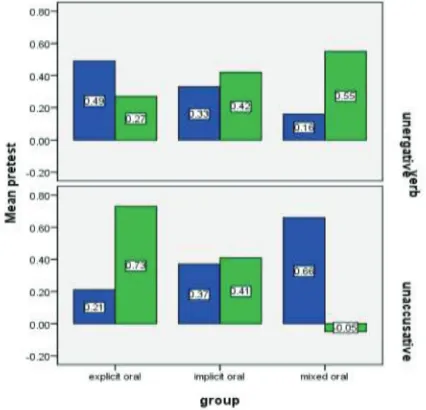
Pseudopassive Structure. Pseudopassive structures, like resultative structures, aimed at examining the students’ deep knowledge of unac-cusative and unergative verbs. Unlike resultatives, the pseudopassive structure is allowed with transitive and unergative verbs’ subjects, but not allowed with unaccusative verbs’ subjects. Therefore, a mean score of (+2) for unergative verbs and (-2) for unaccusative verbs showed the students’ maximum acquisition of unergative and unaccusative verbs, respectively. In Figure 3, the pre-tests mean scores of the intermediate and advanced level students of each group are illustrated.
Figure 3.Pre-test mean scores of verbs with Pseudopassivestructure
23
Table 3
Mean differences of pre- and post-test scores of verbs with
resultative structure
Group
Level
Explicit
oral
Implicit
oral
Mixed
oral
Unaccusatives Intermediate
0.70
0.85
1.02
Advanced
0.82
1.01
0.60
Unergatives
Intermediate
0.63
0.61
1.07
Advanced
0.71
0.55
0.10
As it is shown in Table 3, the intermediate-level students, who received a combination of
implicit and explicit oral corrective feedback, had the highest improvement in judging the
grammaticality of sentences with unaccusative (1.02) and unergative verbs (1.07).
PseudopassiveStructure.Pseudopassive structure, like resultative structure, aimed at
examining students’ deep knowledge of unaccusative and unergative verbs. Unlike
resultatives,
pseudopassive structure is allowed with transitive and unergative verbs’ subjects, but not allowed
with unaccusative verbs’ subjects.Therefore, a mean score of (+2) for unergative verbs and (
-2)
for unaccusative verbs showed students’ maximum
acquisition of unergative and unaccusative
verbs, respectively.
In Figure 3, the pre-tests mean scores of the intermediate and advanced level students of
each group are illustrated.
Table 3:Mean differences of pre- and post-test scores of verbs with resultative structure
Pseudopassive Structure. Pseudopassive structures, like resultative structures, aimed at examining the students’ deep knowledge of unac-cusative and unergative verbs. Unlike resultatives, the pseudopassive structure is allowed with transitive and unergative verbs’ subjects, but not allowed with unaccusative verbs’ subjects. Therefore, a mean score of (+2) for unergative verbs and (-2) for unaccusative verbs showed the students’ maximum acquisition of unergative and unaccusative verbs, respectively. In Figure 3, the pre-tests mean scores of the intermediate and advanced level students of each group are illustrated.
Figure 3.Pre-test mean scores of verbs with Pseudopassivestructure
44 S. M. Meraji and F. Sadighi
Table 3:Mean differences of pre- and post-test scores of verbs with resultative structure
Pseudopassive Structure. Pseudopassive structures, like resultative structures, aimed at examining the students’ deep knowledge of unac-cusative and unergative verbs. Unlike resultatives, the pseudopassive structure is allowed with transitive and unergative verbs’ subjects, but not allowed with unaccusative verbs’ subjects. Therefore, a mean score of (+2) for unergative verbs and (-2) for unaccusative verbs showed the students’ maximum acquisition of unergative and unaccusative verbs, respectively. In Figure 3, the pre-tests mean scores of the intermediate and advanced level students of each group are illustrated.
As it is shown in Figure 3, both intermediate and advanced level stu-dents had the ability to judge the grammaticality of the sentences with unergative verbs and pseudopassive structure. The bar-graphs of stu-dents’ judgments on sentences with unaccusative verbs illustrates that all groups but the advanced-level students, who were supposed to re-ceive a combination of implicit and explicit corrective feedback, failed to judge the grammaticality of sentences with unaccusative verbs and pseudopassive structure.
As the focus of the study was to compare the students’ judgments before and after receiving corrective feedback, Figure 4 illustrates the performance of each group after receiving the corrective feedback.
The bar-graphs of Figure 4 indicate a change in students’ grammat-icality judgments for both unergative and unaccusative verbs. However, the students’ grammaticality judgment of unergative verbs in the pre-tests revealed that the judgments’ scores were on the positive side of the axis. The post-test results indicated that the students’ ability to judge the grammaticality of sentences with unergative verbs had improved.
Figure 4. Post-test mean scores of verbs with Pseudopassivestructure
differ-ences of the pre-and post-tests of the different levels of all groups were calculated (Table 4).
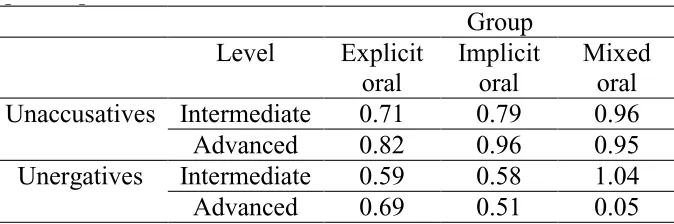
Table 4:Mean differences of pre-and post-test scores of verbs with pseudopassive structure
As it is shown in Table 4, the intermediate-level students, who received a combination of implicit and explicit oral corrective feedback, had the highest improvement in judging the grammaticality of the sentences with unaccusative (0.96) and unergative verbs (1.04).
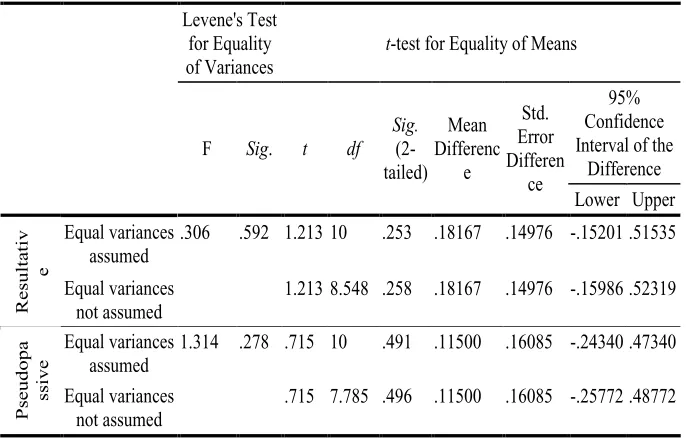
To provide answer for the third research question of the study, and to find out at which level of language learning (intermediate or advanced) can learners best take advantage of the corrective feedback, an inde-pendent samples t-tests was run for intermediate-and advanced-level learners’ performance on resultative and pseudopassive structures in all experimental groups (Table 5).
As it is shown in Table 5, none of the structures (i.e., resultative & pseudopassive) revealed no significant difference between the perfor-mance of advanced-and intermediate-level students. Therefore, despite of the different mean scores obtained by different groups, no significant difference was found.
26
Table 4
Mean differences of pre- and post-test scores of verbs with
pseudopassive structure
Group
Level
Explicit
oral
Implicit
oral
Mixed
oral
Unaccusatives Intermediate
0.71
0.79
0.96
Advanced
0.82
0.96
0.95
Unergatives
Intermediate
0.59
0.58
1.04
Advanced
0.69
0.51
0.05
As it is shown in Table 4, the intermediate-level students, who received a combination of
implicit and explicit oral corrective feedback, had the highest improvement in judging the
grammaticality of the sentences with unaccusative (0.96) and unergative verbs (1.04).
To provide answer for the third research question of the study, and to find out at which
level of language learning (intermediate or advanced) can learners best take advantage of the
corrective feedback, an independent samples
t
-tests was run for intermediate- and advanced-level
learners’ performance on resultative and pseudopassive structures in all experimental groups
Table 5: Independent Samples t-test for intermediate- and advanced-level learners
Discussion and Conclusion
Considering the findings from the WEPT, the scores of the post-tests of all three groups who received oral corrective feedback were signifi-cantly different from the scores of the pre-tests. Regarding the unergative verbs, the results revealed that the post-tests performance of all groups indicated an improvement and the effect sizes of all three groups who received oral corrective feedback, were considered as large. The results also revealed that the effect size of the group who received a combina-tion of implicit and explicit oral corrective feedback was larger than the other two groups who received either explicit or implicit oral corrective feedback. Although the groups who received oral corrective feedback had different effect sizes, the results of the One-way ANOVA revealed no significant difference between the explicit, implicit and mixed oral strategies.
27 Table 5
Independent Samples t-test for intermediate- and advanced-level learners Levene's Test
for Equality of Variances
t-test for Equality of Means
F Sig. t df
Sig. (2-tailed) Mean Differenc e Std. Error Differen ce 95% Confidence Interval of the
Difference Lower Upper
R esult ati v e Equal variances
assumed .306 .592 1.213 10 .253 .18167 .14976 -.15201 .51535 Equal variances
not assumed 1.213 8.548 .258 .18167 .14976 -.15986 .52319
P
se
udopa ssive
Equal variances assumed
1.314 .278 .715 10 .491 .11500 .16085 -.24340 .47340
Equal variances
not assumed .715 7.785 .496 .11500 .16085 -.25772 .48772
As it is shown in Table 5, none of the structures (i.e., resultative&pseudopassive)
revealed any significant difference between the performance of advanced- and intermediate-level
students. Therefore, despite of the different mean scores obtained by different groups, no
significant difference was found.
Discussion and conclusion
Considering the findings from WEPT, the scores of the post-tests of all three groups which
received oral corrective feedback were significantly different from the scores of the pre-tests.
Regarding the unergative verbs, the results revealed that the post-tests performance of all groups
indicated an improvement and the effect sizes of all three groups which received oral corrective
feedback, were considered as large. The results also revealed that the effect size of the group
which received a combination of implicit and explicit oral corrective feedback was larger than
A comparison of the results of the present study with those of Kawa-guchi and Ma (2012) showed that in both studies oral corrective feed-back was found to be effective for L2 learners’ grammar development. Kawaguchi and Ma evaluated the participants’ performance on noun plural forms, verb past tense, subject-verb agreement, and question for-mation. They stated that oral corrective feedback and negotiation of meaning resulted in better performance by the participants. The result of the present study also revealed the same findings for the effective-ness of oral corrective feedback for the acquisition of unergative and unaccusative verbs.
The results of the present study were also in-line with the results of the studies conducted by Bowles and Montrul (2009) in that both stud-ies revealed that a combination of explicit and implicit oral corrective feedback would result in the acquisition of grammar. Findings of Russell and Spada (2006) were also compatible with the findings of the present study in that both studies found that oral corrective feedback would help L2 learners of English acquire the grammar.
Although the results of the present study showed agreement with the studies which found the positive effects of corrective feedback, the present study provided the literature with information on the fact that the three types of oral corrective feedback can equally result in the ac-quisition of unergative and unaccusative verbs.
ability to judge the grammaticality of sentences with unaccusative verbs. The results of this study provide further support for the results of the previous studies such as the one done by Rezai and Ariamanesh (2012), as both studies indicated that Iranian EFL learners had difficulty with judging the grammaticality of sentences with unaccusative verbs before receiving instructions. Since Rezai and Ariamanesh did not provide their participants with instructions or corrective feedback, comparison of post-tests results is not applicable.
Results of Abbasi Bagherianpoor’s (2010) study supported the find-ings of the present study, indicating that learners had difficulty in struc-tures with unaccusative verbs and although learners were screened into intermediate and advanced levels, their performance was not signifi-cantly different. Compared with AbbasiBagherianpoor’s findings, the present study revealed that students of intermediate and advanced-levels had difficulty with unaccusative verbs. However, what makes the re-sults of the present study different from the previous ones is that in the present study the students’ performance is also evaluated after receiving the corrective feedback and explicit instruction. According to the results of the post-test, although both levels’ ability to judge grammaticality of sentences increased, advanced-level learners had slightly outperformed intermediate-level learners for items with unaccusative verbs; however, this difference was not considered significant.
Since the body of research points to universal acquisition challenges for unaccusatives (Zobl, 1989; Oshita, 1997; Hirakawa, 2000; Abbasi-Bagherianpoor, 2010; & Mortazavi, 2012), these findings provide a fur-ther support for the afore-mentioned challenges and also suggest solution (i.e., explicit instruction & oral corrective feedback) to overcome and re-duce the effects of those challenges on L2 acquisition.
since there is not any significant difference between the different correc-tive feedback strategies, it is teachers’ decision to determine which type or types of corrective feedback can help the students.
Limitations of the Study and Suggestions for Further Research
The present study, which targeted Iranian EFL majors, has some lim-itations in relation to the participants and the instruments. Since the participants of the present study were chosen based on a nonprobability sampling and from among an accessible population, they were Persian speakers. As Abbasi Bagherianpoor (2010) and Hirakawa (2000) claimed that unaccusative/unergative acquisition in L2 English follows from L1 universals, it is recommended that future research replicate the present study using participants with different L1 backgrounds. Another limi-tation of the present study was unavailability of computer-assisted cor-rective feedback. Since technology plays an important role in education, the incorporation of computer-assisted feedback into classes may provide the learners and teachers with its advantages/disadvantages. Therefore, there is a need for studies which focus on the incorporation of such programs into EFL classes.
References
[1] Abbasi, A. & MirjaniArjenan, F. (2014). Translation of English passive and unaccusative verbs into Farsi: A comparative study of three trans-lations of ’Animal Farm’by three Iranian translators.Procedia-Social and Behavioral Sciences, 98,9-15.
[2] Abbasi Bagherianpoor, A. (2010).The acquisition of English unaccusative verbs by Iranian EFL majors. Unpublished Ph. D dissertation, Shiraz University, Iran.
[3] Annett, J. (1969).Feedback and human behaviour.Harmondsworth, UK: Penguin.
since there is not any significant difference between the different correc-tive feedback strategies, it is teachers’ decision to determine which type or types of corrective feedback can help the students.
Limitations of the Study and Suggestions for Further Research
The present study, which targeted Iranian EFL majors, has some lim-itations in relation to the participants and the instruments. Since the participants of the present study were chosen based on a nonprobability sampling and from among an accessible population, they were Persian speakers. As Abbasi Bagherianpoor (2010) and Hirakawa (2000) claimed that unaccusative/unergative acquisition in L2 English follows from L1 universals, it is recommended that future research replicate the present study using participants with different L1 backgrounds. Another limi-tation of the present study was unavailability of computer-assisted cor-rective feedback. Since technology plays an important role in education, the incorporation of computer-assisted feedback into classes may provide the learners and teachers with its advantages/disadvantages. Therefore, there is a need for studies which focus on the incorporation of such programs into EFL classes.
References
[1] Abbasi, A. & MirjaniArjenan, F. (2014). Translation of English passive and unaccusative verbs into Farsi: A comparative study of three trans-lations of ’Animal Farm’by three Iranian translators.Procedia-Social and
Behavioral Sciences, 98,9-15.
[2] Abbasi Bagherianpoor, A. (2010).The acquisition of English unaccusative
verbs by Iranian EFL majors. Unpublished Ph. D dissertation, Shiraz
University, Iran.
[4] Bilodeau, E. A. (1969). Supplementary feedback and instructions. In E.
A. Bilodeau (Ed.),Principles of skill acquisition (pp. 235-253).New York:
Academic Press.
[5] Bitchener, J., Young, S., & Cameron, D. (2005). The effect of different
types of corrective feedback on ESL student writing. Journal of Second
Language Writing, 14(3), 191-205.
[6] Bowles, M. & Montrul, S. (2009). Back to basics: Incomplete knowledge
of Differential Object Marking in Spanish heritage speakers.Bilingualism:
Language and Cognition, 12(03), 363-383.
[7] Campillo, P. S. (2003). An analysis of implicit and explicit feedback on
grammatical accuracy. Miscelanea: A Journal of English and American
Studies, (27), 209-228.
[8] Chomsky, N. (1965).Aspects of theory of syntax.Cambridge, Mass: MIT
Press.
[9] George, H. V. (1972).Common errors in language learning.Rowley, Mass:
Newbury House.
[10] Han, Z. (2002). A study of the impact of recasts on tense consistency in
L2 output.Tesol Quarterly, 36(4), 543-572.
[11] Hawkins, E. (1987).Modern languages in the curriculum.Second edition,
Cambridge: CUP.
[12] Hirakawa, M. (2000). Unaccusativity in second language Japanese and
English.(Unpublished doctoral dissertation). McGill University, Canada.
[13] James, C. (2013). Errors in language learning and use: Exploring error
analysis.London: Routledge.
[14] KarimiDoostan, Gh. (1997).Light verb construction in Persian.
(Unpub-lished doctoral dissertation). Essex University, England.
[15] Kawaguchi, S. & Ma, Y. (2012). Corrective feedback, negotiation of meaning and grammar development: Learner-learner and learner-native
speaker interaction in ESL. Open Journal of Modern Linguistics, 2(02),
57.
[16] Leeman, J. (2007). Feedback in L2 learning: Responding to errors
dur-ing practice. Practice in a second language: Perspectives from Applied
Linguistics and Cognitive Psychology,111-137.
[4] Bilodeau, E. A. (1969). Supplementary feedback and instructions. In E. A. Bilodeau (Ed.),Principles of skill acquisition (pp. 235-253).New York: Academic Press.
[5] Bitchener, J., Young, S., & Cameron, D. (2005). The effect of different types of corrective feedback on ESL student writing. Journal of Second Language Writing, 14(3), 191-205.
[6] Bowles, M. & Montrul, S. (2009). Back to basics: Incomplete knowledge of Differential Object Marking in Spanish heritage speakers.Bilingualism: Language and Cognition, 12(03), 363-383.
[7] Campillo, P. S. (2003). An analysis of implicit and explicit feedback on grammatical accuracy. Miscelanea: A Journal of English and American Studies, (27), 209-228.
[8] Chomsky, N. (1965).Aspects of theory of syntax.Cambridge, Mass: MIT Press.
[9] George, H. V. (1972).Common errors in language learning.Rowley, Mass: Newbury House.
[10] Han, Z. (2002). A study of the impact of recasts on tense consistency in L2 output.Tesol Quarterly, 36(4), 543-572.
[11] Hawkins, E. (1987).Modern languages in the curriculum.Second edition, Cambridge: CUP.
[12] Hirakawa, M. (2000). Unaccusativity in second language Japanese and English.(Unpublished doctoral dissertation). McGill University, Canada.
[13] James, C. (2013). Errors in language learning and use: Exploring error analysis.London: Routledge.
[14] KarimiDoostan, Gh. (1997).Light verb construction in Persian. (Unpub-lished doctoral dissertation). Essex University, England.
[15] Kawaguchi, S. & Ma, Y. (2012). Corrective feedback, negotiation of meaning and grammar development: Learner-learner and learner-native speaker interaction in ESL. Open Journal of Modern Linguistics, 2(02), 57.
[17] Lightbown, P. M. & Spada, N. (1999). Instruction, first language influence, and developmental readiness in second language acquisition.The Modern Language Journal, 83(1), 1-22.
[18] Littlewood, W. (1984).Foreign and second language learning: Language acquisition research and its implications for the classroom. Cambridge: Cambridge University Press.
[19] Long, M. H. (1996). The role of the linguistic environment in second lan-guage acquisition. In Ritchie, W. C., & Bahtia, T. K. (eds.), Handbook of second language acquisition (pp. 413-68).New York: Academic Press. Reprinted in Ortega, L. (ed.),Second language acquisition: Critical con-cepts in linguistics.London: Routledge.
[20] Lyster, R. & Mori, H. (2006). Interactional feedback and instructional counterbalance.Studies in Second Language Acquisition, 28(02), 269-300.
[21] Lyster, R. & Ranta, L. (1997). Corrective feedback and learner up-take.Studies in Second Language Acquisition, 19(01), 37-66.
[22] Maicusi, T., Maicusi, P., & Lopez, M. J. C. (2000). The error in the second language acquisition. Encuentro. Revista de investigacion de innovacion en la clase de idiomas, 11,1999-2000.
[23] Mortazavi, M. (2012). Overpassivization of unaccusatives in ESL: Effects from tense and have.EFL Journal, 3(1).33-45.
[24] Narciss, S. (2008). Feedback strategies for interactive learning tasks.Handbook of research on educational communications and technol-ogy, 3,125-144.
[25] Oshita, H. (1997). The unaccusative trap: L2 acquisition of English in-transitive verbs. Unpublished Ph.D dissertation. University of Southern California, Los Angeles.
[26] Park, K. S. & Lakshmanan, U. (2007). The unaccusative-unergative dis-tinction in resultatives: Evidence from Korean L2 learners of English.In Proceedings of the 2nd conference on generative approaches to language acquisition North America (GALANA) (pp. 328-338).
[27] Perlmutter, M. (1979). Age differences in adults’ free recall, cued recall, and recognition.Journal of Gerontology, 34(4), 533-539.
[17] Lightbown, P. M. & Spada, N. (1999). Instruction, first language influence, and developmental readiness in second language acquisition.The Modern Language Journal, 83(1), 1-22.
[18] Littlewood, W. (1984).Foreign and second language learning: Language acquisition research and its implications for the classroom. Cambridge: Cambridge University Press.
[19] Long, M. H. (1996). The role of the linguistic environment in second lan-guage acquisition. In Ritchie, W. C., & Bahtia, T. K. (eds.), Handbook of second language acquisition (pp. 413-68).New York: Academic Press. Reprinted in Ortega, L. (ed.), Second language acquisition: Critical con-cepts in linguistics.London: Routledge.
[20] Lyster, R. & Mori, H. (2006). Interactional feedback and instructional counterbalance.Studies in Second Language Acquisition, 28(02), 269-300.
[21] Lyster, R. & Ranta, L. (1997). Corrective feedback and learner up-take.Studies in Second Language Acquisition, 19(01), 37-66.
[22] Maicusi, T., Maicusi, P., & Lopez, M. J. C. (2000). The error in the second language acquisition. Encuentro. Revista de investigacion de innovacion en la clase de idiomas, 11,1999-2000.
[23] Mortazavi, M. (2012). Overpassivization of unaccusatives in ESL: Effects from tense and have. EFL Journal, 3(1).33-45.
[24] Narciss, S. (2008). Feedback strategies for interactive learning tasks. Handbook of research on educational communications and technol-ogy, 3,125-144.
[25] Oshita, H. (1997). The unaccusative trap: L2 acquisition of English in-transitive verbs. Unpublished Ph.D dissertation. University of Southern California, Los Angeles.
[26] Park, K. S. & Lakshmanan, U. (2007). The unaccusative-unergative dis-tinction in resultatives: Evidence from Korean L2 learners of English. In Proceedings of the 2nd conference on generative approaches to language acquisition North America (GALANA) (pp. 328-338).
[28] Rezai, M. J. & Ariamanesh, A. A. (2012). Acquisition of English unerga-tive and unaccusaunerga-tive structures by Persian EFL learners. Journal of Teaching Language Skills, 4(2), 53-85.
[29] Richard, J. C., Platt, J., & Platt, H. (1992).Dictionary of language teach-ing & applied lteach-inguistics.Essex: Longman.
[30] Russell, J. & Spada, N. (2006). The effectiveness of corrective feedback for the acquisition of L2 grammar. Synthesizing Research on Language Learning and Teaching,133-164.
[31] Sauro, S. (2009). Computer-mediated corrective feedback and the devel-opment of L2 grammar. Language Learning & Technology, 13(1), 96-120.
[32] Selinker, L. (1972). Interlanguage.IRAL-International Review of Applied Linguistics in Language Teaching, 10(1-4), 209-232.
[33] Sorace, A. (1993). Incomplete vs. divergent representations of unac-cusativity in non-native grammars of Italian.Second Language Research, 9(1), 22-47.
[34] Tamayo Maggi, M. R. & Quishpe, D. C. C. (2017). EFL teachers’ correc-tive feedback and its effect on learners’ error repair in speaking. Revista Cientifica Axioma, 16,96-104.
[35] Wager, W. & Wager, S. (1985). Presenting questions, processing re-sponses, and providing feedback in CAI. Journal of Instructional Devel-opment, 8(4), 2-8.
[36] Zobl, H. (1989). Canonical typological structures and ergativity in En-glish L2 acquisition.Linguistic Perspectives on Second Language Acquisi-tion,203-221.
[37] Zohrabi, K. & Ehsani, F. (2014). The role of implicit & explicit corrective feedback in Persian-speaking EFL learners’ awareness and accuracy in English grammar.Procedia-Social and Behavioral Sciences, 98,2018-2024.
[28] Rezai, M. J. & Ariamanesh, A. A. (2012). Acquisition of English unerga-tive and unaccusaunerga-tive structures by Persian EFL learners. Journal of Teaching Language Skills, 4(2), 53-85.
[29] Richard, J. C., Platt, J., & Platt, H. (1992).Dictionary of language teach-ing & applied lteach-inguistics.Essex: Longman.
[30] Russell, J. & Spada, N. (2006). The effectiveness of corrective feedback for the acquisition of L2 grammar. Synthesizing Research on Language
Learning and Teaching,133-164.
[31] Sauro, S. (2009). Computer-mediated corrective feedback and the devel-opment of L2 grammar.Language Learning & Technology, 13(1), 96-120.
[32] Selinker, L. (1972). Interlanguage.IRAL-International Review of Applied Linguistics in Language Teaching, 10(1-4), 209-232.
[33] Sorace, A. (1993). Incomplete vs. divergent representations of unac-cusativity in non-native grammars of Italian.Second Language Research, 9(1), 22-47.
[34] Tamayo Maggi, M. R. & Quishpe, D. C. C. (2017). EFL teachers’ correc-tive feedback and its effect on learners’ error repair in speaking.Revista
Cientifica Axioma, 16,96-104.
[35] Wager, W. & Wager, S. (1985). Presenting questions, processing re-sponses, and providing feedback in CAI.Journal of Instructional Devel-opment, 8(4), 2-8.
[36] Zobl, H. (1989). Canonical typological structures and ergativity in En-glish L2 acquisition.Linguistic Perspectives on Second Language
Acquisi-tion,203-221.