Please cite this article as: H. Safikhani, M. Jamalinasab, Pareto Optimization of Two-element Wing Models with Morphing Flap Using Computational Fluid Dynamics, Grouped Method of Data handling Artificial Neural Networks and Genetic Algorithms,International Journal of Engineering (IJE),IJE TRANSACTIONS A: Basics Vol. 31, No. 4, (April 2018) 666-672
International Journal of Engineering
J o u r n a l H o m e p a g e : w w w . i j e . i rPareto Optimization of Two-element Wing Models with Morphing Flap Using
Computational Fluid Dynamics, Grouped Method of Data handling Artificial Neural
Networks and Genetic Algorithms
H. Safikhani*a, M. Jamalinasabb
a Department of Mechanical Engineering, Faculty of Engineering, Arak University, Arak, Iran b Department of Mechanical Engineering, Malek-ashtar University of Technology, Isfahan, Iran
P A P E R I N F O
Paper history:
Received 20August2017
Received in revised form 17October2017 Accepted 04January2018
Keywords:
Two-element Wings Morphing Flap
Multi-objective Optimization Grouped Method of data Handling NSGA II
Quadrature Phase Shift Keying
A B S T R A C T
A multi-objective optimization (MOO) of two-element wing models with morphing flap by using computational fluid dynamics (CFD) techniques, artificial neural networks (ANN), and non-dominated sorting genetic algorithms (NSGA II), is performed in this paper. At first, the domain is solved numerically in various two-element wing models with morphing flap using CFD techniques and lift (L) and drag (D) coefficients in wings are calculated. Afterward, for modeling L and D using grouped method of data handling (GMDH) type artificial neural networks, numerical data of the preceding step will be applied. Eventually, for Pareto based multi-objective optimization of two-element wing models with morphing flap using NSGA II algorithm, the modeling, which is accomplished by GMDH will be applied. It is shown that the achieved Pareto solution includes important design information on such wings.
doi: 10.5829/ije.2018.31.04a.19
1. INTRODUCTION1
Unmanned aerial vehicles (UAVs) with their various fields of usages such as: weather research, military, geographical, reconnaissance, communications and exploration, can be controlled by autonomous navigation systems or computer programs. The increases of the operating range, flight endurance, load carrying capacity; stability and maneuverability as well as the reduction of fuel consumption and noise whole together are attributed to the increase of UAVs aerodynamic efficiency, which has substantially important impact on our considerations [1, 2]. An influential scheme which causes the improvement of aerodynamic efficiency is the use of a high-lift system. Multi-element wing can be mentioned as one of the various types of this system. The flow field around a multi-element airfoil has a highly intricate physic because of the interaction between each of its
*Corresponding Author’s Email: [email protected] (H. Safikhani)
components, which is profoundly affected by the changes in the distance between these elements and by their overlap and deflection angles. One of the most significant designs for the enhancement of high aspect ratio wings for UAVs with lasting endurance is a two-element airfoil. In addition, with respect to the changing flight condition the notion of morphing structure can be adapted to the form of a flying vehicle in order to enhance its efficiency. The energy consumption, boost the flight efficiency can be declined by utilizing this technology on the wings of UAVs, furthermore, the excess noise, which is generated by these aerial vehicles, can be eliminated too [3].
Kanazaki et al. [4] presented an optimum design for a three-element airfoil consisting of the main wing, slat and flap. In order to achieve maximum aerodynamic efficiency, Jeong et al. [5] used one of the response surface means called Kriging, which determines the relationship between and objective function and the design variable.
to obtain the effects of each factor and their interactions on the output. Simpson et al. [6] compared the second-order response surface models and Kriging model for optimizing the model of a simulated aerospike nozzle by means of the Computational Fluid Dynamics (CFD). The variance analysis results confirmed the abilities of the mentioned methods in estimating the optimal values. Landman and Britcher [7] designed and tested a three-element airfoil equipped with separate flaps with the goal of finding the best flap position for achieving maximum lift force. They published the results of lift coefficient with respect to horizontal and vertical flap positions for 8º and 14º angles of attack. Vavalle and Qin [8] developed an optimization technique based on the response surface approach for a 2D airfoil (RAE2822) design for the transonic flow regime. The PARSEC method was used to model this airfoil and numerous experiments were performed to validate the approach. This research considers the response surface method to be a more effective technique than the other common numerical aerodynamic optimization methods. Xiong-feng et al. [9] proposed an optimization technique based on dynamic mesh for optimizing the wings of High Altitude Long Endurance (HALE) aircrafts. After parameterizing the airfoil, the proposed model was designed with the help of the design of experiments method and analyzed by means of CFD.
Proclaiming that the commercial development of today’s aircrafts lacks an established technique for design optimization based on optimal cost and efficiency, Ross and Krossley [10] proposed the Taguchi method (one of the design of experiments approaches) as a suitable low-cost method. Secanell et al. [11] used a highly accurate computer program based on CFD solver for the aerodynamic shape optimization with the Spalart-Allmaras turbulence model and a sequential second-degree algorithm to achieve optimal UAV airfoils for different flight conditions.
Kim et al. [12] applied an adjoining-based design optimization method for a 2D multi-element high-lift configuration. They used the RANS-based Navier-Stokes equations and the Spalart-Allmaras turbulence model to investigate the high Reynolds effects. In this research, the shape of the airfoil, the angle of attack and positions of the elements were chosen as the design variables and the three-element configuration producing the maximum lift was defined as the objective function. The results adequately agreed with the empirical data. Matteo et al. [13] performed extensive research on a proposed design including a hinge-less morphing flap with a flexible trailing edge and internally-actuated deformation with the aim of increasing the lift and aerodynamic efficiency. In a parametric study, Balaji et al. [14] determined the effects of 2D flap and slat in a high-lift flow on a three-element airfoil system by using the Spalart-Allmaras turbulence model and numerically
solving the Navier-Stokes equations. Rogers et al. [15] evaluated the performances of four flow turbulence models, including the Baldwin-Barth, Spalart-Allmaras, K-w and the Durbin-Mansour models, in obtaining the flow over a three-element airfoil. Steinbuch et al. published the results of their studies on two-element airfoils, including the Heron-1, FT/EX, SA-14 and FX-M2D, for subsonic laminar flows[3]. Dehghan menshadi and Jamalinasab [16] investigated the optimization process of a two element wing model using RSM method. They investigated the L over D (L/D) parameter as the objective function.
Increasing in the lift (L) and drag (D) coefficient will be resulted by using two-element wing models with morphing flap; therefore, optimal design points should be identified by utilizing a multi-objective optimization. In this study, for two-element wings model with morphing flap, the multi-objective optimization will be used in the ensuing procedure: using CFD techniques, Artificial Neural Networks (ANN) modeling and NSGA II algorithm. Grouped Method of Data Handling (GDMH) type neural network can be used in order to transform the CFD discrete data into continuous function. The paramount goal of GDMH modeling is that; by using this modeling method a quadratic polynomial function in a feed forward network whose coefficients were obtained using regression technique [17]. Recently, neural networks for modeling various parameters in engineering issues [18-20] are exerted by many researchers. The NSGA II and GMDH modeling algorithm, which used in this paper, is one of the best and complete multi objective optimization algorithms. For the very first time, this algorithm proposed by Deb [21], that recently has been exerted abundantly for multi-objective optimization of engineering issues [22-24].
A infantile of the followed process, which is used in this paper, is numerically solved in various two-element wing models with morphing flap using CFD techniques and lift and drag coefficients were calculated. Subsequently, to attain the polynomial models for the effects of the diverse parameters on L and D, GDMH neural networks are used. Afterward, the obtained polynomial models are used in a Pareto based multi-objective optimization approach to find the best conceivable combination of L and D, which are known as Pareto front. Some imperative design principles are the corresponding variations of design variables, known as the Pareto set.
2. MATHEMATICAL MODELING
of 1 m. The flap is rigid and its angle using a hinge mechanism can be changed. In this investigated design, a morphing flap is used instead of the rigid flap. A morphing flap can be replaced horizontally and vertically in proportion to the main airfoil and curved using an internal mechanism. This mechanism, which is installed at the end section of the morphing flap, enables it to modify and adapt its shape.
2.2. Wing Parameterization The vertical and horizontal positions of the flap and its curvature were parametrically defined to optimize the position and curvature of the flap. Therefore, the parametric expression could be adequately flexible; moreover, the changes of position and curvature are able to be adequately considered in the defined range to accomplish an optimum design. Therefore, in this modeling of this airfoil, five variable parameters were applied. These five parameters are demonstrated in Figure 2. The position and curvature of the flap can be appropriately specified by using these five parameters. If the mechanism carefully examined; it would be perceivable that this mechanism is made up of many rigid sections. The mechanism can change angle in proportion to one another and that the angle among the lower and upper surfaces of each section of the mechanism is fixed. Therefore, the changes of the flap curvature with regard to the physics of the problem can be expressed well by the defined angle parameters. Distinct designs are accessible by changing the variables and they can be simulated by CFD.
Subsequent, utilizing the GDMH type neural networks, which is afterward used for Pareto based multi-objective optimization of two-element wings models with morphing flap, two polynomials can be brought about.
Figure 1. Cross sectional geometry of the two-element wing [24, 25]
Figure 2. Geometrical parameters determining the position and curvature of the flap
2.3. Governing Equations By exerting the continuity and momentum equations we can simulate and analyze the fluid flow behavior. The continuity equation is expressed as follows:
𝜕𝜌
𝜕𝑡+
𝜕(𝜌𝑢𝑖)
𝜕𝑥𝑖 = 0 (1)
Navier-Stokes equations constitute the momentum equations governing the fluid flow. In general form, these equations are expressed as follows:
𝜌𝐷𝑉
Dt+ ∇P = 𝜇∇
2𝑢 + 𝐹 (2)
2.4. Turbulence Modeling A one-equation model, which solves a modeled transport equation for the kinematic eddy turbulent viscosity, is the Spalart-Allmaras model. Aerospace applications involving wall-bounded flows is one of the specific reasons, which led to the equation designed. Furthermore has been demonstrated that this equation can be used to give good results for boundary layers subjected to adverse pressure gradients. Consequently, for the modeling of flow turbulence [26] this model has been applied. The equation stated as follows:
𝐷𝜈̃
𝐷𝑡= 𝐶𝑏1[1 − 𝑓𝑡2]𝑆̃𝜈̃+ 1
𝜎[∇. ((𝜈 + 𝜈̃)∇𝜈̃)] +
𝐶𝑏2(∇𝜈̃)2− [𝐶𝑊1𝑓𝑤 −𝐶𝑘𝑏12𝑓𝑡2] (
𝜈 ̃
𝑑)
2
+ 𝑓𝑡1 ∆𝑈2
(3)
The kinematic eddy viscosity, νt is related to the eddy viscosity term v through the equation [27]:
𝜈𝑡= 𝜈̃𝑓𝜈1 (4)
2.5. Boundary Conditions For a flow with these characteristic: Reynolds number of 1M, density of 1.007 Kg/m3 and viscosity of 1.726×10⁻⁵ N.s/m2, the flow velocity at the inlet was set at 17.14 m/s at an angle of attack of 5º as the velocity inlet. In addition, outlet flow at the downstream was defined as the pressure outlet. The flow regime is subsonic; also, we can factor in the regime as an incompressible flow. The use of the pressure based solver and the ‘Simple’ algorithm can be justified by the flow characteristics.
substantially enhance the increasing number of elements above 61026.
2.7. Validation The achieved lift coefficient values from the wind tunnel tests for this airfoil have been published in credible papers [3]. In order to validate the obtained results, data were applied to be compared with the obtained results. The lift coefficient values for the considered wing section at a Reynolds of 1M and at distinct angles of attack and fixed flap can be shown by these results. Using the compared results, which are displayed in Figure 3 indicated that at a 5º angle of attack, the computational error for lift coefficient is approximated to be 1%. Also, the figure indicates that this coefficient in the worst case becomes less than 6% (i.e., at 11.6º angle of attack). The difference between these two subsequent values as 3.6E-7 was shown by the evaluation of the input and output flow rates. Furthermore, this evaluation proves the precision of the numerical method in solving the problem.
3. Modeling of L and D Using GMDH Type Neural Networks
An extensively used and compete neural networks, which is available today, is the GDMH type neural network. The neural network’s neurons, in this means are formed by relating diverse pairs though a quadric polynomial. The network conveys the approximation function fˆ with output
y
for a set of inputs)) ,..., , (
(x x1 x2 xn with the least value of error in
comparison with the real output, by synthesizing the quadric polynomials, obtained from all neurons.
Figure 3. Comparing the diagrams of lift coefficient vs. angle of attack obtained by the numerical method and via wind tunnel experiments [3]
Consequently, for M data encompasses n inputs and one output, the real results are expressed as follows:
) in x ,..., 3 i x , 2 i x , 1 i x ( f i
y (5)
As a matter of fact, we are trying to accomplish a neural network of GDMH type, that the value of output for every input vector x, is predictable by such approach. Hence: ) in x ,..., 3 i x , 2 i x , 1 i x ( fˆ i
yˆ (6)
The considered GDMH type neural should have this ability to minimize the square of error between the real and the predicted values; in other words:
min 2 ] ) ,..., 3 , 2 , 1 ( ˆ 1 [
f xi xi xi xin yi
M
i
(7)
By means of a complex polynomial function the generic form of relation between the input and output variables can be expressed as follows:
...
1 1 1 1 1
1
0
n i n j n i n
j xjxk
n
k aijkxi j x i x ij a i x n
i ai a
y (8)
The preceding relation is known as Ivakhnenko polynomial [28]. The ensuing relation is a quadric form of this polynomial which is used typically for many cases: 2 5 2 4 3 2 1 0 ) , (
ˆ G xi xj a a xi a xj a xixj a xi a xj
y (9)
Now, in order to find the polynomial models of
L and D of two-element wing models with morphing flap with respect to their effective input parameters the GDMH is utilized. In this paper, for designing the number of input-output data in GDMH modeling, Response Surface Methodology (RSM) which is a sub method of Design of Experiments (DOE) is used [32, 33]. There are a total number of 42 input-output CFD data considering five design variables and two objective functions. The following equations are GDMH polynomial relations, using to define L:
-51.08 -0.089 0.12 0.22 18.97
0.15 2 2
1
Y (10a)
H H
H
Y 0.07 6.78 6.51 0.03 2-0.07 2 0.08
2 (10b)
1 2 2 1 1
3 0.05-33.82Y 42.73 0.18Y -0.03 -0.19Y
Y (10c)
V Y V Y V Y Y 2 2 2 2 2
40.0415.27 -7.92 -0.13 0.06 0.16 (10d)
4 3 2 4 2 3 4
3 0.38 0.004 0.003 -0.0054 0.28
-0.00052 Y Y Y Y YY
L (10e)
1.24 6.5 0.0007 0.007 0.06
0.002 2 2
1
Y (11a)
H H
H
Y 0.002 0.06 1.10 0.00012 0.0007 2 0.007
2 (11b)
H H
H
Y 0.003 0.318 0.007 0.001 2 0.0005 2 0.0004
3 (11c)
1 2 2 1 1
4 3.33 0.094Y 0.149 0.001Y 0.0017 0.0045Y
Y (11d)
3 2 2 3 2 2 3 2
5 -10.71 0.30Y 1.607Y 0.017Y 0.04Y 0.028YY
Y (11e)
5 4 2 5 2 4 5
4 1.43 0.039 0.073 0.072
0.64
-10.92 Y Y Y Y YY
D (11f)
The 42 existing data have been divided into two groups; 32 data have been used to train, and the remaining 10 data have been utilized in order to test the network. The capability of the models can be evaluated through statistical methods; in addition to observe the prediction ability of the neural network models. In order to reach this paramount goal, statistical parameter, which is called the absolute fraction of variance (R2) is used. The following relations define this parameter:
n 1 i 2 CFD i 2 CFD i ANN i 2 Y ) Y Y ( 1 R (12)The high accuracy of the attained models in the prediction of the numerical CFD data can be indicated by the statistical values.
In the next section for the multi-objective optimization of two-element wing models with morphing flap are applied. In this section for prediction of L and D, the GMDH neural network models are used.
4. MULTI OBJECTIVE OPTIMIZATION OF TWO-ELEMENT WING MODELS WITH MORPHING FLAP USING NSGA II ALGORITHM
The GDMH modes obtained in section 4 are now exerted in a multi-objective optimization procedure using NSGA II algorithms [22, 23]. The optimal performance of two-element wing models with morphing flap was investigated. In all runs a population size of 60 has been chosen with crossover probability (Pc) and mutation probability (Pm) as 0.7 and 0.07,
respectively. The L and D that should be optimized simultaneously with respect to the design variables are the two conflicting objective in this study. The multi-objective optimization can be devised in the ensuing form: ) , , , , ( ) , , , , ( 2 1 i i V H f D Minimize V H f L Maximize (13)
The Pareto front of the mentioned objective functions is displayed in Figure 4. Obviously, the points have no dominancy over one another. That means, there are not two points can be found where one of their objective functions is the same as the other one. In other words, one objective function evolves and other one exacerbates, as we moved from one point to another. Four optimal points, whose corresponding design variables are designated by A, B, C and D, can be observed in this figure.
Moreover, the illustrated points in Figure 4 have unique characteristics. By considering the points A and B it is observable that they demonstrate the least drag and the highest lift coefficient, respectively. As we follow the direction from point A to point B, drag seldom changes (increases around 8%), whereas the changes in lift is gigantically substantial (increases around 17.2%). This striking attribute makes the point
B, which is known as the break point, very interesting for the design. Typically, finding a point at which both objective functions are abundantly gratified is ideal. We applied the mapping method [22] in order to find such a point. The values of both objective functions were assumed between 0 and 1, and the norm of these functions were calculated to reach this purpose. The ideal design point is constituted by the point with the highest norm value. Both objective functions of L and D
can be sufficiently satisfied by the point C, which is the point that has been attained from this approach.
By the CFD approach, the optimal points obtained from the Pareto front and neural networks must be validated. In a post numerical study, using CFD the design points of the obtained Pareto front were re-evaluated. The validity of the implemented procedure in the course of modeling with neural networks and in the optimization process can be proved by this difference.
In achieving the design objectives, the changes of the design variables interlocked with the Pareto front can be beneficial. Without the use of the multi-objective Pareto optimization process and CFD techniques presented in this paper, the mentioned useful relationships that indefeasible among the optimum design variables of two-element wing models with morphing flap, cannot be discovered.
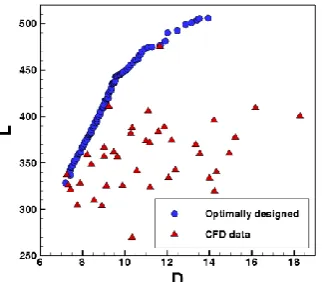
Ultimately, comparing the 42 primary data from the CFD simulations with the extracted Pareto front in this section not only is interesting but also is useful. The initial CFD data and the overlap of the Pareto front are shown in Figure 5.
Figure 4. Pareto optimal points for lift and drag for optimal design points
Figure 5. Overlap graph of the obtained optimal Pareto front with the CFD simulation data
5. CONCLUSION
By the use of a synthesis of CFD, GDMH type ANN and NSGAII algorithm; multi-objective optimization of two-element wing models with morphing flap was successfully implemented in this paper. H, V, 𝛼, 𝛽 and 𝜃 were the design variables, and the reduction in drag coefficient and increase in the lift simultaneously was the ultimate goal of this study. At the beginning, to solve the domain in several two-element wing models with morphing flap CFD techniques were used. Subsequent to the validating the results, for modeling of objective functions of L and D by means of the GDMH type ANN, the CFD data were applied. By employing various statistical parameters the significant precision of GDMH polynomials was demonstrated. Eventually, in order for the multi-objective optimization of two-element wing models with morphing flap and the extraction of the Pareto front by means of the NSGAII algorithm, these polynomials were exerted. The Pareto front contained imperative design information, with regard to the two-element models with morphing flap, which could be acquired just by combining CFD, GMDH and the multi-objective optimization method.
6. REFERENCES
1. Gamboa, P., Aleixo, P., Vale, J., Lau, F. and Suleman, A., Design and testing of a morphing wing for an experimental uav. 2007, University Of Beira Interior Covilha (Portugal).
2. Trapani, G., Kipouros, T. and Savill, A., "Computational aerodynamic design for 2d high-lift airfoil configurations",
Pegasus AIAA, (2010).
3. Steinbuch, M., Marcus, B. and Shepshelovich, M., "Development of uav wings-subsonic designs", in 41st Aerospace Sciences Meeting and Exhibit., (2003), 603-610. 4. Kanazaki, M., Tanaka, K., Jeong, S. and Yamamoto, K.,
"Multi-objective aerodynamic optimization of elements' setting for high-lift airfoil using kriging model", in 44th AIAA Aerospace Sciences Meeting and Exhibit., (2006), 1471-1480.
5. Jeong, S., Murayama, M. and Yamamoto, K., "Efficient optimization design method using kriging model", Journal of Aircraft, Vol. 42, No. 2, (2005), 413-420.
6. Simpson, T., Mistree, F., Korte, J. and Mauery, T., "Comparison of response surface and kriging models for multidisciplinary design optimization", in 7th AIAA/USAF/NASA/ISSMO Symposium on Multidisciplinary Analysis and Optimization., (1998), 4755-4762.
7. Landman, D. and Britcher, C.P., "Experimental geometry optimization techniques for multi-element airfoils", Journal of Aircraft, Vol. 37, No. 4, (2000), 707-713.
8. Vavalle, A. and Qin, N., "Iterative response surface based optimization scheme for transonic airfoil design", Journal of Aircraft, Vol. 44, No. 2, (2007), 365-376.
9. Xiong-feng, Z., Zhong-xi, H., Zheng, G. and Zhao-Wei, L., "Dynamic mesh based airfoil design optimization", World Academy of Science, Engineering and Technology, International Journal of Mechanical, Aerospace, Industrial, Mechatronic and Manufacturing Engineering, Vol. 6, No. 9, (2012), 1902-1907.
10. Ross, T.E. and Crossley, W.A., "Method to assess commercial aircraft technologies", Journal of Aircraft, Vol. 37, No. 4, (2000), 570-579.
11. Secanell, M., Suleman, A. and Gamboa, P., "Design of a morphing airfoil using aerodynamic shape optimization", AIAA Journal, Vol. 44, No. 7, (2006), 1550-1562.
12. Kim, S., Alonso, J. and Jameson, A., "Design optimization of high-lift configurations using a viscous continuous adjoint method", in 40th AIAA Aerospace Sciences Meeting & Exhibit., (2002), 844-852.
13. Di Matteo, N., Guo, S., Ahmed, S. and Li, D., "Design and analysis of a morphing flap structure for high lift wing", in 51st AIAA/ASME/ASCE/AHS/ASC Structures, Structural Dynamics, and Materials Conference 18th AIAA/ASME/AHS Adaptive Structures Conference 12th., (2010), 3096-3103. 14. Renukumar, B., Bramkamp, F.D., Hesse, M. and Ballmann, J.,
"Effect of flap and slat riggings on 2-d high-lift aerodynamics",
Journal of Aircraft, Vol. 43, No. 5, (2006), 1259-1271. 15. Rogers, S., Menter, F., Durbin, P. and Mansour, N., "A
comparison of turbulence models in computing multi-element airfoil flows", in 32nd Aerospace Sciences Meeting and Exhibit., (1994), 291-300.
16. Manshadi, M.D. and Jamalinasab, M., "Optimizing a two-element wing model with morphing flap by means of the response surface method", Iranian Journal of Science and Technology, Transactions of Mechanical Engineering, Vol. 41, No. 4, (2017), 343-352.
18. Amanifard, N., Nariman-Zadeh, N., Farahani, M. and Khalkhali, A., "Modelling of multiple short-length-scale stall cells in an axial compressor using evolved gmdh neural networks", Energy Conversion and Management, Vol. 49, No. 10, (2008), 2588-2594.
19. Nariman-Zadeh, N., Darvizeh, A. and Ahmad-Zadeh, G., "Hybrid genetic design of gmdh-type neural networks using singular value decomposition for modelling and prediction of the explosive cutting process", Proceedings of the Institution of Mechanical Engineers, Part B: Journal of Engineering Manufacture, Vol. 217, No. 6, (2003), 779-790.
20. Amanifard, N., Nariman-Zadeh, N., Borji, M., Khalkhali, A. and Habibdoust, A., "Modelling and pareto optimization of heat transfer and flow coefficients in microchannels using gmdh type neural networks and genetic algorithms", Energy Conversion and Management, Vol. 49, No. 2, (2008), 311-325.
21. Deb, K., Pratap, A., Agarwal, S. and Meyarivan, T., "A fast and elitist multiobjective genetic algorithm: NSGA-II", IEEE Transactions on Evolutionary Computation, Vol. 6, No. 2, (2002), 182-197.
22. Safikhani, H., Akhavan-Behabadi, M., Nariman-Zadeh, N. and Abadi, M.M., "Modeling and multi-objective optimization of square cyclones using cfd and neural networks", Chemical
Engineering Research and Design, Vol. 89, No. 3, (2011), 301-309.
23. Sanaye, S. and Hajabdollahi, H., "Thermal-economic multi-objective optimization of plate fin heat exchanger using genetic algorithm", Applied Energy, Vol. 87, No. 6, (2010), 1893-1902. 24. Sanaye, S. and Dehghandokht, M., "Modeling and multi-objective optimization of parallel flow condenser using evolutionary algorithm", Applied Energy, Vol. 88, No. 5, (2011), 1568-1577.
25. Shepshelovich, M. and Nagel, A., Slotted high lift aerofoils. 2012, Google Patents.
26. Spalart, P. and Allmaras, S., "A one-equation turbulence model for aerodynamic flows", in 30th aerospace sciences meeting and exhibit., (1992), 439-446.
27. M., N.K. and Muddkavi Y., "Cfd analysis of multi-element aerofoils using openfoam", in Proceedings of the 37th National & 4th International Conference on Fluid Mechanics and Fluid Power, IIT Madras, Chennai, India., (2010).
28. Ivakhnenko, A.G., "Polynomial theory of complex systems",
IEEE Transactions on Systems, Man, and Cybernetics, No. 4, (1971), 364-378.
Pareto Optimization of Two-element Wing Models with Morphing Flap Using
Computational Fluid Dynamics, Grouped Method of Data handling Artificial Neural
Networks and Genetic Algorithms
H. Safikhania, M. Jamalinasabb
a Department of Mechanical Engineering, Faculty of Engineering, Arak University, Arak, Iran b Department of Mechanical Engineering, Malek-ashtar University of Technology, Isfahan, Iran
P A P E R I N F O
Paper history:
Received 20August 2017
Received in revised form 17October 2017 Accepted 04January 2018
Keywords:
Two-element Wings Morphing Flap
Multi-objective Optimization Grouped Method of data Handling NSGA II
Quadrature Phase Shift Keying
هديكچ
لا ود یاه لاب یفدهدنچ یزاس هنیهب دنیآرف ،یفدهدنچ کیتنژ متیروگلا زا هدافتسا اب هلاقم نیا رد ینام
ا ا هدش ماجن رد .تس
ض تابساحم یمامت رد و تسا هدش لح یتابساحم تلاایس کیمانید زا هدافتسا اب یتابساحم ۀیحان ادتبا بیار
ب اسپ و ار
م کبش زا هدافتسا اب فده عباوت یزاسلدم تهج لبق هلحرم یاه هداد زا دعب هلحرم رد .دنا هدش هبساح بصع ه
دش ماجنا ی ه
ب یم یناملا ود یاه لاب یحارط دروم رد یدیفم رایسب تاعلاطا لماش هک وتراپ رادمن نایاپ رد .تسا ،دشا
ا ا هدش هئار .تس
![Figure 1. Cross sectional geometry of the two-element wing [24, 25]](https://thumb-us.123doks.com/thumbv2/123dok_us/30988.2003570/3.595.99.237.605.709/figure-cross-sectional-geometry-element-wing.webp)
![Figure 3. Comparing the diagrams of lift coefficient vs. angle of attack obtained by the numerical method and via wind tunnel experiments [3]](https://thumb-us.123doks.com/thumbv2/123dok_us/30988.2003570/4.595.66.273.514.694/figure-comparing-diagrams-coefficient-attack-obtained-numerical-experiments.webp)