Research Paper:
The Mediating Role of Identity Styles in the Relationship
Between Procrastination and Academic Performance in
High School Boy Students
Najmeh Tavakoli1 , Ramezan Hasanzadeh1* , Olia Emadian1
1. Department of Psychology, Islamic Azad University, Sari Branch, Sari, Iran.
* Corresponding Author: Ramezan Hasanzadeh, PhD.
Address: Department of Psychology, Islamic Azad University, Sari Branch, Sari, Iran.
Tel: +98 (911) 3232106
E-mail: [email protected]
Background: Academic performance is associated with an individual’s psychological state.
Objectives: The purpose of this study was to investigate the mediating role of identity styles in the relationship between procrastination and academic performance in high school boy students. Materials and Methods: This correlational research using a structural equation modeling was conducted on 330 9th grade high school boy students from 10 high schools in Qaemshahr, Iran in winter 2019selected by convenience sampling. Data collection tools included the Academic Performance Questionnaire, the Identity Style Inventory, and Procrastination Assessment Scale-Students. In the present study, the structural equation modeling was utilized to analyze the collected data using SPSS V. 18 and Amos V. 23 software.
Results: The results showed a significant relationship between procrastination and identity styles, and academic performance (P≤0.01). Also, the research model was fit and showed that 0.57 of the dispersion of the academic performance was influenced by procrastination and identity styles. Besides, identity styles had a mediator role in the relationship between procrastination and academic performance.
Conclusion: The present research indicated the importance of identity styles and procrastination in explaining academic performance. Therefore, identifying students’ identity styles and improving their status in educational settings can reduce academic procrastination leading to better academic performance.
A B S T R A C T
Keywords:
Identity, Procrastination, Academic performance
Citation Tavakoli N, Hasanzadeh R, Emadian O. The Mediating Role of Identity Styles in the Relationship Between Procrastination and Academic Performance in High School Boy Students. Avicenna J of Neuropsychophysiology. 2019; 6(4):211-218. http://dx.doi. org/10.32598/ajnpp.6.4.7
:
http://dx.doi.org/10.32598/ajnpp.6.4.7 Use your device to scan
and read the article online
Article info: Received: 21 Mar 2019
Accepted: 19 Sep 2019
Introduction
he success and development of today’s
societies are associated with some cru-cial students’ abilities and talents [1].
Many students face problematic social and educational situations in the
class-room and at home and at school [2].
Practice and application are the most important criteria for evaluating learners in the process
of learning [3]. The learning process can be evaluated by academic performance and academic achievement
[4] and the term “academic performance” is defined as the amount of individual learning measurable by
vari-ous tests [5]. Numerous factors, such as intelligence, ap-titude, family status, and even parents ‘attitudes toward education affect students’ academic performance [6].
Psychological processes in the educational field can explain behavioral performances, such as procrastina-tion [7]. Procrastination refers to a person’s voluntary
delay and is common among learners [8]. Although
not always problematic, it can often have undesirable and irreparable consequences by affecting the person’s
progress towards goal achievement [9].
Due to the complexity and cognitive, emotional, and behavioral components, procrastination has various manifestations, including academic procrastination, general procrastination, decision procrastination, neu-rotic procrastination, and obsessive-compulsive pro-crastination [10]. It is perceived by individuals as the dominant tendency to postpone activities and is con-sidered as an important factor affecting the person’s goals, desires, and overall identity [11]. Identity is a fundamental and intrinsic aspect, by which a person relates to his past and feels a sense of continuity and integration [12]. According to Berzonsky, three identity styles, namely information, normative, and confused or avoidant styles can be considered [13]. Individuals with information styles actively evaluate information and ac-tively modify the aspects of their identities when con-fronted with incompatible situations[14]. In normative style, people consider core values and follow them [15].
In a confused or avoidant style, people generally avoid encountering conflicting situations [16].
Shah Karamipour and Mehdi-Nejad [7] showed that
environmental stress factors affect academic perfor-mance. McIntyre et al. [18] reported that academic
performance prediction was influenced by psycho-logical characteristics, dimensions of acquired identity, the extent of social communication, and
communica-tion patterns of the learners. Kyere and Huguley [15]
showed that the type and quality of the style of identity acquired in adolescents, in addition to predicting their academic performance, could determine their future job well-being. According to Kim et al. [10], the degree of procrastination of individuals can be influenced by their personality traits, which can affect their academic performance. Semprebon et al. [19] found that procras -tination and academic procras-tination had a significant effect on academic performance and increased feel-ings of personal inefficiency. Also, Suri and Ishala [20]
showed that there is a relationship between identity crisis and procrastination among students. Zhang et al.
[21] reported a significant relationship between the di-mensions of identity and procrastination.
On the other hand, following the self-determination theory by Ryan and Deci [22], which examines the fac-tors affecting academic performance, they emphasized that cognitive factors, such as identity and motivation, as well as behavioral factors, like procrastination, play a central role in academic performance. Accordingly, it can be concluded that students’ academic failure and in-appropriate performance are of particular importance. Students who do their tasks inappropriately, their lives will be changed because of the association between their education and their future jobs and social status. Also, this issue is one of the research priorities of the educational assistants of the education organizations to bridge the gap between census results so far as a model. This research aimed at determining the mediating role of identity styles in the relationship between procras-tination and academic performance in male students.
Materials and Methods
This correlational research using a structural equation modeling was conducted on 9th-grade high school boy students from 10 high schools in Qaemshahr, Iran in winter 2019. To determine the sample size, according to the number of observed variables and considering the coefficient of 30 for each observed variable (11 variables were observed in the model) [23], as well as due to the probability of incomplete questionnaires, 330 students were selected by the convenience sampling method.
Inclusion criteria were 9th-grade high school students studying in Qaemshahr city, male gender, and the age of 15 years. Exclusion criteria included incomplete answers to the questionnaires and an unwillingness to continue the study.
Before sampling, the students were informed about the research objectives and the confidentiality of
mation. The informed consent letter was received from the students and then, the questionnaires were
distrib-uted to collect the data.
The relevant data were collected by the Academic Performance Questionnaire designed by Pham and Tay-lor (1999), Procrastination Assessment Scale-Students (PASS) developed by Solomon and Rothblum (1984), and Identity Style Inventory (ISI) developed by Berzon-sky et al. (1992). Data analysis was done by structural equation modeling using SPSS v. 18 and Amos v. 23 soft-ware at the 0.05 probability level.
Study instruments
Academic Performance Questionnaire by Pham and Taylor
The academic performance questionnaire was de-signed by Pham and Taylor (1999) [24] with 48 ques-tions to evaluate academic performance from various domains (self-efficacy, emotional effects, planning, lack of consequence control, and motivation). It is scored on a 5-point Likert scale from strongly disagree to strongly agree. Its construct validity and convergent validity were confirmed by the developers. The reliability of the ques-tionnaire was 0.94 using Cronbach’s alpha for self-effica-cy, 0.86 for emotional effects, 0.95 for planning, 0.77 for lack of consequence control, and 0.82 for motivation. Dortaj in Iran confirmed the content validity and con-struct validity of this scale by factor analysis [25]. The
reliability of the questionnaire using Cronbach’s alpha was obtained 0.92 for self-efficacy, 0.73 for emotional effects, 0.93 for planning, 0.64 for lack of consequence control, 0.73 for motivation, and 0.74 for the whole scale. In the present study, Cronbach’s alpha reliability for self-efficacy was 0.88, 0.81 for emotional effects, 0.82 for planning, 0.72 for lack of consequence control, 0.68 for motivation, and 0.73 for the whole scale.
Procrastination Assessment Scale-Students (PASS) by Solomon and Rothblum
PASS was designed by Solomon and Rothblum in 1984
[26], with 27 questions to assess procrastination in three areas of homework preparation (questions 1-8), exam preparation (questions 9-19), and preparation of articles at the end of the semester (questions 20-27). It is scored on a 5-option Likert scale from strongly dis-agree to strongly dis-agree. Its construct validity and con-vergent validity were confirmed by the creators and its reliability using Cronbach’s alpha method was 0.81 for homework preparation, 0.83 for exam preparation, 0.87
for preparation of articles at the end of the semester, 0.89 for the whole scale. In Iran, Nariman and Hosse-inChari using Cronbach’s alpha method reported con-struct validity and concurrent validity and reliability of 0.79 for homework preparation, 0.78 for exam prepara-tion, 0.83 for and preparation of articles at the end of the semester, and 0.82 for the whole scale [27]. In the present study, its reliability was obtained by Cronbach’s alpha for preparing assignments (0.80), exam prepara-tion (0.76), and preparaprepara-tion of articles at the end of the semester (0.82), and also for the whole scale (0.81).
Identity Style Inventory (ISI) by Berzonsky
ISI was designed by Berzonsky in 1992 [28] with 40 questions and three styles (informational, normative, and confused-avoidant). In this study, 30 questions were 30 identity style items and 10 questions were ISI com-mitment items. The questionnaire is scored on a 5-point Likert scale from strongly disagree to strongly agree. The construct validity and convergent validity of the ISI was approved by its creators and the Cronbach’s alpha reli-ability was reported 0.62 for information identity style, 0.66 for normative identity style, and 0.73 for confused-avoidance identity styles. In Iran, it was standardized by Ghazanfari (2004) and its construct validity was con-firmed by internal consistency [29]. Also, Cronbach’s alpha reliability for information identity style was ob-tained 0.67, 0.52 for normative identity style, and 0.62 for confused-avoidance identity style. In the present study, Cronbach’s alpha reliability was found to be 0.62 for information identity style, 0.58 for normative identity style, and 0.66 for confused-avoidance identity style.
Results
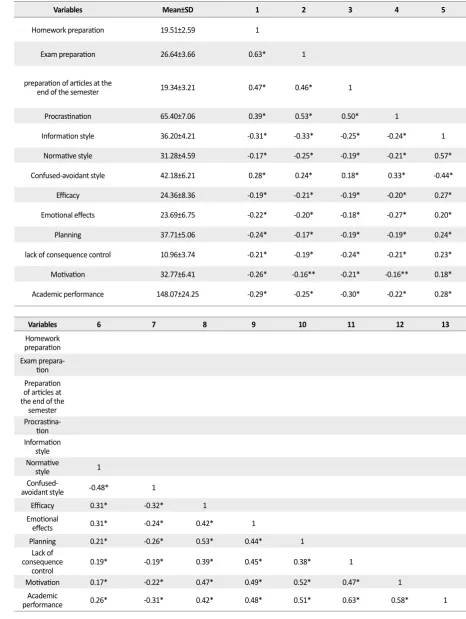
Statistical assumptions were first evaluated by the Kol-mogorov-Smirnov test and normal distribution of the data was confirmed. Also, the three-variable model was confirmed. The results of Table 1 indicate a significant correlation between procrastination, identity styles, and academic performance in the subjects. There was a significant inverse relationship between procrastination and avoidant identity style, and academic performance (P≤0.01). Also, a significant direct relationship was found between informational and normative identity styles, and academic performance (P≤0.01). According
Table 1. Descriptive statistics and Pearson correlation matrix of the relationship
Variables Mean±SD 1 2 3 4 5
Homework preparation 19.51±2.59 1
Exam preparation 26.64±3.66 0.63* 1
preparation of articles at the
end of the semester 19.34±3.21 0.47* 0.46* 1
Procrastination 65.40±7.06 0.39* 0.53* 0.50* 1
Information style 36.20±4.21 -0.31* -0.33* -0.25* -0.24* 1
Normative style 31.28±4.59 -0.17* -0.25* -0.19* -0.21* 0.57*
Confused-avoidant style 42.18±6.21 0.28* 0.24* 0.18* 0.33* -0.44*
Efficacy 24.36±8.36 -0.19* -0.21* -0.19* -0.20* 0.27*
Emotional effects 23.69±6.75 -0.22* -0.20* -0.18* -0.27* 0.20*
Planning 37.71±5.06 -0.24* -0.17* -0.19* -0.19* 0.24*
lack of consequence control 10.96±3.74 -0.21* -0.19* -0.24* -0.21* 0.23*
Motivation 32.77±6.41 -0.26* -0.16** -0.21* -0.16** 0.18*
Academic performance 148.07±24.25 -0.29* -0.25* -0.30* -0.22* 0.28*
Variables 6 7 8 9 10 11 12 13
Homework preparation Exam
prepara-tion Preparation of articles at
the end of the semester
Procrastina-tion Information
style
Normative
style 1
Confused-avoidant style -0.48* 1
Efficacy 0.31* -0.32* 1 Emotional
effects 0.31* -0.24* 0.42* 1
Planning 0.21* -0.26* 0.53* 0.44* 1
Lack of consequence
control 0.19* -0.19* 0.39* 0.45* 0.38* 1
Motivation 0.17* -0.22* 0.47* 0.49* 0.52* 0.47* 1
Academic
performance 0.26* -0.31* 0.42* 0.48* 0.51* 0.63* 0.58* 1
to and larger than 0.9, which indicate that the appropriate
used measurement model. According to Table 3, procrasti-nation and identity styles had a significant direct effect on
academic performance.
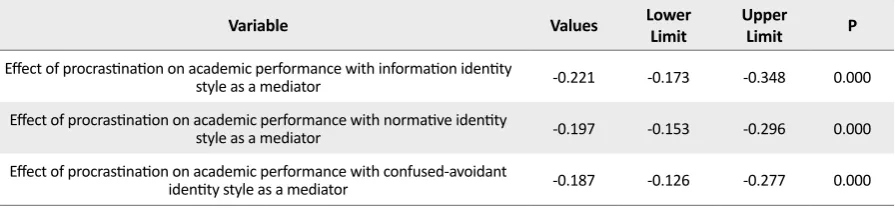
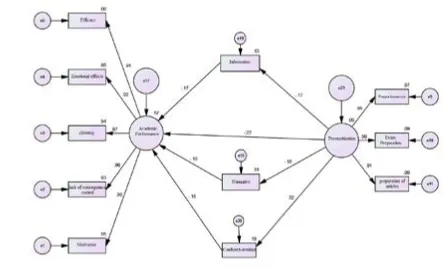
As can be seen in Table 4, the three considered in-direct paths based on the obtained values were sig-nificant and confirmed by the Bootstrap method at the level of 0.01.According to Figure 1, 0.57 of the academ-ic performance dispersion was influenced by procrasti-nation and identity styles.
Discussion
According to the obtained results, identity styles had a mediating role in the relationship between procrastina-tion and academic performance. In this regard, Sempre-bon et al. [19] showed that academic procrastination had a significant effect on academic performance and increased feelings of personal inefficiency. Shah Karami-pour and Mehdi Nejad [7] reported that environmental
stress factors affected academic performance. Accord-ing to Kim et al. [10], the degree of procrastination of individuals can be influenced by their personality traits,
Table 2. Fit indices derived from data analysis and variables
Tests Acceptable Values Obtained Values
The ratio of Chi-square to its degrees of freedom (χ2/df) >3 2.436
Root Mean Square Error of Approximation (RMSEA) >0.1 0.044
Goodness of Fit Index (GFI) <0.9 0.996
Normed Fit Index (NFI) <0.9 0.981
Comparative Fit Index (CFI) <0.9 0.978
Degree of Freedom (DF): 152
Table 3. Direct estimation of the model through the maximum likelihood method
Variable b β R2 t P
Effect of procrastination on academic
performance -0.504 -0.217 0.109 5.124 0.001
Effect of information identity style on
academic performance 0.396 0.224 0.088 5.428 0.001
Effect of the normative identity style on
academic performance 0.341 0.212 0.072 5.089 0.001
Effect of confused-avoidant identity style on
academic performance -0.287 -0.166 0.047 3.864 0.002
Table 4. Indirect estimation of the model through the Bootstrap method
Variable Values Lower Limit Upper Limit P
Effect of procrastination on academic performance with information identity
style as a mediator -0.221 -0.173 -0.348 0.000
Effect of procrastination on academic performance with normative identity
style as a mediator -0.197 -0.153 -0.296 0.000
Effect of procrastination on academic performance with confused-avoidant
which may affect academic performance. Kyere and
Hugu-ley [15] showed that the type and quality of the style of identity acquired in adolescents, in addition to predicting their academic performance, could determine their future job well-being. Suri and Ishala [20] showed that there is
a relationship between identity crisis and procrastination among students. Zhang et al. [21] showed that there is a
significant relationship between the dimensions of identity and procrastination. McIntyre et al. [18] found that predic -tors of academic performance were influenced by psycho-logical characteristics, acquired identity dimensions, and learners’ communication patterns.
Procrastination reflects a lack of self-regulation behaviors in students. Also, confused identity and ineffective self-defense strategies are used to avoid failure, self-esteem,
and personal value [30]. Therefore, students who post-pone preparation for exams to the night before the exam
experience severe psychological stress during the test.
Procrastination causes high levels of stress and anxiety in students and reduces their self-esteem [31]. Neglectful be-haviors have a high potential to cause painful social and psychological effects; therefore, avoiding them requires a high coping ability, which can impede adaptive identity [4].
This may be because procrastination is a personality trait rooted in one’s personality and identity style rather than a variable factor [8]. On the other hand, adolescents who
use positive coping strategies to cope with academic stress
have less adolescent neglect and are likely to have norma -tive style [32], indicating the importance of gaining and in-creasing knowledge. However, they do not have the time or ability to understand the reason to delay their academic
performance.
Procrastination first lowers students’ ability to concen-trate, regulate, and strengthen their intellectual cohe-sion, and then leads to reduced academic achievement. Notably, based on the theory of Berzonsky’s [33], people with informational identity style have higher self-esteem than those with normative identity style. In general, iden-tity styles focus on competitive strategies, effort, personal goals, and professional goals. Academic success concerns interests and outcomes, self-esteem, and effective lead-ership and strategies. Individuals with confused-avoidant identity styles do not have stable goals, higher-level skills, and self-efficacy, leading to poor academic performance.
The present study was limited to boy high school stu-dents in Qaemshahr city in 2019. Also, self-report tools and a cross-sectional method were used. Another limita-tion of this research was the lack of an etiology to indi-cate the effect of exogenous variables (identity styles and procrastination) on the endogenous variable (academic performance).
Conclusion
The obtained results showed that identity styles mediat-ed the relationship between procrastination and students’
academic performance. We indicated the importance of
identity and procrastination styles in explaining academic performance. It was found that 0.57 of the academic per-formance dispersion was influenced by procrastination and identity styles. Therefore, identifying students’ identi-ty sidenti-tyles and improving their status in educational settings will lead to reduced academic procrastination, and conse-quently better academic performance. Psychologists and school counselors should consider identity styles to reduce academic procrastination.
Ethical Considerations
Compliance with ethical guidelinesAll ethical principles were considered in this article. The participants were informed about the purpose of the research and its implementation stages and signed
the informed consent. They were also assured of the
confidentiality of their information. Moreover, They were allowed to leave the study whenever they wish, and if desired, the results of the research would be available to them.
Funding
This study was extracted from the PhD. thesis of first au-thor in Educational Psychology by Najmeh Tavakoli. Also, This study was approved by the Islamic Azad University, Sari Branch (Code: IR.IAU.AH.REC.1397.024).
Authors' contributions
Conceptualization, resources, and supervision: Najmeh Tavakoli; Methodology and writing -original draft: Olia Ema-dian; Investigation and writing-review & editing: Ramezan Hasanzadeh; Funding acquisition: All Authors.
Conflict of interest
The authors declared no conflict of interest.
References
[1] Mastoory Y, Harandi SR, Abdolvand N. The effects of communica-tion networks on students’ academic performance: The synthetic approach of social network analysis and data mining for education.
International Journal on Integrating Technology in Education. 2016; 5(4):23-34. [DOI:10.5121/ijite.2016.5403]
[2] Foster TA. [An exploration of academic resilience among rural stu-dents living in poverty (English)]. [PHD. dissertation]. Demorest: Pied-mont College; 2013.
[3] Sobhi N, Ghaffari M, Molaei M. [Sense of coherence, self-dilution and student academic performance relationships: The interpersonal role of personal intelligence (Persian)]. Iranian Journal of Medical Education. 2016; 16:165-75.
[4] Kim KR, Seo EH. The relationship between procrastination and aca-demic performance: A meta-analysis. Personality and Individual Dif-ferences. 2015; 82:26-33. [DOI:10.1016/j.paid.2015.02.038]
[5] Forsberg L. Homework as serious family business: Power and sub-jectivity in negotiations about school assignments in Swedish fami-lies. British Journal of Sociology of Education. 2007; 28(2):209-22.
[DOI:10.1080/01425690701192695]
[6] Savari K, Borna MR. [The relation between the religious attitudes and the goals of progress with the tendency to cheating in the exam through mediation of academic performance (Persian)]. Applied Re-search in Educational Sciences. 2015;2(2):29-38.
[7] Shah-Karamipour N, Mehdi-Nejad J. Investigation of environmental stressful resources in educational space of architectural design atel-iers and impact of stress on academic performance. 1th international
congress of civil, architecture and urban development. Tehran; Per-manent Secretariat Conference: 2017.
[8] Grunschel C, Schwinger M, Steinmayr R, Fries S. Effects of using mo-tivational regulation strategies on students’ academic procrastina-tion, academic performance, and well-being. Learning and Individual Differences. 2016; 49:162-70. [DOI:10.1016/j.lindif.2016.06.008]
[9] Iranpour S, Eteksamzadeh P. The Relationship between identity
styles and academic performance in high school girl students in Ah -vaz, international conference on humanities, psychology and social sciences. Tehran; Institute of Managers of Iliya Capital Ideas: 2015.
[10] Kim S, Fernandez S, Terrier L. Procrastination, personality traits, and academic performance: When active and passive procrastination tell a different story. Personality and Individual Differences. 2017; 108:154-7. [DOI:10.1016/j.paid.2016.12.021]
[11] Balkis M, Erdinç DU. Gender differences in the relationship be-tween academic procrastination, satifaction with academic life and academic performance. Electronic Journal of Research in Educational Psychology. 2017; 15(1):105-25. [DOI:10.14204/ejrep.41.16042]
[12] Monacis L, De Palo V, Griffiths MD, Sinatra M. Social networking addiction, attachment style, and validation of the Italian version of the Bergen Social Media Addiction Scale. Journal of Behavioral Addic-tions. 2017; 11;6(2):178-86. [DOI:10.1556/2006.6.2017.023][PMID] [PMCID]
[13] McMillan W. Identity and attribution as lenses to understand the relationship between transition to university and initial academic performance. African Journal of Health Professions Education. 2015; 7(1):32-8.
[14] Berzinski C. Recovery mentorship programs and recovery from ad-diction. Minnestonsa: ST. Catherine University; 2012.
[16] Xie X, Wang X, Wang P, Wang Y, Lei L, Guo J, et al. Academic adapta-tion and pursuit of the symbolic funcadapta-tion of mobile phones among adolescents: Moderating role of self-identity and mediating role of academic performance. Child Indicators Research. 2018; 9(14):1-12.
[DOI:10.1007/s12187-018-9560-5]
[17] Dasht Bozorgi Z. The relationship between Persecution and per-fectionism with Academic achievement and Burnout in medical students. Education Strategies in Medical Sciences. 2016; 9(1):34-41.
[18] McIntyre JC, Worsley J, Corcoran R, Harrison Woods P, Bentall RP. Academic and non-academic predictors of student psychological distress: The role of social identity and loneliness. Journal of Mental Health. 2018; 27(3):230-9. [DOI:10.1080/09638237.2018.1437608] [PMID]
[19] Semprebon E, Amaro, HD, Beuren IM. The procrastination influ-ence on academic performance and the moderating role of personal sense of power. Education Policy Analysis Archives. 2017; 7(2):25-20.
[DOI:10.14507/epaa.25.2545]
[20] Suri S, Ishala K. Identity crisis, procrastination and academic moti-vation among university students. International Journal of Education and Management Studies. 2018; 8(1):148-52.
[21] Zhang Y, Xiao HM, Lin XY, Li K. The correlation analysis of profes-sional identity and procrastination among nursing undergraduates. Chinese Journal of Nursing Education. 2017; (12):25.
[22] Deci EL, Ryan RM. Self-determination theory: A macrotheory of human motivation, development, and health. Canadian psychol-ogy/Psychologie canadienne. 2008; 49(3):182-5. [DOI:10.1037/ a0012801]
[23] MacCallum RC, Browne MW, Sugawara HM. Power analysis and determination of sample size for covariance structure modeling. Psychological Methods. 1996; 1(2):130-49. [DOI:10.1037/1082-989X.1.2.130]
[24] Pham LB, Taylor SE. From thought to action: Effects of process-ver-sus outcome-based mental simulations on performance. Personality and Social Psychology Bulletin. 1999; 25(2):250-60. [DOI:10.1177/01 46167299025002010]
[25] Dortaj F. [Investigating the effect of process and process mental simulation on improving academic performance of students, con-structing and standardizing academic performance test (Persian)].
Tehran: Allameh Tabatabaei University; 2004.
[26] Solomon LJ, Rothblum ED. Academic procrastination: Frequency and cognitive-behavioral correlates. Journal of Counseling Psychol-ogy. 1984; 31(4):503-9. [DOI:10.1037/0022-0167.31.4.503]
[27] Narimani S, Hossein-Chari M. Explaining Students’ academic pro-crastination based on religious beliefs and control core. Journal of Educational Psychology. 2011; 8(14):99-126.
[28] Berzonsky MD. Identity style inventory: Revised version. Unpub-lished manuscript. (ISI-3) [Database record]. APA PsycTests; 1992.
[DOI:10.1037/t21352-000]
[29] Ghazanfari A. [Validation and standardization of identity style ques-tionnaire (Persian)]. Pedagogical and Psychological Studies. 2004; 5(1):81-94.
[30] Poursharbi R. Evaluation of academic procrastination and its di-mensions in students of Tabriz University of Medical Sciences and their relationship with academic performance. Developmental Steps in Medical Education. 2016; 13(5):488-96.
[31] Soltani Z, Jamali N, Khojasteniam A, Dargahi S. Role of self- efficacy and psychological resiliency in academic procrastination of students. Education Strategies in Medical Sciences. 2016; 9(4):277-84.
[32] Rice KG, Ray ME, Davis DE, DeBlaere C, Ashby JS. Perfectionism
and longitudinal patterns of stress for STEM majors: Implications
for academic performance. Journal of Counseling Psychology. 2015; 62(4):718-31. [DOI:10.1037/cou0000097][PMID]
[33] Berzonsky MD, Cieciuch J, Duriez B, Soenens B. The how and what
of identity formation: Associations between identity styles and