Forest Road Access Decisions for Woods
Chip Trailers Using Ant Colony
Optimization and Breakeven Analysis
Storm Beck, John Sessions
Abstract – Nacrtak
Non-conventional products provide opportunities for the forest industry to increase econom-ic value from forests; however, these products may require transport by specialized veheconom-icles. The existing forest transportation network was not necessarily designed to the road standards required for these specialized vehicles. Several road modifications can be made to give special -ized vehicles access to the forest transportation network including filling the ditch, removing the superelevation, reversing the superelevation, or reconstructing the roadway. For each in-vestment, there is an associated vehicle that can traverse the road segment if the investment is made. For scheduling multiple biomass operations over a road network, we use the Ant Colony heuristic to identify the combination of optimal vehicle choices and road modifications to effectively transport non-conventional products. These combinations related to a 27% reduc -tion in total transporta-tion costs. For isolated biomass opera-tions, we use breakeven analysis to make the vehicle selection and road modification option. Decisions for isolated biomass operations depend on road modification cost, transport volume, and transport costs on forest and highway roads.
Keywords: ant colony optimization, biomass transport, vehicle accessibility
trailers with rear self-steering axles, pole trailers with stinger-steered axles, fifth-wheel chip trailers (with and without self-steering rear axles), and stinger-steered chip trailers. We define a pole trailer as a sting-er-steered trailer with a bunk-to-bunk distance longer than 8.5 m, hauling logs that are longer than 13.7 m. We focus on the economical assessment of varying sized chip trailers (chip vans) throughout the forest transportation network for the remainder of the paper, although the principles are the same for other special-ized trailers.
2. Problem Description –
Problematika
Several choices can affect the accessibility of these specialized vehicles. These choices include temporar-ily filling the ditch, removing or reversing the super-elevation to reduce lateral tire slip, and widening the roadway. During the dry months, temporarily filling
1. Introduction –
Uvod
The production of high valued non-conventional products, such as utility poles or the production of low valued products such as chips or hogfuel, provide op-portunities for the forest industry to increase econom-ic value from forests. However, most of the forest transportation system has been designed and built for long-log, stinger-steered trailers (Sessions et al. 2010) and there is little engineering record of road design or location throughout the forest industry (Craven et al. 2011).
the ditches or changing the superelevation of the road-way are options that permit specialized vehicles ac-cess. Temporarily filling the ditch provides a greater road width for the specialized vehicle to pass, usually 0.5 to 1.5 m of extra road width. Single lane forest roads surfaces are insloped, outsloped, or crowned. Positive superelevation of the road surface is often constructed into forest roads to counteract centrifugal force created by vehicles in curves (Oglesby and Hicks 1982). Negative superelevation of the road surface is sometimes constructed into curves to adjust the nor-mal forces on the driving axles to permit climbing steeper grades (Anderson and Sessions 1991). Out-sloping a forest road is sometimes used to drain water from the road surface without diverting water to ditches and insloping of forest roads is done for safety when roads are icy (Bowers 2006). During the dry months, superelevation may not be needed either be-cause side friction is greater and/or cross slope drain-age is not an issue; providing an opportunity to alter the road surface to reduce lateral tire slip toward the inside of a curve. Two options exist when altering the superelevation (1) remove the superelevation and (2) reverse the superelevation. Removing the supereleva-tion reduces the amount of off-tracking that a vehicle produces by reducing the amount of lateral tire slip due to gravity (Glauz and Harwood 1991). Reversing the superelevation could be used to counteract off-tracking; allowing the weight of the vehicle and the effects of gravity on an inclined plane to counter the effects of off-tracking. Lastly, forest engineers and
managers can affect the outcome by redesigning the roadway to allow these vehicles access along the entire roadway length. This is achieved by widening the roadway and removing obstacles close to the roadway such as standing trees.
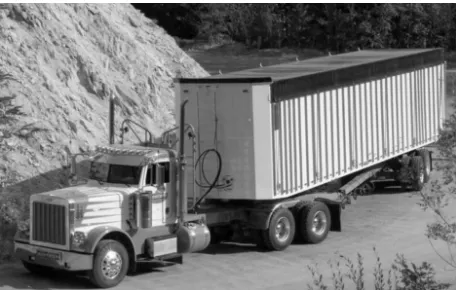
Each modification option has an associated cost and benefit. For example, if a 13.7 m drop center 5th
wheel chip van (Fig. 1) needs an extra half meter of road width to access a harvest unit, the ditches might be temporarily filled to allow the 5th wheel chip van
access. If the ditches were not filled, the only vehicle that might have access to the unit would be a stinger-steered chip trailer (Fig. 2). Not only does the amount of off-tracking vary between vehicles, so does the vol-ume of chips or hogfuel consistent with weight restric-tions that these vehicles can haul. The operating cost and traveling speed vary for each vehicle configura-tion, creating a multi-dimensional problem.
We look at two cases. The first case involves sched-uling multiple biomass operations over a road net-work, where trucks from several biomass operations can take advantage of the same road investment. The second case looks at isolated biomass operations, where the road investment is used by only one opera-tion. For both cases, mixed integer linear programming can be used to exactly solve the underlying mathemat-ical problem. However, for the second case it is more convenient to use a breakeven analysis. For larger problems of the first case, due to the solution time for mixed integer programming, heuristics such as Ant Colony Optimization (ACO) can be used to determine a high quality solution for vehicle type, path, and road modifications for transporting biomass. Other useful heuristics are described by Glover and Kochenberger (2002), Hoos and Stutzle (2005) and Geem (2009).
Fig. 1 A 13.7 m drop center 5th wheel chip van being loaded on a forest road in Lane County, Oregon
Slika 1. Poluprikolica za šumsku sječku dugačka 13,7 m (utovar na sredini prikolice) tijekom utovara na šumskoj cesti u Lane County, Oregon
Fig. 2 A stinger-steered chip van. Photo courtesy of Western
Trailer Company
3. Mathematical Formulation – Case One
Matematički prikaz – slučaj prvi
The mathematical problem is to minimize the sum of road modifications and biomass transportation costs. Let G = (N, A) be a directed network with nodes
N and arcs (i,j) within A. We associate with each node
i within N a number S(i), which indicates the supply or demand depending on whether S(i) > 0 or S(i) < 0. The minimal cost problem is then:
Minimize
( ) ( )
t t t t
ij ij ij ij
t T i,j A i,j A
FC Y VC Volume
∈ ∈ ∈ × + ×
∑
∑ ∑
( )∈ ( )∈ ∈( )
× + × ∀ ∈ ∈∑
t t∑ ∑
t tij ij ij ij
t T i,j A i,j A
, ,
FC Y VC Volume i j A t T (1)
Conservation of Flow
( )
{
∈}
{
( )∈}
( )
− = ∀ ∈
∑
t∑
t tij ji
ji i,j A ji j,i A
Volume Volume V i i N
(2) Sale Volumes
( ) ( )
∈ = ∀ ∈∑
tt T
V i S i i N (3)
Road Triggers
( )
∈
× ≥ ∀ ∈
∑
t 1ij ij
t T
,
M Y Volume i j A (4)
( )
( )
∈ ≥
× ≥ ∀ ∈
∑
t 2ij ij
t T t 2
,
M Y Volume i j A (5)
( )
( )
∈ =
× ≥ ∀ ∈
∑
t 3ij ij
t T t 3
,
M Y Volume i j A (6)
Decision Variables
{ }
( )
= ∀ ∈ ∈
t
ij 0,1 , ,
Y i j A t T (7)
( )
≥ ∀ ∈ ∈
t
ij 0 , ,
Volume i j A t T (8)
Equation (1) is the objective function. t
ij FC is the fixed cost to modify link ij to allow truck type t access.
t
ij
Y is a binary variable, zero if the link is not used, and one if the link is used. t
ij
VC is the round trip variable cost over link ij in truck type t, ($/tonne). t
ij Volume is the amount of volume crossing link ij in truck type t,
(tonnes). Equation (2) provides conservation of flow at each node for each truck type. V it
( )
is the volumeentering each node i for each truck type t, (tonnes). Equation (3) requires that the total supply or demand
at each node S i
( )
(tonnes), equal the sum of the vol-ume transported over all truck types. Equation (4) re-quires that the road modification for truck type 1(the lowest standard truck type)be made to at least pass truck type 1, if there is volume passing over link ij in truck type 1. Equation (5) requires that the road mod-ification for truck type 2 (the moderate standard truck type) be made to at least pass truck type 2, if there is volume passing over link ij in truck type 2. Equation (6) requires that the road modification for truck type 3 (the highest standard truck type) be made to pass truck type 3, if there is volume passing over link ij in truck type 3. Equation (7) requires that the road trigger for link ij for truck type t be a binary variable, zero or one. Equation (8) requires that the volume passing over link ij for truck type t be equal to or greater than zero.4. Review of Ant Colony Optimization
Opis optimizacije metodom mravlje
kolonije
The ACO (Dorigo and Stutzle 2004) is based on the analogy of ants searching for food. Ants randomly walk in search of food leaving a pheromone behind as they travel. The pheromone is a scent that influences other ants to take that path. As more ants travel over the same path the pheromone increases, increasing the possibility of an ant choosing that path. This process continues until all ants are following the same path to the food source. The ACO heuristic has been used to solve fixed cost and variable cost forest transportation problems with side constraints (Contreras et al. 2008). Outside of the forest industry, this heuristic has been used to solve vehicle route scheduling problems, ca-pacitated vehicle routing problems, and other schedul-ing problems (Donati et al. 2008, Rizzoli et al. 2007).
5. Ant Colony Optimization –
Optimizacija
metodom mravlje kolonije
The ACO developed in this paper is designed to minimize the total transportation cost. The total trans-portation cost is the sum of the modifications costs plus the round trip variable costs multiplied by the volume of each harvest unit. If a truck is loaded at sale
x, it must make it to destination z using the same truck. If different types of trucks use the same link, the one with the maximum fixed cost will be applied. Therefore, if road modifications are applied so that a 16.2 m drop center 5th wheel chip van (Fig. 3) can
place for other truck types. The ACO regards each road modification option as a separate link. In other words, between each node, three links exist; one that has no fixed cost, one that has a moderate fixed cost, and one that has a large fixed cost; all of which end up at the same node (Fig. 4). As the algorithm pro-gresses through each set of ants, each ant in each set has a designated modification option that it will choose from as it progresses through the network. It was chosen to have three kinds of ants; a truck type 1 ant, a truck type 2 ant, and a truck type 3 ant to diver-sify the search. With this formulation, each modifica-tion opmodifica-tion has its own set of pheromones. The start-ing pheromones provided an equal probability choosing each link leaving a node for each truck type. As the algorithm identifies a lower total cost route from each sale, the links that are not part of that path
have their pheromones decay. We used a constant de-cay factor of 25 %.
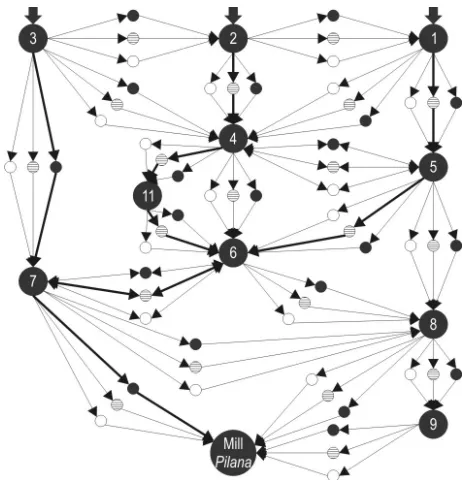
The ACO was compared to a mixed integer linear programming model, using a small network (Fig. 4). The large black circles are the nodes in the network. The small black circles are the road modification op-tion for the 16.2 m drop center 5th wheel chip van, the
small horizontally hatched circles are the road modi-fication option for the 13.7 m drop center 5th wheel
chip van, and the small white circles are the no road modification option for the stinger-steered chip van. In this formulation, three different degrees of road modification could be applied, no modification, mod-erate modification, or major modification. The no modification option will only allow a stinger-steered chip van access. The moderate modification option will allow a stinger-steered chip van and a 13.7 m drop center 5th wheel chip van access. The major
modifica-tion will allow all three trucks access to the road seg-ment. Each truck has a different hourly operating cost. The stinger-steered chip van has an estimated hourly cost of $ 95.37, the 13.7 m drop center 5th wheel chip
van hourly cost is $ 90.95, and the 16.2 m drop center 5th wheel chip van hourly cost is $ 99.79 (Table 1). We
assumed cost per hour is the weighted average hourly cost and did not vary with speed or road type.
The modification costs vary by the magnitude of the required modifications. The moderate modifica-tion opmodifica-tion was assumed to require removing the su-perelevation within the roadway and filling the ditch-es to allow the 13.7 m drop center 5th wheel chip van
access. We assumed that these modifications would cost $ 3,281 per km. The major modification option
Fig. 3 A 16.2 m drop center 5th wheel chip van near Port Angeles, Washington
Slika 3. Poluprikolica za šumsku sječku dugačaka 16,2 m s utova
-rom na sredini u blizini Port Angeles, Washington
Table 1 Chip Van Operating Characteristics for the three truck types
Tablica 1. Tehničke značajke triju promatranih tipova prikolica
Trailers
Prikolice
Volume Capacity, m3
Obujam, m3
Speed on Forest Roads (empty or loaded), km/h Maksimalna brzina na šumskoj cesti (puna ili
prazna), km/h
Speed on Highways (empty or loaded), km/h
Maksimalna brzina na autocesti (puna ili prazna),
km/h
Operating Cost, $/h Jedinični trošak, $/h
Modification Cost, $/km Troškovi rekonstrukcije, $/km
12.8 m Stinger Steered Samokretna prikolica dugačka
12,8 m
73.6 16.1 72.4 $ 95.37 $ 0
13.7 m Drop Center 5th wheel
Poluprikolica dugačka 13,7 m s utovarom na sredini
93.4 16.1 72.4 $ 90.95 $ 3,281
16.2 m Drop Center 5th wheel
Poluprikolica dugačka 16,2 m s utovarom na sredini
half of the link length needed to be modified because forest road curves are approximately half of the trans-portation network.
Table 2 Sale Nodes
Tablica 2. Mjesta prodaje
Volume of Biomass – Volumen biomase
Harvest Node Mjesto iveranja
Destination Node Mjesta isporuke
Biomass, m3
Biomasa, m3
1 10 135,921
2 10 28,883
3 10 175,564
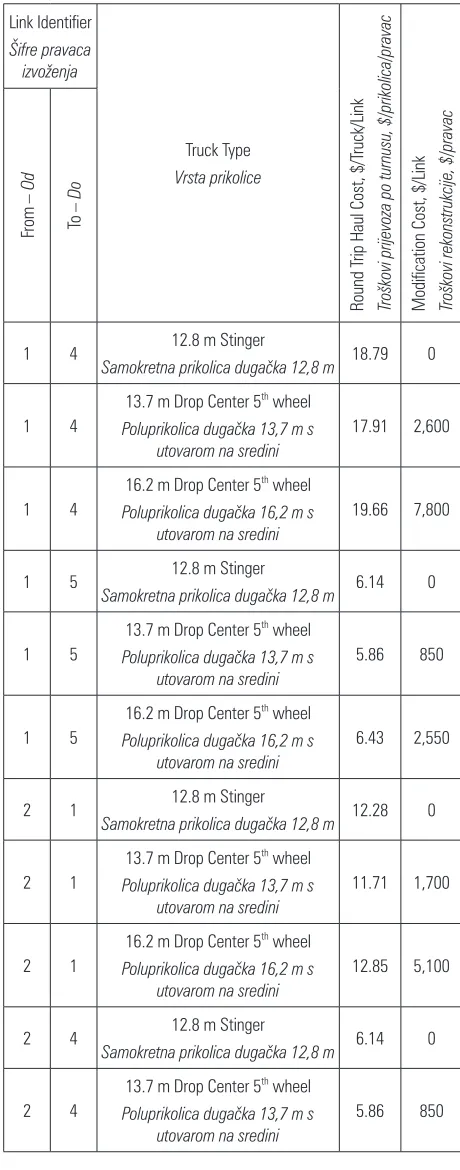
The sale nodes for the small network (Fig. 4) are nodes 1, 2, and 3. The associated amount of biomass for each sale (chips or hogfuel) is identified in Table 2. All of the biomass is to be delivered to only one mill (Node 10). The haul and modification costs per link are pro-vided in the appendix (Table 5).
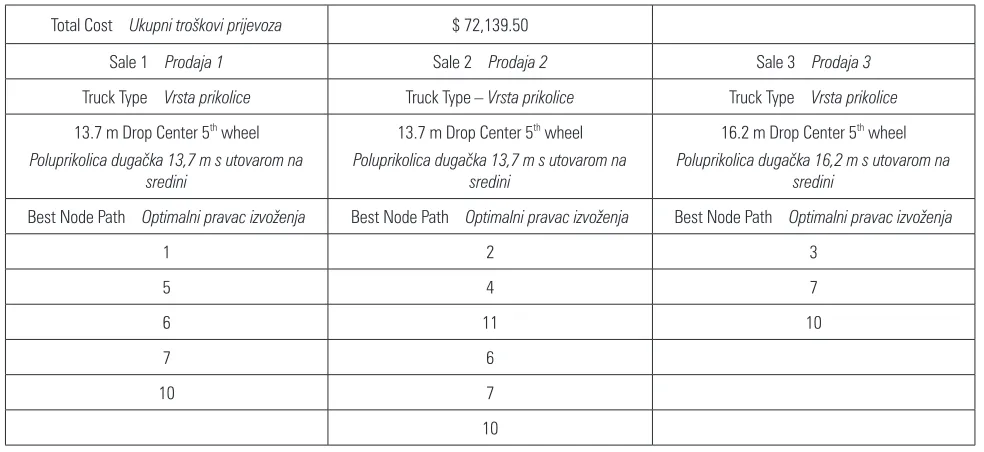
The ACO had a stopping criterion of 1,000 itera-tions. The heuristic converged on its solution rather quickly (iteration 282). The optimal solution to this problem using the ACO is $ 72,140. This amounted to $ 6,225 in modification costs and $ 65,915 in hauling costs. The optimal path is shown for each sale in Table 3 and Fig. 4. There were 1,454 trips from Unit 1 to the
Fig. 4 Small example road modification network, adapted from
(Sessions 1985)
Slika 4. Primjer modificirane mreže šumskih prometnica (prilagođe
-no iz Sessions 1985)
was assumed to require filling the ditches, reversing the superelevation, and widening the roadway on a few select curves. These modifications were estimated to cost $ 9,843 per km (Table 1). We assumed that only
Table 3 The Optimal Path for the Small Network Using Ant Colony Heuristic
Tablica 3. Optimalni pravac izvoženja prema metodi mravlje kolonije
Total Cost – Ukupni troškovi prijevoza $ 72,139.50 –
Sale 1 – Prodaja 1 Sale 2 – Prodaja 2 Sale 3 – Prodaja 3
Truck Type – Vrsta prikolice Truck Type – Vrsta prikolice Truck Type – Vrsta prikolice
13.7 m Drop Center 5th wheel
Poluprikolica dugačka 13,7 m s utovarom na sredini
13.7 m Drop Center 5th wheel
Poluprikolica dugačka 13,7 m s utovarom na sredini
16.2 m Drop Center 5th wheel
Poluprikolica dugačka 16,2 m s utovarom na sredini
Best Node Path – Optimalni pravac izvoženja Best Node Path – Optimalni pravac izvoženja Best Node Path – Optimalni pravac izvoženja
1 2 3
5 4 7
6 11 10
7 6 –
10 7 –
Þ Visually Sensitive, Even-aged Forest, Þ Structurally Diverse Forest.
Biomass utilization is gaining interest in western Oregon and several biomass-powered cogeneration plants exist within 95 km of McDonald Forest. A major cost of biomass operations is the transportation cost. With small profit margins, it is important to determine the least cost method for transporting biomass from the woods to the mill. Being able to determine the optimal trucks and haul routes that would reduce total trans-portation costs would be important to the decision to utilize biomass. We applied the ACO heuristic to de-velop a least cost path from a sample of harvest units distributed through McDonald Forest. McDonald For-est is approximately 2,914 ha with 113 km of road or about 37.3 m of forest roads per hectare (Lysne D. and Klumph, B. OSU College Forests, Corvallis, Oregon, Personal Communication, December 14, 2011). The McDonald Forest road network and possible truck routes through Corvallis are shown in Fig. 6.
Thirty hypothetical timber harvests (sales) were spread through McDonald Forest (Fig. 6) for the pur-pose of reducing fuel loading around the urban inter-face. These timber harvests were assumed to produce and recover 89.7 green tonnes of biomass per hectare or 113.3 m3 of biomass with 50 % moisture content. It
was estimated that each sale would harvest between 45 and 95 ha (black triangles in Fig. 6). The destination node for all of the transported biomass is a biomass plant in Eugene (48 km south of Corvallis). The
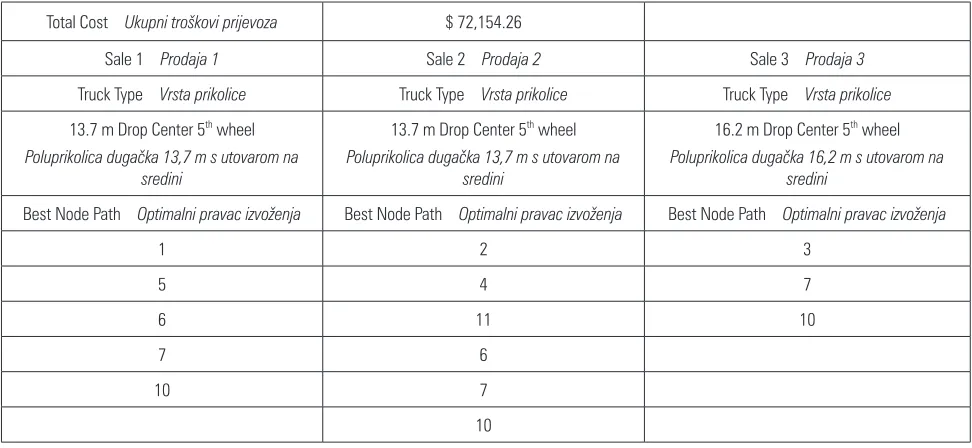
esti-Table 4The Optimal Path for the Small Network Using Mixed Integer Programming
Tablica 4. Optimalni pravac izvoženja prema metodi mješovitoga cjelobrojnoga linearnoga programiranja
Total Cost – Ukupni troškovi prijevoza $ 72,154.26
Sale 1 – Prodaja 1 Sale 2 – Prodaja 2 Sale 3 – Prodaja 3
Truck Type – Vrsta prikolice Truck Type – Vrsta prikolice Truck Type – Vrsta prikolice
13.7 m Drop Center 5th wheel
Poluprikolica dugačka 13,7 m s utovarom na sredini
13.7 m Drop Center 5th wheel
Poluprikolica dugačka 13,7 m s utovarom na sredini
16.2 m Drop Center 5th wheel
Poluprikolica dugačka 16,2 m s utovarom na sredini
Best Node Path – Optimalni pravac izvoženja Best Node Path – Optimalni pravac izvoženja Best Node Path – Optimalni pravac izvoženja
1 2 3
5 4 7
6 11 10
7 6 –
10 7 –
– 10 –
Mill, 309 trips from Unit 2 to the Mill, and 1,550 trips from Unit 3 to the Mill.
The ACO solution was compared to a mixed inte-ger solution (Table 4, Fig. 5). The mixed inteinte-ger and ACO produced similar results; a $ 13 difference be-tween the two approaches. This was the result of rounding when formulating the mixed integer prob-lem. Both methods used the same truck types and paths to transport the biomass to the mill. This small example illustrates that the heuristic appears reason-able for determining near optimal solutions for similar road modification problems.
6. Application to a realistic forest
transportation network –
Primjena na
stvarnoj šumskoj transportnoj mreži
Following the favorable results of the small net-work, the ACO heuristic was used on the McDonald Forest, to determine the least cost path for future har-vesting activities. McDonald Forest is located 11.3 km north of Corvallis and is managed by Research Forest staff, College of Forestry, OSU. McDonald Forest is a teaching, research and demonstration forest revolving around four themes. These themes are:
Þ Short Rotation Wood Production with High Re-turn on Investment,
Fig. 5 Ant Colony Optimal Haul Routes. The bold arrows indicate optimal haul routes. The large black circles indicate nodes within the transportation network. The small black circles indicate the road modification option for the 16.2 m drop center 5th wheel chip van, the small horizontally hatched circles indicate the road modification option for the 13.7 m drop center 5th wheel chip van, and the small white circles indicate the road modification option for the stinger-steered chip van
Slika 5. Optimalni pravac izvoženja prema metodi mravlje kolonije. Podebljane strelice označuju optimalni pravac izvoženja, dok veliki krugovi označuju raskrižja transportne mreže. Mali tamni kružići ozna
-čuju šumsku cestu prilagođenu poluprikolici za šumsku sječku du
-gačkoj 16,2 m s utovarom na sredini, mali vodoravno iscrtkani kru
-žići označuju šumsku cestu prilagođenu poluprikolici za šumsku sječku dugačkoj 13,7 s utovarom na sredini, dok mali bijeli kružići označuju šumsku cestu prilagođenu samokretnoj prikolici za šumsku sječku
mated travel speed on forest roads was 16.1 km/h and 72.4 km/h on major highways (loaded or unloaded). On public highways, it was assumed that any truck combination could be used without incurring any road modification costs.
The transportation network included 405 nodes and 2,433 links, including the existing transportation network and two modification options for each link. The existing transportation network was assumed to only permit stinger-steered trailer access. The other two trailer types required temporary road modifica-tion for access similar to the small network problem. The chip van operating characteristics in this problem
Fig. 6 Mixed Integer Optimal Haul Routes. The bold arrows indicate optimal haul routes. The large black circles indicate nodes within the transportation network. The small black circles indicate the road modification option for the 16.2 m drop center 5th wheel chip van, small horizontally hatched circles indicate the road modification option for the 13.7 m drop center 5th wheel chip van, and the small white circles indicate the road modification option for the stinger-steered chip van
Slika 6. Optimalni pravac izvoženja prema metodi mješovitoga cje
-lobrojnoga linearnoga programiranja. Podebljane strelice označuju optimalni pravac izvoženja, dok veliki krugovi označuju raskrižja tran
-sportne mreže. Mali tamni kružići označuju šumsku cestu prilagođe
-nu poluprikolici za šumsku sječku dugačkoj 16,2 m s utovarom na sredini, mali horizontalno iscrtkani kružići označujuju šumsku cestu prilagođenu poluprikolici za šumsku sječku dugačkoj 13,7 s utovarom na sredini, dok mali bijeli kružići označuju šumsku cestu prilagođenu samokretnoj prikolici za šumsku sječku
are the same as Table 1. Once the chip vans were out-side of the McDonald Forest, it was assumed that any chip van could be used without incurring a road mod-ification cost. It was also assumed that adequate turn-arounds exist to permit use of each truck type.
The routes for the 30 sales produced by the ACO in 10,000 iterations are shown in Fig. 8. For every sale, the ACO determined that the least cost path used a 16.2 m drop center 5th wheel chip van. The total
Fig. 7 McDonald Forest Road Network, Corvallis, Oregon, USA
Slika 7. Mreža šumskih cesta u šumi »McDonald« Corvallis, Oregon, SAD
Fig. 8 Optimal route path for all 30 sales, McDonald Forest, Corval-lis, Oregon, USA
Slika 8. Optimalni pravac izvoženja za svih 30 turnusa u šumi »Mc
-Donald« Corvallis, Oregon, SAD
stinger steered chip van could have been used with a total transportation cost of $ 3,703,310 (100 % haul costs). In this example, the ability to modify the road-way to allow larger trucks access to these sales re-duced the total transportation cost by 27 %. The abil-ity to reduce transportation costs by 27 % is a large benefit when margins are as slim as they are in the biomass market. This implies that being able to reduce the haul cost with the application of road modifica-tions could have a significant positive impact.
7. Single Harvest Unit Analysis
– Case Two –
Analiza pojedinačne
sječine – slučaj prvi
The network example provides an example of how several nearby chip or hog fuel sales and the use of road modifications can reduce overall transportation costs when considering road investments that benefit more than one sale. However, the ability to have near-by chip or hog fuel sales may not be practical. For the case of isolated sales, we provide a decision-making
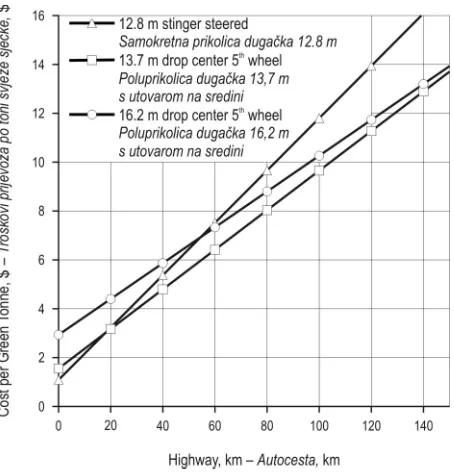
framework to assist in deciding the optimal truck type. When comparing cost per tonne versus highway haul kilometers, the 16.2 m drop center 5th wheel chip van
is the most economical (Fig. 9). However, if the forest transportation network requires modification, the most economical chip van changes. For illustration, we assume that loaded and empty vehicles of a given type travel at the same speed and have the same hourly cost (Table 1). The cost per tonne including transport and road investment is:
t t
t
Ht t Ft t
t t
2 2
HK OC FK OC
Cost Per Ton
KPH VC KPH VC
FK PFK MC
t T H V
× × × ×
= + +
× ×
× ×
+ ∀ ∈
× (9)
Where:
HK distance traveled on highway roads (one-way), km,
FK distance traveled on forest roads (one-way), km,
two trucking options) can be calculated for any two trucking options:
HM FK
OC
KPH VC
PFK MC H V
OC
KPH VC
PKM MC H
= ×
× + +
×
× −
× × −
× ×
2 b 2
Fb b
b b a
Fa a
a a
VV OC
KPH VC
OC
KPH VC
×
× − ×
×
2 a 2
Ha a
b
Hb b
(10)
The subscripts »a« and »b« indicate the two truck-ing options betruck-ing compared. Equation 10 assumes that both truck options can be operated on the highway. Some counties may have restrictions over some roads that do not permit trucks or trailer combinations over a maximum length or weight.
The breakeven equation between the 12.8 m sting-er-steered chip van and the 16.2 m drop center 5th
wheel chip van, if no road investment is required, is trivial (Fig. 9). The cost per tonne in the 16.2 m drop center 5th wheel chip van is always lower than the cost
per tonne in the 12.8 m stinger-steered chip van. The breakeven highway distance between the 12.8 m stinger-steered chip van and the 13.7 m drop center 5th wheel chip van for the 90 green tonnes of
biomass per hectare case as a function of in forest ki-lometers (FK) is (operating characteristics from Table 1 were rounded for ease of illustration):
2 $ 91 0.5 3 281 2 $ 95
15 29.9 90 15 23.6 2 $ 95 2 $ 91 75 23.6 75 29.9
= FK H
HM
× × ×
× + −
× × ×
× − ×
× ×
(11)
Equation (11) is the highway distance (km) needed to be traveled before the 13.7 m drop center 5th wheel
chip van becomes economical for a given in forest hauling distance. The breakeven distance for a harvest area of 50 ha between these two vehicles for 2 km on forest roads is 17.8 highway km. For distances less than 17.8 km, it is more economical to use the 12.8 m stinger-steered chip van. For distances greater than 17.8 km and less than 179.4 km, it is more economical to use the 13.7 m drop center 5th wheel chip van (Fig.
10). A breakeven analysis of an in forest hauling dis-tance of 15 km is shown in Fig. 11.
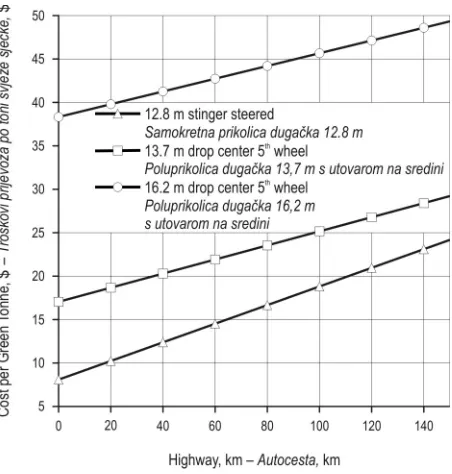
For the case of removing 45 green tonnes per hect-are (such as a thinning operation) on a harvest unit of 50 ha and the in forest, hauling distance was either 2 km (Fig. 12) or 15 km (Fig. 13). The optimal trucking option would be the 12.8 m stinger-steered chip van for highway hauling distances less than 45.7 km, when hauling on 2 km of forest road and 342.6 km when hauling on 15 km of forest road. As volume removed is reduced, the use of road modifications to allow
Fig. 9 Comparison of cost per tonne versus highway kilometers
when traveling on highway roads. When traveling over highway roads or when traveling on the forest transportation network, where no modifications are required for all vehicles, the most economical chip van is the 16.2 m drop center 5th wheel chip van. On an 80 km highway haul, the cost savings is $ 2.71 per tonne comparing a 12.8 m stinger-steered chip van to a 16.2 m drop center 5th wheel chip van. We assumed each trailer is weight limited
Slika 9. Usporedba troškova prijevoza po toni prema udaljenosti prijevoza autocestom. Prilikom prijevoza autocestom ili šumskim cestama gdje nije bilo potrebe za rekonstrukcijom najekonomičnijom se pokazala poluprikolica za šumsku sječku dugačka 16,2 m s uto
-varom na sredini. Na 80-om km autoceste ta je poluprikolica 2,71 $ po toni isplativija od samokretne prikolice za šumsku sječku dugačke 12,8 m uz pretpostavku poštivanja ograničenja nosivosti
VCt volume capacity of chip van, t,
KPHHt average operating speed on highway roads
for chip van, t (km/h),
KPHFt average operating speed on forest roads
for chip van, t (km/h),
PFKt %age of the forest road kilometers that need
to be modified for chip van, t,
MCt forest road modification cost for chip van,
t ($/km),
V harvest volume per hectare, tonnes/ha,
H total harvest area, ha.
close vicinity, the larger transport volume justifies a greater investment and makes a larger chip van eco-nomical.
8. Concluding Remarks –
Zaključna
razmatranja
Mixed integer programming and breakeven analy-sis have been applied for a long time to address forest transportation problems. The focus of this application has been in response to the worldwide interest in the utilization of forest residues for alternative energy. Un-like the primary log market, roads were not built to extract forest residues and the limited value of these
Fig. 10 Comparison of cost per tonne versus highway kilometers, when traveling over 2 km on forest road. This comparison uses 90 green tonnes per hectare for a 50 ha harvest unit. Modification costs are only applied to half of the distance traveled on a forest road. As the highway haul distance increases, a larger chip van becomes more economical. In this case, 17.8 km of highway haul-ing is the breakeven case between a 13.7 m drop center 5th wheel chip van and a 12.8 m stinger-steered chip van. The 16.2 m drop center 5th wheel chip van becomes economical over the 13.7 m drop center 5th wheel chip van at 179.4 km highway hauling
Slika 10. Usporedba troškova prijevoza po toni prema udaljenosti prijevoza autocestom kada je vožnja šumskom cestom dulja od 2 km. Dobiveni podaci temelje se na sječnoj površini od 50 ha i 90 t svje
-že sječke po hektaru. Troškovi potrebni za rekonstrukciju šumskih cesta izračunavaju se za pola njihove duljine. S povećanjem udjela vožnje autocestom veća prikolica postaje ekonomičnija. U ovom slučaju na 17,8 km autoceste poluprikolica za šumsku sječku dugač
-ka 13,7 m s utovarom na sredini postaje ekonomski isplativija od samokretne prikolice za šumsku sječku dugačke 12,8 m, dok polu
-prikolica za šumsku sječku dugačka 16,2 m s utovarom na sredini postaje ekonomski isplativija od poluprikolice za šumsku sječku du
-gačke 13,7 m s utovarom na sredini na 179,4 km autoceste
Fig. 11 Comparison of cost per tonne versus highway kilometers
when each truck must travel 15 km on forest road. This comparison uses 90 green tonnes per hectare for a 50 ha harvest unit. Modifi-cation costs are only applied to half of the distance traveled on a forest road. As the highway haul distance increases, a larger chip van becomes more economical. In this case, 133.8 km of highway hauling is the breakeven case between a 13.7 m drop center 5th wheel chip van and a 12.8 m stinger-steered chip van
Slika 11. Usporedba troškova prijevoza po toni prema udaljenosti prijevoza autocestom kada je vožnja šumskom cestom dulja od 15 km. Dobiveni podaci temelje se na sječnoj površini od 50 ha i 90 t svježe sječke po hektaru. Troškovi potrebni za rekonstrukciju šumskih cesta izračunaju se za pola njihove duljine. S povećanjem udjela vožnje autocestom veća prikolica postaje ekonomičnija. U ovom slučaju na 133,8 km autoceste poluprikolica za šumsku sječku du
-gačaka 13,7 m s utovarom na sredini postaje ekonomski isplativija od samokretne prikolice za šumsku sječku dugačke 12,8 m
larger vehicle access tends to increase transportation costs per tonne.
work, the ACO heuristic obtained an optimal solution to a small problem; and when applied to a more real-istic problem, quickly provided a solution. As trans-port volume increases, more could be spent on road modifications to allow larger truck capacity access. Be-ing able to modify the forest transportation network to accommodate larger trucks access could greatly re-duce hauling costs. Decisions for isolated biomass op-erations depend on road modification cost, transport volume, and transport costs on forest and highway roads. Breakeven analysis can be used to determine the optimal vehicle type. Further research is required to determine if the associated costs used in this paper accurately represent the road modification costs re-quired to allow these non-standard trucks access.
Fig. 12 Comparison of cost per tonne versus highway kilometers
when traveling over 2 km on forest road. This comparison uses 45 green tonnes per hectare for a 50 ha harvest unit. Modification costs are only applied to half of the distance traveled on a forest road. As the highway haul distance increases, a larger chip van becomes more economical. In this case, 45.7 km of highway hauling is the breakeven case between a 13.7 m drop center 5th wheel chip van and a 12.8 m stinger-steered chip van. Not shown, the 16.2 m drop center 5th wheel chip van becomes economical over the 13.7 m drop center 5th wheel chip van at 368.9 km highway hauling
Slika 12. Usporedba troškova prijevoza po toni prema udaljenosti prijevoza autocestom kada je vožnja šumskom cestom dulja od 2 km. Dobiveni podaci temelje se na sječnoj površini od 50 ha i 45 t svje
-že sječke po hektaru. Troškovi potrebni za rekonstrukciju šumskih cesta izračunaju se za pola njihove duljine. S povećanjem udjela vožnje autocestom veća prikolica postaje ekonomičnija. U ovom slučaju na 45,7 km autoceste poluprikolica za šumsku sječku dugač
-ka 13,7 m s utovarom na sredini postaje ekonomski isplativija od samokretne prikolice za šumsku sječku dugačke 12,8 m, dok polu
-prikolica za šumsku sječku dugačka 16,2 m s utovarom na sredini postaje ekonomski isplativija od poluprikolice za šumsku sječku du
-gačke 13,7 m s utovarom na sredini na 368,9 km autoceste
Fig. 13 Comparison of cost per tonne versus highway kilometers
when traveling over 15 km on forest road. This comparison uses 45 green tonnes per hectare for a 50 ha harvest unit. Modification costs are only applied to half of the distance traveled on a forest road. As the highway haul distance increases, a larger chip van becomes more economical. In this case, the 12.8 m stinger-steered chip van is the most economical for highway hauling distances less than 342.6 km
Slika 13. Usporedba troškova prijevoza po toni prema udaljenosti prijevoza autocestom kada je vožnja šumskom cestom dulja od 15 km. Dobiveni podaci temelje se na sječnoj površini od 50 ha i 45 t svje
-že sječke po hektaru. Troškovi potrebni za rekonstrukciju šumskih cesta izračunaju se za pola njihove duljine. S povećanjem udjela vožnje autocestom veća prikolica postaje ekonomičnija. U ovom slučaju samokretna prikolica za šumsku sječku dugačka 12,8 m naj
-ekonomičnija je do 342,6 km autoceste
products will usually not support widespread recon-struction of the forest network. However, strategic investments in the existing road network - some tem-porary, some permanent, may be justified. Decision support for temporary activities, such as filling ditch-es and changing road cross slopditch-es to enable large ve-hicle access, has not been available in the literature.
net-9. References –
Literatura
Anderson, P., Sessions, J., 1991: Factors affecting the maxi
-mum grade a truck can climb around a curve. In: Proceed
-ings, Fifth International Conference on Low Volume Roads. Transportation Research Board, National Research Council, Washington, D.C. TRR 1291, Volume 2: 15–19.
Bowers, S., 2006: Managing Woodland Roads, A Field Hand
-book. Oregon State University Extension Service, Oregon State University, Corvallis, Oregon.
Contreras, M. A., Chung, W., Jones, G., 2008: Applying Ant Colony Optimization Metaheuristic to Solve Forest Trans
-portation Planning Problems with Side Constraints. Cana
-dian Journal of Forest Research 38(11): 2896–2910.
Craven, M., Wing, M., Sessions, J., Wimer, J., 2011: Assess
-ment of Airborne Light Detection and Ranging (LiDAR) for use in Common Forest Engineering Geomatic Applications. M.S. Thesis, Oregon State Universtiy, College of Forestry, Corvallis. Retrieved from Oregon State University: <http:// hdl.handle.net/1957/21803
Donati, A. V., Montemanni, R., Casagrande, N., Rizzoli, A. E., Gambardella, L. M., 2008: Time Dependent Vehicle Rout
-ing Problem with a Multi Ant Colony System. European Journal of Operational Research 185(3): 1174–1191.
Dorigo, M., Stutzle, T., 2004: Ant Colony Optimization. The MIT Press.
Geem, Z., 2009: Music-Inspired Harmony Search Algorithm. Springer–Verlag.
Glauz, W. D., Harwood, D. W., 1991: Superelevation and Body Roll Effects on Offtracking of Large Trucks. Transpor
-tationResearch Record 1303, Transportation Research Board of the National Academies.
Gover, F., Kochenberger, G., 2003: Handbook of Metaheuris
-tics. Kluwer Academic Publishers.
Hoos, H., Stutzle, T., 2005: Stochastic Local Search, Founda
-tions and Applica-tions. Morgan Kaufmann Publishers. Rizzoli, A. E., Montemanni, R., Lucibello, E., Gambardella, L. M., 2007: Ant colony Optimization for Real-World Vehicle Routing Problems: From Theory to Applications. Swarm Intelligence 1: 135–151.
Sessions, J., 1985: A Heuristic Algorithm for the Solution of the Variable and Fixed Cost Transportation Problem. Society of American Foresters Symposium, Athens, Georgia 324– 336.
Sessions, J., Wimer, J., Costales, F., Wing, M. G., 2010: Engi
-neering Considerations in Road Assessment for Biomass Operations in Steep Terrain. Western Journal of Applied For
-estry 25(3): 144–153.
Appendix –
Dodatak
Table 5 Haul and Modification Cost for the Small Network
Tablica 5. Troškovi prijevoza i rekonstrukcije
Link Identifier Šifre pravaca izvoženja Truck Type Vrsta prikolice Ro un d Tr ip H au l C os t, $/ Tr uc k/ Lin k Tr oš ko vi pr ije vo za p o tu rn us u, $ /p rik ol ica /p ra va c M od ific at io n Co st , $ /L ink Tr oš ko vi re ko ns tru kc ije , $ /p ra va c Fr om – Od To – Do
1 4 12.8 m Stinger
Samokretna prikolica dugačka 12,8 m 18.79 0
1 4
13.7 m Drop Center 5th wheel
Poluprikolica dugačka 13,7 m s utovarom na sredini
17.91 2,600
1 4
16.2 m Drop Center 5th wheel
Poluprikolica dugačka 16,2 m s utovarom na sredini
19.66 7,800
1 5 12.8 m Stinger
Samokretna prikolica dugačka 12,8 m 6.14 0
1 5
13.7 m Drop Center 5th wheel
Poluprikolica dugačka 13,7 m s utovarom na sredini
5.86 850
1 5
16.2 m Drop Center 5th wheel
Poluprikolica dugačka 16,2 m s utovarom na sredini
6.43 2,550
2 1 12.8 m Stinger
Samokretna prikolica dugačka 12,8 m 12.28 0
2 1
13.7 m Drop Center 5th wheel
Poluprikolica dugačka 13,7 m s utovarom na sredini
11.71 1,700
2 1
16.2 m Drop Center 5th wheel
Poluprikolica dugačka 16,2 m s utovarom na sredini
12.85 5,100
2 4 12.8 m Stinger
Samokretna prikolica dugačka 12,8 m 6.14 0
2 4
13.7 m Drop Center 5th wheel
Poluprikolica dugačka 13,7 m s utovarom na sredini
2 4
16.2 m Drop Center 5th wheel
Poluprikolica dugačka 16,2 m s utovarom na sredini
6.43 2,550
3 2 12.8 m Stinger
Samokretna prikolica dugačka 12,8 m 9.39 0
3 2
13.7 m Drop Center 5th wheel
Poluprikolica dugačka 13,7 m s utovarom na sredini
8.96 1,300
3 2
16.2 m Drop Center 5th wheel
Poluprikolica dugačka 16,2 m s utovarom na sredini
9.83 3,900
3 4 12.8 m Stinger
Samokretna prikolica dugačka 12,8 m 6.50 0
3 4
13.7 m Drop Center 5th wheel
Poluprikolica dugačka 13,7 m s utovarom na sredini
6.20 900
3 4
16.2 m Drop Center 5th wheel
Poluprikolica dugačka 16,2 m s utovarom na sredini
6.80 2,700
3 7 12.8 m Stinger
Samokretna prikolica dugačka 12,8 m 6.32 0
3 7
13.7 m Drop Center 5th wheel
Poluprikolica dugačka 13,7 m s utovarom na sredini
6.03 875
3 7
16.2 m Drop Center 5th wheel
Poluprikolica dugačka 16,2 m s utovarom na sredini
6.61 2,625
4 5 12.8 m Stinger
Samokretna prikolica dugačka 12,8 m 9.03 0
4 5
13.7 m Drop Center 5th wheel
Poluprikolica dugačka 13,7 m s utovarom na sredini
8.61 1,250
4 5
16.2 m Drop Center 5th wheel
Poluprikolica dugačka 16,2 m s utovarom na sredini
9.45 3,750
4 6 12.8 m Stinger
Samokretna prikolica dugačka 12,8 m 6.14 0
4 6
13.7 m Drop Center 5th wheel
Poluprikolica dugačka 13,7 m s utovarom na sredini
5.86 850
4 6
16.2 m Drop Center 5th wheel
Poluprikolica dugačka 16,2 m s utovarom na sredini
6.43 2,550
4 11 12.8 m Stinger
Samokretna prikolica dugačka 12,8 m 4.34 0
4 11
13.7 m Drop Center 5th wheel
Poluprikolica dugačka 13,7 m s utovarom na sredini
4.13 600
4 11
16.2 m Drop Center 5th wheel
Poluprikolica dugačka 16,2 m s utovarom na sredini
4.54 1,800
5 4 12.8 m Stinger
Samokretna prikolica dugačka 12,8 m 7.95 0
5 4
13.7 m Drop Center 5th wheel
Poluprikolica dugačka 13,7 m s utovarom na sredini
7.58 1,100
5 4
16.2 m Drop Center 5th wheel
Poluprikolica dugačka 16,2 m s utovarom na sredini
8.32 3,300
5 6 12.8 m Stinger
Samokretna prikolica dugačka 12,8 m 3.61 0
5 6
13.7 m Drop Center 5th wheel
Poluprikolica dugačka 13,7 m s utovarom na sredini
3.45 500
5 6
16.2 m Drop Center 5th wheel
Poluprikolica dugačka 16,2 m s utovarom na sredini
3.78 1,500
5 8 12.8 m Stinger
Samokretna prikolica dugačka 12,8 m 6.14 0
5 8
13.7 m Drop Center 5th wheel
Poluprikolica dugačka 13,7 m s utovarom na sredini
5.86 850
5 8
16.2 m Drop Center 5th wheel
Poluprikolica dugačka 16,2 m s utovarom na sredini
6.43 2,550
6 7 12.8 m Stinger
Samokretna prikolica dugačka 12,8 m 5.42 0
6 7
13.7 m Drop Center 5th wheel
Poluprikolica dugačka 13,7 m s utovarom na sredini
5.17 750
6 7
16.2 m Drop Center 5th wheel
Poluprikolica dugačka 16,2 m s utovarom na sredini
5.67 2,250
6 8 12.8 m Stinger
Samokretna prikolica dugačka 12,8 m 6.50 0
6 8
13.7 m Drop Center 5th wheel
Poluprikolica dugačka 13,7 m s utovarom na sredini
6.20 900
6 8
16.2 m Drop Center 5th wheel
Poluprikolica dugačka 16,2 m s utovarom na sredini
7 6 12.8 m Stinger
Samokretna prikolica dugačka 12,8 m 1.81 0
7 6
13.7 m Drop Center 5th wheel
Poluprikolica dugačka 13,7 m s utovarom na sredini
1.72 250
7 6
16.2 m Drop Center 5th wheel
Poluprikolica dugačka 16,2 m s utovarom na sredini
1.89 750
7 8 12.8 m Stinger
Samokretna prikolica dugačka 12,8 m 6.50 0
7 8
13.7 m Drop Center 5th wheel
Poluprikolica dugačka 13,7 m s utovarom na sredini
6.20 900
7 8
16.2 m Drop Center 5th wheel
Poluprikolica dugačka 16,2 m s utovarom na sredini
6.80 2,700
7 10 12.8 m Stinger
Samokretna prikolica dugačka 12,8 m 9.03 0
7 10
13.7 m Drop Center 5th wheel
Poluprikolica dugačka 13,7 m s utovarom na sredini
8.61 0
7 10
16.2 m Drop Center 5th wheel
Poluprikolica dugačka 16,2 m s utovarom na sredini
9.45 0
8 9 12.8 m Stinger
Samokretna prikolica dugačka 12,8 m 5.06 0
8 9
13.7 m Drop Center 5th wheel
Poluprikolica dugačka 13,7 m s utovarom na sredini
4.82 700
8 9
16.2 m Drop Center 5th wheel
Poluprikolica dugačka 16,2 m s utovarom na sredini
5.29 2,100
8 10 12.8 m Stinger
Samokretna prikolica dugačka 12,8 m 19.51 0
8 10
13.7 m Drop Center 5th wheel
Poluprikolica dugačka 13,7 m s utovarom na sredini
18.60 0
8 10
16.2 m Drop Center 5th wheel
Poluprikolica dugačka 16,2 m s utovarom na sredini
20.41 0
9 10 12.8 m Stinger
Samokretna prikolica dugačka 12,8 m 9.03 0
9 10
13.7 m Drop Center 5th wheel
Poluprikolica dugačka 13,7 m s utovarom na sredini
8.61 0
9 10
16.2 m Drop Center 5th wheel
Poluprikolica dugačka 16,2 m s utovarom na sredini
9.45 0
11 6 12.8 m Stinger
Samokretna prikolica dugačka 12,8 m 0.36 0
11 6
13.7 m Drop Center 5th wheel
Poluprikolica dugačka 13,7 m s utovarom na sredini
0.34 50
11 6
16.2 m Drop Center 5th wheel
Poluprikolica dugačka 16,2 m s utovarom na sredini
0.38 150
Sažetak
Odlučivanje o izvoznim pravcima prikolica za šumsku sječku uz optimizaciju
metodom mravlje kolonije i analizu prekretnice troškova
U slučaju višestrukoga izvoženja biomase primijenjena je metoda mješovitoga cjelobrojnoga linearnoga programi -ranja i metoda temeljena na principu mravlje kolonije »Ant Colony Optimization« (ACO). Obje su metode korište-Obje su metode korište -ne na malom uzorku prikazanom na slici 4. Jedina razlika između tih dviju metoda iznosi $ 13, a nastala je tijekom izračuna (zaokruživanja) kod metode mješovitoga cjelobrojnoga linearnoga programiranja (tablice 3 i 4). Metoda ACO primijenjena je pri određivanju optimalnoga specijaliziranoga vozila (prikolice) te pri izboru optimalnoga pravca izvoženja za 30 hipotetski odabranih mjesta iverenja u šumama »McDonald« u Corvallisu, Oregon, Sjedin -jene Američke Države (slika 7). Metodom ACO utvrđeno je da su ukupni troškovi prijevoza najmanji prilikom ko -rištenja najveće prikolice za šumsku biomasu, što razumijeva najveću rekonstrukciju šumske ceste na pravcima iz -voženja. Na dionicama gdje nije bila potrebna izmjena kolničke konstrukcije ukupni troškovi prijevoza manji su za 27 %.
Pri pojedinačnom izvoženju biomase primijenili smo prikladniju analizu prekretnice troškova. Analiza prekret -nice troškova pretpostavlja da su pravci izvoženja poznati, dok su varijable operativne karakteristike prikolice za šumsku biomasu te troškovi izgradnje pripadajuće šumske ceste s uračunatim troškovima rekonstrukcije šumske ceste (jednadžba 9). Pomoću jednadžbe 10 može se utvrditi na kojoj su udaljenosti (autoceste) troškovi transporta kod promatranih dviju opcija jednaki. U ovom smo radu procijenili četiri različita slučaja, čistu sječu i prorede s kratkim i dugim duljinama privlačenja. Utvrđeno je da se zbog povećanja privlačenja drvnih sortimenata te zbog potreba za izmjenom kolničke konstrukcije pri korištenju većega kamiona nadmašuje korisnost povećanoga obujma biomase po tovaru većega kamiona. Osim toga, zbog smanjenja obujma biomase po hektaru (proreda) te troškova rekonstrukcije pojedine šumske ceste potreban je dulji transport autocestom (veća udaljenost) da bi veći kamion bio ekonomičan. Ovom je analizom utvrđeno da rekonstrukcija šumskih cesta nije uvijek ekonomičan izbor.
Ključne riječi: optimizacija metodom mravlje kolonije, transport šumske biomase, pristupačnost vozilima
Received (Primljeno): October 24, 2012 Accepted (Prihvaćeno): December 30, 2012
Authors’ address – Adresa autorâ: Storm Beck, MSc. *
e-mail: [email protected] Prof. John Sessions, PhD.
e-mail: [email protected] Oregon State University
Department of Forest Engineering, Resources and Management
Oregon State University Corvallis, Oregon 97331 USA