ScholarWorks @ Georgia State University
Middle and Secondary Education Dissertations Department of Middle and Secondary Education
8-11-2015
A Teacher's Journey: Making Sense of How
Reading Combined Text Genres Influenced
Instructional Practices in a Sixth Grade Science
Class
Romesa Bryant Davis
Follow this and additional works at:https://scholarworks.gsu.edu/mse_diss
This Dissertation is brought to you for free and open access by the Department of Middle and Secondary Education at ScholarWorks @ Georgia State University. It has been accepted for inclusion in Middle and Secondary Education Dissertations by an authorized administrator of ScholarWorks @ Recommended Citation
Davis, Romesa Bryant, "A Teacher's Journey: Making Sense of How Reading Combined Text Genres Influenced Instructional Practices in a Sixth Grade Science Class." Dissertation, Georgia State University, 2015.
This dissertation, A TEACHER’S JOURNEY: MAKING SENSE OF HOW READING
COM-BINED TEXT GENRES INFLUENCED INSTRUCTIONAL PRACTICES IN A SIXTH
GRADE SCIENCE CLASS, by MESA B. DAVIS, was prepared under the direction of the
candi-date’s Dissertation Advisory Committee. It is accepted by the committee members in partial
ful-fillment of the requirements for the degree, Doctor of Philosophy, in the College of Education,
Georgia State University.
The Dissertation Advisory Committee and the student’s Department Chairperson, as representa-tives of the faculty, certify that this dissertation has met all standards of excellence and scholar-ship as determined by the faculty.
_________________________________ Kadir Demir, Ph.D.
Committee Chair
_________________________________ _________________________________
Jennifer Esposito, Ph.D. Amy Seely Flint, Ph.D.
Committee Member Committee Member
_________________________________ _________________________________
Anat Yarden, Ph.D. First Name Last Name, Degree
Committee Member
_________________________________
Date
_________________________________ Gertrude Tinker Sachs, Ph.D.
Chairperson, Department of Middle and Secondary Education
_________________________________ Paul A. Alberto, Ph.D.
Dean
AUTHOR’S STATEMENT
By presenting this dissertation as a partial fulfillment of the requirements for the advanced degree
from Georgia State University, I agree that the library of Georgia State University shall make it
available for inspection and circulation in accordance with its regulations governing materials of
this type. I agree that permission to quote, to copy from, or to publish this dissertation may be
granted by the professor under whose direction it was written, by the College of Education’s
Di-rector of Graduate Studies, or by me. Such quoting, copying, or publishing must be solely for
scholarly purposes and will not involve potential financial gain. It is understood that any copying
from or publication of this dissertation which involves potential financial gain will not be allowed
without my written permission.
NOTICE TO BORROWERS
All dissertations deposited in the Georgia State University library must be used in
accordance with the stipulations prescribed by the author in the preceding statement. The author
of this dissertation is:
Mesa Bryant Davis 50 Sunset Ave NW #92016
Atlanta, GA 30314
The director of this dissertation is:
Kadir Demir, Ph.D.
Department of Middle and Secondary Education College of Education
CURRICULM VITAE
Mesa Bryant Davis
ADDRESS: Mesa Bryant Davis
50 Sunset Ave NW #92016 Atlanta, GA 30314
United States of America
EDUCATION:
Ph.D. 2015 Georgia State University Teaching and Learning M.Ed. 1997 Georgia State University
Science Education
B.S. 1995 Georgia Institute of Technology Applied Biology
PROFESSIONAL EXPERIENCE:
2007 – present Science Teacher Independent School Atlanta, GA
2009 – 2011 Graduate Research Assistant Georgia State University Atlanta, GA
2006 - 2007 Science Teacher
Fulton County Schools Atlanta, GA
2001-2005 Program Coordinator
The University of Texas at Austin Austin, TX
1997-2000 Science Teacher
Fulton County Schools Atlanta, GA
CONFERENCE PRESENTATIONS
Davis, M. & Demir, K. (2015, April). How literacy integration contributed to the understanding of scientific practices through reading combined text genres. Paper presented at the annual meet-ing of the National Association of Research in Science Teachmeet-ing, Chicago, Illinois
Yarden, A., Ariely, M., Nueckles, M., Davis, M. B., Demir, K., Zer-Kavod, G., Osborne, J. F., & Phillips, L. M. (2015, April). The use of adapted primary literature in secondary schools: From theory to practice. Paper presented at the annual meeting of the National Association of Re-search in Science Teaching, Chicago, Illinois
Davis, M., Gul, T., Puvirajah, A., Demir, K. (2014). A Preliminary Examination of a Teacher Internship Program on STEM Majors’ Perceptions of Science Teaching. Poster presented at the National Science Foundation Robert Noyce Teacher Scholarship Program Conference, Washing-ton, D.C.
Davis, M. (2010). A preliminary examination of a teacher internship program on STEM majors’ perceptions of science teaching. The Southeastern Association for Science Teacher Educators, Atlanta, Georgia
Davis, M. (2008, January). Using Everyday Items to Bring Engineering into the Classroom.
Venezuelan Association of North American Schools Teacher’s Conference, Valencia, Venezuela
Davis, M. (2008, January). The Teacher Who E.A.T.S. Her Students. Venezuelan Association of North American Schools Teacher’s Conference, Valencia, Venezuela
Davis, M. (2005). Planning an Effective Student Meeting. Society of Hispanic Professional En-gineers National Institute for Leadership Advancement Conference Peachtree City, Georgia.
PROFESSIONAL ORGANIZATIONS American Educational Research Association
A TEACHER’S JOURNEY: MAKING SENSE OF HOW READING COMBINED TEXT GENRES INFLUENCED INSTRUCTIONAL PRACTICES IN A SIXTH GRADE SCIENCE
CLASS
by
MESA BRYANT DAVIS
Under the Direction of Kadir Demir
ABSTRACT
This investigation explored how the experience of literacy integration, defined as using
com-bined text genres (traditional science textbooks, popular science articles, and Adapted Primary
Literature), influenced the instructional practices of a middle school science teacher (Phillips &
Norris, 2009). The combined texts were put in a hermeneutic circle within the classroom
com-munity and discussed (Eger, 1992). During the discussions the teacher monitored the students’
meaning construction processes and made metacognitive decisions about her instructional
prac-tices (Ruddell & Unrau, 2004). The participants were Melissa, a sixth grade science teacher, and
ten (n=10) of her students at an academically rigorous, independent school in the southeastern
col-lection (DeWalt & DeWalt, 2002; Rubin & Rubin, 2005), were informed by other sources of data
such as the collection of teacher and student artifacts and a questionnaire for the purpose of
crys-tallization. The transcript data was transcribed, analyzed, and coded using performance/dialogic
analysis. Categories from the codes were used to develop themes (Lichtman, 2013; Riessman,
2008) that were organized into a narrative that chronicled the teacher’s understanding of how the
reading of combined text genres influenced her instructional practices. The findings are
present-ed in the form of a case study (Yin, 2009). These assertions emergpresent-ed from the data: (1) Melissa
was able to make text visible (Lemke, 1990) and maintain an active learning environment while
using minds-on instructional practices and (2) despite the tendency to compartmentalize each
text genre, the teacher became metacognitive about her instructional practices. The implication is
that literacy integration need not be a mystery or deterrent to science teachers (Shanahan, 1997).
With the right resources, such as access to combined text genres, and through trial and error with
a variety of instructional practices, teachers can successfully implement literacy integration into
their classrooms.
A TEACHER’S JOURNEY: MAKING SENSE OF HOW READING COMBINED TEXT GENRES INFLUENCED INSTRUCTIONAL PRACTICES IN A SIXTH GRADE SCIENCE
CLASS by
MESA BRYANT DAVIS
A Dissertation
Presented in Partial Fulfillment of Requirements for the
Degree of
Doctor of Philosophy
in
Teaching and Learning
in
Department of Middle and Secondary Education
in
the College of Education
Georgia State University
Copyright by Mesa Bryant Davis
DEDICATION AND ACKNOWLEDGEMENTS
This dissertation is dedicated to my family. Johnnie, there are no words to express my
gratitude for your support and willingness to do whatever it took to give me time to study, write,
or rest. Thank you does not even come close. You have been a constant source of love and
en-couragement. I could not have done it without you. This is our dissertation.
Dearest R.E.D, thank you so much for the hugs and kisses at my desk. They kept me going
when I wanted to quit. Never again will Mommy have to work instead of spending time with you
and Daddy. I have been a student all of your life, but I finally just get to be your Mommy. When
you grow up, I hope that you use my journey as proof that you do anything with the support of
those who love you.
Mom and Dad, you two have always been a constant source of support and validation.
You raised me in a way that my race and gender have never been barriers. I owe my strength and
determination to the two of you. Thank you for being my biggest cheerleaders.
To my five siblings (Brandon you are included here), thank you for listening to the
whin-ing, talking me home from classes, and just being there. You guys are my best friends.
I have a committee of scholarly giants. Thank you my advisor, Kadir Demir, for always
pushing me forward. Even as I dug in my heels I realized that you were preparing me to meet the
challenges that were ahead. Your guidance through this process (and you were always right there)
has been invaluable. I have learned many lessons from you. Thank you to Jennifer Esposito and
Amy Seely Flint for your expertise and time. I want you to know that I paid attention to every
word, either as a student in your respective classes or during this process, and took them to heart.
greatest moment in my scholarly career was presenting alongside you. To all of you, I am
hum-bled to be in your company.
I have to thank my participants for letting me in and teaching me so much about science
education. Melissa, you are a gift to the teaching profession. It was a pleasure to watch you and
your kids. The eleven of you made the impossible possible.
Trish Morgan, Donna Barrett-Williams, and Melissa Schoene…You ladies have been my
collective rock through this process. There is a lot to be said for experiential knowledge, no?
Thank you for being there and understanding. I could not have done this without you.
Thank you to my work colleagues for pushing me forward. Whether it was just asking
how the process was going or calling me “Dr.” the encouragement was heartfelt.
Finally I would like to say thank you to The College of Education and Human
Develop-ment staff. There was never a time that you were not able to fulfill my needs. A special thank
you goes to Ms. Bobbie Turner and Ms. Carla Woods. Both of you ladies always went above and
TABLE OF CONTENTS
LIST OF TABLES………...VIII LIST OF FIGURES………... .. IX
1 THE PROBLEM ... 1
Research Questions ... 5
Theoretical Framework ... 7
Reading as a Meaning Construction Process: ... 7
Text and Classroom Context: A Model ... 11
Assumptions of the Study ... 13
2 REVIEW OF THE LITERATURE ... 14
The Centrality of Literacy Instruction in Science Classroom Communities ... 14
Text Genres... 16
Narrative versus expository text. ... 16
Characteristics and features of traditional science textbooks. ... 17
Characteristics and features of popular science articles. ... 20
Characteristics and features of APL ... 21
The Use of Literacy Integration to Scaffold in Minds-on Science ... 24
Literacy Integration and the D/discourse of Science ... 26
Exploration of the Teacher’s Role in Literacy Integration ... 27
Challenges. ... 27
How perceptions of meaning construction influence instructional practices . 32
Motivations for changing instructional practices ... 34
Gaps in the literature: Using combined text genres to address science learning. ... 34
3 METHODOLOGY ... 36
Using a Qualitative Research Paradigm ... 36
Presenting the Narrative as a Case Study... 36
Using Narrative Inquiry as a Methodological Approach ... 37
Ontological and epistemological assumptions of narrative inquiry ... 37
Context of Study ... 38
The Purpose ... 38
The school. ... 40
Addressing researcher subjectivities. ... 40
Teacher participant. ... 42
Teaching philosophy and instructional approach ... 42
Teacher attitude regarding science texts in use. ... 43
Student participants. ... 43
Intervention ... 44
Acquiring Texts. ... 44
Teacher Training. ... 45
Data Collection Methods ... 47
Observations and fieldnotes ... 48
Semi-structured Interviews ... 50
Student Questionnaires ... 51
Artifacts. ... 52
Data Analysis ... 52
Eliciting Discourse Using The Text and Classroom Context Model ... 53
Using Dialogic Analysis to Analyze Classroom Discourse. ... 53
Coding Study Data. ... 55
Strategies to Ensure the Quality of the Research ... 56
Trustworthiness ... 56
Crystallization ... 57
Reliability ... 58
Ethical Considerations... 59
The Role of the Researcher ... 60
Significance of the Study ... 60
4 FINDINGS ... 63
Introduction ... 63
Melissa’s Profile ... 64
The physical classroom space. ... 66
The flipped classroom environment. ... 67
Melissa’s perception of text use in the classroom ... 69
The Narrative ... 70
Unit 1: Human Growth and Brain Development. ... 70
Unit 1, Part 1: Using text in a pre-study, flipped classroom environment. ... 71
Reading combined text genres: An overview of text use during the study. .... 78
Overview of Unit 2: The Use of Pesticides on Frogs. ... 111
Overview of Unit 3: Asexual Reproduction ... 113
The Analysis ... 114
Assertion 1 ... 115
Assertion 2 ... 125
Assertion 3 ... 128
Assertion 4 ... 132
Summary ... 137
5 DISCUSSION ... 140
Summary of Study ... 140
Discussion of research findings in context of existing literature ... 141
Conclusion ... 147
In terms of teacher complacency. ... 148
Implications of the study ... 150
Policy. ... 150
Practice. ... 151
Ideas for future research ... 152
Limitations of the Study ... 153
References ... 157
LIST OF TABLES
Table 1 ... 24
Table 2 ... 39
Table 3 ... 40
Table 4 ... 44
Table 5 ... 46
Table 6 ... 79
Table 7 ... 81
Table 8 ... 106
LIST OF FIGURES
Figure 1.. ... 9
Figure 2.. ... 33
Figure 3 ... 67
Figure 4 ... 118
1 THE PROBLEM
In the twenty years that I spent in the classroom I used many pedagogical and
instruc-tional approaches. These strategies changed from year to year, from class to class, or from
mo-ment to momo-ment, depending on the culture of the school district, school building, or specific class
that I taught. Despite my openness to change for the benefit of my students, there was a single
aspect of my instructional practices that remained constant—my refusal to use the traditional
sci-ence textbook as anything other than a pre-reading resource.
When I began teaching at the secondary level, the traditional science textbook was the
cornerstone of teaching. It was a time, pre-internet, when teachers relied heavily on the textbook,
requiring students to read the chapter, answer the questions at the end of each section, and
com-plete the end of chapter review. At that time science teachers widely considered reading as a
pas-sive, unidirectional process and teachers expected students to accept the content as written,
memorize it, and churn out these scientific facts. Unfortunately, this view of reading endured and
the use of traditional science textbooks necessitated, albeit implicitly, that a student act as a
ves-sel into which facts are poured and from which these facts are decanted in the purest of form.
(Yore, Craig, & Maguire, 1998). Students who challenged the science by asking why or how it
came to be challenges themselves because the curriculum, which relied on the traditional science
textbook, left no room to wonder about or question what was being taught.
In 1998, which was early in my teaching career, I noticed that my students tended not to
read the science textbook. My efforts to figure out why led to the realization that traditional
sci-ence textbooks are difficult to understand because they were written in the language of school
science which is different from everyday language. The language of school science was a
familiar (Fang, 2006). The lack of familiarity with the technical vocabulary limited the ability to
draw on prior knowledge, thus the text appeared nonsensical (Anderson, 2004). The experience
of reading was virtually useless in the eyes of my students, making them less likely to engage
with the text again and therefore less likely to learn from it (Guthrie, 2004; Mathewson, 2004).
Another shortcoming of the traditional science textbook is that it failed to fully convey the
nu-ances of science (Crowther, Lederman, & Lederman, 2005; McComas, 1998; Sterling, 2009).
Rather than presenting science as a creative, human endeavor in which the ways of knowing
were subject to change (Sterling, 2009), traditional textbooks presented science as absolute fact
(Donahue, 2000; Pappas, 2006). They present a sanitized view of science, never mentioning its
tentativeness and the processes that led to the results (McComas, 1998; Norris, Macnab,
Wonham, & Vries, 2009). Again, my students found it difficult to engage with the traditional
science textbook and were not motivated to read (Guthrie et al., 2004; Mathewson, 2004).
Not reading posed a problem because reading is considered to be the primary mode in
which students acquire knowledge (Shanahan, 1997) and it is through reading that the author’s
words take on meaning for the student (Rosenblatt, 1988). My students’ choice not to read (even
the traditional science textbook) hindered their ability to construct meaning in science because
reading is such a large part of being able to learn and do science (Phillips & Norris, 2009). While
this anecdotal information comes directly from my personal experiences as an educator, similar
scenarios played out in classrooms across the country. The result would be an overall negative
impact meaning construction in science which would eventually spur a national movement
to-ward literacy integration in the science classroom.
In 2012, students in the US ranked 27th in science literacy among 65 participating
Development [OECD] member countries) on the Programme for International Student
Assess-ment (PISA) exam (OECD, 2013). These low scores, especially for such a developed country,
inspired two national movements, The Common Core State Standards (CCSS) Initiative and the
Next Generation Science Standards (NGSS), that addressed issues with science learning
(Achieve, Inc., 2013; National Governors Association Center for Best Practices, Council of
Chief State School Officers, 2010a). Collectively, the intentions of the CCSS and the NGSS are
to bridge the gap between professional and school science (National Research Council, 2012;
Shanahan, 1997). The CCSS are designed to bride the gap through integrating literacy learning
into all grade levels and content areas. The NGSS, which are based on the CCSS, are designed to
bridge the gap by integrating scientific (and engineering) practices, the crosscutting of concepts,
and disciplinary core ideas from kindergarten to twelfth grade. The overarching goal of both
movements is to prepare career ready, informed consumers who can engage in public discussions
about science. Both movements also include elements of literacy integration. Admittedly, not all
of the issues with science learning stem from challenges with reading, however the development
of the CCSS Science and Technical Standards Grades 6-8 and the NGSS was a clear validation
of the centrality of literacy instruction in learning science (Donahue, 2000; Ebbers, 2002;
Guthrie et al., 2004; National Governors Association Center for Best Practices, Council of Chief
State School Officers, 2010b; Sutherland, 2008).
Because I understood the importance of reading as an information portal in the science
classroom long before it was an issue on the national stage, I integrated the use of popular
sci-ence articles into my instructional practices. Popular scisci-ence articles are a genre of scientific text
that makes science understandable to the general public. Although popular science articles are
inclined to read them, understand them, and want to discuss what they had read (Jean Parkinson
& Adendorff, 2004). For years, the combination of readings from traditional science textbooks
and popular science articles served me well. The popular science articles facilitated and
support-ed classroom discussions into which I wove the more difficult language of school science (Fang,
2006; Lemke, 1989). I used popular science articles to bridge the gap between traditional science
text and science for general audiences, but I was still unable to fully convey the nuances of
sci-ence to my students through text until I discovered Adapted Primary Literature (APL), a text
genre that conveyed the nuances of science in a way that was age appropriate.
Upon first glance APL turned out to be exactly what I was looking for because it bridged
the gap between primary scientific research and traditional science textbooks (Baram-Tsabari &
Yarden, 2005; Falk & Yarden, 2009; Norris, Stelnicki, & de Vries, 2012; Phillips & Norris,
2009). All the elements of professional science were inherent in APL articles from the structure
of the article to the way it lent itself to discussion and multiple interpretations (Falk & Yarden,
2009; Phillips & Norris, 2009). My initial perception of APL was that it is the perfect text genre
to use in class, but after immersing myself in the literature, accessing APL articles, and
conduct-ing a pilot study I found that APL had shortcomconduct-ings, just like the other text genres. An APL
arti-cle can be difficult to understand as it is highly technical (Falk, Brill, & Yarden, 2008; Norris et
al., 2012). Within the text genre, there was an assumption that the reader has already mastered
the content, so it was not an effective tool for presenting new material. Admittedly I was
dis-mayed, however my disappointment was the catalyst for a shift in my research interests. Instead
of focusing on how students construct meaning from text, I began to wonder using all three
gen-res of text in combination would influence a teacher’s instructional practices in a science
This exploration made sense of a sixth grade science teacher’s journey as she navigated
the use of combined text genres (traditional science textbooks, popular science articles and
Adapted Primary Literature [APL]), in her classroom. The study sought to broaden the scope of
literacy integration in science classrooms beyond the use of a single text genre or comparisons of
how different text genres contribute to scientific literacy (Baram-Tsabari & Yarden, 2005;
Ebbers, 2002; Phillips & Norris, 2009). Classroom discussions underpinned by The Reading as
Meaning Construction Model, in which readers focus on the text and teachers perform constant,
metacognitive assessments of the classroom environment with the goal of adjusting instructional
strategies to suit the specific needs of their students (Ruddell & Unrau, 2004a), were used to
con-struct a narrative that accounted for how reading combined text genres influenced a teacher’s
in-structional practices in a sixth grade science classroom.
Research Questions
The integration of literacy instruction in the content areas has been widely studied, but
ef-fective integration of literacy instruction in science has always been elusive (Shanahan, 1997).
Most science education studies on literacy integration focused on the use of a single text genre or
were a comparison of how various genres of science text—traditional science textbooks, trade
books, popular science articles or some form of primary literature—contributed to scientific
lit-eracy (Baram-Tsabari & Yarden, 2005; Ebbers, 2002; Falk et al., 2008; Falk & Yarden, 2009;
Fang, 2006; Norris et al., 2008; Phillips & Norris, 2009). Literacy and language studies that
ex-plored reading across the curriculum focused on strategies that increased student comprehension,
but painted science with broad, sweeping strokes rather than addressing the uniqueness and
sub-tleties of science (Alvermann, Phelps, & Ridgeway, 2009; Alvermann & Swafford, 1989;
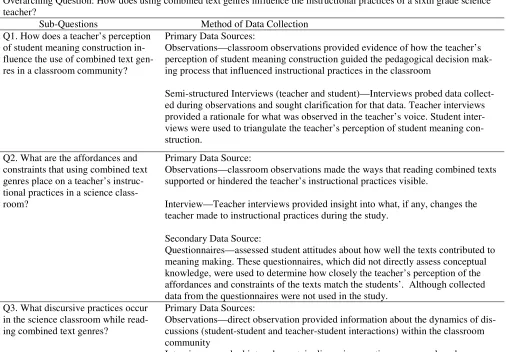
gen-res of text influenced a sixth grade science teacher’s instructional practices. The following
over-arching question and three research sub-questions listed below guided the research study:
Overarching Question: How using combined text genres influence the instructional
prac-tices of a sixth grade science teacher?
Sub-Questions:
1. How does a teacher’s perception of student meaning construction influence the use of
combined text genres in a classroom community?
2. What are the affordances and constraints that using combined text genres place on a
teacher’s instructional practices in a science classroom?
3. What discursive practices occur in the science classroom while reading combined text
genres?
Participants in this study were a sixth grade science teacher and ten of her students. Data
collec-tion occurred over the course of eight weeks during Spring Semester. Because this study was a
narrative inquiry into how using combined text genres influenced a teachers’ instructional
prac-tices, the primary data sources were classroom observations and interviews. Secondary data
sources included field notes, student surveys, and the collection of both teacher and student
arti-facts.
As previously mentioned, the US is moving toward the integration of literacy in all content
areas, including science (NGA Center, 2010a). Understanding how the teacher used the reading
of combined text genres to influence instructional practices with an overall goal of scaffolding
meaning construction by the students in her class will contribute to the body of knowledge
re-garding the effectiveness and practicality of literacy integration in science classrooms. The
practi-cal way to integrate literacy into science classrooms. The following section outlines my
theoreti-cal framework.
Theoretical Framework
Because this exploration examined how members of a classroom community used text, it
was appropriate to use a theoretical framework with roots in language and literacy. The model
that underpinned this study is called Reading as a Meaning Construction Process developed by
Ruddell and Unrau, but first it is important to pay homage to Rosenblatt’s theory of transactional
reading, the foundation for Ruddell and Unrau’s model.
Rosenblatt viewed reading as an iterative process of meaning construction between the
text and the reader; it is a transaction (Rosenblatt, 1988, 2004). Meaning construction was based
on the meaning that the reader gave to the words on the page of a book and the nature of that
meaning can be attributed to a combination of the author’s intended meaning and the reader’s
prior knowledge (Anderson, Spiro, & Anderson, 1978; Block, Parris, Reed, Whiteley, &
Cleve-land, 2009; Rosenblatt, 1988, 2004). According to Rosenblatt, as more text is read the reader
continually refined his or her interpretation of the text (Kucan & Beck, 1997; Rosenblatt, 2004;
Ruddell, 1992). Rosenblatt’s theory of transactional reading focused on an individual’s ability to
construct meaning from text, but stopped short of considering reading as a meaning construction
process for a classroom community as a whole which is an essential part of this study. This is
where Ruddell and Unrau’s model of Reading as a Meaning Construction Process picks up.
Reading as a Meaning Construction Process: The Reader, the Text and the Teacher.
Ruddell and Unrau (2004b) took Rosenblatt’s theory of transactional reading a step further and
described a meaning construction process that depicted how text, when used in a classroom
(student), text, and the teacher. The beauty of using Ruddell and Unrau’s process is that it
sup-ports the negotiation of meaning by the teacher and students around, through, and about the text.
The process creates both collaborative and individual spaces for interpretation of the text by
al-lowing the teacher and students to enter into parallel meaning construction processes: the
dents use the text as a foundation for meaning construction and the teacher monitors the
stu-dents’ meaning construction from the text then uses those perceptions to influence instructional
practices. Grounded in Vygotsky’s theory of socially mediated learning, this process promotes
the meaning construction through teacher-student and peer-peer interactions (Brown, Pressley,
Van Meter, & Schuder, 2004; Forman & Cazden, 2004; Ruddell & Unrau, 2004b) and broadens
Rosenblatt’s theory of transactional reading so that it is applicable to the meaning construction
processes that occur in a classroom community.
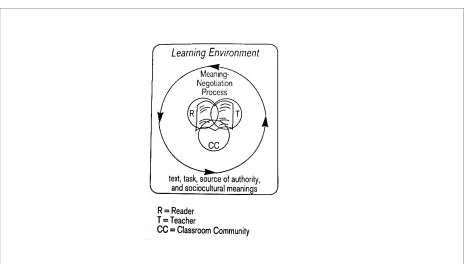
Within Ruddell and Unrau’s meaning construction process lies a model that depicts how
meaning is made from text through interactions between the reader, text and the teacher (Figure
1). Before examining how the model directly supported this study it is important to briefly
dis-cuss the reader and the teacher as integral parts of the meaning construction process that occurs
within the model. It is also important to note that even though this study did not directly
exam-ine student meaning construction, it is still an integral part of the study because the teacher
par-ticipant based her decisions about which instructional strategies to employ on her perception of
Figure 1. The Text and Classroom Context. A visual representation of the meaning
mak-ing process that exists between the reader, teacher and classroom community in the
Read-ing as a MeanRead-ing-Construction Process. Adapted from “ReadRead-ing as a MeanRead-ing-
Meaning-Construction Process: The Reader, the Text and the Teacher,” by Ruddell, R. B., &
Unrau, N. J. In R. B. Ruddell & N. J. Unrau, Eds., 2004, Theoretical Models and
Pro-cesses of Reading 5th ed., p. 1498. Copyright 2004 by the International Reading
Associa-tion.
The reader.Embedded in this meaning construction process is the recognition that the
readers are not blank slates. All readers bring a host of prior knowledge and belief systems that
affect how they construct meaning from the text. Rosenblatt (2004) wrote:
Every reading act is an event, or transaction involving a particular reader and a particular
pattern of signs, a text, and occurring at a particular time in a particular context. Instead
to-tal dynamic situation. The ‘meaning’ does not reside ready-made ‘in’ the text or ‘in’ the
reader, but happens or comes into being during the transaction between reader and text.
(2004, p. 1369)
In other words, reading is a transaction between the reader and the text with meaning being made
during the reading experience. Because meaning is fluid, a reader’s stance, a “perspective and
orientation toward a given text,” determines the nature of the meaning made (Ruddell & Unrau,
2004b, p. 1471). There are four stances (social, textual, institutional, and field) that determine the
lens that the reader uses while constructing meaning from text. Of particular interest in this study
are the social, textual and field stances, which allow the reader to construct meaning as part of a
community of learners, from the features of the text, and from the perspective of a science
pro-fessional, respectively.
The teacher.The role of the teacher in the meaning making process parallels that of the
reader. Like readers, teachers bring background knowledge and their own belief systems into the
learning environment, but the motivation and engagement on their part is directed at the student
rather than the text. Ruddell and Unrau (2004) wrote, “the teacher engages the student in a
col-laborative process of inquiry and self-improvement in which both teacher and student seek to
refine respective skills and knowledge” (p. 1489). To do this effectively, teachers must bring
enough content knowledge and pedagogical strategies to address the needs of the students. The
teacher’s role is to “manage and oversee the instructional decision-making process and meaning
construction” (p. 1495). Teachers act as facilitators of the meaning construction process, helping
students reach their own interpretations of text through social interactions with other members of
Below I will discuss the model used in this study that made student meaning making
vis-ible to the teacher through classroom discussions.
Text and Classroom Context: A Model. The Text and Classroom Context Model was “de-signed with a social constructivist perspective of learning in which the teacher fosters a learning
environment that engages students in a meaning construction process. During that process,
read-ers construct and negotiate meanings for texts, tasks, sources of authority, and features of the
so-ciocultural setting” (Unrau & Ruddell, 1995, p. 21). The model considers an expanded view of
reading as something more than a solitary activity during which the reader absorbs meaning from
the text and recognizes that learning is a social process (Yore et al., 1998). Reading is seen as a
active meaning construction process that should be accompanied by listening, speaking, and
writing so members of the classroom community have every opportunity to evaluate, negotiate,
and restructure their understanding of the text (Draper, 2002; Phillips & Norris, 2009; Ruddell &
Unrau, 2004b; Schmidt, Gillen, Zollo, & Stone, 2002; Sutherland, 2008).
In this model, the teacher scaffolds the meaning making process, but is not the driving
force behind it. Instead meaning is constructed through the experience of reading text and
inter-actions between the text, the teacher and students in the classroom community. The only
mean-ing that matters is the one negotiated by the community of learners who shared in the experience
of reading the text as long as the meaning is supported by evidence in the text (Rosenblatt, 2004;
Ruddell & Unrau, 2004b; Unrau & Ruddell, 1995). All members of the classroom community
are part of a hermeneutic circle, sharing in the meaning making process and the constant, cyclical
reshaping of those meanings as the result of discussion and reflection within the classroom
envi-ronment. Each learner begins with an interpretation of meaning that is shaped by the experience
the classroom community. Even though a student might not experience a transformation in the
meaning that has been made, being a member of a hermeneutic circle will engage the learner in
more critical considerations of his or her own meaning making process from the text based on
interactions within the classroom community. The same applies to the teacher. He or she may not
chose to immediately change his or her instructional practices, but there is considerable
consid-eration as to how those practices shape meaning construction in the classroom community.
How the process and model support this study. Science educators frequently make
ar-guments for the importance of doing science (Achieve, Inc., 2013; Lumpe & Oliver, 1991;
National Research Council, 2012), yet research argues that minds-on science is equally as
im-portant. Schmidt et al. (2002) conducted a study in a second grade classroom and found that
minds-on activities such as reading, writing, listening, and speaking, or more concisely the
inte-gration of literacy practices, enhanced learning to the point that students in the study were able to
demonstrate an understanding of all major concepts. Shmaefsky (2005) wrote about how
neces-sary it is to employ minds-on science techniques when conducting classroom demonstrations
otherwise demonstrations became how-to directives rather than meaning construction processes.
Supported by research, this study explored how a minds-on practice, such as reading combined
text genres, influenced a teacher’s instructional practices as she engaged in metacognitive
analy-sis of how her students constructed meaning from the reading texts.
Reading as a meaning construction process is representative of minds-on science
instruc-tion and can be used by practiinstruc-tioners to directly impact meaning construcinstruc-tion processes in the
classroom (Ruddell & Unrau, 2004b). Ruddell and Unrau (2004a) presented a model in which
the teacher, reader and text interact during a meaning construction process within a classroom
meaning making process as the teacher performs constant, metacognitive assessments of the
classroom environment, adjusting instructional strategies to suit the specific needs of their
stu-dents. In this study, this process “direct[ed] the flow and conduct of instruction through specific
purpose setting, planning and organizing, and strategy construction” (2004b, p. 1466). The
mod-el represents how a classroom community undergoes a meaning construction process while
expe-riencing the reading of a single source of text. This study applied this model to a situation in
which multiple text genres were used to explore how the reading a combination of text genres,
the traditional science textbook, popular science articles, and APL articles, influenced the
in-structional strategies of a sixth grade science teacher.
Assumptions of the Study
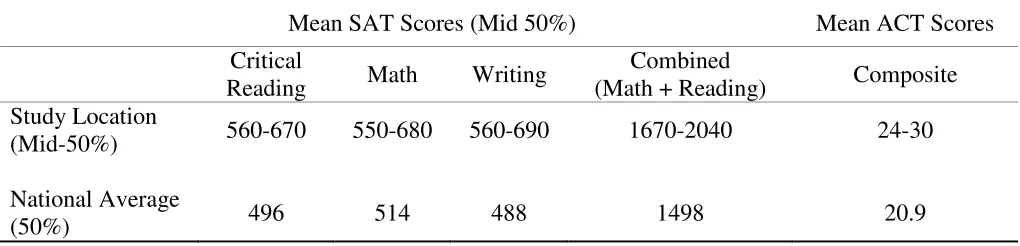
The reason for conducting the study at my place of employment is based on the
reputa-tion of the institureputa-tion; it is known for academic rigor. One hundred percent of its graduating
sen-iors are accepted into four year colleges whether or not they choose to attend. The 50th percentile
of sixth grade students in the study tested twenty points above the national average on reading
comprehension section of the Comprehensive Testing Program 4th edition (CTP4) exam. Based
on this assumption, the students’ reading comprehension skills would not present an obstacle in
the construction of meaning from the articles.
The following section presents a review of the literature surrounding literacy integration
in science classrooms, the specific text genres to be used in the study, and how reading a
2 REVIEW OF THE LITERATURE
The Centrality of Literacy Instruction in Science Classroom Communities
Science is not a standalone subject and should not be taught as such (Ford, 2009;
Pea-cock, 2001). Science instruction should include the integration of literary practices with a
com-bination of modeling and real world application of scientific facts and theories (Ronald
Ander-son, 2007; Howes, Lim, & Campos, 2009; Schmidt et al., 2002). Why is it important to
incorpo-rate literacy practices in science classrooms? The skill set that a student develops as a result of
literacy instruction in science classrooms enables him or her to read critically, synthesize
infor-mation and use previous learning experiences to make sense of new inforinfor-mation (Baram-Tsabari
& Yarden, 2005; Bruce & Wasser, 1996; Shanahan, 1997; Sutherland, 2008). Integrating literacy
practices into science instruction also increases motivation and engagement, strengthens the
skills necessary to wholly participate in inquiry learning, makes cross curricular connections
be-tween science and language arts, and gives students a better idea of how these subjects are
intri-cately linked (Douville, Pugalee, & Wallace, 2003; Kachan, Guilbert, & Bisanz, 2006; Olson &
Truxaw, 2009; Pappas, 2006; Purcell-Gates, Duke, & Martineau, 2007; Shanahan, 1997;
Suther-land, 2008).
Database searches revealed that studies exploring how literacy integration supports
sci-ence learning generally contain at least one of the following elements: the use of elementary
school populations, an assessment of the quality of curriculum materials, an examination of
teacher attitudes about integration, or some aspect of inquiry learning. For example, Schmidt et
al. (2002) conducted a study linking literacy instruction and inquiry learning in a second grade
out-standing of science concepts. Norris et al. (2008) found that commercial readers used in
elemen-tary schools forsake the technical aspect of science content for sake of a cohesive narrative. At
the elementary level, text supports learning to read rather than reading to learn and the accuracy
and thoroughness of the science in the text is sacrificed (Fang, 2006; Pappas, 2006). Sutherland
(2008) wrote about the role she played in the development of reading materials for a middle
school project-based, inquiry-based science curriculum. As a literacy expert she guided science
educators through constructing text that was “considerate” (p. 177) to the needs of the students.
Sutherland found that text shapes science learning during reading, therefore the structure,
audi-ence appropriateness, and readability of the text send both implicit and explicit messages to
stu-dents about what information is worth retaining. In a study on the development of curriculum
materials to promote inquiry, Trumbull, Bonney, and Grudens-Schuck (2005) found that the
pro-pensity of elementary school science curriculum materials to promote inquiry learning depended
on how those materials presented science. Their efforts were largely unsuccessful because the
materials did not “[scaffold the] concepts and behaviors to enable students to move from
science-as-information to science-as-inquiry” (p. 888). Collectively these articles point to the important
role that text plays in science classes. In general text supports meaning construction processes,
but the nature of the meaning made (i.e. rote memorization, inquiry-based, etc.) is implicit within
the type, or genre, of text being used.
In contrast to the studies referred to above, research studies using middle or high school
populations tend to be situated in science education rather than oriented in literacy-focused
re-search paradigms. The next section of this literature review discusses some of these studies in an
qualities of each genre, and explain how reading a combination of these genres provides students
with a holistic understanding of science.
Text Genres
Narrative versus expository text. Narrative text is the predominant text choice used in teaching students to read, especially at the elementary level (Cox, Fang, & White Otto, 2004;
Fang, 2006; Norris et al., 2008; Wray & Lewis, 1997). Studies by Norris et al. (2008) and Pappas
(2006) indicated that the subject of these narrative texts are not typically science. Even in those
texts that addressed science content, the scientific accuracy and thoroughness of the content of
the text was secondary to the ability to assist students with learning to read. For example, the text
discussed a bee’s waggle dance or mentioned why spiders built webs, but they did not fully
ad-dress the scientific nature behind these instinctive, life-promoting processes. These narratives
privileged learning to read rather than reading to learn through the use of overly simplistic and
incomplete stories that forsook science in order to teach students to read.
In middle school, students face an abrupt shift as their reading goals change from
learn-ing to read to readlearn-ing to learn. Readlearn-ing to learn necessitates a switch from the use of narrative
text to nonfiction and/or expository texts (Fang, 2006, 2008; Wray & Lewis, 1997).
Unfortunate-ly, most students are unprepared to make the shift due to the lack of exposure to expository text
in earlier grades and consequently the lack of explicit instruction in content area reading
(Alvermann et al., 2009; Armbruster, Anderson, & Ostertag, 1987; Fang, 2008; Guthrie et al.,
1998; van den Broek, Virtue, Gaddy Everson, Tzeng, & Sung, 2002; Wray & Lewis, 1997). Fang
(2008) states, “The continuing emphasis on…primary grade reading instruction, does not,
how-ever, adequately prepare students to read more challenging expository texts of, for example,
“without specific training in the art of expository reading, students will find expository texts
al-ienating and difficult to read”. The inability to easily make sense of text contributed to negative
reading experiences and the reluctance to engage in the act of reading (Cox et al., 2004).
Present-ing students with text choices that provide positive yet varied readPresent-ing experiences while they
read to learn promotes this idea of self-efficacy. Reading a combination of text genres in
con-junction with text appropriate reading instruction, can support learning in the classroom
envi-ronment at a variety of levels depending on the genre of science text being used (Armbruster et
al., 1987).
The following section of the literature review discusses the texts that represent combined
text genres used in this study.
Characteristics and features of traditional science textbooks. The traditional science text-books fails students in multiple ways: there is little opportunity to reason and argue, too few
ex-plicit connections are made to modern science, and connections to scientific conclusions are not
frequently addressed (Norris, Macnab, et al., 2009). There is little reason for students to insert
themselves into the science because it is presented as a summary of what has already occurred
rather than as active and fluid (Baram-Tsabari & Yarden, 2005; Goldman & Bisanz, 2002;
Phil-lips & Norris, 2009; Trumbull et al., 2005). Trumbull (2005) states:
Contemporary science textbooks and laboratory manuals continue to convey a view of
science knowledge as certain and invariant. Such representations of science limit the
suc-cess with which learners understand science, including making sense of contradiction and
disagreement among science experts. Further, when science is presented as a stable body
and explanations of observed phenomena. Students subsequently are limited in ability
and confidence with regard to inquiry. (p. 881)
The effectiveness of traditional science textbooks and the views of science portrayed in
these texts are questionable because their expository nature presents science as absolute fact,
which does not allow students to approach text in the questioning, dynamic spirit of science
(Donahue, 2000; Draper, 2002; McComas, 1998; Olson & Truxaw, 2009; Phillips & Norris,
2009; Trumbull et al., 2005). As a result of science being presented as it ‘is’ rather than what it
‘could possibly be’, students do not develop the skills necessary to grapple with the science
text-book.
Science textbooks demand only a functional literacy; students are simply asked to read,
absorb the information and recall it on assessments (Donahue, 2000; Scruggs, Mastropieri,
Bakken, & Brigham, 1993). At no point are they required to interpret the text, construct their
own meanings, or synthesize knowledge (Shanahan, 1997) because science is presented as an
endpoint of research not a process (Baram-Tsabari & Yarden, 2005). Traditional science
text-books do not give students the opportunity to connect scientific discoveries to the scientific
pro-cesses that yielded them. Their learning is no more than rote memorization and the process of
science and power literacy are lost on them (Donahue, 2000).
Studies have found that science textbooks are difficult to read and perhaps
unintentional-ly responsible for student misconceptions (Goldman & Bisanz, 2002; Vacca & Vacca, 1999).
Goldman and Bisanz (2002) state:
Analyses of American science textbooks indicate that they cover too many topics, use
difficult vocabulary, make little contact with students’ background knowledge, and do
sys-tematically develop concepts and relate topics to one another in a systematic and
mean-ingful way. (p. 39-40)
Students find reading traditional science textbooks difficult because the structure of this genre of
expository text is vastly different from the narrative text they were taught to read. These
differ-ences necessitate the explicit instruction in the use of text structure in order to increase reading
comprehension of expository text.
Armbruster et al. (1987), Goldman and Bisanz (2002), and Vacca and Vacca (1999)
pro-vide epro-vidence that the comprehensibility and recall of information in traditional science
text-books depends largely upon a reader’s understanding of its text structure. There are threemain
categories of text structure used in traditional science textbooks that convey meaning: technical
vocabulary, typographic aids, and organizational patterns. Fang (2006) referred to the technical
vocabulary within traditional science textbooks as the (written) language of school science (LSS)
and attributed the difficulty that students have in understanding the LSS in expository texts to the
fact that it is vastly different from everyday language. Traditional science textbooks are
infor-mation dense as indicated by readability formulas and there is a need to explicitly teach students
to analyze the meaning of technical vocabulary terms by using morphemic analysis (Alvermann
et al., 2009; Fang, 2006). Vacca and Vacca (1999) state, “When students use morphemic analysis
in combination with context, they have a powerful strategy at their command” (p. 74) because
they are able to construct meaning by taking the words apart.
Typographic aids, a second type of text structure, are indices of text format and include
features such as font characteristics (bold, italics, etc.), indicators of paragraph levels (headings
and subheading) and visuals (pictures or graphics) to indicate conceptual significance
signi-fy the importance of words or provide clues about the level of detail. Unfortunately uninformed
“students tend to gloss over a typographic aid instead of using it to spotlight…meaning” (Vacca
& Vacca, 1999, p. 70) which affects their ability to interpret the meaning of text.
Another category of text structure in traditional science textbooks are organizational
pat-terns such as lists, sequencing, comparing and contrasting, cause and effect relationships, and
problem-solution patterns. According to Vacca and Vacca (1999), these organizational structures
use “the grammatical relationships among words in a sentence or the structural arrangement
among sentences in a passage [to help] clarify the meaning of a particular word” ( p. 70) and are
more difficult for students to determine and decipher on their own. Armbruster et al. (1987)
found that students who understand the author’s organizational structure recalled more than
stu-dents who did not. Furthermore, the stustu-dents who understood the author’s organizational
struc-ture used it to organize their own meaning construction. Conversely students who struggled with
meaning construction could not make sense of the text structure or the content within the text.
This indicates that explicit strategy instruction for students who are unable to make sense of the
text features in traditional science textbooks is sometimes required (Alvermann et al., 2009;
Armbruster et al., 1987; Fang, 2006; Vacca & Vacca, 1999).
Characteristics and features of popular science articles. Popular science articles, also called Journalistic Reported Versions (JRV), are expository texts written to inform general audiences
about science (Goldman & Bisanz, 2002; Yarden, 2009). According to Goldman and Bisanz
(2002) these texts report new research, whether or not the research claims have been accepted by
the scientific community and are designed to present science in a manner that the public can
un-derstand. Generally speaking, these articles are news stories featuring members of a community;
sci-entific knowledge is presented in a popular science article, it can fall anywhere on a continuum
of extreme certainty to conditional, depending on the article and/or topic (Goldman & Bisanz,
2002; Yarden, 2009). A unique feature of popular science articles, when compared to the other
genres of text featured in this study, is the inclusion of the human perspective. Any focus on
ob-jectivity is from the author’s perspective as he or she is certain to include information from both
sides of the argument (Goldman & Bisanz, 2002). These articles make science seem more like a
human endeavor and less sanitized than the traditional science textbook (Kucan & Beck, 1997).
Popular science articles are narrative in nature and do not contain regularly occurring text
fea-tures. They typically take on a format dictated by the publication in which they appear.
Popular science articles can be a valuable resource in science classrooms when used to
complement more technical reading materials. They also present authentic opportunities for
criti-cal reading and the discussion of multiple interpretations generated by members of the classroom
community. Although these texts are less technical than traditional science textbooks or APL
ar-ticles and not academic enough to use in educational settings alone (Goldman & Bisanz, 2002),
exposure to popular science articles in an academic setting is important because these are the
texts that students are most likely to come across once they leave academic settings (Yarden,
2009). It is important that they understand what they are and how to use them.
Characteristics and features of APL. APL was developed in response to the need to use primary research articles in science classrooms. Baram-Tsabari and Yarden (2005) wrote,
Primary literature not only closes the gap between public knowledge and the frontiers of
scientific inquiry, it can also develop the following components of scientific literacy:
ac-quaintance with the rationale of the research plan; exposure to research methods and their
scien-tific communication; development of the ability to critically assess the goals and
conclu-sions of scientific research; exposure to problems in a certain discipline and acquaintance
with the continuity of the scientific research process. (p. 404)
With all of these qualities, it is easy to see how using primary literature can benefit the
teaching and learning of science. Unfortunately, because primary literature is “written by
scien-tists for scienscien-tists” in “technical language specific to the area of research” (Norris, Macnab, et
al., 2009, p. 322), also known as scientific discourse (Gee, 1999; Lemke, 1988), the articles are
often difficult for students to read and understand. To mitigate this problem science writers have
taken the information from primary research articles and make it grade level accessible for
sec-ondary students. This text genre is called Adapted Primary Literature (APL). The language of
APL articles is less technical than that of primary literature and the complex data is explained
qualitatively rather than quantitatively. APL articles are reviewed by scientists as a measure of
quality control (Norris, Macnab, et al., 2009).
APL is different from traditional science textbooks and similar to primary literature in
that it presents students with the discourse of science while maintaining the structural integrity of
empirical research articles (Baram-Tsabari & Yarden, 2005; Falk et al., 2008; Ford, 2009;
Norris, Falk, et al., 2009). The continuity of structure from one APL article to another (Abstract,
Introduction/Background, Methods, Results and Discussion) reinforces understanding of the
sci-entific method while engaging students in reading and discussing the text (Baram-Tsabari &
Yarden, 2005; Norris, Macnab, et al., 2009; Phillips & Norris, 2009). Reading APL articles
re-quires students to navigate the text like true scientists (Baram-Tsabari & Yarden, 2005; Falk &
Yarden, 2009; Phillips & Norris, 2009); they are presented with the opportunity to question,
In a 2005 study, Baram-Tsabari and Yarden found using APL beneficial because APL
bridged the gap between common language and scientific discourse. The study also
demonstrat-ed that students learndemonstrat-ed more about scientific inquiry when using APL. In fact, APL has
consist-ently been shown to increase a student’s understanding of the scientific process, the nature of
science, and the use of scientific inquiry (Baram-Tsabari & Yarden, 2005; Falk et al., 2008;
Norris, Macnab, et al., 2009). However, these same studies do not necessarily conclude that there
is a significant difference in the understanding of content knowledge between students who read
APL and those who read other text genres. Unlike traditional science textbooks, APL highlights
the fluidity of science and gives students the opportunity to integrate literacy practices while
learning science through the processes of reasoning, rationalizing and argumentation. Reading
becomes an authentic literacy activity through the use of APL (Duke, Purcell-Gates, Hall, &
Tower, 2006). Students use these authentic reading experiences to construct meaning on their
own terms and are adept at demonstrating their understanding of science (Phillips & Norris,
2009). Table 1 presents the characteristics and features of each text genre.
The following section of the literature review begins with a discussion of minds-on
Table 1
Characteristics and features of the text genres that will be used in this study
Traditional Text-books
Popular Science APL
Authors Science educators and scientists
Science journalists Science educators and scientists
Audience Students (K-16) General public Secondary students
Content Summaries of facts Facts with little evidence
Evidence to support conclusions
Structure Discipline specific Publication specific Canonical
Presentation of sci-ence
Certain, without processes
Continuum of cer-tainty
Uncertain
Note. Adapted from “Reading scientific texts: Adapting primary literature for promoting
scien-tific literacy” by A. Yarden, 2009, Research in Science Education, 39, p. 308. Copyright 2009 by
Springer Science + Business Media B.V.
The Use of Literacy Integration to Scaffold in Minds-on Science
Minds-on science activities that encourage questioning and develop higher order thinking
skills are examples of inquiry learning. The NRC (1996) describes inquiry1
as a:
Multifaceted activity that involves making observations; posing questions; examining
books and other sources of information to see what is already known; planning investigations;
reviewing what is already known in light of experimental evidence; using tools to gather,
ana-lyze, and interpret data; proposing answers, explanations, and predictions; and communicating
the results. Inquiry requires identification of assumptions, of critical and logical thinking, and
consideration of alternative explanations. (p. 13-14)
From this perspective inquiry, like literacy integration, can be presented as an educational
outcome that provides rich and varied opportunities to construct meaning and collaborate in
or-der to increase both unor-derstanding and engagement (Anor-derson, 2007). Students engaged in
in-quiry as an educational outcome read for information, summarize what they have read,
synthe-size new information, and communicate with their peers thus showing evidence of learning
out-comes and mastery of skill (Ebbers, 2002; Howes et al., 2009; Norris et al., 2008; Phillips &
Norris, 2009; Schmidt et al., 2002; Sutherland, 2008). Though inquiry learning is often
associat-ed with hands-on activities, it can also be achievassociat-ed through minds-on work like literacy
integra-tion.
According to Wetzel (1997), literacy integration and minds-on science share similar
ob-jectives: the processing and managing of ideas and information. During minds-on science
activi-ties, students “share what they observed with others to assess the universality of their
under-standing” (Shmaefsky, 2005, p. 44) by reading, talking, writing and listening, the cornerstones of
literacy practices (NRC, 2000). In a study by Howes et al. (2009) science teachers whose
instruc-tional practices combined minds-on activities with literacy integration provided opportunities for
students to construct meaning and demonstrate deeper understandings of science through
read-ing, writread-ing, and speaking. Until now the focus of this literature review has been literacy
integra-tion through reading. Now I would like to address the importance of using discussion as a means
Literacy Integration and the D/discourse of Science
Literacy integration includes activities that highlight speaking thinking, and writing about
text. James Paul Gee (1999, 2004) used the terms Discourse and discourse to describe accepted
practices and language in the situated context of social environments. Discourse, with a big ‘D’
refers to a way of being that is accepted by members of that group. Students engaged in inquiry
based activities such as asking questions and proposing answers, analyzing and interpreting data,
and communicating (NRC, 1996) are engaging in the same behaviors as professional scientists;
they are situated in the Discourse of professional science. Speaking about those behaviors or
oth-er aspects of science, language in use, is what Gee (2004) refoth-erred to as discourse with a little
‘d’. Full literacy integration of literacy should include text that supports the Discourse (social
nature) and discourse (language) of science (Gee, 1999, 2004; Lemke, 1988) yet provide enough
space for students to construct meaning individually (Boghossian, 2006; Gee, 2000) before
con-tributing to the making of meaning as part of a group.
Since literacy itself is a social construct (Gee, 1999, 2004; Leu, Jr., Kinzer, Coiro, &
Cammack, 2004), the integration of literacy can be used to bring the Discourse of professional
scientists into the science classroom, maximizing science learning opportunities. It is through
these learning environments, designed to close the gap between professional and classroom
sci-ence (Falk & Yarden, 2009), that students will be able to operate in the scientific Discourse of
professional scientists, using “language-in-action” (Gee, 1999, p. 11) to read, write and speak
like scientists (J. Parkinson, Jackson, Kirkwood, & Padayachee, 2007). Lemke (1990) agreed
that bridging the gap between school science and scientific practice is critical in science meaning
construction. He suggested that teachers move backward and forward between the discourses to
discussion of text, both formally and informally, both teacher-driven and study-led, is the best
way to achieve this goal.
According to Gee (1999), “Discourses are always embedded in a medley of social
institu-tions, and often involve various ‘props’ like books and magazines…laboratories,
class-rooms…and a myriad of other objects” (p. 18). The books Gee referred to are primary literature
manuscripts, articles, and journals that professional scientists produce and use to define
prob-lems, discuss findings and collaborate. In this study, combined text genres served as the props
that brought students into the Discourse of professional science through classroom discussions.
In a classroom setting it is those discussions that inform a teacher perception on student meaning
construction and serve to influence his or her instructional practices.
Exploration of the Teacher’s Role in Literacy Integration
Challenges. The way that science teachers think about reading can be a serious barrier to literacy integration in science classrooms (Wray & Lewis, 1997). Hall (2005) found that
pre-service teachers felt that they neither knew how to nor were they interested in learning how to
teach reading. In the same study service teachers felt that while they did not know how to
in-corporate literacy strategies into their classrooms, their students could benefit from the practice.
It is likely that teachers believe that incorporating literacy strategies in science classrooms means
focusing on code-based reading instruction, which is not necessarily true. In a study by Greenleaf
et al. (2001), researchers found that even students who read below grade level do not always
need “skill instruction focused on phonics, word attack, vocabulary, and spelling” (p. 83). What
they need is guidance on building skills that help them make meaning of science text (T. H.
An-derson, West, Beck, MacDonell, & Frisbie, 1997; Guthrie et al., 1998, 2004; Irving, 2001).