ScholarWorks @ Georgia State University
ScholarWorks @ Georgia State University
Art and Design Theses Ernest G. Welch School of Art and Design
Winter 12-18-2012
Creativity Beliefs of Elementary Students: efficacy,
Creativity Beliefs of Elementary Students: efficacy,
Self-esteem and Beliefs in Between
esteem and Beliefs in Between
Mollie E. Spardello Georgia State University
Follow this and additional works at: https://scholarworks.gsu.edu/art_design_theses
Recommended Citation Recommended Citation
Spardello, Mollie E., "Creativity Beliefs of Elementary Students: Self-efficacy, Self-esteem and Beliefs in Between." Thesis, Georgia State University, 2012.
https://scholarworks.gsu.edu/art_design_theses/123
This Thesis is brought to you for free and open access by the Ernest G. Welch School of Art and Design at ScholarWorks @ Georgia State University. It has been accepted for inclusion in Art and Design Theses by an authorized administrator of ScholarWorks @ Georgia State University. For more information, please contact
SELF-EFFICACY, SELF-ESTEEM AND BELIEFS IN BETWEEN
by
MOLLIE SPARDELLO
Under the Direction of Melody K. Milbrandt
ABSTRACT
Creative development in students is an important aim for the art educator. The visual arts class
can be a realm for exploring and nurturing creativity in students. While all students may not
grow up to produce works of art outside the classroom, visual arts education can impact a
stu-dent’s understanding of their own creativity. This paper explores the creativity beliefs of
elemen-tary students. The research seeks to understand the implicit theories or beliefs of creativity that
SELF-EFFICACY, SELF-ESTEEM AND BELIEFS IN BETWEEN
by
MOLLIE SPARDELLO
A Thesis Submitted in Partial Fulfillment of the Requirements for the Degree of
Master of Art Education
in the College of Arts and Sciences
Georgia State University
Copyright by Mollie Everitt Spardello
SELF-EFFICACY, SELF-ESTEEM AND BELIEFS IN BETWEEN
by
MOLLIE SPARDELLO
Committee Chair: Dr. Melody K. Milbrandt
Committee: Dr. Melanie G. Davenport
Dr. Kevin Hsieh
Electronic Version Approved:
Office of Graduate Studies
College of Arts and Sciences
Georgia State University
DEDICATION
I dedicate this thesis to my husband. Thank you for supporting and encouraging me
ACKNOWLEDGEMENTS
I offer tremendous thanks to the art education faculty at Georgia State University. Dr.
Milbrandt, thank you for guiding me through the research process; your listening ear and your
time were so valuable as I worked through writing this paper. I offer thanks to Dr. Davenport and
Dr. Hsieh for their feedback and direction in developing my manuscript. Thank you to the
TABLE OF CONTENTS
ACKNOWLEDGEMENTS ... v
LIST OF FIGURES ... x
CHAPTER 1: INTRODUCTION ... 1
Purpose of the Study ... 1
Purpose of the Study ... 5
Operational Definitions... 6
CHAPTER 2: REVIEW OF LITERATURE ... 7
Creative self-efficacy and implicit theory ... 10
Creative self-efficacy and creative development ... 11
Creative self-efficacy and creativity myths ... 14
Creative self-efficacy and creativity ... 17
Creative Self-efficacy and Teacher Beliefs of Creativity ... 18
Conclusion ... 21
CHAPTER 3: METHOD ... 22
Research questions ... 22
Methodology ... 22
Participant Characteristics... 23
CHAPTER 4: FINDINGS AND ANALYSIS OF SURVEY ... 28
Survey Responses ... 28
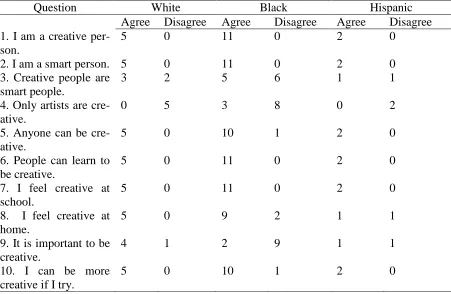
Third Grade Responses ... 31
Fourth Grade Responses ... 36
Fifth Grade Responses ... 39
Final Thoughts on Survey Responses ... 44
CHAPTER 5 : FINDINGS AND ANALYSIS OF INTERVIEWS ... 45
Creativity Stories ... 46
Audrey, 4th Grade ... 46
Marcus, 4th Grade ... 49
David, 4th Grade ... 51
Keisha, 5th Grade ... 53
Hiram, 4th Grade ... 56
Melanie, 3rd Grade... 58
Steve, 4th Grade ... 61
Amber, 3rd Grade ... 63
Matthew, 5th Grade ... 65
Christian, 3rd Grade ... 68
Emily, 3rd Grade ... 70
CHAPTER 6: CONCLUSIONS ... 78
Implications... 84
Recommendations for Future Research ... 88
APPENDIX ... 93
Appendix A ... 93
Appendix B ... 94
Appendix C ... 95
Appendix D ... 97
LIST OF TABLES
Table 1. Survey Responses ... 31
Table 2. Third Grade Responses by Race ... 34
Table 3. Third Grade Responses by Gender ... 34
Table 4. Fourth Grade Responses by Race ... 38
Table 5. Fourth Grade Responses by Gender ... 39
LIST OF FIGURES
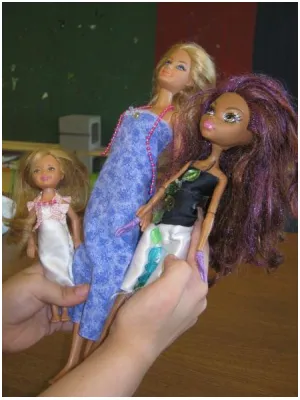
Figure 1. Melanie's Barbie Clothes ... 60
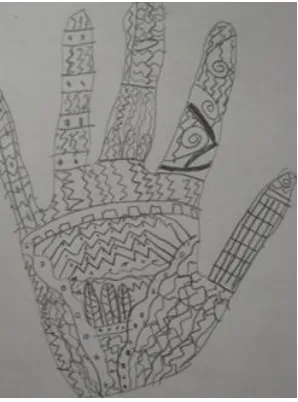
Figure 2. Emily's hand design ... 71
CHAPTER 1: INTRODUCTION
Early in life we as people begin to identify ourselves related to different intellectual, bodily
and mindful characteristics. Educators and students have a unique relationship in the
develop-ment of identity. Art educators are not merely shaping content in the minds of students as they
work, we also co-construct with students, building their self-identities and perceptions of their
abilities. In the field of art education creativity has been an important concept. However there is
still a lack of consensus on issues of creativity such as how we define and recognize creativity. In
addition to a lack of consensus among the educators and leaders of the field there is a lack of
re-search on what students know and think about creativity. As I think about my students I wonder
how their view of their own creativity will develop as they grow into adolescents and then adults.
As an art educator, what is my role in the development of that view? I am most interested in
ex-amining what my students believe about creativity. Understanding the creativity beliefs of my
students will enable me to determine how to support their creative development. My position as
an art educator can empower me to help students recognize and develop their creativity.
Purpose of the Study
Creativity is an important topic for research in art education. In the past two years, two of
issues of the academic journal Art Education have been devoted to issues of creativity (Art
Edu-cation, Vol.63 & 64). Therefore, we know that creativity is at the forefront of the mind of many
art educators and scholars in the field. In this study I focus on the personal aspects of creativity
and investigate the phenomena of creative self-efficacy in upper elementary students at the
In the field of art education, creative self-efficacy is a critical topic of study. As much as
one might like, not every art teacher is nurturing the next Picasso, Claudet, Ringgold or Bearden.
Every student who walks into the art classroom is not destined for a life as a working artist, or
even working in a field related to the arts. However, the visual arts provides a platform for
stu-dents to develop their creative potential and set it to use in whatever form they find most
valua-ble.
Developing creative potential, nurturing a creative concept, sustaining creative
self-efficacy and promoting creative confidence are some of my personal aims as an art educator.
My interest in promoting creative self-efficacy is not just to raise student self-esteem or pump
students up with unfounded hot air, but to challenge them with the notion of accepting their
crea-tive potential and living fully with it.
Creative self-efficacy is a facet of the larger concept of self-efficacy. Self-efficacy is
dis-cussed further in the review of literature. However, it is important to note the distinction between
self-esteem and self-efficacy. Self-esteem and self-efficacy are both self-perceptions held by an
individual. Unjust praise and blind acceptance can raise self-esteem levels in students but may
actually be harmful to their achievement in the end. Self-efficacy beliefs on the other hand are
built more intrinsically within the individual and come from the struggle toward mastery
experi-ence. The visual arts can be an excellent vehicle for raising self-esteem. Students can feel
ac-complishment, esteem or pride in a successful work they created. A student can gain
self-efficacy by understanding why their work is successful and not only feeling pride but also
under-standing the process that led them to that success. Self-efficacy is a more valuable belief for
stu-dents to develop because it focuses not only on their feelings but on their beliefs about their
We know that disciplines other than the visual arts find value in creative thought as well.
Creativity is often included in curriculum. Sometimes creativity is overtly included in county,
state or national standards and other times it is in the individualized curriculum of a single
educa-tor (Burton, 2010). Having positive creative self-efficacy beliefs may help students to
under-stand the interdisciplinary nature of creative thinking. Creative self-efficacy beliefs may be
use-ful to students in different learning domains and in an interdisciplinary way. Creativity is often
understood as being domain specific (Amabile, 1996) and therefore people may be less likely to
believe they are creative if they focus on how creative outcomes may look in specific domains.
Understanding their own creativity may help students be more aware of ways they can be
crea-tive, even in different domains where the products will look vastly different.
Nurturing and developing creativity in students can lead to career interests, and often the
rationale behind the inclusion of creativity in the curriculum is for the promotion of creative
ca-reers. Creative careers are on the rise and society tends to laud those leaders and entrepreneurs
whose creative work brings about new products, technologies and methodologies. Gibson
(2005) writes of the hidden issues of justifying creativity in education for economic ends.
Pro-moting creativity purely for economic means lends cultural value to the creative act. Creativity
for marketing cars may hold a different cultural (and perhaps moral) value than creativity to end
greenhouse gas emissions (Gibson, 2005). While I agree with the importance of preparing
stu-dents to be career ready by promoting creative development, I do not see the potential for
crea-tive careers as the only benefit to creacrea-tive development.
I advocate for the idea that creativity is essential to all human existence, what Bohm refers
to as a ‘creative quality of living’ (Bohm, 1986). Anthropologists and evolutionists suggest that
intelligently designed and endowed by a creator or evidenced in other ways, humanity has
evolved because of creativity (Dissanayke, 1990). All humans possess a certain amount of
crea-tive potential. If one is not afraid to harness or explore it, creativity can become an important
as-pect of identity.
Creativity is valued differently in different cultures. Culture will play a role in how
stu-dents develop efficacy beliefs of many types and specifically culture will influence how stustu-dents
develop creative self-efficacy beliefs. Many countries advocate for creativity as an educational
aim. Great Britain, Japan, Chinese societies (Hong Kong, Taiwan, and mainland China), are
ex-amples of cultures where creativity is valued in order to impact economic growth. Like the
Unit-ed States in Great Britain and Chinese societies creativity is valuUnit-ed in Unit-education in order to
pre-pare students for creative careers (Chien & Hui, 2010; Gibson, 2005). In Japan creativity is
val-ued in education for the cultural ramifications. “The Japanese apparently view creative problem
solving as a teachable skill important to the character and success of members of their society
(Davenport, 1993, p. 79).”
Furthermore, I believe every student has the right to claim creativity for him or herself.
Without an understanding of how everyday creativity can exist in the life of an individual many
students may never know their actions as creative. Students need to learn to recognize their
eve-ryday creativity, not to give students an inflated self-view, but as Beghetto (2007) suggests help
students be greater thinkers by helping them recognize their own creativity and how it may be
used in different contexts.
Discussions surrounding creativity often distinguishes between creativity in eminent
indi-viduals and creativity in the less eminent. A common way to refer to these two types of creativity
self-efficacy is needed because as would be expected so much emphasis is placed on Big C
crea-tivity, or creativity that is recognized by large swaths of society. It is just as important to value
little c, mini c creativity, and even everyday creativity (Kaufman & Beghetto, 2009).
Most of humanity will not rise to the level of big C creativity, but all of humanity can
ex-perience everyday creativity in their life. However, many people struggle to identify themselves
as creative. People often lament, “I am not creative.” Sadly, even young students at times will
make this definitive statement about themselves. Without a strong belief in their own creative
self-efficacy, individuals will not experience creativity in their own lives because they will not
believe that they have the ability to be creative. Because of this dichotomy, the need and
im-portance of creativity in the life of each individual and the apparent lack of creative self-efficacy
I believe a research study regarding creative self-efficacy in elementary students is necessary.
Purpose of the Study
The purpose of this research study was to investigate creative self-efficacy in elementary
students, particularly the elementary students who are currently in my visual arts class. As their
art teacher I was curious about their understanding of the concept of creativity and their creative
self-efficacy beliefs. I wonder what I have been communicating to them about creativity. What
notions of creativity have they gleaned from their classroom experience, from our school culture
at large, and from their home lives? I wished to investigate how these different contexts are
in-fluencing students understanding of creativity and their individual creative self-efficacy beliefs.
My research study proposed a written survey regarding what students think about the concept of
creativity and what they think about their own creative self-efficacy or creative self-esteem.
Af-ter implementing the survey I conducted inAf-terviews with a small number of the study participants
Using the data of the survey and the personal narratives from the interviews I developed a
deeper understanding of my students and their beliefs of creativity. A primary goal of this
re-search was to understand the factors that influence students as they construct their beliefs of
creativity. The findings from this research will direct my art teaching practice and provide much
needed research about how elementary students understand creativity and how they build their
creative self-efficacy beliefs.
Operational Definitions
Several key terms for this research study are briefly defined below. These terms and
con-cepts are outlined in greater detail within the review of literature. These definitions merely serve
to explain how the author is operating with these concepts throughout the research.
Creativity- An innate human characteristic to think, act and produce in novel and appropriate
ways on either a public, professional or private stage (Amabile, 1996; Cropley, 2001; Kaufman
& Beghetto, 2009). Creativity may not only describe a product or action but also a pattern of
thinking processes employed by an individual (Lehrer, 2012; Bernstein &
Root-Bernstein,1999).
Self-efficacy – “belief in an individual’s capabilities to organize and execute the courses of
ac-tion required to manage prospective situaac-tions” (Bandura, 1995, p.2).
Creative Self-efficacy - A self-efficacy belief regarding one’s ability to think, act and produce in
creative ways (Beghetto, Kaufman & Baxter, 2011).
Implicit Theory - Theories of a topic that are constructed by people that reside in the minds of
these individuals. Implicit theories or beliefs can provide an overview regarding what beliefs
people hold about a certain topic. Implicit theories would be somewhat connect to the idea of a
CHAPTER 2: REVIEW OF LITERATURE
Literature on the concept of creativity is ever expanding. Some examples of common
re-search topics of creativity are measurements of creativity, accounts and profiles of creative
per-formance, the development of creativity, and the role of creativity in everyday life. The review of
literature for this research study discusses broad notions of creativity and then presents research
related to creative self-efficacy. One goal for education is for each student to develop a strong,
positive creative self-efficacy belief. A positive creative self-efficacy belief will empower
stu-dents in their ability to solve practical problems in many areas of life in unique and appropriate
ways. A positive creative self-efficacy belief will give students a voice for expression and
per-sonal reflection through out their life.
Creativity is a complex and multifaceted phenomenon. There are many directions from
which to approach the issues of creativity. First there is the difficulty of defining creativity.
Many feel they know creativity when they see it but perhaps have trouble distinguishing why one
thing would be creative and why another thing would not be. For the purposes of this research I
am defining creativity as the innate human characteristic to think, act and produce in novel and
appropriate ways. I agree with creativity researchers such as Runco (2002,2007) who argue that
all humans have some amount of creative potential. If creativity is available to all human beings
it is troubling that more people do not describe creativity as an aspect of their identity. I believe
this comes from the both definitions and myths of creativity that perpetuate common knowledge
and the way creativity is handled in the classroom.
Some research has suggested the notion that creativity is domain specific (Amabile, 1996).
What it means to be creative is influenced by the lens or domain with which one is looking at an
dif-ferently in different domains. A creative solution for dance will not be a viable creative solution
for a physics problem. However, some creativity researchers conclude that while the products
may vary between domains, the processes of creative thinking may not. The way of working
to-wards a creative solution, the creative process, may be more similar among domains than the
fi-nal products would suggest (Root-Bernstein & Root-Bernstein, 1999).
With a focus on domain specificity in creativity some may develop a belief that recognizes
only consider certain domains or disciplines to even be creative. Some would look only at artistic
endeavors as a stage for creativity. Such limiting views of creativity can be influenced by
teach-ing practice. Even in the specific domain of the visual arts, creativity can be presented in an
in-clusive way that helps students understand creativity as a part of daily life.
Robert and Michelle Root-Bernstein (1999) support the idea of interdisciplinary creativity
and provide thirteen tools: observing, imaging, abstracting, recognizing patterns, forming
pat-terns, analogizing, body thinking, empathizing, dimensional thinking, modeling, playing,
trans-forming and synthesizing utilized by great creative minds. No one tool applies to only one
disci-pline in order to promote creative thought. Instead, the Root-Bersteins suggest that the
overlap-ping and the interaction of these thinking tools are what bring out creative thought and action in
the individual. Others have also noted certain personality traits or characteristics that are
com-mon acom-mong creative individuals across disciplines (Cropley, 2001). Dancers, scientists, visual
artists, and writers are all highlighted as exemplars of how each thinking tool can lead to creative
outcomes, or how each thinking tool served these individuals in their creative work. In
describ-ing and detaildescrib-ing the examples of the thirteen thinkdescrib-ing tools the Root-Bernsteins discuss how the
tool may be incorporated into the curriculum of educators in different disciplines. The idea of
will influence students in their feelings of creative self-efficacy. Therefore even working in the
domain of the visual arts if I seek to educate students in their ways of thinking and provide
op-portunities for them to practice and experience the thinking tools described by Root-Bernstein
then their creative self-efficacy may be enhanced even if they manifest their creativity in another
domain.
Interestingly enough the Root-Bernsteins also provide examples of several eminent
indi-viduals who first displayed creativity in one field but found their life’s work and major creative
accomplishments in another field. Similarly elementary students may experience their creativity
in the visual arts at one point in life and then find another realm to experience creativity later on
in life.
An individual may understand the domain specific nature of creative products and also
understand the interdisciplinary nature of thinking strategies. However this knowledge is still
different from recognizing and understanding one’s own creativity. For students to truly
experi-ence creativity throughout their lives they must have an understanding and experiexperi-ence of
them-selves as creative. Creative self-efficacy refers to the self-perception of an individual believing
they are creative or not. Some researchers extend the definition of creative self-efficacy to not
just include that initial thought of “I am creative” or “I am not creative,” but to be a more
nu-anced perception regarding the individual’s belief of the ability to think and act in creative ways.
Creative self-efficacy can be defined as one’s belief in their ability to think, solve and perform
creatively (Beghetto, Kaufman, & Baxter, 2011). The idea of creative self-efficacy stems from
the notion of self-efficacy in general. Albert Bandura defines self-efficacy as “the beliefs in
one’s capabilities to organize and execute the courses of action required to manage prospective
(Bandura, 1995, p.2). An individual can have different levels of efficacy beliefs in different
realms of life. High self-efficacy in one arena does not necessarily mean high self-efficacy in
every arena. I believe there is a connection between an individual’s implicit theory of a concept
and their self-efficacy belief in that concept.
Creative self-efficacy and implicit theory
Since efficacy beliefs can be connected to implicit theories of a concept, studying creative
self-efficacy also involves exploring what students believe about creativity. Personal beliefs
about a concept are also known as implicit theories. Sternberg (1985) defines an implicit theory
as “a construction of person which resides in the mind of the person” (p.608). Sternberg has
looked into the implicit theories of intelligence, creativity and wisdom. In his research he
discov-ered that most people use their implicit theories accurately both in evaluating themselves and
evaluating hypothetical others (1985). In order to understand creative self-efficacy in students
one must first discover what students know and think about being creative, and therefore we
must investigate what their implicit theory or beliefs of creativity might be.
The implicit theory that a student holds regarding creativity will influence their creative
self-efficacy (Karwowski, 2011). The four C model of creativity presents that there are more
distinct ways to break apart the complex notion of creativity than just Big C and little c
(Kauf-man & Beghetto, 2009). How a student’s implicit theory aligns with the four C’s could influence
their creative self-efficacy beliefs.
Big C creativity is the idea that an individual, work, or product is creative if it brings about
a paradigm shift within a discipline or society at large. The artists who champion new
move-ments of art, the coaches who invent new defensive strategies on the field, the poets who present
these are the individuals who are creative. Little c creativity would be the creativity of those
who, while perhaps not yet eminent, are recognized by a given setting as novel and appropriate.
Mini c creativity refers to actions, work or products that are creative to the individual. If the
work, product or action is novel and appropriate for the problem facing the individual even if the
same solution has been found before by another individual at another time it is still creative
un-der the notion of mini c creativity. Everyday creativity refers to the novel and appropriate
solu-tions that individuals find to problems in their daily lives. While these acsolu-tions and solusolu-tions may
not affect any other individuals they are still creative for that individual (Richards, 2007).
If a student’s implicit theory or beliefs of creativity align with Big C creativity then they
are likely to have low creative self-efficacy, because they would view only eminent creators who
reach high levels of recognition as creative. However, if a student understands the notion of mini
c creativity or everyday creativity then they will most likely hold a higher degree of creative
self-efficacy. Understanding the notion of everyday creativity can help students see that their
per-sonal creativity can take many forms and be related to the challenges and solutions they find
within everyday life. This research will focus on what implicit theories or beliefs students hold
regarding creativity and the connection between these implicit theories and the level of creative
self-efficacy reported by students. The implicit theory of creativity that a student holds is related
their creative self-efficacy beliefs. Whatever they believe to be true about the nature of creativity
will color their understanding of themselves as holding creative abilities.
Creative self-efficacy and creative development
If creativity ability is available to all then there will be something to say about creativity
in the course of human development. For the purposes of this research we are not interested in
under-stood by the individual during their course of development. Many will argue that all children are
creative. Their actions tend to be less inhibited than adults and they may not understand or
ap-preciate some social norms and therefore feel more freedom to experiment in certain situations.
Amabile offers that a child is creative when their actions, thoughts or words meet two criteria,
“First it must be substantially different from anything the child has done before and anything the
child has seen or heard. Second, it cannot be merely different; it should be correct, useful toward
achieving a goal, appealing or meaningful to the child in some way” (1989, p.25). Educators and
parents may look at the words, actions and products of students and decide that they are creative
using such criteria. However, there is a difference in adults classifying a child as creative and a
child acting with intention, recognizing and appreciating their own creativity.
Piagetian theory describes four stages of development: sensorimotor, pre-operational,
con-crete operational and formal operational. Taylor (1975) offers five classifications of creativity
that somewhat follow those developmental stages: expressive spontaneity, technical creativity,
inventive creativity, innovative creativity and emergent creativity. Taylor’s first stage of
expres-sive spontaneity would fall towards the end of the sensorimotor stage. A child’s expresexpres-sive mark
making with many types of objects would be an example of this creativity. During the
pre-operational stage children may also exhibit technical creativity, which involves mastery of
knowledge, techniques and skills. Following this stage when children are in the concrete
opera-tions stage they may also rise to the inventive level of creativity, which demonstrate use of the
known in new ways. During the formal operations stage children may develop into the
innova-tive and emergent levels of creativity as described by Taylor. The stages of Piagetian
pass through all of Piaget’s stages at the same pace, some individuals may rise through Taylor’s
levels of creativity faster than expected.
The students of this research study are in third, fourth and fifth grade ages ranging from 8 -
11 placing them most likely in the concrete operations stage where according to Taylor their
technical and inventive creativity will be developing. At this age most students would have the
mental capacity to develop a creative-self efficacy belief. They are at an age to understand
inten-tion as related to their acinten-tions, whereas the expressive spontaneity demonstrated in the
sen-sorimotor stage would be less intentional in most children. When studying creativity in this age
group some researchers have noted diminishing creativity often referred to as the ‘fourth-grade
slump.’ However ‘the fourth-grade slump’ may have more to do with the instruments used to
measure creativity (Cropley, 2001). From an art teacher’s perspective we know that students in
the concrete operations stage become interested in mastering realism in their drawings.
At this stage in life students have developed schemas for the world around them and realize that
their images may not match the schemas in their mind. Therefore their drawings may show
inhi-bition and be less prolific but that does not necessarily mean their creativity is diminishing.
Stu-dents are growing in knowledge and maturity so there is more opportunity for novelty in their
life being that more of the ‘conventions’ are known. Perhaps their drawings will not show as
much creativity when measured with criteria of a creativity test such as the Test for Creative
Thinking and Drawing Production (TCT-DP) but their creativity can be expressed in different
ways (Cropley, 2001).
The discussion of creative development leads us once again back to the idea of creative
self-efficacy. What good is it for adults to judge and label student actions as creative or not,
stu-dents’ own understanding or feelings about creativity? If authority figures, such as teachers, ask
students for creative performance with ‘test-like’ situations and then determine their creativity
based on those isolated incidents, what is being communicated about creative work in real life?
Students must be taught to recognize creativity in their own life and in the everyday world
around them rather than focusing on how creativity is measured in isolated occurrences.
Creative self-efficacy and creativity myths
There are several prevalent myths regarding creativity that could feed the implicit theories
or beliefs held by students. Myths of creativity feed into stereotypes and typologies of creativity
(Bleakley, 2004; Plucker, Beghetto & Dow 2004). A cloud of confusion can form with myths,
stereotypes and typologies swirling together and raining down many misconceptions in the
minds of students as to what creativity actually is and what forms it may take.
Primarily these myths, stereotypes and typologies develop because the product or moment
of insight continues to be focused on as the most important aspect of creativity. Focusing on the
product or moment of insight lessens the value of all the other work involved in the creative
pro-cess. When the average person considers the art of Jackson Pollock a token response is “my
child could paint that” - what people fail to realize and take into consideration is the work that
led Pollock to produce his action paintings. Pollock devoted of his life to the study of art and he
became frustrated at his ability to express himself through representative means. He hit a wall
and had a creative problem to solve, so he needed to develop a way of creating that would allow
his ideas and expression to flow forth. Action painting developed from the need for making art in
his own way. The focus is on the splatters of paint on the canvas and then people imagine that
this occurred randomly and spontaneously in a matter of seconds, and fail to understand and
When the focus of creativity is on moments of insight and unconventional products then
some can develop a notion of creative work as easy (Cropley, 2001; Lehrer, 2012). As a result
when one actually tries to be creative they are suddenly frustrated, downtrodden, and
disillu-sioned with how difficult it can truly be. Then creative self-efficacy slips out of grasp. In almost
any endeavor when an individual experiences failure or extreme frustration then they are less
likely to engage in such endeavors in the future. Without engagement and eventual success an
individual will never feel more efficacious (Bandura, 1995). Students need to be educated
re-garding the struggles of creativity, the difficulty of the journey that leads to the joy of the
mo-ment of insight. Efficacy beliefs are actually made stronger when success comes from
persever-ance with an endeavor. Endeavors that normally come with smooth sailing can be damaging to
self-efficacy beliefs because the failures or struggle may be taken harder when encountered by
the individual (Bandura, 1995). In order to build creative self-efficacy, educators need to
demon-strate the difficulty of creative work and then celebrate the success of a creative outcome. Then
the work of being creative can be approached with a more determined and dedicated mindset
in-stead of just wishing that the muses would strike. Half of the story of creativity is left untold if
the ‘novel and original product’ and the ‘aha’ moment are the only moments of the creative
pro-cess viewed as important.
Aside from the myth of perpetual moments of insight, another myth of creativity is that
on-ly certain disciplines offer the chance for creative work. Often when the term creativity is said
aloud the first images that come to mind would be of work in the arts. Pieces of art, symphonies,
and dramas - these are the creative works. When creativity in all disciplines is acknowledged
and encouraged then students have the chance to find just how creative they can be, they are not
If everyday creativity is celebrated then students can understand creativity as an aspect of their
whole life. They can understand their personal solutions to everyday problems as expressions of
their creativity.
A third myth of creativity surrounds the possibility of change in one’s creativity. Many
would say that creativity is a fixed attribute. Research has refuted this myth. One study found
that giving more chances for creative work can raise levels of creativity when measured on
crea-tivity tests (Amabile, 1996) and sometimes just the admonition to be creative can raise levels of
creativity when measured with creativity tests. Such findings also coincide with findings
regard-ing mastery experiences and efficacy. Provided with more mastery experiences one’s
self-efficacy can rise.
The myth of creativity only being evident in certain disciplines contributes to a separation
of creativity from intelligence. Other myths of creativity support this separation. If creativity is
an all or nothing phenomenon, either one is possessed with creativity or not, then creativity and
intelligence are likely to be disassociated. If intelligence can be built through skill, practice and
effort but creativity is a blessing from the gods, then the notion of intelligent effort in creative
work will not be understood. Again this circles back to the myth of moments of insight. To
achieve the ‘aha’ moment in a creative endeavor there is often much thinking going on behind
the scenes, either previous efforts with unsuccessful results or incubation periods where the mind
loses focus on the creative struggle in order to achieve the solution subconsciously (Lehrer,
2012).
The myths discussed above correspond with the statements on the survey that is a part of
this research project. Students’ implicit beliefs surrounding creativity will determine whether or
explicitly taught definitions or ideas about creativity they develop their own set of implicit
theo-ries of beliefs. Whatever the implicit theotheo-ries or beliefs that students are developing these beliefs
will impact their creative self-efficacy.
Creative self-efficacy and creativity
Creative self-efficacy is an important aspect of creativity to study in students because past
research has indicated a relationship between creative self-efficacy and creativity. Much of this
research has looked at creativity in the workplace and how influences such as work duties,
em-ployee/supervisor relationships and workplace environment affect creative self-efficacy. Some
studies have looked into the malleability of creative self-efficacy and how changes in job duties
and other workplace issues can affect creative self-efficacy (Tierny & Farmer, 2011). Tierny and
Farmer’s research on creativity in the work environment discovered that individuals who
report-ed high levels of creative self-efficacy demonstratreport-ed more creativity in the workplace (2011).
The research of Jaussi, Randel and Dionne (2007) also found creativity in the workplace and
cre-ative self-efficacy to be related in a positive way.
However, one’s feelings of creative self-efficacy do not always line up with actual creative
performance or other creative evidence (Lemons, 2010). Lemons’s study on self-reported
crea-tivity and creative self-efficacy in college students found that the highest reporters of creative
self-efficacy also had a deep understanding of how and why their performances, actions and
thought processes were creative. They offered reflective and articulate descriptions when asked
to explain their rating of creativity and creative self-efficacy. However, in the group reporting
the second highest levels of creative self-efficacy there was almost no connection between the
students’ self- reported rating and any reasoning they could offer for their rating. In the group of
creativity and the descriptions of the work, activities and thought process they engage in. From
the standpoint of the researchers much that was offered by these students would be considered
creative but the students did not rate themselves with high creative self-efficacy (Lemons, 2010).
One study found gender and socio-economic differences in over and under-estimating
crea-tive ability. In the student population of this study a significant number of male students of high
socio economic status rated themselves with high creative self-efficacy, while results from an
objective creativity test revealed lower levels of creativity. In the same study a significant
num-ber of males from low socioeconomic status rated themselves with lower creative self-efficacy
compared to their results on the creativity test. Females reported low creative self-efficacy
re-gardless of socio economic status (Karwowski, 2011). The results of this study are not stated
here to be generalized to all populations but perhaps to indicate that environmental factors could
influence the perceptions that students develop of their creative self-efficacy. Karwowski
hy-pothesizes that the culture of lower socio-economic households may not value creativity as a trait
in their children (2011).
Research has indicated a variety of factors can influence understandings of creative
self-efficacy. Particularly since students are in a developmental stage of life and are still forming their
notions of personhood and identity, knowing what their attitudes are of their own creative
abili-ties can help educators in preparing them to tackle creative problems and grow as creative
thinkers.
Creative Self-efficacy and Teacher Beliefs of Creativity
Another important factor in creative self-efficacy of students will be the teacher’s beliefs
about creativity. What can art educators do to communicate what creativity is to students? When
putting letters together is to form words, the reason we want to recognize words is to improve
our understanding of text, the reason that we want to read is to learn the information contained in
the words on the page before us. Even if we lead students through a myriad of creativity
build-ing skills, brainstormbuild-ing, divergent thinkbuild-ing exercises, etc., are we communicatbuild-ing that these
ac-tivities have an educational purpose in daily life? That these exercises challenge our minds to
think in creative ways and creative thinking can help us solve the problems of our lives,
com-municate our feelings and bring about new ideas. Will students better understand the notion of
everyday creativity if they can point to their learning and say that was preparing me for this, to
do this, to think in this way? Should creativity remain a mystery, something we seek to nurture in
students, hoping they will recognize and realize that they have it when they need it?
Classroom environments have an impact on student creativity and therefore could also
have an impact on student feelings of creative self-efficacy. Teacher beliefs about creativity will
influence how they communicate creativity to their students, how they model thinking strategies,
how they reward and recognize creative work - what work they, in fact, recognize or reward as
creative. Sometimes teachers may recognize and reward work that is eccentric and unique as
creative but perhaps is not an acceptable solution to a problem. A British study of student
teach-er’s beliefs on creativity indicated that teachers would acknowledge work that was ‘out of the
box’ as creative even if it led to an incorrect solution, such as a unique way to solve a math
prob-lem even if it did not produce the correct answer (Diakidoy & Kanari, 1999). This would lead to
a skewed concept of creativity in students because while novelty and uniqueness are indeed
qual-ities of creative thought and work, there also must be an aspect of appropriateness or usefulness
if the work is considered to be creative. Most creativity researchers offer this two-pronged
constructiveness being the other (Amabile, 1996). Creativity must not only be equated with the
strange, and often this may be the message that art teachers communicate to students.
McClure (2011) writes of a perpetual myth of inherent creativity in children. McClure’s
views on the myth of inherent creativity are not incompatible with the notion of everyday
crea-tivity or the universality of creative potential. By denying the myth of inherent creacrea-tivity
McClure is not saying that creative potential doesn’t exist in every student. McClure is taking
issue with the way creativity and childlike behaviors are equivocated, and specifically what
childlike actions are recognized and rewarded as being creative. According to McClure the myth
of all childlike acts as being creative dulls and dims the meaning of creativity and does not
rec-ognize or acknowledge the true voice of children in their artistic work. McClure suggests that
education institutions accept child work that deals with innocent themes and presents a certain
aesthetic as creative but do not acknowledge work that deals with subversive themes or
presenta-tions as creative. This view of creativity perpetuated by the myth she describes is a very sterile
and predictable type. Students whose work does not fit into these categories may not hold high
levels of creative self-efficacy if the learning environment is teaching them to recognize a certain
type of work as creative (McClure, 2011).
Why should the message art educators are sending the students about creativity be of
concern? Many voices are constantly encouraging students to reach for creativity. While the
av-erage educator may not have the most precise definition for creativity or the deepest
understand-ing of this complex construct she knows that creativity is important for her students. She knows
that jobs of the future demand creativity and schools should prepare students to be competent
and contributing workers. Organizations such as Project Zero and The Partnership for 21st
to students is that it is important for them to be creative and yet they may be fed the wrong
mes-sages related to what creativity actually means and how they can understand it and experience it
personally.
Conclusion
Due to the fact that creativity is talked about widely in our educational system today and
due to the fact that most find creativity to be a desired trait in ourselves and others, an
under-standing of creativity is an important part of student’s development. In my opinion even more
important than understanding the concept of creativity as a human concept is the understanding
of creativity as a personal concept, an aspect of each individual’s life. I believe it is important for
the educational environment to promote strong and a validated sense of creative self-efficacy in
all students. Available research demonstrates the importance of creative self-efficacy and
partic-ularly demonstrates the need for more research on creative self-efficacy in young students. This
research study is necessary and appropriate because it provided personal narratives regarding
creative self-efficacy in a particular group of upper elementary students. For me, as the art
edu-cator, the narratives inform my teaching practice in the visual arts so I may communicate the
ideals of creativity and provide mastery experiences to develop strong and valid creative
CHAPTER 3: METHOD
The research methodology involved mixed methods but primarily used a qualitative
methodology. The research study was a small descriptive study. The research data includes
sur-veys, interviews and narrative reflection. The research study was designed to show general
be-liefs about creativity within the population of students from the responses on a written survey.
Then the research study involved an interview with some of the participants whose responses on
the survey represented a variety of diverse perspectives within the population.The survey
por-tion of the study provided some quantifiable data and the interviews and narrative reflecpor-tion
pro-vided a qualitative, descriptive component.
Research questions
What are the beliefs or implicit theories of creativity held by elementary age students in the
school where I teach?
What factors may be influencing these beliefs or implicit theories?
How do students’ beliefs about creativity affect their creative efficacy or creative
self-esteem?
Methodology
Students first completed a written survey consisting of agree or disagree responses for
statements about creativity and creative self-efficacy. I then analyzed the results and determined
trends within the responses of the participants. I compared themes within the responses of the
survey. Based upon the results of the surveys a small number of students were selected for
fol-low up interviews. The students selected for the interview gave responses that correspond to the
evi-dence and narrative responses to explain the students’ answers on the survey. Since I am
specifi-cally interested in exploring such an internal notion as creative self-efficacy the format of an
in-terview was a valuable way to collect this data from the students. The audio of the inin-terviews
was recorded but no identifying information about the students was reported. The recorded
au-dio was used for transcription and reflection. Anything reported from the interviews was
repre-sented in group form or with a pseudonym.
The survey investigated students’ thoughts about their own creative self-efficacy or
crea-tive self-esteem and their implicit theories or beliefs of creativity. The survey consisted of ten
statements and students were asked to ‘agree’ or ‘disagree’ with each statement. The survey
statements were crafted to correspond with different views and myths of creativity and different
levels of creative self-efficacy. While some research studies have used more open ended
prompts when investigating participants’ views of creativity and creative self-efficacy (Lemons,
2010) having the statements provided in this research study was more appropriate for this
young-er population of students. Students at this level may not have the written communication skills
required to articulate their feelings and therefore the format of an interview was able to provide
more insight into the students’ creativity beliefs. The qualitative nature of the interview
provid-ed more personal and anecdotal data aside from the raw numbers of the survey responses.
Inter-viewing my students gave voice to their stories and provided a deeper understanding of some of
their creativity beliefs. The Rockdale County Board of Education and the Institutional Review
Board of Georgia State University approved the research study.
Participant Characteristics
The participants for this research study were third, fourth and fifth grade students. The
a part of the Rockdale County Public School System. Demographic information is maintained
with a program called SchoolNet. The demographic data was obtained through the Instructional
Technology Specialist of the school.
Shoal Creek Elementary has an enrollment of 740 students. Within the three upper
elemen-tary grades 348 students are enrolled. Fifty-five percent of the upper grade students are male,
and 45% are female. Seventy-three percent of the upper grade students are Black, 20% are
White, 7% are Hispanic, 1.4% are Asian, and 0.2% are Hawaiian/Pacific Islander.
Of the 127 third graders enrolled 58% are female and 42% are male. The third grade
stu-dents are 70% Black, 20% White, 9% Hispanic and 1% Asian. In the third grade most stustu-dents
are 8 or 9 years of age. Twenty-five students in the third grade qualify for free and reduced
lunch. Eight third grade students are in the gifted program and 14 students are in the early
inter-vention program. Three third grade students are classified as homeless and four third grade
stu-dents are classified as English Learners.
Fifty percent of the 102 fourth graders are female and 50% percent are male. The fourth
grade students are 73% Black, 20% White, 4% Hispanic and 2% Asian. In the fourth most
stu-dents are 9 years of age. Fourteen stustu-dents in fourth grade qualify for free and reduced lunch.
Sixteen fourth graders are in the gifted program and 12 fourth graders are in the early
interven-tion program. Two fourth graders are English Learners.
Females account for 56% of the 119 fifth graders and males account for 44%. The fifth
graders are 77% percent Black, 18% percent White, 3% Hispanic and 2% Asian. In the fifth
grade most students are 10 years of age. Fifteen fifth graders are in the gifted program and 20
fifth graders are in the early intervention program. One fifth grader is classified as homeless and
Students were recruited from Shoal Creek Elementary using a promotional flier. Consent
forms were distributed to all third, fourth and fifth grade homeroom classes following the flier.
One hundred and five students returned consent forms signed by a parent or guardian. Of the 105
consenting students, 52 were third graders, 34 were fourth graders and 19 were fifth graders.
Sixty-one percent of the participants are Black, 24% are white, 11% are Hispanic, 3% are
bi-racial and 0.1% is Indian.
Within the group of 52 third grade participants 50% were female and 50% were male.
Black students made up 58% of the third grade participants. Bi-racial students were 2% of the
participants and Hispanic students were 15% of the participants. White students accounted for
twenty-five percent of the third grade participants. Black students made up 65% of the 34 fourth
grade participants. Bi-racial students were 6%, Hispanic students were 6%, Indian students were
3% and white students were 20%. Sixty-eight percent of the fourth grade participants were
fe-male and 32% were fe-male. In the fifth grade participants 58% were Black, 10% were Hispanic
and 32% were white. In the fifth grade there were 63% female and 37% male participants.
The participant group for this research study does not represent each demographic of the
school equally. Third grade had the highest level of participation. The participation level
creased with the two higher grade levels. Still, the participants seem to represent the basic
de-mographic trends of the school according to race and gender. Therefore the sample size is
appro-priate because it will represent a snap shot of the larger school population. The school librarian
collected assent from students and administered the survey during one of their regularly
sched-uled art classes. The students who did not return consent forms completed another activity in the
After the survey administration I followed up with eleven students to conduct interviews.
The students I chose to interview responded in ways that represented trends in the overall survey
responses as well as students whose responses represented anomalies. I selected four third grade
students, five fourth grade students and two fifth grade students to interview. I selected six male
students and five female for the interview. I set up a time to meet with each student individually
during a regular school day and conducted a twenty to thirty minute interview with each student.
I constructed the interview to follow the same statements on the written survey. I asked each
stu-dent to explain his or her response for each statement on the survey. I allowed the conversation
to flow and asked follow up questions as the students spoke about their survey responses. The
interviews were audio recorded for the purposes of transcription and reflection. Students were
asked if they had a preferred pseudonym and if they did not provide one then I selected a
pseu-donym for them. The narratives compiled from the interviews are reported in a later chapter of
this paper.
Limitations
This research study is a small descriptive study. The number of participants in the study
was not large enough to draw any major conclusions that could apply to the population as a
whole. However the study is meaningful to me as an educator and will inform my teach practice.
Also, it is important to note that sometimes a glimpse into a small descriptive study can provide
impetus or inspiration for larger studies.
The self-reporting nature of the survey in this research study is an appropriate way to
gather data on creative self-efficacy as other research on creative self-efficacy has used similar
models (Beghetto et al., 2011; Karwowski, 2011; Lemons, 2010). However self-reports on a
re-spond in insincere ways. Other limitations to consider would be any bias that may enter into the
study with respect to the wording or framing of the survey questions.
As I hold a student-educator relationship with the subjects of this research study I realize
that my relationship may influence their responses on the survey and interview. It is possible that
some students will respond in the way they think that I would desire. To minimize bias the
CHAPTER 4: FINDINGS AND ANALYSIS OF SURVEY
Survey Responses
The survey responses given by third, fourth and fifth grade students display some
inter-esting evidence in relation to the research questions. One aim of this research was to investigate
the implicit theories or beliefs of creativity held by the students at the school where I serve as the
art teacher. A second research question was to what factors might be influencing creativity
be-liefs. The third research question is to investigate if the implicit theories or beliefs held by the
students would affect their creative self-efficacy or creative self-esteem. The research study was
designed as a descriptive study beginning with a survey consisting of ten statements that present
ideas of creative-self efficacy and creativity beliefs. The statements correspond with the common
creativity myths discussed in the Review of Literature. The survey asked students to agree or
disagree with the ten statements (See Appendix A). There was also an open ended item at the end
of the survey asking students to respond with any other thoughts on creativity with blank lines
provided for a response. Following the survey a small group of students whose responses
repre-sent trends and anomalies were interviewed in order to gain more anecdotal evidence in regards
to the three research questions.
The raw data of the responses to the survey are shown in Table 1. One hundred and five
third, fourth and fifth grade students participated in the survey. Sixty-six students were black,
three were bi-racial, 12 were Hispanic, one was Indian and 26 were white. There were 63 girls
and 45 boys.
Overall, the student survey responses reveal positive creative self-efficacy beliefs. A
ma-jority of the students, 96% (101/105) agreed with the statement “I am a creative person”. Results
self-efficacy belief. Students also reported that they believe that they are smart people. At first
glance these results could indicate that students are simply agreeing with these statements
be-cause they may be traits that they recognize as valuable and therefore want to believe about
themselves. Such a large number of students responding both that they are creative and that they
are smart may reveal more of a feeling of creative self-esteem rather than a belief of creative
self-efficacy.
Earlier in this paper we made note of the distinction between efficacy and
self-esteem. Because “creative” and “smart” may simply be desirable labels for students, they may be
reporting agreement with those statements not because they hold actual self-efficacy beliefs in
their abilities but because they are responding to positive feelings related to those concepts and
wish to believe that about themselves. Further investigation of the survey responses and evidence
from the interviews with students revealed that their implicit theories of creativity would actually
support strong creative self-efficacy beliefs.
The students of this sample do not seem to hold implicit theories or beliefs that
corre-spond with common creativity myths. Students recorre-sponded in disagreement to most of the
state-ments representing creativity myths. The statement “Only artists are creative” corresponds with
the myth of creativity as entirely dependent on domains, 79% (83/105) of subjects disagreed with
this statement. Two other statements connected to this myth (“I feel creative at home” and “I feel
creative at school”) also suggest students’ understanding of the interdisciplinary nature of
crea-tivity in that 86% (91/105) and 85% (89/105) of students agreed with these statements
respec-tively. Students’ responses suggest that since they understand creativity to apply in different
en-vironments or contests they may also be able to understand creativity in different domains.
demonstrating that the subjects in this research study have some understanding of the universal
potential of creativity and the ability for an individual to become more creative. If believing the
myths of creativity would have a negative affect on creative self-efficacy then students’ positive
creative self-efficacy beliefs can be understood because their beliefs do not seem to correspond
with the creativity myths described in the Review of Literature.
A surprising result of the survey indicates that a majority of students in this sample do not
agree that creativity is important. When asked if they agree or disagree with the statement “It is
important to be creative,” 56% (61/105) responded in disagreement. Even when comparing the
response to Question 1 and Question 9, only 40% (39/101) of those who responded that they are
creative also responded in agreement to the statement “It is important to be creative.” This
sug-gests that though students believe themselves to be creative they do not believe it is an important
characteristic. While responses express creative self-efficacy beliefs and a belief in the
universal-ity of creative potential, there seems to be some dissonance when it comes to the importance of
such notions in the minds of these students. The remaining sections of this chapter will detail and
Table 1. Survey Responses
Question “I Agree” “I Disagree”
1. I am a creative person. 96% (101/105) 4% (4/105)
2. I am a smart person. 95% (100/105) 5% (5/105)
3. Creative people are smart
people.
67% (71/105) 32% (34/105)
4. Only artists are creative. 21% (22/105) 79% (83/105)
5. Anyone can be creative. 92% (96/105) 8% (8/105)
6. People can learn to be
cre-ative.
91% (95/105) 9% (9/105)
7. I feel creative at school. 86% (91/105) 14% (14/105)
8. I feel creative at home. 85% (89/105) 15% (15/105)
9. It is important to be
crea-tive.*
38% (40/105) 63% (66/105)
10. I can be more creative if I
try.
92% (96/105) 8% (9/105)
N=105
*Indicates that a blank response or that a student provided both responses
Third Grade Responses
The third grade sample size was fifty-two students. Thirty of the third grade survey
par-ticipants were black, one was bi-racial, eight were Hispanic, and thirteen were white. The
Ma-jority of third grade students agree that they are creative. They have a creative self-efficacy
Ma-jority of third grade students believe that they are also smart. Sixty-five percent (34/52) of third
grade students believe that creative people are smart people. Only 30% (16/52) of third grade
responders agree that only artists are creative. All of the students who responded that only artists
are creative also responded that they feel they are creative, therefore these students may not only
have a creative self- efficacy belief but they also have a belief in ‘artist’ as an aspect of their
identity.
Responses indicate that third grade students believe in the universal potential of
creativi-ty, 92% (48/52) of the third grade responders agree that anyone can be creative. Eighty-seven
percent (14/16) of the students who responded in agreement that only artists can be creative also
agreed with the statement that anyone can be creative, so there may have been some
misunder-standing or insincere answering. Most responders say that feel creative at school and at home. A
majority, 71% (37/52) of third grade responders disagree that it is important to be creative. A
majority of responders agree that they can be more creative if they try.
Results of this survey seem to that third grade student’s implicit theories about creativity
do not fall into the common myths of creativity discussed in the review of literature. It appears
that students have some understanding of the universality of creative potential and that creativity
can adapt to different contexts (i.e agreeing that they feel creative at home and at school). The
most surprising result is the lack of agreement on the importance of creativity. Students
respond-ed that they agree they are creative and they agree they can become more creative but they
re-sponded in disagreement to the idea that it is important to be creative.
Twenty-one third grade students responded to the prompt to write more about creativity
at the end of the survey. The prompt provided several blank lines and said: “Use this space to
justification for their creative self-efficacy belief. “I am creative. I make Barbie clothes, dog
houses and dog clothes” or “I am creative because if I find loose paper I build something with
it.” Some students responses on the open ended prompt suggest a social value of creativity, like,
“If you do an art project, you can win!” or “I like to be creative because you get to share your
artwork with others, also to get compliments.” Six third grade students gave an open-ended
re-sponse that suggests a social value of creativity, four of those students disagreed with the
state-ment “It is important to be creative.”
Overall, the third grade students in this research project have a positive creative
self-efficacy belief; they believe themselves to be creative people. Most responses suggest that
stu-dents have not bought into some of the most common myths of creativity, such as, creativity is
either present or not in people.The students in this study believe that intelligence and creativity
are not mutually exclusive (i.e creative people are smart people). The third grade students in this
study seem to understand that creativity can happen in different places (i.e I feel creative at
home, I feel creative at school). Students also seem to believe that creativity can be learned. (i.e
Anyone can be creative, People can learn to be creative, I can be more creative if I try).
Howev-er, the 3rd graders’ responses on the open-ended prompt still focus on products, particularly
products of an arts related nature. Students wrote about being creative based on what they make
and several of the open-ended responses mention art and artistic products by name as evidence of
students’ creativity. The findings of this research suggest that students may not necessarily hold
strong beliefs in the myths of creativity; but, their understanding of creativity at this stage and
the way in which they report their understanding still gravitates towards the discussion of artistic
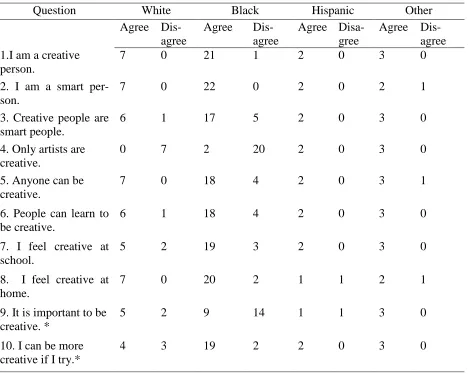
Table 2. Third Grade Responses by Race
N=52
*Indicates that no response was given or a student provided both responses
Table 3. Third Grade Responses by Gender
N=52
*Indicates that no response was given or a student provided both responses
White Black Hispanic
Agree Disagree Agree Disagree Agree Disagree
1. I am a creative per-son.*
9 2 29 1 8 0
2. I am a smart person. 12 1 28 2 7 1
3. Creative people are smart people.*
9 5 17 13 8 0
4. Only artists are crea-tive.
1 12 12 18 3 5
5. Anyone can be crea-tive.
12 0 28 2 8 0
6. People can learn to be creative.*
9 3 30 0 8 0
7. I feel creative at school.
11 2 25 5 7 1
8. I feel creative at home.
9 3 27 3 7 1
9. It is important to be creative. *
4 9 8 22 3 5
10. I can be more creative if I try.*
12 1 30 0 7 1
Question Male Female
Agree Disagree Agree Disagree
1. I am a creative person. 26 0 23 3
2. I am a smart person. 22 4 26 0
3. Creative people are smart people. 18 8 16 11
4. Only artists are creative. 11 15 5 21
5. Anyone can be creative.* 25 0 24 2
6. People can learn to be creative. 25 1 24 2
7. I feel creative at school. 21 5 23 3
8. I feel creative at home. 19 6 24 2
9. It is important to be creative. * 5 20 10 17