Communication Theses Department of Communication
5-10-2014
Global Audience Participation in the Production and Consumption
Global Audience Participation in the Production and Consumption
of Gangnam Style
of Gangnam Style
Soo keung JungFollow this and additional works at: https://scholarworks.gsu.edu/communication_theses
Recommended Citation Recommended Citation
Jung, Soo keung, "Global Audience Participation in the Production and Consumption of Gangnam Style." Thesis, Georgia State University, 2014.
https://scholarworks.gsu.edu/communication_theses/106
This Thesis is brought to you for free and open access by the Department of Communication at ScholarWorks @ Georgia State University. It has been accepted for inclusion in Communication Theses by an authorized
by
SOOKEUNG JUNG
Under the Direction of Professor Hongmei Li
ABSTRACT
This thesis examines the cultural consumption of the Korean music video Gangnam
Style in the broader context of the increasing popularity of Korean popular content, often called
the Korean Wave, and of complex conditions of transnational consumption. Specifically, it
in-vestigates why the music video Gangnam Style gained popularity not only in East Asia but also
over the world, how it is circulated, and what conditions contribute to its success. It focuses on
the role of the networked audiences and the interactions between the networked audiences and
mainstream media through a chronological analysis on the distribution and reproduction process
of Gangnam Style on YouTube. Through the case study of Gangman Style, this thesis attempts to
rethink the established globalization theories and to suggest new perspective of cultural
circula-tion in the globalized and digitalized media environment.
by
SOOKEUNG JUNG
A Thesis Submitted in Partial Fulfillment of the Requirements for the Degree of
Master of Arts
in the College of Arts and Sciences
Georgia State University
Copyright by Sookeung Jung
by
SOOKEUNG JUNG
Committee Chair: Hongmei Li
Committee: Hongmei Li
Leonard R. Teel
Sharon Shahaf
Electronic Version Approved:
Office of Graduate Studies
College of Arts and Sciences
Georgia State University
DEDICATION
Dedicated to
my love Kihun, Beom and Dan,
ACKNOWLEDGEMENT
This thesis could not have been written without the guidance and support of my adviser,
Dr. Hongmei Li, who gave me confidence that my project is worthwhile and never ceased to be
encouraging. While I have met a number of fine scholars and teachers in my life, it is a rare
op-portunity to meet such an excellent professor. She is the model of a passionate scholar, dedicated
teacher, thoughtful adviser and hard-working organizer. I am also deeply grateful for my
disser-tation committee, Dr. Leonard R. Teel, whose feedbacks were as keen as his heart is generous,
and Dr. Sharon Shahaf, who greatly inspired me with her expertise.
Throughout my days at GSU, I have benefited from the advice and encouragement of
many professors, friends and staffs. I want to express my thanks to Dr. Greg Smith, who first
advised me to approach to this topic from more academic perspectives. And, I am deeply grateful
to Dr. Carrie Packwood Freeman for her heartfelt support and advice on improvement of my
re-search skills. Her responsible life and attitude of community has been truly impressive to me.
Sejung Park, Amber Welch, and Chung Chen have my thanks and affection for the friendship,
encouragement, and academic discussion. I am also grateful to Ms. Tawanna Tookes, and Ms.
Diane Sealey at Department of Communication Office for their support from the beginning to the
end of my master’s degree program. In addition, I would like to express my profound gratitude
and deep regard to Meredith Samb, for proofreading all my drafts. Without her full support and
advice, I couldn’t have done so much paper work.
I am forever indebted to Dr. Jinsun Lee, my professional as well as academic mentor,
who has inspired me with her startling admonition and resounding cheer, thereby leading me to
Sung-kyunkwan University, for guiding me to the academic world. They helped me to achieve my
longtime dream of getting education at age forty.
I cannot thank enough my family for their support, patience, and love. My profound
gra-titude goes to my mother Dosija Ahn, who has given me unchanging love and support and my
father Kwondae Jung, who has shown an unwavering confidence in me and always respects my
decisions in life. I am thankful to my mother-in-law Kyeongsoon Lee, who has given me support
and encouragement. Also special thank goes to my sister, Hiyoung Jung for her dedication to my
family. While studying English at GSU language institute, she has taken good care of my family
and myself. My thoughtful son, Beom Kim has fully understood his busy student mom and
re-lieved me with a cup of coffee he made. My lovely daughter, Dan Kim has also made me happy
and helped me smile. Finally, I should give gigantic thanks to my husband, Kihun Kim, for all
his patience, help when I needed it, and companionship throughout the years. As a PhD
candi-date in Economics, he helped me keep on track with his experienced advice and academic
TABLE OF CONTENTS
1 INTRODUCTION ...1
1.1 Theoretical Background of the Study ...2
1.2 Significance of the Study ...6
1.3 Outline of the Study ...8
2 LITERATURE REVIEW ...9
2.1 Transnational Media Flow ... 10
2.2 Transnational Consumption of Audience ... 15
2.3 The Networked Audience and New Trend of Cultural Flow ... 17
2.4 The Circuit of Culture: Interconnection of Cultural Meaning and Values. 19 3 A DYNAMIC CULTURAL PHENOMENON, THE K-POP... 23
3.1 The History of the K-pop ... 23
3.2 Cultural Distinctions and Global Competitiveness of K-pop ... 25
3.3 K-pop Leads Neo-Korean Wave ... 27
3.4 The Global Reception of Gangnam Style ... 31
4 RESEARCH METHODS ... 38
5 DISSEMINATION PROCESS OF GANGNAM STYLE ... 40
5.1 Dissemination Trend of Gangnam Style in the First 100 days ... 40
5.2 Classification of the Sampled Gangnam Style Videos on YouTube ... 42
5.3.1 The first stage (July 11~July 29) ... 47
5.3.2 The second stage (July 30 ~August 21) ... 51
5.3.3 The third stage (August 22 ~ September 26) ... 54
5.3.4 The fourth stage (September 28~ )... 57
6 DISCUSSIONS AND CONCLUSION: TRANSNATIONAL AUDIECNE PARTICIPATION IN GLOBALIZATION OF K-POP ... 58
6.1 Collaboration of Fans, Celebrities, and Mainstream Media ... 59
6.2 Gangnam Style on YouTube, Conjunction of New Media and Old Media .. 61
6.3 From Translationto Parody, Cultural Hybridity and Spreadability of Gangnam Style ... 63
6.4 Limitation and Future Research ... 66
REFERENCES ... 69
Primary Sources ... 69
Secondary Sources ... 72
APPENDICES ... 80
LIST OF TABLES
Table 5.1 The major events in disseminating Gangnam Style in the first 100 days ... 41
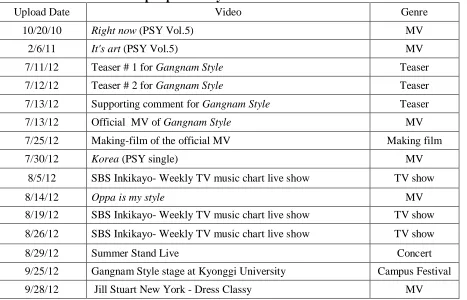
Table 5.2 The list of video clips uploaded by PSY’s official YouTube account ... 43
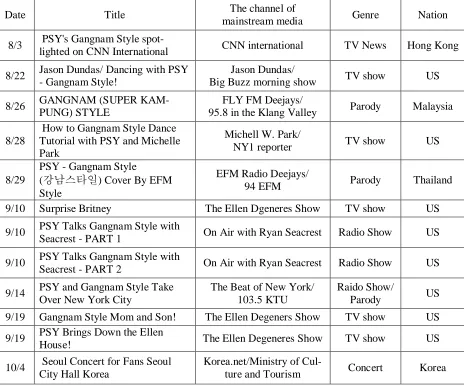
Table 5.3 The list of the video clips uploaded by mainstream media and the hosts ... 44
LIST OF FIGURES
Figure 2.1 The circuit of culture ... 21
Figure 3.1 Number of views of K-pop videos on YouTube during 2011………29
Figure 3.2 The amount of K-pop export, 2006-2011 (Unit: $1,000) ... 30
1 INTRODUCTION
On December 17, 2012, YouTube published ‘Rewind YouTube Style 2012.’ The video
includes ten YouTube stars who found their way into the limelight during the same year. The
music video Gangnam Style was placed at the top of the list. As the mash-up video indicates,
Gangnam Style was one of the most notable phenomena in the world of popular culture in 2012
in that a Korean song by an unknown singer has gained tremendous popularity throughout the
world in a few months.
Gangnam Style symbolizes the global consumption of Korean popular culture. Created
by the unknown Korean musician PSY,1
1
PSY is a South Korean singer, songwriter, rapper, dancer and record producer. His real name is Park Jae-sang and was born December 31, 1977. PSY debuted with his full-length album PSY from the Psycho World in January 2001. His first single Bird gave the Korean pop market of those days a refreshing jolt with blunt lyrics, bizarre dance and ridiculous appearance. At that time, he brought the term of “엽기 (yup-gi,獵奇, bizarre)” into vogue.
the mash-up video, featuring PSY’s funny dance moves
and catchy music beats, went viral through YouTube and Social Network Service (SNS) services
after it was released online on July 15, 2012. The song reached number two on the billboard Hot
100 chart in less than two months. The music video broke the 800-million-views record of Justin
Bieber’s Baby and became the first YouTube video that reached a billion views according to a
report on December 21, 2012 (Gruger, 2012, December 21).PSY’s online popularity also went
offline. He was invited to perform in various countries. On New Year’s Eve 2012, PSY and
rap-per MC Hammer rap-performed in New York City in front of more than a million spectators on site
(Bora, 2013, January 2). The original music video remains the number one spot of the world’s
More importantly, the impact of the Gangnam Style phenomenon has extended beyond
PSY’s singular music video. According to a YouTube Trend report (2013, July 15), the views of
Korean music videos in a year after the release of Gangnam Style, have recorded a threefold
in-crease over the previous year. This means Gangnam Style has changed the landscape of Korean
pop music industry and pulled the growth of K-pop in the online music market. Therefore, the
successful case of Gangnam Style can be a key clue to understand the current global circulation
of K-pop.
1.1 Theoretical Background of the Study
The rapid growth of Korean popular culture, called Korean Wave or Hallyu, has
at-tracted attention from many cultural researchers. Korean popular culture has become one of the
most important subjects in East Asian cultural studies over the past ten years. Few studies on
Ko-rean popular culture were produced until around 2000, but even the little that existed did not pay
attention to the global production and consumption of Korean popular content. This is because
Korean popular content abruptly appeared in the global market. From the late 1990s, Korean
popular content including Korean dramas, films, and music started to become popular in China.
Now Korean popular content have gone beyond the borders of East Asia and reached all over the
world (Hong, 2013; Jeon et al., 2012; Son, 2011). Specifically, Korean popular music, called
K-pop, has extended the fan base to part of the Middle East, Africa, South and North America, and
Europe.
Since Korean culture has not been dominant in modern Asian history, Korean Wave’s
abrupt and unexpected success has surprised many observers. Most importantly, Korean popular
content with a local language and cultural code has mainly focused on the domestic market.
global fandom beyond East Asian markets and the Korean diasporic network (Hong, 2013). The
dominant globalization discourses, which focus on North American and Euro-centered cultural
domination and transnational cultural flow mediated by mass media, cannot explain the current
Korean Wave phenomenon. In this way, as the Korean popular content has shown noticeable
paths in the global market, a considerable amount of research on the cultural phenomenon has
been generated for a decade.
The earlier studies on Korean Wave can be divided into three categories. First, the policy
research examining the economic potential of Korean Wave have been abundant (Chung 2001;
Ha, 2006; Ha & Yang 2002; Kim Y.D. 2005; Kim & Kang 2000; Park 2001; Yoon 2006). In a
meta-analysis of 250 Korean research papers on Korean Wave from various academic fields,
Seunghye Son (2009) finds the strong emphasis on policy suggestions rather than on
accumulat-ing fundamental information about the audiences and markets of the importaccumulat-ing societies. This
research applies the logic of cultural industry. Based on the analysis of dissemination of Korean
media content in East and Southeast Asia, the researchers suggest various export strategies for
the growth of Korea’s cultural industry. These export-centered studies which stem from the
pers-pectives of cultural nationalism tend to overlook the existing cultural inequality on global
me-diascape which resulted from dominant power of transnational media corporation and
overesti-mates the potential of the content which is supported by Korean government.
The second research trend examines diverse textual attractions of Korean media culture
to Asian regional audiences (Hanaki et al., 2007; Heo, 2002; Iwabuchi, 2008a; Yang, 2003; Yoo
& Lee, 2001). Focusing on how Korean popular culture is consumed and accepted in the social
and cultural context of each country, these studies attempt to discover the characteristics of
of the Korean Wave resulted for several reasons: high quality of the content including
outstand-ing actors and actresses, compelloutstand-ing stories, production skills, and price competitiveness; cultural
demands of importing countries, which are accompanied by their political, economic, social, and
cultural growth; non-violent and non-sexual content of Korean popular culture; and Korean
cul-ture is less threatening to East Asian countries than that of Japan or the U.S. In the same vein,
many studies have been conducted using the notion of “cultural proximity” to understand how
Korean popular culture is consumed and accepted in the social and cultural context of each
coun-try (Hanaki et al., 2007; Heo, 2002; Iwabuchi, 2008; Yang, 2003; Yoo& Lee, 2001). Jin Heo
(2002) and Sekyeong Yoo and Kyeongsook Lee (2001) argue that the cultural proximity of
Ko-rean popular content, especially Confucianism and modern Asian urban lifestyle, works as a
cru-cial element to attract Asian audiences. However, this perspective is confronted with a criticism
that consumption of Korean media content in Asia should be examined with multisided angles
because Asian audiences have various social and cultural identities and historical experiences
(Hanaki et al., 2007; Ling & Tong 2008; Mori 2008; Yang F. K., 2007). In addition, the concept
of ‘cultural proximity’ can no longer account for the simultaneous dissemination and
consump-tion of Korean popular content over the world beyond Asian areas in a digitalized media
envi-ronment.
The third line of approach considers Korean Wave as a case of globalization of local
popular culture (Cho, 2005; Chua & Iwabuchi, 2008; Kim, H. M., 2005; Lee, D.Y., 2004; Lee, K.
H., 2008; Lee & Won, 2005; Shim, 2006; Shin, 2003). From a critical perspective, these
re-searchers claim that Korean Wave phenomenon should be considered not only in the aspect of
cultural characteristics and textual attractions, but also in relation to political relations and
politics and economy (Ching, 2000). These researches view Korean Wave as outcomes of
glob-al/regional tactics of transnational/local media firms and Korean government, thus theorizing the
discourse based on ideological realm: cultural nationalism, neoliberal commercialism,
post-colonialism etc. In this sense, the success of Korean Wave can be considered as the outcome of
complex interactions between the industrial integration carried by neoliberal capitalism, national
restrictions and the emotional sensitivity based on historical ties (Lee, D. Y., 2004; Onishi, 2006;
Chua, 2004). Specifically, Jongwon Lee & Yongjin Won (2005) and Dubo Shim (2006)
recog-nize Korean popular music as a hybrid culture produced by the mixture of western cultural style,
unique star system of Korean media industry, and regional fandom culture. Paying attention to
synchronic modernization and globalization in the Asian area, they suggest integration of Asian
regional culture by mediation of Korean popular culture (Lee & Won, 2005). This notion has a
significant implication in that it shows a possibility that local/regional culture integrates against
global cultural dominance. However, since the concept of hybridization can also be a
commodi-fication strategy of transnational media content toward local/regional market (Mosco, 1996; Van
der Veer, 1997), hybrid features of Korean media content alone cannot demonstrate formation of
a regional bloc in the global media market.
Although various research on the Korean Wave have been conducted in textual,
theoret-ical, and industrial perspectives, most studies focused on a certain country, particularly East
Asian countries like China and Japan and consumption preference and patterns of the audience.
This limited access cannot grasp the current brisk circulation of the Korean popular content over
the world beyond the Asian market. More recently, the convergence media culture has increased
and its implication of this new trend of cultural flow, detailed observation and practical approach
on the networked audience and transnational cultural circulation are required.
1.2 Significance of the Study
The purpose of this thesis is to understand how and why Korean popular culture,
specifi-cally K-pop, is circulated and consumed across the world. To comprehend the transnational
cir-culation of the K-pop in the context of convergence media culture, this research takes note of the
case study of the Korean music video, Gangnam Style. What is especially intriguing in Gangnam
Style phenomenon is that not only is the music video endlessly circulated online, but numerous
user-generated videos centered on this video have also been circulated, produced and reproduced,
thus amplifying the impact of the Gangnam Style music video as a cultural product and process.
This music video not only problematizes the idea of viewing cultural globalization as merely
flowing from the West to the rest, but also blurs the line between production and consumption.
The global audiences’ reception, translation and adaptation played an important role in
popula-rizing and disseminating this phenomenon. In a way, this music single symbolizes the growing
disjuncture and interruptions between capital, humanity, media, technology, and ideology
(Ap-padurai, 1990) and the increasingly complex connectivity and networks of interconnections on a
global scale (Tomlinson, 1991).
Compared with the previous research on the Korean popular culture, this case study
pro-vides insights into the way that fans of transnational cultural content are engaged in a system of
global media flow, which are determined by cultural, economic, and political forces. Some
stu-dies on Korean popular content have already focused on local audiences and active fans, this
between global networked audience and the music video, and between new media and
main-stream media in the interactive and converging media environment.
In order to catch detailed production and consumption activities of global audiences, and
at the same time, understand their roles in the context of cultural globalization, new research
de-sign encompassing quantitative and qualitative analysis on the circulation and consumption of
Gangnam Style are needed. The research method is basically a chronological analysis of
Gang-nam Style videos’ global production, consumption, dissemination, and re-production. The
circu-lation of the music video in different cultures and global users’ active role in producing and
re-producing new meanings in the process are explored. This closer observation on the circulation
and consumption of K-pop, which has the strongest and rapidest dissemination power among
Korean popular culture, helps to account for the reality of converging media environment and
growing potential of global networked audience, thus elucidating the complexity of cultural
glo-balization to some extent. Therefore, this innovative approach to the study of global consumption
of local media content can break new ground in cultural globalization research.
The research questions focus on how the music video was disseminated and consumed
over the world, what roles users played in the diffusion process, and what conditions enabled the
success of Gangnam Style. With the audience-centered approach on the Korean popular culture,
this study contributes to delineate the position and dynamic transformation of a global audience
consuming Korean popular culture. In addition, this case study offers an opportunity to rethink
the established globalization theories and to suggest new perspectives of cultural production and
1.3 Outline of the Study
This study consists of six chapters. Chapter one is an introduction which gives an
over-view of the study. The theoretical background of the study reover-views the existing research on
Ko-rean popular culture. Next, the purpose and value of the study are discussed. In addition, the
re-search objectives and outline of the study are listed.
Chapter two provides a brief introduction of the Korean Wave, particularly K-pop and
its chronology focusing on specific genres, importing countries, and marketing strategies. This
chapter illustrates characteristics of K-pop and its cultural distinctions based on a review of the
previous research and media articles. In addition, the textual distinctions of the music video,
Gangnam Style are described.
Chapter three is a literature review scoping on relevant theoretical arguments. This
chap-ter sets up the analytic frame for examining the Korean Wave and active circulation of Korean
media content in the world. The theoretical concepts include cultural imperialism, flow and
con-tra-flow, center-periphery, cultural hybridity, cultural proximity, cultural discount, and
globaliza-tion. In addition, by using Paul du Guy and colleagues’ concept of circuit of culture, this chapter
addresses the interactions between production and consumption. Furthermore, discourse of
cul-tural shifts which resulted from Web 2.0 technology focusing on Henry Jenkins’s notion of
spreadable media and fan studies is discussed.
Chapter four provides explanation and justification for the research methodology of this
study. As a primary method, the chronological analysis on dissemination of Gangnam Style
vid-eos on YouTube is examined by using the functions of Google Trend. In addition, the
analysis on the global consumption process of Gangnam Style, the time-periodic characteristics
of interaction between the original music video and the user-generated videos are classified.
Chapter five contains an analysis on the dissemination and reproduction process of
Gangnam Style videos. This chapter investigates textual characteristics and number of Gangnam
style videos by diffusion period and genre, thus drawing cultural implications in the
dissemina-tion process of the videos. Addidissemina-tionally, the interacdissemina-tions between new media and mainstream
media are examined.
Chapter six includes the theoretical and empirical findings concerning the global
produc-tion and consumpproduc-tion of Gangnam Style. Applying the model “spreadable media” and “circuit of
culture,” this chapter analyzes interaction between the networked global audience and the videos,
and its outcomes. In addition, implications of the cultural phenomenon and the limitations of the
case study are discussed. This chapter strongly supports the notion that current K-pop is
trans-forming as a cultural commodity attracting participation of the global audience and utilizing
convergence media actively, thus evolving as a successful model of cultural globalization in the
digital environment.
2 LITERATURE REVIEW
This chapter provides an overview of key theories and literatures to be used and
dis-cussed in the thesis. In terms of the study of current popular culture, it is important to
under-standing the process of globalization. Globalization theories have focused on the ways in which
political and industrial powers move media content around the globe, the uneven distribution
in the study of globalization of media, fan and audience studies, and cultural studies on
transna-tional production and consumption.
The literature review of this work explores previous scholarship in five areas. First,
gen-eral discussion about the transnational media flow is explored. Second, transnational
consump-tion of local audience is studied. Third, emerging trends of the networked audience in converging
media environment are reviewed. Forth, cultural studies on global production and consumption
of media commodities are discussed. Finally, exploration of the existing work on the Korean
Wave is provided.
2.1 Transnational Media Flow
Today, globalization has become a major frame of reference in international
communi-cation research and global cultural studies. Historically, globalization scholars have been
con-cerned with the homogenization, synchronization, and westernization of global media system
dominated by the transnational media industry of the United States. However, this cultural
diffu-sion model has been criticized by the scholars saying that transnational cultural circulation is
more complex and complicated. While media industries from the United States have had an
un-deniable impact on the world, the dominant power of the American media industries must take
many factors into account. In order to better understand current transnational circulation of
popu-lar culture, this study outlines the schopopu-larship to present about globalization and cultural flows.
Early studies on international communication identified transcultural media flows as
dominance of western or American media over underdeveloped and less powerful countries.
These studies paid attention to the one-sided, and a dominant-subordinate relationship between
developed and developing countries. In particular, cultural imperialists consider culture and
industry, particularly U.S. hegemony have given rise to Americanization as well as
homogeniza-tion of local culture (Hamelink, 1983; Schiller, 1991; Tomlinson, 1991; Tunstall, 1977). Herbert
Schiller (1991) deliberates how imperialism was done and how much it has changed from the
past. According to Schiller, cultural imperialism is the shift from the “Hard Power,” which
means physical force such as military power, to the “Soft Power,” such as culture, an ability to
get what you want by negotiating and cooperating rather than commanding. Thus, imperialism
has just taken a different form –“cultural imperialism,” and the world is heading towards
homo-geneity through transnational media domination. Cees J. Hamelink (1983) also takes note of the
power of transnational corporations as the primary agents of cultural synchronization. He
indi-cates that American popular culture replaces local culture with U.S. media culture by global
in-vestment and marketing strategy. Considering the local culture’s assimilation into the U.S.
com-mercial culture, John Tomlinson (1991) asserts cultural diffusion directs from the center to the
periphery.
Although the transnational media circulation has the potential to preoccupy the global
cultural market and to weaken local culture, the ‘one-way dominant flow’ thesis has faced robust
criticism. As the many co-existent cultural phenomena based on intra-regional media flow apart
from U.S. centric hegemony and interdependence in global economic relations have emerged,
many scholars refute that cultural imperialism places too much emphasis on the ideological
in-terpretation of cultural dominant and overlooks distinctness of various nations and autonomy of
worldwide audiences and the change of media environment based on technological development.
(Appadurai, 1996; Iwabuchi, 2002; Sinclair et al., 1996; Straubhaar, 1991; Thussu, 1992).
While there is no denying that the relationships between the West and the rest remains
countries have led to “asymmetrical interdependence” between unequal nations (Straubhaar,
1991). That is, U.S. media hegemony still exerts its influence in many developing countries, but
local media systems autonomously work to some degree in cultural production and distribution.
The industrial and technological advancement of the national and local media market have made
transnational media circulation patterns more complex and multidirectional.
Paying attention to the change of transnational media circulation, Oliver Boyd-Barret and
Daya Thussu (1992) suggest the advent of local resistance in the global media and “contra-flows”
of information, which contrasts dominant flow of the U.S. global industry. They argue that
‘glo-calization’ strategy of global media, which involves geo-cultural media and linguistic groups in
order to maintain their cultural domination in local and regional markets, can help local cultural
media to form reverse flows against the global media industry hegemony. David Morely (2006)
points out that cultural imperialism does not account for glocalization, as a counterstrategy of
global media producers to the minor flow from local mediascapes, such as cultural protectionism
and local audience’s active role, thus failing to address the complexity of transnational media
flow in a multilayered global sphere. Therefore, the inflow of U.S. content to local culture is a
dynamic interaction with local values, preferences, and meaning systems.
With regard to the complexity of cultural flow, some scholars interpret the nature of
cul-tural globalization as a dynamic force of culcul-tural exchange, that is, hybridity (Tomlinson, 1999;
Kraidy, 2002; Papastergiadis, 2005). Conceptualization of hybridity as a characteristic of
globa-lization arose with postcolonial theories. Homi Bhabha (1990) regards a nation and national
identity as a transitional social reality to reflect the ambivalence of the human psyche –“us” and
“other,” rather than as a sign of the modernity. For Bhabha, the nation is a narrative strategy for
rationality, thus producing counter-narratives with the hybridization strategy in order to resist
imperial domination. Focusing on the dialectic relationship between cultural structure and
agen-cy, Kraidy confirms that hybridity is a global existential cultural condition “to characterize the
dual forces of globalization and localization, cohesion and dispersion, and disjuncture and
mix-ture, that capture transnational and transcultural dialectics” (2002, p. 327). The concept of
hy-bridity, however, encounters criticism for the conceptual ambiguity and structural vulnerability
for anti-progressive appropriation. The critics refute that hybridity overlooks or justifies the
commercial and capital nature of the global expansion process (Van der Veer, 1997), and
over-states cultural dimensions, especially the unequal and asymmetrical relationships among
coun-tries, cultures, regions and audiences, thus leading to a neglect of the dynamic impact of structure
(Golding, 1997).
As transnational cultural circulation no longer flows unilaterally, the dichotomous view
of the cultural production and distribution are challenged (Appadurai, 1996; Iwabuchi, 2008a;
Tomlinson, 1999; Thussu, 1997).Based on the “five dimensional disjuncture or interruptions in
global cultural flow – ethnoscapes, mediascapes, technoscapes, financescapes, and ideoscapes,”
Ajun Appadurai asserts that the global cultural economy cannot any longer be interpreted by
bi-nary perspectives, nor does it necessarily imply homogenization of Americanization.
“Globaliza-tion is itself a deeply historical, uneven, and even localizing process” (1996, p 17). John Sinclair,
Liz Jacka, and Stuart Cunningham (1996) also criticizes that the real world cannot be divided
through binary concepts such as “center-periphery,”“dominance-subordination,” or “the
West-the rest” intranational cultural flows. They take note of West-the clout of some metropolitan cities
out-side dominant nations, like the U.S., in cultural production and distribution. It is true that each
speaking world, Canada and Australia have one or two powerful metropolitan centers of
audiovi-sual productions, and these peripheries have their own internal dynamics as well as global ties.
Since each geolinguistic region is itself dominated by the regional cultural center rather than the
U.S. global media center, the binary view of the world cannot properly explain semi-peripheral
societies like Australia and Canada, and the cultural production capacity of peripheral countries.
In relation to a regional pattern of media flow, media industry strategy driven by the
na-tion-state has triggered reformation of local/regional cultural circulation (Curtin, 2007; Keane,
2007; Lee & Won, 2005; Mosco, 1996; Thussu, 2007). In fact, Asian countries were generally
reluctant to open their national and local cultural market to foreign cultural capital due to their
past colonial experience (Hoskins & Mirus; 1988; Waterman & Rogers, 1994). However, this
conservative attitude toward foreign culture quickly changed by widespread globalization and
hyper-urban modernization. Riding on the neoliberal reform in the late 1990s, Asian media
sys-tems were rapidly commercialized, privatized, and industrialized. Asian countries realized more
industrial opportunities for cultural markets, and at the same time, needs for protection of their
own media industry (Iwabuchi, 2005). With the support of the state, Asian media systems have
begun to reshape industrial structure and local and regional markets. According to Michael
Keane (2007), the creative industrial clusters, as a part of cultural industry strategy, play a crucial
role in globalizing regional cultures in East Asia. Since these clusters tend to provide cultural
products and services for the global market rather than the domestic market, they become hubs
that direct and organize transnational flows of media content, thus glocalizing the local/regional
cultures. In the same logic, Michael Curtin (2007) pays attention to the emerging centers of
transnational cultural production. As an approach to the complex patterns of cultural flow, Curtin
and complex forces and flows interact. Through empirical analysis on the East Asian megacities
such as Hong Kong, Taipei, Singapore, Beijing and Shanghai, Curtain reconstructs the complex
and intersecting networks shaping the role and status of these media capitals in the regional
cul-tural market at various levels of development.
2.2 Transnational Consumption of Audience
Another explanation to the transnational cultural flow is focusing on the reception of
au-diences. The study of audience has been mainly concerned with why audiences preferred some
transnational media content and what textual attractions of the content drew the attention of
au-diences. Based on the broad survey on the television networks in East Asian countries, David
Waterman and Everett M. Rogers (1994) discover that the regional consumers tend to prefer
their domestic media content to foreign content. Regarding this local consumption tendency,
Co-lin Hokins and Rolf Mirus (1988) propose the notion of “cultural discount.” They illustrate
cul-tural discount by showing that a media product tends to be less valued by foreign audiences who
lack the cultural background, language and knowledge about the product. Examining the role and
influence of television on cultural identities, Chris Barker (1997) supports the “cultural discount”
theory. Barker claims that since global television is a proliferating source for the social
construc-tion of cultural identity, to which language is central, transnaconstruc-tional television content is unevenly
distributed and differently received. Particularly, language is a very essential issue in global
cul-tural reception. Even though the imported programs are dubbed or subtitled, it is obvious that
local audiences cannot fully appreciate the content. Hence, foreign programs are likely to be
traded in reduced prices. Comparing to U.S. media content with cultural hegemony and
preva-lence of English language, non-western content cannot avoid a relatively high reduction of price
competitive power, the cross-regional media flow has increased (Iwabuchi, 2002, 2004; Morely,
2006; Straubharr, 1996; Thussu, 1998).
In terms of the growth of region-centered media flow, Straubharr (1991, 1996) presents
the theory of “cultural proximity,” which defines that transnational media content from an
adja-cent region is easily consumed by audiences rather than from less geoculturally related regions.
Sinclair and his colleagues (1996) insist that television viewers prefer their local content despite
the increasing multi-channel and global content. As an evidence of cultural proximity, Kalyani
Chadha and Anandam Kavoori (2000) assert that local audience’s preference, along with the
na-tional gatekeeping policy and competitiveness of local media content, is one of the major
ele-ments to undermine the dominance of the Western media content in developing Asian countries.
For Asian audiences, however, cultural proximity cannot be applied successfully, because the
Asian area is geographically too broad and ethnographically too diverse (Hanaki et al., 2007; Lin
& Tong 2008; Mori 2008). Even though East Asian countries have shared the same racial
identi-ty, it is hard to say that they have an emotional bond with each other. Presenting the survey on
Taiwanese and Japanese audience, Iwabuchi (2002) emphasizes that rather historical experience
and social connection with neighbor countries influence the preference of local audiences to the
regional content.
The research on cultural consumption more boldly interprets the autonomy of local
au-dience. As Morley indicates previously, local audience can play an active role in decoding
tran-scultural messages, thus compelling transnational media producers to adopt glocalization
strate-gy (2006). Ien Ang (1994), a feminist audience researcher, asserts that a homogeneous culture at
a global level has never existed. This is because the transnational content within local cultural
Bourdieu’s notion that popular pleasure is characterized by an immediate emotional or sensual
involvement in the object of pleasure, Ien Ang notes that “what matters is the possibility of
iden-tifying oneself with (a popular cultural text) in some way or other, to integrate it into everyday
life. In other words, popular pleasure is first and foremost a pleasure of recognition” (1985, p.20).
2.3 The Networked Audience and New Trend of Cultural Flow
The cultural implication of audience has sharply expanded since the emergence of media
convergence. As Web 2.0 technology allows users to communicate and collaborate with each
other in virtual communities such as social network services, wikis, and video sharing sites, the
boundary between producers and consumers has blurred, and the dynamic interaction between
them has triggered sweeping changes in cultural circulation (Bruns, 2007; Jenkins, 2006;
Living-stone, 2004).
Although the advancement of new media technology has increased the speed and scope
of media content circulation, audience studies take note of the users’ participation and their
mo-tivation rather than technology (Jenkins, 2006; Jenkin, Ford, & Green, 2013). That is because the
values of the shared content on converging media are created not by the technology, but by the
users’ activities which “reuse, rework, and redistribute” media content (Burgess, 2008). In this
convergence media culture, media content is freely circulated, and at the same time, it is
distri-buted as a potential commodity for unanticipated markets. This dual economic force – i.e., “gift
economy” (Barbrook, 1998) and “long tail economy” (Anderson, 2005) depends on users’
activi-ties (Jenkins, Ford, & Green, 2013).
In particular, fan studies focusing on fans’ devotion to production and consumption of
popular cultural texts show that fans are not abnormal but part of an enduring cultural
with the new media technology demonstrate the functions of online media as a social space for
fans community and identity-building (Baym, 2000; Bacon-Smith, 2000). Nancy Baym (2000)
characterizes the fan community of soap operas as a social world where audiences who never
meet face-to-face can build their online world through their participation. In the same vein,
Ca-mille Bacon-Smith (2000) proposes that online fan communities create spaces for interaction
be-tween creators and audience and the roles of producers and consumers are frequently
inter-changed in the community. Furthermore, she emphasizes fandom is not determined by simply
geographical variation but by cultural choice which results from the active engagement of
au-dience.
Based on the long term observation on online fan activities and grass-root participatory
culture, Jenkins et al. suggests the model of “spreadable media,” which accounts for the
mechan-ism of current convergent media circulation in accordance with active audience’s participation
(2013). They uncover that spreadable media are potable, reusable, multiple, open-ended,
attrac-tive, collecattrac-tive, ambiguous, temporary localized content including fantasies, humor, parody,
mysteries, controversies etc. Because of the nature of spreadable media, the increasing diversity
of transnational media is an inevitable consequence. The main agencies of the spreadable media
include transnational fans, diasporic communities, and pop cosmopolitans, who understand,
con-nect, and desire cultural difference as well as are networked with new media (Jenkins, 2004;
Jenkins et al., 2013). In addition, Jenkins adds that since the “networked computing is
multidi-rectional and lowers transaction costs, it will insure that more non-Western goods make it into
the West” (2004, p. 117).
Admittedly, there still exists a chance that the users’ participation can be exploited by
activi-ties advantage global capital, their activiactivi-ties can benefit from the increased access to niche
con-tent and from the collaboration with producers to create and spread their own media concon-tent. In
terms of the limitation of participation capacity caused by educational, economic, and geographic
inequality, they dispute that the educated and affluent population exists in even underdeveloped
countries, and the population may actively interact with each other as global networked
au-diences. Therefore, even though transnational spreadable media flow is still uneven and
imba-lanced, they can provide the networked audiences an opportunity to challenge global cultural
dominance (Jenkins et al., 2013).
2.4 The Circuit of Culture: Interconnection of Cultural Meaning and Values
While the domains of producers and consumers have been blurred and interchanged, the
media structure and industrial system cannot be ignored because audience activities are
entan-gled within the global system of power. In order to understand the mechanism of current
transna-tional cultural production and consumption, researchers should try to identify the complicated
relationship between audiences, producers, media products, and any relevant contextual matter,
with more comprehensive perspectives – neither simply a close-up view on the cultural texts, nor
a wide view of global industries. This is because, on one hand, media contents are not simply the
products of monolithic industries for making profit, nor the results of hegemonic organizations.
On the other hand, popular cultural contents are not free form the industrial production system
and media structure. That is, the cultural products and even audiences who are consuming the
products have to be understood in the global political, economic, social, and cultural basement.
From this perspective, cultural studies on media production and consumption have
fo-cused on how cultural values and meaning are created, maintained, and transformed through
shared social meaning, Stuart Hall (1981) presents the circuit of cultural model as a way of
un-derstanding the process of ‘representational system.’ In the four-stage heuristic model involving
moments of production, circulation, use, and reproduction, Hall asserts that each stage exerts
constraints on its associated meanings and practices, at the same time, it is constrained by other
stages. Hence, the meanings in a cultural artifact are negotiated by the users. Refuting that Hall’s
model overlooks the interpretive nature of consumption as their lived experience in favor of
so-cial structure, Richard Johnson (1986) modifies this model focusing on the creative agency of
consumers and their everyday life articulating social interactions between production and
con-sumption and a linkage between the public and private domains of concon-sumption. Reflecting this
critique, Paul du Gay, Stuart Hall, Linda Janes, Hugh Mackay, and Keith Negus (1997) develop
the revised model including totally interconnected spheres of representation, identity, production,
consumption, and regulation (See Figure 2.1). In this model, du Gay et al. claim that although the
elements in each part of the circuit are considered as a specific object in cultural studies, they
overlap and intertwine with complex and contingent ways in the real world and the
meaning-making consistently processes through the interactions in the circuit of cultural production,
Figure 2.1 The circuit of culture
Reprinted from du Gay, P (1997).Production of culture/ cultures of production. Thousand Oaks, CA: SAGE.
As new media like the Internet become a primary communication tool of everyday life,
the model of circuit of culture has been adapted and applied in recent media studies. Nick
Dyer-Witherford (1999) applies the model to the social sphere in which new media technology forms
the site of struggle between capital and labor. He asserts that the Internet can play not only as a
means of control and commercialization but also as means of democratic and resistant
organiza-tion, because of the ambivalence of high technology. Matthew Soar (2000) utilizes the model to
identify the dynamic roles of the cultural subjects as ‘cultural intermediaries’ in the moment of
commercial cultural production. Based on the analysis of user-centered design, Guy Julier (2007)
context of social participation and associated identities of designers and consumers. In these
ways, the status of the cultural circuit has been constantly changing in accordance with the
con-temporary social and cultural contexts including interactive, hyper-textual, and multi-functional
media environment.
In sum, the transnational media flow is heading in two ways, the top-down flow of global
dominant media capitals and the bottom-up flow of local and regional media market. The studies
of global dominant flow in the international cultural market emphasize a unilateral stream from
the central to peripheral region from the perspective of political economy. On the other hand,
more recent studies of multilateral cultural flow focuses on the autonomous and plural movement
of local or regional media market and audience. These media circulation patterns reflect
ever-changing and complex global communication environment. Particularly, the rapid growth of
na-tional and regional media systems in Asia brings attention to the internana-tional media production
and consumption. The dynamic interactions of local, regional, and global agencies within the
Asian media market have formed a remarkable path in global media circulation. The Korean
Wave has been in the middle of the cultural flow. In order to understand the transnational
cultur-al production and consumption of Korean popular content, it is necessary to look closer at the
reality of the converging media culture and its agents ’dynamic interactions in the circuit of
cul-ture.
This study aims to examine the new transnational media flow in the convergence media
culture through the analysis of Gangnam Style’s transnational circulation. Through the
dissemi-nation and consumption process of Gangnam Style, how global users played an important role in
making the Korean popular content successful is focused on. The study addresses the following
1) How was Gangnam Style promoted, consumed, and disseminated over the world?
2) What roles did users play in the dissemination process of Gangnam Style?
3) How were the interrelationships between the original music video and its
user-generated videos, and between new media and mainstream media in the dissemination
process demonstrated?
4) What conditions enabled the popularity and success of Gangnam Style?
3 A DYNAMIC CULTURAL PHENOMENON, THE K-POP
The transnational fever for the Korean popular music, or its abbreviation K-pop, started
along with the tremendous popularity of the Korean Wave led by Korean TV drama series in
China, Taiwan, and Hong Kong in the late 1990s (Shim, 2006; KOCIS, 2011; Jeon et al., 2012).
Since the Korean drama series What is Love, which was aired on Channel 1 of CCTV and A
Wish Upon a Star, which was broadcast by Phoenix TV in 1998, became a mega-hit in China,
Korean popular songs began to be introduced to the Chinese cultural market. Starting from the
success of Forever, the theme song of the TV drama A Wish Upon a Star, Chinese audience have
become familiar with K-pop through Chinese radio programs, regional music television channels,
and satellite channel such as Channel V and Star TV (Shim, 2006; Jang, 2012).
3.1 The History of the K-pop
Specifically, Korean dance music has formed its huge fan base among Chinese teens and
twenties. H.O.T. and N.R.G., famous Korean boy bands in the late 1990s and the early 2000s,
surprised music critics by selling tens of thousands of copies over a short period and attracting a
big crowd. Following the boy bands, a number of Korean singers and idol groups have entered
Chinese journalists coined the new term Korean Wave or Hallyu (韓流), which literary means
“flow of Korea.” Since Beijing Youth Daily first used the term Korean Wave or Hallyu in 1999,
the terminology entered into general use through the repeated quotation of Chinese news media.
In the Japanese music market, K-pop has won success in the same way. The popularity of
K-pop in Japan began with the big hit of the Korean drama Winter Sonata in 2003 (KOCCA,
2011, No. 10). Taking the opportunity of the Korean TV drama boom in Japan, the boys’ idol
groups ‘TVXQ’ and ‘Big Bang’ etc. made a soft landing on the Japanese music market.
Capita-lizing on the inroads to Chinese and Japanese market, these young Korean stars have also gained
tremendous popularity in Southeast Asia including Thailand, Vietnam, Indonesia, Malaysia,
Sin-gapore etc.
The reason why the Korean popular music was successful in Asian market is related to
the political and economic change in Korean society in the 1990s (Kim, 2001). First, the
im-provement of diplomatic relations between Korea and neighboring countries such as China and
Japan gave an opportunity for Korean popular content to enter the regional market. Korean
gov-ernment normalized the diplomatic relation with China in 1992 and gradationally lifted
censor-ship or bans on the importation of Japanese popular culture since the beginning of the cultural
exchange policy between Korea and Japan in 1998. As a result, Korean pop music has been far
more diverse and creative, and then, easily exported to the Japanese market.
However, the most decisive motive of the K-pop’s overseas market expansion lay in the
limitation of the domestic music industry itself. Compared to American or Japanese music
mar-ket which occupies the majority of global music marmar-ket, Korean music marmar-ket was so small that
the music companies could hardly thrive in the domestic business. What was worse, illegal music
In this situation, Korean music entertainment agencies were compelled to open up overseas
mar-kets. That is, the globalization strategy of K-pop was the only option for survival of the Korean
music industry (Jeon et al., 2012).
3.2 Cultural Distinctions and Global Competitiveness of K-pop
While K-pop may include any genre of South Korean popular music in a large scope, it is
generally limited to songs produced by K-pop idols like ‘Girl’s Generation,’ ‘Super Junior,’
‘Wonder Girls,’ ‘Big Bang,’‘2NE1’ etc. and their management agencies such as SM, YG, and
JYP entertainment. In other words, K-pop is the products of Korean music entertainment
agen-cies, which aimed at the world market.
The differentiation strategy of K-pop for the global market is roughly threefold: numbers
of the group members; physical attractiveness; and dance-singing coordination (Oh, 2013). First,
from the perspective of producers, the most important point is profitability. They want their
sing-ers to become global stars and eventually to generate high cash returns on initial investments.
However, since it generally takes five to ten years for the singers to be stars, producers seek to
utilize the idol group in various ways. To achieve this, producers compose the group with
vari-ous talented members who share roles and responsibility. For example, one boy group may
con-sist of one or two main vocalists who lead songs, sub vocals who take charge of visual attraction
and dance, rappers with witty words and performance, a leader who commands the team etc. Due
to this role division strategy, K-pop idol groups need many members.
Second, K-pop idol members show off much more sophisticated looks and bodies in
comparison with other Asian idol bands like J-pop groups. They are thin, tall, and have feminine
looks regardless of gender. With this physical attractiveness, K-pop music videos and concerts
K-pop singers resulted from their TV–dependent marketing. Since 1991, Korean broadcasting
industry began to reform toward a free-market system. As the broadcasting industry depended on
advertising revenues, Korean TV producers under pressure of the rating of their programs tried
to seek the programs capturing the public fancy (Kim, 2001). As a result, entertainment TV
pro-grams started to grow and pop music was one of the most attractive sources to fill the propro-grams.
Music videos, clips from concerts, interviews with pop singers, as well as live music
perfor-mance were constantly shown on television. K-pop singers appeared in a lot of different TV
shows such as talk shows, comedy shows and even drama series. For the singers, television was
an essential tool to succeed in marketing themselves. The looks and performance of the K-pop
idol bands have been improved through TV performances over the last decades.
The third feature of the globalization strategy of K-pop is dance-singing coordination in
large groups. K-pop idol group members demonstrate well-organized and synchronized dance
moves along with their songs. This is an outgrowth of the star-marketing system of Korean
enter-tainment companies. Like venture capital firms, they develop idol stars as a commodity for
over-seas market. The management companies select potential idols through internal auditions and
train them, like Sparta, for a long time often ranging from five to ten years. During the training
period, trainees master the technique of singing, dancing, theatrical acting, and speaking foreign
languages. The well-trained and good-looking idol groups draw the attention of young teenagers
around the world. Their personality, image, and fashion have a strong impact on forming fashion
trends of young viewers.
In terms of musical distinctions, K-pop is a hybrid music genre as a mixture of hip-hop,
rap, electronic, rhythm and blues (R&B) etc. (Shim, 2006; Hong, 2013). This is because the
(Jeon et al., 2012). Modern K-pop started from the appearance of ‘Seo Taiji & Boys’ in the
ear-ly1990s, which created a new type of music through various experiments with different midi
sounds. Since then, the integration of foreign music elements has become common practice in
the production of K-pop songs (Shim, 2006). In recent years, world-famous music producers and
writers have taken part in producing K-pop songs, thereby enhancing hybridization of music
form and genre (KOCIS, 2011).
In addition to the musical elements, K-pop idols represent themselves as a hybrid cultural
identity (Hong, 2013). The fact that K-pop singers with Western-style looks and body type sing
African-American music such as hip-hop, rap, and R&B clearly demonstrates the characteristic
of K-pop. Seokkyeong Hong asserts that “K-pop is circulated as a stylish hybrid culture
includ-ing a sound youth culture, nonblack Black music, nonwhite White face, and ‘politically correct’
and safe multi-culture” (Hong, 2013, p.339).
3.3 K-pop Leads Neo-Korean Wave
In the late 2000s, Korean popular content started to expand its base by taking advantage
of new media technology. That is a linkage with social media and mobile devices. Owing to the
IT innovation, Korean popular culture expanded the scope of fans beyond Asia to Europe, Latin
America (KOCIS, 2011; Hong, 2013). Specifically, video sharing sites such as YouTube, YouKu,
Tudou, Sohu, Dramafever etc. have greatly influenced the spreading the Korean Wave to the
world. Most Korean dramas, entertainment TV programs, films, and animations have been
al-most instantly uploaded on the sites after the release in the domestic market. Compared to the
past, the propagation speed of the Korean Wave and its impact have quickened and deepened
more at an increasing rate, and the social strata of Korean pop culture consumers have become
The primary axis of the Neo-Korean Wave is K-pop. Based on the remarkable growth of
online music streaming and downloading service industry caused by the advance of mobile
In-ternet devices and smart phones, the export of K-pop has increased not only in East Asia and
Southeast Asia but also in Europe and North and South America. In the case of a K-pop concert
in Paris, 2011, the tickets were all sold out within fifteen minutes after the beginning of the sale
of advance tickets. Some fans who couldn’t purchase the ticket performed a flash mob to request
additional concerts at Louvre Museum in Paris and Trafalgar Square in London. This event
clearly revealed the global influence of K-pop (Son, 2011; Jeon et al., 2012; Hong 2013).
Particularly, YouTube linked with other SNS sites Twitter and Facebook have led the
K-pop’s overseas market expansion. SM Entertainment, one of the largest K-pop management
agencies, entered into the partnership program of YouTube and opened their accounts under
name of ‘sment’ or ‘SMTOWN’ since 2009. Through their official YouTube accounts, SM
En-tertainment uploaded the music videos of their idol groups including ‘Girls’ Generation,’ ‘Super
Junior,’ ‘Shinee,’‘f(x)’ etc. Before the advent of PSY’s Gangnam Style, each music video of
‘Girls’ Generation’ recorded tens of millions hits on YouTube. ‘Big Bang’ and “2NE1’ affiliated
with YG Entertainment have also utilized YouTube as a key tool of marketing themselves.
According to a report of Joongang Ilbo (2012, January 2), K-pop music videos on
You-Tube, based on the singers affiliated with SM, YG, and JYP Entertainment, had been viewed 2.3
million times in 235 countries around the world during the year of 2011. Figure 3.1 clearly
shows the global dissemination and consumption of K-pop. In response to this global fandom of
K-pop, YouTube created a K-pop genre as an independent music genre. It was the first case in
which a particular country’s music was introduced exclusively as a music genre like rock, folk,
Figure 3.1 Number of views of K-pop videos on YouTube during 2011
Reprinted from Seo, M. (2012, July) Lessons from K-pop’s Global Success. SERI Quarterly. Samsung Research Institute. .
According to 2012 Statistics of Content Industry in Korea (KOCCA, 2012), the total
sales of mobile music services in 2011 increased 121% compared with the previous year, rising
from US$83,262,000 in 2010 to US$196,113,000 in 2011. The sales of music content production
for the Internet and mobile service in the same year also recorded an increase of 58.2%
com-pared with the previous year. The bullish market of the online music service industry has
Figure3.2 The amount of K-pop export, 2006-2011(Unit: $1,000)
Note: Author’s reconstruction from the 2012 White paper of Korean music industry, Korean Creative Content Agency.
Evidently, the huge success of Gangnam Style accelerated the rapid growth trend of
K-pop in the global music market. A YouTube Trend report, which was published on July 15, 2013
in celebration of the first anniversary of the release of Gangnam Style, presented interesting data
regarding K-pop consumption on YouTube. According to the report, while official music videos
of K-pop singers such as ‘Girls’ Generation’ and ‘Big Bang’ were viewed over 2.2 billion times
in the year before Gangnam Style, the number jumped up to more than 7 billion views in the year
following.
More interesting point is that the viewership on top K-pop channels from outside the
Asia-Pacific region was recorded as less than half of that from the Asia-Pacific region in 2011,
whereas, after two years, the viewership from outside the Asia-Pacific region were in the
majori-ty. Also, 91% of viewing was outside South Korea in 2012. Moreover, In the U.S. where many
people were not familiar with K-pop before the release of Gangnam Style, the watching of top
K-0 20,000 40,000 60,000 80,000 100,000 120,000 140,000 160,000 180,000 200,000
pop singers doubled the year after the mega hit of Gangnam Style (YouTube Trend, 2013, July
15).
3.4 The Global Reception of Gangnam Style
The Korean music video Gangnam Style is a pop culture icon to show the cultural
dis-tinctions and values of the globalization and digitalization era. In order to understand the
charac-teristics of diffusion mechanism of Gangnam Style and its cultural implication, this study
uncov-ers its textually distinct features in advance.
Like other K-pop music videos, Gangnam Style was also introduced to the market
through YouTube for the first time. As soon as it was published on YouTube, it caught the eyes
and ears of people all around the world. Burgess argues that successful videos have textual
at-tractions to stimulate users’ choice for repetition and then these hooks become cultural
reperto-ries (2008). Gangnam Style music video also provides several textual hooks for users to replicate
in their own videos.
The attraction of the Gangnam Style music video lies in its musical and visual elements.
In terms of music, Gangnam Style is far from elegance or high-class. PSY has been singing hip
hop songs like Gangnam Style with crude lyrics and antic gestures since his debut twelve years
ago. While his song may sound cheesy and kitsch, unlike well-developed K-pop idols, his works
are praised as sophisticated pieces that are full of satire and humor. Most music critics believe
that the fascination of Gangnam Style is a highly addictive electronic riff and a repeated lyric,
“Oppan Gangnam Style.” Woojin Cha, who is a Korean music critic, says “its musical style is
electronic pop, so it sounds familiar to audiences. On the other hand, its lyrics and music video
As many music critics point out about the characteristics of K-pop, Gangnam Style is
al-so an easy-to-follow al-song. Although its lyrics in Korean couldn’t be understood by most people
of other countries, the song has transcended language barriers and has quickly been spread to the
world. Rather, as the lyrics were seasoned with codes of sexuality, they were translated into
to-tally different meanings. Large numbers of male English speakers misheard “Oppan Gangnam
Style” as “Open condom style” (Wagner, 2012, August 24) and in Japan, it was mistranslated as
“Oppaiga Gundam Style (おっぱいガガンダムスタイル: Breast is Gundam Style)” (Kim,
2012, August 9). Critics assert that Gangnam Style has a linguistic playfulness that allows it to
leap across language barriers. They present a few similar examples: Tunak Tunak Tune, which is
an Indian Pop love song by Daler Mehndi released in 1998; Macarena, a Spanish dance song by
Los Del Rio in 1994; and Scatman (Ski-Ba-Bop-Ba-Dop-Bop), an American pop song by
Scat-man John in 1995. A Korean music critic, Kyeongjoon Lee says “The reason that non-Korean
people are enthusiastic about Gangnam Style despite being completely out of their depth in its
Korean lyrics is that the supranational and repeated lyrics have a lot of fun.” (Yim, 2012, August
26). That is, the Korean lyrics “Oppan Gangnam Style” work as an entertaining element for the
fun-seeking audiences who are unfamiliar with Korean language.
In the respect of visual performance, the most notable thing in the music video is the
rid-ing horse dance. Wearrid-ing a dressy suit, performrid-ing the ridrid-ing horse dance has become the brand
of the song - “Dress Classy, Dance Cheesy.”2
2
When PSY appeared The Ellen DeGeneres Show (NBC) in September 10, 2012, he said this slogan in order to teach Britney Spears the point of the dance.
In fact, the riding horse dance was not a figment of
a certain artist’s imagination. It was created by a group of choreographers. In order to develop
the novel dance, PSY held a dance contest of professional choreographers through SNS offering