ScholarWorks @ Georgia State University
ScholarWorks @ Georgia State University
African-American Studies Theses Department of African-American Studies
Spring 5-10-2014
Maternal Ministry, Other Mothering, And Finding Power For
Maternal Ministry, Other Mothering, And Finding Power For
Women In The Black Church: A Phenomenological Exploration
Women In The Black Church: A Phenomenological Exploration
Shauntia Lovett
Follow this and additional works at: https://scholarworks.gsu.edu/aas_theses
Recommended Citation Recommended Citation
Lovett, Shauntia, "Maternal Ministry, Other Mothering, And Finding Power For Women In The Black Church: A Phenomenological Exploration." Thesis, Georgia State University, 2014.
https://scholarworks.gsu.edu/aas_theses/23
This Thesis is brought to you for free and open access by the Department of African-American Studies at
ScholarWorks @ Georgia State University. It has been accepted for inclusion in African-American Studies Theses by an authorized administrator of ScholarWorks @ Georgia State University. For more information, please contact
MATERNAL MINISTRY, OTHER MOTHERING, AND FINDING POWER FOR WOMEN IN THE BLACK
CHURCH: A PHENOMENOLOGICAL EXPLORATION
by
SHAUNTIA N. LOVETT
Under the Direction of Makungu Akinyela, Ph.D.
ABSTRACT
Studies have examined the ways in which other mothering functions in the black
community. Yet, few scholars have investigated how other mothering may operate in religious
environments. This study utilizes a qualitative design with a feminist phenomenological approach
to explore the ways in which the phenomenon of other mothering has evolved into a ministry for
black women. A sample of 14 African American women were selected from the membership of two
metropolitan Atlanta area churches, Mt. Olive Baptist Church and Big Bethel African Methodist
Episcopal Church. Focus groups and semi-‐structured interviews were analyzed using descriptive
and pattern coding. Womanist theology was chosen as the theoretical framework. The researcher
believes that this study contributes to the body of existing literature that examines mothers’
ministries and that the participants find liberation through their mothering roles despite their
historical marginalization in the church.
INDEX WORDS: Black church, Black women, Bible, Motherhood, Other mothering, Maternal ministry
MATERNAL MINISTRY, OTHER MOTHERING, AND FINDING POWER FOR WOMEN IN THE BLACK
CHURCH: A PHENOMENOLOGICAL EXPLORATION
by
SHAUNTIA N. LOVETT
A Thesis Submitted in Partial Fulfillment of the Requirements for the Degree of
Masters of Arts
in the College of Arts and Sciences
Georgia State University
Copyright by Shauntia Nakole Lovett
MATERNAL MINISTRY, OTHER MOTHERING, AND FINDING POWER FOR WOMEN IN THE BLACK
CHURCH: A PHENOMENOLOGICAL EXPLORATION
by
SHAUNTIA N. LOVETT
Committee Chair: Makungu Akinyela
Committee: Monique Moultrie Akinyele Umoja
Electronic Version Approved:
Office of Graduate Studies
College of Arts and Sciences
Georgia State University
DEDICATION
This work is dedicated to my family: My mother, Alva, thank you for all of your love
and support during this process. Antwan, my brother, us working on our theses together
has made this process a lot easier and bearable. I love you both.
This work is also dedicated to my church family, Mt. Olive Baptist Church. The
members here have taken such a vested interest in my education. They are partly the
reason why I kept pushing forward with this thesis. I am very appreciative for all of your
support.
Finally, this work is dedicated to those who participated in this study and to all of
the other mothers who thought it not robbery to stand in as parental figures to those who
needed or need you.
ACKOWLEDGEMENTS
I would like to express my appreciation to my thesis committee. Dr. Makungu
Akinyela, thank you for your support and guidance, for believing in this topic and grounding
me so deeply in its importance. Dr. Monique Moultrie, thank you for expertise on women in
the church and giving my thesis another woman’s touch. You have become an other mother
to me. Dr. Akinyele Umoja, thank you for taking the time to prepare me for the criticisms I
will receive for conducting a study of this nature. Thank you Dr. Davis for your love,
support, guidance, and for keeping me sane throughout this entire process. I would also like
to thank the African American Studies department, for without them, this study would be
impossible. Lastly, thank you to my dear friend, Jasmine Tillman for your support and to all
of my old and new other mothers who nurtured me through this process.
TABLE OF CONTENTS
ACKNOWLEDGEMENTS……….………v
LIST OF TABLES………...ix
1 INTRODUCTION………..………..……… 1
1.1 Background………..……….…………..……….. 1
1.2 Problem Statement……….……….. 4
1.3 Purpose of Study .………..………...5
1.4 Significance of Study……….6
1.5 Nature of Study………..…………...7
1.6 Research Questions………...………7
1.7 Theoretical Framework………...………...…………..8
1.8 Definitions of Terms………...………...11
1.9 Assumptions and Biases………...………..…………11
1.10 Scope, Limitations, and Delimitations………12
1.11 Summary.………12
2 LITERATURE REVIEW……….…………...13
2.1 The Black Church: More Than Just a Religious Institution……….………13
2.2 Theological Discourse………..16
2.3 Locating Spaces for Black Women in Biblical and Theological
Discourse……….………... 17
2.4 Black Women React to Their Neglect.………..……….……... 21
2.5 Gender Roles in the Black Church……….……….….…… 22
2.6 Mothering in the Black Church……….….…… 24
2.7 Summary………..….… 28
3 METHODOLOGY………...…. 30
3.2 Participants………. 32
3.3 Procedures………..………...……...…. 33
3.4 Instrument………..………...…. 34
3.5 Data Analysis………..………...……… 35
3.6 Reliability and Validity………..………. 35
3.7 Summary ………...……….. 35
4 FINDINGS……….…………..………..……...37
4.1 Church Histories and Affiliations………...38
4.2 The Participants……….………..43
4.3 Data Analysis………..………….…...46
4.4 Discussion of Themes and Categories………..………….………46
4.5 Other Mothering in the Church………..………….…….……..47
4.5.1 Love, Mothering, and Ministry………..……….….………47
4.5.2 Teaching are ministers too……….……….……..………...50
4.6 Everyday Experiences and Mothering……….……..………...……53
4.6.1 Other Daughters to Other Mothers………...………... 53
4.6.2 The Intersection of Church, Community, and Family………..………… 59
4.7 Ideas About Faith and the Bible………..…... 64
4.7.1 Servanthood and Being Christ-‐like .………..……….….64
4.8 Women Empowered by their Ministerial Roles……….66
4.8.1 Women Ordained by God……….….….……….66
4.8.2 Women Affirmed in the Bible……….…..….…...68
4.9 Summary……….…...…. 69
5 CONCLUSION, IMPLICATIONS, AND RECOMMENDATIONS………...…...71
5.2 Implications……….……...84
5.3 Recommendations………. 85
5.4 Conclusion……….87
REFERENCES………..………..…………... 91
APPENDICES……….…………... 96
Appendix A: Informed Consent.……….……… 96
Appendix B: Demographic Survey………... 98
Appendix C: Instrument for Focus Group………...……..99
Appendix D: Instrument for Individual Interviews……….……...101
Appendix E: Church Bulletin Post………...102
LIST OF TABLES
Table 4.1: Study Participants.……….……….….45
1 Introduction
This chapter explains the background of the research questions, as well as the significance
and the nature of the study. This chapter also includes the purpose of the study and the problem
statement. The research questions, theoretical framework, and important definitions of key terms
are also included in this section. Finally, the biases and limitations of the study are addressed.
1.1 Background
Mothering within religious institutions may take different forms, but there is a clear link
between black women’s roles as mothers and their ability to provide spiritual guidance to those
(children and adults) who may or may not be biologically their own. As I reflect on Lorraine
Hansberry’s A Raisin In The Sun, I remember the importance of a scene between a mother and
daughter. In this scene, the mother uses her maternal identity to impart faith-‐based lessons to her
daughter who doubts the importance of being religiously grounded in the Gospel of Christ and
questions her overall belief in God. See scene below as quoted by Lincoln and Mamiya (1990):
Beneatha: “Mama, you don’t understand. Its all a matter of ideas and God is just one idea I don’t
accept…There is simply no blasted God –there is only man and it is he who makes miracles!”
(Mama slaps Beneatha powerfully across her face.)
Mama: “Now-‐ you say after me, in my mother’s house there is still God. (Pause) In my mother’s
house there is still God.”
Beneatha: “In my mother’s house there is still God” (p.57).
In this scene, Hansberry both captures the role that motherhood plays in Christian youth
development and demonstrates the African American cultural critique of reliance on man instead of
God. This interaction between Beneatha and Mama stands to represent the ways in which black
mothers incorporate their religious beliefs into their rearing of their children and how they relay
the importance of having a relationship with God. Growing up, my biological mother made sure to
Church (Mt. Olive) or as I often call them, maternal ministers. Black women, who may or may not
have children, may portray this type of ministry because many women share similar maternal
instincts which they may use to spiritually feed parishioners. This thesis looks at these maternal
ministers as other mothers by examining black women’s relationships with children and adults who
are not biologically their own regardless of whether they are biological mothers or not.
The current study developed as an extension of an auto-‐ethnography I constructed about
my experiences at my church home, entitled, “Maternal Ministers, Other Mothering, and Finding
Power for Women in a Black Baptist Church: An Auto Ethnographic Exploration.” Upon finding that
black women have been considered subsidiary assets to men in the church and reflecting on the
perception of black women in my own church, I grew interested in studying the laywomen at my
church and the ways in which they have and will potentially be marginalized. Mt Olive is where my
mother, father, brother, grandmother, immediate and extended family presented me at the altar in
front of a large congregation and allowed my former pastor to christen me. Growing up in this
church and forming relationships with three different pastors has provided me with varying
experiences. Bishop Richard B. Lankford, Sr. christened me and had a special relationship with the
children of the church. Most of the children considered him to be like a second father to them. Up
until this day, whenever he visits the church for special programs or events, the youth flock to him
because they miss his fatherly presence. My second pastoral relationship was with Pastor Samuel L.
Williams. Sadly, my relationship with him was short-‐lived, for he passed after a few short years of
ministering. Pastor Jimmy R. Gibson Sr. is my current pastor. He baptized me at the age of twenty-‐
one. His motto has remained, “Love is what love does” (Gibson, 2011). I try to live by this mantra
and I respect my pastor, but my religious experiences are informed and shaped by the black women
in my church, who have relayed the importance of faith through their roles as mothers.
I have grown up in the midst of black women who take on roles as church mothers,
label their numerous roles. As a member of this Baptist church, I have been taught to look to my
pastor, my spiritual leader, or spiritual “daddy” as I have often heard him say, to receive guidance as
a Christian (Gibson, 2013). Initially, I grew to internalize the belief that the pulpit is considered
“men’s space” while the pew is considered a “women’s place” (Lincoln and Mamiya, 1990, p.274).
Yet, the women at Mt. Olive are positioned in many different spaces outside of the pews and many
of them have become of central importance to me as maternal ministers. I deem these women
maternal ministers because they impart religious teachings through the role of a mother. In order
to define motherhood, I relied on my own interpretation of motherhood and Teresa Fry Brown’s
discussion of her ancestor’s attributes. I define a mother as someone who is female, a disciplinarian,
a nurturer, a caretaker, a counselor, and a role model. Brown (2000) historically contextualizes
mothering through a discussion of her ancestors, showing how the strength of her foremothers
informs her perception of motherhood and other mothering. Brown (2000) uses terms, “Backbone,
courage, durability, energy, fortitude, nerve, stability, tenacity, and vitality…the mentality, strength,
intensity, faithfulness, and forbearance” to describe her ancestors that endured the numerous
adversities that have plagued the black community (p. 9). When combining both my understanding
of mothering and Brown’s description of her ancestors, I saw an adequate lens to examine examples
of mothers and other mothers. Many of the women at my church exude the aforesaid characteristics.
As elders, youth coordinators, and ministers just to name a few roles, these women have acted as
conventional and unconventional ministers to me and provided guidance to the pastor’s flock
through their church work. Thus, their roles are just as essential as the pastor’s.
I developed the idea of maternal ministry from the concept of other mothering, which stems
from the idea of community mothering, which will be explained more precisely in chapter two of
my thesis. Edwards (2000) cites James (1993) who defines other mothering as “acceptance of
responsibility for a child not one’s own, in an arrangement that may or may not be formal” (p.88).
called for other mothers and childcare and became the assumed task of black women in addition to
their other tasks. Due to the instability of familial structures during this period, black women often
found themselves caring for children that were not their own, when the biological mothers of
enslaved children were sold to different plantation owners (Edwards, 2000). Thus, other mothering
became a survival mechanism for the enslaved community. By historically contextualizing other
mothering, it is clear that black motherhood may extend beyond blood relations and have a
religious influence upon those who rely on other mothers for spiritual guidance.
1.2 Problem Statement
In chapter one of Stephanie Mitchem’s, Introducing Womanist Theology, entitled, “Black
Women: Race, Class, and Gender,” Mitchem (2002) cites Michelle Wallace (1990), who posits, black
women suffer from “invisibility blues” in that, “what most people see of the black woman is a void, a
black hole, that appears to be empty, not full” (p.19). The purpose of Mitchem’s chapter is to
represent the intersectionality between race, class, and gender; three interlocking systems of
oppression that have marginalized black women despite their significance to the black community
and the black church. Ultimately, “Black women continue to struggle against misrepresentation in a
society that still undervalues who they really are” even in religious environments (Mitchem; 2002,
p.19). Although, the black church is an intricate component of black culture, being a place where
those of the black community have sought solace in the face of adversity, it has not been equally
liberating for all members of the community. African American women play a pivotal role in
religious communities, often taking on multiple responsibilities and roles, maintaining the
functionality of their affiliated church and/or institution (Lincoln and Mamiya, 1990).Yet, their
invisibility has been perpetuated, which neglects not only their duties in the church but their
postionality, which is informed by the intersectionality of race, class, and gender.In my research, I
have found there to be an array of research produced on the church being a platform for social and
(Higginbotham, 1993). However, men were at the forefront of freedom movements, such as the
Civil Rights Movement and allotted most of the credit for its development. Black women were left at
the sidelines, despite being the ones who gathered resources within communities, churches, and
social organizations to maintain the success of such freedom initiatives. As a result of their
misrepresentation, it is important to acknowledge blacks women’s contributions to the community
and religious environments.
In biblical and theological texts, black women have become mere footnotes, failing to be
adequately recognized as contributors to black religious scholarship. Despite their dehumanization,
their oppression has been seemingly ignored, for black women have majorly occupied the
marginalized spaces in religious texts. However, over the past forty years, womanist theologians
and even some black male theologians have begun to integrate women into “God-‐talk,” discussing
the ways in which their lived experiences inform their understanding of theology and
interpretation of who Jesus is in their lives. Whereas black women’s visibility has been a rising
issue, the intersectionality of black women’s racist, sexist, and classist oppression is now being
examined in religious discourse by womanist theologians such as Jacquelyn Grant, Delores
Williams, Linda Thomas, and many more. The aforementioned scholars’ discussion of womanist
theology will be used to examine the ways in which maternal ministers practice womanist theology.
This study seeks to help alleviate the varying “invisibility blues” that black women may suffer from,
particularly other mothers, who are rarely mentioned in scholarship, and even less in religious
scholarship.
1.3 Purpose of Study
In an effort to counter black women’s “invisibility blues,” this study seeks to provide a space
for other mothers from diverse backgrounds in religious discourse. This study explores the ways in
which other mothers interact with parishioners, who may be children and adults. I looked at what
and their overall agency in their place of worship. Using womanist theology as a theoretical
framework, this study conducts a qualitative, feminist phenomenological research study. I used
focus groups and utilize semi-‐structured interviews with open-‐ended questions to understand the
concept of other mothering through a religious lens. As a result, I hope that this study will help bring
attention to black maternal ministers and their roles as other mothers and the ways in which they
utilize their motherly roles to provide spiritual guidance to congregants. This study also seeks to
acknowledge the different forms of oppression and lived experiences of these women, which may
include and extend beyond race, class, and gender struggles.
1.4 Significance of Study
In biblical and theological texts, blacks women’s’ presence has been minimal. They have not
been adequately recognized as contributors to black religious scholarship or highly accredited with
maintaining the functionality of black churches. Black women have been positioned outside of the
pulpit, a place deemed for black men. However, black women have exercised their scriptural
teachings and faith-‐based lessons without a sanctified stage. Outside of the mother’s ministry, there
are other mothers who preach and speak “God-‐talk” within and beyond the pulpit. While many of
these women have children, a great number of them have never had children, yet they still contain
motherly instincts and use their mother role to instill religious principles. This study is significant
because it seeks to shed light on the contributions that ordinary laywomen, elders, and
clergywomen contribute to black religious communities through their maternal ministry. Research
over the last forty years by womanist theologians and even some black male theologians has begun
to integrate black women’s stories into religious talk, addressing the tri-‐dimensionality of their
racist, sexist, and classist oppression. This study not only seeks to add to the existing literature on
black women’s roles in the church but also seeks to add to the current discourse surrounding black
women’s unacknowledged duties. I hope to give maternal ministers a new voice, a voice that hasn’t
significant to African American Studies because it identifies an arena in the black community where
black mothers foster the religious development of both children and adults. Black mothers have
constantly been blamed for the hardships and stigmas attached to the black community. However,
this study positions black other mothers in admirable spaces and reveals their contributions to
religious development instead of blaming them for the plight of a racial group.
1.5 Nature of Study
This study utilizes a qualitative research design. Qualitative methodology provides the most
suitable research method to capture and understand the lived religious experiences of other
mothers and their ministry in diverse religious communities. In an effort to explore the meaning of
what mothering and ministry when viewed in connection to each other means to the participants, it
is important to incorporate the participants stories’ and document and describe them through an
interpretive lens, which will then lend themes and patterns. The participants ultimately brought
their own experiences, thoughts, and voices to the study. According to Denzin & Lincoln (2011) as
cited by Creswell (2013), “qualitative researchers study things in their natural settings, attempting
to make sense of, or to interpret, phenomena in terms of the meanings people bring to them” (p.44).
Such an open and cooperative relationship between the participants and the researcher will allow
for honest in-‐depth discussions. Through the use of focus groups and semi-‐structured interviews, I
was able to delve into the complexities of these women’s religious lives and learn of the
participants’ diverse views on maternal ministry.
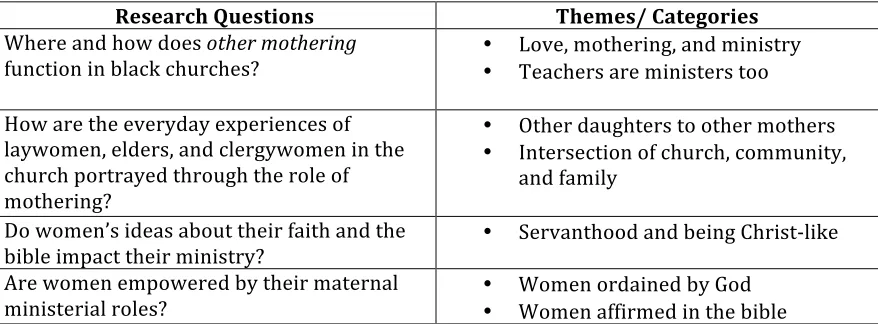
1.6 Research Questions:
• Where and how does other mothering function in black churches?
• How are the everyday experiences of laywomen, elders, and clergywomen in the church
portrayed through the role of mothering?
• Do women’s ideas about their faith and the bible impact their ministry?
1.7 Theoretical Framework
When examining the importance of black women in the black church, it is important to
utilize a liberation theology that thoroughly explores the complexities of black women’s roles in
everyday life, which intersects with their overall racist, sexist, and classist oppression. This paper
will utilize womanist theology to examine black women’s religious lives at Mt. Olive and Big Bethel
African Methodist Episcopal Church (Big Bethel). This study takes on a feminist approach to the
research, because this is the only research method offered by Creswell that centers women’s lived
experiences. However, the chosen theory is womanist theology, for this theory is the most suitable
for this study and most representative of the participants’ experiences. It also fills the gaps of
feminist theory. According to Phillips (2006):
Feminism is that critical perspective and social movement that revolves around
the eradication of sexism, the dismantling of patriarchy, and the elimination of
violence against women. Black feminism is a Black expression of feminism animated
by womanist idea and conveyed through womanist frames. Stated differently, womanism
is what’s left when feminism is lifted off Black feminism…womansim can infuse any
critical perspective or social movement-‐ feminism is not the sole instrument through
which it speaks. In the end, womanism is a social change-‐perspective that focuses on
harmonizing and coordinating difference, ending all forms of oppression and
dehumanization, and promoting well-‐being and commonweal for all people, regardless of
identity, social address, or origins (p.xxxvi).
Black Christian women were one of the first groups of people to use womanist theory to frame their
discussion of a more liberative theology. Thus, they took advantage of the freedoms informed by
womanist thought. Phillips (2006) explains that theology “was the first discipline to really latch on
to the womanist idea and develop womanism as a unique and freestanding perspective” (p.xliv).
theologies (Thomas, 1998). Those associated with this theological perspective include Katie
Cannon, Emilie Townes, Jacqueline Grant, Delores Williams, Cheryl Townsend Gilkes, Kelly Brown
Douglas, Renita Weems, and most recently Monica Coleman, just to name a few. Linda Thomas, also
a womanist theologian, defines herself and these women as a body of women who comprise over
fifty percent of the black church in America, as seminary professors, as pastors, as prayer warriors,
as mothers, as daughters, as lovers, and most importantly, as sisters (Thomas, 1998).
Womanist theology arises from Alice Walker’s use of the term “womanist,” a term she uses
in her essay collection, In Search of Our Mother’s Gardens. Cannon notes, that the objective of
womanist theologians is to use Walker’s four part definition of this term as a “critical,
methodological framework for challenging inherited traditions for their collusion with androcentric
patriarchy as a catalyst in overcoming oppressive situations through revolutionary acts of rebellion
(Cannon; 1995, p. 23). Within this definition, Walker defines a womanist as one who acts womanish
or who is a black feminist, a woman who loves women sexually and non-‐sexually, loves music, food,
dance, and black culture, and finally describes a womanist to a feminist as purple is to lavender
(Walker, 1983). For womanist theologians, the task of womanist theology is to critique male
centered traditions within theological and biblical discourse. Utilizing this definition, theologians
have begun to reject their oppressive roles in the church and society, recasting the meanings of this
term through a religious lens.
The actual meaning and task of womanist theology speaks to its relevance to black women
at Mt. Olive and Big Bethel. Womanist theology is “the critical reflection upon black women’s place
in the world that God has created and takes seriously black women’s experience as human beings
who are made in the image of God” (Thomas;1998, p.1). This theory becomes beneficial to utilize
when examining the ministry of black women at the two aforesaid churches, which I have deemed
to be both traditional and untraditional. Womanist theology’s tasks include examining the
marginalized African American women, and assessing the positive and negative images of the
church, community, and wider society (Coleman, 2008). Such tasks reveal the significance of this
theological perspective.
In order to practice womanist theology, and bring black women’s experiences into religious
discourse, there are several ideas to consider. Womanist theologians may study spirituals and
conjure, personal narratives, women’s experiences in slavery, syncretic black religiosity, African
American fiction and poetry, 19th century black women leaders, church doctrine, and gospel music
(Coleman; 2008). Delores Williams offers a method to practicing womanist theology that will assist
in further developing the theory. Christian womanist theology must be informed by four elements,
which include a multi-‐dialogical intent, a liturgical intent, a didactic intent, and a commitment both
to reason and to the validity of female imagery and metaphorical language in the construction of
theological statements (Williams, 2006). Each element ultimately serves a different purpose. A
multi-‐dialogical intent will allow for womanist theologians to engage in discourse and action with
diverse communities (social, political, religious) who are concerned with human survival and
enhancing the quality of life for the oppressed (Williams, 2006). A liturgical intent will allow
womanist theology to be practiced and relevant in the church and will critique the traditional
practices of the black church (Williams, 2006). A didactic intent contends that womanist
theologians should be teachers and impart new insights to Christians (Williams, 2006). Finally,
metaphorical language and female imagery will allow black women’s history, culture, and
experiences to be incorporated into womanist theological statements (Williams, 2006).
I used womanist theology to discuss the ways maternal identity is constructed at the two
churches and to understand how the mothers at these churches have acted as ministers through
their mothering roles. While assessing their importance, I have looked at the ways in which
womanist theology allows for an examination of the construction of gender in the church and how
can be an oppressive task for black women, for they are responsible for the upkeep of the black
community. However, mothering can also be a dignified as well as a liberating task for black
women.
1.8 Definitions of Terms
Other mothering
• According to Patricia Hill Collins (2008), “Biological mothers, or blood mothers, are
expected to care for their children. But African and African-‐American communities have
also recognized that vesting one person with full responsibility for mothering a child may
not be wise or possible. As a result, other mothers-‐ women who assist blood mothers by
sharing mothering responsibilities-‐traditionally have been central to the institution of
Black motherhood” (Troester; 1984, p.192).
• According to Arlene Edwards (2000) who cites James (1993) other mothering is defined “as
[the] acceptance of responsibility for a child not one’s own, in an arrangement that may or
may not be formal” (p.88).
Maternal Ministry
• A ministry in which women impart religious lessons and spiritual guidance to parishioners
through their maternal/mothering characteristics.
1.9 Assumptions and Biases
My assumptions and biases stem from my personal experiences with other mothering. I
came to assume that like the women at Mt. Olive, the women at Big Bethel take on mothering roles
that touch the lives of parishioners. I assumed that many of these women might see their roles in
the church as motherly and ministerial, while many of these women may see themselves as simply
being a faithful servant of God. Due to the influence that other mothers have had over my life, I grew
the ways in which my background has promoted my interests in the study, yet remaining open to
gaining new insights from the research (Creswell, 2013).
1.10 Scope, Limitations and Delimitations
This study will utilize a population consisting of women who are 35 years of age and older,
African American, and women who have been a member of Mt. Olive or Big Bethel for five years or
more. For the purposes of the study, it was important to choose women who have been members of
these churches for at least five years, a length of time that speaks to their commitment to the
church. Due to the time constraints, I only sought out 14 participants to fully engage in the lived
experiences of these women in a thorough, timely, and efficient manner. With more time, I would
have been able to enlarge the sample and retrieve even more diverse responses and methods of
other mothering. I chose not to extensively examine literature on church mothers, who may also be
considered other mothers, because their roles have been acknowledged. I also chose to conduct
interviews in addition to focus groups to expand my data retrieval and to pinpoint 2 women who
stood out from the rest of participants, investing more time in learning their individual stories.
1.11 Summary
This chapter introduced the proposed research study, its purpose and the overall
significance of the study to the African American community and African American Studies
discipline. It also provided clarity on terminology that may be unfamiliar to readers and addressed
the assumptions, biases, scope, limitations, and delimitations of the study. The next chapter
includes a literature review on black women’s roles in the black church, their invisibility in biblical
and theological studies, black women’s reactions to gender and power dynamics in the church, and
the role of motherhood in the church.
2 LITERATURE REVIEW
Much of the literature for this chapter comes from biblical and theological texts. Also the
literature was gathered from databases including JSTOR and EBSCOhost. This literature review is
divided into six sections. The first section examines the black church as more than a religious
environment, the second section is a discussion on theological discourse, and the third section looks
at black women in biblical and theological discourse. In addition, the fourth section examines black
women’s reaction to their neglect, section four examines gender roles in the black church, and the
final section looks at mothering in the black church and other mothering and community mothering.
In my attempts to understand the ways in which other mothering functions in black
religious environments, I ran into several challenges. Other mothering is a fairly new idea in the
African American Studies discipline, although it is an extension of community mothering. Thus, the
literature on other mothering is scarce. Also, literature on the black church has primarily focused on
the church’s role in helping liberate those of African descent from their oppressive realities, in
which one may see prominent leaders utilizing theological discourse to engage in such a task. Black
women have reacted to their invisibility in such texts and discussions, which have neglected their
contributions and roles in religious environments, by critiquing patriarchy. However, in regards to
social mothering in the church, I was able to salvage little information outside of the examination of
mothers' ministries in the church. Thus, I was forced to examine other mothering and black
religious experiences as almost mutually exclusive and then in juxtaposition to one another, in
which I came to coin the idea of maternal ministry.
2.1 The Black Church: More than Just a Religious Institution
The black church as an institution has promoted racial uplift and social justice, and
liberatory messages have been integrated into religious teachings. Although the black church is
more than an institution of social relevance to black men, black women receive less attention than
women as it has black men. This section of my literature review will act as a framework for
describing the multiple roles of the church in the black community. As a result, it will inform my
discussion of black women’s oppression in this institution, hence drawing attention to the need for
a nuanced discussion of black mothering. It is not enough to describe the black church as a religious
institution, for it serves multiple purposes in the black community, outside of its devout mission to
save troubled souls and provide a dwelling place for Christian worship. Ward (2005) posits, Black
churches are of central importance to the black community and its culture. For some, it is a place to
worship but for others, it may be a community center, a place to develop familial relationships, a
safe haven, and a learning facility, specifically for those understanding the meaning and
responsibility of being in leadership positions. This facility addresses various communal needs
which demonstrates is versatility and complex nature. Taylor, Lincoln, and Chatters (2005)
substantiate the aforementioned claim, for they contend that church network systems may be
useful outlets to accommodate the needs of African Americans. Though the church has many
functions, research has extensively proven that the black church has acted as both a support system
and the grounds on which political activism in the black community has grown and been nourished.
Studies by Ward (2005), Taylor, Lincoln, and Chatters (2005), and Walls (1992), shows that
much research has been conducted on the black church and the ways in which it serves as a support
system to the community. Ward (2005) notes, church relationships are important among blacks of
all classes and backgrounds, for they promote religious socialization and strong support networks.
Ward posits the church as an influential and supportive institution in the black community, claims
substantiated by Taylor, Lincoln, and Chatters (2005). This study by these researchers serves as an
adequate lens to look at the ways in which African Americans have sought out the church as a place
of refuge. Taylor, Lincoln, and Chatters (2005) note, “churches and religious participation have
played a particularly important role in addressing various supportive needs in African American
organizing, educational development, and civic endeavors” (p. 502). Walls (1992), further
substantiates this notion in her study, in which she examines the role of the church in the lives of
older adults. Walls (1992) conducts an exploratory study of adults ages 65 to 104 and measures
“social support, religiosity, well-‐being, health status, and functional health status” (p.33). Similar to
Walls; Taylor, Lincoln, and Chatters (2005) look at indicators of subjective closeness that inform
church support networks and how characteristics of church networks are associated with support
provisions.
In addition to being a source of support, the black church has served as the platform on
which black activists have acted as leaders, taking on the task of reaping civil rights for African
Americans. Harris (1994) examines the relationship between religion and political activism in the
black community, finding there to be positive links between black religiosity and political activism.
Black activists often use the church to address political and socio-‐economic issues in the black
community. Fitzgerald and Spohn (2005) extend the assertions of Harris as they discuss the ways in
which the church facilitated activism. They cite McAdam (1996), to justify claims that the black
church played a major role in the Civil Rights Movement as shown by the religious and biblical
teachings imparted by Civil Rights leaders like Dr. Martin Luther King Jr. who advocated for human
rights and equality. Secondly, Fitzgerald and Spohn (2005) who cite McAdam (1982) and Morris
(1981,1984) explain how the church became an essential tool in organizing blacks to become
involved in the movement “by providing the organizational and institutional resources necessary
for boycotts, sit-‐ins and other protest activities” (p.1016). Black churches often provided the
resources for such freedom movements to take place. As religious messages were translated to
congregants by political figures, such as King, there would often be a political uproar among blacks
to challenge society’s injustices. Upon reviewing literature that examined the influence that such
leaders as Dr. King had over the black community, it became important to understand the content
community in helping its members overcome adverse situations and oppressive realities.
Seemingly, the theology of Dr. King and other black male theologians would not assist in eradicating
black Christian’s womens’ oppression.
2.2 Theological Discourse
James E. Cone and Gustavo Gutierrez have developed theologies that speak to liberating the
oppressed community through the Gospel of Christ. These two theologians began developing
liberation theologies almost simultaneously. The term, “liberation theology” was first used by
Gustavo Gutierrez, a Peruvian Roman Catholic priest in 1973 (Berryman, n.d., p.7). Liberation
theology is “a school of thought among Latin American Catholics according to which the Gospel of
Christ demands that the church concentrate its efforts on liberating the people of the world from
poverty” (Berryman, n.d., p.8). Cone, who is considered the father of black liberation theology, was
developing a theology to reflect the religious experiences of black people in the 1970s.Biblical
scholars and black theologians within the African American Studies discipline utilize religious
teachings to examine socio-‐political forces that inform the oppressive realties of blacks. As
previously asserted, the African American religious experience is one in which faith is merged with
liberation. When these two ideas unite, religion ultimately becomes a source of refuge or a source of
strength to those who may or may not find themselves in adverse situations. James E. Cone (1970),
posits, “The function of theology is that of analyzing the meaning of that liberation for the
oppressed community so that they can know that their struggle for the political, social, and
economic justice is consistent with the gospel of Jesus Christ” (p.11). However, when Christianity is
viewed as purely applicable to the lives of one ethnic group, it does not promote the theme of
liberation. Initially, if one were to consider the ways in which African Americans have suffered as a
racially oppressed group, it would appear as though Christianity has not worked in the favor of
African Americans or even served as a means of alleviation for their hardships. Yet, black
in light of the black experience to challenge the idea that Christianity is purely Eurocentric. In
creating a theology that speaks to the lived experiences of the oppressed, it is important that these
theologies provide spaces for blacks of different classes, genders and creeds. Yet, upon reviewing
the literature, I noticed the utter neglect of black women’s lived experiences.
2.3 Locating Spaces for Black Women in Biblical and Theological Discourse
Cone (2008) and Wilmore (1998) both take on radical approaches in their efforts to
denounce mainstream White Christianity. In essence, Wilmore lays the foundation for Cone’s
theological perspective and God-‐talk through his historical analysis and interpretation of black
religion. In Cone’s (1970) edition of A Black Theology of Liberation, he denounces racist theology
that fails to fully legitimize the black experience in its religious traditions. Cone offers a very
nuanced argument through both his advocacy of Black Nationalist ideals, as they are applicable to
studying Christianity and his criticism of these ideals as they relate to understanding the image of
God. This text contained several shortcomings, which Cone relays in his 2008 edition. Cone (2008)
critiques his failure to discuss sexism in the black community, his failure to provide a global
analysis of oppression and class analysis of oppression, and finally he critiques his own reliance on
the theology of Karl Barth. Despite Cone’s recognition of his shortcomings, he still fails to
adequately discuss the oppression of black women and does not adequately include them into his
liberatory proclamation to the oppressed. Ultimately, women still appear to assume a postion that
is secondary to black men, though less obvious.Wilmore (1998) does not focus specifically on
theology; but rather examines the dualistic nature of the black church. He explores the overall
radical and conservative nature of the black church that has developed throughout the centuries
and provides readers with a historical account of this evolution. Wilmore (1998) cites Kelly Miller,
author of “Radicalism and Conservatism” (n.d.), who contends, “Radical and conservative Negroes
agree as to the end in view, but differ as to the most effective means of attaining it. The difference is
perspectives, their perceptions represent a convergence of the ideologies that have existed in the
black church.
Black women’s presence in both works is minimal if existent at all. In Cone’s first edition, he
dedicates an entire section to assess “Man in Black Theology.” In his most recent text, this chapter
title is changed to the “Human Being in Black Theology.” It would have been more beneficial and
liberating to simply add a chapter that examines black women in theology, because simply
transitioning from man to human being does not acknowledge the specificity of black women’s tri-‐
dimensional oppression. When Cone (2008) began composing this piece, he explains, “It was clear
to me that what was needed was a fresh start in theology, a new way of doing it that would arise out
of the black struggle for justice and in no way would be dependent upon the approval of white
academics” (p.191). To commence this new start in theology, Cone (2008) explains how leaders,
Marcus Garvey, Elijah Muhammad, Malcolm X, and Martin Luther King Jr. have demonstrated the
role that religion has played in the black community. Cone (2008) notes, Dr. King “preached black
liberation in the light of Jesus Christ and thus aroused the sprit of freedom in the black community”
(p.37). King sought to advance freedom to the black community through his theological talk and a
practice of non-‐violence. Malcolm X, though more radical than King, shared his liberatory
sentiments. Cone (2008) recalls a quote from Malcolm X that was of great influence to him as he
composed his work, which reads, “I believe in a religion that believes in freedom. Anytime I have to
accept a religion that won’t let me fight a battle for my people, I say to hell with that religion” (p.
xii). Although Cone chose two pillars of the freedom movement whose philosophies both served the
black community in different ways, Cone’s support of black women became questionable, for their
contributions are completely overlooked.
Similarly, Wilmore ignores the contributions of women. Wilmore examines the beginnings
of black radicalism, which inform black liberation theology. In chapter four of Black Religion and